



Abstract
Reasons to adopt Corporate Social Responsibility reporting by leather tanning companies must primarily be sought in the specific nature of the industry, where leather is a material from renewable sources, however part of its manufacture process might pose one of the gravest environmental hazards in the world. The tanning industry appears, therefore, as a sector compiling CSR reports expected to confirm its environment-friendly actions. The purpose of this research is to examine and understand CSR roles and diffusion in the small and medium enterprises of the leather tanning industry in Catalonia (Spain), especially in relation with the adoption of other management systems. It identifies the most distinguished CSR practices, procedures and metrics and the profiles of companies more prone to adopt them. We used a qualitative approach to fulfill this aim. Results show that leather companies are familiar with CSR practices, but there is further scope for improvement in terms of formalization of CSR procedures and measurement systems. Results show that the majority of socially responsible practices are related to environmental issues and consequently there is a relation between CSR and the application of environmental management systems. The analysis reveals that the management of CSR activities improves with the diffusion of knowledge on CSR practices.
Introduction
Leather sector is a world-wide leading market as it provides raw materials for a wide range of consumer goods. The principal destination use of leather has traditionally been the footwear sector, that is still the first client in Europe with a 38% share on the total. The tanning process plays a fundamental role concerning the processing of skin or hide of animals into a durable material preventing its decay and making it persistent and flexible. Leather making is a very old traditional process that serves social needs, employs many skilled/unskilled persons while being one of the highest contributors of global economy. 1 Today, with more than 2000 years of history, the tanning industry in Europe represents a strategic segment of the manufacturing sector, thanks to the combination of tradition and continuous innovation. At national level European tanneries present different characteristics, depending on their productive specialization. The most important tanning sectors of southern Europe, such as Italy, Spain, France, and Portugal, are mainly composed by small and medium enterprises (SMEs) and they are mostly specialized in the production of leather for the fashion industry. Such leather often needs an artisanal approach that big companies are not always able to provide. Conversely, the tanning sectors of central and northern Europe (Austria, Netherlands, Germany, Sweden, UK) present higher average dimensions of companies as scale economies play a key role for their productions. The average size of an EU tanning company is currently 21 employees and it is important to notice that the rate was 24 in Y2000. This tendency seems to support the slogan “Small is beautiful,” suggesting that those companies have been better in reacting to the big changes that the industry had to face since the beginning of the new millenium. The European leather production has always been characterized by its capability of processing the hides and skins of all the main animal typologies and of serving customers in all the main manufacturing applications. As a matter of fact, about 99% of the EU leather production constitutes the recycling of animal by-products, residues of the meat industry. Complementarily, the niche of exotic leather concerns a tiny share in terms of square meters (about 1% of the total) but it is quite relevant in terms of value. Such leathers are highly requested by clients of the luxury segment a
On a Spanish level tanning is an industrial sector with a long-standing tradition: beginning amongst craftsmen, it has remained in place for centuries, evolving progressively to its current high technological level (see Tables 1 and 2). This sector is made up by 98 companies employing around 2.300 workers in 2018. The companies geographical distribution shows a strong concentration in the regions of Catalonia, Valencia, and Murcia. 2018 tanning industry output reached 690 million euros led by Catalonia, one of the most industrial regions in Spain, concentrating more than the 50% of total workers, and companies from this sector, b however, the impact of COVID-19 on Europe’s Leather Industry, its workers and their families, may trivialize the progress of the sector’s social accountability and environmental performance. More detailed data can be found on the Ministry of Industry website. c
Geographical and size distribution of the Spanish tanning industry (2018).

Source: Spanish Tanning Association Acexpiel.
Spanish tanning industry production by value (Thousand €).

Source: Spanish Tanning Association Acexpiel.
The importance of sustainability in the leather industry has continually increased over time focusing its research on the environmental aspect.2,3 In this sense, the first decade of the 21st century in particular has seen a renewed debate about tanning and its sustainability. This is owing to advances in technology, legislation, standards, corporate social responsibility (hereinafter CSR), and consumer demands 4 while fewer published research about the social and economic aspects existence,5,6 even though the interconnectedness of the dimensions, environmental endeavors can have multiplier effects on social, and economic sustainability and vice versa. 7
Following the Brundtland definition of sustainable development, 8 the main challenge for the sector is to demonstrate that, despite the fact that leather production is perceived as a polluting industry and its stigmatization, it contributes to upcycle waste (hides and skin) generated from the meat and dairy industries, 9 thus reinforcing the “circular economy industry” nature of leather and that companies mind their social dimensions. 7 It is important to remember that the leather Industry market is strictly connected to the meat market. In fact, this industry is able to convert a by-product of the food industry into a noble material which otherwise should be disposed into waste. 10 Leather industry has to deal with these challenges and has to assume responsibilities in local and national development. Tannery processes are characterized by the use of significant quantities of chemicals, energy, and water.1,3 As a result, research to improve the sustainability and ethical management of the industry processes has proliferate during the last two decades. 7 Sustainable development and ethical management have been included in the European Leather Industry Partner’s Roadmap 2018–2025, d and various national and international initiatives have developed frameworks for sustainability. For instance, 2030 Agenda for Sustainable Development and its 17 Sustainable Development Goals (SDGs) promoted by the United Nations 11 which look ahead to the opportunities and how to best address the many interconnected challenges of a sustainable recovery at all levels. Another instance is the Confederation of National Associations of Tanners and Dressers of the European Community (COTANCE) has formulated some basic principles of good practice in which they outlined the challenges and opportunities for the sector in four areas: industrial, social/societal, trade, and environmental. e The adoption of socially responsible practices – that is, environmental protection; dialog with stakeholders; community-investment programs; commitment to the rights of employees in the company’s policies, etc.6,12 – helps companies to maintain an image of commitment toward the environment and their stakeholders, and to lead the pursuit of a social approval to operate, which is aimed to secure the support of local communities. The social dimension, together with the environmental and economic dimensions, shapes the triple bottom line, 13 which is at the basis of CSR. 14
CSR may be defined as the group of actions that are undertaken by an organization in order to accept the responsibilities resulting from the impact of its activities on society and the environment. 15 This new business approach has special significance in tanning activities. Globalization has exposed human rights violations and environmental pollution in deprived parts of the world, and the reporting of these unacceptable practices often paints the whole sector with the same brush increasing public concern about CSR over the last years. The writings by the influential journalist Lucy Siegle 16 are usual: “But as well as leather being one of the most prevalent materials in our wardrobe, its production and processing phase is one of the most polluting systems that humankind has managed to come up with.” She continues with a description of a visit to Uttar Pradesh in India and describes current issues with tannery pollution getting into the Ganges. The number of places in the world that people may travel to see unsatisfactory tanning sights is sadly quite large and does extra harm when built into a narrative by the anti-leather and anti-animal lobby on the internet. These are issues which are approached by pressure groups which use the most striking style to push their opinions out to a narrow audience. According with Redwood et al. 4 the value of the above-described approach is questionable up until now. The leather industry has chosen to ignore this activity yet there is considerable evidence of spill-over into the general public and perhaps more importantly into key user groups. In order to overcome the potential effects of these kind of negative recognition most companies are engaging in both CSR communication and implementation. 17 The debate surrounding CSR in the leather tanning industry has gained considerable attention with in the academic community since sales of leather goods and shoes have expanded greatly during the past decade due to companies have turned leather into a seasonal fashion. 18 The discussion about CSR has emphasized its commitment to social responsibility as an emerging topic, and literature seems to indicate that tannery companies have increased their environmental and social consciousness. 19 In this sense, this 21st century in particular has seen a renewed debate about tanning and its sustainability owing to public concern about the current degradation of the environment and about social actions in the communities affected. 20 Different authors have analyzed the topics relating to CSR reporting in the leather sector globally. For instance, 21 has outlined why sustainability reporting provides several benefits for leather supply chain companies. 22 has concentrated on carbon foot printing of leather, and 6 compared the impacts of CSR reporting on pro-ecological actions between large and small tanneries. Other authors have studied the impact of CSR on local communities23,24 and have analyzed the practices involved in different countries.25,26
In Western developed countries companies have started to carefully consider the social, ethical, and environmental effects of their actions. Many Spanish companies, especially the largest ones, have introduced CSR policies, and the adoption of business ethical practices is increasing. The aim of this paper is to find out whether the leather industry is also committed to CSR by focusing in the leather tanning supply chain industry in Catalonia.
Although the voluntary CSR initiatives are varied, many of them relate to the areas of quality, environmental management and occupational safety, 27 areas which may in turn be managed according to international standards such as ISO9001(quality), ISO14001(environment), and OHSAS18001 (health and safety at work), to cite the most common ones. In Europe, and especially in Spain, such standards have been adopted by many companies, from the smallest ones to the largest ones. 28 According to Vintró et al. 29 the success of management systems makes us think of them as a means for the introduction of CSR practices, even more when CSR is also supported by international standards (ISO26000:2010 Guidance for Social Responsibility).
In the next section, the paper explores the current discussions on CSR in the leather industry in order to gain insight into the positive and negative contributions of leather tanning to sustainable development. The research methodology is then introduced. Next, the results obtained are presented. Discussions and conclusions follow.
CSR in the leather industry
Before society had access to glass, paper, rubber, plastics, and many modern textiles leather was the most essential material for industry, warfare and many aspects of everyday life. It has constituted one of the world’s largest industries for most of man’s time on earth. 4 Long before modern science understood the processes fully the industry used chemistry, biotechnology, and technology copied from other areas or from trial and error. 30 Today the manufacture of leather utilizes between 20 and 40 process steps that vary according to the end use of the leather and the preferences of the tanner, 31 however according to 32 in all tanning technology operations wastes are generated causing that leather production is defined as an annoying industry and gained broad recognition which lasts to this day as a source of pollution in terms of air, water, and solid wastes. Although this might be true in the past, during the last decades several drivers such as advances in technology, legislation, standards, CSR, and consumer demands, have created the right conditions to accelerate a transformation. 4
The debate surrounding leather activities and CSR is now centered on sustainability at a global scale. 7 While some authors highlight the positive impacts that leather activities can have4,33 there is still some kind of nuisance with the link “sustainable development and leather.” A major argument against this sector contributing to sustainable development is the nervousness about the CO2 of cattle plus comments about the chemicals and waste involved – that is, the sportswear company Puma. f Moreover, due to the animal origin with a strong link to mistreatment, it is a controversial material with a hostile and harmful social opinion around it. The industry is associated with images of enclosed animals, in poor condition, and which are bred and or killed exclusively for their skin.
On the other hand, primary examples of positive contributions of leather to sustainable development and social management include caring for the country, people, and culture. These incorporate providing employment to residents of local communities in times when robots and artificial intelligence are eliminating many jobs. Over the last few decades since 1960, leather using industries have helped pull millions of people out of poverty in Korea, Taiwan, India, China, and many other countries. 19 Jakov Buljan of UNIDO discussed this multiplier at an industry conference in 2014 indicating 1 sq. ft. of leather (routinely produced) creates 50 jobs in leather using industries.
As stated by Moktadir et al., 34 leather industry can contribute to sustainable development by minimizing the environmental and social impacts throughout its lifecycle, and this is best accomplished through effective CSR management. The author give some guidance on how to improve the sustainability in tanning operations.
Leather activities might be viewed as more socially and environmentally responsible if CSR practices were adopted. In this sense, 6 states that tanneries would need to be subject to a formalized system of environmental monitoring in order to ensure that CSR reporting have direct impact on pro-ecological activities of tanning enterprises. In the literature, there are several studies regarding the extensive interest on the topic of curbing environmental pollution of the manufacturing process in the leather industry,1,32,35 –37 materials life cycle analysis 9 and green chemistry approaches.38,39 Sustainable development is a priority that has become a common denominator of the corporate policies of European tanneries. It is an irreversible trend, involving all the parties in the supply chain. This is demonstrated by the huge investments that the industry has made over the years and the significant costs that companies have to bear in relation to CSR. This commitment costs on average, 4% of turnover, a figure that grew markedly in the first decade of the 2000s and which has now become a constant on the balance sheets of the sector.g,40 defines the Economic sustainability as the “profit” dimension which takes into consideration an organization’s effort to improve the value it generates and delivers to its customers, at the same time reducing the cost of its supply chain related activities. In the context of the leather industry, studies relating to economic sustainability have usually been found in topics relating to customer perceptions and sustainable behaviors when making buying choices.33,41 Genuine leather products provide several advantages such as quality, good craftsmanship, and esthetic appeal. It is expensive and in many cases much more expensive than products made of man-made textiles. 42 It is not only bought for its functional value (quality, durability, etc.), but also for social, personal, and financial value.43,44
Methodology
The basic information for this work comes from a more extensive study that analyzes the application of quality, environmental, occupational health, and safety and CSR management systems in the leather industry in Catalonia. The research was started with the design of a questionnaire, which was the main source for data collection. A pilot-test was conducted with in a small number of Catalan leather companies guided by the leather cluster of Barcelona in order to prove viability and to detect difficulties in the interpretation of questions. This cluster is a private and non-profit association that represents the interests of the companies and agents of the leather industry in Catalonia. The final version of the questionnaire comprised 25 items concerning the diffusion of CSR practices, CSR procedures, CSR measurement systems, and CSR management systems, and the perception of companies about the benefits experimented in their business results. Some of the items were open-ended questions, others were multiple choice questions and some used a five point Likert scale.
The target population was identified by the “leather cluster of Barcelona (year 20020).” Although a single company may operate in more than one location, the unit of analysis for this research was the company. The population considered was 48 companies. All questionnaires were sent by electronic mail (web-based survey tool) and were addressed to the Management Systems Manager or to the Business Manager. A cover letter explaining the purpose of the study accompanied the survey questionnaire. To increase the response rate, companies were previously contacted by telephone. After the whole process, the deficiencies detected in the answers were rectified through telephone calls or electronic mail.
A total of 19 completed responses were received (39.6% response rate), which reached the targeted overall response rate for a valid assessment since 45 observes that response rates of 20% are common and considered satisfactory for post surveys in Spain. 46 suggest a response rate of over 20% for a positive assessment of mail survey results. The statistical analysis of the data was performed using Google forms and SPSS software. Table 3 shows the technical record of the study.
Technical record of the study.

Source: Questionnaire survey.
Results and discussion
Companies’ profile
The distribution of the sampled companies is composed by 100% medium or small sized firms according to the European Union Recommendation 2003/361/EC. The quantity of leather produced varies from 20,000 to 3 million square meters a year. These companies mainly concentrate their commercial activity on a international scale.
The literature suggests that bigger companies are more likely to be under public scrutiny 47 and are generally skilled of having better resources. 48 Nonetheless, the study conducted evidence that medium and small companies have also undertaken various socially and environmentally responsible actions (we refer the reader to subsequent sections).
Management systems
Management systems are a set of organizational procedures, responsibilities and processes that help to implement corporate policies regarding quality, environment, health, and security, etc. Most usual management systems are in accordance with international certifiable standards such as ISO 9001 (product and service quality management system), ISO 14001 (environmental management system), or OHSAS 18001 (occupational health and safety management system).
About 60% of the surveyed companies described efforts like ISO 9001 certification, ISO 14001 certification, or OHSAS 18001 certification to align business practices with the needs and expectations of society. The percentages of application of management systems are detailed in Table 4.
Management systems implemented.

Source: Questionnaire survey.
Results show that companies have experience in management systems. The number of certifications has increased throughout time, especially when referring to quality and environmental management systems. Customers’competitive pressure 49 in the first case, and growing environmental regulatory pressure 8 in the second case, have contributed to this fact.
Six out of the nineteen surveyed companies had an specific CSR management system certificate. Three of them implemented Leather Working Group (LWG) procedures, which measures environmental performance whereas the ISO standard does not. The ISO standard relates to the management system and is explicit in not attempting to quantify environmental performance. The LWG Environmental Audit Protocol is developed by not-for-profit organization responsible for the world’s leading environmental certification for the leather manufacturing industry and assesses leather manufacturing facility operations in absolute terms, for example energy requirement to produce a square foot of leather, proportion of wastes recycled, etc. The others have chosen other options, for instance ZDHC MRSL (Manufacturing Restricted Substance List) focused on measuring indicators such as, wastewater, sludge, and air quality validating the work that is being done with chemical inputs, and processes. It helps to determine if the output water and air is safer. Another example is the introduction of the United Nations Global Compact initiatives based on CEO commitments to implement universal sustainability principles and to take steps to support UN goals in the areas of Human Rights, Labor, Environment, and Anti-Corruption.
The other 40% admitted the existence of certain difficulties in the implementation of management systems. The main considerations had been; time constraints and lack of financial resources.
In spite of these barriers, companies showed an emergent interest in management systems. Most companies (36% of companies that had implemented the ISO 14001 or LWG, 26% for ISO 9001 standard, and 21% for OHSAS 18001) admitted that the implementation of management systems had conveyed some benefits (i.e. better operational implementation and document management). For instance, a surveyed Manager asserted in a questionnaire that:
Industry environmental regulations have “forced” us to reinvent ourselves, we have to become environmentally aware, the new generations have transformed a business that has been professionalized and modernized rapidly
CSR practices
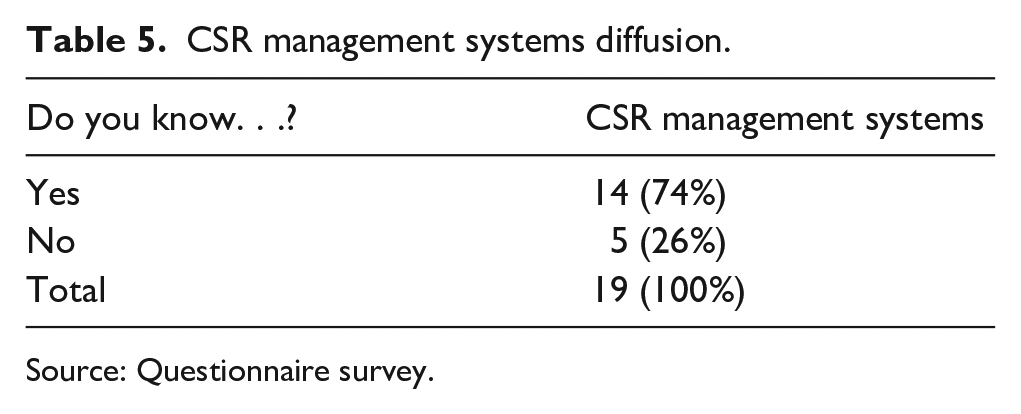
Around 74% of the leather companies participating in the study stated that they knew or had heard about CSR management systems (Table 5). This result led us to high expectations regarding the implementation of CSR practices.
CSR management systems diffusion.
Source: Questionnaire survey.
In this sense, the actions promoted by public administrations and professional associations may play a prominent role in the diffusion of CSR. Similar conclusions were published in previous studies. For instance, 50 already considered that public administrations should take a leading role in the promotion of environmental actions. We examined the dissemination of CSR practices. Respondents were required to indicate which of the eight practices detailed in the questionnaire their companies had implemented (See Table 6).
Distribution of CSR practices.

Best available techniques provided by the Spanish Ministry of the Environment in 2013.
Source: Questionnaire survey.
Around 60% of the companies had implemented at least three different CSR practices and 16% had applied six or more CSR practices. This is a favorable result and it may even be enhanced in the future. The results in Table 6 mean that companies have committed themselves to ethical and sustainable issues. For example, one of the surveyed companies asserted that: Our sector has been improved ostensibly in all its areas: wastewater control, animal welfare, reduction of chemicals, efficient processes, greater energy efficiency, . . . But we are afraid that its evolution has not transformed into a change in the perception of the sector
We combined the all CSR practices into three main groups according to the three vertices of the CSR Munasinghe triangle (environmental, social, and economic criteria): CSR management practices linked to environmental management (Figure 1), CSR management practices linked to human resources management (Figure 2) and CSR management practices linked to sustainable administration of funds.
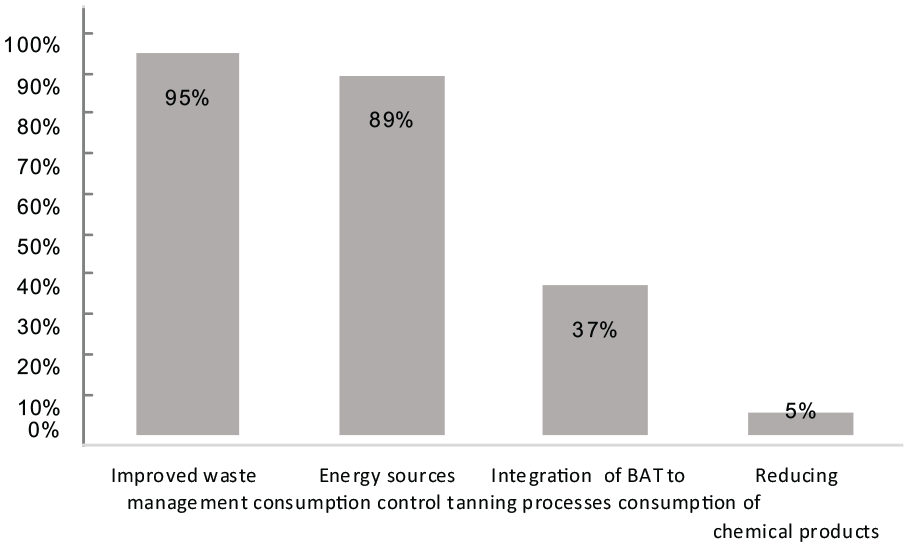
CSR management practices linked to environmental management.

CSR management practices linked to human resources management.
Global results (Figures 1–3) imply that CSR environmental practices (such as waste management, control of energy consumption, and integration of best technology) are more widespread than social actions (i.e. cooperation with non-governmental organizations, promotion of local communities). While this difference could be attributed to a number of reasons, a key element may be the high impact of the leather industry on the environment.

CSR management practices linked to sustainable administration of funds.
CSR procedures and measurements systems
A procedure is a specified way to carry out an activity or process. Procedures describe the aim of the process and its necessary steps, technical elements, technical conditions, and human resources. Procedures are included within the documentation of quality, environmental and occupational health and safety management systems. In the same way, procedures are an essential element of CSR management systems.
We examined the application of CSR procedures and measurement systems in the leather companies. Similar work has been considered by Vintró et al. 29 examining the application of CSR procedures and measurement systems in the mining companies.
Variables “CSR procedures” and “CSR measurement systems” were measured with five point (1–5) Likert scales in order to evaluate their application. Descriptive statistics for these variables are shown in Table 7. The mean value (3.052 for CSR procedures and 2.578 for CSR measurement systems), are close to the central point (3) of the scale at the 0.05 level, however suggest that measurement of CSR practices should be improved as it is slightly below.
Statistical summary of the variables “CSR procedures” and “CSR measurement systems.”

Source: Questionnaire survey.
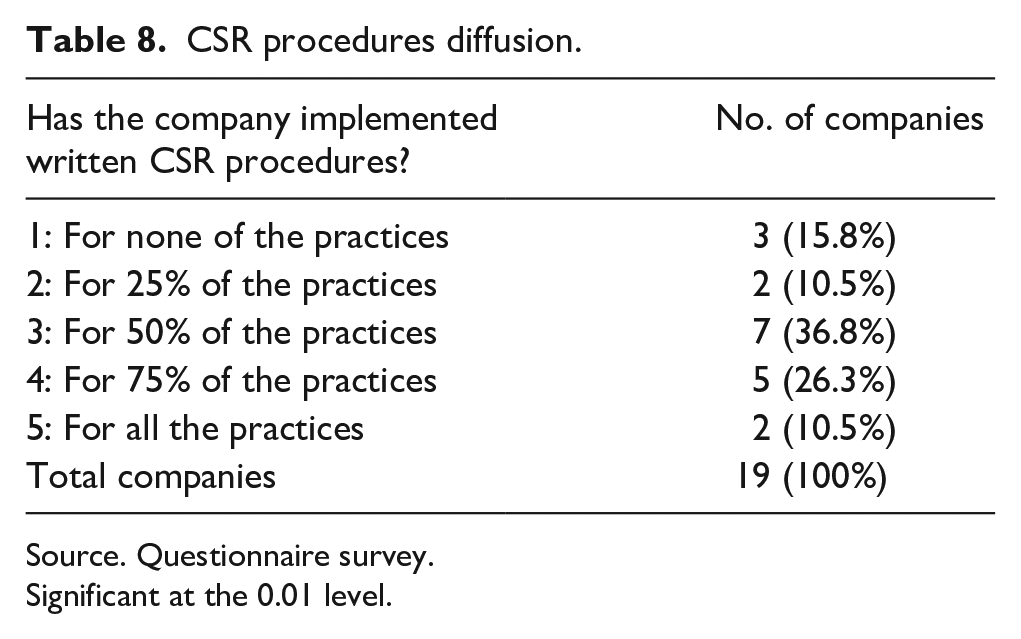
The results obtained in the questionnaire survey indicate a relevant application of CSR procedures (Table 8) however only 10% of the respondents had written procedures for all the CSR activities implemented.
CSR procedures diffusion.
Source. Questionnaire survey.
Significant at the 0.01 level.
The percentage of CSR measurement systems implementation is relatively low (Table 9) in comparison with CSR procedures. However around half of the surveyed companies (47.3%) use measurement systems regularly.
CSR measurement systems diffusion.

Source: Questionnaire survey.
It is important to note that, in literature, there are some proposals of CSR indicators. For example, 51 proposes a general framework with a relatively simple, yet comprehensive set of indicators for identification of more sustainable practices for industry. 52 analyzed a set of sustainable development indicators from several companies based on a global reporting initiative (GRI). There is still a great deal of work to be done in this area for the leather sector. Hence, future research to investigate sector-specific indicators may be necessary to set the foundation for unification on related practices.
Perceived CSR utility
Respondents were required to assert whether CSR practices were contributing to improve business results or whether they were not (Figure 4).

Perceived CSR utility.
Variable “perceived CSR utility” was measured with an open question. Around 78% of the companies perceived a positive impact lead by “Reduction of environmental management cost” followed by the chance to access to more competitive markets. But not only this, respondents also were required to answer if the implementation of environmental practices contributes to the possibility of reducing the risk of sanctions and litigation measured with a five point (1–5) Likert scale. Almost 90% rated very highly (4–5) this statement.
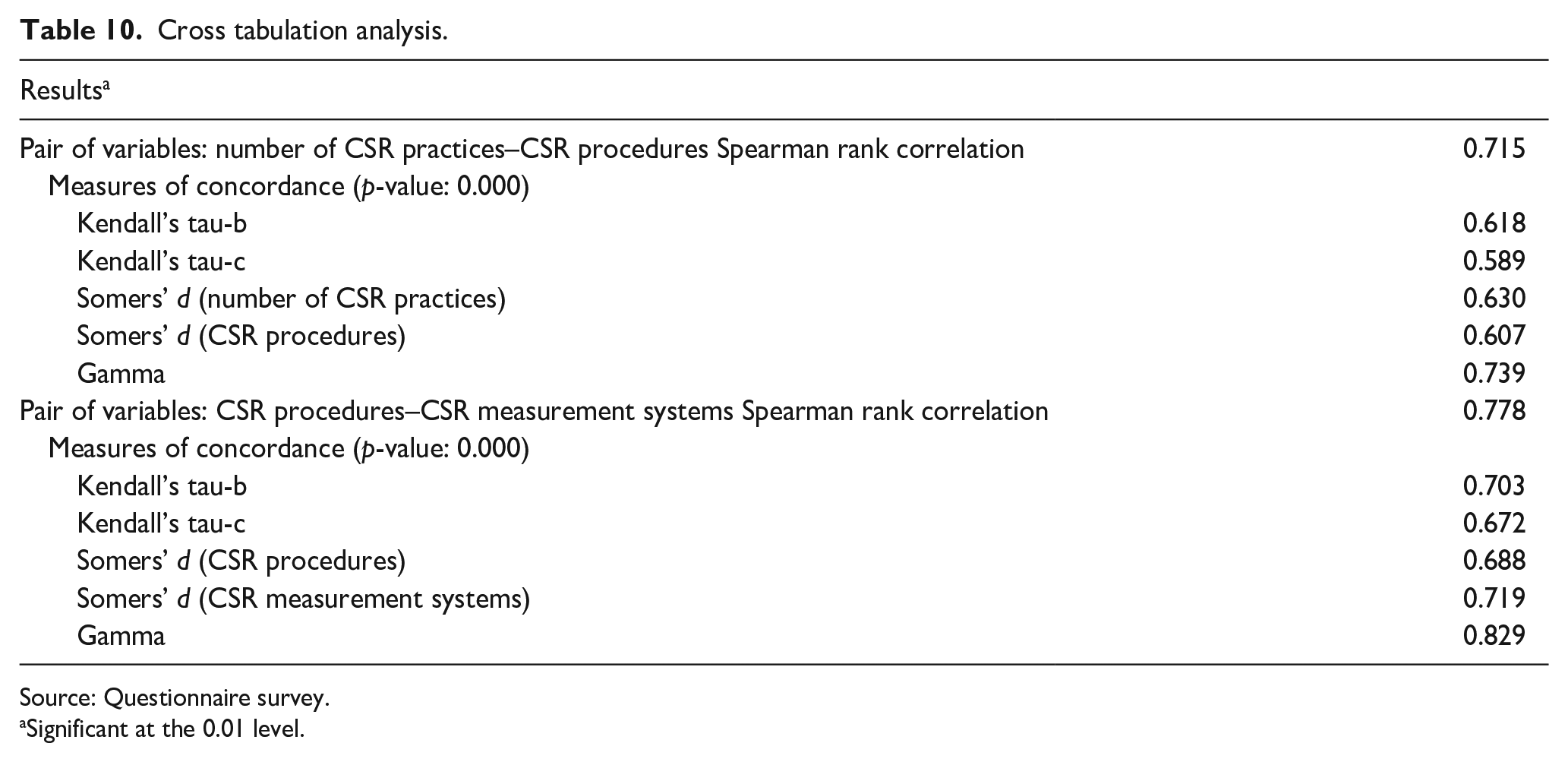
Cross tabulation tables were used in this study to explore the relationship between different pairs of variables: number of CSR practices versus CSR procedures; CSR procedures versus CSR measurement system. Spearman rank correlation coefficient and measures of concordance were used in the analysis. The results obtained are summarized in Table 10.
Cross tabulation analysis.
Source: Questionnaire survey.
aSignificant at the 0.01 level.
The variable “number of CSR practices” is significantly and positively associated with the variable ’CSR procedures’ at p < 0.01. Another variable that shows a positive correlation (p-value < 0.01) with “CSR procedures” is “CSR measurement systems.”
Conclusions
Leather manufacturing sector upcycles an unavoidable waste from the food industry, to produce a versatile, durable, unique material, ideal for the circular economy that the world must move toward. However, it is often dismissed through a lack of understanding of the manufacturing process and its supply chain, or through the application of questionable science generally in the form of incomplete and incomparable or out-dated Life Cycle Assessments, and the marketing of new, often fossil fuel-based materials claiming unfounded levels of sustainability.
In order to set lights of consciousness into this darkness, CSR communication has increased over the years, and many companies of different sectors communicate about economic, environmental, and social issues in some form, and most of them engage in sustainability reporting. Environmental and social responsibilities are of strategic magnitude for leather activities. As Giuseppe et al. 53 states, it is important that companies have a clear understanding of the issues affecting sustainability in the local communities. As a result, sustainable development and ethical management have been included in the corporate policies. This paper has examined the diffusion of CSR practices, procedures, and measurement systems within the leather industry in Catalonia et al. companies from leather industry are small or middle sized, like most companies in Europe. Nevertheless does not stop them from implementing management systems. The great majority of companies realize the benefits of having a management system while others admitted unawareness or difficulties to implement them.
Findings highlight commitment to CSR: leather companies engage with stakeholders and have implemented different CSR practices oriented to promote the organization’s environmental and ethical behavior. According to Cai et al. 54 this, theoretically should provide further benefits to this sector due to CSR engagement is positively associated with firm value in controversial industries. Leather companies in the sample understand the negative impact of their activities on the environment and want to observe the law and collaborate with both internal and external stakeholders. For these reasons they have implemented several CSR practices. It is observed that the implementation degree of environmental practices in internal processes is higher than social actions. This result can be attributed to the impacts generated by the tanning processes on the environment which constitute the most perceived threats of leather activities. Cooperation with non-governmental organizations was the least frequent activity. This is also pretty similar to the findings of Vintró et al. 55 which examines the adoption of environmental practices in the surface mining industry in Catalonia. Results obtained in the study show that companies with a higher number of CSR practices had implemented more CSR procedures. Moreover, companies with the highest percentages of CSR procedures implementation also described the highest levels of CSR measurement systems application. Consequently, we expect that if the diffusion of CSR practices increases, the formalization and systematization of CSR management will be enhanced.
This results also help to justify that several CSR practices are possible in leather activities, even in small companies. Furthermore CSR may improve the image of leather and tanning companies and help them improve the way they perform their operations. Since companies are used to management systems, this might contribute to the diffusion of CSR management systems and hence the formalization of CSR practices.
Footnotes
Declaration of conflicting interests
The author(s) declared no potential conflicts of interest with respect to the research, authorship, and/or publication of this article.
Funding
The author(s) disclosed receipt of the following financial support for the research, authorship, and/or publication of this article: This work was supported by the Ministerio de Ciencia e Innovaci’on under contract PID2020-113614RB-C22 funded by MCIN/AEI/10.13039/501100011033.
Also, the authors are members of the research group 2021-SGR1308, funded by the Generalitat de Catalunya.
