



Abstract
Leather industry is facing the consequences of their historic lack of communication and now are under an increasing pressure to communicate their position and policies with regards to corporate social responsibility (CSR), informing consumers about the corporations’ good intentions and actions to recover clarity and be able to affirm without doubts that responsibly manufactured leather is sustainable. Under this context, this paper aims to examine CSR communication in the leather sector on Twitter identifying the main topics of CSR and the main participants in the creation of content and thus contribute to the development of CSR strategies for the leather industry. A software framework has been implemented in order to manage big text data in the study of CSR and sentiment computational content analysis to classify the tweets as positive, negative, or neutral. The results show that the general public associates leather with the environment, sustainability, and fashion. The general opinion about the leather industry’s CSR is rather neutral. Nonetheless, negative opinions occupy a close second place, and positive opinions are rare. Lastly, alternative bio-materials sneak in the industry reshaping the opinions to more positive ones.
Introduction
The relevance of Corporate social responsibility (hereinafter CSR) in business management is behind the growing importance of CSR communication, 1 particularly for those sectors historically considered by the society as a threat to the natural surroundings, with environmental effects. Some might think that these industries are engaging CSR as a “window dressing” to legitimize questionable business and deceive stakeholders, but what if society is still including wrongly one sector under the same umbrella? This is the case of leather industry which is trying to make a new start and desist from the historical burden. Considered a dirty job, nasty, and without any social prestige from a hard and difficult sector which starts from an awkward but inevitable fact; the death of the animal. The industry has been traditionally located in the worst areas (outside the walls), physically cornered, expelled from the city. These traits influenced its industry personality making them reserved and unused to communication. In addition, the fact of commonly being a family business, rather small and very close to each other, has fostered this suspicious dynamic. This lack of communication from the industry geared toward its customers, consumers, and the community at large has led to consider it in the past as one of the most polluting industries in the world due to the usage of significant quantities of chemicals, energy, and water as well as the potential release of harmful substances during leather production process.2,3 Based on our 21st century knowledge, we acknowledge that leather making in history would not be categorized as sustainable today. Processes and chemicals that were used in some periods of history were thought to be safe at the time. As scientific knowledge improved some were identified as problematic or potentially dangerous. There are many similar instances in other industries such as cosmetics and medicines where lead, arsenic, cadmium, and other poisonous materials were used extensively in industry before we understood their dangers, while “Progress” was seen as important and no one had properly realized the environmental damage it could do as industry grew bigger. The consequences of this may be dire, particularly for sustainability which has become a “weasel” word thrown carelessly into documents, publicity material, and conversations often with only limited interest in the truth.
Nowadays the industry do not avoid self-criticism and assume bad practices of the past 4 investing resources mainly in the environmental sustainability aspect. 5 They are becoming proud of their industrial transformation forced by the strict environmental regulations together with the professionalization and modernization of new generations entering to the business. This led to significant advances and it is safe to say that the sector has been improved in all its areas; wastewater control, animal welfare, reduction of chemicals, energy efficiency, etc, however there’s a feeling of fear that its evolution has not turned into a change of the industry perception.
Leather sector plays a fundamental role upcycling an unavoidable waste from the food industry, to produce a versatile, durable, unique material, ideal for the circular economy that the world must move toward. Leather making is a very old traditional process that serves social needs, employs many skilled/unskilled people while being one of the highest contributors of global economy. 2 But more important than this, the world needs materials that are sustainable, renewable, recyclable, biodegradable, and most importantly, do not add to the burden of atmospheric carbon. Natural fibers, such as leather, are part of the biogenic carbon cycle and as such are comprised of carbon that has been in the atmosphere for a millennia. These readily available raw materials, when ethically and properly produced, are an important replacement for fossil fuels, reducing the need for its extraction and retaining more carbon in the earth.
It is clear then, leather tanning industry need to focus special attention to their CSR communication in order to change stakeholder’s perspective. Research on CSR may facilitate a strategy to grasp stakeholder’s interests, enhance dialog, meet their demands and expectations as well as be transparent when reporting back their actions, therefore generate real value for their different interest groups. According with Pons et al. 6 it may also be worth to measure the impact of the actions undertaken by the companies together with interpretations and feelings being generated toward each interest group, and thus be able to redefine priorities and responsibilities within the organization from a triple perspective: economic, social, and environmental.
The arrival of big data has shown an improvement in the identification and analysis of perceptions and sentiments from stakeholders which are relevant for all sectors, but even more for those seen as a threat such as Leather tanning. Now, debates have mainly shifted to social media where either internal and external stakeholders discuss and criticize in relation to actions taken by companies and its consequences. Some general studies on the disclosure of CSR in social media can be found in the literature. For instance, Morsing and Schultz 7 affirms that social media platforms favor the involvement and dialogic strategies based on CSR activities. Furthermore, social media communication encourages stakeholders to participate in the content provided in those platforms by companies. 8 As a consequence, companies gain more credibility and competitive advantage through the interaction with the stakeholders.9,10 Specific studies referring to the leather sector are very scarce.
Under this context, this paper aims to examine CSR communication in the leather sector on Twitter and identify the main topics of CSR and the main participants in the creation of content. For this purpose, two main hypothesis have been proposed:
H1: There is a growing concern at the social level around environmental issues (i.e. environmental impacts, sustainable practices, green approaches, etc.) in the leather industry sector.
H2: Stakeholders opinion toward CSR leather industry practices is quite negative.
The main contribution of the investigation is the creation of a database on CSR topics which provides a valuable source of information for companies in order to develop strategies oriented toward stakeholders concerns. That is, the results obtained will contribute to the development of CSR strategies for the leather industry and similarly other studies may be conducted to redefine CSR roles and priorities. The study is sustained in how organizational research focused on social media may translate stakeholder engagement into organizational goals and create the basis of effective strategy development. Twitter was chosen since it is one of the most commonly used social network sites 11 where opinions or expressions of sentiment about organizations, products, events, and people have proven extremely useful for social studies. 12 The data was collected during 2021 and 2022 and it resulted in around 400,000 Twitter posts.
In the next section, the paper details the architecture of the framework, describing its functionality and the algorithms implemented are then introduced. Next, the results obtained are presented. Discussions and conclusions follow.
Methodology
This paper aims to provide an interactive automatic system (Code of the system can be found at: https://github.com/virus-404/data-miner) which predicts the sentiment of the review/tweets of the people posted in twitter using an automatic micro-service completely independent hosted on a server designed to be integrated inside a back-end ecosystem. Due to time limitations, only one social network source of information is processed, notwithstanding the service has a structure that allows the integration of more than one incoming source of information.
The work can be broadly separated into two processes, the first receives data and stores it, the second calculates and writes in graphics the results. In the interest of clarity, hereinafter referred to as hub and analyzer respectively. This method requires communication between them in order to share data collected. This is schematically shown in Figure 1.

Basic schema of the micro-service.
Twitter API
The Twitter Streaming API (https://developer.twitter.com/en.html) is used to collect streaming Tweets and notifications from Twitter in real time. However it requires a high performance, persistent, always in the connection between the server and Twitter. It searches for hashtags, keywords and geographic bounding boxes simultaneously. The filter API helps for searching and delivers the continuous stream of Tweets which matches the filter tag. The work of the streaming implementation is to record the incoming events as quickly as possible and process them in the background. However, this suffers from limitations due to we only use the free version of the API which means it gives limited information about each bit of data. Consequently, it is required to call back using the identifier of each tweet to get the whole information.
Streaming tweets
Figure 2 shows the structure used for the streaming of tweets. The hub is the responsible of receiving and storing live data from Twitter into the database, however its design has been thought for a potential extension and comply with the requirements and necessities of adding multiple social networks (hence its name).

Hub’s structure.
The sub-processes named SNX (where X is a number) are responsible for receiving data streams from SN (in Figure 2 labeled as Stream SNX_bookmark4 (Labeled as SNX.Y where X refer to their parent process)). We have proposed a two levels approach for a better performance, SNXs may call other sub-processes_bookmark5 (Labeled as SNX.Y where X refer to their parent process) to handle multiple streams from the same source.
As the Figure 2 reflect, the sub-process SNX can only handle up to one stream. This limitation prevents overload work for any SNX and keeps the structure of the code clear. Although, different SNX imply different algorithms for gathering data, they have to save the data at the same location.
The technologies used for that purpose have been the programming language Python_bookmark6 (https://www.python.org/), MongoDB, Mongo-Express, and Alpine. Python was chosen as the programming language for its simplicity, performance, and flexibility. MongoDB is a document-oriented database with dynamic schema. This allows to offer high performance and facilitates the development of applications. In turn, it prevents from having Joins and Transactions, something very common in relational databases. It should be noted that MongoDB stores documents in JSON format and its structures. 13 Therefore, Mongo-Express was needed as it is a web-based MongoDB interface for administration purposes. Not only allows to manage databases remotely in a user-friendly manner, but also helps to monitor the service.
This approach requires an optimal solution to backup data periodically given that all the data gathered is a critical asset. For this purpose we used Alpine, which is a lightweight version of Linux appropriate for backups. It runs a script that copies all data from the corresponding social network. The script is stored in the crontab and executed daily. 14 For security reasons, we suggest to register a log entry every time a backup is registered successfully.
Tweets were streamed in real time with the API of Twitter and a string was created to filter and select the tweets according to the parameters summarized in Table 1. Each Leather word is combined with CSR words and the same with Hashtags. The result is a long list of word combinations that will ensure the tweets found are from the appropriate topic.
Main Filters that we used to stream tweets.

Algorithm
Twitter streaming process incorporates two important set of rules to be followed. In the first place the implementation of the algorithm streaming_connection is required to perform tweet streaming 24 h a day, every day of the week to make sure we do not lose any tweets according to the rules established. Secondly, the algorithm called updating_connection is needed to update metrics. The proposed method not only considers that both algorithms run in parallel, but also accounts to exchange information through a database between them.
The function called create_header() must be placed in the header of all queries in order to get access to Twitter’s API through a token provided by this platform.

Algorithm 1 deletes the old rules, inserts new ones, listens for incoming data streams, and stores them into the database. The responsible for deleting and inserting new rules to the API session are get_rules, delete_all_rules and, set_rules. First and foremost challenge was to get enough data quality. Several times the rules had to be readjusted to ensure inaccurate data that has nothing to do with the leather industry do not access to the database. This type of data ranges from explicit content to video-game items. The function get_stream is process-blocking, and it only unblocks if the connection is lost. Once the process is unlocked, it iterates again to recover the connection failure.
In other words, the algorithm 1 identifies those tweets that are going to be analyzed with further detail without extracting the important information such as metrics, type of publication, etc. For this reason it is required a second algorithm that can obtain this key data for a further sentiment analysis.
As noted above, algorithm 2 was needed to fill the gaps. This algorithm retrieves tweets from the database and updates them.

Beforehand, the IDs (Each object within Twitter has a unique ID: Tweet, Direct Message, User, List. . .) were created through the Twitter’s API, and they were stored by algorithm 1. The function gathering_ids queries every single document generated by algorithm 1 and list each ID.
After that, the algorithm 2 queries the missing information to the API and saves the updated information in the same database. This algorithm also compiles information regarding the user or content creator taking into account if is a tweet, retweet, or a reply. In these last two cases it also saves the same information from the original or source tweet in a different database collection.
Analyzer
After the processing of all the data collected and the stemming of the text we present the method used to solve the problem of the classification of texts by their feeling at the document level and graphics generation to summarize the results in a readable way.
The analyzer makes use of an API powered by Azure (Microsoft) called Text Analytics, developed to analyze a text and return the overall sentiment. The possible outcomes from this API are labeled with the category of feeling to which they belong such as positive, negative, neutral, or in case of uncertainty, mixed.
We considered that there were important benefits from using this Artificial Intelligence (AI), namely, it does not require machine-learning expertise, it is heavily trained by Natural Language experts, including it is trained outside the samples to reduce the likelihood of bias.
The analyzer consists of one main process in charge of sending data coming from the hub to the Text Analytics API, receive the calculation result and transform them into graphs. To do so, it gathers tweets from Twitter’s API that complies with the rules that have been previously set up. When the analyzer receives those tweets, they are stored in a document-oriented database. Once there are enough tweets stored, the analyzer preprocesses them in order to remove those which are clearly inappropriate. After that, the tweets are sent in bulk to the Azure Sentiment Analysis endpoint. This API returns scores of each tweet. The scores given are whether the tweet was in favor or not in relation to the leather keywords set up in the analyzer.
This is schematically shown in Figure 3, the results obtained graphically are stored inside the system as raw files due to all results are graphics. As a result, a database solution was discarded due to, in principle, can give rise to memory management constraints, and a data center was also dismissed because of its complexity.

Analyzer’s structure.
The Analyzer process may not be fast because it depends on how many preprocessed data is available. The larger it is, the more time it will take, bearing in mind it has to be tolerant to internet disconnections since it is using an external API for the sentiment analysis calculations.
Algorithm 3 gives us a brief idea of the global structure we have applied to get the tweets’ data from the database. This is executed by the function called get tweets idtext which returns a list of dictionaries_bookmark12 (Dictionaries are Python’s implementation of a data structure, more generally known as an associative array of key-value pairs. Each key-value pair maps a key to an associated value.).

These dictionaries only have the id and the text as keys. As we were only interested with the texts for illustrations purpose we used the function get_tweets_text made from textids. After counting all words the function calculate_sentiment_analysis takes action calculating the opinion of each ID in order that the pie.generate can create the graphics for the according sentiment analysis. Technologies used for plotting the graphics are mathplotlib for purely standard graphics and wordcloud for fancy word clouds.
Algorithm 4 filters from the whole database those tweets which at least contain one set of words that belongs to the row word in the Table 1.

Framework overview
Despite the jargon, the framework is simple. Figure 4 shows the global structure and the toolkit used for the streaming of tweets and the further analysis. We considered it was needed to set an environment that isolates the program from the hardware. One of the simplest ways to do it is running all elements of the program with containers (A container is a standard unit of software that packages up code and all its dependencies so the application runs quickly and reliably from one computing environment to another.) where the database is in the middle between components.

Micro-service framework overview.
Results
This section summarizes and discusses the main findings of the work.
Word clouds
The roots of the words were used to get a more accurate result of the filtered words. For example, the root “leather” refers to all the words that are written by those letters, as its plural “leathers.” These words or combination of words (i.e. “leathers,” “sustainable leather,” “fashion leather”) are the ones that Twitter users use when they talk about CSR in the leather industry, which indicates that when they hear about these terms those are the first ideas with which they relate the CSR. Figure 5 gives a general vision of which words do people use when talking about topics related to CSR in the leather industry. The most used word after leather (Because the research scope is on the leather industry) is fashion since the sales of leather goods and shoes have expanded greatly during the past decade given by most companies from these industries have turned leather into a seasonal fashion. 15 It is followed by Environment and sustainable which is clearly illustrated that the connection between them and leather is less strong however if we extrapolate results we can conclude that when people think about leather the second topic that comes to their mind is which impact have against the planet and the economy. These results are consistent with different studies published in the literature that reveal the extensive interest on the topic of curbing environmental pollution of the manufacturing process in the leather industry,16 –18 materials life cycle analysis, 19 and green chemistry approaches, 3 and therefore sustain hypothesis 1 (H1: “There is a growing concern at the social level around environmental issues”). Whatever the reasons, and despite the huge improvements made by so many tanners around the world and the academic research, the leather industry has not moved ahead of this preoccupation. 20

Word-clouds without any correction.
We thought that study data might be supplemented by removing the word leather and thus detect weaker links. This is depicted in Figure 6 which demonstrates that doesn’t exists too much connection between leather and tanneries as well as a weak link between leather and finished products.

Word-clouds without the leather word.
The results obtained in the last Figure 7 may have implications for understanding where the CSR of the leather industry is shifting. More and more people is demanding greener alternatives to the traditional leathers. These results are also in line with previous researches. For instance, Choi and Lee 21 studies consumers’ posts in Google and Twitter focusing on the transition of global consumers’ awareness toward vegan materials. Chong Liao and Solatorio 22 compares a synthesized bio-material in the lab with animal and imitation leather. Developing biotextiles has become fashionable, with novel biodegradable materials developed from waste pineapple leaf fibers (Pinãtex™), fungi or even cactus garnering “likes” and shares on social media. It is worth mention that it is deceiving to call a material “Vegan Leather,” but this is often done to market the material to imply it has the beauty, natural quality and long lasting benefits of leather. “Vegan leather” is usually either artificial or synthetic, or one of a new variety of alternative materials. 23

Word-cloud without filters.
Sentiment analysis of tweets
The results obtained with the user and the Text Analytics API show in Figure 8 there is a clear tendency to classify the tweets as negative (around 43%). Approximately one of every five (20%) tweets is considered mixed, while positive tweets account approximately just for 8%.

Sentiment classification of the total Tweets.
Figure 9 shows the results by CSR topic. Due to the wide variety of words, it has been chosen a set of seven CSR key words well distanced in meaning so there is no overlapping between them. In the interest of clarity, it may be mentioned that the sentiments are classified in four categories; positive, negative, neutral, and mixed. One sentiment is counted as mixed when falls into two different categories. As an example, a positive sentence plus a neutral one in a tweet is counted as mixed.

Opinion related to topics.
In addition there is a concluding result that indicates in which topics (economy, human rights, sustainability. . .) CSR fails and where it succeeds. Sustainability and transparency are less favorable in the public eye whereas green (Word related to friendliness with the environment) and human rights are more favorable.
According to the Figure 9, there is evidence to support hypothesis 2 (H2: Stakeholders opinion toward CSR leather industry practices is quite negative). All columns appear to confirm the hypothesis, however the SN might contain bots (Definition: Software that controls a Twitter account via the Twitter API. It may autonomously perform actions such as tweeting, re-tweeting, liking, following, unfollowing, or direct messaging other accounts.) and most of these negative tweets belong to people with negligible influence. Consequently the results must take into account the engagement perceived. Otherwise, it would not give a clear picture of the opinions because it gives equal weight to all tweets. And as a consequence, it would not confirm the hypothesis.
Retweets and likes are indicators of the impact of tweets on society. In Figure 10 we take into account retweets, likes, replies, and quotes when weighing the results. For this reason, Figure 10 is clearly different compared with Figure 9. It can be assumed that Figure 10 has a consensus of neutrality with the exception of sustainability. On the other hand, it is important to underline that the positive tweets outweighs the negative ones except the word social and sustainability.
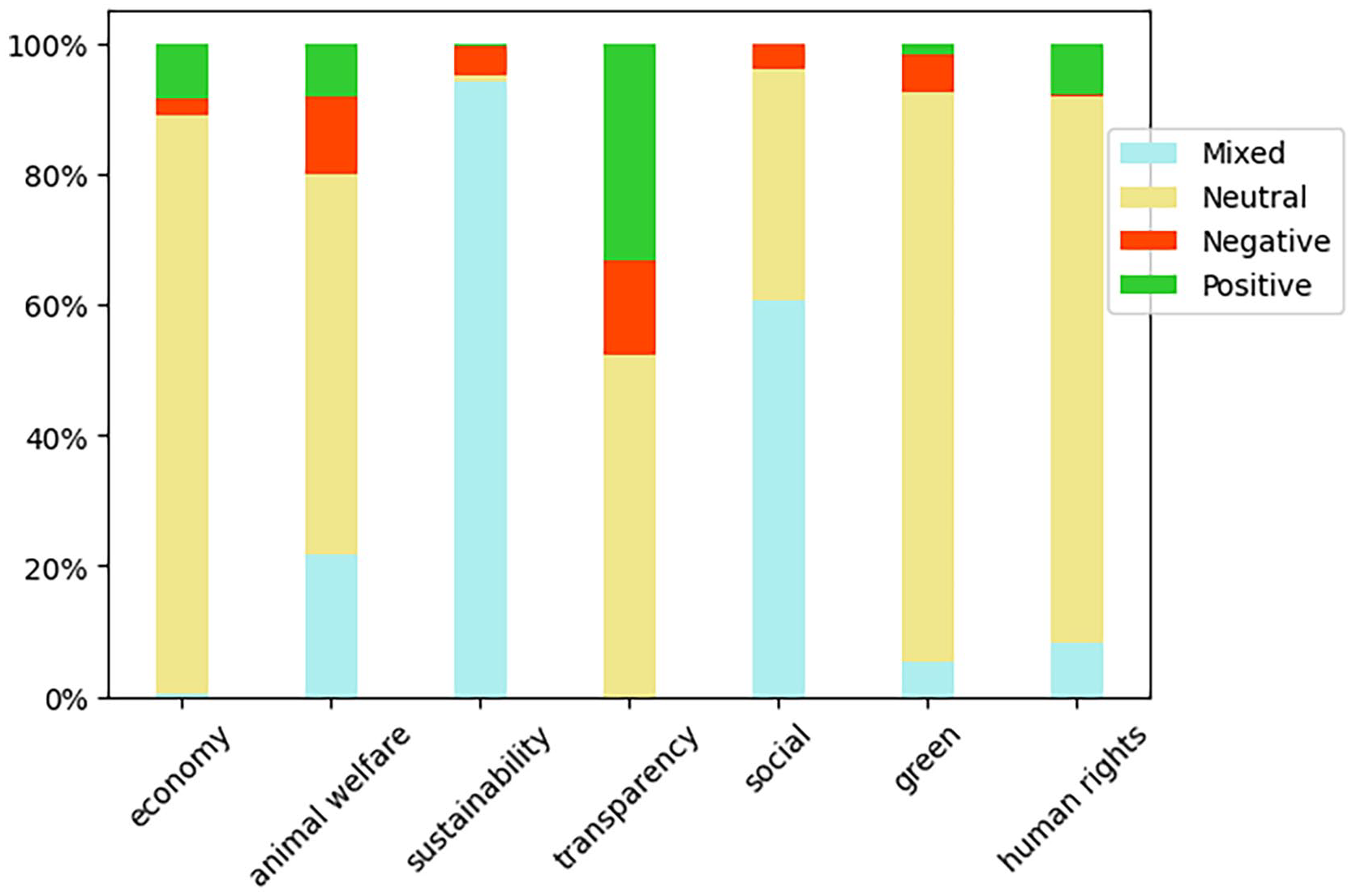
Opinion related to topics weighted.
With the weighted result in hand, it is imperative to re-frame hypothesis 2 (H2) so it can be supported by Figures 9 and 10.The new hypothesis asserts: “By giving the same significance to all opinions, the leather industry is thought mainly negative. Notwithstanding, the opinions that generate more impact in the public eye are prone to neutral.”
Users classification
Figure 11 depicts the percentage of tweets written by anonymous personal accounts (i.e. public in general) and those written by official accounts (i.e. leather companies, leather associations, and CEOs of these companies or associations). The amount of “anonymous” (not verified) users is normal in this SN because to become a verified user, one has to have a certain amount of followers, or reputation. Furthermore, that explains why negative tweets nearly always eclipse in number the neutral ones. This means, that “anonymous” user tweets criticize on the leather industry.
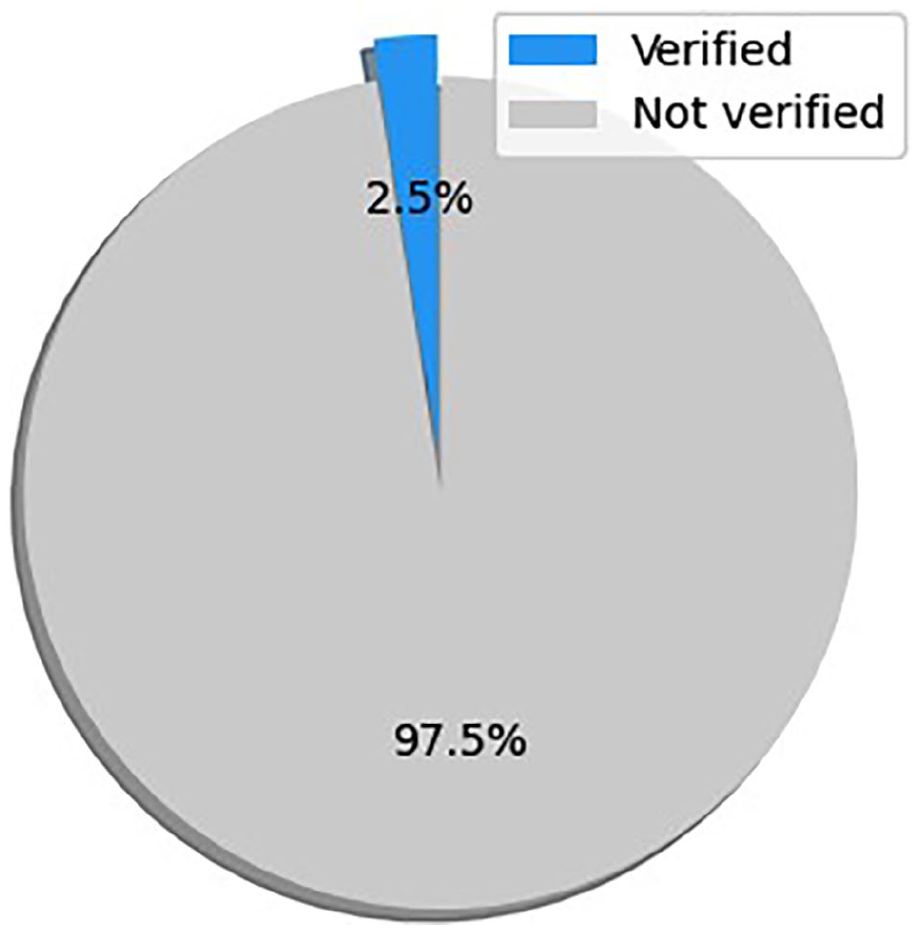
Users classification.
Results show that only a small amount of tweets (around 2%) are from official accounts. These type of accounts generally have more followers and more influence on society than anonymous personal accounts therefore they should increase the adoption of new strategies to reach stakeholders satisfaction and transparent results reporting. According to a report published by Euroleather 24 the need for the leather sector to use social media and communicate effectively has become increasingly important since it opens up windows of opportunity for businesses to disseminate information and to engage stakeholders.25,26
Discussion
Implications for theory
In accordance with previous studies published in the literature,1,5,27,28 we find empirical evidence that CSR in the leather sector is an increasingly studied topic by different researchers and is a core strategy of many companies. Leather companies have increased the adoption of socially and environmentally responsible oriented strategies, and have implemented practices to promote the organization’s environmental and ethical behavior. On this behalf, the leather industry has addressed different issues to respond to the global sustainable development goals (SDG) of the 2030 Agenda of the United Nations, and therefore the sector has boosted its vision toward innovation, efficiency, and sustainability. Examples of actions undertaken include the management and implementation of less polluting and contaminating processes, the promotion of safer working environments, or the collaboration between different stakeholders across different sectors of the leather industry. These efforts however remain commonly far from social perception. The industry is still associated with images of enclosed animals, in poor condition and which are bred and or killed exclusively for their skin, and with an industry that has negative effects on the environment and with poor labor conditions. Consequently, despite progress in sustainability and responsible management, there is still some kind of nuisance with the link “sustainable development and leather.”
While previous studies published in the literature have mainly used traditional methods for data collection such as reports, interviews, or questionnaires, this investigation has introduced the use of big data, which opens up new opportunities for research and provides a valuable source of information. To take advantage, CSR researchers and practitioners need to be familiar with computational data collection techniques such as APIs and programming algorithms.
Although the project has third party dependencies, the project is easy to maintain and update as it makes use of API calls. By updating those calls, the project should be running again. Additionally, the project has been developed independently of the hardware meaning that hardware compatibility will not be a limitation. Twitter is the perfect data source due to maximum tweet length allowed as too long documents have noise features that hinders the sentiment analysis accuracy. 29 This research has made a substantial contribution in the engineering part establishing a base where further opinion mining developers can rely on.
The results obtained in this work provide a new database of tweets for the leather sector that will serve for future projects in this area helping to understand which are the most spoken topics about leather’s CSR words, which are the opinions about them and where the industry is shifting in terms of CSR.
Implications for practice
Despite having highly valued features and properties, leather is just perceived as a product; a bag, a sofa, a jacket, but it seems to have no value in itself. From the point of view of the end user the leather goes straight from the slaughterhouse to the luxury shop window and everything in between is the absolute darkness. Leather companies face a challenging competitive environment and must adapt and realign strategies to continue responding positively to environmental and sustainable issues. Fashion industry probably has been the “Savior” of leather during last decades and major brands have had and still have control of all marketing and perception of leather in their hands. This indicates a need to take action in favor of leather industry in order to decide what is good and wrong, which skin or hide counts and provide added value and meaning to the manufactured leather.
As Lattemann and Stieglitz 30 state, social media connects companies with their stakeholders and engage them to discuss opinions on current topics and trends. In this sense, the results of the study presented in this paper show that some leather companies have started to use social networks to provide a viable source of information and to create an environment for effective stakeholder dialog in CSR discussions on social network platforms as Twitter.
From the business side, the project has clarified some questions regarding public opinion and the main topics discussed on the leather industry related with CSR. This is a valuable source of information for the CSR strategy definition. A key strength of this research lies within the fact that this framework provides a platform for further research and application to other sectors.
Limitations of the study and further research
Our research has some practical limitations. The sole focus on the word leather when applying Twitter’s filters leaves other industry-related words discarded that may add value to this research. There are identifiable shortcomings with the Twitter API due to the constraints in quantity, length, and structure of the rules. Due to time limitations, only one inbound source of information is processed. Nonetheless, the service has a structure that allows the integration of more than one incoming source of information and thus compare results between different social networks. It would be also interesting to conduct similar studies analyzing correlations between topics and words and to correlate topics and profiles of users.
Conclusions
CSR engagement of firms in controversial industries has been a topic of great interest in recent years for shareholders, regulators, and academic researchers. Leather sector has been included by the society under this sinful umbrella due to they have not made themselves known and its lack of communication to justify or contradict all the negativity focused against them. The results obtained in the investigation are consistent with the fact of not being transparent and communicative generates a multiple negativity in Social networks.
Communicating effectively CSR activities benefits company stakeholder engagement and may turn into positive attitudes from stakeholders toward the company. In this sense, some leather companies have started to use social networks to inform stakeholders and to promote their CSR practices, and now, different stakeholders play an active role in CSR discussions on social networks sites such as Twitter.
Leather sector needs to communicate better their contribution to upcycle an unavoidable waste from the food industry, to produce a versatile, durable, unique material, ideal for the circular economy that the world must move toward. However, these same materials are often dismissed through a lack of understanding of the manufacturing process and its supply chain, or through the application of questionable science generally in the form of incomplete and incomparable or out-dated Life Cycle Assessments, and the marketing of new, often fossil fuel-based materials claiming unsubstantiated levels of sustainability. In this sense, the examination of big amounts of data obtained from social media may help in the aim of analyzing the CSR debate in order to communicate with its stakeholders more effectively.
This project has achieved the objectives proposed. We have developed a big data tool that mines opinions about the leather industry’s CSR aimed to understand what topics of CSR in the leather industry are discussed in the Twitter sphere. This has enabled us to test the initial hypothesis formulated.
In the course of this work we discovered that fashion is linked in a strongly manner with leather, probably due to industries have turned leather into an all-season product. The debate is related with the impact of leather industries against the planet and the economy and many stakeholders advocate for more environmental responsibility since they consider vegan alternatives such as organic bio-materials that are made of anything except animals. On the other hand, the percentage of tweets posted by anonymous personal users (public in general) accounts for 97.5% while those written by official users only reach 2.5%. These findings indicate that the leather sector should improve the CSR disclosure and adopt a better stakeholder engagement strategy. There are several studies that confirm social networks can lead to positive outcomes since they are not just a way to advertise what company does in regards to CSR, but also to receive input from others for their CSR activities.
Results also reveal a clear tendency to negative sentiment tweets (around 43%) in front of mixed tweets (20%) and positive tweets account approximately just for 8%. Sustainability and transparency are less favorable in the public eye whereas green and human rights are more supportive.
Footnotes
Declaration of conflicting interests
The author(s) declared no potential conflicts of interest with respect to the research, authorship, and/or publication of this article.
Funding
The author(s) disclosed receipt of the following financial support for the research, authorship, and/or publication of this article: This work was supported by the Ministerio de Ciencia e Innovación under contract PID2020-113614RB-C22 funded by MCIN/AEI/10.13039/501100011033. Also, the authors are members of the research group 2017-SGR363, funded by the Generalitat de Catalunya.
