



Abstract
This study examines the urban consumer in India, the largest category among the stakeholders of sustainable fashion. A survey on consumer perception and consumer behaviour with regard to a green purchase decision of sustainable or eco-friendly clothing was done among 460 participants in two of the south Indian cities of Chennai and Bengaluru. A conceptual framework was adapted for green consumerism from the Theory of Planned Behaviour. The theory was used to understand consumer perceptions and their influence on their purchase behaviour with regard to sustainable clothing. The ‘product attributes’ of sustainable clothing brands were considered as intervening variables and their effects on ‘green purchase decision’ were examined. Probit regression was used to analyse the data. One of the significant findings of the study is that ‘environmental knowledge’, ‘environmental attitude’ and ‘perceived consumer effectiveness’ have a significant effect on urban ‘purchase intention’ of sustainable clothing. Practical implications of the study are discussed.
Keywords
Introduction
The relationship people have with their clothing has changed greatly over the 20th century. The most dramatic shift took place in the last two decades of the 21st century. 1 In this era of extreme production and consumption, many people get into a mindless cycle of acquiring and discarding garments instead of taking time to value and use them. Consumers’ physical and mental space has not been able to keep up with the increasing speed of consumption habits. Therefore, it is not surprising that what we are left with is a serious problem of waste management affecting communities and economies. This problem does not end only with the waste that finds it difficult to biodegrade in landfills. It also extends to the precious resources (such as water, energy, labour and time, not to mention the money spent that make the garments) which are easily discarded. The fashion industry can be re-organized to bring about structural changes that will ensure a renewed pattern of production and consumption more aligned to the needs of the environment at large. 2 Given its global relevance, the fashion and lifestyle industries are uniquely positioned to collaborate and engage with the Sustainable Development Goals, in particular on climate action, and responsible production and consumption. 3
India is the most populous country in the world with 1.4 billion people. The country is the sixth largest economy with its current GDP growth rate at 6%. The textile manufacturing sector contributes 18.21% to the Indian GDP and the labour force in the Indian textile industry is 60 million. As India’s economy grows, the middle class is predicted to grow by 1.4% every year between 2018 and 2023, and as more and more people move into the middle class, they gain access to goods that eventually contribute to the world’s pollution which includes discarded textile and clothing products. Therefore, this study has primarily looked into the consumers, who form the largest category among the stakeholders of sustainable fashion. There is a consumer behaviour gap in particular with regard to attitude, product use and practices of sustainability in clothing which has to be addressed. 4 The attitude-behaviour gap has not been adequately explored with regard to consumer behaviour in sustainable fashion. Busalim et al. 5 expressed concern over how existing studies on consumer behaviour did not ground themselves or advance theory significantly. Therefore, this study tries to bridge the gap.
Sustainable fashion brands in India can be classified under criteria such as organic fabric, zero waste, ethical practices and upcycled fashion. A few of these sustainable fashion brands are: Ethicus, Nicobar, Doodlage, I was a saree, No Nasties and Upasana. Most of these brands have individual e-commerce websites and are promoted through social media. Other popular access to sustainable clothing in India is visiting exhibitions specially during festivals where handloom and craft-based artisanal products are exhibited. Some tourist spots have expos throughout the year where consumers have access to quality sustainable fashion goods: For example, Dilli Haat in New Delhi. Products from these brands are priced at a premium when compared to the clothing available in retail stores that are mass produced.
Sustainability is demanded worldwide, yet with different communication purposes – with distinctiveness in the Western world, group cohesion in Latin America and the Middle East. 6 ‘Sustainable fashion’ is not just about naturally coloured clothes made of organic fibres. The definition goes beyond the material choice, and it encompasses the methods of production, consumption as well as disposal after use. As consumers, people are far removed from the process of production that they do not fully understand how a garment comes into existence. The efforts and methods are largely unknown to the consumers. This starts with research and development, product development, production of raw materials, conversion into fabric, fabric treatment, manufacture of thread and buttons and zippers, pattern-cutting, stitching and finishing, packaging, selection by a buyer, shipment and arrival in a shoppe, merchandising and retailing and sales people. Although it seems as if the process is complete when the garment arrives in the closet of the consumer, it extends to the care, usage and disposal of the garment. On the equation between need and sustainability, Fletcher 7 says the sustainability questions related to fashion become less about technical issues like making sure that consumers buy organic cotton or that they buy from a factory that upholds good processes but also more about how much consumers really need, and how they engage with the things they buy.
In a systematic review on why consumers make green purchase decisions, Zhaung and Dong 8 recommend that authors of future studies consider adjustments to the survey objects to weaken the subjectivity of the data. Therefore, in this study, though the variables are termed as per green marketing, the following three aspects were prioritized:
Levels of awareness, understanding and knowledge concerning sustainable clothing among urban Indians.
The variables that influence the purchase intention of sustainable clothing.
Product attributes of sustainable clothing that influence purchase decision.
The following section elaborates on the theoretical framework adapted for the study as well as the literature and the development of the hypotheses. The section on methodology considers how data was collected and it describes the sample under the study with their socio-demographics. The results using Probit regression were interpreted, followed by the discussion of the results and conclusion of the study.
Literature, theoretical framework and hypotheses
The European Commission defines environmental design as one that uses low-impact materials, focuses on resource efficiency, invests in high quality and durability, reuse, recycle and renew. 9 Green marketing, on the other hand, encompasses actions directed to all consumers, and incorporates a broad range of marketing activities (e.g. planning, process, production, promotion and people) designed to demonstrate the brand’s goal of minimizing the environmental impact of its products and services. 10 Among the India’s most sustainable companies, only four of the clothing manufacturers made it to the list. Welspun India was listed in A, B list had Aditya Birla Fashion and retail, and under B+ Grasim industries and Arvind Limited. They were rated based on an assessment process by Sustain Labs Paris using the SLP cube assessment framework for their resource efficiency, social entrepreneurship, financial management, employee wellbeing, clean revenue and inclusive supply chain. 11
Not only is knowledge of sustainability essential but the ability to engage rationally one’s knowledge by putting it into practice is a pre-requisite towards sustainable behaviour. The increasing number of reports on environmental concerns has made people sit and take cognizance of the harmful repercussions of individual and collective consumption habits.12,13 As values and environmental preconceptions underlie environmental behaviour, the human-nature connect develops attitudes towards sustainability. 14
Consumers’ perceived value and willingness to pay affects the green purchase intention and the buying behaviour, which was confirmed in earlier studies conducted in a few Asian countries including India. 15 Koszewska 16 found that the attitudes of consumers had a great impact on determining if they will pay a higher amount for sustainable textiles and if they are influenced by the recognisability of eco-labels and social labels. Awareness surrounding the environmental implications of purchase behaviours are slowly increasing owing to active crusading by various organizations including NGOs as well as the media 17
In a study focussing on consumer behaviour with regard to eco-fashion, Lambert 18 found that self-identity had a crucial role to play in influencing people’s purchase intentions and how they orient their consumption practices in line with sustainability. A purchase intention was significantly influenced by attitudes, social norm, environmental concern and environmental knowledge. Consumers perceived behaviour was not always an accurate predictor of actual purchase behaviour, whereas social norm and environmental knowledge highly influenced purchase of eco-friendly clothing. 19
Ojukwu and Tariq 20 probed as to whether the use of traditional textiles production techniques have any direct bearing on the sustainability quotient of the products. The results suggested that traditional methods were inherently more sustainable in nature and there was a higher level of consumer attachments to products when they were produced using traditional techniques translated into longer usage of the product. Da Costa et al. 2 suggested that consumers needed to be trained in more sustainable practices such as buying second-hand clothes and adapting to slow fashion as trend. There is a need to open more factories that recycle old clothes and outlets that sell them.
Empirical studies on green purchase decisions reveal that ethical commitment and ethical values were a strong driver towards purchasing eco-clothes, eco-materials, recycled clothing and ethically made garments. 21 Kong et al. 22 demonstrated that a green corporate perception, eco-label, and green product value had positive significant influences on green purchase intention within consumer perception. The findings also revealed that eco-label and green product value made the largest contribution in influencing a green purchase intention among consumers. In contrast, both green advertising and green packaging had no significant impact on consumer intention to purchase green products. Social knowledge also played an important role in forming attitude towards sustainable textile products; therefore, businesses that claimed to be sustainable should incorporate such effective sources of knowledge in their marketing strategies. 23
Neupane et al. 24 suggested that there was a mismatch between the value expected by apparel consumers and the value offered by eco-apparel. To attract mainstream apparel consumers, environment-friendliness claims should be implicit while aesthetic claims should be explicit. Perceived psychological risk due to misleading information, combined with the effort required to purchase due to limited availability, had added to the problems of marketing eco-apparel. Moon et al. 25 classified the barriers to sustainable clothing in a study among Asians. These barriers included limited knowledge of sustainable clothing and textiles among consumers, insufficient supply sources or less access to sustainable fashion, economic issues with sustainable fashion being expensive than conventional clothing, and product design. In product design, the concentration was more on environmentally friendly dyes and fibres rather than on aesthetic designs and styles.
Sharma 26 profiled consumers based on their environmental concern and specific product attributes such as degree of concern, basis, and type of purchase. A Canadian survey by Weber et al. 27 that studied consumers’ disposal styles of textile waste as against their interest in accumulation of fashion goods found that those who were on the higher scale of fashion consumption actually had lower disposal rate than non-fashion consumers. Determinants of a green purchase decision was classified into three indicators by Zhuang et al. 28 : individual factors (psychological, habits, experiences, lifestyle and socio-demographics), product attributes and marketing, and social factors (social norms and social capital). Whether consumers think sustainability to be an important consideration while making purchase decisions of clothing material remains contestable.
According to Rausch et al. 29 consumers tend to prioritize cost effectiveness, quality as well as the comfort and fit of the apparel rather than attributes of sustainability such as the durability of the material, the issue of fair wages, and the conditions under which they were produced. But there is a lack of adequate eco-consciousness on the part of consumers in relation to their textiles purchase and consumption. Discourses on second-hand clothing is country-specific and they reflect the unique socio-economic milieu of a particular nation and culture. However, notwithstanding these differences, there is much to relate for the industry of used and second-hand clothes which is a global phenomenon. 30 With regard to challenges in sustainable design, there is a lack of consensus, knowledge, and perceived trade-offs with other design criteria such as aesthetic styles, costs and fashion trends. Additional concerns in implementing sustainability by businesses includes perceived insufficient consumer demand, attitudes and behaviour gaps in consumer purchasing decisions on sustainable collection ranges. 31
To enable consumer behaviour change in alignment with concerns for sustainability, Brett 32 created a framework that identified three key factors that impact decision-making: product attributes (such as cost, quality and sustainability), customer diversity (differences in knowledge, values and social norms) and customer inconsistency (shifting interests, contexts and mindsets). Apart from this, several labelling schemes may cause confusion and frustration. Consumers’ confusion of terms related to environment and sustainability is a primary reason for rising number of labelling schemes, which makes it even more difficult for consumers to understand any significant differences between them, which facilitates greenwashing. 16
Based on the literature review, the hypotheses were formulated:
Hypothesis 1: Environmental knowledge, environmental attitude, and perceived consumer effectiveness of sustainable clothing significantly influence purchase intention.
Hypothesis 2: Purchase intention of consumers significantly influences green purchase decision of sustainable clothing.
Hypothesis 3: Product attributes of sustainable clothing such as perceived relative advantage, parity with non-green product attributes, and perceived risks have a significant influence on a green purchase decision.
Studies on cognitive domain by Bloom et al. 33 on affective domain by Krathwohl et al. 34 and psychomotor domain by Harrow 35 have been encompassed into the three domains of learning. The tripartite theory or the notion that attitudes have three components – affect, cognition and behaviour – has enjoyed a long history. Traditionally, affect has been used to describe the positive and negative feelings that one holds towards an attitude object. Cognition has been used to refer to beliefs that one holds about the attitude object, and behaviour has been used to describe overt actions and responses to the attitude object. This aspect was used to develop the theory of planned behaviour. Based on this paradigm, Sharma and Joshi 36 adapted the Theory of Planned Behaviour propounded by Ajzen. 37 They examined green consumerism and its influence on green purchase behaviour. They explored the role of environmental concern and green product attributes on actual purchase behaviour. The framework () looks into ‘environmental knowledge’, ‘environmental attitude’ and ‘perceived consumer effectiveness’ as independent variables leading to ‘purchase intention’ moderated by various levels of ‘environmental concern’ and ‘product attributes’. ‘Product attributes’ comprises ‘perceived relative advantage’, ‘parity with non-green product attributes’ and ‘perceived risks’. Finally, this leads to a ‘green purchase decision’ which is the dependent variable. The study has thus used the Theory of Planned Behaviour framework to analyse the attitude of a consumer towards sustainable textiles and clothing. Although there are a few limitations in the application of the theory towards green consumption behaviour such as assuming subjects to be rational in their decision and focussing only on psychological factors, the Theory of Planned Behaviour is the most used in the recent years with regard to consumer behaviour. 38

Theory of Planned Behaviour as adapted by Sharma and Joshi. 36
Methodology
The study adopted a survey method using a questionnaire as a tool to collect data on consumer perceptions of sustainable clothing in the south Indian cities of Chennai and Bengaluru. Chennai and Bengaluru were fourth and fifth in the list of highest municipal solid waste generating cities with 5000 and 4200 tonnes per day respectively. Composition of solid waste consists of 7% clothing and textile waste in India, whereas in developed countries it was just 2%. 39
The sampling technique used is judgement sampling as the population is scattered. Judgement sampling, also called purposive sampling, is a non-probability sampling technique in which the samples are chosen on the basis of the decision of the researchers. Since the samples were selected with a good knowledge base, it is more likely that the results obtained is accurate with a minimum margin of error and a limited degree of bias. A total number of 50 questionnaires were distributed as part of the pilot study. Vague questions were eliminated, after the feedback got from the pilot study, thus ensuring reliability and validity. The questionnaire was administered between September and December 2021, and 460 of the respondents had fully filled the questionnaire. It was circulated using a Google form, a useful and free tool to create and manage surveys, questionnaires, multiple-choice tests, quizzes, and the like. Some questions were elaborated using a three-point Likert scale. The responses were anonymous, and the results described the behaviour of respondents about clothing and textile matters, from their preferences in buying to the discarding of clothes. The sections of the questionnaire were elaborated based in certain cases on previous surveys conducted by Hur and Cassidy. 31 Respondents were requested to complete a form concerning the following topics, divided into four sections:
Demographic details
Clothing purchase behaviour
Awareness, perception and purchase intention
Perceived product attributes and green purchase decision.
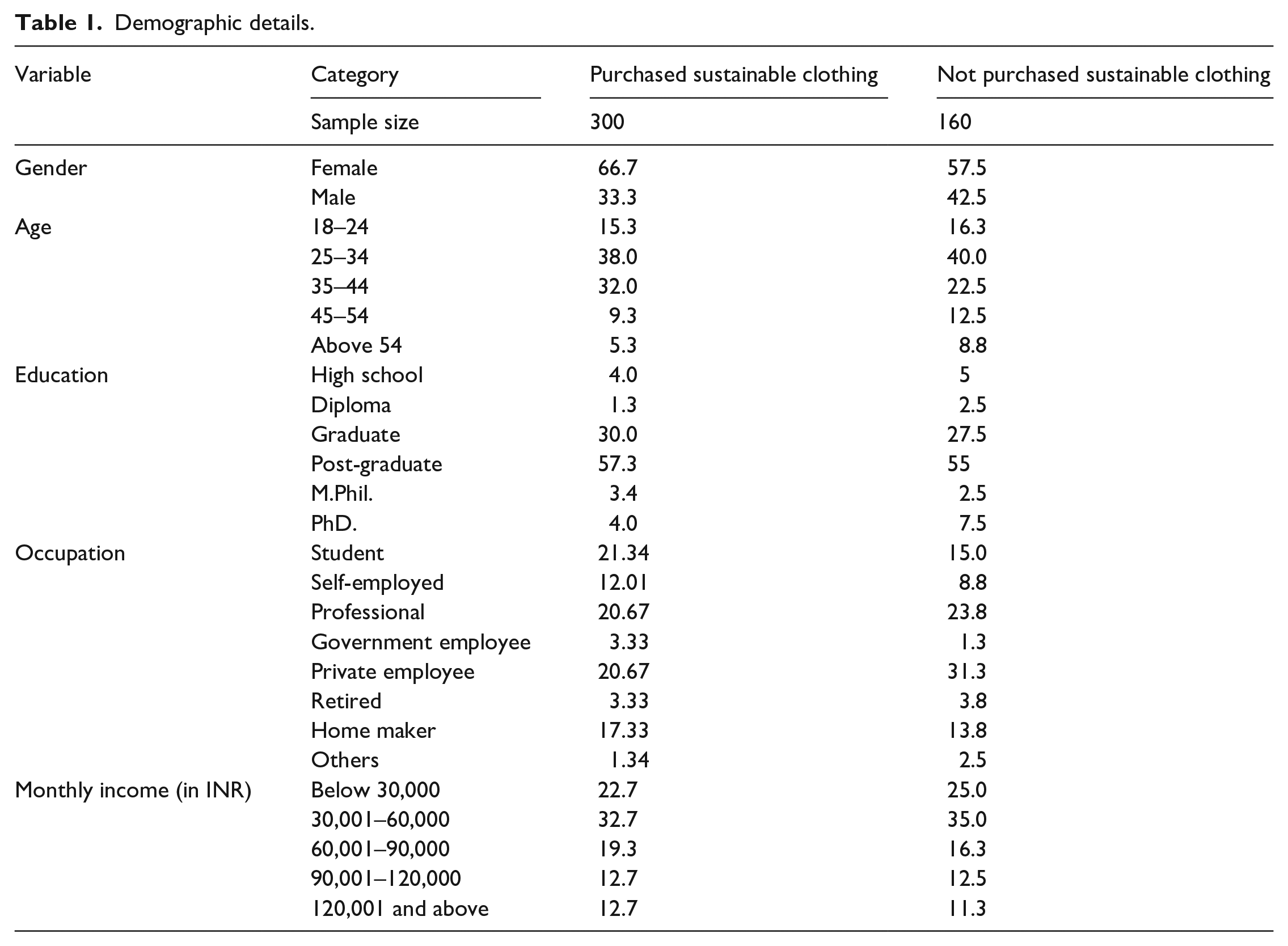
Probit regression and its marginal effect on factors influencing the dependent variables were analysed since the dependent variables were considered as binary variables. The variables studied such as ‘environmental knowledge’, ‘environmental attitude’ and ‘purchase intention’ were indexed variables. Depending on the number of sustainability aspects in fashion that the respondents selected for each variable, the responses were categorized as high ‘1’ to low ‘3’. To understand one variables’ effect on the other and to check for robustness, regression estimates were run with other important socio-demographics such as age, income and education. Hence, demographic variables as in Table 1 were included in the tables for robustness of the data. All the variables used in the regression models are given in Table 2.
Demographic details.
Variables used in regression models.

Results and data analysis
Hypothesis 1: Environmental knowledge, environmental attitude and perceived consumer effectiveness on sustainable clothing significantly influence the purchase intention
Table 3 represents the direction and significance of the variables in the Hypothesis 1. ‘Environmental knowledge’ and ‘perceived consumer effectiveness’ positively affect ‘purchase intention’ significantly. For example, keeping other variables constant, a one-unit change in ‘environmental knowledge’ will increase the probability of ‘purchase intention’ by 0.176 times. Likewise, one unit change in ‘perceived consumer effectiveness’ will increase the probability of ‘purchase intention’ by 0.485 times. ‘Environmental attitude’ negatively affects ‘purchase intention’ significantly. One unit change in ‘environmental attitude’ will reduce ‘purchase intention’ by 0.210 times. Women are more likely to be affected by ‘purchase intention’. The other variables do not significantly explain ‘purchase intention’. Socio-demographic variables were also analysed for robustness check of the data in all three hypotheses. There is no considerable change while analysing the data along with socio-demographics, and therefore the results are consistent.
Probit regression and its marginal effects on factors affecting purchase intention.

, **, ***Statistically significant at 10%, 5% and 1% levels of significance respectively.
The female demographic characteristic is also significant with respect to ‘purchase intention’ with 1% level of significance, whereas the other socio-demographics are not significant with respect to ‘purchase intention’. Except for ‘environmental attitude’, all other parameters positively affect ‘purchase intention’. Hence the Hypothesis 1: Environmental knowledge, environmental attitude, and perceived consumer effectiveness on sustainable clothing significantly influence the purchase intention is accepted. ‘Environmental attitude’ is insignificant with respect to purchase intention which is the outcome variable, whereas in a study by Zhuang et al. 28 on factors affecting green purchase intention, attitude was positively correlated with ‘purchase intention’. Geury 40 sought to establish the influence of psychological and social aspects on textiles consumption behaviour with consumers as drivers and found environmental concerns to have an insignificant influence.
The urban middle-class consumer has awareness of sustainable clothing but whether or not this translates into a purchase intention is questionable in most cases since price points of sustainable clothing brands is four or five times expensive than the trendy fast fashion brands. 41 Although a person may be economically well-off to buy from a sustainable clothing brand, the information on availability of retail outlets of such brands is limited. Sustainable clothing has different meanings to different individuals – it may be re-cycled, re-purposed or re-sourced cotton/linen. The consumer should have the understanding that it takes about 300 years for the discarded polyester or spandex blend garments to bio-degrade. This awareness should translate into an eco-friendly purchase decision. Such a responsible purchase decision will lead to good health, safe environment, besides fair trade in the making and selling of the garment.
Hypothesis 2: Purchase intention of consumers significantly influences a green purchase decision of sustainable clothing
‘Purchase intention’ positively affects a ‘green purchase decision’ significantly. For example, keeping other variables constant, a one-unit change in ‘purchase intention’ will increase the probability of a ‘green purchase decision’ by 0.106 times. Since ‘purchase intention’ significantly affects a ‘green purchase decision’ positively, the Hypothesis 2: Purchase intention of consumers significantly influences a green purchase decision of sustainable clothing has been accepted. The demographic data had little or no significance with regard to a ‘green purchase decision’ in this study since the results were consistent (Table 4).
Probit regression and its marginal effects on factors affecting a ‘green purchase decision’.
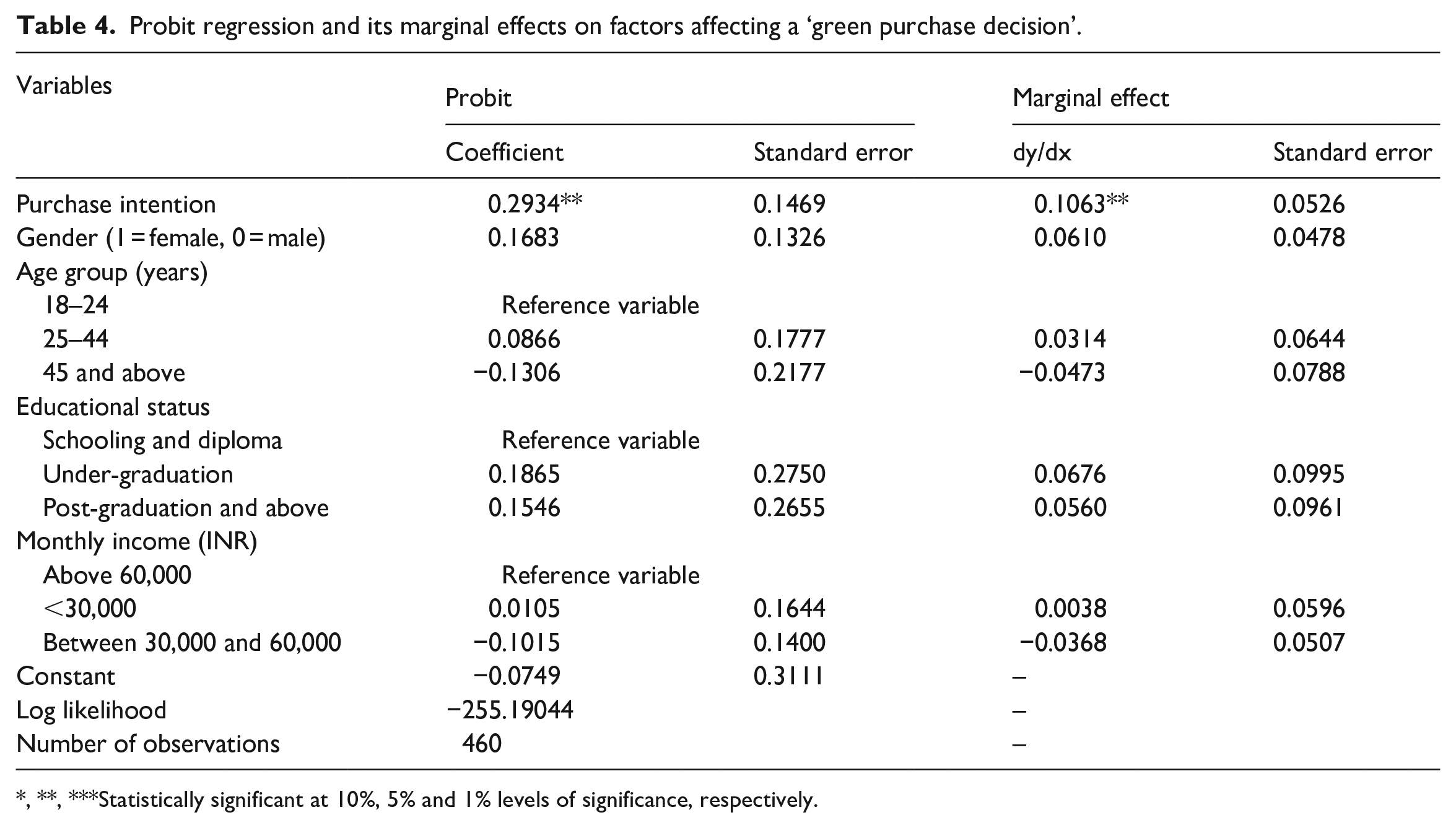
, **, ***Statistically significant at 10%, 5% and 1% levels of significance, respectively.
Purchase intention is a measure of each buyer’s habit of buying a product. It involves cognitive, affective and behavioural aspects towards adoption, purchase and use of the product. Purchase intention is translated into purchase behaviour when a decision is made. Therefore, a purchase intention is different from a green purchase decision wherein the intent to buy a product is translated into actual behaviour through a purchase. Covid-19 pandemic had reduced the buying capacity of consumers and reduced their desire to buy new clothes quite often. Sustainable clothing must sell clothes keeping in mind not only aesthetics but also the changing trends. Such brands must also encourage hand-made clothes of poor artisans by buying from them and also providing them with training necessary to adapt to the aesthetics associated with sustainable clothing.
Hypothesis 3: Product attributes of sustainable clothing such as perceived relative advantage, parity with non-green product attributes, and perceived risks have a significant influence on a green purchase decision
‘Parity with non-green product attributes’ positively affects ‘green purchase decision’ significantly. For example, keeping other variables constant, a one-unit change in ‘parity with non-green product attributes’ will increase the probability of a ‘green purchase decision’ by 0.654 times. Compared to respondents’ educational status with schooling and diploma, respondents’ educational status with post-graduation and above are more likely to be affected by a ‘green purchase decision’ (Table 5).
Probit regression and its marginal effects on factors affecting a green purchase decision.
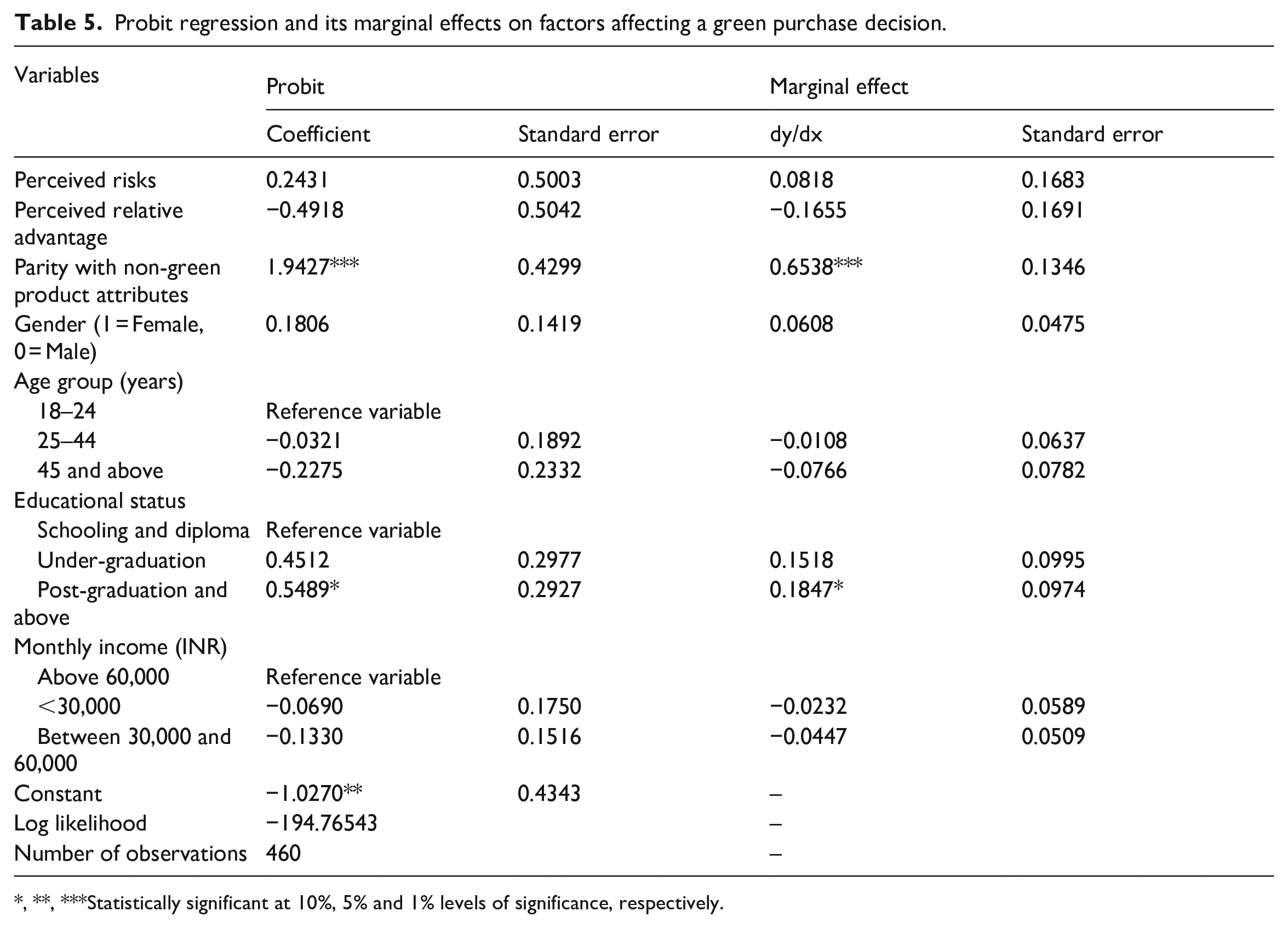
, **, ***Statistically significant at 10%, 5% and 1% levels of significance, respectively.
The product attributes of sustainable clothing considered in the study which was elaborated under the sub-variables were comfort, easy care and maintenance, affordability/price, value for money, fit, aesthetics and variety in terms of design and collection. Among the product attributes, only ‘parity with non-green product attributes’ significantly affects a ‘green purchase decision’. ‘Perceived risks’ and ‘perceived relative advantage’ do not have any significant effect on a ‘green purchase decision’. Therefore, the Hypothesis 3: Product attributes of sustainable clothing such as perceived relative advantage, parity with non-green product attributes, and perceived risks have a significant influence on a green purchase decision is rejected.
There is a millennial trend of burgeoning sustainable fashion brands being marketed through celebrities and influencers on social media. But branding claims may not always determine the purchase from sustainable clothing whereas, functionality, price benefits and appearance were highly considered while purchasing from sustainable fashion brands. The urban middle-class looks particularly into pricing while going in for buying new clothes. One of the respondents to the survey said: ‘I’ve always thought eco-friendly clothes are expensive so I did not look for it often. When I think of the word “eco-friendly” what comes to my mind is only Fabindia (a brand that sells ethnic textile products made by crafts men across rural India). I lack awareness on this topic. I try to be eco-friendly even when I use stationery items such as papers but not while buying clothes. This survey has made me think’.
Discussion and implications
The implications of the study such as theoretical implications, implications to consumers, to managers of sustainable clothing and suggestions for further research has been discussed below.
Theoretical contributions and implications
This study’s findings enrich the theoretical basis for understanding consumers’ behaviour of sustainable clothing. It provides further directions towards factors influencing a ‘green purchase decision’. The results of the study bought about clarity in terms of awareness, understanding and knowledge of the urbanites on sustainable clothing and the variables that influence purchase intention and purchase decision eventually. The attributes of consumer perception – ‘environmental knowledge’, ‘environmental attitude’ and ‘perceived consumer effectiveness’ – significantly affected ‘purchase intention’. Perception on sustainability translates into intention to purchase from sustainable clothing, but may or may not become a ‘green purchase decision’. ‘Purchase intention’ of consumers significantly and positively influenced a ‘green purchase decision’ of sustainable clothing. ‘Purchase intention’ of sustainable clothing translates into a ‘green purchase decision’, provided there is a considerable concern for the environment. ‘Product attributes’ of sustainable clothing such as ‘perceived relative advantage’, ‘parity with non-green product attributes’ and ‘perceived risks’ do not have a significant influence on a ‘green purchase decision’. ‘Product attributes’ referred in this study such as better comfort, better fit, better value for money, aesthetically appealing and variety in terms of design and collection do not necessarily translate into a green purchase decision. However, the product attribute ‘expensive compared to conventional clothing’ does translate into a ‘green purchase decision’ as most people do not opt for expensive textile products although they are promoted to be sustainable and give sustenance to the slow dying artisan community.
Implications for consumers
A respondent to the survey said: ‘Sustainable clothing are something we need as easily available as regular clothing is. If the material is locally sourced and the value chain is streamlined better, the garment will not be priced much higher than the regular ones. We reduce, reuse, recycle/upcycle but in the end, we need reliable brands that gives us ethically sourced, eco-consciously manufactured clothes without having to spend hours on researching the credibility of the brand every time we buy a piece of clothing. There is a severe lack of trust in the claims of sustainable brands’. Another view was that eco-friendly clothing is more expensive than regular clothes and although influencers try to promote this as a trend there will be a real impact on the environment only when it is accessible to the middle-class consumer. During and after the Covid-19 pandemic, buying clothes had considerably reduced as reported by 80% of the respondents. The respondents say that there is not enough publicity on sustainable clothing and fashion as in other segments of consumer consumption like food and beverage. They had also expressed the desire to know more about sustainable clothing and ways to adapt to slow fashion.
Implications for managers
Considering the results of the study, fashion brands that promote themselves to be sustainable may consider below suggestions as a result of the study. It is clear that factors such as buying local, supporting craftmanship and artisanal clothing take precedence when it comes to shopping from sustainable brands since awareness, knowledge and understanding of sustainability have increased. There is a millennial trend of burgeoning sustainable fashion brands being marketed through celebrities and influencers on social media. But branding claims may not always determine the purchase from sustainable clothing brands whereas functionality, price benefits and appearance were highly considered while purchasing from sustainable fashion brands.
For instance, one may have a liking for sustainable clothing brands but factors such as cost, family preference, care and maintenance and accessibility may hinder the purchase. A shift in consumer behaviour with a particular emphasis on decreasing clothing purchases and increasing garment lifetimes will minimize the detrimental environmental impact of unsustainable clothing practices.
Unless a consumer who is aware, want to take action in their efforts to safe guard the earth through their clothing consumption, there are less chances of a consumer to intentionally search for sustainable clothing brands and purchase from them.
Limitations and future research directions
This study has scope for furtherance, and barriers for sustainable consumption of textile goods, perceptions and other aspects of consumer behaviour could be studied. The study can be used by sustainable businesses in their efforts to promote themselves and also in policy making and governance. Similar studies could be done in rural areas as well as in other developing countries, and comparative studies too could be undertaken.
Conclusion
Although there is a shift in consumers’ consumption behaviour towards more sustainable patterns across a variety of different contexts, sustainable apparel has still not become a mainstream trend in spite of the textile industry’s excessive usage of valuable resources. 29 A growing middle class, powerful manufacturing sector combined with increasingly tech savvy consumer, has made India an essential destination for fashion companies 42 and therefore the findings are relevant in the context of this study. Sustainable consumption in the field of fashion and clothing can gain traction when consumers decide quality over quantity and expensive over cheap. Intentionally choosing to stay sustainable takes awareness, change in perception and attitude.
Footnotes
Declaration of conflicting interests
The author(s) declared no potential conflicts of interest with respect to the research, authorship, and/or publication of this article.
Funding
The author(s) received no financial support for the research, authorship, and/or publication of this article.
