



Abstract
Concrete canvas reinforced with spacer fabric has increasingly gained popularity due to its lightweight, great flexibility, high strength and low contamination compared to ordinary concrete. In order to fully explore the structure and performance of this novel composite, this review illustrates how to design high-performance concrete canvas and presents a summary of recent application status of it. Firstly, the structure and properties of knitted and woven spacer fabric and concrete material that comprise concrete canvas is introduced. Secondly, internal and external mechanisms affecting the properties of concrete canvas have been described. To illustrate how to evaluate and test the mechanical behavior of concrete canvas, typical mechanical experiments such as tensile and flexural experiment and failure mechanisms are explained. In terms of the characteristics of concrete canvas, the present article reviews current applications of it in disaster relief tent, slope protection, ditch lining and furniture design areas. Nevertheless, its practical applications are still in the preliminary stage, it is of great necessity to expand its application from the point of view of replacing traditional materials, changing structural design, external reinforcement and perfecting performance evaluation system.
Introduction
Concrete canvas reinforced with spacer fabric (CC for short) is a typical sandwich structure. It is filled with cement powder on the mesh surface of 3D spacer fabric evenly, then coated with a layer of sealant on the lower surface of the fabric after being compacted. When using, spray water directly for hardening and molding with the hydration reaction. 1 Overcapacity of cement clinker currently bothers building materials industry in China, therefore, in the development plan of the building material industry during the 13th 5-year plan period, it is proposed that not only should we continue to optimize its industrial structure and expand the scale of the industry, but also put special emphasis on green development. Thus, recent years have witnessed increasingly national investment in the environmental protection building materials industry, showing great development potential of this industry.
Served as a novel environment-friendly building material, CC takes great advantage over ordinary concrete, which is harmful to environment and has relatively low tensile and flexural strength. 2 The utility of varied fibers, cement powders, other additional materials and structural design can give CC distinctive performance. Main advantages of CC are as follows: (1) Low cost and good flexibility: CC can be packed in large batched rolls with roughly 15 kg per square meter and 1700–2000 kg/m3 of the final hardened CC apparent density, only 70%−80% of that of ordinary concrete. 2 Therefore, it is convenient for transportation, loading and unloading without heavy equipment. By virtue of its softness and flexibility before hardening, it can be laid on irregular shapes of the ground like a soft cloth. 3 (2) Excellent properties: After hardening, the initial strength of CC is rather high 4 while maintaining for a long time, for instance, its compressive strength can reach 40–50 MPa. And there is a greater likelihood of producing a hardened matrix with high porosity owing to loosening of the compacted powders and over-dosage of added water. 3 Meanwhile, the force distribution is more even due to the existence of spacer fabric and cement matrix, which contributes to the improvement of tensile strength, flexural strength and durability. Moreover, CC has good flame retardancy, 1 water resistance, 4 and corrosion resistance. 5 Good flame retardancy can be achieved by using proper spacer fabric made of flame retardant fiber; water and corrosion resistance can be achieved by selecting waterproof materials and appropriate spacer fabric. (3) Environment-friendly: a large quantity of global resources covering water, concrete and gravel is required and a lot of carbon dioxide is emitted when manufacturing ordinary concrete. On the contrary, small amount of traditional materials are consumed when manufacturing CC because of the structure of spacer fabric. It greatly helps cope with the overcapacity of cement and reduce the emission of carbon dioxide. Furthermore, CC has little impact on the ecosystem with less content of alkali, strong surface erosion resistance and chemical resistance.
Notwithstanding the advantages of CC, it also has some drawbacks, such as high porosity, low post-hardening apparent density and inadequate ani-penetration performance. 1 Furthermore, current commercial CC can not meet all the demands in practical applications. The domestic fundamental research needs to be improved. Consequently, it’s of vital significance to do more basic research to design high-performance CC with novel materials and structure to meet the requirements of more applications, particularly in emergency engineering field.
Since the performance of CC is mainly determined by spacer fabric and concrete, this review first presents the structure and properties of these two main raw materials. Then the internal and external mechanisms influencing performance of CC are revealed. With the illustration of flexural and tensile behavior of CC, its test methods and failure mechanisms are explored. Finally, the application status of CC is summarized.
Materials of CC
Spacer fabric
Knitted spacer fabric
Warp-knitted spacer fabric
Warp-knitted spacer fabric (WKSF for short) is a kind of 3D hollow structure fabric with upper and bottom surface fabrics connected by spacer yarns, also called spacer monofilaments. 6 WKSF is produced on Raschel double needle bar warp knitting machines. 4 As shown in Figure 1(a), the spacer yarn system generally uses monofilaments or yarns to penetrates the two outer exteriors to form a spacer layer, which brings a large space. Warp-knitted technology is the most commonly known and applied technology for the production of spacer fabrics 7 and CC is widely fabricated with WKSF.

WKSF obtains plenty of performance advantages for its unique sandwich structure which are as follows: the spacer filaments generally adopt synthetic fiber monofilaments such as polyester with better mechanical properties including strong compression resistance and great durability. 11 Moreover, WKSF will be only damaged on the top layer when impacted at a low speed, 12 which makes it possess preferable impact resistance. Additionally, WKSF also shows superiority in lightweight, thermal insulation, moisture resistance, sound insulation, less production pollution. 13 Thus, WKSF has been extensively applied in aerospace, automobile, civil engineering, military, energy, medical and other fields12,14,15 by virtue of its low cost, high productivity, extensive structural variations and excellent properties.10,16 For net WKSF, it has excellent air permeability and water vapor permeability due to the mesh structure of the upper and lower exteriors and the large space of the spacer layer, 17 which shows great potential for plant growing.
Due to the big spacer space of the spacer fabric, many researchers have filled or coated varied additional components in WKSF to enhance its properties. Silicone coating can reduce the peak transmission force of about 10 kN, 18 significantly improving the impact resistance of WKSF. Filling silicone rubber into WKSF can obviously enhance the load capacity of WKSF, while the elasticity is better and the deformation is reduced. 19
Weft-knitted spacer fabric
Like WKSF, weft-knitted spacer fabric is also a sandwich structure while it is produced on double-bed, flat or circular knitting machines with a rotatable needle cylinder and needle dial20 –22 so that its two outer layers are weft-knitted organization, as shown in Figure 1(b). Spacer monofilaments in weft-knitted spacer fabric are not interconnected and will be separate if the two outer layers are removed. Thus, it possesses less structural integrity and inferior mechanical properties than WKSF.23,24 Most properties of weft-knitted spacer fabric are similar to WKSF, but limited researches have been launched with regard to this particular fabric. In recent years, compressive characteristics, air permeability, water vapor permeability and thermal conductivity of weft-knitted spacer fabric are often explored for cushioning applications and wound dressings. Its compression resilience is mainly affected by the length, density and fineness of spacer yarns and the number of knit and tuck stitches9,25,26 and its comfortability is relevant to inclination angles, length and density of spacer yarns and knit and tuck stitches of outer layers. 27
Woven spacer fabric
Different from knitted spacer fabric, 3D woven spacer fabric is achieved by connecting the upper and bottom surfaces, which are interlaced warp and weft yarns in a regular pattern, with pile yarns in the Z direction,28,29 as shown in Figure 1(c). The connected pile yarn structure can be formed along warp or weft direction, meanwhile, the bonding points between adjacent pile yarns can be found in the other direction. Although pile yarns of warp and weft direction possess the same density, different widths and thicknesses are exhibited, 30 which results in different mechanical properties along the two directions.
Compared to knitted spacer fabrics, the production efficiency of woven spacer fabrics is lower, but its weaving adaptability to high-performance materials is superior. Due to less bending of fibers in the woven fabric, full play can be given to the performance of the fibers, rendering higher stiffness and strength. With integrally produced 3D spacer, woven spacer fabric can exhibit high delamination resistance compared to the conventional sandwich composites. 31 The spacer structure can be designed with different cell geometrical parameters, such as rectangular, triangular and trapezoidal cell geometries, providing guidelines for producing high performance composites. Additionally, mechanical properties of woven spacer fabric can be affected by factors like core thickness, thickness of skins, pile density, pile structure, and load direction. 32
Cement powders
Concrete is a kind of hydraulic cementitious material with cement as binder and sand and stone as aggregate, which is the most important building material being employed in a huge quantity worldwide.33,34 Compared to other building materials, concrete has the characteristics of wide range of raw materials, low cost, mature production technology, general availability and wide applicability. 35 Nevertheless, ordinary concrete has the disadvantages of high brittleness, low tensile strength, poor crack resistance and enormous CO2 emissions. Therefore, it is difficult to satisfy the demands of environmental-protection and durability of today’s buildings. And corrosion is a hidden danger in the use of concrete, which shortens its service time. 36 Ordinary Portland cement (OPC) powder, calcium aluminate cement (CAC) powder and calcium sulfoaluminate cement (CSA) powder are common cement powders used in CC. 3 As a result, selecting appropriate cement powder is one of the key steps to design high-performance CC.
Mechanisms affecting properties of CC
Structure determines performance, the factors affecting performance of CC can be considered mainly from the internal factors covering concrete materials, spacer fabric and bonding state between them. Besides, its performance can be further optimized from later surface packaging and coatings.
Influence of concrete materials
To design high-strength CC, improving the properties of concrete is of great significance. Pore structure is rather critical to the properties of concrete. 37 To enhance the intensity and toughness of concrete and reduce concrete consumption meanwhile, superplasticizer, mineral admixtures such as silica fume 38 (SF), fly ash (FA), and slag powder 39 (SP) and varied fibers 37 are commonly employed. Besides, the applications of different mortar matrix and different doping agents have a certain impact on the hydraulic properties of CC.
Adding SF can give concrete filling and pozzolanic effects, significantly enhancing its intensity and durability by strengthening the cement paste-aggregate bond strength.40,41 According to experimental results, the optimal replacement of OPC with SF is in the range of 15%−25% and the compressive and flexural strength can be enhanced by 10–25 MPa after 28 days. The porosity of samples with 15%−25% silica fume is only 3% and 5%−8% after 28 days, respectively. However, when 25% silica fume was mixed, the strength began to decrease owing to reduced flowability and slightly increased porosity. 38 Mixing FA and SP is also a common method to obtain high-strength concrete. It was found that the compressive strength of concrete containing high content of FA reached over 200, 234, 250 MPa after standard room curing, steam curing and autoclave curing, respectively. 42 FA, SP or other mineral admixtures replacement can decrease the consumption of cement and SF serves as an alternative silica source. 43 These mixtures have important environmental benefits. However, when coarse and fine aggregate is added into concrete to improve durability, its porosity and permeability may be reduced. Bonicelli et al. observed that when 5% fine sand was added to concrete, the strength and surface properties of it were improved, but the permeability of concrete showed a downward trend. 44 Thus, when adding aggregate to optimize the performance of concrete, it is of necessity to take the impact on permeability and other properties into consideration.
Apart from adding mineral admixtures to get high-performance concrete, using self-consolidating concrete (SCC) is gaining great popularity in construction practice. SCC can diffuse into matrix evenly on account of its own gravity and high fluidity. 45 It is able to achieve good bonding performance without vibration, making the filling more uniform without exhibiting defects caused by segregation and bleeding. 8 Moreover, when mixing fibers with SCC, it exhibits superior performance to conventional concrete. 46 The porosity and pore structure of concrete determine its performance, which can be optimized by adding doping agents that have been discussed above. After concrete curing, the number of maintenance days and conditions will also affect its performance. 47
Influence of spacer fabric
When a crack occurs in the concrete matrix, the fiber can transfer the stress at the crack so that the stress is dispersed to the fiber. On the other hand, fibers undergo deboning and pull-out behavior after the matrix has cracked, thus increasing the energy absorption of the composite. 1
From the perspective of raw materials of spacer fabric, WKSFs made of different fibers exhibit different advantages. For instance, bamboo-structure hollow polyester monofilaments have great potential to enhance the compression properties and reduce the weight of spacer fabric 48 ; WKSF fabricated by polypropylene fibers has a low density, strong corrosion-resistance and shrinkage cracking resistance so that it is increasingly popular in reinforcing concrete. 35 With high strength and high durability, carbon fibers with epoxy resin can massively enhance the flexural strength and impact strength of spacer fabric. 49
From the perspective of spacer yarns, they play a critical role in enhancing the properties of CC, increasing the stability of the structure by fixing the outer layers. And spacer yarn causes the Z direction to be enhanced, which can limit failure by delamination and resists shear stresses that occur on the beam during stretching. Therefore, the spacer yarn plays a stabilizing and reinforcing role meanwhile. 50 Furthermore, the nonlinear and complex geometry of the fabric provides better mechanical anchoring property.51,52 The tilted angle of spacer yarns also presents an influence on spacer fabric. When spacer yarns are parallel to the stress, the utilization of reinforcing ability of the fabric is higher. Haik et al. 50 prepared spacer yarns with an average angle of 79.6° and 52.7° in the direction of warp and weft, respectively. The experimental results showed that the stretching performance of the warp tested fabric was significantly better than that of the fabric tested in weft direction. That is because yarns are wound in a loop on the warp yarn, wrapping the bundled filaments tightly together. Thus, monofilaments are stretched simultaneously and cause higher friction between them, which contributes to increasing the strength in this direction. In turn, the monofilaments in the weft direction are freer and stretched separately, resulting in lower strength. For the height of spacer monofilaments, maximum compression force decreases with the increase of the filament height from 4.32 to 9.32 mm. 53 This is because longer spacer monofilament has greater moment arm and the applied force will decrease when reaching the same compression deformation.
From the perspective of the structure of WKSF, mesh size and the arrangement of spacer yarns can be concluded. WKSF with larger mesh obtains lower modulus, 8 the arrangement of spacer yarns has I, X or IXI configurations, among which IXI is the most widely applied one owing to its good stability. 54
Influence of interface bonding performance
The bonding performance of spacer fabric and cement matrix interface will obviously affect the stress transfer mechanism inside the composite. If interface bonding strength is too weak, fabric-reinforced concrete is prone to de-adhesive damage; while it is too strong, growing cracks in the composite destruction can easily spread to the interface under stress. 55 Thus, it is of great necessity to keep the appropriate interface bonding strength to enhance the toughness of CC. With several experiments, Peled and Bentur 52 found that increasing the elastic modulus of fibers could improve bonding strength. Low-modulation fibers, such as polyethylene and polypropylene, are low in binding to cement matrix. High-modulation fibers, such as aramid, carbon fiber or high-density polyethylene, are highly integrated with cement matrix on the contrast. This is because the matrix self-shrinkage produces higher clamping stress around the fiber.
In addition, there are plentiful ways to improve the bonding properties of fabric and cement matrix, such as treating the surface of fibers by physical and chemical methods, adding polymers and binders to the cement matrix and increasing chemical bonding.51,56
Influence of surface package and external reinforcement
The packaging material is to wrap three-dimensional (3D) spacer fabric on the surface, preventing leakage of internally filled cement powder, in turn affecting the comprehensive performance of CC. As shown in Figure 2, after filling the 3D spacer fabric with concrete mixed powder, seal the mesh fabric (MF) layer with epoxy resin to bond a layer of PVC film. When the epoxy is cured, the solid fabric (SF) layer can be sprinkled with water, 5 then CC can be put into use. Since the fabric density of SF is much higher than that of MF, cement dry powder can easily be injected into 3D space fabric from the MF gap, filling the space between the space yarns by vibration. SF prevents cement powder from leaking through the bottom layer of the space fabric. Once the mesh fabric is coated with PVC film, the cement powder is sealed in the spacer fabric with no leakage. 5

3D structure of CC. 5
In order to further improve the strength of CC, coating fabrics on the surface of the composite before spraying water is a potential method. Fabric-reinforced cementitious matrix (FRCM) consists of one or more layers of unidirectional or bi-directional fiber nets embedded in cement/lime-based matrix layers. 57 The fiber inside can play the role of reinforcement, which presents the advantages of high tensile strength, light weight, good ductility, small volume and convenient construction. Aramid fiber cloth has been employed to be bonded on the external side of CC by virtue of its unique high mechanical properties.2,51 Li et al. 5 found that aramid fiber-reinforced CC showed superior advantage when facing rain or other severe environments. Studies have been launched to investigate the influence on CC by bonding one layer of carbon nanotube modified ultra-high molecular weight polyethylene (UHMWPE) unidirectional fabric with epoxy. 4 It was found that the flexural and tensile strengths of the UHMWPE-coated CC were roughly 3 and 3.8 times of that of ordinary CC specimens, respectively after 28 curing days.
The above-mentioned four influencing factors basically determines the final mechanical properties of CC. In the practice of production, CC with excellent performance can be prepared by selecting appropriate parameters according to the above factors.
Mechanical behaviors of CC
Flexural behavior
The flexural behavior of CC is usually characterized by three-point or four-point bending test. The three-point bending test is to place the specimen with rectangular or circular section on a steel support base, then adjust the span, and the vertical load is applied onto the central position of the specimen 58 until the specified bending degree or fracture occurs. Obviously, there is a stress concentration at the point of loading, nevertheless, for four-point bending, there is uniform bending moment, leading to pure bending loading. 8
The bending strength of CC is affected by support span, displacement rate and bending load. The support span is determined by the size of specimens, displacement rate could be 0.5 mm/min 8 or 0.05 mm/min, 59 and bending load should be in the range of load capacity. The termination point for the test can be complete or incomplete fracture of specimens.8,60 Under flexural load, CC fails owing to flexure mechanism in the warp direction while failure is caused by shear and flexure mechanism in the weft direction. 50 The load-deformation curve of CC contains elastic stage and the multiple crack stage. 61 The former stage is due to the crack of cement matrix while the latter is because of the structure of spacer fabric. The toughness of CC is significantly stronger than that of pure cement matrix.
Finite element (FE) modeling is often employed to predict the flexural behavior of fabric-reinforced concrete for verifying the experimental data. And spacer yarns and cementitious matrix should be modeled. Based on FE model, the structural force analysis of the designed structure as real as possible can be obtained and crack patterns and failure modes can be illustrated. In previous research, Jirawattanasomkul et al. 62 have used FE method to predict flexural behavior of geosynthetic cementitious composite mat (GCCM). And the existing model of fiber-reinforce polymer (FRP) was adopted because GCCM exhibits behavior similarly to that of concrete bonding with FRP. And stiffness of adhesive and fabric were optimized to predict flexural behavior well. Abdellahi et al. 63 predicted the flexural behavior of CC with a 3D FE model and the simulation results were consistent with the experimental results. By FE analysis, the maximum spacer yarn stress can be obtained and it was found decreased orientation angle of spacer yarns led to increased flexural strength of CC. On top of FE modeling, Valeri et al. 64 came up with a method to stimulate and predict the response of bending stress concentration factor based with the elastic crack stress field (ECSF) method. Through this method, three-point bending test results of two full-scale flange members were presented, which could accurately predict the structural response in terms of strength and deformation capacity.
Tensile behavior
Uniaxial tensile test
To ascertain the tensile strength of CC, uniaxial tensile test is usually launched in warp and weft directions, which is shown in Figure 3(a). Tensile strength is affected by test speed, clamping distance and specimen size. After experiments, non-linear stress versus strain curve can be obtained. 65

As for theoretical analysis of CC tensile behavior, on the one hand, spacer yarns can be considered as hyper-elastic materials. Their nonlinear hyper-elastic model can be described by the Ogden strain energy formulation and the mechanical behavior of single yarn can be predicted by uniaxial test data with one strain energy potential. 63 Then, the mechanical behavior of the fabric can be predicted by Ogden strain energy function with two strain energy potential. On the other hand, the tensile response of cementitious matrix can be modeled with concrete damaged plasticity (CDP). CDP is a 3D constitutive model with isotropic hardening and isotropic softening, described on the basis of damage theory. 68 And the calculated data by these models can be entered into the FE software for further analysis. Furthermore, a numerical model based on nonlinear finite difference method has been proposed to simulate uniaxial tensile behavior of fabric-reinforced concrete. Crack evolution process and main factors affecting composite tensile response are explained by numerical simulations. 69
Double-sided pullout test
The double-sided pullout test is used to illustrate the durability of fiber-matrix interfaces. The specimen is usually thick at both ends and thin in the middle. When launching experiments, slit steel plates are glued to the loading areas of specimens and then fixed between the clamping jaws of the testing machine, as shown in Figure 3(b). When the crack of specimens reaches a certain depth, the experiment will be terminated. The crack of CC can be divided into three stages. The first stage is the deformation of uncracked specimen and the peak load can be reached, then a sudden drop in force occurs in view of specimen’s under-critical fiber content, and in the last stage the typical multi-filament yarn pullout takes place with the load increasing first and then decreasing.67,70
Application status of CC
CC tents
When confronted with earthquake disasters, plenty of permanent building structures will collapse. Short-term rescue after the earthquake is typically done by setting up tents. In 2005, CC was initially invented by British inventors Brewin and Crawford for semipermanent tents with low cost, fast prototyping and resistance to wind, rain, snow and other loads. 1 Finally, 3D spacer fabric is selected to reinforce the cement-based composite, as shown in Figure 4. The specific setting-up method is to first spread out the rolled CC at the deployment site, then connect the air compression pump and pour air into the inflatable bag to prop up the canvas bag into a tent. After that, spray the outside of the tent with water to hydrate the concrete embedded in the fabric. Furthermore, multiple units can be connected to form a larger internal space. The use of CC not only saves manpower and material resources, but shortens the construction period, which is of great significance for disaster relief.

CC tents application: (a) CC tents (b) Fire resistance test of CC. 1
To further enhance the properties of CC tents, several measures can be taken into consideration. Coating with self-compacting shrinkage-compensating mortar and elastic acrylic on the surface of CC can maintain its performance well to resist environmental erosion. 71 Flame retardancy can be improved by covering alkali-free fiberglass steel wire cloth on the tent. Its impermeability, freezing resistance, impact resistance and corrosion resistance can be elevated by adding modified polyester fiber and water absorbent resin in cement-based composites. 1
Slope protection
With the continuous acceleration of infrastructure construction, the implementation of some projects is prone to cause additional issues. A knotty one of them is extensive bare slope, which is not only unsightly, but easily leads to soil erosion, water runoff and shallow landslides. Shotcrete (a conventional material) is widely used in highway engineering as a traditional slope protection material.5,72 Nevertheless, with the emergence of CC, it has gradually become an environmental-friendly building material for efficient slope protection by virtue of its dust reduction and rapid construction, as shown in Figure 5(a).
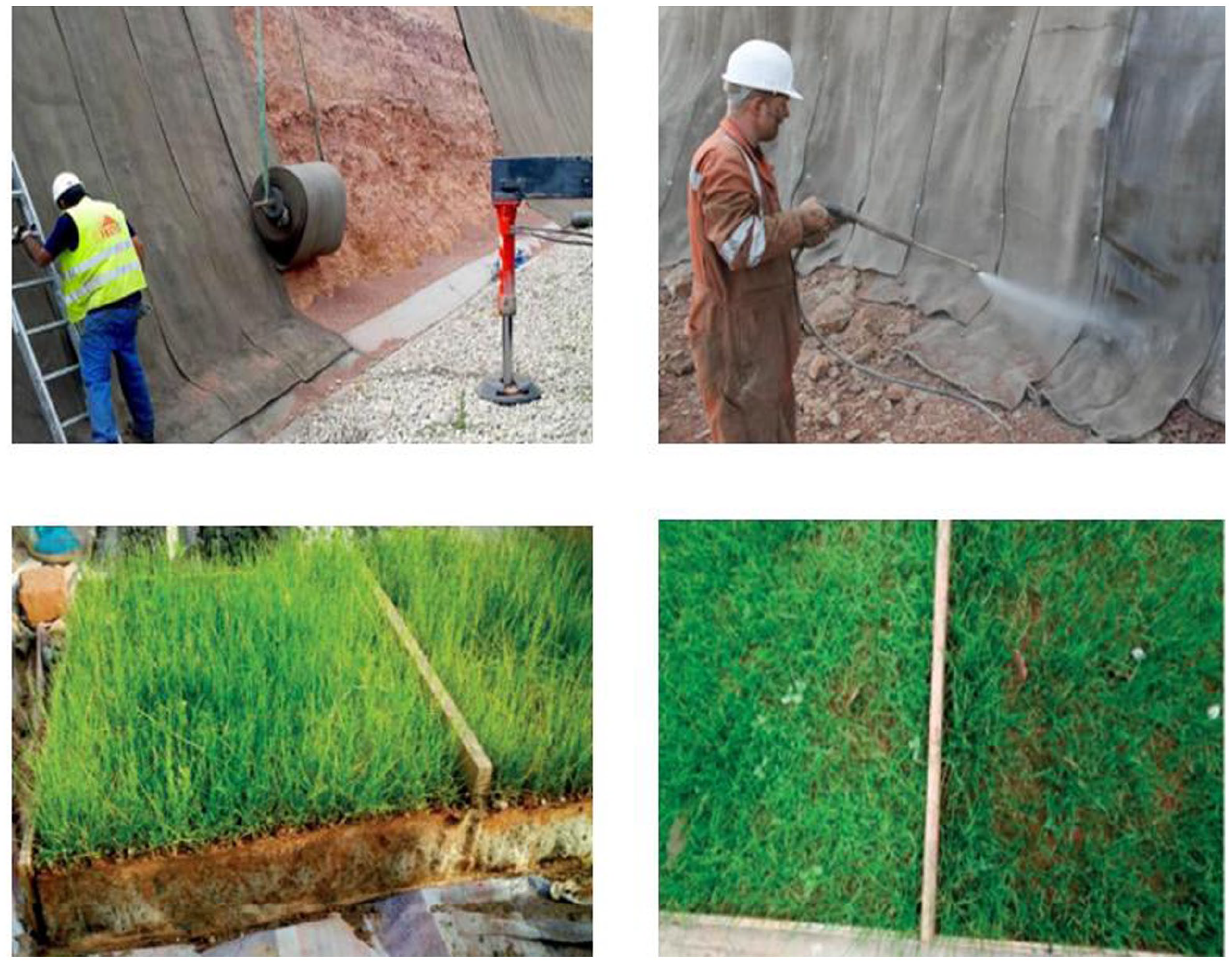
Generally, the construction steps of slope protection are including slope tamping and shaping, hanging line, laying CC, slope anchor reinforcement, lap processing between CC, water solidification and later sprinkling maintenance. After laying, it is necessary to check if there are any abnormal situations including cracks, bulges and slope displacement and make sure the stability of CC meets the practical demands.
For slope protection, there are high requirements for stability and shock resistance. Studies have been launched to investigate the seismic response of reinforced CC to study the effects of varied CC tilt degrees with a series of shaking table tests. 74 Experimental results showed that 30° reinforcement reached a threshold level. Also with the same tests, Ding et al. 75 researched the behavior and performance of different reinforced slopes during earthquake loading. It was demonstrated from the experimental results that composite reinforcement was the best to optimize seismic resistance, increasing the safety distance by approximately 67%. Thus, the external reinforcement of CC can effectively improve the stability of slope protection. Li et al. 5 have simulated the stability of FRP-reinforced CC (FRP is glued to the surface of CC) and shotcrete with different curing time and the stability of CC slope protection under rainstorms. It was found that when the slope height was less than 10 m, FRP-reinforced CC was able to satisfy the design demands of slope protection. Compared to traditional cementitious materials like shotcrete, FRP-reinforced CC provides a better option for fast slope construction.
Additionally, the combination of vegetation and CC has taken great attention in recent years. Typically, slope is vulnerable to erosion before revegetation owing to slope vegetation cleaning for urban development. 76 The feasibility of varieties of Australian forage grasses combined with different proportions of porous concrete for slope protection has been investigated, 76 as shown in Figure 5(b). It was found that the intensity of tested porous concrete is similar to that of existing slope protection concrete and Chloris truncate is the most adaptable to environment among all tested grasses. The root of grass can grow into the slope soil through the pores of porous concrete, which contributes to enhancing the stability. Consequently, the research for vegetation concrete is of vital significance to environmental slope protection. Similarly, CC has great potential to be planted grass with net structure of spacer fabric due to good permeability and big space of spacer fabric.
To summarize, compared with two-dimensional conventional geotextiles applied in slope protection, 3D spacer fabric in CC can reinforce in the direction of thickness, which can limit delamination failure. Therefore, there are great strengths and development potential of CC in slope protection. On the one hand, the environmental protection situation is increasingly severe due to the pollution of traditional construction materials including cement and gravel, which are limited in manufacture and transportation. On the other hand, the issues regarding the labor reduction and uneven qualities of employees in the slope protection industry can be effectively solved by virtue of simplified operation and low labor-intensity of CC. Meanwhile, it’s of great importance to optimize the properties of CC and expand its application by seeking novel materials and modifying CC in novel ways.
CC retaining wall
A retaining wall is a structure that supports roadbed fill or hillside soil and prevents soil filling or soil deformation and instability. CC retaining wall is the CC-faced retaining wall with reinforced soil. As CC is soft before hardening, it is easy to fix it onto other substrates using pegs, anchor trenches, soil nails or ground anchors. The process can be divided into three steps, as shown in Figure 6. The first step is to fix CC on the on the surface of support. After spraying water, the reinforcements shall be embedded into the CC-faced wall. Lastly, when the strength of CC wall reaches more than 70% of the final strength, the soil can be filled into the retaining wall. 4 The CC-faced retaining wall presents a promising potential to shorten construction period with high tensile strength compared to conventional retaining wall.

Process of CC retaining wall establishment: (a) supporting and spraying water, (b) embedding reinforcements, and (c) filling soil. 4
Ditch lining
The traditional ditch lining material is shotcrete, but it will begin to degrade over time. To effectively cope with seasonal high flow and high velocity, expanding the water diversion channel is of great necessity. CC can be prototyped rapidly composed of a fiber matrix of dry concrete with special formula. By virtue of the small number of personnel training and equipment required, the installation speed is considerably accelerated. 77 Therefore, CC is extensively applied in ditch lining projects abroad, as shown in Figure 7(a).

American concrete composite Co., Ltd. has employed CC for lagoon lining, as shown in Figure 7(b). In March 2018, the inclined walls of two lagoons in Beira Vista in northern Paraguay were lined with CC with excellent impermeability. Also, a high visibility welding rod is used to render the joints to be thermally connected to the double-rail air passageway, which enables fast and simple on-site pressure testing. 78 The project, which is less affected by rainy days, can be accomplished by a team of four people within 5 days with high transportation efficiency of materials and convenient installation.
Weed control
CC is increasingly widely used in weed control. Owing to long-term and long-lasting hydrocarbon resistance provided by CC, it can prevent plant growth from eroding it. And it can be installed on limited access sites and around sensitive infrastructure without the need for plant equipment. CC is available in bulk and batched rolls, with the latter allowing safe track and roadside installation, and CC can provide effective, durable and long-term weed suppression. 79
Concrete repair
Compared to new-build infrastructure, repairing existing assets can significantly save costs and improve operational efficiency. CC presents a great potential for application in concrete repair. CC repair can extend service life with its excellent abrasion resistance, strong weather resistance, puncture resistance, impact resistance and animal damage protection, whilst the flexibility of CC allows for artificial baffling for flow velocity reduction. 80
Furniture and artistic design
As a novel environmental-protection material, CC is of widespread application in construction, civil engineering, post-disaster reconstruction and ecological restoration. Furthermore, CC also presents great exploration value in the field of furniture due to its characteristics of safety, environmental protection, rapid hydration and high strength. Through integration with textile art, production costs can be reduced and diversified styles can be created. 1 The New Whorl Table, designed by designer Neal Aronowitz, is a practical artwork with dynamic beauty, combining the flexible and foldable creativity of plywood furniture and paper furniture, as shown in Figure 8(a).

Furniture and artistic design of CC: (a) the new whorl table, (b) inflation of CC furniture, and (c) rock girl public bench.
For CC furniture, it mainly includes modeling, structure and decorative design. When designing the structure, the shape of CC furniture can be fixed by model or inflation, referring to the inflatable furniture. After hardening, the model can be taken out or be a part of the design, as shown in Figure 8(b). In the modeling design, CC has a strong plasticity. For decorative design, colorful threads or ropes can be sewn on the surface of CC furniture on account of the fiber structure and softness of CC. Figure 8(c) shows a Rock Girl public bench designed by West African designer Laurie Wiid van Heerden. Apart from this, the furniture can be stitched and connected. For instance, ordinary gray cement powders can be replaced with colorful cement powders to create a more beautiful effect, which can make up for the monotonous color and difficulty in dyeing of CC.
However, CC furniture is still at the initial stage for two main reasons. Firstly, the surface comfort and surface finish of CC is not good, which considerably hinders its promotion and development. Secondly, the research regarding the mechanical properties of CC furniture has hardly been done, which is difficult to guarantee good quality. Presently, CC furniture is still in experimental stage and the trend of mass production has not been formed. Consequently, it’s of vital significance to improve the surface finish of CC and launch studies about mechanical properties of CC furniture.
In recent years, CC has been applied in many fields, but there is still a lot of research space for development of high-performance CC. And high-performance CC shows great application potential particularly in military fields, such as emergency shelters and rapid repairment of combat sites. To design such CC, views of replacing the structure of spacer fabric and concrete materials, changing structural design, external reinforcement and perfecting performance evaluation system can be taken into consideration, as shown in Figure 9.

Structure and application of CC.
Conclusion
Based on the above literature and discussions, varied spacer fabric and cement powders are introduced to provide a theoretical basis for the design of high-strength CC. Then mechanisms influencing properties of CC are illustrated from four perspectives and typical experiments to test CC performance are explained. Lastly, the application status of CC is introduced. Through previous studies, the performance characteristics and mechanical properties of CC can be understood, but there is a lack of research on its comprehensive properties, such as impact resistance, bursting resistance, et al. And suitable theoretical model is needed to be established to predict the performance of CC. Since building materials tend to be more lightweight, intelligent and environment-friendly, it’s of great value to research CC applications in civil engineering by virtue of its flexibility, high strength, and low contamination. Additionally, although CC presents excellent properties, to meet higher emergency standards, varied component materials still need be selected and external reinforcement materials can be used to expand its application range. And the application of CC is still in the preliminary stage, so it is of great necessity to invest more energy and money to sharpen innovation ability and make up for the deficiency. Furthermore, the domestic evaluation system of green environmental protection is imperfect, which limits the development of new composites to some extent. With the integration of textile and construction, this novel material is expected that there will be great development in the future.
Footnotes
Declaration of conflicting interests
The author(s) declared no potential conflicts of interest with respect to the research, authorship, and/or publication of this article.
Funding
The author(s) disclosed receipt of the following financial support for the research, authorship, and/or publication of this article: The authors acknowledge the financial support from the financial support from the National Science Funds of China (11972172), and a Project Funded by the Priority Academic Program Development of Jiangsu Higher Education Institutions (PAP).
