



Abstract
Clothing plays a significant role in affecting the performance, comfort, and mobility of human body. However, no study explored the clothing for delivery personnel with improved ergonomic performance. The purpose of this study was to develop a pair of novel work pants to increase the mobility and comfort of delivery personnel. Skin deformation rates of eight university students were measured using surface-painting-line method under various typical activities simulating those of the delivery personnel. Then, based on the results, a pair of novel pants was developed. After that, 25 male students were recruited to compare the ergonomic performances between the novel work pants and traditional pants using both objective and subjective methods. It is discovered that the largest skin deformation rate was at the centerline in the upper (49.3%) and lower knee regions (52.3%) under riding activity. Novel work pants were then developed by creating folded structures in the regions based on the deformation rates, which could be stretched and shortened following human movement. Human tests revealed that the novel pants could significantly increase the range of motion of hip flexion and improve ease of move and comfort sensations in the knees and limbs as well as reducing pressure sensations in these regions. The novel work pants could effectively improve wearers’ mobility and comfort both in the limbs and was thus expected to reduce the limb fatigue and improve performance of the delivery personnel.
Introduction
It is reported that the scale of China’s catering industry reached more than 100 billion dollars in the year of 2019, and the booming industry generates more than 7 million practitioners for catering distribution (i.e. delivery personnel). 1 The work performance of the delivery personnel are strongly linked to their distribution quantity and efficiency. For achieving high performance, nearly all personnel work more than 8 h, and they always raced due to the urgent distribution time.2,3 The prolonged and urgent work time accompanied with the complex work environment easily causes human fatigue, scraping, collision, fall, and other accidents.2,4 It is thus of great need to develop prevention measures to keep health and safety of the delivery personnel.
Clothing serves as a medium between human body and environment, and its proper design greatly affects human performance, comfort, and mobility. 5 However, only few studies were retrieved for investigating clothing design for delivery personnel. Jiang and Jia 6 selected the fabrics that have excellent UV resistance, water repellency, and air permeability, and then designed clothing for delivery personnel that satisfies the requirements of safety, functionality, practicality, and fashion. Whereas the impacts of the fabric selection and design features on clothing performance were not evaluated in this study, and ergonomic performance of the clothing such as movement restriction was not discussed as well. A recent field study reports that the delivery personnel often complain their current wear patterns, and ergonomic issues rank high on the list, attributed to the working pattern of the personnel (mainly the frequent body movements). 7 In view of this, more research studies should be performed to develop clothing with improved ergonomic performance for delivery personnel.
The ergonomic design of the clothing for delivery personnel may learn from that in other fields.8 –16 Yang et al. 9 measured the skin deformation rates during cycling motion, detected that the largest deformation rates were at the waist circumference, hip circumference, front crotch, back crotch, and leg length, and then designed the cycling pants with proper processing at the front crotch, back crotch, and knees based on the results to improve its ergonomic performance. Lee et al. 14 developed an ergonomic outdoor pants by making the two-dimensional pants pattern of the optimal crotch curve which is closer to V-shape compared to the conventional pattern, based on body skin deformation mapping. Wang et al. 16 measured the skin deformation mapping of women’s limbs under five representative yoga moves using three-dimensional scanning method and developed weft-knitted seamless yoga pants based on the mapping results. In addition, series of research studies8,10 –13,15 acquired skin deformation rates of human body under various exercising scenarios and give practical suggestions for developing clothing with improved ergonomic performance such as motorcycle clothing and sportswear. Though the clothing was scientifically developed for improved ergonomic performance, few studies explored its actual performance.
For the ergonomic performance evaluation, the present studies mainly focused on the evaluation on protective clothing. Range of motion (ROM) method was extensively applied to assess the movement restriction of protective clothing, which measured the maximum changes in human joint angles with the electro-goniometer and flexometer.17 –20 In addition, subjective evaluation was extensively applied for assessing the ergonomic performance of functional or protective clothing.21 –24 These evaluation methods were referential for evaluating the ergonomic performance of clothing for delivery personnel.
This study aims to develop novel work pants with improved ergonomic performance for delivery personnel. Two experimental studies were conducted. In the first experiment, the skin deformation rates of human body were measured using the surface-painting-line method under various typical activities performed by delivery personnel, 16 and then designed novel work pants based on the skin deformation results. In the second experiment, the ergonomic performance of work pants was evaluated using both ROM and subjective evaluation methods.
Experimental
Experimental 1: Measurement of the skin deformation rates and developing novel work pants
Motion analysis
The first step is to analyze the motions of delivery personnel to obtain the skin deformation in the limbs required by work pants design. Based on observation, delivery personnel usually ride an electric bicycle to deliver catering, and the common activities include riding, pushing the bicycle at the overpass, steep slope, and outdoor stairs, walking on the road, walking upstairs and downstairs. The activity of walking upstairs or downstairs under different conditions could be regarded as a type of activity. In addition, given the ergonomic performance of clothing is more demanding for delivery personnel with large range of limb movements, three types of activities were recognized, that is, riding, walking upstairs and downstairs, shown in Figure 1. The angles between thighs and calves are approximately 90°, 120°, and 110° for the three activities, respectively.

The activities of delivery personnel with large ranges of movements including riding (a), walking upstairs (b), and walking downstairs (c).
Measurements of skin deformation rates
A total of eight healthy male university students were employed in this study, and their age, weight, and body surface area are 21.3 ± 1.3 years, 167 ± 10 cm, 59 ± 12 kg, and 1.65 ± 0.18 m2, respectively.
The skin deformation rates (SDRs) of the lower limbs were measured with the surface-painting-line method. The method measures the length of line pre-painted on skin when human is standing still and being in movement states. In this study, the participants were drawn with horizontal circumference lines on the thigh (A1-A2-A3-A4), knee (C1-C2-C3-C4), positions 5 cm above (B1-B2-B3-B4) and below the knee (D1-D2-D3-D4), calf (E1-E2-E3-E4), and ankle (F1-F2-F3-F4) using a water-soluble marker (Figure 2). Then, the fourth equinox points on the front, back, and both sides of the above circumference lines were marked, and lines were drawn between the two equinox points on the adjacent circumference lines, producing four longitudinal lines, that is, the outside seamline (A1-B1-C1-D1-E1-F1), front centerline (A2-B2-C2-D2-E2-F2), inside seamline (A3-B3-C3-D3-E3-F3), and back centerline (A4-B4-C4-D4-E4-F4) (Figure 2). Five regions including the thigh, upper knee, lower knee, upper calf, and lower calf regions were recognized, and a total of 44 lines were marked on the right limb.

The limb surface painting lines under standing state: (a) the image for the painting lines and (b) the sketches for the painting lines.
After that, the length of the 44 lines were measured using a scale tape under the static standing state (L1), and then were measured under the three activities (L2) listed in Figure 1. The SDRs of the lines under the three activities could be calculated using equation (1). Noteworthy is that the deformation rates of the 44 lines were examined.

Design of the new work pants for delivery personnel
Based on the skin deformation rates measured on the limbs, novel work pants were developed, which will be described in Section 3.
Experimental 2: Evaluation of the novel work pants
Human test for evaluating the novel work pants
Human tests were conducted to evaluate the ergonomic performance of the novel work pants. Twenty-five male students with age of 20.1 ± 1.0 years, height of 174.1 ± 4.82 cm, and weight of 67 ± 6.79 kg (BMI ranging from 22.1 to 23.4 kg/m2) were recruited in this study. Noteworthy is that four students in the first experiment were employed in this study to ensure that the subjects were of similar figure and could wear the same size of pants. Objective and subjective measurements were performed by having each participant wear the novel work pants (NWP) and the traditional pants (CON) with the specification of 170/88A in a randomized and counter-balanced order. It is noted that the specification of the main fabrics of NWP and CON are listed in Table 1. The participants were not allowed to do intense activities 8 h before tests. In the objective measurement, range of movement (ROM) was performed, and each participant was asked to perform three movements, that is, hip flexion, hip abduction, and knee flexion in CON or NWP (Figure 3). It is noted the movements were adapted from Huck. 25 The participants were required to exert their utmost to perform the three movements without straining, and images were taken immediately once they are ready. Joint angles were measured using the photoshop software. Noteworthy is that each movement was repeated five times, and the presented angles were the average value of the five repetitions.
Fabric structure and properties of the main fabrics of the two work pants.

“a” represents the average value on 10 samples, “b” represents the average value on five samples, and “c” means the average value on eight samples.

Range of movements conducted, and angles measured: (a) hip flexion, (b) hip abduction, and (c) knee flexion.
The procedure of the subjective measurement was shown in Figure 4. The participants were asked to change into CON or NWP in a lab, and they also all dressed in shorts, T-shirt, socks, and sports shoes. Then, the participants rested on a chair for 10 min, during which they were briefed about the items listed in the questionnaires. After that, they squatted on the ground for 2 min, sat cross-legged for 2 min, and then walked upstairs as quickly as possible. It is noted that the floor number for the walking upstairs activity is 6, the height of each stair is 16 cm, and the number of the stairs per floor is 11. Finally, the participants were required to ride a cycle ergometer for 5 min at their preferred speed. Noteworthy is that the participants were asked to fill the questionnaire at the end of the four activities. The tests were conducted in an environment with temperature of 26°C ± 1°C and relative humidity of 50% ± 5%.

The procedure of the subjective test.
The subjective perceptions listed in the questionnaire include the pressure sensations of pants on the knees and the limbs, comfort sensations at the knee and limbs, ease of movements at the knees and limbs, and attractiveness of the pants. The scales of the seven subjective perceptions were displayed in Figure 5.

The measurements of the seven subjective perceptions.
Statistical analysis
Data were expressed as mean ± standard deviation (SD). In this study, we want to examine types of work pants on ROM when human performing movements. Besides, we are concerned that the effect of the different types of movements on body ROM might be different depending on the work pants. We suspect that body ROM will depend on both work pants and the types of movements. As such, we want to determine if a two-way interaction effect exists between work pants and types of movements in explaining ROM. A two-way repeated measures ANOVA can be used to examine whether such a two-way interaction exists. Specially, for the objective measurement, a two-way repeated measures ANOVA (Test scenarios (NWP vs CON)) × Types of movements ((i.e. hip flexion, hip abduction, and knee flexion)) was conducted using SPSSv.20 (IBM Inc., Armonk, NY, USA) to assess the differences in the angles between the two test conditions, effects of movements and the interaction effect between conditions and the movements. For the subjective test, a two-way repeated measures ANOVA (Test scenarios (NWP vs CON)) × Types of activities ((i.e. squatting, sitting cross-legged, climbing stairs, and riding)) was also performed to assess the differences in the subjective perceptions between the two test conditions, effects of movements, and the interaction effect between conditions and the movements. During the calculating process, when the Mauchly’s Test of Sphericity was violated, the Greenhouse-Geisser correction was employed as statistical significance. When the repeated measures displayed a significant effect, a paired sample t-test was conducted at each time point. The significance levels were p < 0.05 (marked * on the graphs) and p < 0.01 (**) in all tests.
Results and discussion
Results of skin deformation rates
Figure 6 displayed the skin deformation mapping in the limbs under the activities of riding, walking upstairs and downstairs. It is detected that larger skin deformation rates were found in the front upper and lower knee regions than the rest regions in both horizontal and longitudinal directions under the three activities. The explanation is that curvature of the knee region is much larger than other limb regions, inducing the larger SDRs in this region. The finding is consistent with previous studies that discovered that the knee regions have larger skin deformation than other regions when human body is bending knees.8,16 Specifically, skin length values in both horizontal and longitudinal directions of the front knee region increased under the three activities. In addition, skin contracted significantly in the longitudinal direction of the back knee region under the activities. The bending of knees could explain the skin deformation change. Apart from that, larger skin deformation rates were found in the longitudinal direction than in the horizontal direction. This was consistently with previous studies11,14 that also found the phenomenon when human body is performing riding activity.

The skin deformation mapping in the limbs under the activities of riding, walking upstairs and downstairs.
Figure 7 displays the specific SDRs in the horizontal directions under the three activities. It is noted that the limb circumferences all increased under the three activities (Figure 7(a1–a5)), though the SDRs demonstrate increase and/or decrease in the various horizontal directions (Figure 7(b1–b5)). It is also observed that circumference SDRs in the positions at the knee, 5 cm above and below the knee (ranging from 2.8% to 11.3%) are larger than those at the thigh and calf (ranging from 1.1% to 2.6%). In addition, SDRs were observed much larger in the upper and lower knee regions under riding (ranging from 8.6% to 11.3%) than walking upstairs and downstairs (ranging from 2.8% to 5.9%) (Figure 7(a2–a4)). This may be also caused by the larger curvature of the knee region during riding than other activities. Noteworthy is that the skin deformation in the ankle was not given due to the neglectable deformation in this region.
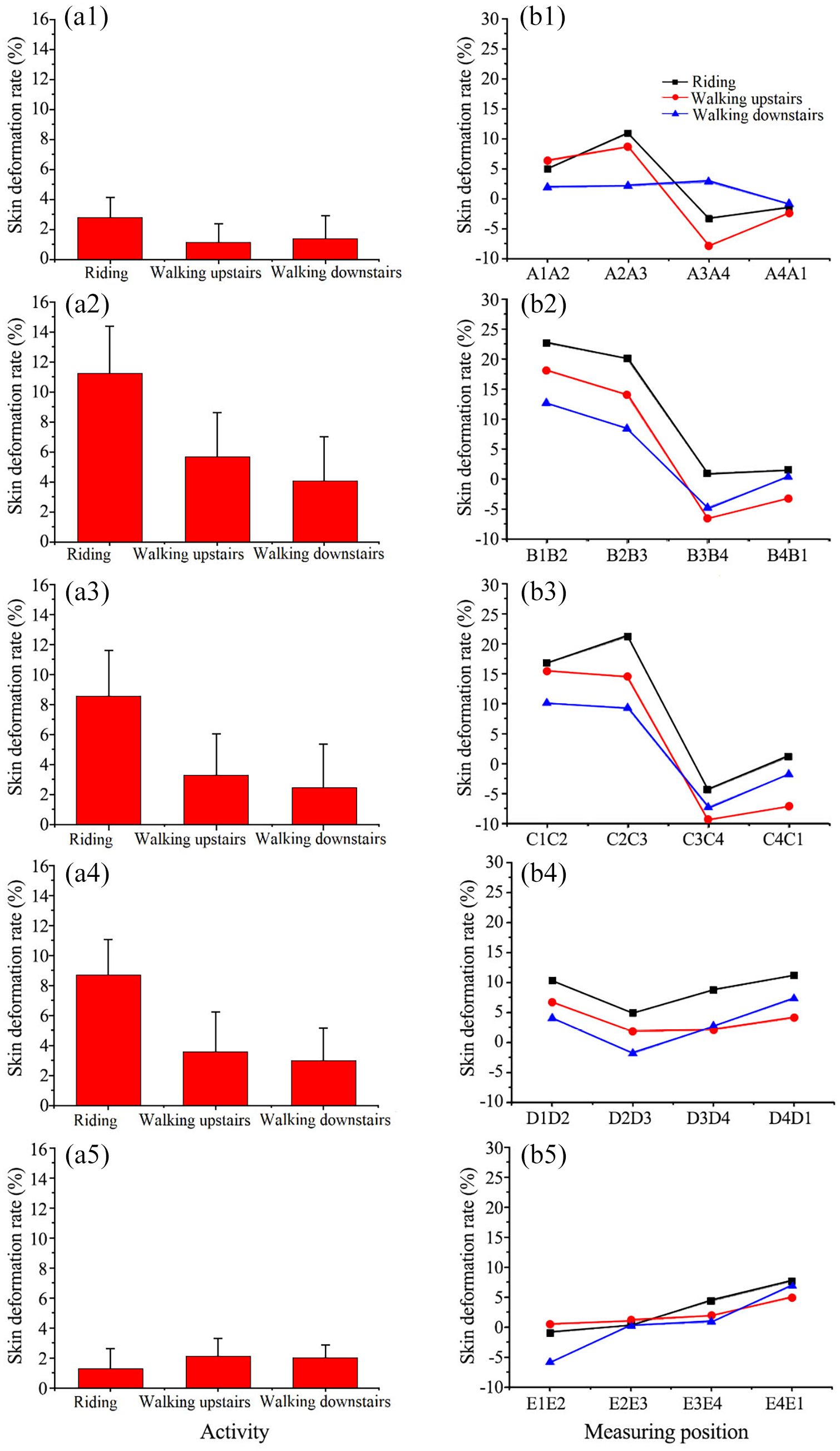
The skin deformation rates in the horizontal direction under the activities of riding, walking upstairs, and walking downstairs: (a1, b1) horizontal line at the thigh (A1-A2-A3-A4), (a2, b2) at the position 5 cm above the knee (B1-B2-B3-B4), (a3, b3) at the knee (C1-C2-C3-C4), (a4, b4) at the position 5 cm below the knee (D1-D2-D3-D4), and (a5, b5) at the calf (E1-E2-E3-E4).
Figure 8 displayed the SDRs in the longitudinal directions under the three activities. It is observed that larger SDRs were observed at the centerline of the front thigh and knee regions (ranging from 4.8% to 52.3%) than at other regions (ranging from −50.1% to −0.3%) under the three activities. It is also observed that the SDRs were larger at the centerline in the front upper and lower knee regions (30.1%−52.3%) than other regions (−50.1% to 16.3%) under the three activities. Noteworthy is that the largest SDRs were observed at the centerline in the upper (49.3%) and lower knee regions (52.3%) under riding activity.
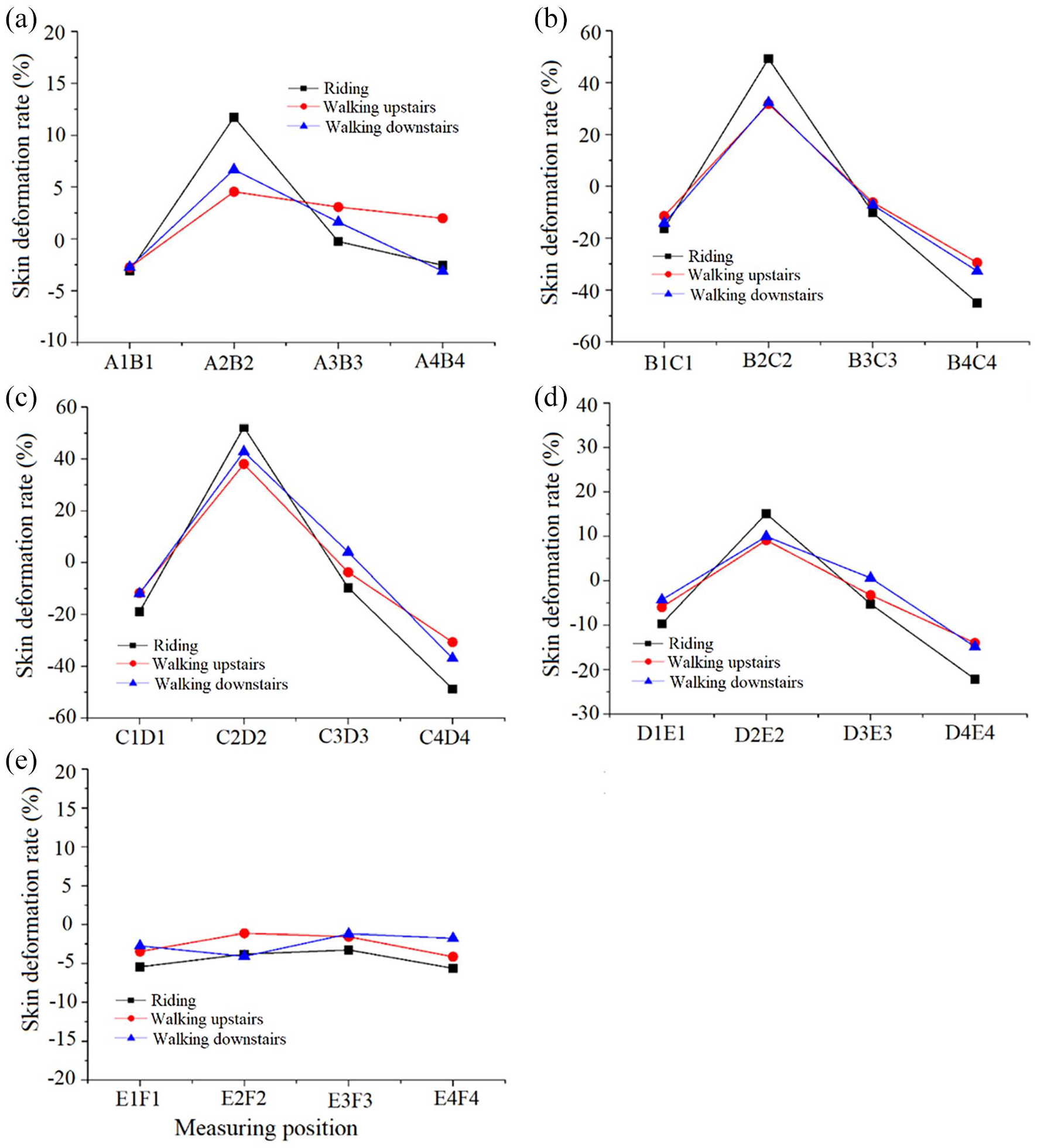
The skin deformation rates in the longitudinal direction under the activities of riding, walking upstairs, and walking downstairs: (a) longitudinal lines at the thigh region, (b) longitudinal lines at the upper knee region, (c) longitudinal lines at the lower knee region, (d) longitudinal lines at the upper calf region, and (e) longitudinal lines at the lower calf region.
Design of the new work pants
Novel work pants (NWP) were developed using the specification of 170/88A specified in GB/T 2664-2017. 23 The largest horizontal and longitudinal deformation amounts under the various activities should be determined to know the looseness required by NWP. Based on a previous survey, 26 the average circumferences in the thigh, knee and calf positions for Chinese males aged from 20 to 50 years are 52.2, 36.3, and 36.6 cm, respectively. The circumferences at the position 5 cm above and below the knee were the average values of those in the thigh and knee (i.e. 44.3 cm), and those in the knee and calf (i.e. 36.5 cm), respectively. Given the largest skin deformation rates in the thigh, positions 5 cm above and below the knee, knee and calf under the various activities are 2.8%, 11.3%, 8.7%, 8.6%, and 2.1%, respectively, the increasements of the circumferences are 1.5 cm (i.e. 52.2% × 2.8%), 5.0 cm (i.e. 44.3% × 11.3%), 3.2 cm (i.e. 36.5% × 8.7%), 3.2 cm (i.e. 36.3% × 8.6%), and 0.7 cm (i.e. 52.2% × 2.8%) in the five regions, respectively. Considering that at least 5 cm loose quantity was already created on the four positions of the traditional pants, 23 there is no need to increase the circumference dimensions for NWP. The main circumference values of NWP can refer to those of the traditional pants, 23 listed in Table 2.
The main sizes in the circumference of the new work pants.

In the longitudinal direction, it is also noted the largest skin deformation rates were in the front centerlines of the knee region, that is, 49.3% and 52.3% for B2C2 and C2D2, respectively. Given the skin length values of B2C2 and C2D2 are both 5 cm, the skin deformation amount in the region is 5.1 cm (i.e. the elongation of B2D2 equals to 5 cm × (49.3% + 52.3%)). Based on the results, a folded structure was sewn up on the knee region, and the length of the folded piece was 6 cm to ensure sufficient looseness (Figure 9). The folded piece could be stretched and shortened accompanying with the movements of human knees.
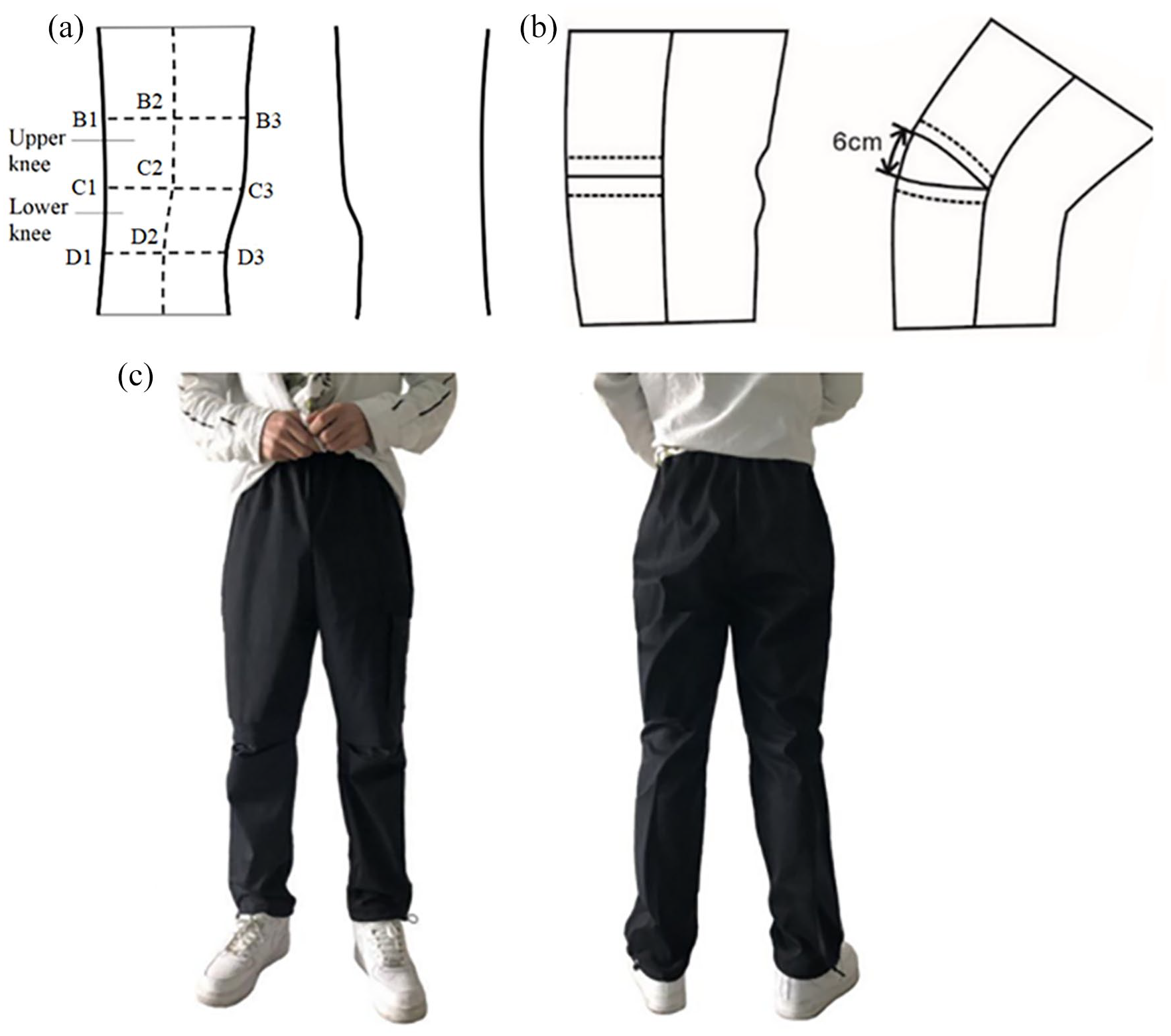
The design of the novel work pants: (a) the front upper and lower knee regions with large skin deformation rates, (b) the folded structure, and (c) the image of the novel work pants.
It is noted that the folded structure is made of 100% cotton fiber, owned twill structure and weighted 180 g/m2, lighter than main fabric of NWP listed in Table 2. The fabric selection could make the folded structure more flexible and softer, which could be stretched or shortened more easily, and exert less friction on the knees. The pattern and image of NWP were displayed in Figure 9.
Evaluation of the novel work pants
Figure 10 shows the angle values for participants wearing CON and NWP during the three activities, that is, hip flexion, hip abduction, and knee flexion. It is discovered that the angles were much larger in NWP than CON during hip flexion (p < 0.05), and no remarkable difference in the angles was discovered between the two types of work pants during hip abduction and knee flexion. The larger range of motion during hip flexion in NWP was caused by the folded structure at the knee region, which exerts less restriction to the limbs.
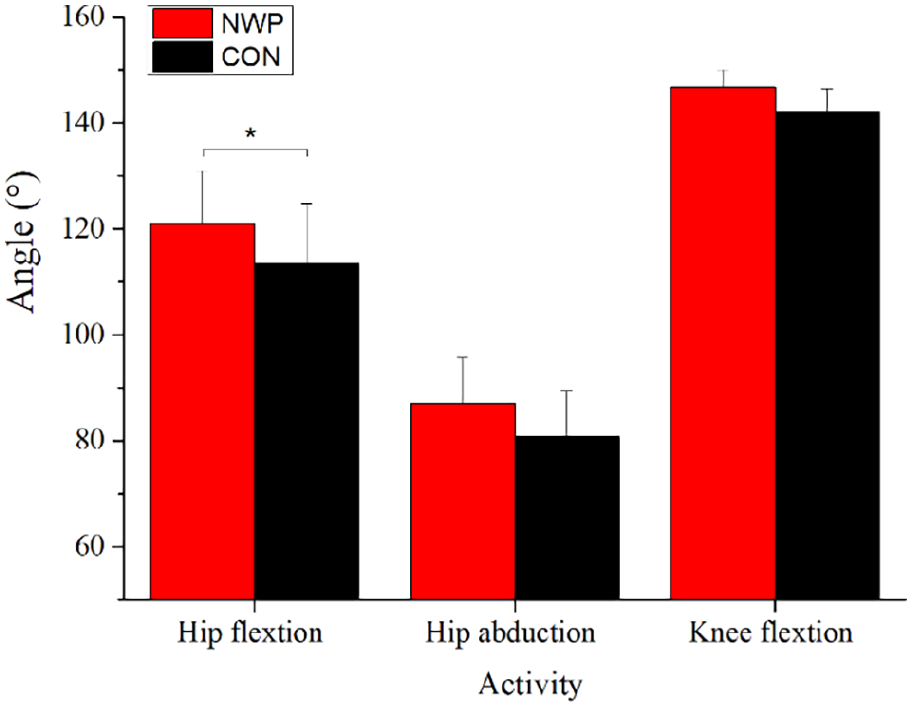
The angles of participants in the novel and traditional work pants under the three activities.
Figure 11 displayed the subjective perceptions of the participants on the accomplishment of the activities of squatting, sitting cross-legged, walking upstairs, and riding. It is discovered that pressure sensation, ease of movement, and comfort sensation in the knees were all significantly improved in NWP than in CON under the four activities (p < 0.05). This demonstrated that the folded structure was beneficial in improving mobility and comfort sensation at this region by providing effective looseness design. Accordingly, it is also discovered that the subjective perceptions in the limbs were remarkably improved under the various activities except pressure sensation under the sitting cross-legged and comfort sensation under the squatting. Noteworthy is that the pressure sensations in the knees and limbs for participants wearing CON were significantly lower under sitting cross-legged activity than other activities (Figure 10). The relatively lower pressure sensation in the knees during sitting cross-legged may account for the insignificant difference in the pressure sensations between wearing NWP and CON. No significant difference in comfort sensation was observed between wearing NWP and CON under the squatting. The possible explanation is that the static power force generated during squatting contributes greatly to the comfort sensation of the participants, and the difference in this sensation between NWP and CON was thus possibly weakened.

The subjective perceptions of the participants after the activities of squatting, sitting cross-legged, walking upstairs, and riding: (a) pressure sensation in the knees, (b) pressure sensation in the limbs, (c) ease of movement at the knees, (d) ease of movement at the limbs, (e) comfort sensation in the knees, and (f) comfort sensation in the limbs.
It is also noted that the pressure sensation, ease of movement, and comfort sensation values in the knees and limbs were rated “no pressure” (score lower than 0.5), “very easy” or “slight easy” (score ranging from 0.17 to 0.58), and “very comfortable” (score lower than 0.38), respectively, for participants wearing NWP under the various activities. Whereas, the subjective perceptions were rated “slight pressure” in CON (score ranging from 0.7 to 1.1), “slight easy” or “moderate” (1.33–1.78), and “slightly uncomfortable” (score ranging from 0.63 to 0.95), respectively, for participants in CON. These further indicated that the NWP could maintain the mobility and comfort of the limbs. Noteworthy is that the mobility and comfort of limbs in CON worsened to a lesser extent, which is very likely to be caused by the simplified experimental procedure here.
In addition, NWP was regarded as more attractive than CON (0.9 ± 0.9 vs 1.9 ± 1.3) (p < 0.05). The participants reported that the unique structure of the NWP makes it more attractive.
Practical implications, limitations, and suggestions
In the actual scenarios, delivery personnel performed the activities of walking, running, climbing, and riding usually at a high movement frequency, and the ergonomic design of the work pants greatly affects the comfort and mobility of human body. Research findings presented here have evidently demonstrated that NWP is effective in improving wearers’ mobility and comfort both in the knees and limbs while performing the typical activities encountered by the delivery personnel. It may be expected that NWP could improve the performance and reduce the limb fatigue of the delivery personnel.
However, several limitations must be acknowledged. Only a small number of young male students were employed for skin deformation measurement and clothing ergonomic evaluation, and future studies should recruit a larger sample of participants also including females and the elderly. Besides, the actual activities of the delivery personnel last longer than those conducted in the study here, and it is expected that the NWP could be more effective in reducing ergonomic issues and improving human comfort in the actual scenario, which will be investigated in future studies. Beyond that, field tests should be also performed to examine the ergonomic performance of NWP for delivery personnel during prolonged work duration and under various physical terrain environments.
Conclusions
This study developed novel work pants to increase the comfort and mobility of lower limbs of delivery personnel, and thereby improve their working efficiency and reduce ergonomic issues. The skin surface deformation of their lower limbs was measured, and the largest skin deformations were found on the knee region. Novel work pants were developed by seaming a folded structure at the knee based on the skin deformation results. The objective measurement showed that the work pants significantly increased the range of motion during hip flexion activity, and the subjective evaluation revealed that the work pants could significantly improve the ease of movement and comfort sensation as well as reducing pressure sensations in the knee and limbs.
Footnotes
Declaration of conflicting interests
The author(s) declared no potential conflicts of interest with respect to the research, authorship, and/or publication of this article.
Funding
The author(s) disclosed receipt of the following financial support for the research, authorship, and/or publication of this article: The study was supported by the humanities and social science research project of ministry of education fundation (no.502210196) and the innovation and entrepreneurship project of Guangdong University of Technology in 2023 (“Professional clothing design for high temperature environment”).
