




Abstract
Thermo-physiological wear comfort is mainly determined by the thermal and moisture performance of clothing. Moreover, moisture is widely recognized as one of the most important factors contributing to discomfort sensations. Functional yarns with a thermo-regulating effect improve thermal and moisture performance of fabrics, but the integration of elastic yarns into the fabric structure can impair thermo-physiological wear comfort. The goal of this research was to compare, in dry and wet states, the thermal comfort properties of elastic knitted fabrics with thermo-regulating yarns, namely Viscose Outlast® and Polyester Coolmax® to better understand thermal behavioral changes due to moisture content of the fabrics. Surface moisture transfer between the fabrics and a wet skin was also assessed and enabled to evaluate the level of the unpleasant contact feeling. Air permeability that is related to the thermal behavior was also investigated. The results obtained showed that at 22% moisture content, which simulates a sweating sensation, the change in thermal properties is similar for both fabrics. Above the ‘sweating sensation’ moisture, significant differences on the thermal properties with the moisture content were registered between fabrics, Outlast® fabric being more prone to thermal properties changes due to moisture uptake than the Coolmax® one. When worn in conditions of wet skin, the unpleasant cool feeling increased for both fabrics, but the effect is more pronounced for Outlast® fabric.
Introduction
Comfort sensations are classified into three main groups: thermal and moisture sensations, tactile sensations and pressure sensations. During normal wear, i.e., under steady-state conditions, comfort sensations are mostly related to tactile and pressure sensations. These are mainly determined by fabric surface structure, primarily associated with skin contact descriptors (such as smoothness or prickliness) and by clothing fit and stretch, which are related to and influence tactile sensations but also affect the ability of fabrics to dissipate heat and moisture (in vapour and liquid forms) [1]. Under transient wear conditions, caused by physical activity or weather conditions, comfort sensations are mainly related to the thermal properties, the moisture vapor resistance of clothing and the percentage of moisture accumulated inside the clothing [2]. Thus, if the clothes worn next to skin get wet, the final thermo-physiological comfort is dependent on two main factors: the thermal resistance in wet state and the active cooling resulting from the moisture evaporation from skin through the clothing and from the direct evaporation of sweat from the fabric surface [3,4]. The use of functional yarns with a thermo-regulating effect improve the thermal and moisture performance of fabrics made from the yarns, but the integration of elastic yarns into the fabric structure can impair the thermo-physiological wear comfort [5]. Therefore, the study of thermal behavioral changes due to moisture content in functional elastic fabrics, is of importance to design and predict wear comfort, particularly for sportswear applications.
There is limited literature on properties of knits from new generation fibers with elastane yarn, and most studies refer to changes in physical and dimensional characteristics of the fabrics. Knitting with elastomeric yarns usually results in a compact structure because of the yarn extension in the knitting zone, fabric relaxation after taking-off and yarn compression, which leads to changes in the loop geometry. The elastomeric yarn allows the fabric to stretch more than traditional fabrics, creates a more resilient fabric, which is resistant to snagging, fiber fatigue, pin holing and which increase the useful life of fabric [6].
Examination of inter-reliance of geometrical attributes of elastomeric knitted fabrics, particularly loop length and type of structure, and the aerodynamic and comfort properties was the subject of a previous study [7]. The results indicated that the loop length significantly influences especially the air and water vapor permeability of the fabrics, and the structure type influences the thermo-physiological comfort properties.
In this paper, the thermal comfort properties of elastic knitted fabrics produced with functional yarns with thermo-regulating effect are compared in dry and wet states, and the moisture transfer between the fabrics and a wet skin is assessed, using the indirect measuring method derived by Hes [8] for evaluating surface moisture absorptivity of the fabrics. Three parameters were used in the evaluation: thermal conductivity, thermal resistance, and thermal absorptivity. Besides the thermal properties of the fabrics, air permeability that is related to the thermal behavior was also investigated.
Materials and methods
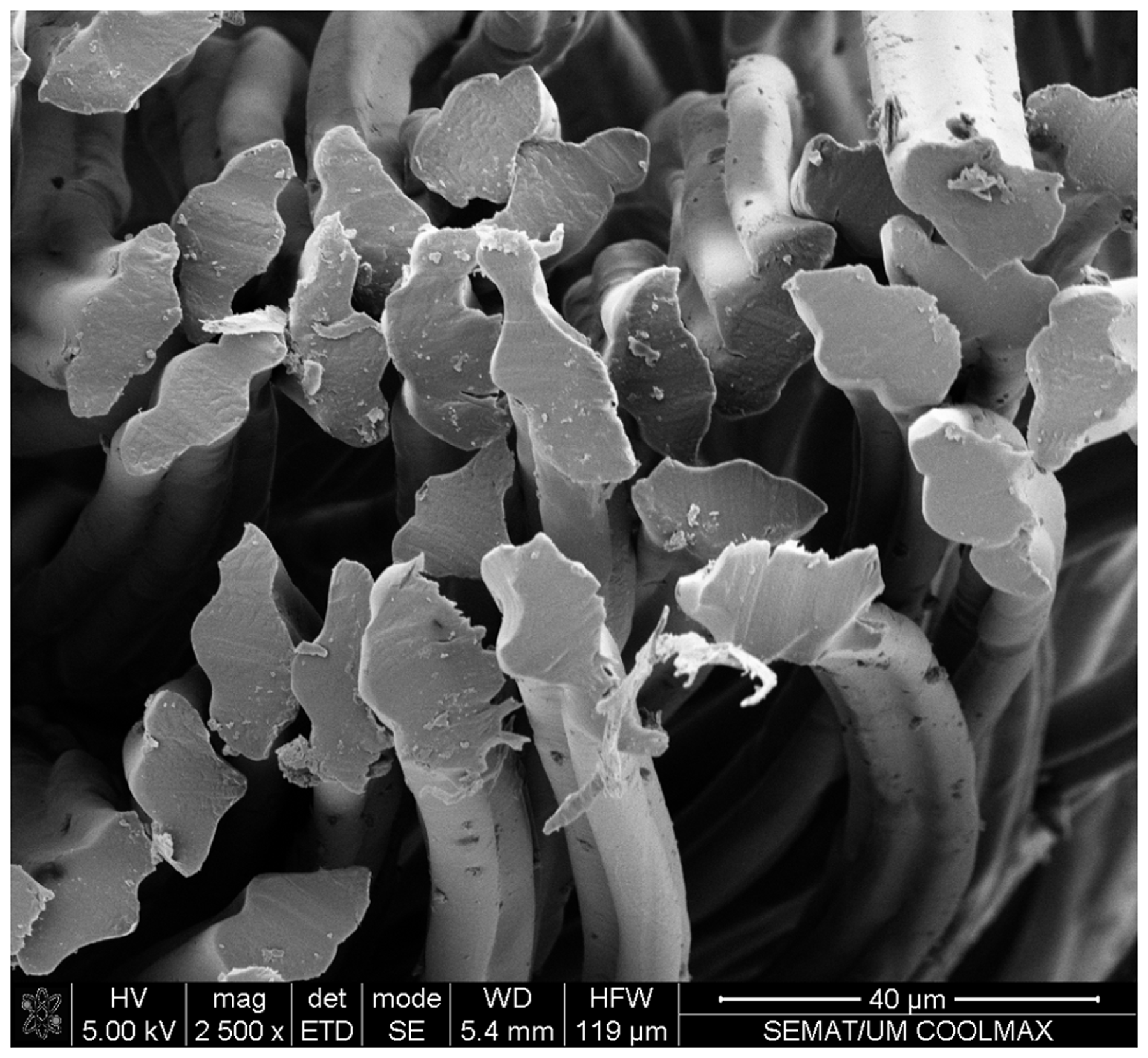
Two functional yarns were used in this study, namely, a 30% Viscose (Outlast®)/70% Cotton yarn, 14.7 tex, and a 100% Polyester (Dacron) Coolmax® yarn, 14.3 tex. These yarns were selected due to the different approach of achieving the thermo-regulating effect. Outlast® yarn incorporates thermally active material, i.e., paraffinic phase change material (PCM) microcapsules, within the viscose fiber structure, according to the Outlast® Technology, and the thermo-regulating effect results either from heat absorption or heat emission of the PCM [9, 10]. The thermoregulation effect of Coolmax® relies on the moisture management due to the shape of the fibers, namely multi-channel cross section (Figures 1 and 2), which applies the capillary theory and absorb sweat and moisture from the surface of the skin, transport it to the fabric surface and then evaporate [11,12].
SEM image of Coolmax® yarn longitudinal view. SEM image of Coolmax® yarn cross-sectional view.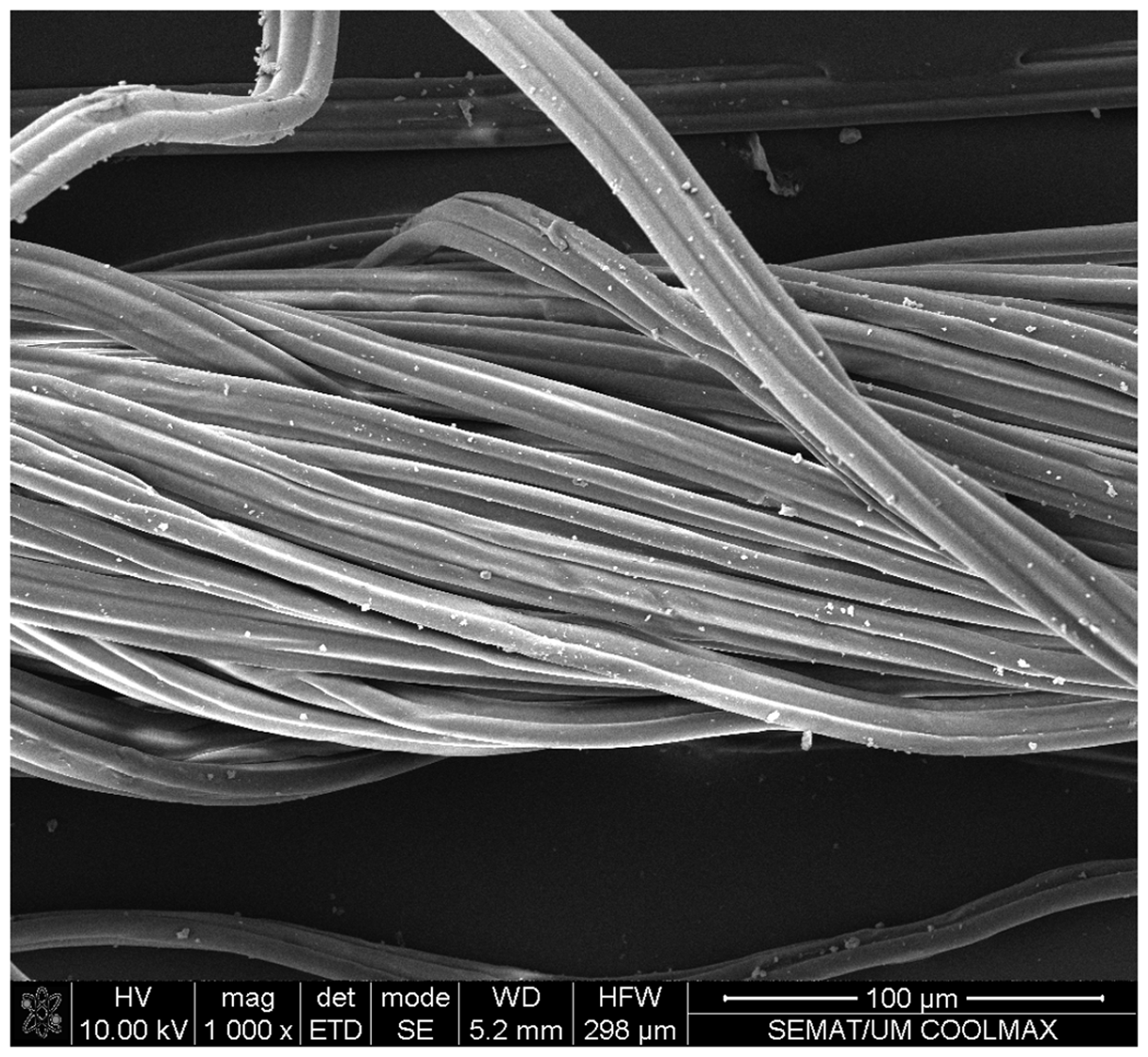
Single Jersey fabrics incorporating the selected functional yarns, plated with elastane (Creora®) 77 dtex, were produced on an 8-feed Single-Jersey Circular Knitting Machine MERZ–MBS with the following characteristics: gage – E28, diameter – 13", speed – up to 1.0 m/s, number of needles – 1152. The machine setting for the loop length was the same for all fabrics.
Plating is a common technique to produce elastic knitted products, and refers to the simultaneous formation of the loop from two yarns so that one yarn will lie on the face of the fabric while the other one is fed to the needles in such a way that it forms the reverse of the fabric [13]. In this case, the elastomeric yarn was fed by using electronic feeder BTSR KTF 100 HP. The plaiting yarn (elastane) appears in the back side and the ground yarn in the front side of the plain knitted fabric.
Characteristics of Viscose Outlast® and Polyester Coolmax® fabrics

The thickness of the fabrics was determined using the SDL – Digital Thickness Gage M034A according to the standard NP EN ISO 5084:1996 and was confirmed by Alambeta results. Bulk density of the fabrics was calculated by dividing their mass per unit areas by thickness.
The bulk density is 0.238 g/cm3 for Viscose Outlast® fabric, and respectively 0.279 g/cm3 for Polyester Coolmax® fabric.
The thermal regulation performance of the fabric containing phase change material (PCM) microcapsules – Outlast® – was assessed using a DSC- Differential Scanning Calorimeter (Mettler Toledo 822). Table 2 and Figures 3 and 4 present the results obtained.
DSC heating curve. DSC cooling curve. Outlast® fabric thermal regulation characteristics

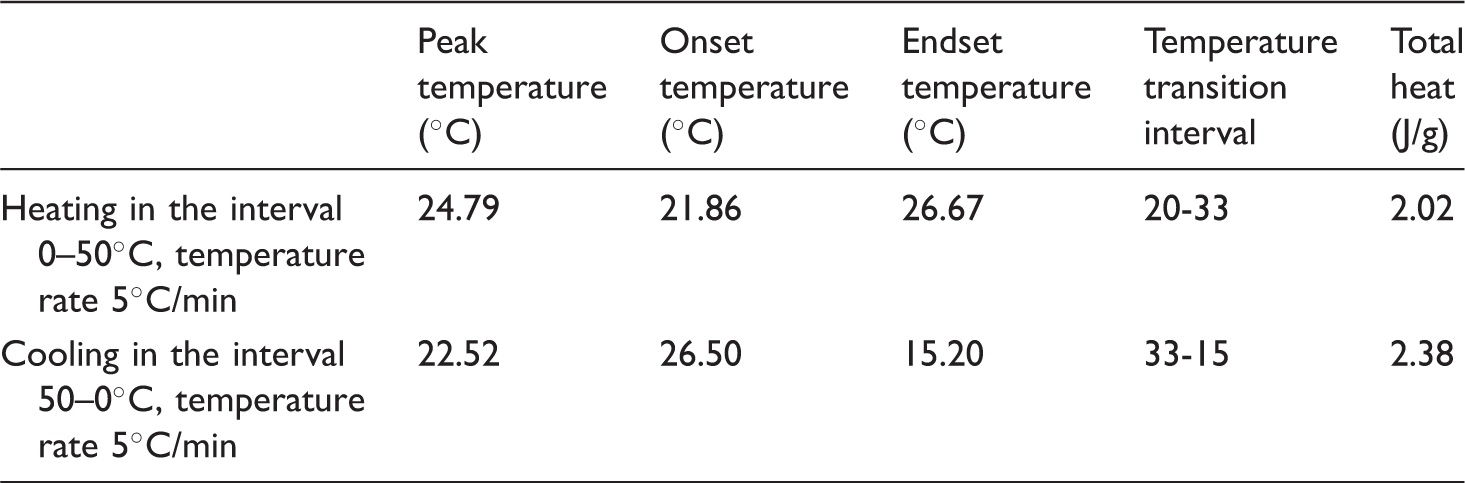
When the fabric is heated in the PCM temperature transition interval (20–33°C), it absorbs heat energy (2.02 J/g) as the PCM moves from a solid state to a liquid state. This phase change produces a temporary cooling effect in the clothing layers. Once the PCM completely melted the heat accumulation stops, the cooling effect ceases and the textile material behaves as plain fabric that has a certain capacity of thermal insulation. If the PCM garment is worn in a cold environment where the fabric temperature drops below the transition temperature, the microencapsulated liquid PCM will change back to a solid state, generating heat energy (2.38 J/g) and a temporary warming effect.
Air permeability was evaluated according to standard ISO 9237:1995 using a Textest FX-3300 air permeability tester. The air pressure differential between the two surfaces of the material was 100 Pa.
The thermal properties in dry and wet states were evaluated using the Alambeta instrument according to standard ISO 11092:1993. The measuring head temperature of the Alambeta was approximately 32°C and the contact pressure 200 Pa in all cases.
Measuring the thermal properties of wet fabrics requires a rapid technique, especially with specimens containing higher amounts of water, to prevent moisture redistribution during the test [14]. As test duration in the Alambeta instrument is below 180 seconds, a reliable measurement of fabric thermal properties in wet state can be obtained. In this test, the fabrics were cut into circular samples of 100 cm2 and the dry weight was recorded. Then, the samples placed on a horizontal surface were wetted with distilled water. The water weight added to the fabric was equal to 115% of the dry sample weight (considered for dripping wet). To get different percentages of moisture in the fabrics, samples were left to dry on the plate of the balance in standard ambient conditions. Before each test, sample weight was recorded and the moisture content relative to initial weight was calculated.
The surface moisture absorptivity of the fabrics was determined using the indirect method proposed by Hes [8]. To simulate the effect of a sudden sweat discharge onto the skin, a 0.06 mm thick 100% polyester woven fabric, was used as interface and a volume of 0.4 ml of water was placed on the center of the surface of this interface fabric. Within less than 1 minute the liquid distributed uniformly within a circle of approximately 50 mm (to cover the area of 25 × 25 mm2 of the heat flux sensors of Alambeta instrument).
All tests were performed under standard ambient conditions (20 ± 2°C and 65 ± 2% R.H).
The statistical evaluation of the data obtained was performed using PASW Statistics 17 software package.
Results and discussion
Knitted fabric properties in dry state
Air permeability
The air permeability of Coolmax® fabric is lower than that of Outlast® fabric (Figure 5). This is most probably due to the higher thickness of the fabric and to the geometry of fibers. The higher surface area of the Coolmax® fiber increases the resistance to air flow, which results in lower air permeability.
Air permeability in dry state − l/m2/s.
Thermal properties
ANOVA analysis showed that there are statistically significant differences between thermal conductivity, thermal resistance and thermal absorptivity of Coolmax® and Outlast® fabrics in dry state, with a significance level of 95%. Figures 6, 7, and 8 illustrate the differences between the two fabrics.
Thermal conductivity in dry state λ (×10−3), W/mK. Thermal resistance in dry state R (×10−3), m2K/W. Thermal absorptivity in dry state b, W s1/2/m2 K.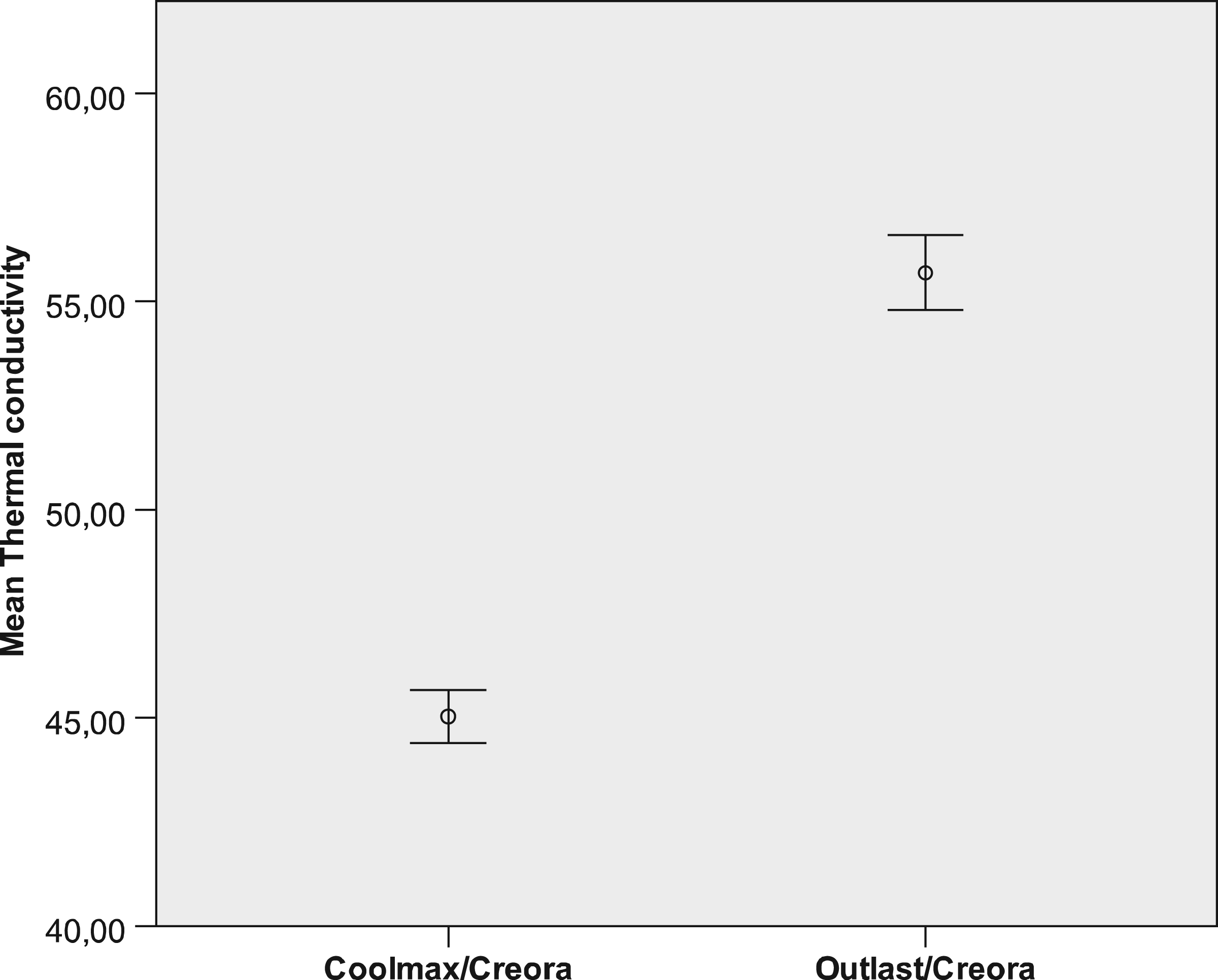


Thermal conductivity of a fabric represents the ability of the fabric to transport heat and results from the combination of fibers conductivity and structural characteristics of the fabric [15,16].
As it can be observed in Figure 6, the thermal conductivity of Coolmax® fabrics is lower than the Outlast® ones and the ‘spread’ of the data, as measured by the interquartile range (IQR), is approximately the same for both fabrics. Due to the high homogeneity of structural parameters of the fabrics (Table 1), the intrinsic fiber properties such as composition (inclusive the PCM presence), porosity, density and structure are the relevant factors responsible for the difference observed between both fabrics.
As expected due to the previous behavior, Coolmax® fabrics have higher thermal resistance than the Outlast® ones (Figure 7). Moreover, the magnitude of variation in thermal conductivity and thermal resistance values between both fabrics is similar (respectively, a decrease or an increase of approximately 130%). Fiber intrinsic properties, namely fiber conductivity and yarns/fabrics structural characteristics, particularly thickness of the fabric, are the main factors determining, respectively, thermal conductivity and resistance in dry state.
Thermal absorptivity is directly related with heat flux and is a surface-related parameter. It represents the objective measurement of the warm-cool feeling of fabrics. When an individual touches a fabric whose temperature is different from that of the skin, heat exchange occurs between the two surfaces [16]. Experiments demonstrated that, in dry state, thermal absorptivity of the fabrics varies between 20 and 300 Ws1/2/m2K and these values increase to 330–750 Ws1/2/m2K when they get superficially wet. For some woven and knitted fabrics in wet state the thermal absorptivity can be higher even than 1000 Ws1/2/m2K. The higher this value is, the cooler the feeling at first contact. In general, fibers with higher moisture regain promote a cooler feeling [17–19].
From Figure 8, it is apparent that the knitted fabrics made of yarns integrating Outlast® exhibit higher thermal absorptivity values, thus giving a cooler feeling at first contact with the skin. Once again the magnitude of the variation observed on thermal absorptivity between both fabrics is approximately 130%.
Knitted fabric properties in wet state
Air permeability, thermal conductivity, resistance and absorptivity were measured in both fabrics for different amounts of water added, expressed as percent excess moisture, i.e., the water content above equilibrium regain (throughout this article called, moisture content) ranging from 5% to 115%. According to Hollies et al. [20], the sweating sensation could be artificially generated by adding approximately 20% of water to the fabrics. Thus, this limit will be considered in this study as a starting point to provide the ‘sweating sensation.’
Air permeability
The results of measurement of air flow through wet fabrics show that with increasing fabric moisture the air flow decreases (Figure 9). The reduction in fabric porosity due to fiber swelling for Outlast® fabric, and the replace of air in the void spaces with water are responsabe for this behavior. The relationship between fabric moisture and air permeability was linear up to 80–90% of fabric humidity. At higher moisture level water creates continous film and the transfer of air through fabric is limited.
Air permeability of fabrics in wet state.
Thermal properties
The relationship between the thermal conductivity and the moisture content on both fabrics is illustrated in Figure 10.
Thermal conductivity of fabrics in wet state.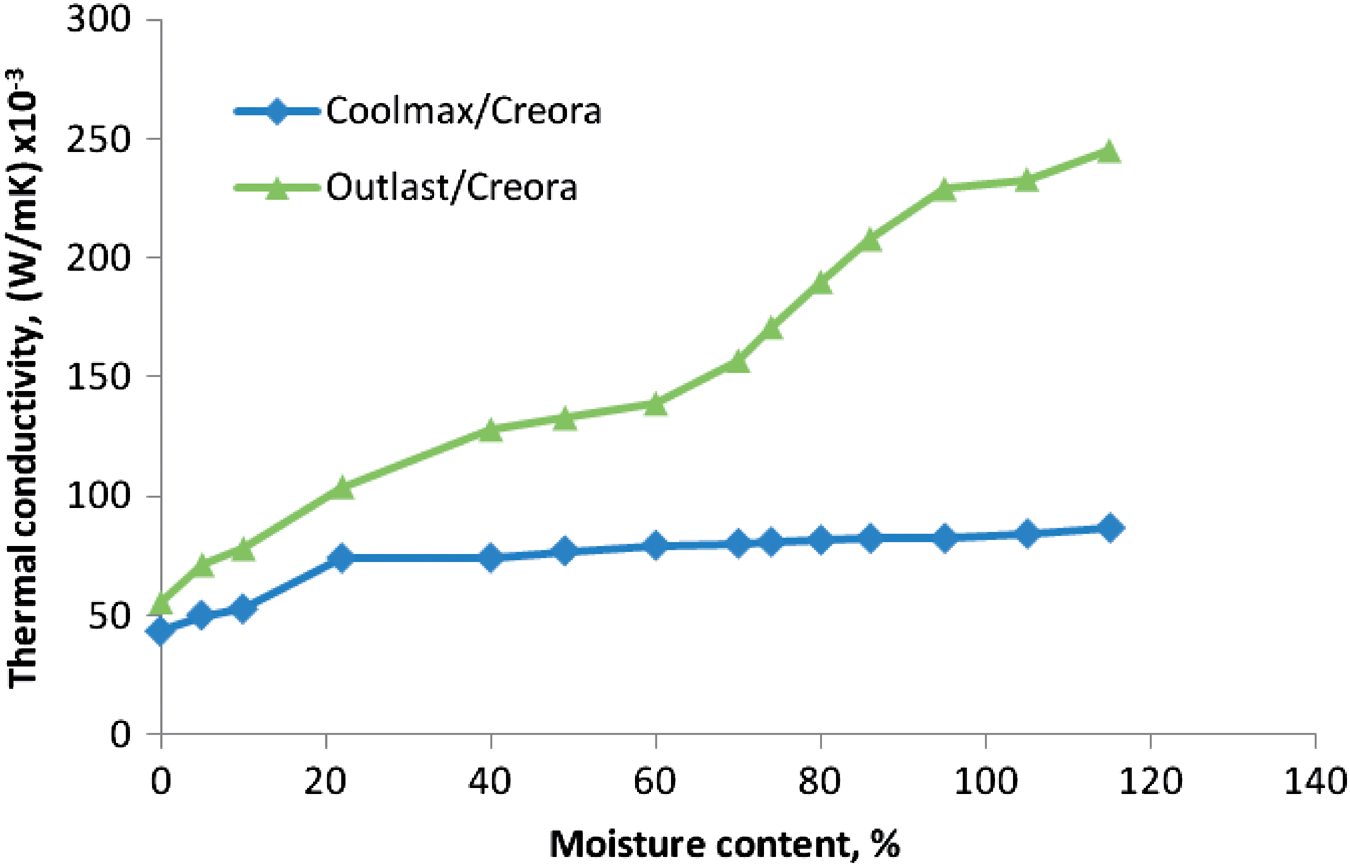
As can be seen from the graph in Figure 10, both fabrics in wet state have higher values of thermal conductivity than in dry state. This is an expected result as the thermal conductivity and thermal capacity of water is much higher than those of the fibres and air entrapped within the fabric, which leads to a higher heat conduction. However, the thermal conductivity behavior of the studied fabrics with moisture content is markedly different.
In the Outlast® fabric, the thermal conductivity significantly increases with moisture content of the fabric with a high nonlinear behavior. In the Coolmax® one, the increase in thermal conductivity with moisture content is rapidly for a small quantity of water in the structure and is not significant for moisture content higher than 22%. These disparate behaviors can be explained in terms of different amount of water retained and different types of water held within the fibers and fabrics. The water can be absorbed into the fiber structure (in the case of Outlast® material), retained as water vapors (saturated air) in the pores or as free water between fibers and yarns.
The thermal conductivity behavior of Outlast® fabric seems to follow a four-step process: the first one taking place between 0% and 40% moisture contents, the second one from 40% to 60%, the third one until 95% moisture content and another from this value on. At lower moisture content the water is mostly absorbed within the fibers structure and the thermal conductivity of the fabric increases linearly with the moisture content increase. Between 40% and 60% moisture content is observed a stabilization of thermal conductivity. At higher moisture contents (from 60%) a steep increase on thermal conductivity values is observed until 95% (which most probably corresponds to fabric saturation) followed by a smooth slope up above this point. Moisture sorption and diffusion until saturation as well as additional moisture in liquid form (free water) onto the surface, seem to trigger and steer this behavior.
The change of thermal properties of Outlast® fabric due to increased moisture content will influence also the thermo-regulating effect. With increase moisture content increases the thermal conductivity (i.e., the rate of temperature change of PCM during the transition) and reduces the actuation time of PCM.
For Coolmax® fabric (nonabsorbent fibers) a small quantity of water in the structure at the initial stage, 0–22%, will cause the heat flux through the fabric to increase rapidly due to water on the fiber surfaces. The thermal conductivity behavior of Coolmax® fabric with moisture content above 22% is fairly linear and constant. This can be explained by the hydrophobic character and the special design of the constituent fibers. Moisture diffusion seems to be assured by the capillary effect of the fibers and the void spaces of fiber and fabric structures, which lead to nonsignificant changes in the thermal conductivity with the moisture content of the fabric.
The amount of internal energy stored per unit volume at different moisture contents was calculated according to Hes et al. [17] for both fabrics, and is illustrated in Figure 11.
Thermal capacity of fabrics in wet state.
Thermal capacity of Outlast® fabric increases until 70%, remaining almost constant until 115%. As it can be seen between 40% and 60% moisture contents the rate of increase of the thermal capacity of Outlast® fabric is reduced. Accessibility of the fabric to moisture is most likely reduced due to fiber swelling, leading to a higher accumulation of moisture onto the fabric surface and heat transfer takes place mainly on fabric surface, which reduces the rate of increase of thermal capacity.
Thermal capacity of Coolmax® fabric increases liniar with the moisture content.
The relationship between the thermal resistance and the moisture content of both fabrics is shown in Figure 12.
Thermal resistance of fabrics in wet state.
As it can be seen from the graphs, the thermal resistance for both fabrics is lower in wet state than in the dry state. Once again the behavior with moisture content is different for both fabrics. In the Outlast® fabric a significant decrease on thermal resistance is observed up to about 40% moisture content, which stabilizes between 40% and 60% and gradually decreases after this moisture content. The thermal resistance of the Coolmax® fabric with moisture content follows a similar trend to the one observed with thermal conductivity: thermal resistance variation with moisture content is not significant above 22% moisture content.
The influence of moisture content on the thermal absorptivity of fabrics is illustrated in Figure 13. As it can be depicted from the graphs, an increase in moisture content leads to an increase of the thermal absorptivity for both fabrics. This parameter is greatly influenced by the surface character of the fabric and by the fibre/yarn ability to absorb and diffuse water. In the Coolmax® fabric a gradual slope up increase is observed with moisture content. The thermal absorptivity behavior of Outlast® fabric follows a trend line similar to the one observed in thermal conductivity. As thermal absorptivity is directly related with thermal conductivity and thermal capacity of the fabric, this is an expected result.
Thermal absorptivity of fabrics in wet state.
Surface moisture absorptivity
The surface moisture absorptivity of the fabric under test was assessed measuring the thermal absorptivity of the set ‘fabric under test-interface fabric.’ The resulting thermal absorptivity is related to the amount of liquid kept in the interface fabric due to the poor moisture absorption of the fabric under test.
Figure 14 compares the thermal absorptivity of Outlast® and Coolmax® fabrics obtained in dry state and by simulating a sudden sweat discharge (with interface fabric). The results obtained indicate that, in a sudden contact with a wetted surface, the Coolmax® fabric has lower thermal absorptivity than the Outlast® one and thus poor surface moisture absorptivity. As most of the liquid is kept in the interface fabric a warmer feeling is given by the Coolmax® fabric.
Comparison between the thermal absorbtivity of fabrics in dry state and after sudden contact with a wet skin (simulated).
Conclusions
The thermal comfort properties of functional elastic knitted fabrics produced from Coolmax® and Outlast® yarns have been studied and analyzed. The knitted fabrics were produced with identical constructional parameters and the tests were performed in dry and in wet states.
In dry state, the Coolmax® fabric exhibited higher thermal resistance, lower thermal conductivity and lower thermal absorptivity when compared with the Outlast® one. Due to the high homogeneity of structural parameters of fabrics, it is apparent that thermal conductivity and hygroscopicity of the constituent fibers determined different thermal properties. The air permeability of Coolmax® fabric is lower due to the higher thickness of the fabric and to geometry of fibers.
The air permeability of wet fabrics decreases with increasing fabric moisture. The reduction in fabric porosity due to fiber swelling for Outlast® fabric, and the replace of air in the void spaces with water are responsabe for this behavior.
In wet state, higher thermal conductivity and absorptivity and lower thermal resistance were registered for both fabrics, when compared to the dry state. For the Coolmax® fabric, the effect of increasing moisture content above the ‘sweating sensation’ was not significant on thermal conductivity and resistance. In the Outlast® one, moisture content increase significantly raised thermal conductivity, and to a lesser extent, decreased the thermal resistance. The thermal absorptivity increase with moisture content was steeper on the Outlast® fabric.
From the results obtained it is apparent that Outlast® fabrics are more prone to significant thermal properties changes due to moisture uptake than the Coolmax® ones. In addition, 60% moisture content seems to be the threshold to major changes on Outlast® fabrics thermal properties.
These findings help in designing a product with the most suitable material or combination of materials for sportswear applications, where wear comfort is an important issue. Different solutions can be devised depending on weather or ambient conditions, on the intensity level of the activity to be performed and on the body areas that will be covered by the clothing.
Footnotes
Acknowledgement
This work was conducted under support of FCT – Fundação para a Ciência e a Tecnologia and 2C2T – O Centro de Ciência e Tecnologia Têxtil, Universidade do Minho, Portugal, within the framework of ‘Ciência 2008’ Program.