



Abstract
Four layers of glass fiber filaments with the fineness of 2400 tex were used as warp yarns, five layers of glass filaments with the fineness of 600 tex were used as weft yarns 110 tex and aramid fibers were used as Z yarns to process a three-dimensional woven reinforcement. Then, 307-3 unsaturated polyester resin was used as the matrix, and the three-dimensional woven reinforced composite was prepared by the VARTM method (resin transfer molding method). The bullet impact composite was modeled by ABAQUS (Finite element software). The starting conditions of the bullet incidence and the actual conditions were set consistently to analyze the change of the remaining velocity and acceleration of the bullet and the worth energy loss after the bullet impact. The results showed that the theoretical and experimental values of bullet incidence velocity and residual bullet velocity were linearly related. When the impact velocity of bullet incidence was higher, the slope of the straight line of the initial phase of bullet velocity decrease was larger, and the peak of the absolute value of acceleration after bullet impact was larger. The calculated value of energy loss after bullet impact simulation is basically consistent with the experimental value, This also fully proved that the bullet impact composite material model established was correct and effective.
Introduction
At present, many research scholars are focusing on studying the various properties of bullet impact composites, such as the incident velocity and the instantaneous velocity after penetration of the bullet into the composite.1,2 However, few have studied the deformation of the bullet in the composite, the velocity change, and the mode of material destruction. These analyses and studies are of great reference value to explore the deformation of the composite during the bullet impact and its mode of material destruction. In order to obtain this useful information, some researchers have captured it by high-speed photography, but it is not easy to analyze the obtained data and information. 3 ABAQUS is widely considered the most powerful finite element analysis software for analyzing complex solid and structural mechanics, especially for navigating large and complex problems and simulating highly nonlinear problems.
Nowadays, in China, Beihang University applied the nonlinear finite element software ABAQUS to simulate and calculate the analysis of viscoplastic materials, and the simulation can obtain very good simulation efficiency and results; Yancheng Institute of Technology applied ABAQUS simulation software to analyze the bending properties of laminated composites, core structural materials, and three-dimensional corner interlocking fabrics.4,5 Muñoz et al. 6 combined impact experiments and finite element analysis to study the mechanical behavior of three-dimensional woven orthotropic composites under the action of impact. Their results showed that the finite element method could reproduce the residual velocity profile of the projectile and the energy dissipation mechanism of the three-dimensional woven material. Rodríguez-Millán et al. 7 studied the mechanical behavior of aluminum alloys under impact loading. They studied the mechanical behavior of the target plate under the impact load by changing the force state through the shape of the projectile head and studied the mechanical behavior of the target plate numerically. The numerical results correlated well with the experimental results in terms of residual velocity and ballistic terminal velocity. Zhang et al. 8 established a finite element model for impact damage analysis based on the three-dimensional damage rate intrinsic model of the component and the cell model of the composite structure, taking the three-dimensional woven composite target plate as the object of study. It was shown that there was an approximately linear relationship between the three stages of the intrusion process and the main damage forms of the material and the residual velocity of the projectile and the collision velocity of the projectile, and the finite element model can be used for the design of damage resistance of three-dimensional woven composites. Simulation of the impact process can save time, reduce cost, provide more intuitive observation of the material deformation and energy changes, and obtain data that are difficult to measure in experiments, thus providing more information to understand the material damage characteristics during the impact process.
ABAQUS has superior performance in simulating low and high-speed impacts on materials, such as simulated tool drops, flying bird impacts, and high-speed impacts of bullets on bulletproof helmets and armor, and has broad application prospects in both civilian and military fields.9,10 This study establishes a bullet impact model by ABAQUS, which aligns the bullet incidence starting conditions and the environment with the actual setup, and compares the calculated results with the experimental results.11,12 On the one hand, it can verify the correctness of the model; on the other hand, it can calculate the change of bullet velocity in the composite and the way of deformation and damage of the composite.
Material and model
Materials and technical parameters
Four layers of glass fiber filaments with the fineness of 2400 tex were used as warp yarns, five layers of glass filaments with the fineness of 600 tex were used as weft yarns, and the density of warp and weft yarns were 50.3 and 40.2 per 10 cm, respectively, with 110 tex aramid fibers as Z yarns, processed into three-dimensional woven reinforcement, and their structural sketches are shown in Figure 1.13,14 The 307-3 unsaturated polyester resin was used as the matrix, and the three-dimensional woven reinforced composites were prepared by the VARTM method (resin transfer molding method) .15,16

Cross-section diagram of three-dimensional woven fabric reinforced.
Impact experiments were conducted on the above three-dimensional woven fabric-reinforced composites by bullets. The 7.62 mm Type 56 ballistic launcher was selected and put into an armor-piercing incendiary bullet with a steel core, 17 the mass of the bullet body was about 7.69 g, the bullet diameter was 7.62 mm, and the bullet impact velocity came to match with the charge. Based on the photoelectric detection principle to characterize the velocity of the bullet, as in Figure 2, when the bullet is shot from the chamber, relying on the photoelectric gate can measure the moment the bullet stays between the two light curtain targets, and the distance between the light curtain targets is constant. The incident velocity of the bullet in the three-dimensional woven reinforced composite can be derived mathematically, and the residual velocity of the bullet is also derived from the above principle.

Bullet impact testing device.
The technical parameters related to unsaturated polyester resin, glass fiber, aramid fiber, and the elastic body are shown in Tables 1 to 3. In Table 1, E denotes modulus, G denotes stiffness, and v denotes Poisson’s ratio. Three-dimensional contains X, Y, and Z directions, but there are only radial and axial directions for fibers. As the three-dimensional woven reinforcement is a symmetric body, so its elastic constants are not many, with Z = 0 as the plane of symmetry, then the constants in the positive direction of X, Y, and Z axes are the same as the constants in the opposite direction, and T, C, and S denote tensile, compression, and shear properties, respectively.
Stiffness and strength parameters of filament.

Basic mechanic parameters of matrix.

Impacting bullet size and property parameters.

Establishment of bullet model for impact experiment
Build the three-dimensional woven reinforced composites into a single-cell module, on which the bullet impact damage finite element simulation calculation is performed. Because the three-dimensional woven reinforced composite has symmetry, the one-half symmetric continuous medium model is chosen to reduce the workload, shorten the calculation process and enhance the calculation processing speed.18,19 Combined with FORTRAN language and based on the elasto-plastic constitutive relationship, the unit cell model VUMAT interface program is adopted, in which the critical failure area criterion and the maximum stress criterion are the main principles we use. Using VUMAT and ABAQUS, the stress update calculation of each component of the three-dimensional woven reinforced composite is carried out on the explicit algorithm, and the ballistic impact is calculated by numerical simulation. Finally, the finite element calculation results are obtained.
The finite element model is divided into two parts, which are the bullet and the experimental target plate. Be sure to ensure that the finite element model is consistent with the experimental dimensions. According to Table 1, a standard Type 56 armor-piercing incendiary bullet is designed with a steel core diameter of 7.62 mm. The appearance structure of the bullet is shown in Figure 3, and the main appearance dimensions of the bullet are shown in Table 3. The length, width, and thickness of the three-dimensional woven reinforced composite (target plate) are cut to 30, 20, and 1.5 cm, respectively, and the basic mechanical parameters of the bullet body are shown in Table 3.

Outline size of bullet.
Division of grid cells
The finite element simulation subroutine is used to master the structure and properties of the single-cell, so the simulated single-cell structure possesses a high degree of consistency with the real single-cell structure.20,21 To ensure that there is no fluctuation in the calculated structure, a single cell is divided into two parts, so the model can be converted into a one-half model so that the total number of cells of the bullet reaches 272. After griding, the number of cells in the longitudinal, latitudinal, and thickness directions are 73, 43, and 9, respectively, as shown in Figure 4. Figure 4(c) shows the three-dimensional cells of the grid generated by the computer itself after the finite element analysis.

Schematic diagram of grid division: (a) division of bullet grid, (b) griding plane of target plate material, (c) target plate material finite element analysis of the three-dimensional structure.
Evaluation of ballistic impact model
After ABAQUS establishes the ballistic impact model, the initial conditions and environment set are basically consistent with the actual conditions. Then, through simulation calculation, the calculated results are compared with the experimental results to illustrate the correctness of the model. On this basis, the ballistic penetration failure of composite materials is calculated according to this model.
Results and discussion
Analysis of the residual velocity of the bullet
Comparison of the theoretical and actual values of the residual velocity of the bullet
The different initial velocities (VS) of the bullet was selected to impacting the three-dimensional woven reinforced composite, the relationship between the obtained residual theoretical velocity and the calculated value is shown in Figure 5. From Figure 5, it can be seen that although the incident velocity of the bullet is not the same, it is linearly related to both the theoretical and experimental values of the residual velocity. The main reason is that during the finite element simulation calculation, the warp direction, weft direction, and thickness direction (Z-direction) of the three-dimensional woven reinforced composite are regarded as continuous mediums.22,23 However, three-dimensional woven reinforced composites is made of filament yarn and matrix combined according to a certain structure, and the mutuality between them is not considered during the theoretical calculation. It is obvious that the residual velocity of the bullet is closely related to the woven knot of fibers in the three-dimensional structural reinforced composites. The Z yarn in the thickness direction of the three-dimensional structure has a binding effect, which has a good binding effect on the filament yarn in the warp and weft direction. It can ensure the structural stability of the three-dimensional woven reinforced composites and prevent the shear failure between the layers as much as possible, so the fiber is sheared and broken.24,25 On the other side, the fibers undergo tensile fracture and it can effectively weaken the impact velocity of the bullet and reduce the residual velocity of the bullet. The finite element simulation calculation process can’t take into account and can only be entered into the subroutine in a single direction. The cross-joining of different directions is not considered, leading to a certain error between the experimental and simulated theoretical values.26,27

Comparison chart of bullet terminal velocity (theoretical value and actual value) and incident velocity.
Comparison of different initial velocity courses when the bullet impacts the composite material
During the impact experiment, the bullets impacted the composites with velocities of 747, 656, 604, 486, and 395 m/s, respectively. It can be clearly seen from Figure 6 when the impact velocity of bullet incidence is higher, the slope of the straight line in the initial phase of bullet velocity drop is larger, and the lower the impact velocity of bullet incidence is, the slope of the straight line in the initial phase of bullet velocity drop is smaller, that is, the initial velocity of impacting composites has a significant effect on the bullet drop velocity. Refining the individual impact velocity-time variation curves as shown in Figure 7(a) to (e), the slope of the curve is the largest in about 0–22 μs. The curve between 32 and 62 μs becomes a smooth straight line, and the change is not obvious. The reason is that when the three-dimensional woven reinforced composite is in contact with the impact bullet, the composite start to be damaged. The resistance of the three-dimensional woven reinforced composite to the bullet is greater if the impact depth of the bullet is deeper. When the impact damage capacity exceeds the capacity of the target plate, the three-dimensional woven reinforced composite will be destroyed, and the bullet will completely pass through the target plate.28,29 When the bullet head penetrates the composite, the traversing speed of the bullet will gradually tend to moderate-the curve mentioned above tends to the straight line of the state.

Velocity-time graph of bullets under different initial velocity.

Single bullet impact velocity-time curve: (a) Vs = 747 m/s, (b) Vs = 656 m/s, (c)Vs = 604 m/s, (d) Vs = 486 m/s, and (e) Vs = 395 m/s.
Analysis of acceleration change during bullet impact
Figure 8 shows the variation of acceleration after the bullet impacting the three-dimensional woven fabric reinforced composite. From Figure 8, it can be found that the greater the velocity at the time of bullet incidence, the greater the peak of the absolute value of acceleration, but the change of acceleration has certain volatility, and the size of the fluctuation is also related to the initial incidence velocity, and the smaller the initial incidence velocity, the smaller the fluctuation change. Refining the acceleration-time variation curves of the impact is shown in Figure 9(a) to (e). It can be seen from Figure 9 that the fluctuation of the acceleration variation during the bullet impacting and the appearance of the fluctuation indicates that there is an interaction force between the bullet and the three-dimensional woven reinforced composite. Due to the different simultaneity of the fracture between the filament yarn and the matrix inside the composite, this leads to the interaction force between the bullet and the composite during the impact process is not constant. While the mass of the bullet is constant, the acceleration and value of each moment of the bullet impacting process can be deduced from Newton’s law F = ma. When the bullet impacting velocity is small, the interaction force between the bullet and the target plate is also small because the impulse of the bullet on the target plate is also small at the same time, which naturally also leads to a decrease in acceleration. 8 The following equation understands this principle.

Where: F—impact force of the bullet, N
m—the mass of the bullet, kg
a—acceleration of the bullet, m/s2
Δv—velocity difference, m/s
Δt—time difference, s
I—impulse of the bullet, kg.m/s
t—impact time of the bullet, s

Acceleration-time graph of bullets impacting composite.

Single bullet impact acceleration-time curve: (a) acceleration curve of the bullet at Vs = 747 m/s, (b) acceleration curve of the bullet at Vs = 656 m/s, (c)acceleration curve of the bullet at Vs = 604 m/s, (d) acceleration curve of the bullet at Vs = 486 m/s, and (e) acceleration curve of the bullet at Vs = 394 m/s.
When the bullet impacts three-dimensional woven reinforced composite at high speed, a significant stress wave is generated inside the composite, and the estimation of the stress wave can be used to analyze the damage process of the bullet impacting the composite. The following equation can calculate the propagation velocity of the stress wave on the fiber bundle inside the composite.

Where: c—propagation velocity of stress wave, m/s
E—modulus of elasticity of fiber bundles at high strain rate (bullet impact at high speed), MPa
ρ—the bulk density of the filament yarn, g/cm3
From the above equation, it can be predicted that the propagation velocity of the stress wave on the fiber bundle inside the composite is much higher than the velocity of the bullet impacting. Generally speaking, when the bullet impacts the composite, the stress wave is generated and propagates from the longitudinal and transverse directions at a very high speed. The tensile reflection wave is generated when it meets the blocking interface. Due to the double impact of tensile and compression waves, when the bullet has not directly impacted the bonded area of fiber and matrix, the reverse side of the composite will appear matrix cracking, thus producing a small number of fragments, indicating that the impacted back side of the composite is damaged to a certain extent. When the composite is subjected to certain bending deformation and bending stress, the energy of the bullet will be gradually consumed. In contrast, the load on the composite will gradually increase to the maximum value, which can be seen from the graph of bullet acceleration change that the absolute value of the bullet acceleration also gradually increases to the maximum value.
Analysis of impact energy loss change about bullet
The graph of impact energy loss change in the process of the composite impacted by bullet is shown in Figure 10, and the process of energy loss change of bullet is basically the same as the velocity change of the bullet. Generally speaking, we can only estimate the final size of energy loss of the bullet by experiment, and the process of intermediate energy loss of the bullet can be obtained by finite element simulation. The theoretical calculation formula of the bullet impact energy loss process is as follows. 30

Where: Vs—the instantaneous velocity of the bullet when it is incident on the composite, m/s
Vr—the instantaneous velocity of the bullet when it penetrates the composite, m/s
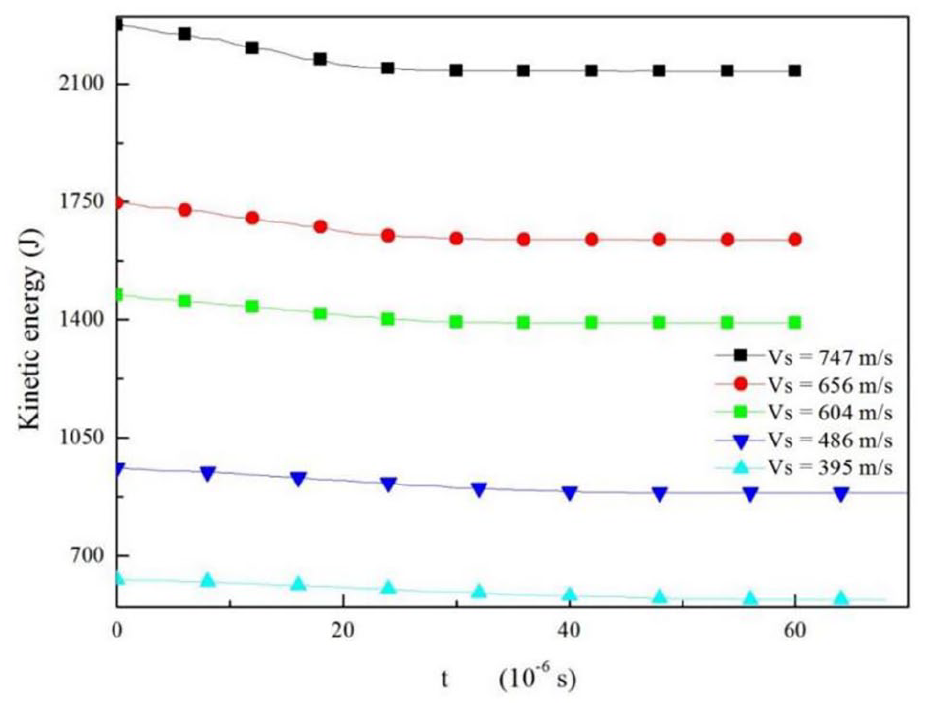
Comparison of energy loss process of a bullet under different incident velocity.
From the above equation, the magnitude of bullet energy loss can be calculated, and the calculation results of the simulation by verification are basically consistent with the experimental results. This fully proved that the bullet impact composite material model established was correct and effective. Figure 11 shows the comparison between the simulated value and the calculated result of this experiment. From Figure 10, it can be seen that when the bullet incidence velocity gradually increases, the loss of bullet energy is also greater, but there is no certain regularity between them.

Comparison graph of the end bullets energy loss.
Conclusion
The theoretical and experimental values of the incident velocity of the bullet impacting the three-dimensional woven reinforced composite are linearly related to the residual velocity of the bullet. The higher the impact velocity of the bullet impacting the three-dimensional woven reinforced composite, the greater the slope of the straight line of the initial phase of the velocity drop curve after the bullet impact. The higher the velocity of the bullet at the time of incidence, the higher the peak of the absolute value of the acceleration after impacting of the bullet. However, the change of acceleration has a certain fluctuation, and the size of the fluctuation is also related to the initial incidence velocity. The smaller the initial incidence velocity, the smaller the fluctuation change. The process of impact energy loss change of the bullet during the impact of the bullet on the composite is basically consistent with the process of bullet velocity change. The calculation results of the simulation by verification are basically consistent with the experimental results.
Footnotes
Acknowledgements
Fei Qian and Lei Zhao are co-first authors of the article.
Declaration of Conflicting Interests
The author(s) declared no potential conflicts of interest with respect to the research, authorship, and/or publication of this article.
Funding
The author(s) disclosed receipt of the following financial support for the research, authorship, and/or publication of this article: The work is funded by Integration Platform of Industry and Education of Jiangsu Higher Vocational Education (Jiangsu Vocational Education 2019. No 26), the project supported by scientific research fund of Yancheng Polytechnic College(ygy2008), Jiangsu High Vocational College Academic Leaders High-end Research and Training. The work is also funded by Deeply Integrated Training Platform of Industry and Education of Jiangsu Higher Vocational Education (Jiangsu Higher Education 2016. No 19), Qing Lan Project of Jiangsu Colleges and Universities for Young Academic Leaders (Jiangsu Teachers’ letter〔2020〕No. 10), Jiangsu Province Higher Vocational Education High-level Major Group Construction Project-Modern Textile Technology Major Group (Grant number: Jiangsu Vocational Education 2020. No 31). Brand Major Construction Project of International Talent Training in Colleges and Universities-Modern Textile Technology Major (Grant number: Jiangsu Foreign Cooperation Exchange Education 2022. No 8) also supports the research of this subject.
