




Abstract
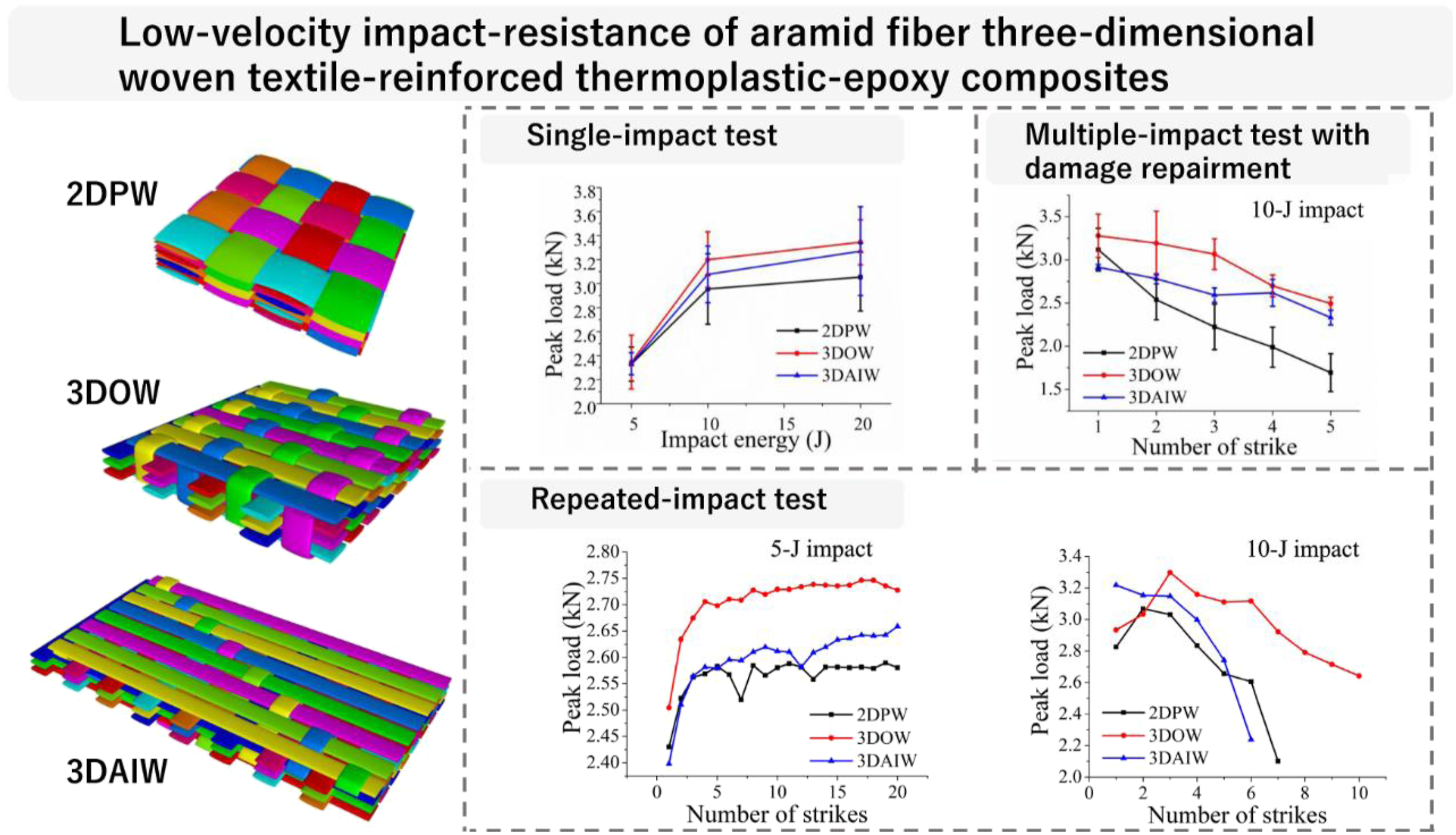
The development of impact-resistant composite materials for protective applications such as helmet and body armor has attracted considerable attention. In this study, a novel aramid fiber-woven thermoplastic-epoxy composite was developed. Furthermore, three types of woven textiles, namely three-dimensional (3D) orthogonal-woven (3DOW), 3D angle-interlock woven (3DAIW), and two-dimensional plain-woven (2DPW) textiles, were used as reinforcement structures. To study the effect of the woven structure, impact energy, and damage repairment on impact-resistance performance of these composites, low-velocity drop-weight impact tests with various impact scenarios, such as single-impact, repeated-impact, as well as multiple-impact with hot-press damage repairment, were conducted. The results revealed that the woven structure exhibited an obvious effect on the composite impact-resistance performance and failure modes when subjected to specific impact scenarios. For the single-impact scenario, especially under high impact energy levels (10 and 20 J), the 3DOW structure exhibited superior impact-resistance performance as well as damage tolerance, followed by 3DAIW and 2DPW structures. Furthermore, 3DOW achieved superior impact-resistance to the other two structures for the 10-J repeated-impact scenario. The 3DAIW structure, in which debonding or delamination as well as severe resin cracks dominated, achieved superior impact-resistance to multiple impacts with damage repairment.
Keywords
Highlights
• Aramid fiber 2D/3D woven textile-reinforced thermoplastic-epoxy resin composites were manufactured for the first time. • Three types of woven textiles, such as 2DPW, 3DOW, and 3DAIW were designed and manufactured as reinforcement structures. • Low-velocity impact tests with various impact scenarios were conducted to investigate impact-resistance performance. • Woven structures exhibited an obvious effect on the impact-resistance performance and failure modes for the composites.
Introduction
Fiber-reinforced polymer composites (FRPs) have wide applications in aerospace, automotive, and civil engineering, because of their high mechanical performance, low weight, and easy manufacturing processes. The development of impact-resistant or ballistic composite materials for specific protective applications, such as helmet 1 and body armor, 2 has attracted considerable research attention.
High-performance fibers, such as aramid fiber, are commonly used to fabric ballistic or stab/impact-resistant textiles or textile composites.3–7 Aramid fiber is typically used to develop textile panels or composites subjecting to ballistic or high-velocity impacts due to its excellent mechanical performance, however, the low-velocity impact of such materials is also attracting research attention in recent decades.8,9 Liu et al.10,11 developed carbon/aramid fiber hybrid three-dimensional (3D) woven composites and carbon-fiber composites reinforced with same woven structures and subsequently investigated their low-velocity impact performance. The results revealed that the addition of the aramid fiber as binder yarns in these hybrid 3D woven composites could considerably improve impact-resistance performance compared with carbon-fiber counterparts (e.g., increasing 23.6%–92.7% peak-load values under 6-J impacts). In these woven structures, a larger volume combined with a smaller waviness degree of the aramid binder yarn contributed considerably to impact-resistance and damage tolerance. Aramid fiber is one of the preferred options for developing protective composite materials which may be subjected to low-velocity impacts in specific applications.
Typical thermosetting-epoxy resin are mostly used as the matrix in FRPs. Thermoplastic resin composites have attracted considerable attention because of their higher fracture toughness and better damage tolerance than their thermosetting counterparts. Studies have focused on fiber-reinforced thermoplastic composites with various thermoplastic resin types.12–14 Claus et al. 15 developed polypropylene (PP) and typical epoxy-based composites reinforced with aramid and carbon woven textiles and subsequently investigated the impact-resistance performance of the composites to compare the contribution of the matrix and the fibers to the impact-resistance of those composites. The results revealed that aramid-PP composites absorbed the most energy among the four composites. Thermoplastic-PP composites exhibited superior impact-resistance to that of thermosetting-epoxy composites. Kinvi-Dossou et al. 16 developed thermoplastic acrylic-based, typical thermosetting-epoxy-based, as well as thermoplastic polyester-based composites reinforced with glass fiber and subsequently investigated their impact behavior subjected to Charpy and low-velocity drop-weight impact tests. The results revealed that the thermoplastic acrylic-based composites exhibited higher impact-resistance performance than those of the other two counterparts.
In addition to fiber and resin type, the textile architecture also played a crucial role in the impact-resistance performance of FRPs. Plain-woven textiles are widely used textile architectures as the reinforcement structures of FRPs because of their easy manufacturing and low cost.17,18 By contrast, 3D woven textiles have attracted considerable attention as reinforcement structures. Furthermore, 3D woven structures with three groups of yarn arranging in three perpendicular directions exhibit several advantages, such as superior structural integrity and impact-resistance, to those of conventional laminated structures. 19 Researchers have investigated the impact performance of woven textile-reinforced composites with various textile structures. Min et al. 20 studied the ballistic performance of a 3D woven wadded through-thickness angle-interlock textile-reinforced composites and revealed that the 3D woven structure exhibited a 3.3% higher energy absorption and a 4.6% improved efficiency in energy absorption than a plain-woven textile-reinforced composite panel at an equivalent areal density. Behera et al. 21 developed the following textile composites reinforced with several woven structures, namely unidirectional (UD), two-dimensional (2D) plain-woven, 3D-orthogonal-woven, 3D-warp-interlock-woven, as well as 3D-angle-interlock woven. Furthermore, they studied their impact performance and knife-proof performance and revealed that the 3D woven structures exhibited superior impact-resistance and knife protection compared with those of 2D and UD structures. However, limited comparation studies have been conducted on the impact-resistance performances of thermoplastic composites reinforced with various woven structures under various impact scenarios.
In this study, aramid fiber 2D/3D woven textile-reinforced thermoplastic-epoxy resin composites were manufactured for the first time to develop impact-resistant materials. Two typical 3D woven structures, namely 3D-orthogonal-woven (3DOW) and 3D-angle-interlock-woven (3DAIW), as well as one 2D-plain-woven (2DPW) structure with same textile-areal density were developed based on a self-built 3D weaving loom to reinforce thermoplastic-epoxy resin. These composites were a combination of impact-resistance materials and structures including high-performance aramid fiber, a novel type of thermoplastic-epoxy resin, as well as 3D woven structures and can be used in specific protection engineering. Low-velocity impact tests with various impact scenarios, such as single-impact, repeated-impact, and multiple-impact with damage repairment, were conducted on these woven composites to investigate the effect of the woven structure, impact energy, and damage repairment on their impact-resistance performance.
Experimental
Textile preform manufacturing
Three types of woven structures, that is, 2DPW, 3DOW, and 3DAIW were manufactured using aramid yarn (330tex, Kevlar® 29, Du Pont-Toray Co., Japan) based on a self-built 3D weaving loom with a modified heddle position system.
22
Figure 1 depicts the structural models of the three woven types developed by TexGen software.
23
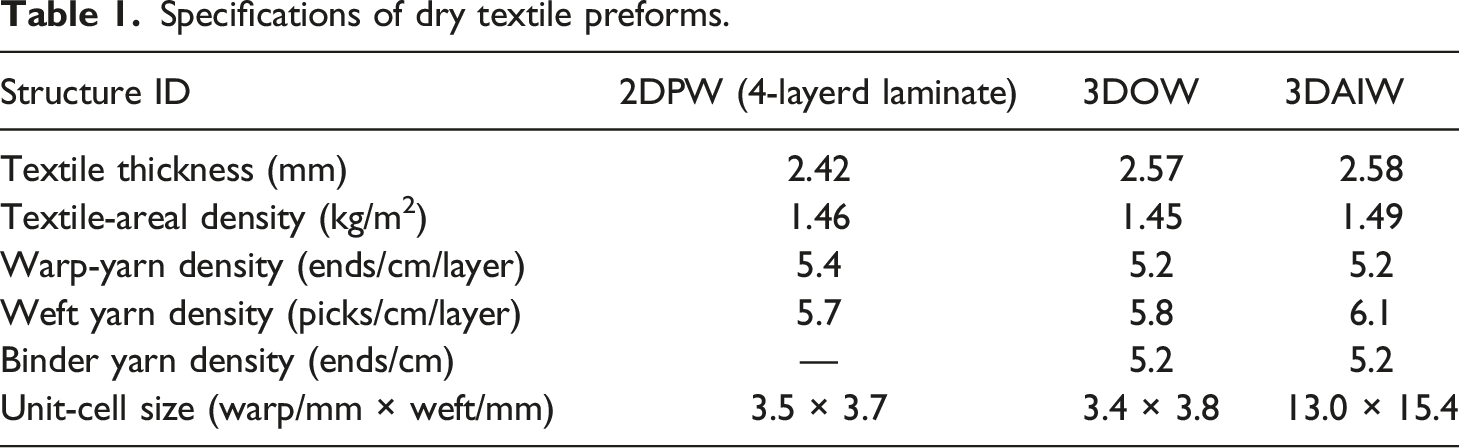
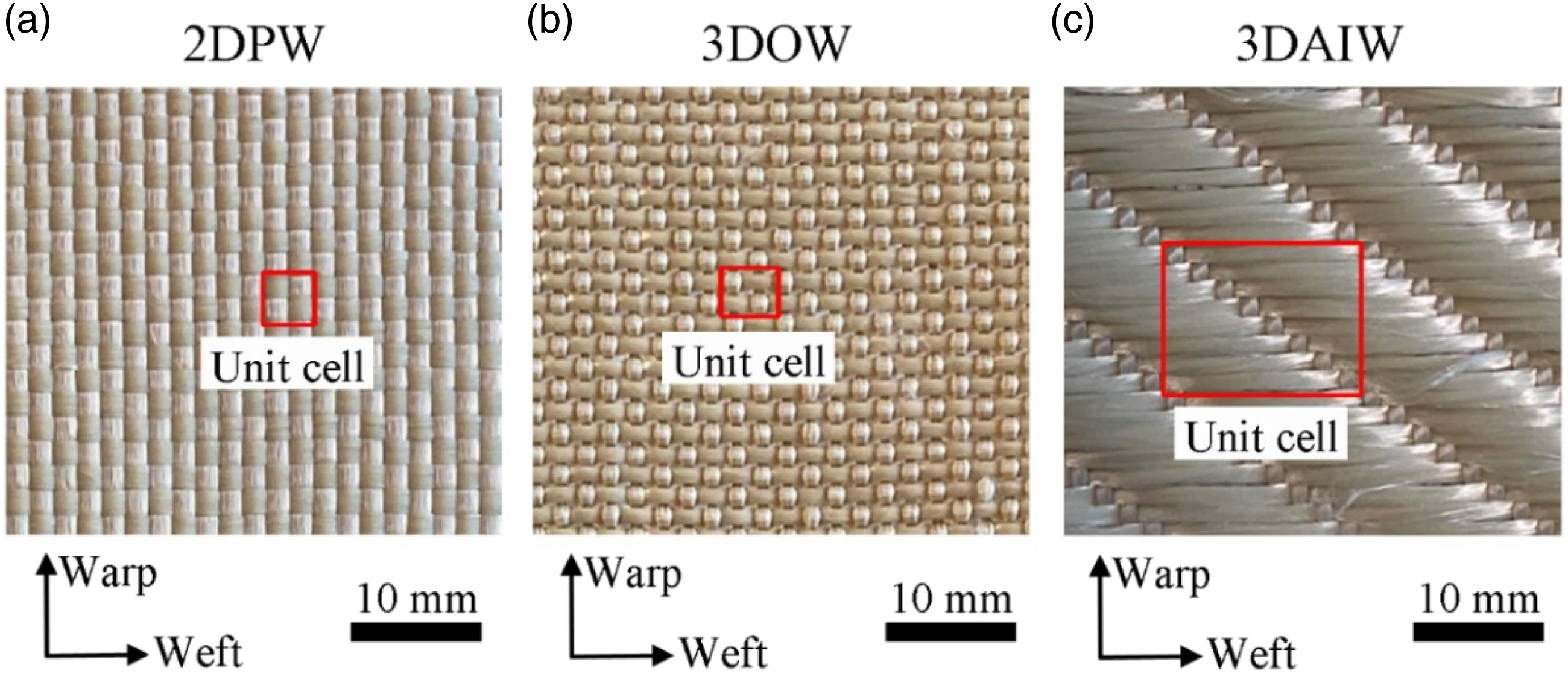
Three warp-yarn layers and four weft yarn layers were used for the 3DOW and 3DAIW structures. Moreover, the binder yarn was in the textile-warp direction in the two woven structures and bound all weft yarn layers from the top layer to the bottom layer in the through-thickness direction. Table 1 lists the specifications of the developed woven textiles. Similar warp- and weft yarn densities (5.2 ends/cm/layer and 5.8–6.1 picks/cm/layer, respectively) were set during weaving processes for 3DOW and 3DAIW structures to acquire similar textile-areal densities. For a single-layer 2DPW textile, a specific warp-yarn density of 5.4 ends/cm was set, and four-layer 2DPW textiles were used to acquire similar textile preform thickness (2.42–2.58 mm) and areal density (1.45–1.49 kg/m2) for the three woven types. Figure 2 displays the photographs of the three woven textiles. The red squares indicate the real size of one repeat-unit in these woven structures, the 3DAIW structure had the largest unit size, and the 3DOW and 2DPW exhibited similar unit sizes. Although the binder yarn density for the 3DOW and 3DAIW structures was the same, the binder yarn in the 3DAIW had limited binding effect compared with the 3DOW structure, which is a tight structural design, because limited weft yarns were bounded, and the binder yarns run more in the warp direction other than in the through-thickness direction in the 3DAIW structure. Structural models for the three types of woven structures: (a) two-dimensional plain-woven (2DPW), (b) three-dimensional orthogonal-woven (3DOW), and (c) three-dimensional angle-interlock woven (3DAIW). Specifications of dry textile preforms. Textile surface photographs for the three types of woven structures: (a) 2DPW, (b) 3DOW, and (c) 3DAIW.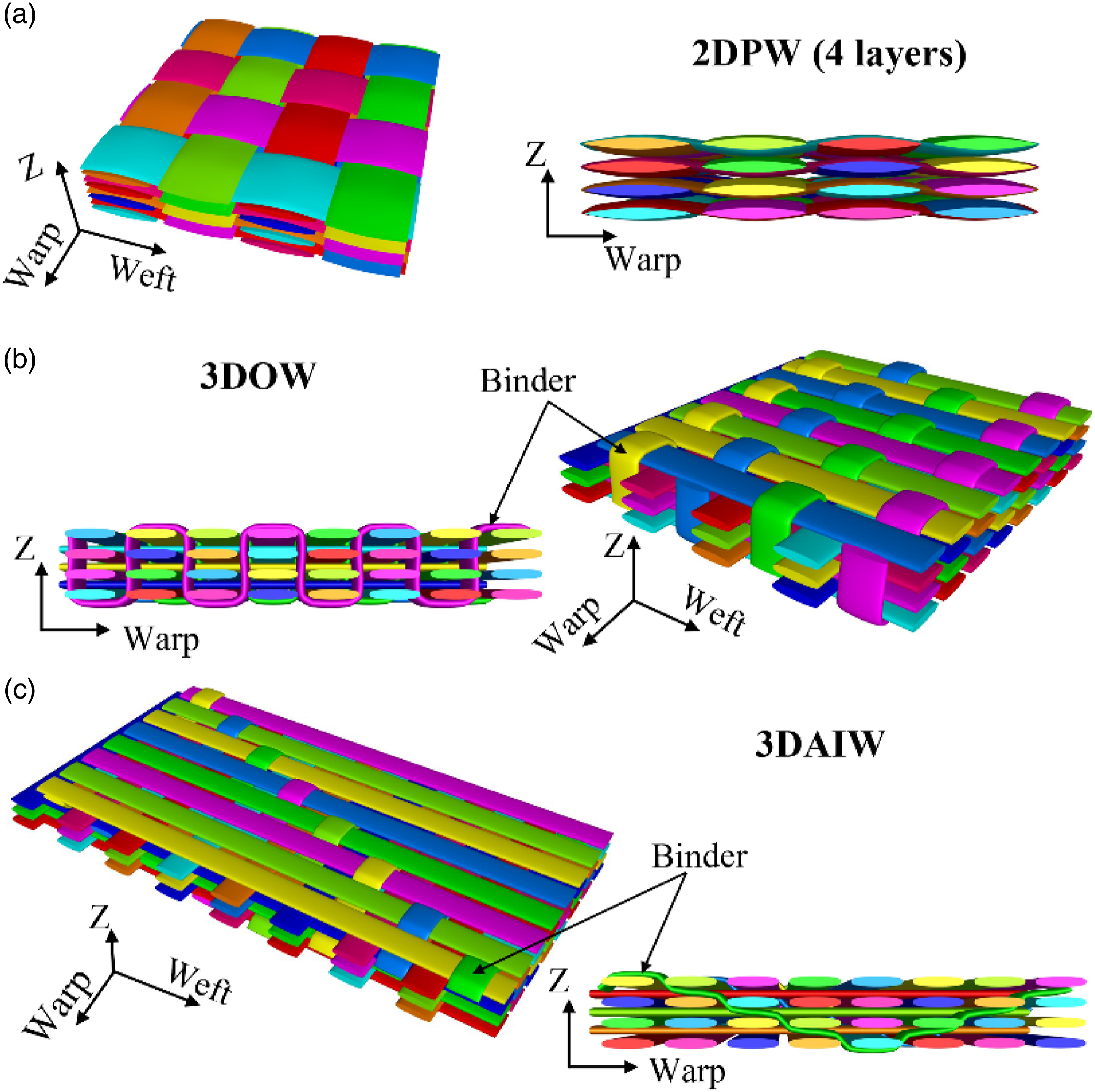
Thermoplastic-epoxy composite fabrication
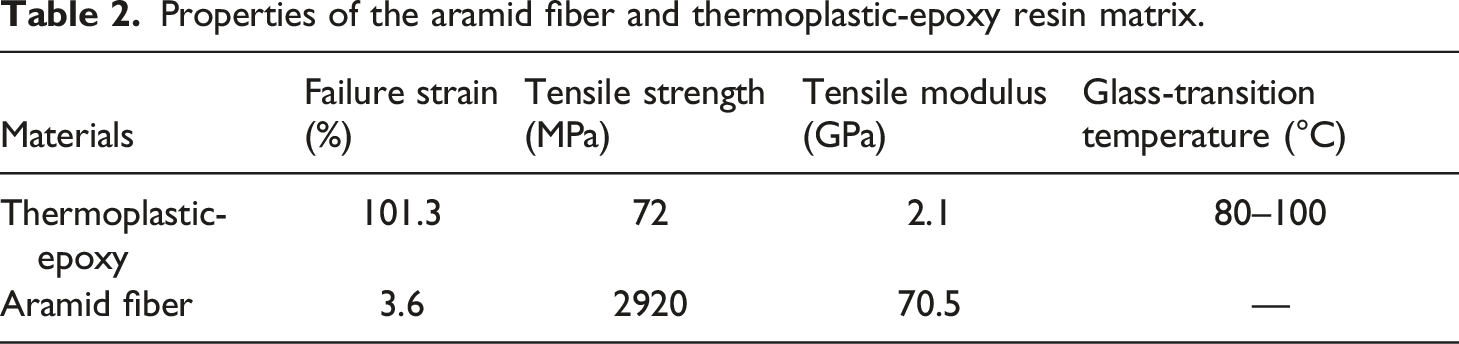
Properties of the aramid fiber and thermoplastic-epoxy resin matrix.
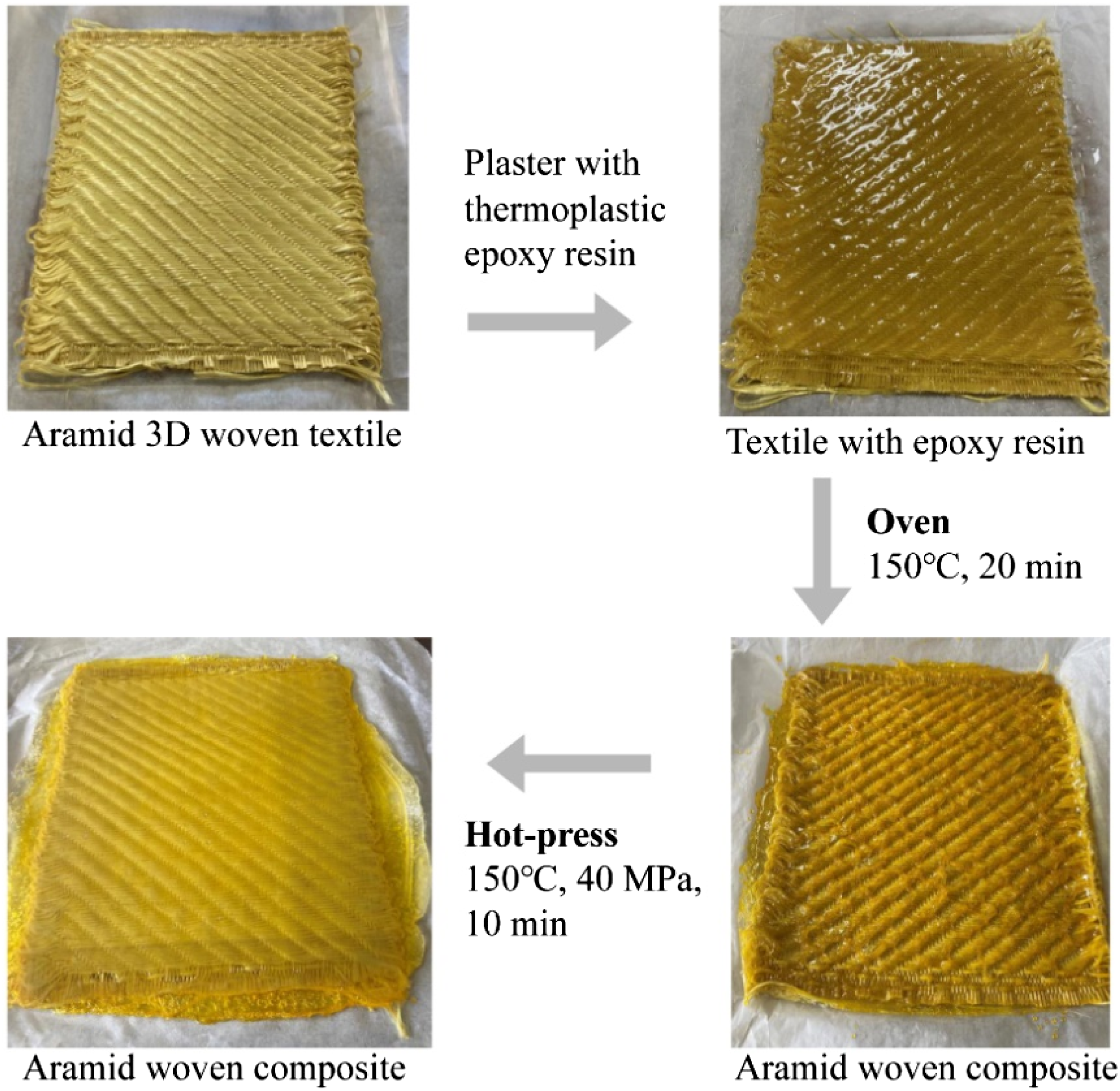
Schematic of the fabrication of aramid fiber-woven textile-reinforced thermoplastic-epoxy composite.
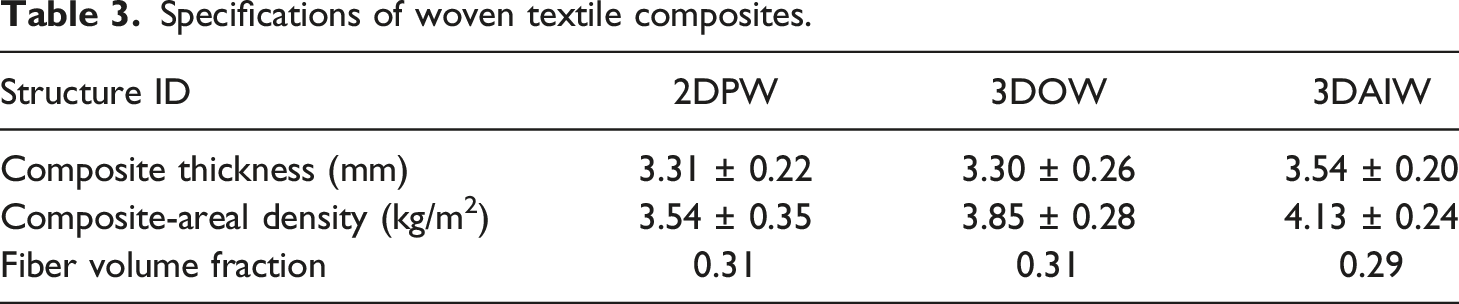
Specifications of woven textile composites.
Drop-weight low-velocity impact test
Low-velocity impact tests were conducted on an Instron Dynatup 9250 HV drop-weight impact testing apparatus. 24 A hemispherical steel impactor with a 12.7-mm diameter, 7.07-kg drop-weight, and 22-kN load cell was applied. The force history was measured by the load cell in the impactor, and the testing apparatus was used to measure the displacement and velocity history of the impactor. The impact energy was adjusted by the height of the drop-weight. The composite specimen with dimensions of 100 × 100 mm2 was held by two rigid square jaw platforms, which had a circular free zone with a diameter of 70 mm, to avoid slippage during test. In this study, single-impact, repeated-impact, and multiple-impact tests with a hot-press damage repairment between two strikes were conducted on the three types of woven composites to investigate their impact-resistance performance under these impact scenarios.
Impact-resistance parameters
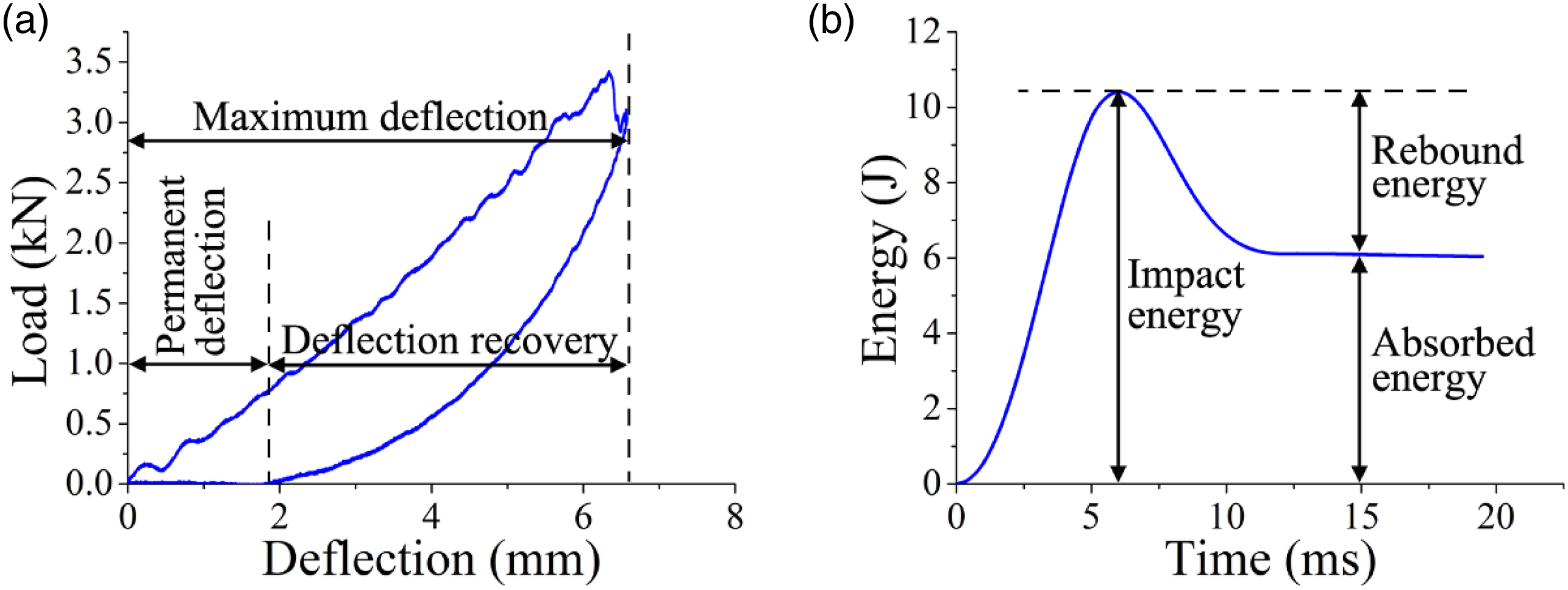
Three types of impact-resistance parameters, such as load-carrying ability, composite deflection characters, and energy characters, were introduced to evaluate the impact-resistance performance of the developed composites. Figure 4 depicts the typical load–deflection and energy–time curves in an impact event. The peak-load was the largest load-carrying ability during the low-velocity impacts. The deflection characters, including maximum deflection ( Typical (a) load–defection and (b) energy–time curves of 3DAIW composites subjected to the 10-J impact test.

Single-impact test
Single-impact tests with impact energy levels of 5, 10, and 20 J were conducted on the three types of thermoplastic composites to investigate the effect of the woven structure and impact energy on their impact-resistance performance. Two composite specimens were subjected to 5-J impacts, four or five specimens were subjected to 10- and 20-J impacts for each woven structure.
Repeated-impact test
Repeated-impact tests with impact energy levels of 5 and 10 J were conducted on 3DOW, 3DAIW, and 2DPW, to investigate the effect of the woven structure and impact energy on their impact-resistance performance and damage development. The same position was stroked in the repeated-impact test. One specimen of each woven structure was subjected to 5- and 10-J impacts.
Multiple-impact test and damage repairment
Multiple-impacted tests with the energy levels of 10 and 20 J were conducted on the damage-repaired thermoplastic composites to investigate the effect of the woven structure and damage-repairment on impact-resistance performance. The damaged composite specimens were repaired using the hot-press machine that was used to fabricate composites at 120°C, 150 MPa, for 20 min. Because the thermoplastic-epoxy resin could be remolded when the temperature returned to its glass-transition temperature (80°C–100°C), the impacted composites could be repaired.25,26 The resin cracks and fiber–matrix debonding or delamination could be repaired to some extent, whereas the aramid fiber-breakage failure could not be repaired. The repaired composite specimens were impacted at the same position with the same energy level. Three composite specimens were tested at each impact scenario. Multiple impacts and damage repairment of these thermoplastic composites were performed to investigate the recyclability of such composite materials.
Failure characterization
Nondestructive X-ray micro-CT (Skyscan 1272, Bruker Corp., USA) was applied to characterize the micro-scale internal failure mechanism and damage repairment effect of the composites after impact tests and hot-press damage repairment, respectively. The inspection specimen (25 × 25 mm2) is cut from the impacted composite plate, and the impacted position is located at the specimen center. The specimen after first X-ray micro-CT inspection was subjected to the damage repairment with same conditions as the specimens in multiple-impact tests, sequentially, a second inspection was applied to observe damage repairment effect. Voxel size of 6–7 µm, specimen rotation step of 0.2°, and two averaging frames at each angular position were set. X-ray beam energy of 90–100 kV and 100–200 μA, and an automatic filter were applied.
Results and discussion
Single-impact-resistance of 3D woven Composites
Figure 5(a1–c2) depict the representative load–deflection and energy–time curves of the three types of woven composites, namely 2DPW, 3DOW, and 3DAIW, subjected to 5-, 10-, and 20-J impact energy levels. The three types of composites exhibited similar load–deflection and energy–time behavior when subjected to 5-J impacts (Figure 5(a1 and a2)) as well as Table 4). This phenomenon could be attributed to the fact that 5 J is a relative low energy level and could cause limited damage in these woven composites. In these 5-J impacts, small maximum and permanent deflections were observed. More energy (49.7%–70.5% of the impact energy) rebounded to the impactor, which indicated that limited damage was introduced to these woven composites when subjected to 5-J impacts. When the composites were subjected to 10-J impacts, maximum and permanent deflections (Figure 5(b1)) were larger than 5-J impacts. Relative less energy rebounded (34.8%–43.0% of the impact energy) compared with that under 5-J impacts, as displayed in Figure 5(b2). These woven composites also exhibited similar impact-resistance performance when subjected up to 10-J impacts. When the composites were subjected to 20-J impacts, larger maximum and permanent deflections occurred (Figure 5(c1)), which revealed that larger damage were introduced in these woven structures. Almost no rebound energy was observed for the 2DPW structure, and limited rebound energy was observed for 3DOW and 3DAIW structures (approximately 16.9% and 13.7% of the impact energy, respectively), as displayed in Figure 5(c2). Representative load–deflection and energy–time curves for the 3D woven composites subjected to (a1, a2) 5-J, (b1, b2) 10-J, and (c1, c2) 20-J single impacts. Single-impact test results: (d) peak-load, (e) deflection recovery ratio (DRR), and (f) impact-resistance index (IRI). Single-impact test results of the three types of woven composites.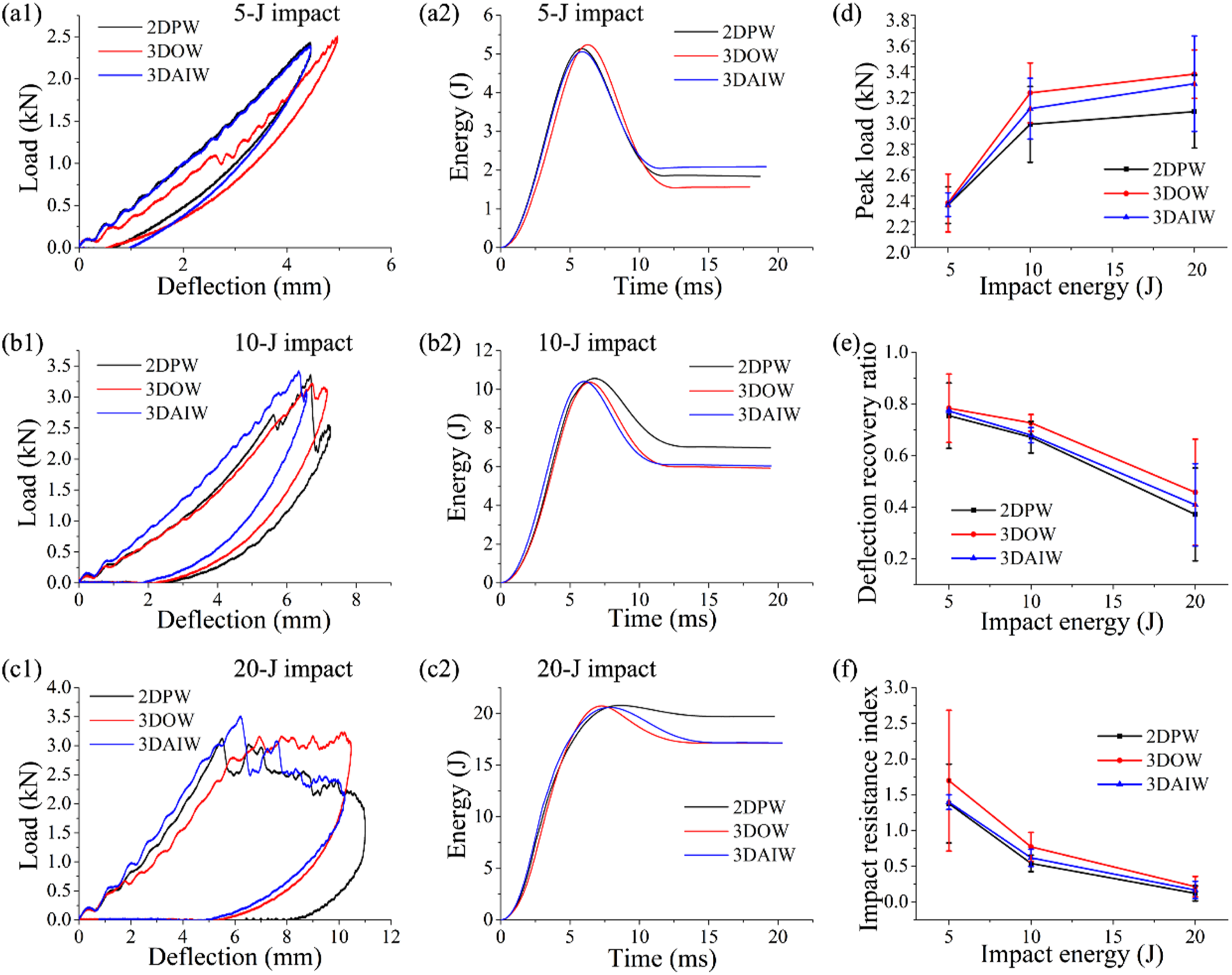
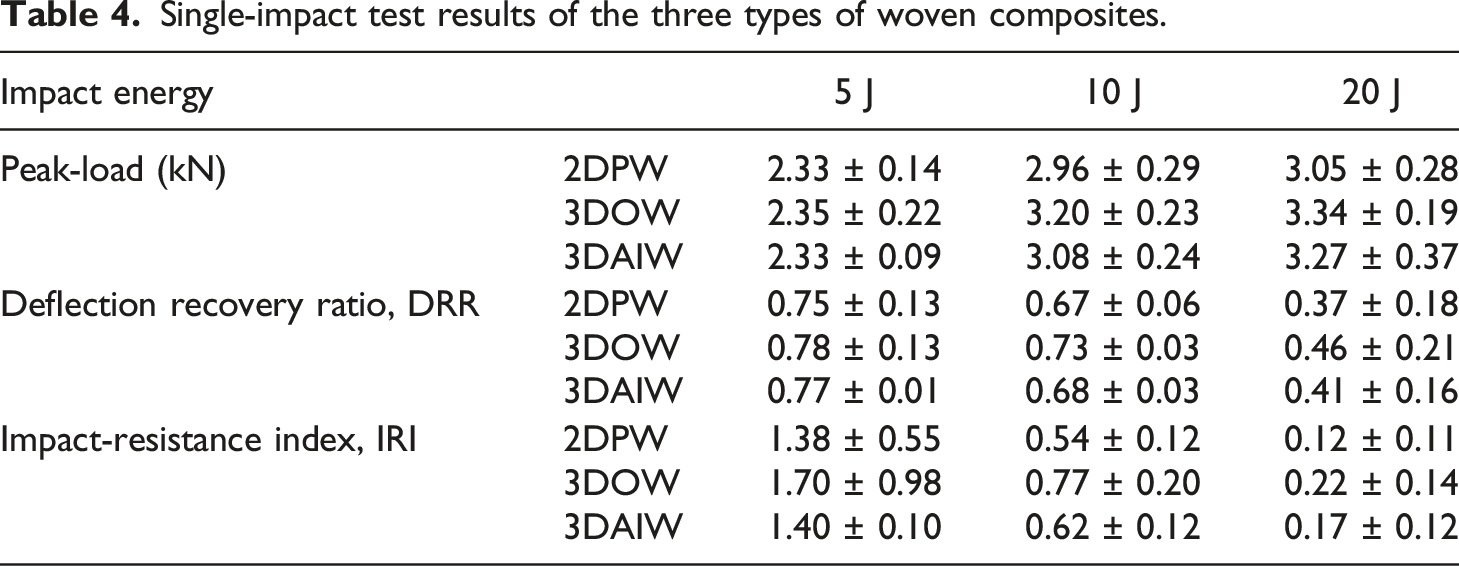
Figure 5(d–f) as well as Table 4 detail the single-impact test results of 2DPW, 3DOW, and 3DAIW subjected to 5-, 10-, and 20-J impacts. The peak-load values increased with the impact energies for all three structures, as displayed in Figure 5(d). Similar peak-load values were observed for the three woven structures when subjected to 5-J impact. A larger value for 3DOW, followed by 3DAIW and 2DPW structures, were observed when subjected to 10- and 20-J impacts. This phenomenon indicates that the 3DOW structure exhibited superior impact performance from the perspective of load-carrying ability and followed with 3DAIW and 2DPW structures, especially for higher impact energy levels (10 and 20 J). For the deflection recovery ability of these woven composites (Figure 5(e)), similar DRR values were observed for 5-J impacts; a slightly larger value for the 3DOW structure than other two structures for 10-J impacts; a slightly larger value for the 3DOW structure and followed with 3DAIW and 2DPW structures for 20-J impacts. The 3DOW structure exhibited superior recovery ability during an impact event, especially in the higher impact energy levels, followed by 3DAIW and 2DPW structures. For the IRI in Figure 5(f), the 3DOW structure exhibited a larger IRI value than other two structures under 5- and 10-J impacts. Furthermore, the 3DOW structure exhibited superior impact-resistance performance and followed with 3DAIW and 2DPW structures when subjected to single impacts from perspectives of these impact-resistance parameters.
Figure 6 displays the bottom (unimpacted side) and top (impacted side) surface photographs of the three woven composites subjected to 5-, 10-, and 20-J single impacts. More failures occurred on the bottom surface than on the top surface. This phenomenon could be attributed to the bottom surface undergoing the largest tensile stress and strain during an impact event. These results were observed in other references 24,27,28. For the 5-J impacts, small-scaled fiber–matrix debonding failure (enclosed with red circles) was observed on the bottom surface for the 2DPW and 3DAIW structures, and resin cracks (marked with bule arrows) were observed for all three composites, as displayed in Figure 6(a1–c1). More resin cracks were introduced for 3DAIW structures, even for 5-J impacts. No obvious damage was observed on the top surface for all three woven structures when subjected to 5-J impacts, as displayed in Figure 6(a4–c4). For the 10-J impacts, larger-scaled damages occurred both on bottom and top surfaces for the three woven structures (Figure 6(a2–c2) as well as (a5–c5)). When compared with fiber–matrix debonding failure, a smaller failure area was observed for 3DOW than those of the other two structures both on the bottom and top surfaces. More resin cracks appeared for the 3DAIW structure on the bottom surface. For 20-J impacts, severe perforation was observed for all three woven composites. On the bottom surface, limited debonding failure area was observed for the 3DOW structure, and more and longer resin cracks were observed for the 3DAIW structure, as displayed in Figure 6(a3–c3). On the top surface, hemispherical dents (enclosed with blue-dotted circles) were observed on the composites for three woven composites, as well as debonding and delamination (enclosed with red circles) were observed around the dents (Figure 6(a6–c6)). Fiber-breakage failures likely occurred within the debonding/delamination area for the three woven composites when subjected to higher impact energy levels (10 and 20 J) through observation. The fiber-breakage failures were more likely developed for 2DPW and 3DAIW structures. Bottom and top surface photographs of the composites subjected to 5-J, 10-J, and 20-J impacts for (a1–a6) 2DPW, (b1–b6) 3DOW, and (c1–c6) 3DAIW.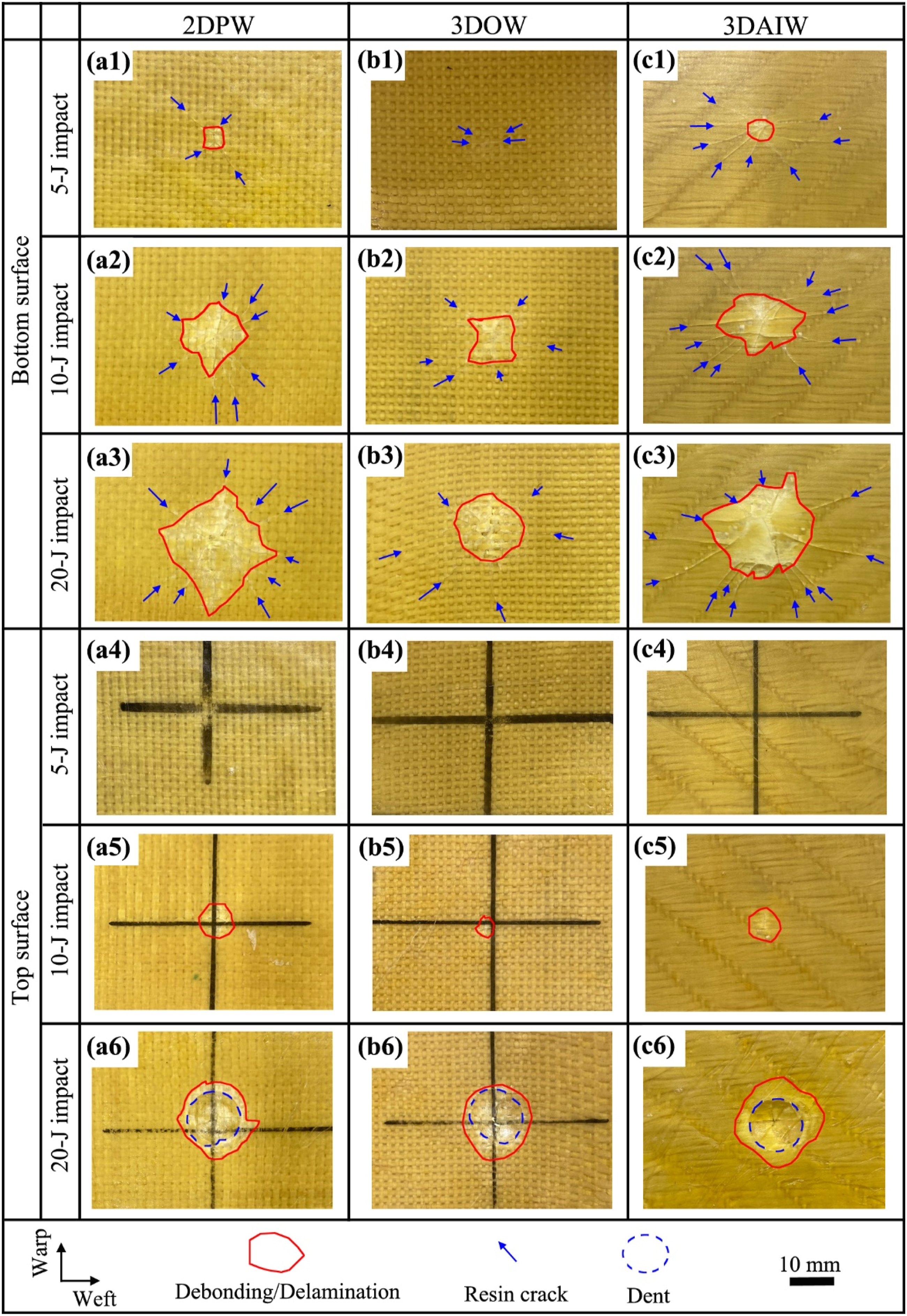
A detailed failure mechanism was characterized for the three types of composites subjected to 10-J single impacts using X-ray micro-CT scanning. Figure 7 depicts the X-ray micro-CT images for the impacted 2DPW composite. Due to the symmetry of warp and weft direction of the 2DPW composite, which is reinforced with plain-woven structures, it is assumed that failure modes are similar along wrap and weft directions. A slice (slice 1) which is parallel to warp direction and beneath the impacted point, as shown in Figure 7(a), was used to observe the failure mode. As shown in Figure 7(c), it could be observed that delamination failures developed in all layers and a collapse failure (enclosed with a white dashed square) developed mainly in bottom two layers which near the unimpacted surface. In the collapse failure area, large-scaled fiber–matrix debonding and fiber failure were observed. Long resin cracks were also observed at the bottom surface as shown in the Figure 7(b), which are identical to the Figure 6(a2). Figure 8 depicts the failure modes in impacted 3DOW composite. Two slices along the warp and weft directions, as shown in Figure 8(a), were used to characterize the failure mechanism. Resin cracks were observed at the bottom surface for the 3DOW composites (Figure 8(b)), which is similar with 2DPW composite. For the slice (slice 1) along the warp direction (Figure 8(c)), resin cracks may be initiated at the bottom surface and developed along binder yarns as the yarn–matrix debonding failure mode. Yarn–matrix debonding failure was also observed in the slice along the weft direction (slice 2), as shown in Figure 8(d). Compared with 2DPW composite, there is no severe collapse failure developed in 3DOW composite, which also proves the superior impact resistance and damage tolerance of the 3DOW composite. It should be noted that there are a lot of voids mainly attributing in the middle layers and near binder yarns of the 3DOW structure (as shown in Figure 8(c) and (d)), and this is mainly because that the tight structural feature of the 3DOW and the molding technique used in the current research. Even though lots of voids existed, 3DOW composite exhibit superior impact performance. Figure 9 depicts the failure modes in the 10-J impacted 3DAIW composite. Two slices along the warp and weft directions, as shown in Figure 9(a), were used to characterize the failure mechanism. Resin cracks and collapse failures were observed at the bottom surface for the 3DAIW composite (Figure 9(b)), which is different from the other two composites. For slice along warp direction (slice 1) as shown in Figure 9(c), severe limited delamination was observed among yarn layers. For slice along weft direction (slice 2) as shown in Figure 9(d), beyond the severe limited delamination, a collapse failure area was also observed near bottom surface, and in which there is fiber failure mode same as 2DPW composites. X-ray micro-CT images of 2DPW composite after 10-J impact: (a) 3D image, (b) bottom surface image, and (c) slice image parallel to warp direction. X-ray micro-CT images of 3DOW composite after 10-J impact: (a) 3D image, (b) bottom surface image, (c) slice image parallel to warp direction, and (d) slice image parallel to weft direction. X-ray micro-CT images of 3DAIW composite after 10-J impact: (a) 3D image, (b) bottom surface image, (c) slice image parallel to warp direction, and (d) slice image parallel to weft direction.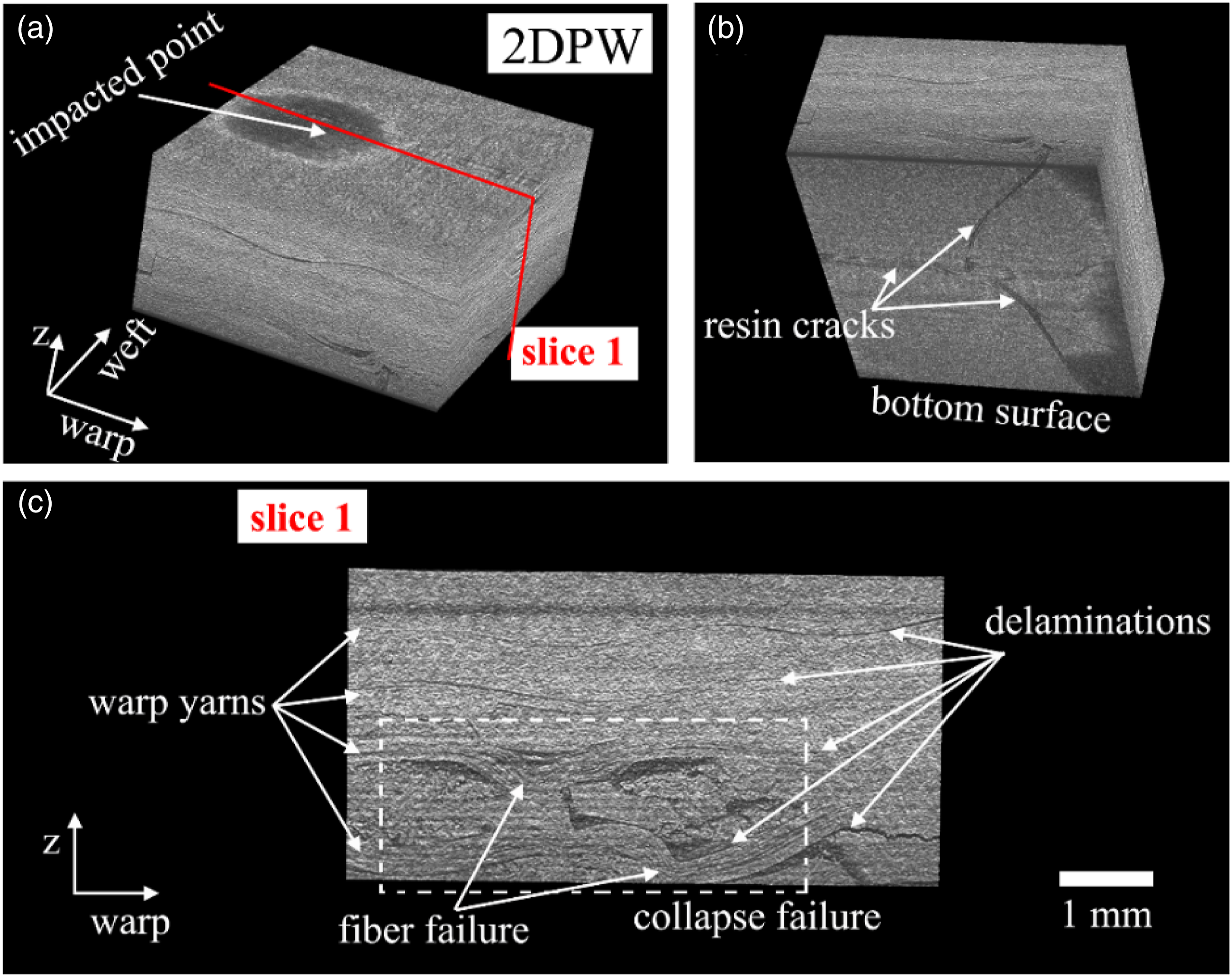
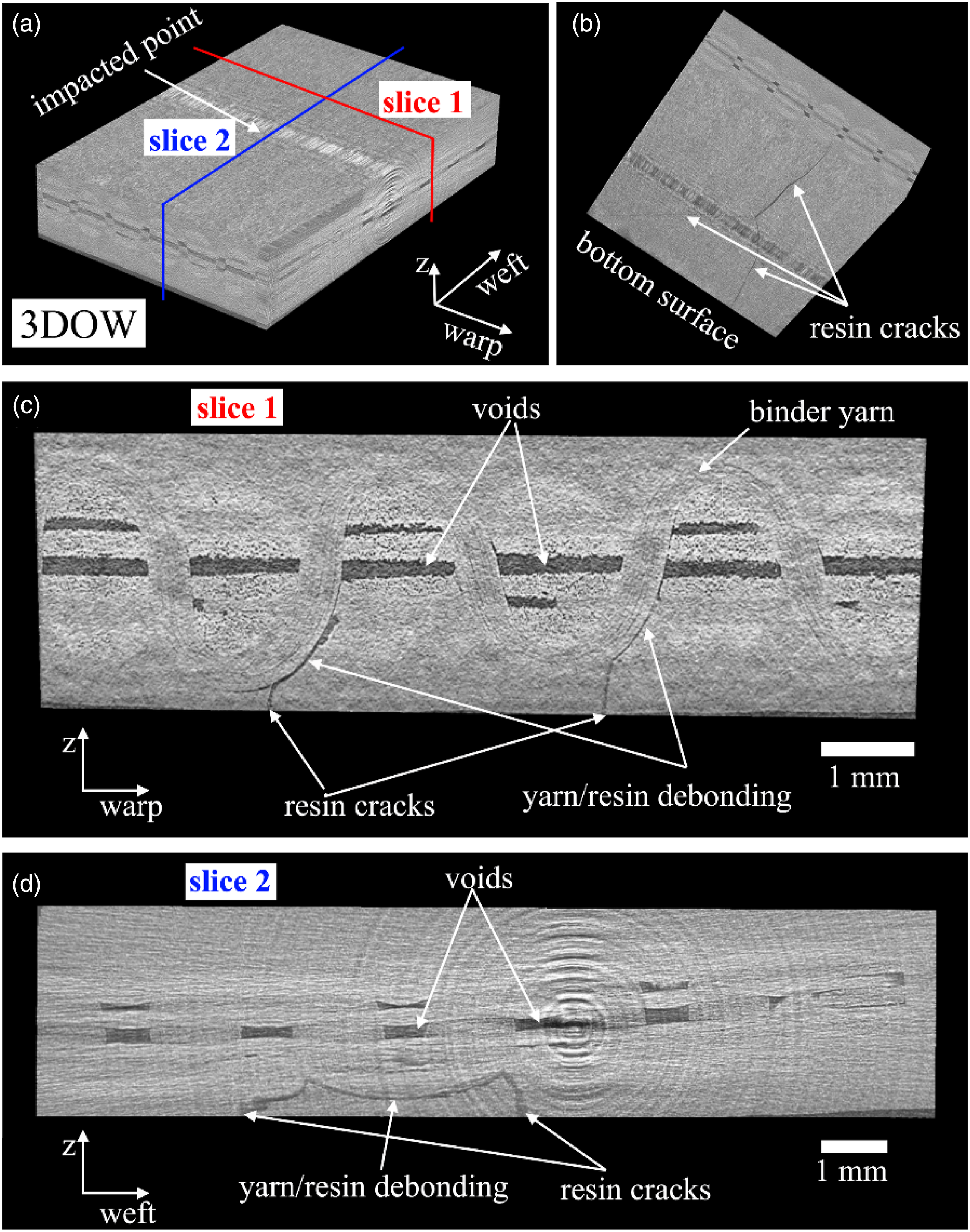
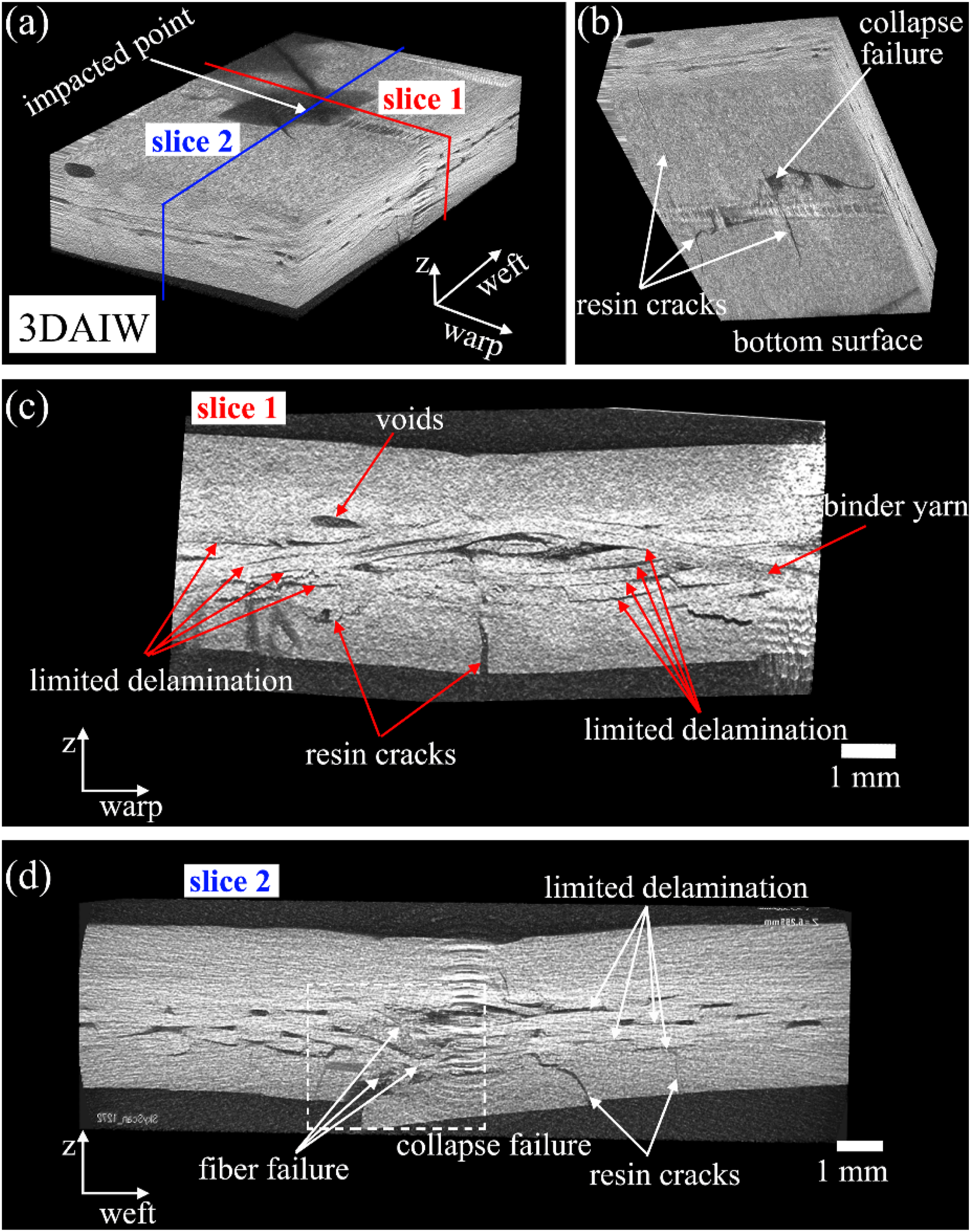
Furthermore, failures, such as fiber–matrix debonding and resin cracks, were likely introduced on the bottom surface for the developed woven composites. The three woven composites exhibited distinct failure modes, especially when subjected to higher impact energy levels. Fiber–matrix debonding or delamination as well as fiber-breakage failure were more easily introduced in 2DPW and 3DAIW structures; severe resin cracks were observed for 3DAIW; least total failures were detailed for the 3DOW. The failure difference of the three woven composites subjected to single impacts typically originated from the woven structure difference. For the 2DPW structure, there is no yarn interlacement at plain-woven interlayers; however, there is warp–weft yarn interlacement at intralayer, which has an impact-resistance effect. For 3DAIW structures, even though binder yarns bound all weft and warp yarns layers together, there is no interlacement between the warp and weft yarns. Moreover, the binder yarn ran more in the in-plane direction and achieved a limited binding effect and a loose structure in the 3DAIW. The 3DOW woven structure exhibited the largest amount binder yarn running in through-thickness direction and binding all warp and weft yarn layers together. This tight interlocking effect may contribute to the higher impact-resistance and damage-tolerance performance among the three woven structures.
Repeated-impact-resistance of 3D woven composites
Repeated-impacted tests with impact energy levels of 5 and 10 J were conducted on 2DPW, 3DOW, and 3DAIW to investigate the effect of the woven structure, impact energy level on their repeated-impact-resistance. Figure 10 depicts the repeated-impact test results of these woven composites. For 5-J repeated impacts (Figure 10(a1–c1)), the three types of composites exhibited similar behaviors. Slightly larger peak-load values were observed for the 3DOW structure, followed by those for 3DAIW and 2DPW structures. However. the peak-load values of the three composites were within 2.55–2.75 kN (constant values after the fourth strike), as displayed in Figure 10(a1). The three woven composites could survive 20 times of 5-J repeated impacts because no peak-load value drops were observed. The peak-load values increased drastically for the first three or four strikes in the repeated impacts, which could be attributed to the indent leaves on the impacted composites increasing the contact surface between the impactor and composites for the first several strikes, which increased peak loads. After three or four strikes, the indent may remain constant, and an obvious peak-load value increment was not observed. For the deflection recovery ability, similar and larger DRR values (above 0.75) were observed for the three woven structures, as displayed in Figure 10(b1), which reveals larger deflection recovery ability for woven composites subjected to 5-J repeated impacts and limited damage. The IRI of the three woven composites subjected to 5-J repeated impacts also had large values above 1.5 (Figure 10(c1)), which revealed that most of the impact energy rebounded (above 60%) to the impactor and the impact-resistance performance remained excellent even after 20 strikes. Repeated-impact test results of 3D woven composites: (a1) peak-load, (b1) DRR, and (c1) IRI subjected to 5-J repeated impacts; (a2) peak-load, (b2) DRR, and (c2) IRI subjected to 10-J repeated impacts.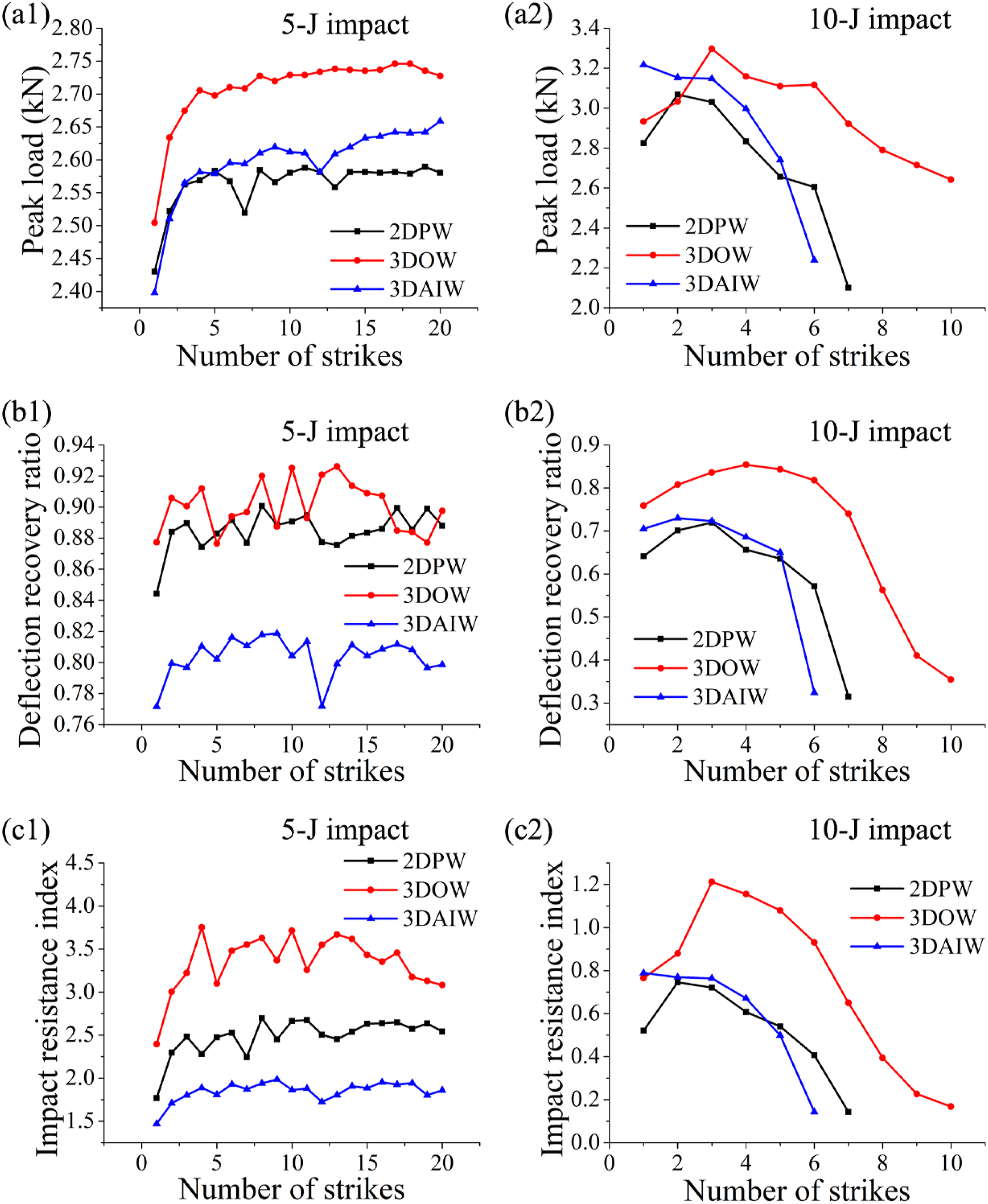
Figure 11 depicts the failure development on the bottom surface of the three woven composites subjected to 5-J repeated impacts. The results revealed that failure development after fifth impact was not obvious for all woven structures. Failure mode difference was observed for the three woven structures. Less long resin cracks were observed at the bottom surface for the 2DPW structure (Figure 11(a1–a5)). For the 3DOW structure, numerous and longer resin cracks developed at the bottom surface after the fifth strike (Figure 11(b2–b5)) than those in 2DPW. For the 3DAIWstructure, longer resin cracks and larger scale of debonding or delamination failure was observed (Figure 11(c1–c5)). The three types of composite structures exhibited similar and excellent impact-resistance performance when subjected to 5-J repeated impacts because failure development was not obvious after the fifth strikes. Longer and more resin cracks were observed for the 3DOW and 3DAIW structures, larger debonding or delamination for 3DAIW. Bottom surface photographs of composites under first, fifth, tenth, fifteenth, and twentieth 5-J repeated impacts for (a1–a5) 2DPW, (b1–b5) 3DOW, and (c1–c5) 3DAIW.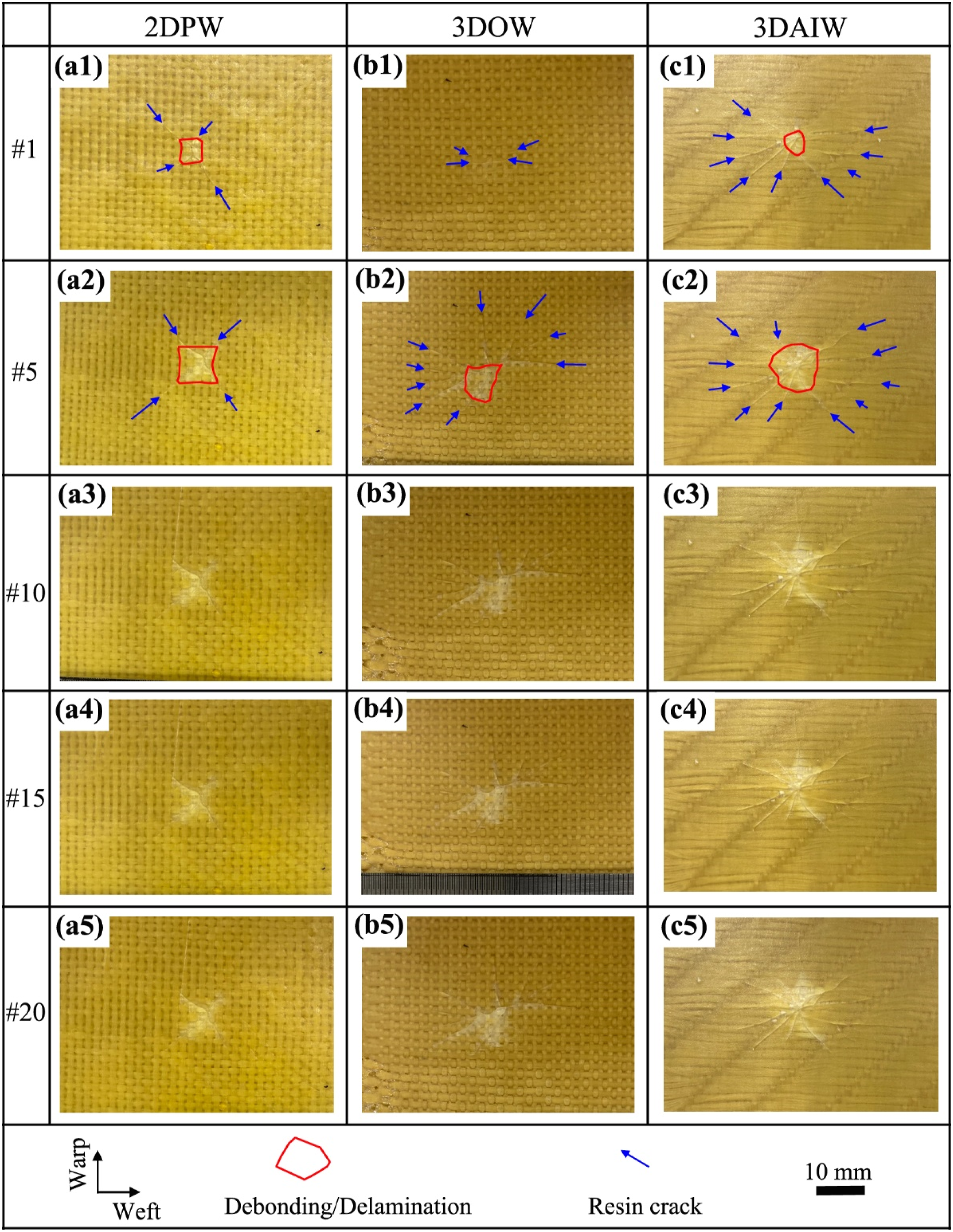
For the 10-J repeated impacts (Figure 10(a2–c2)), distinct behavior was observed for the three woven structures comparted with 5-J impacts. For the peak-load values, slow value drops were observed for the 3DOW structure, and sharp drops were observed for 3DAIW and 2DPW structures after the third strikes (Figure 10(a2)). Thus, less failure occurred for 3DOW structures after third strike compared with the other two woven structures. Furthermore, larger peak-load values were observed for 3DOW, which resulted in larger load-carrying ability. The largest DRR values were observed for the 3DOW structure, and similar values were observed for the other two structures, as displayed in Figure 10(b2). This phenomenon confirmed that the 3DOW structure had less failures and superior deflection recovery ability when subjected to 10-J repeated impacts. The 2DPW and 3DAIW structures exhibited sharp drops in the DRR value after the fifth (from 0.6 to 0.3) and the sixth strikes (from 0.7 to 0.3), respectively, which revealed the occurrence of severe failures. By contrast, the 3DOW structure exhibited sharp DRR value drops after the seventh strike and reached 0.3 at the tenth strike. For the IRI values in Figure 10(c2), similar results with DRR values were observed for the three woven composites. The 2DPW, 3DOW, and 3DAIW structures reached the IRI values of approximately 0.1 at the seventh, sixth, and tenth strikes, respectively. The 3DOW structure could survive more strikes until perforation than the other two woven structures. These results revealed that the 3DOW structure outperformed the other two structures in terms of the impact-resistance performance when subjected to 10-J repeated impacts.
Figure 12 depicts failure development on the bottom surface of the three woven composites subjected to 10-J repeated impacts. Gradual failure development occurred for all three woven composites, especially for fiber–matrix debonding or delamination failure areas (enclosed with red circles in Figure 12). Larger failure areas were observed for the 3DAIW structure, followed by 2DPW and 3DOW structures. More long resin cracks developed for 3DAIW (Figure 12(c1–c3)). The 3DOW structure, which exhibited the highest 10-J repeated-impact-resistance and damage tolerance than the other two structures, was the optimal structural design for the engineering applications subjected to repeated impacts. Bottom surface photographs of composites under first, third, and fifth 10-J repeated impacts for (a1–a3) 2DPW, (b1–b3) 3DOW, and (c1–c3) 3DAIW.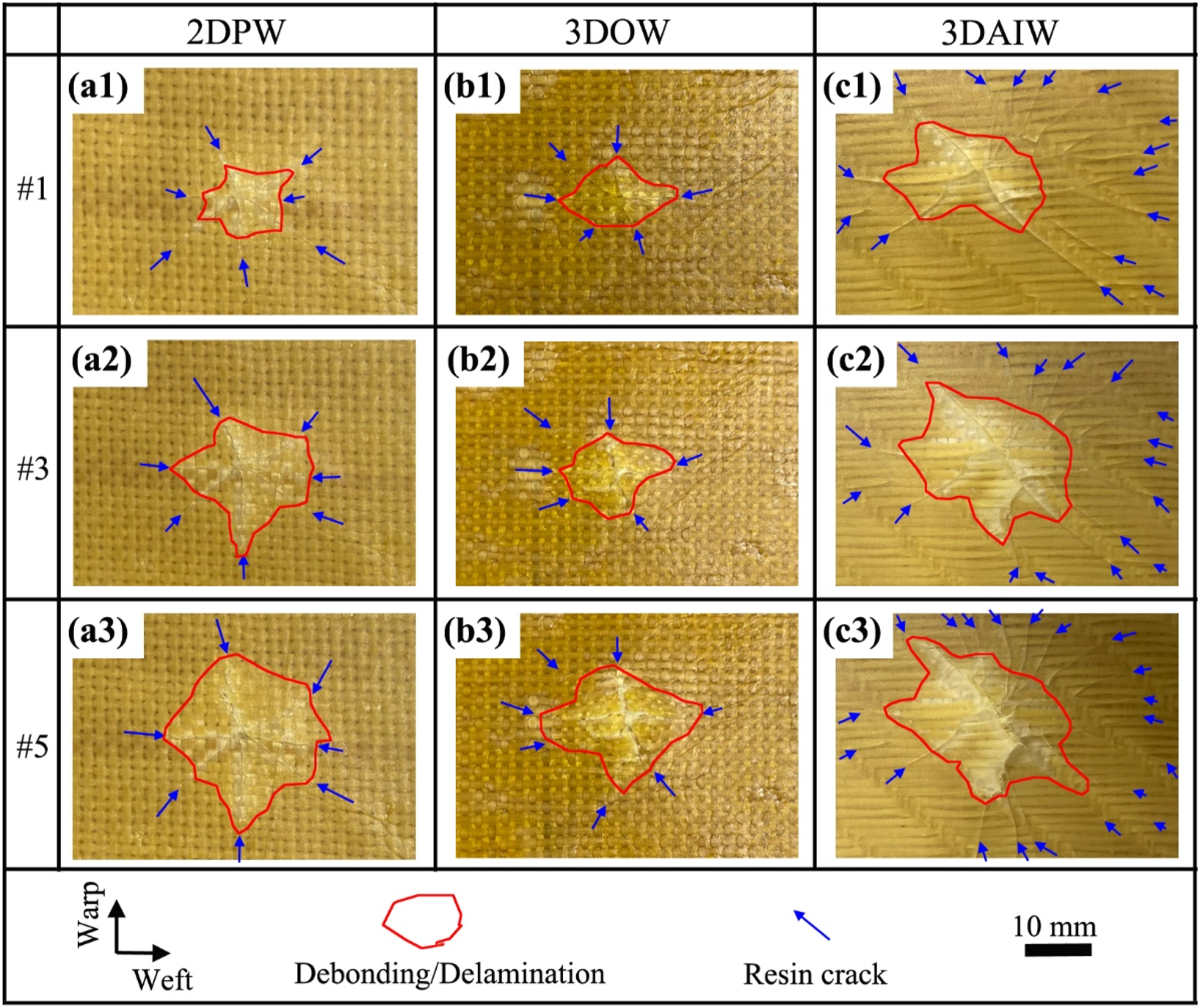
Multiple-impact-resistance of 3D woven composites with damage repairment
Multiple-impact tests with impact energy levels of 10 and 20 J were conducted on the repaired thermoplastic composites, namely 2DPW, 3DOW, and 3DAIW, to investigate the effect of the woven structure, impact energy, as well as damage repairment on their impact-resistance performance. Figure 13(a1–c1) and Table 5 present the results of multiple-impact tests with hot-press damage repairment for the three types of composites subjected to 10 J impact energy level. The load-carrying abilities gradually reduced with the increase in the number of strikes for all three woven composites, as displayed in Figure 13(a1). This phenomenon could be attributed to 10-J impacts that could introduce fiber-breakage failures for all three woven structures. Although the resin cracks as well as fiber–matrix debonding or delamination could be repaired to a certain extent by the hot-press repairment technique, fiber-breakage could not be repaired. The 3DOW structure exhibited larger peak-load values and followed with 3DAIW and 2DPW structures under multiple impacts. Furthermore, the peak-load values under the fifth strikes decreased 45.8%, 24.1%, and 19.9% compared with the first strikes of these composites for 2DPW, 3DOW, and 3DAIW structures, respectively. Hot-press damage repairment was more obvious for the 3DAIW structure, in which fiber–matrix debonding or delamination failure as well as resin cracks dominated and followed by 3DOW and 2DPW structures. Regarding the deflection recovery ability (Figure 13(b1)), 3DOW and 3DAIW structures exhibited similar DRR values during five strikes, whereas the 2DPW structure exhibited gradually drops, which revealed that damage repairment had excellent effect for the 3DOW and 3DAIW composites, and poor effect for 2DPW. From perspectives of the IRI displayed in Figure 13(c1), 3DOW and 2DPW exhibited a decreasing trend with the increasing number of strikes, whereas 3DAIW exhibited did not exhibit any IRI value drop tendency. This phenomenon could be attributed to the 3DAIW structure easily introducing fiber–matrix debonding or delamination failure as well as resin cracks, and these failure modes were likely to be repaired by hot-press damage repairment. Multiple-impact test results with hot-press damage repairment of 3D woven composites subjected to 10 and 20 J impact energy level: (a1–a2) peak-load, (b1–b2) DRR, and (c1–c2) IRI. Multiple-impact test results of 3D woven composites subjected to the 10 J impact energy level.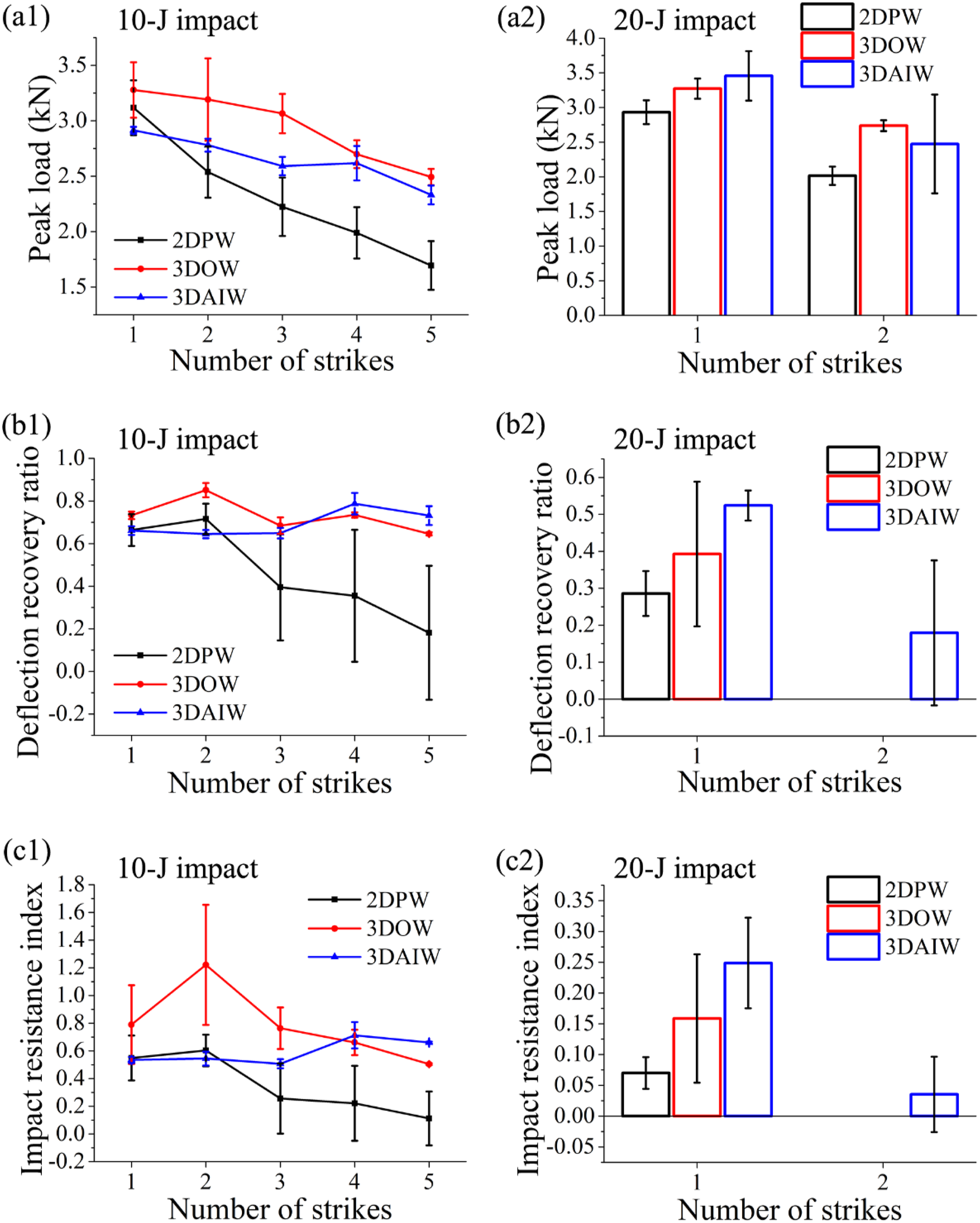
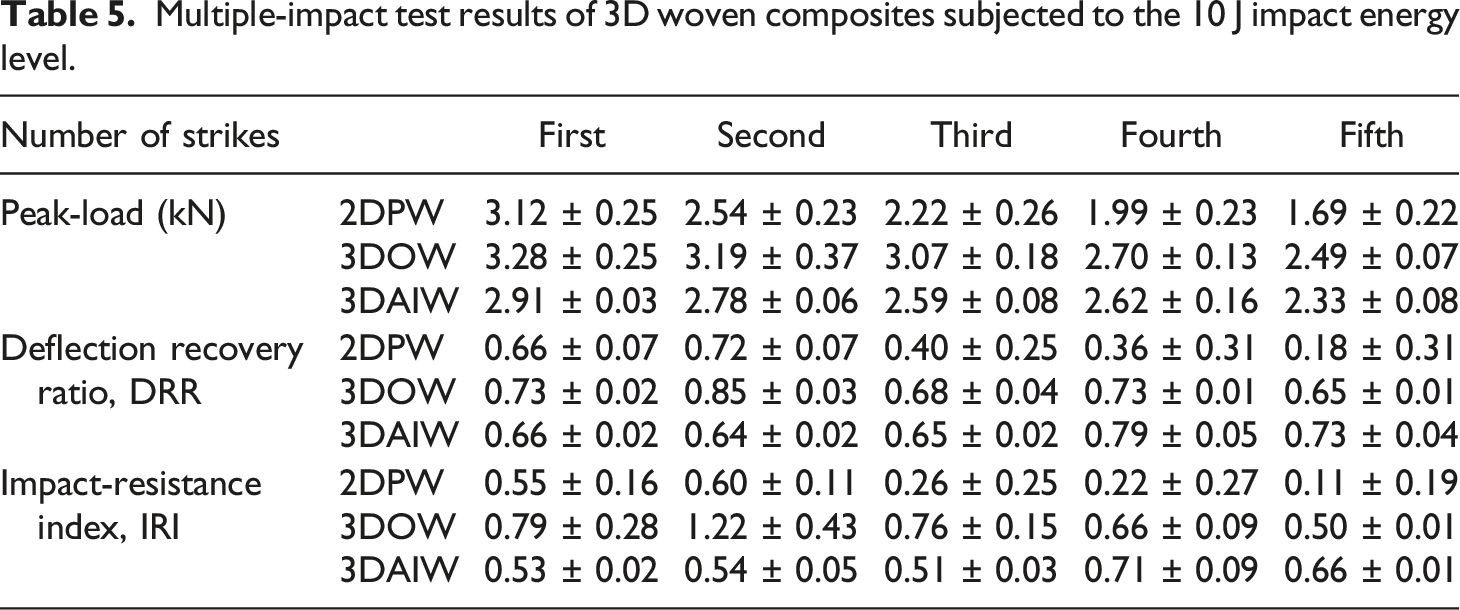
Figure 14 depicts the damage repairment effect on the composites after first 10-J impacts and first hot-press damage repairment. With damage repairment, the impacted composites with pyramid-shaped or hemisphere-shaped failure could return to the original shape (a flat plate). The fiber–matrix debonding or delamination failure could be repaired to a certain extent on the top surfaces of the three composites, as displayed in Figure 14(a1–c1 and a3–c3). Fiber–matrix debonding or delamination failure as well as resin cracks on the bottom surfaces of the three woven composites could be repaired well, as displayed in Figure 14(a2–c2 and a4–c4). This phenomenon confirmed that the hot-press technique had a considerable damage repairment effect on these thermoplastic composites, especially for the 3DAIW structure. Bottom and top surface photographs of composites under first 10-J strike and first repairment for (a1–a4) 2DPW, (b1–b4) 3DOW, and (c1–c4) 3DAIW.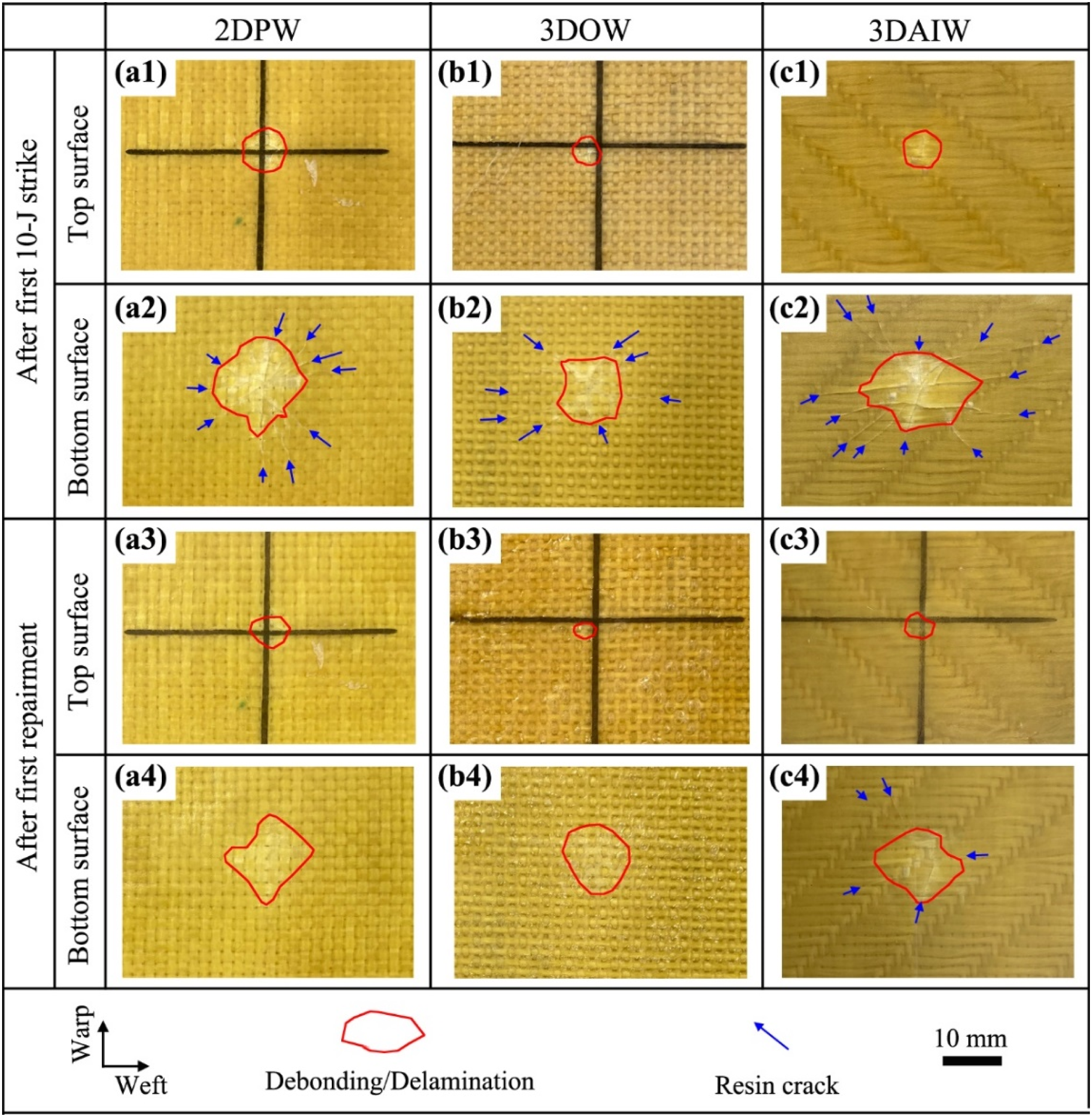
Multiple-impact test results of 3D woven composites subjected to 20-J impact energy level.
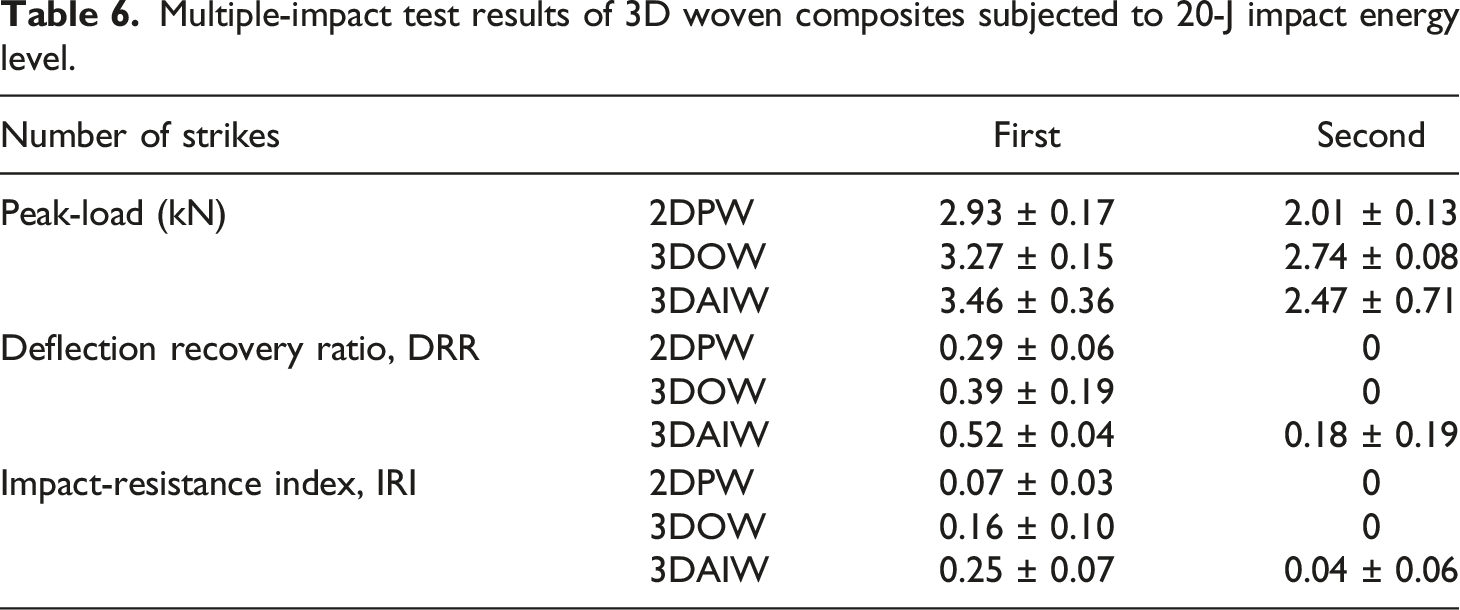
Figure 15 depicts the damage repairment effect on the composites after first 20-J impacts and first hot-press damage repairment. The perforated composites with severe failures could be remolded to the original shape (a flat plate), even though the failed fibers could not be repaired. The perforated hole could be filled after repairment for the three composites, as displayed in Figure 15(a1–c1 and a3–c3). Fiber–matrix debonding or delamination failure as well as resin cracks on the bottom surfaces of the three woven composites could be repaired well, as depicted in Figure 15(a2–c2 and a4–c4). Although the mechanical performance reduced considerably under the high impact energy level of 20 J, the hot-press repairment could repair failures to some extent and ensure structure completeness. Bottom and top surface photographs of composites under first 20-J strike and first repairment for (a1–a4) 2DPW, (b1–b4) 3DOW, and (c1–c4) 3DAIW.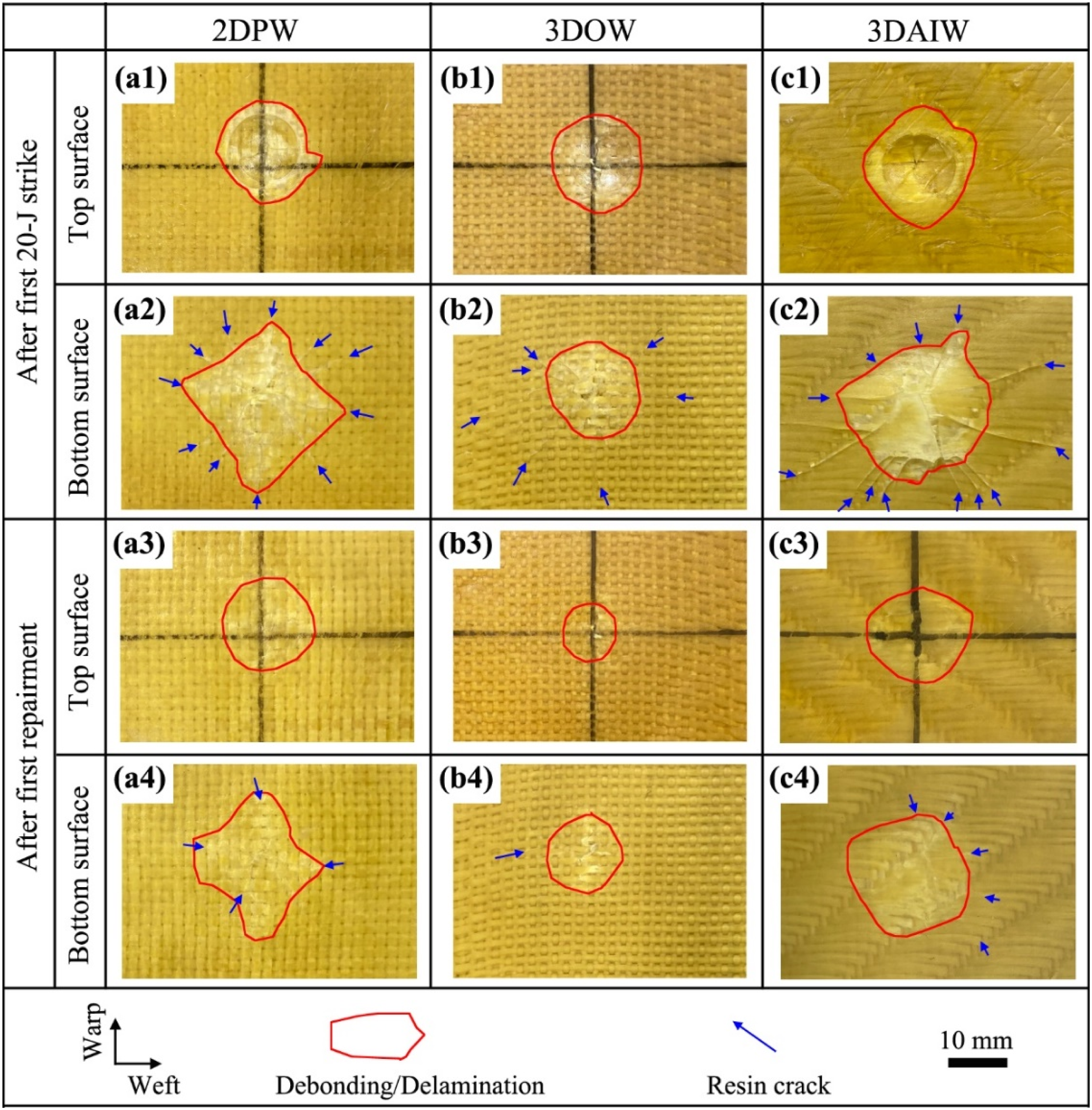
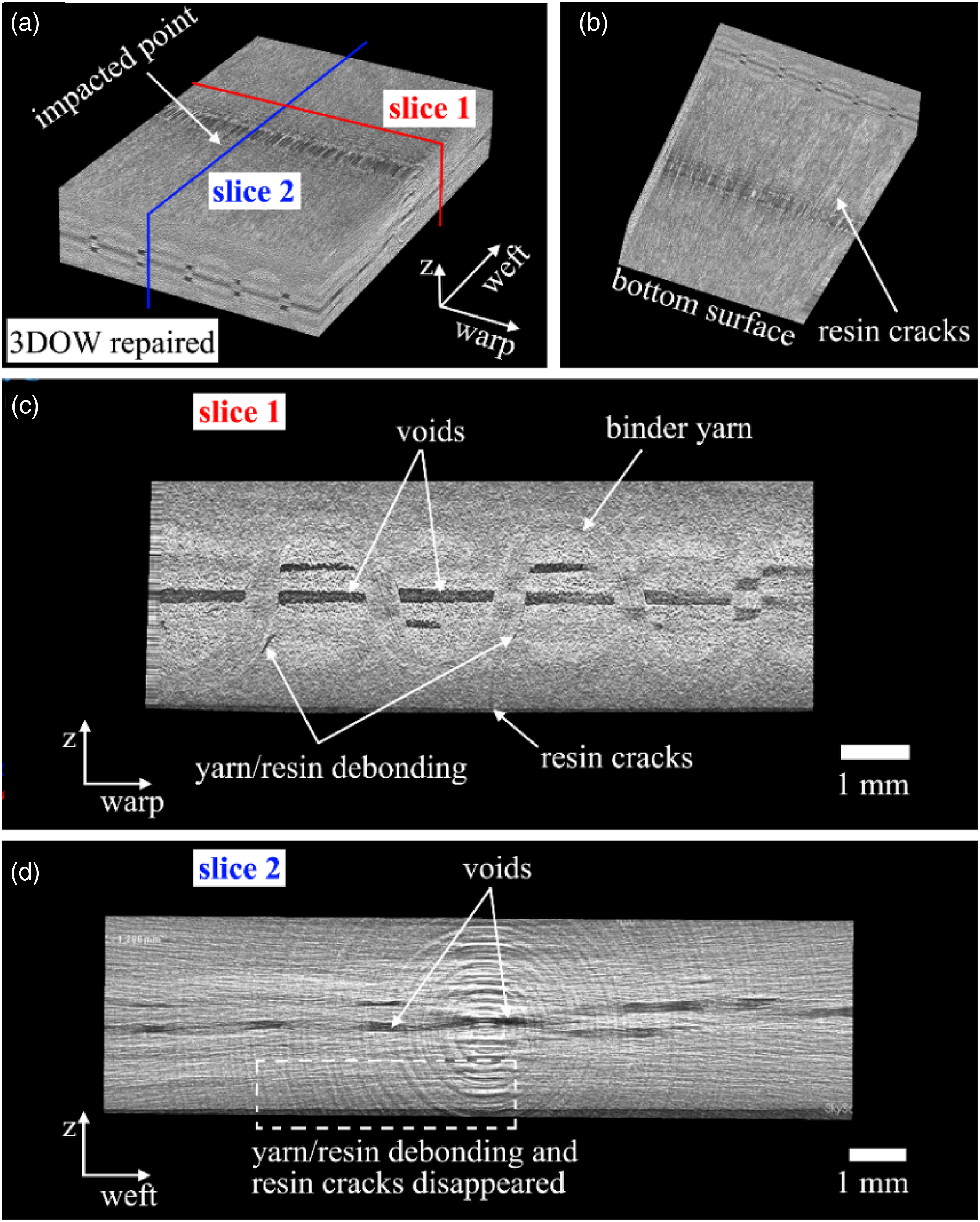
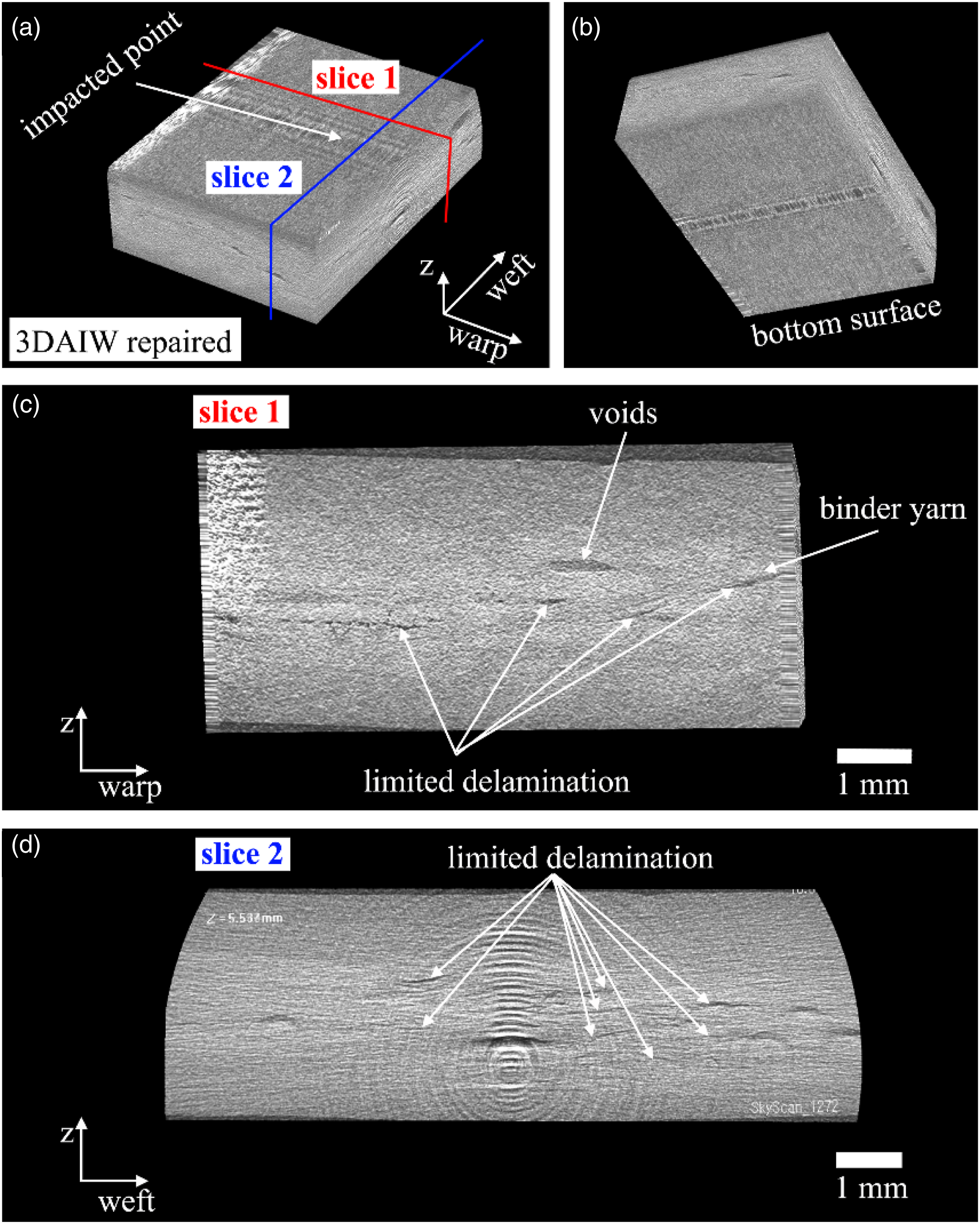
A detailed failure mechanism was observed for the repaired composites of those which were subjected to single 10-J impacts previously, using X-ray micro-CT scanning to clarify the hot-press damage repairment effect. Figures 16–18 depict the X-ray micro-CT images of the three types of repaired composites, and the cross-section slices selected in the repaired specimens are identical to or near the corresponding slices of unrepaired specimens (Figures 7–9). For the 2DPW composite (Figures 16 and 7), the severe resin cracks at the bottom surface were repaired as shown in Figure 16(b), when comparing with the unrepaired specimen (Figure 7(b)); the collapse failure area in the cross-section (slice 1 in Figure 16(c)) disappeared when comparing with unrepaired specimen (slice 1 in Figure 7 (c)); furthermore, the slight delamination leaves after repairment. For the 3DOW composite (Figures 17 and 8), resin cracks at the bottom surface could be repaired to some extent when comparing the repaired and unrepaired specimens as shown in Figures 17(b) and 8(b), respectively; resin cracks and yarn–matrix debonding in the slices along warp direction, as shown in Figures 8(c) and 17(c), were repaired to a certain extent; resin cracks and yarn–matrix debonding in the slices along weft direction, as shown in Figures 8(d) and 17(d), were well repaired. For 3DAIW composite (Figures 18 and 9), the collapse failure at the bottom surface was almost repaired when comparing the repaired and unrepaired specimens as shown in Figures 18(b) and 9(b), respectively. From cross-section slices along warp and weft directions (as shown in Figure 18(c) and (d) as well as Figure 9(c) and (d), severe resin cracks developed form the bottom surface was well repaired. In addition, severe delamination failures could be repaired to some certain extent, even though slight delamination leaves, as shown in cross-section slices. Above all, it could be concluded that the damage repairment is effective for the developed thermoplastic composites to a certain extent and considerably affects the 3DAIW structure that the debonding/delamination as well as resin cracks are more likely developed. A further repairment modification is needed to improve the repairment effect on such thermoplastic composite materials. X-ray micro-CT images of repaired 2DPW composite after 10-J impact: (a) 3D image, (b) bottom surface image, and (c) slice image parallel to warp direction. X-ray micro-CT images of repaired 3DOW composite after 10-J impact: (a) 3D image, (b) bottom surface image, (c) slice image parallel to warp direction, and (d) slice image parallel to weft direction. X-ray micro-CT images of repaired 3DAIW composite after 10-J impact: (a) 3D image, (b) bottom surface image, and (c) slice image parallel to warp direction, and (d) slice image parallel to weft direction.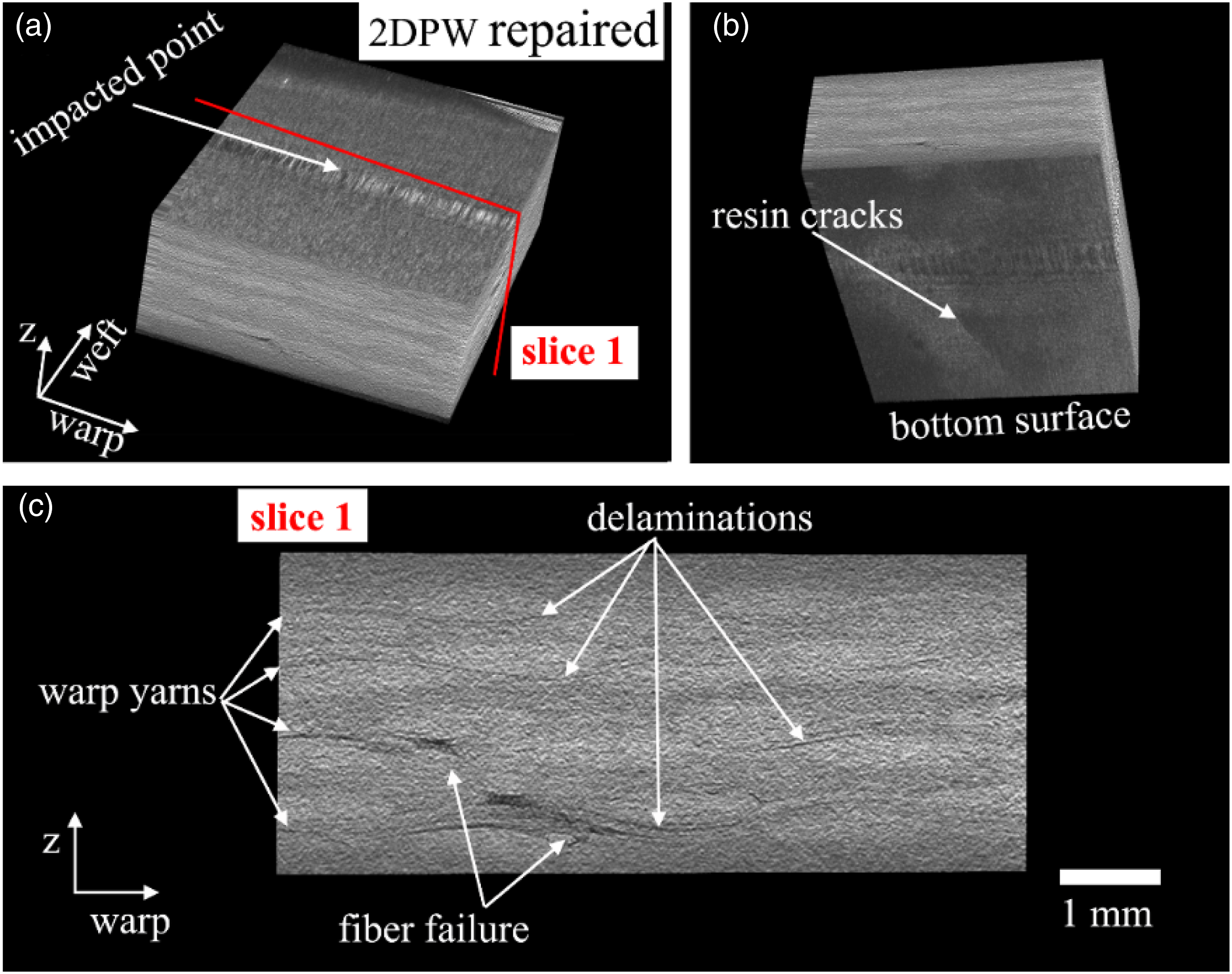
Conclusions
This study is the first to develop aramid fiber 3D woven textile-reinforced thermoplastic-epoxy composites. Three types of woven textiles (namely, 2DPW, 3DOW, and 3DAIW) with similar textile-areal densities were used as reinforcement structures. Low-velocity drop-weight impact tests with various impact scenarios, such as single-impact, repeated-impact, as well as multiple-impact with hot-press damage repairment, were conducted on these woven composites with several impact energy levels to investigate the effect of the textile structure, impact energy, and damage repairment on the impact-resistance performance of such thermoplastic composites. Some conclusions are as follows:
The three types of woven structures exhibited similar impact performance when subjected to a low impact energy level (5 J) for the single-impact scenario. The 3DOW structure exhibited slightly higher impact-resistance performance from perspectives of load-carrying ability, composite deflection recovery ability, as well as energy characters under higher impact energy levels (10 and 20 J) than 3DAIW and 2DOW structures for single-impact scenario. Fiber–matrix debonding and delamination as well as fiber failures are more likely to be introduced in 2DPW and 3DAIW structures; long resin cracks are more likely for 3DAIW; less failures were observed for 3DOW.
Three types of woven composites survived well from 5-J repeated impacts and exhibited similar impact-resistance performance. Failures rarely developed after the fifth strike for all three woven composites. The severe resin cracks were more likely to develop for 3DOW and 3DAIW structures. Furthermore, 3DOW exhibited superior impact-resistance performance when subjected to 10-J repeated impacts, whereas 2DPW and 3DAIW had similar behavior. Failures gradually developed until perforation for the three woven composites under this impact scenario. The 3DAIW structure developed more severe resin cracks than other two structures, 3DOW exhibited the smallest debonding or delamination failure area. The 3DOW structure with a tight structural design is the optimal design for the developed composites for engineering applications that involve repeated impacts.
The impact-resistance performance is gradually reduced for all the three types of woven composites when subjected to 10-J multiple impacts with damage repairment. The damage repairment is effective for the developed thermoplastic composites to a certain extent and considerably affects the 3DAIW structure that the debonding/delamination as well as resin cracks are more likely developed. Damage repairment had a limited effect for the perforated composites subjected to 20-J impacts, and even the perforation holes could be filled as well as the composite structural completeness could be returned by the hot-press technique. Here 3DAIW is the optimal structural design for engineering applications referring to hot-press damage repairment.
Woven structures exhibited an obvious effect on the impact-resistance performance and failure modes for the developed aramid fiber woven thermoplastic-epoxy composites when subjected to various impact scenarios. Specific woven structural design is key for specific engineering applications.
Footnotes
Declaration of conflicting interests
The author(s) declared no potential conflicts of interest with respect to the research, authorship, and/or publication of this article.
Funding
The author(s) disclosed receipt of the following financial support for the research, authorship, and/or publication of this article: This work was supported by the Japan Society for the Promotion of Science, JSPS KAKENHI (JP23H01299); Fujian Provincial Department of Science and Technology for the project of Natural Science Foundation of Fujian Province, China (2022J011111); the Guidance Project of Department of Science and Technology of Fujian Province, China (2022H0048); the Open Competition Mechanism Project of Science and Technology Department of Quanzhou City (2022GZ4).
