




Abstract
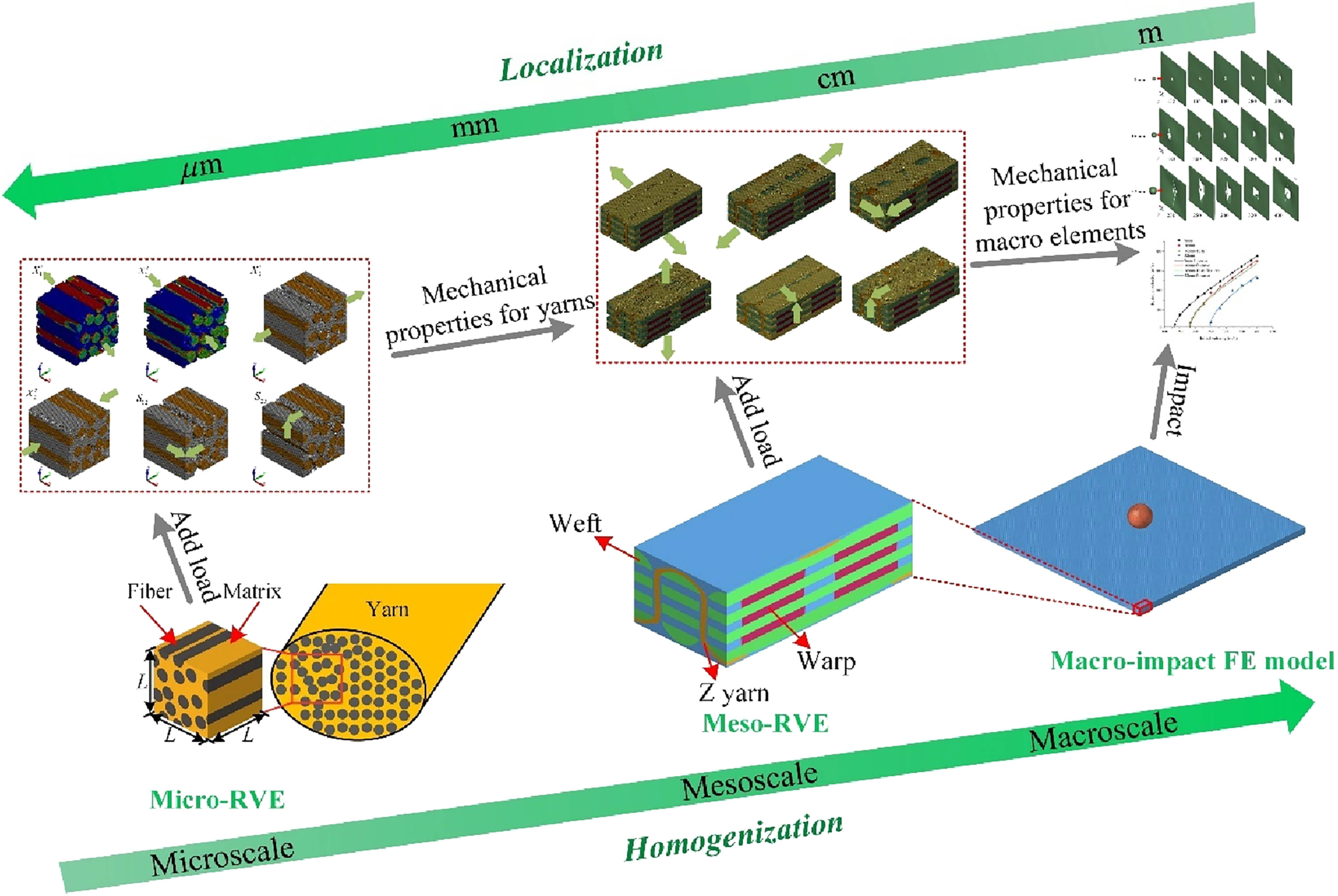
Three-dimensional woven composites (3DWCs) address the limitations of traditional laminated composites, particularly their weak interlaminar strength, and exhibit superior out-of-plane impact resistance. These characteristics make 3DWCs highly promising for applications in aerospace and high-velocity rail industries. However, their service environments are often subject to complex and variable impact conditions, and the diversity of external impact sources and their underlying mechanisms require further systematic investigation. This study establishes a multiscale finite element analysis framework for 3DWCs, incorporating quasi-static experiments such as tensile and shear tests as well as high-velocity impact experiments. The framework encompasses microscopic yarn models, mesoscopic woven models, and high-velocity impact models. Within this framework, the effects of projectile parameters—including diameter, mass, and oblique angle—on impact damage patterns and residual velocity were systematically investigated. The results demonstrate that projectile diameter and mass significantly influence both the damage area and the critical penetration velocity. Furthermore, the in-plane anisotropy of 3DWCs leads to a coupled effect between impact direction and oblique angle under oblique impact. This research provides a reliable and efficient methodological framework for investigating high-velocity impact behavior in textile fiber reinforced composite materials.
Keywords
Get full access to this article
View all access options for this article.