




Abstract
Knitted fabrics finds wide applications in functional/protective areas, as the advancements in textile Industry happens. These fabrics were famous for their stretchable structure and soft feel. This study investigates the mechanical performance, stability, and puncture of weft knitted structures with and without inlay yarns. Specimens were developed using Jute and Flax yarn as inlay yarn while Kevlar® (para-aramid) and polyester yarn as main yarn. Main and inlay yarn effect on tensile strength, elongation, stretch and recovery, and puncture resistance was characterized. The results reveal that mechanical performance and stability of fabric were significantly increased with inlay yarn in the course direction. On the other hand, expansion was greatly reduced, but higher growth was observed in rib specimens without inlay yarn.
Introduction
In weft knitting, a straight yarn is provided to the needles, and it converts it into verticals set of intermeshed loops.1,2 Knitted fabrics are famous for their excellent stretch, flexibility, and comfort to a wearer, but they have low strength, high expansion in both wales and course direction and shrinkage problems. 3 Depending upon the type of material and parameters of knitted fabric, it can be stretchable up to 100%. Strength and stretch in a fabric depend on raw material and fabric structure. In plain woven structure, at least 4%–5% stretchability is due to structure and remaining depending on the material used. In knitted fabrics, 50% of stretchability in the fabric is due to its structure.3,4 The mechanical behavior of knitted fabrics can be divided into two parts, that is, initial behavior of a fabric depends on the structure of a fabric, and lateral relies on the type of material used. The strength of the knitted fabric depends on the type of stitches used in its structure. 5
Fabrics knitted with the knit stitch, that is, plain structure, offers the highest elongation at the break in course direction. 6 The knitted fabric characteristics can be changed by inserting inlay yarn and changing the nature of inlay yarn, that is, rigid yarn or elastic yarn, which is primarily responsible for removing or developing stretch. 7 Effect of stitch length on the course and wale wise expansion is minor, but the count of inlay is a significant factor affecting bursting strength and extensibility in both directions. 8 Inlay yarn has been used in compression and hosiery garments like socks and gloves but is limited in knitted fabrics for cut and puncture resistance. These applications require more stable structures, and on the other hand, knitted structures exhibit large extension and growth. This extension can be controlled by inserting a straight inlay yarn in the course direction. 9 A spacer fabric produced by combining an elastic inlay yarn which can retain air permeability and a lower fabric weight than that made by the knit stitches of elastic yarns together with the surface yarns. By changing the inlay pattern, a spacer fabric with different compression behaviors in different areas of the same fabric can be achieved. 10 The tensile behavior of each knit in the wale-direction shows that the wale-wise behavior is not significantly affected by the in-lay yarn, while the course-wise direction is significantly reinforced and about five times less deformable with inlay yarns. Indeed, the behavior of the knit in this case is mainly the behavior of the inlays. 11 The inlaid material reinforces the fabric in both the wale and course directions, in which the stiffness in the course direction is significantly increased. The inlaid fabric is stronger and resistant to breakage in the course direction when the diameter of the inlaid material is increased. 12 Inlay yarn used in weft knitted structures also increases the mechanical properties in fiber reinforced thermoplastic composites. Knit structures with different inlay tuck points, are highly influence the physical, moisture management, and thermal transmission properties as distinct from inlay materials. 13 An interlock knitted structure composed of tuck stitches having the same back and front, manufactured from para-aramid fibers with and without inlay yarns. Structure with inlay yarns has the best cut and stab performances compared to the different structures with the same mass per unit area and thickness values. 14
Different researchers investigate knitted fabrics’ mechanical performance by modifying different structures and changing knitting parameters. But little or no work has been done to investigate the effect of inlay yarn material type and its comparison with and without inlay yarn structures.
Materials
Four different types of materials, including conventional and high-performance yarns, were used to evaluate and compare the effect of structure and material. Kevlar® and polyester yarn of 1200 denier were used as the main yarn, and Flax and jute yarn of 1200 denier were used as an inlay yarn. The design of experiment and analysis of this study was performed on statistical software package Minitab® 17.1.0. using two experimental factors that is, main and inlay yarn having each two and three levels. A total of six specimens were knitted, which are given in Table 1 with the design code of each specimens. The design code shows first alphabet of the main yarn and then first alphabet of Inlay yarn, separating them by “/.” The letter NA abbreviates that there was no inlay yarn used in that structure.
Design of experiment.

Specimen’s preparation
All six specimens were knitted on a locally manufactured, hand flat knitting machine with gage E7. Production parameters were initially kept constant, that is, Stitch length 1.58 cm. Plain rib Structure was used for all specimens. In Inlay structures, Inlay yarn is passed after each course in the weft direction. The structure and diagrammatic notation of plain rib and plain rib with and without inlay yarn is given in Figures 1 and 2.

Diagrammatic notation of inlay structure.
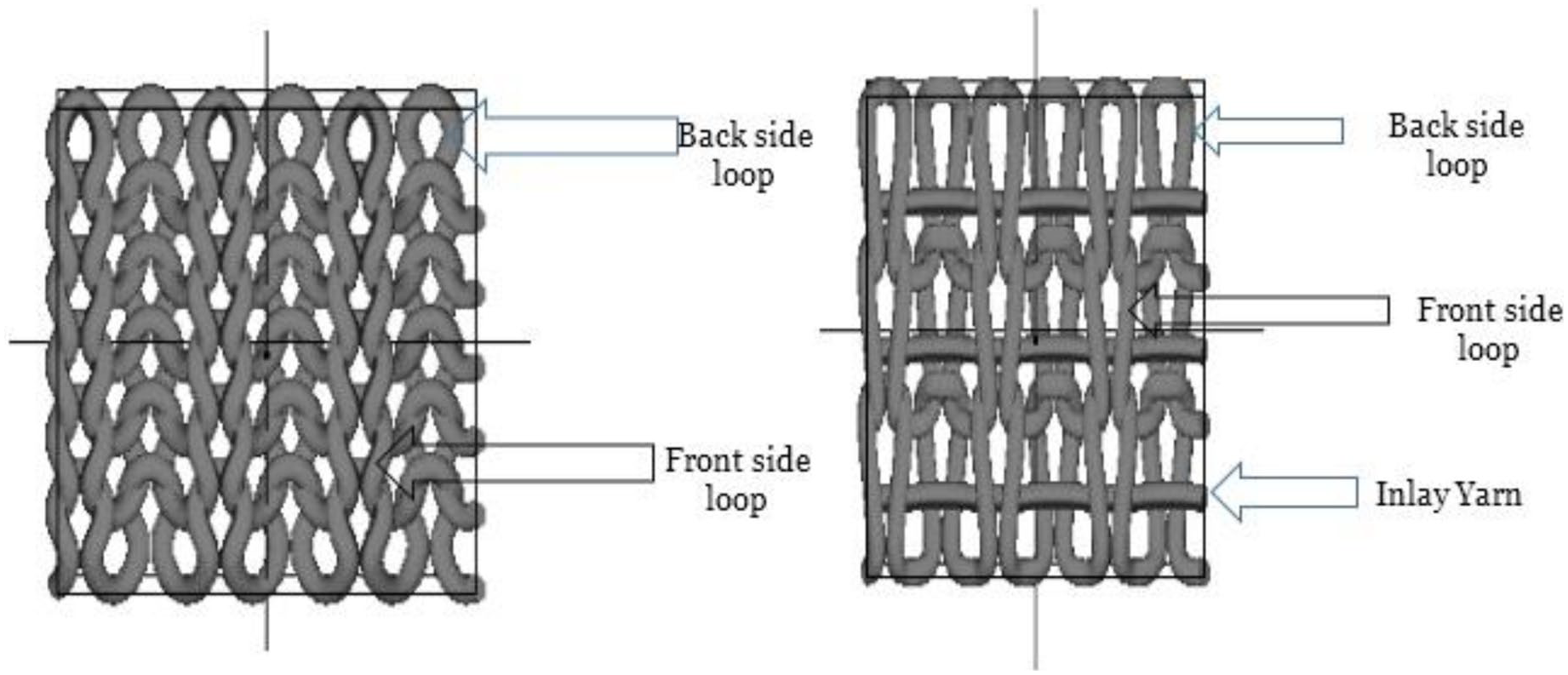
Diagrammatic notation of plain rib and rib with inlay structures.
Characterization
After knitting, all specimens were washed and relaxed according to ISO 6330. All the tests were repeated for three times from a different fabric position and average of each result was used and error bar is given against each test which reflect the reproducibility of test. Different physical parameters of all structures were calculated. Wales per inch and course per inch were checked using pick glass from five different places and calculate the average as per standard ASTM D8007-15. 15 Stitch length and stitch density are calculated. The areal density of all structures was measured according to standard ASTM D3776. 16 Tensile strength and elongation of specimens were evaluated using ISO 13934-1. A specimens of specified dimensions, that is, 250 mm × 200 mm, is clamped in jaws and extended at a constant rate of 100 mm/min until it ruptures. 17 For growth behavior, the specimen was extended by applying a specified constant load of 4.0 lb. for a time period of 5 min and then dimensional change was measured. Next, the load was removed, and the specimen was allowed to relax for 5 min. Specimen growth was calculated from dimensional measurements before and after as per ASTM D6614. 18 Puncture resistance of all specimens was calculated using European safety standard for protective gloves against mechanical risks that is, EN388. This test method includes four different types of testing (abrasion resistance, cut resistance (Coupe Test), tear resistance, and puncture resistance) but in this experiment only puncture resistance was checked. The test uses a standard, rounded stylus which is pushed 50 mm into the specimen at a constant speed of 100 mm/min using a compression test machine and resistance force of the specimen is recorded. 19
Results and discussion
Physical parameters
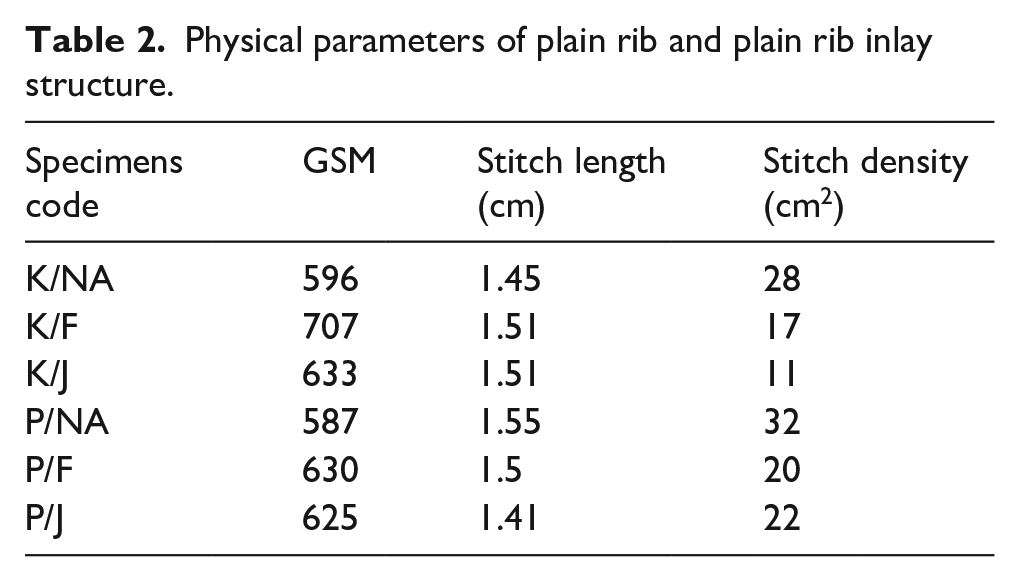
After knitting due to the relaxation of fabric, the dimension of a knitted fabric decreases, and stitch density increases. Stresses applied on the fabric during knitting produce shrinkage in the knitted fabric after relaxing and washing. The relaxation process depends upon the tightness of the fabric. The higher the tightness value of the fabric less it has shrinkage and vice versa. 20 Inlay structure’s relaxation of knitted fabric is different from convention as effects of friction of inlay and main yarn added along with fabric tightness. Straight yarn passes through the complete width of fabric in rib inlay structure, and it resists relaxation of knitted structure. Knitted fabric tries to relax, and inlay yarn resists its relaxation. Now, more surface friction will produce minimum shrinkage and vice versa. 5 The variation in physical parameters of different specimens is due to having different surface friction. When Jute and Flax yarn is used as inlay yarn, due to higher surface friction, it has low shrinkage and less value of stitch density compared with a specimen of Polyester and Kevlar® without the inlay yarns, as shown in Table 2.
Physical parameters of plain rib and plain rib inlay structure.
Tensile strength and elongation
Tensile strength and elongation in the course direction of fabric with inlay yarn were measured at the breaking point of inlay yarn. In contrast, specimens without inlay yarn, that is, K/NA and P/NA after large extension, were measured at the main yarn’s breaking point. Mechanical properties of weft knit fabrics are strongly related to their structure, yarn properties, and fabric direction 21 as it is a two-step deformation process. In the first step, the deformation is related to the structure by straitening loop yarn and occur by slippage of interloped regions. Elongation values of both specimens without inlay yarn specimens, that is, K/NA and P/NA, show more resilience due to large extensions, that is, 190.38 and 237.85 (Figure 3). It was due to the straightening of stretchable knitted loops. Effect of structure extension was prominent in these specimens, including materials extension, which was higher in polyester than Kevlar® specimens (Table 3). Specimens had jute and flax yarn as inlay yarn exhibit the higher mechanical strength due to the inlaid specimen and the least value of elongation.

Force elongation of fabric in course direction.
Result of response variables in course direction.

The behavior of the material will start after the initial deformation in the second step. In the second step, the load is directly transferred to yarn and yarn deformation starts, reflecting the strength of fabric. 21 Therefore, it can be concluded that to increase the stiffness in the course direction of knitted fabric and make them resist deformation, and inlay yarn can be placed.
Strength of specimen with inlay yarn shows the strength of inlay yarn only because it was measured at the breaking point of inlay yarn, whereas without inlay specimens, strength is measured at the breaking point of knitted yarn. K/NA specimen have 1287.45 N load value more excellent than P/NA, which have 475.69 N. Greater strength and more extension reduced significantly when an inlay yarn is used and vice versa. A major strength is related to inlay yarn only, and the effect of main yarn is only to hold the inlay yarns; that’s why specimens K/F, K/J, P/F, and P/J show nearly equal tensile strength because of the same inlay yarns in them.
Tensile strength and elongation in the wale direction of all specimens can be observed in Table 4. Tensile strength and elongation of wale direction measured inlaid and without inlay structure at the breaking point of main yarn as inlay yarn was used in only course direction. When a tensile load is applied in the wale direction to produce extension, two wales, that is, a vertical row of loops, starts coming close to each other and causes to increase in loop height. Due to this, specimen height increased, known as an extension that is reversible up to a limit, but exceeding force causes irreversible extension. When force is increased, a combination of elastic and plastic deformation produces first in structure and then in materials and specimen breaks when forced increased to its breaking load. A large elongation value was observed in all specimens of inlay and without inlay yarn due to stretchable loops behavior in wale wise and no significant effect found of using inlay yarn on elongation in wale wise shown in Table 4.
Result of response variables in wale direction.

Kevlar® specimens show more elongation in wale wise. Polyester specimens have higher stitch density values, as given in Table 2. Higher stitch density will have more vertical rows of loops, which means fewer spaces are present between two wales. When the force is applied on that specimen wale wise, it will not allow adjacent wales to come close more due to the high stitch density of polyester specimens. Low stitch density of the Kevlar® specimen is the reason for having more space between two wales. When force is applied, it allows wales to come closer, which cause to have more increase in stitch height than polyester specimen and produces greater elongation in Kevlar® specimens.
Stretch and growth behavior
Growth behavior in the course and wale direction can be observed in Figures 4 and 5 – growth in course direction significant decrease when inlay yarn is used. Specimens without inlay yarn, that is, K/NA and P/NA, have a large growth value of 135.00 and 145 mm. When a tensile load is applied without inlay knitted specimen, knitted loops allow extension, and that extension is recovered when the load is removed, but when the load is increased from its critical limit, that is, yield stress point, deformation produces which is not recoverable. Knitted fabric has the disadvantage that growth produces changes in dimensions of the knitted specimen when used for a longer period. Using Flax and jute as inlay yarn growth in knitted specimen reduced.

Growth behavior of fabric in course direction.

Growth behavior of fabric in the wale direction.
Growth behavior in wale wise is given in Figure 6, which shows that all specimens show large growth values regardless of inlay yarn used or not. It shows that using inlay yarn has no contribution to wale wise growth of knitted specimens. More extension was observed in Kevlar® specimens than polyester specimens as the removal of force polyester specimen recovered their original dimension than Kevlar® specimens.

Force elongation of fabric in wale direction.
Puncture resistance
Puncture resistance is the resistance of a specimen to penetrate the rounded shape needle through the specimen and is given in Table 4. Due to the larger porosity of knitted fabric, it offers less puncture resistance. After passing the inlay yarn, its porosity decreases as empty spaces between wales are occupied, but complete spaces are still not occupied. Tightly knitted fabric with inlay yarn can resist more than the loosely knitted fabric without inlay yarn. The base of knitted fabric is produced with main yarn, which can be stretched due to the interlooping of yarn. Using inlay yarn reduces spaces between the loops, offers less stretchability, and doesn’t allow the knitted loops to be stretched. From Figure 7, it is clear that when Jute and flax yarn is used as inlay yarn, it offers maximum puncture resistance

Puncture resistance of specimen.
Statistical analysis
This is a full factorial design; statistical significance of individual factor was checked by performing Analysis of variation (ANOVA). p Value (Table 5) shows that effect of input factor on responses is significant or not. It ranges from 0 to 1 and its lower value suggest that effect of input on output is more significant. Any term with p > 0.05 shows lack of significance at a confidence level of 95%. Both input factors main and inlay yarn equally contribute to tensile strength in course direction as both main and inlay yarn have p value 0.321 and 0.32 respectively. In specimens without inlay yarn as load applied only on main yarn and, it contributes to overall strength of fabric. p Value of main and inlay yarn is 0.713 and 0.02 respectively, which shows that main yarn has no significant contribution on elongation of knitted specimen whereas 0.02 p value of inlay yarn effect the elongation percentage of knitted specimens.
p-Values of significant factors for different response variables and R2 value.
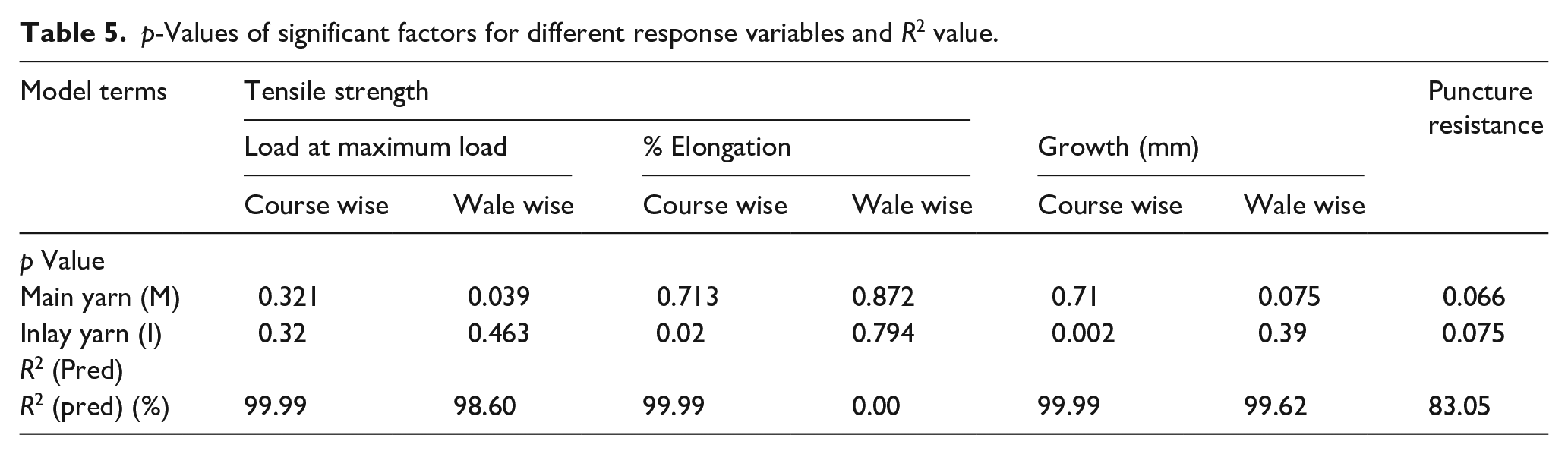
Both main and inlay yarn equally contribute to wale wise strength. p Value of main and inlay yarn is 0.039 and 0.463 which is less significant than strength in course wise direction. p Value of wale wise extension of main and inlay yarn is 0.872 and 0.794 which shows that these input factors doesn’t have any significant contribution on wale wise extension of knitted specimen. Course wise extension is related to inlay yarn whereas wale wise extension is not related to factors discussed in this experimental study.
For stretch and growth p value of main and inlay yarn in course direction is 0.71 and 0.002 respectively (Table 5) which shows that main yarn has less significant effect of growth behavior. 0.002 p value of inlay yarn conclude that inlay yarn significantly associated to growth of knitted specimen. p Value of input factors main and inlay yarn in wale direction is 0.075 and 0.39 and shows that main yarn has more significant effect on growth behavior in wale wise unlike inlay yarn has less significant effect of growth in wale direction. Large amount of growth is observed when no inlay yarn used, growth decreased using inlay yarn.
p Value of input factor main and inlay yarn for puncture resistance is 0.066 and 0.075 respectively which shows that main yarn has more significant effect on the output then main yarn. Using greater linear density of inlay yarn will increase puncture resistance of knitted fabrics by adding its effect to main yarn.
R2 value describes the variation in percentage of response which can be describes by the factors used in this experiment. Higher value of R2 indicates that predictive ability of this experiment is best explained by the factors which already includes in this study but its lower value indicates that variation in the experiment is related to other variables which are not includes in this study. It shows that only wale wise variation in elongation percentage was not related to this study otherwise variation in all other results was related to the factor which were studies in this study.
Conclusion
Different mechanical properties like tensile strength, elongation %, stretch and growth, and puncture resistance of plain rib inlay and without inlay yarn was check and compared. Inlay yarn was the most significant input factor affecting the tensile strength, elongation, and growth in course direction. Mechanical performance and structural stability increased by using inlay yarn in the course direction. Tensile strength of the knitted structure enhanced largely by using inlay yarn. No significant effect was found of inlay yarn on elongation in wales direction. Growth in wales direction was not affected by inlay yarn, and puncture resistance was found to increase by using inlay yarn. The results show that rib inlay structure is more favorable for performance application, that is, puncture and cut resistance fabrics for better mechanical properties and stability. In future studies, more work is needed to compare their cut resistance properties.
Footnotes
Acknowledgements
The authors would like to express their gratitude to the School of Textile Engineering (Knitting section) and National Textile Research Center (NTRC), NTU, Pakistan for providing the opportunity to fabric and characterize specimens for this research work.
Declaration of conflicting interests
The author(s) declared no potential conflicts of interest with respect to the research, authorship, and/or publication of this article.
Funding
The author(s) received no financial support for the research, authorship, and/or publication of this article.
