



Abstract
The wool fibers fineness and strength have a remarkable role to determine the quality of yarn and the subsequent fabrics. The fineness property of the wool fibers is a crucially important fiber property for grading, classifying, selecting for particular applications such as for suit, blanket, shirt, carpet, and so on. The fineness and strength properties of four indigenous (Menz, Wollo, Farta, Tikur), three exotic (Awasi, Dorper, Corrediale), and four cross-breed (50% Dorper, 50% Awasi, 75% Awsi, Washera/Awasi) sheep wool fibers from the four main body parts (sides, neck, back, and belly) at six teeth removed age of 11 different sheep breeds have been investigated. The samples of wool fibers have been conditioned for 24 h at 20ºC ± 1ºC temperature and 65% ± 2% relative humidity. The specimen for sampling has been determined based on ASTM D2130-01. The results revealed that the fineness and strength of whole fibers taken from different parts of sample sheep varied significantly within the breed and among the breeds. The result revealed that the strength and fineness of the wool fibers have a positive correlation and Ethiopian sheep wool fiber is suitable for numerous types of classical and technical applications.
Introduction
Wool fiber plays key role for the economic stability and growth of a country when concerned stakeholders carried out their roles for the optimum and scientific production, utilization and use. 1 Wool fiber producing countries advised to join the International Wool Trade Organization which will help members to practice wool utilization for sustainable economy by improving yield and quality of wool fibers. 2 The global wool market is estimated to be valued at ~35 billion US Dollar by the end of 2019, and is expected to reach ~48 billion US Dollar by the end of 2029, expanding at a Compound annual growth rate (CAGR) of 3.5% during the forecast period (Persistence-Market-Research 2019) 3 . Ethiopia possesses 30,612,976 sheep population composed of 27.82% ram and 72.18% ewe indigenous with quite number of hybrid and exotic sheep breed categories. 4 Though 90% of the world’s sheep can provide wool fibers, 5 Ethiopian sheep wool fiber is not utilized to generate income and increase raw material options in the country and in the globe in general.
In Ethiopia, there are more than fourteen local sheep breeds with few exotic (Awasi, Dorper, and Corriedale) and hybrids. Menz sheep are adapted to the rugged climate of the region and can thrive on poor quality roughages. The sheep breeds are named by their geographical distribution in the highland (woolly sheep), lowland (not woolly), and temperate (woolly sheep) regions of Ethiopia. 32 Amhara, Oromiya, and South Nations Nationalities and People regions are dominant in woolly sheep growing (Gebisa et al. 2017). 6
Analysis of wool characteristics is an effective means of determining and comparing wool quality. Knowledge of these characteristics aids management of product end-use, consumer comfort, and processing intensity. Accordingly, wool characteristics such as fineness, staple length, strength, crimp, and trash directly influence wool prices set by processors and industry. 7 The fiber diameter, strength, and staple length are the most important characteristics. Carpet wool quality and its value are primarily determined by fiber diameter and length which reflect fineness and the degree of wool growth respectively. 8 Similarly, research results indicated that the wool fibers exposure to UV irradiation resulted in better shrinkage and dye ability. Enzyme treated fibers resulted in better dye rate and improved resistance to shrinkage (Wang et al. 2020). 9
Fiber diameter refers to the average width of a single cross section of wool fiber 10 and measured in microns (μm).11 –13 Fiber fineness and strength are the major factors in determining the value of wool. 14 With respect to age, differences in fiber diameter between animals older and younger than 3 years were found, which agrees with the generally accepted concept that fiber diameter increases with age. 15 The analysis of variance revealed that the influence of year of shearing, breed, and sex of the lamb were non-significant sources of variation for fiber diameter (A. Khan et al. 2013). 16 The breed and age of sheep had significant effect on fiber crimp/cm, fiber diameter, staple length, and clean wool yield % (Gouri et al. 2014). 17 The diameter range of fibers in the carpet wools is recommended between 11 and 90 μm.18,19 On the basis of their wool characteristics, sheep breeds can be classified into fine, medium, and carpet (coarse) or mixed wool breeds.20 –23 Wool samples showed coefficients of variation of 29% and 36%, in diameter. 24 High genetic correlations among post-weaning traits across different ages suggest that a selection program would be most suitable with younger animals. Researchers reported that the highly negative correlations between fleece traits and post-weaning live body weight provide a warning of potential problems associated with selecting only one group of traits. Further studies should focus on wool characteristics, in particular wool quality parameters and their correlations with body weight and other traits. 21 The recent research results revealed that the physical and functional characteristics of wool fibers can be improved for better performance. The wool fiber protease treatment with silver nanoparticles incorporation improved conductivity, half-life, and electrical voltage (Memon et al. 2018). 25
Menz, Wollo, Farta, Tikur, Awasi, Corrediale, Dorper, and their cross-breed sheep are the main woolly sheep breeds in the highlands of Ethiopia. Many researchers work on wool fibers characterization, quality, production, modification, and improvement. Scholars are not yet studying the quality of Ethiopian sheep wool fibers by its fineness, length, and strength to identify, improve, and grade its application. And, none of the researchers studied on the significant influence of Ethiopian sheep breeds on wool fibers properties from different body parts of the sheep at a particular age. This study presents not only the significant influence of sheep breeds on fiber properties but the differences of wool fibers diameter and strength from the four major body parts at 2 years and older age of ewe sheep. This group has been selected because in Ethiopia the female sheep population is highest (78.2% of the total sheep population) at 2 years and older. In this study, the wool fibers from the eleven main woolly sheep breeds are characterized and its application is identified based on the property. The other novelty of this research is to clarify the different concepts on factors determining wool fiber fineness and strength. The research will help for worldwide researchers and investors to understand unexploited sheep wool fibers production potential of the country by stopping unprotected disposal of greasy wool which then helps to properly utilize by textile industries. So that the raw material options of the globe will increase to achieve the 2029 world market forecast from wool fibers.
Materials and methods
Materials
The samples are collected from the sheep farm of Debre Birhan Agricultural Research Center and farmers of North Shoa (Amhara), South Wollo, North Wollo, Awi Zone, South Gondar, and North Shoa in Oromiya region at different attitudes (see Table 1).
Sample sheep breeds and location.

An ewe pure Menz, Wollo, Farta, Tikur, Dorper, Awasi, Corrediale, and cross-breeds such as 75% Awasi, 50% Awasi, Awasi/Washera, and 50% Dorper sheep breeds (see Figures 1 and 2) wool fibers from the four main body parts (side, neck, back, and belly) of the sheep at 2 years and older age are investigated (see Figure 3).

Some of Ethiopian indigenous sheep breeds.

Exotic sheep breeds (Corriedale, Awasi, Dorper – from left to right).
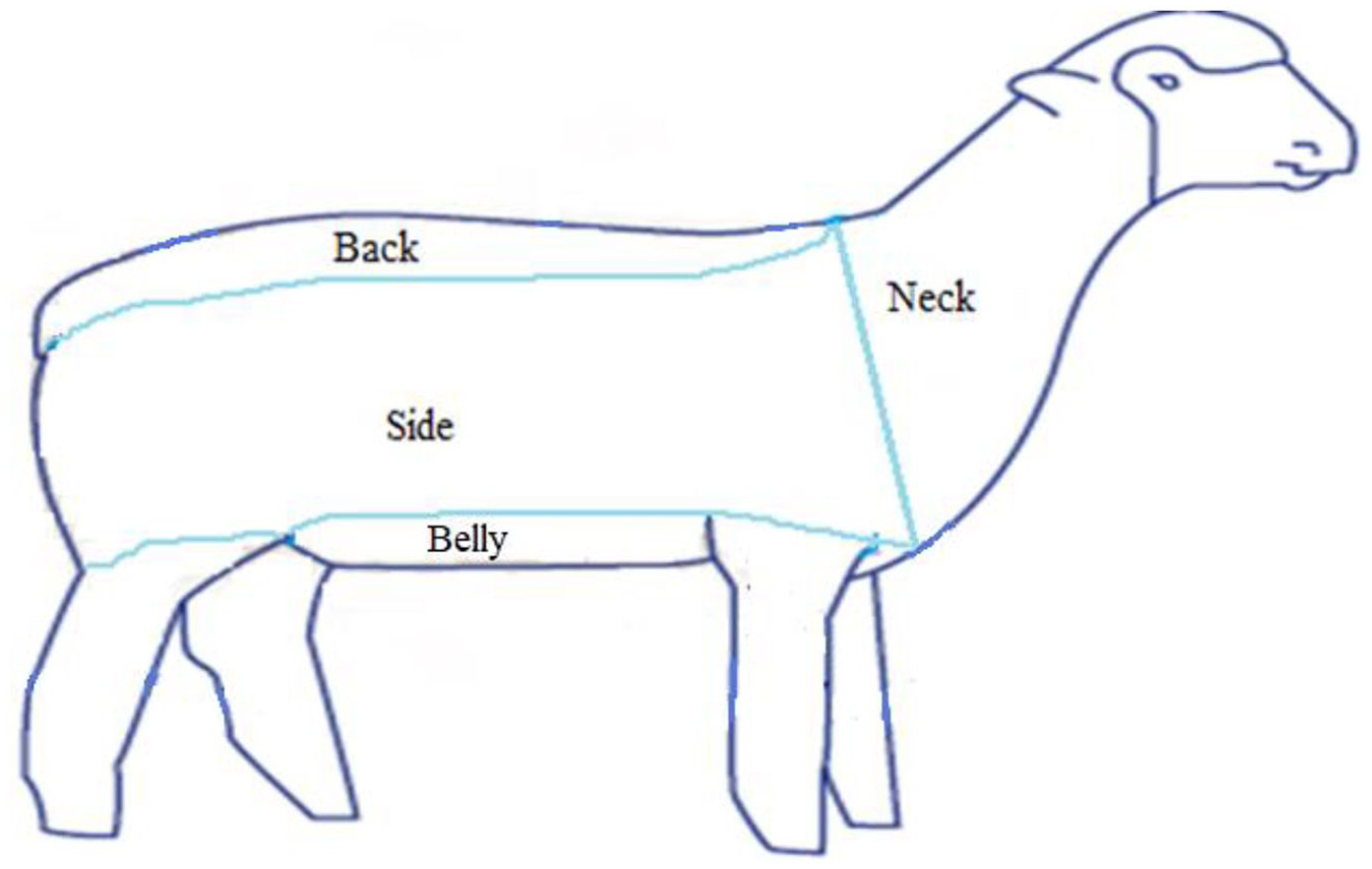
The four main body parts of the sheep for sampling.
The 50% Dorper sheep breed is found by cross-breeding of 50% Dorper (South African) and 50% Menz (Ethiopian). The 75% Awasi found from 25% Menz and 75% Awasi (Israeli), 50% Awasi found by cross-breeding of 50% Menz and 50% Awasi, and Awasi/Washera is found from 50% Awasi and 50% Washera (Ethiopian indigenous) sheep breeds. In this research, the Corrediale and Wollo sheep have no wool fibers (to shear) in their belly and with few exceptions the majority of sheep breeds belly wool fibers are not able to hold by the clamp for strength test.
Methods of measurement
All samples have been conditioned for 24 h at 20ºC ± 1ºC temperature and 65% ± 2% relative humidity. 26 The testing standard used for this study is the American Society for Testing and Materials (see Table 2). In this study 42 samples have been investigated from the different sheep breeds of the four main body parts (see Figure 3) at the six teeth removed age of each breed. The study consists of Eleven (11) sheep breeds from the four body parts (11 × 4 = 44 samples expected). But, wool fibers for sampling are not available on the belly of wollo and corrediale sheep breeds. So, the total samples become 42 instead of 44. Ten sheep are sampled for each sample category and random sample fiber pull performed from all the 10 samples of a particular sheep breed and a specific body part. For example: the specimen from the neck of the wollo sheep is the random pull sample from the mixed fibers of ten same age and same sheep breed. The total numbers of sheep considered in this investigation are 110 (number of breeds multiplied by number of sheep sampled for each breed; 11 × 10 = 110). In this research the fibers diameter is measured by the VIDEO ANALYZER because of its simple or not need calibration and has good agreement with OFDA and LASERSCAN (Peter 2002). 27 Software packages for social sciences (SPSS) have been used for statistical analysis including one-way ANOVA.
Property, machine and its description, number of specimens for each sample and units.

Result and discussion
Wool fibers fineness (diameter)
As shown in Figure 4 and Table 3, the fineness of the indigenous, exotic, and cross-breeds sheep wool fibers is different at 2 years and older age of the four body parts. The fiber diameter of the 2 years and older sheep wool fibers from the side, neck, and back is highest in Tikur sheep (57.95, 54.10, and 51.34 μm, respectively) and from belly in Awasi-Washera (91.99 μm) sheep breed. But, the wool fibers diameter from the side, back, and belly is lowest in the pure Dorper sheep (18.73, 17.89, and 20.46 μm, respectively) and from neck in the 50% Dorper cross-breed sheep (18.82 μm). The wool fibers taken from the side of the sheep is very coarse in 50% Awasi, Awasi, and Tikur (40–58 μm); coarse in Menz, Wollo, and 75% Awasi (31–34 μm); medium in Corrediale, Awasi-Washera, and Farta (25–30 μm), and fine in Dorper and 50% Dorper (19 μm). The wool fibers from the neck of the sheep is very coarse in 50% Awasi and Tikur (39.62 and 54.10 μm); coarse in Awasi and 75% Awasi (36.84 and 33.35 μm); medium in Menz, Wollo, Corrediale, and Awasi-Washera (25–29 μm), and fine in Dorper, 50% Dorper, and Farta (18–23.21 μm). The wool fibers from the back of the sheep is very coarse in Tikur (51.33 μm); Coarse in 75% Awasi, 50% Awasi and Awasi (32–34 μm); medium in Menz and Farta (25–28 μm); fine in Wollo, Corrediale and Awasi-Washera, Dorper, and 50% Dorper (17.89–24.53 μm) sheep breeds. The wool fibers from belly of the sheep is very coarse in Farta, Tikur, Awasi-Washera, and 50% Awasi (58–92 μm); coarse in Awasi (37.86 μm); medium in Menz (26.85 μm), and fine in 75% Awasi, Dorper, and 50% Dorper (20.46–22.56 μm). The Dorper and 50% Dorper (Dorper-Menz) sheep breeds provide fine and super fine wool fibers (17.89–22.49 μm) from the four major body parts of the sample sheep (see Figure 4). The four major body parts of the sheep are significant source of fiber diameter variation (see Table 5). This is because of the sheep’s exposure to friction; suitability of the body part for fleece growth in the sheep (protein rich part of the sheep skin) and direction/position of the hair grow on the sheep.

Mean fiber diameter with the standard deviation as error bar of Ethiopian sheep wool fibers from different breeds.
The Ethiopian sheep wool fibers grading as per ASTM-D3991.
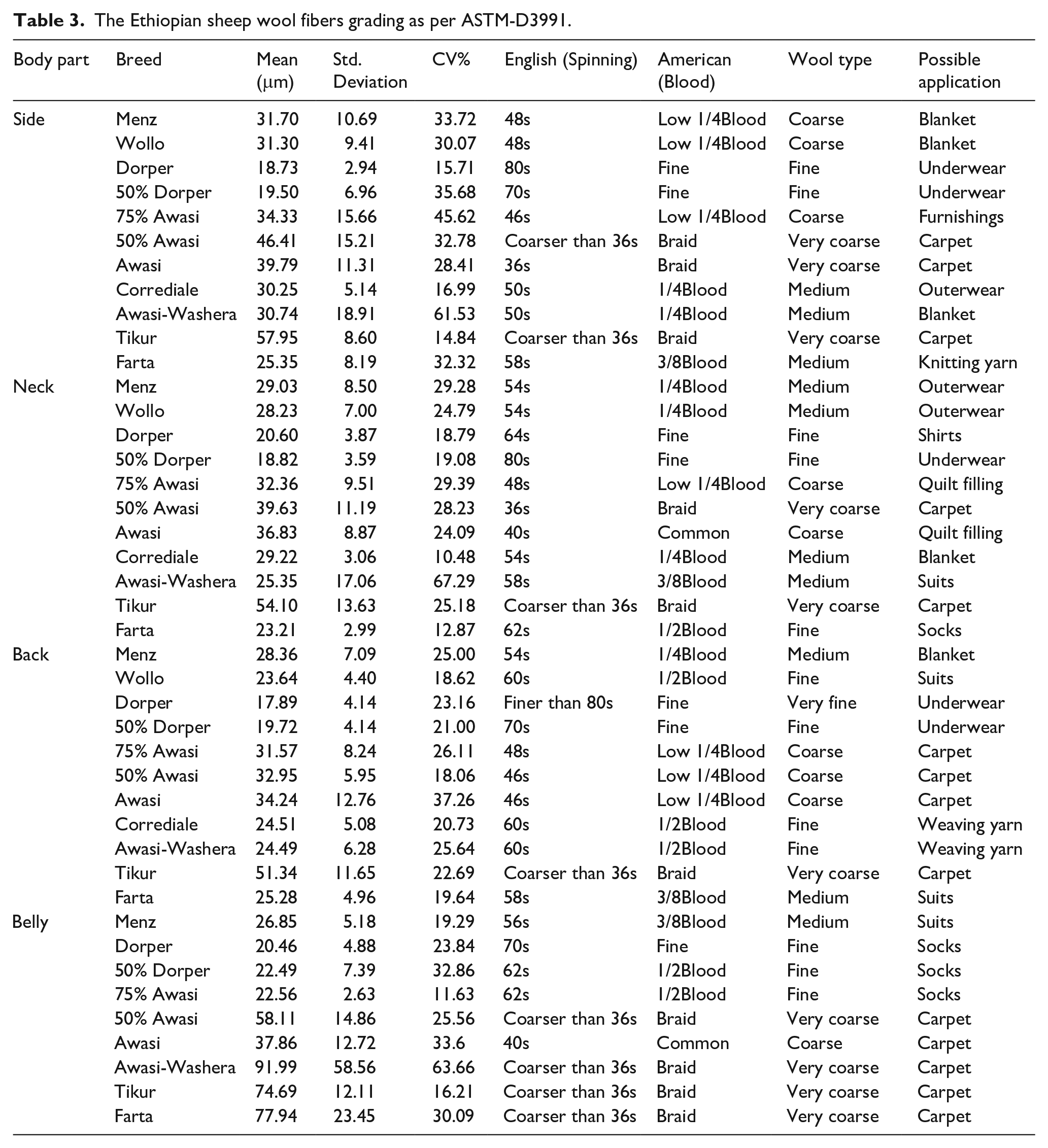
As the statistical presentation in Figure 4 and Tables 3 to 5 shows, the wool fibers fineness is different among the breeds from the different body parts of the sheep. The Dorper and 50% Dorper sheep breeds have fine wool fibers; Menz, Wollo, Corrediale, Awasi-Washera, and Farta sheep breeds have medium fiber fineness; 75% Awasi, 50% Awasi, and Awasi sheep breeds have coarse wool fibers and Tikur sheep breed has very coarse wool fibers (see Table 3). In general, the wool fibers from Ethiopian indigenous sheep breeds are coarse and medium. These sheep grow in the rugged area of Ethiopia that influences its protein production for wool fiber growth and its genetics in general. Ethiopian indigenous sheep breeds find food in the grazing land by walking large rugged areas. So, improving the feeding system is important in addition to cross-breeding to improve the wool fibers quality (fineness).
Analysis of variances on fineness of wool fibers.
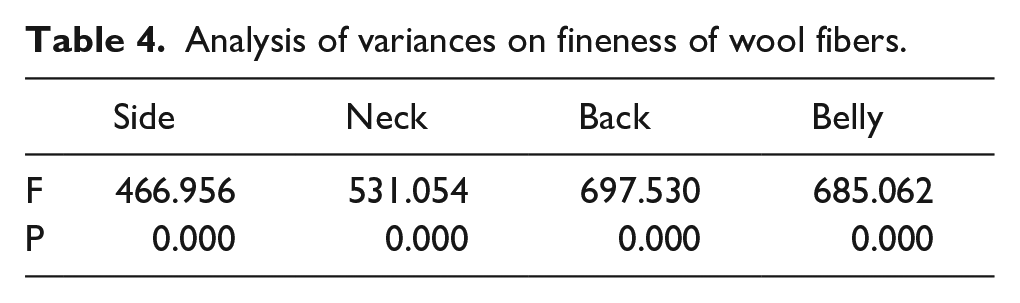
Analysis of variances of effect of body parts on the fineness of wool fibers.

The standard deviations (μm) of all sampled fibers of the different sheep breeds from the four main body parts are similar with slight deviations from their mean. This shows that the values in a statistical data set are closest to the mean of the data set, on average (see Table 3). Wool samples showed coefficients of variation of 29% and 36%, in diameter. 24 In this study it is found that coefficient of variations of fibers diameter is different for the wool fibers from the different body parts of the sample sheep breeds and is between 10% and 67% (see Table 3). The mean, standard deviation, and coefficient of variation shows broad variation because of genetic differences of the sample sheep.
Wool fibers grade
On the basis of the fiber diameter, the wool fibers can be classified into fine, medium, and carpet (coarse) or mixed wool.20 –23 Fiber diameter is used to grade the sheep wool fibers. Here, the fiber diameter is measured in micrometer (microns) but the values are described by other grading systems as American (blood) grade system and English (spinning or count) grade system. The Menz, Wollo, Tikur, Farta, Dorper, Corrediale, Awasi, Dorper-Menz (50% Dorper), Awasi-Washera, 75% Awasi, and 50% Awasi sheep wool fibers at 2 years and older age from the four main body parts lie in the grades shown in Table 3. The wool fibers grade of the sampled sheep breeds lied from fine to very coarse. As shown in Table 3, the grades of samples classified as 10 samples very coarse (the majority is from side and belly), 9 samples coarse (the majority is from side and back), 10 samples medium (the majority is from side and neck), 12 samples fine (the majority is from neck and side), and 1 sample very fine (from back of pure Dorper). The fiber fineness is 45.24% coarse, 23.81% medium, 28.57% fine, and super fine 2.38% of the sample. The side part of the sheep is an abundant source of fiber from very coarse to fine type while belly is the major source of coarse fiber with low fiber yield.
The fiber diameter from the four body parts of the sheep is classified from very fine to very coarser and an ascending order of fiber diameter by the body parts of the sampled wool fiber is back, neck, side, and belly of each sheep. As per the fiber property requirements, Ethiopian sheep wool fiber is suitable for textile products such as rugs, carpets, blankets, outer wears, knit wear, socks, knitting and weaving yarns, quilt filling, furnishing, and related textiles can be produced from the Ethiopian sheep breeds. Wool fiber is a competitive fiber for technical application by processing alone and by blending with other high performance fibers for example in stab protection because of its high vapor absorption to improve the armor vest thermal comfort with the required protection performance. 28
Analysis of variance of wool fibers fineness of Ethiopian sheep breeds
Qureshi et al. 29 considered that the type of sheep breed is a non-significant source of fiber diameter variation. A research by Gouri et al. 20 revealed that type sheep breed is the significant source of wool fibers diameter variation. In this study, the mean differences of wool fibers fineness from the four body parts of the sheep are significant at 0.05 levels. This indicates wool fibers diameter is significantly dependent on the type of sheep breed (see p-value in Table 4).
Similarly, the mean differences of wool fibers fineness of the different sheep breeds from the different body parts are significant at 0.05 levels. This indicates wool fibers diameter is significantly dependent on the body part of each sheep breed (see p-value in Table 5).
Fibers strength
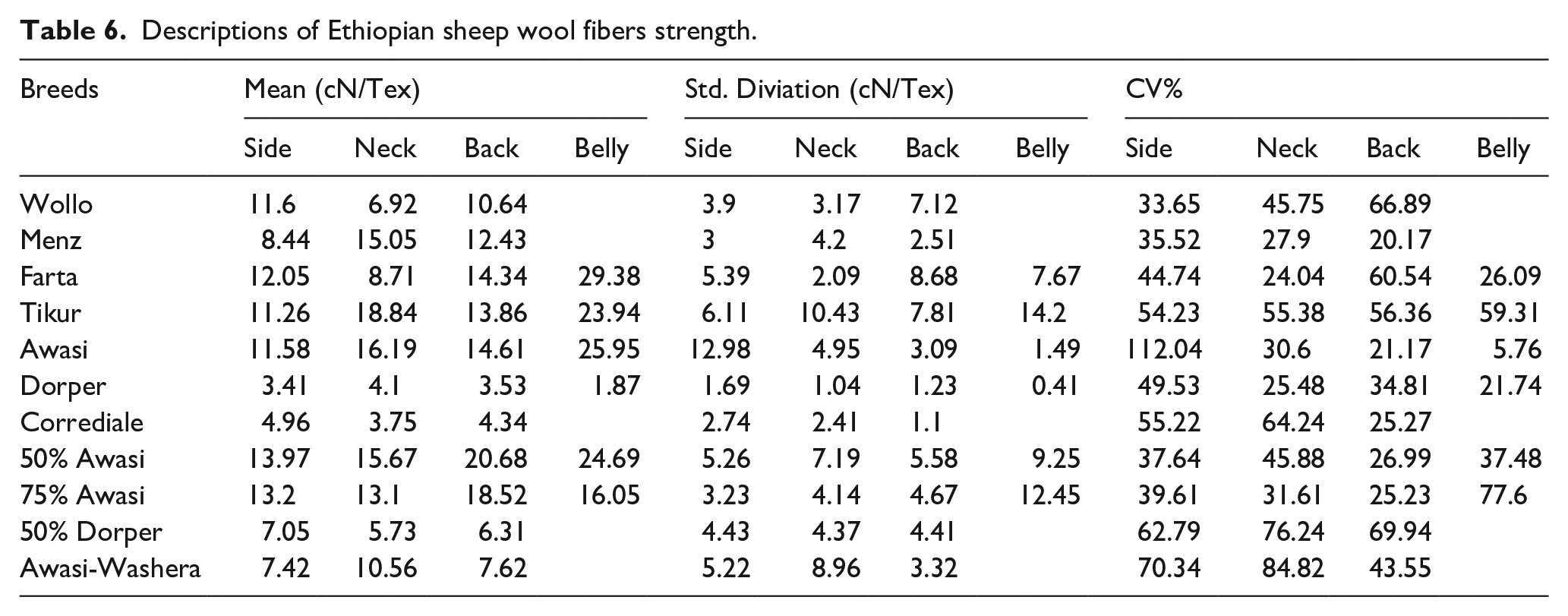
As shown in Figure 5 and Table 6, the strength of Ethiopian indigenous, exotic, and cross-breed sheep wool fiber is different at 2 years and older age of the four body parts. The fiber strength of the 2 years and older sheep wool fiber is highest from the side and back in 50% Awasi sheep (13.97 and 20.68 cN/Tex, respectively), from neck in Tikur (18.84 cN/Tex), and from belly in Farta (29.38 cN/Tex) sheep breeds. But, the wool fibers strength from the side, neck, back, and belly is low in the pure Dorper, 50% Dorper, and Corrediale sheep breeds (1.87–7.04 cN/Tex). The strength of Menz, Wollo, and Awasi-Washera sheep breed’s wool fiber is medium (8–15 cN/Tex). The strength of the wool fibers taken from the belly of the sheep is high (except Dorper 16–29 cN/Tex), from back and neck medium (10–14 cN/Tex) and from side of sampled sheep lower (9.45 cN/tex), on average.
Descriptions of Ethiopian sheep wool fibers strength.

Strength with the standard deviation as error bars of Ethiopian sheep breed’s wool fibers.
The factors and traits which influences the wool fibers quality (strength) needs further study to understand its significance for fiber strength variation. 21 Some researchers concluded that sheep breed for high staple strength may be less responsive. 21 In this study, as the statistical significance assessed from the mean and standard deviations, the results revealed that the type of sheep and its body part are significant source of fiber strength variation. Fiber strength positively influenced by fiber diameter that is, the finer the fiber is weaker while the coarser fiber is stronger (shows high tenacity).
The standard deviations of all sampled fibers of the different sheep breeds from the four main body parts are similar with slight deviations from their mean. This shows that the values in a statistical data set are closest to the mean of the data set, on average. Coefficient of variations of fiber strength is different for the wool fiber from the different body parts of the sample sheep breeds and is between 5.76% and 112.04% (see Table 6) because the fiber strength distribution is not uniform due to fineness variation on each sheep. The mean, standard deviation and coefficient of variation shows broad variation because of genetic differences of the sample sheep.
Interactive effect of fibers diameter and strength
Single end tensile strength and diameter of the wool fibers have positive correlations for which the fiber properties are proportional to each other. The finer the fiber, the weaker it is, while the coarser fiber is stronger. This is the same for the wool fiber from majority the eleven sample sheep breeds of the four major body parts (side, neck, back, and belly) (see Figure 6). The statistical data shows some irregularities of fineness and strength relations specifically in Tikur and Farta sheep breeds. This is also not to all body parts of these sheep breeds rather on the side body part of the sample sheep.

Relationship of wool fibers diameter and strength.
Conclusion
The fineness and strength properties of Menz, Wollo, Tikur, Farta, Dorper, Corrediale, Awasi, 50% Dorper, Awasi-Washera, 75% Awasi, and 50% Awasi sheep breeds wool fibers from the four main body parts of the sheep as side, neck, back, and belly at the 2 years and above age have been investigated. The results show that the breed of the sheep significantly influences the fineness and strength properties of the wool fibers, in Ethiopia. The strength and diameter of Ethiopian sheep wool fibers are related to each other. Though the quality of the wool fiber is improved by cross-breeding, it is not consistent in all body parts of the sheep. The gross fineness of wool fibers from the different breeds of the whole skin of the sheep can be summarized as the Dorper and 50% Dorper sheep breeds have fine wool fibers; the Menz, Wollo, Awasi-Washera, Corrediale, and Farta sheep breeds have medium fibers fineness; 75% Awasi, 50% Awasi and Awasi sheep breeds have coarse wool fibers, and Tikur sheep breed has very coarse wool fibers. Hence, the application of Ethiopian sheep wool fiber is determined as per the characterized fineness properties. Generally, the wool fibers fineness from the four body parts of Ethiopian indigenous, exotic, and hybrid sheep breeds found between very fine and very coarse wool type and the fiber in American grading system is fine, 1/2Blood, 3/8Blood, 1/4Blood, Low 1/4Blood, and Braid. Therefore, the wool fibers from the Ethiopian sheep breeds can be processed to produce underwear, shirts, suits, socks, rugs, carpets, blankets, outer wears, knit wear, knitting yarns, weaving yarns, quilt filling, furnishing, and technical products. The government, international investors, and researchers should focus on Ethiopian sheep wool fiber potentials to make it a potential fiber source and to achieve the forecast global market share of wool fibers. Breed improvement, product development, properties of the products, grading/classifying, cost analysis, market approach, sustainable supply chain, and awareness for sheep owners and promotion are some of the future outlooks. The investors, government, research institutes, industries, and related companies should see the potential of Ethiopia on wool fiber. This will help to create new jobs, bring clean environment, support the economy of the country, satisfy the fabric demands of the people, and serve as additional source of income for concerned communities in the country and the globe in general through import/export trade on wool fiber, its products, machinery, and accessories.
Footnotes
Declaration of conflicting interests
The author(s) declared no potential conflicts of interest with respect to the research, authorship, and/or publication of this article.
Funding
The author(s) received no financial support for the research, authorship, and/or publication of this article.
