



Abstract
This paper summarises the state of the art for strength grading of construction timber grown in the United Kingdom and the Republic of Ireland. It includes the latest approvals based on recent research on spruce, larch and Douglas-fir. It lists the following information along with the primary references: visual grading grades and strength class assignments; grading machines with approved settings for machine control grading; the species, size ranges and strength class combinations covered; and grade determining properties of specific strength classes for the UK and Irish markets. This paper is useful for those grading timber, and those specifying UK and Irish grown timber.
Introduction
In Europe, structural timber is graded under the system set out by the European standard EN14081-1 and its supporting standards (e.g. Lycken et al. 2020). It sorts rectangular cross-section timber into categories based on required characteristic values of grade determining properties. For normal construction timber those primary (grade determining) properties are usually bending strength, bending stiffness and density (at 12% reference moisture content).
Instead of bending, grading can also be based on tension strength and stiffness. Either way, characteristic values of strength and density are specified as fifth percentiles and stiffness by the mean. No tension grading has yet been established for UK and Irish grown timber (although some testing has been done: Ó Fátharta et al. 2020; Gil-Moreno et al. 2019a). In the case of grading established on the basis of bending testing, the tension strength is one of the secondary properties, calculated from equations in EN384. In the case of grading on the basis of tension testing, the bending strength is a secondary property. Grading based on tension testing is most commonly done for glulam production, since tension strength is more important for the design. Since little UK and Irish is currently used for glulam manufacture, there has been no priority for developing tension based grading for this resource.
The UK and Ireland have very similar climatic conditions and forest management, and a long-established exchange timber market with logs crossing the border. This is one of the reasons that modern grading rules usually treat both countries as a single growth area, particularly for Sitka spruce but also more recently for Douglas-fir (Gil-Moreno et al. 2019b) and larch. Collaborative research between Edinburgh Napier University and the National University of Ireland Galway, in the ‘Strategic Integrated Research in Timber’ projects and the ‘WoodProps for Ireland’ programme have confirmed the timber to be suitably similar for the purposes of grading. The research has also shown that the resource is dissimilar to timber grown elsewhere in Europe, with grading tending to be limited by wood stiffness for spruce and larch, as opposed to strength in other places. This is due to differences in climate, forest management, species choice and seed selection. One major difference is higher wind exposure; its effects on wood properties and limits on rotation length.
This paper covers the position in the UK and Ireland as of December 2021 and is for guidance only. When grading, the primary references should be consulted, noting that new assignments and settings can be added, existing ones can be changed, and even the definition of EN338 strength classes may change. The machine grading reports listed are confidential, but the reference number helps to identify the relevant machine settings table. Contact the machine manufacturer or a Notified/Approved Body to obtain more information about specific settings.
Current grading possibilities
There are two parallel systems for grading: visual and machine, both of which follow the same basis: timber is sorted into grades according to a non-destructive assessment that is predictive of the grade determining properties; and the collective characteristic properties of the timber sorted into those grades determines the strength class (see Ridley-Ellis et al. 2016a for a more detailed explanation). The timber design properties are therefore usually specified with reference to one of the strength classes listed in the European standard EN338, although there are other strength classes in use (see below). It is also possible to declare all properties directly, without reference to a strength class.
Definition of UK and IE specific strength classes (reference moisture content is 12%). Year of approval in bold.
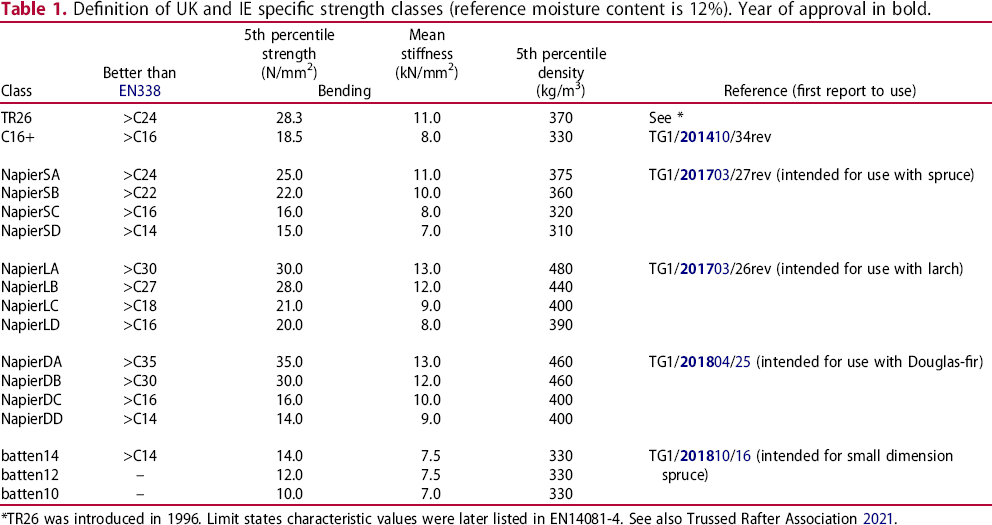
*TR26 was introduced in 1996. Limit states characteristic values were later listed in EN14081-4. See also Trussed Rafter Association 2021.
Species codes and combinations in use with UK and Irish grown timber.
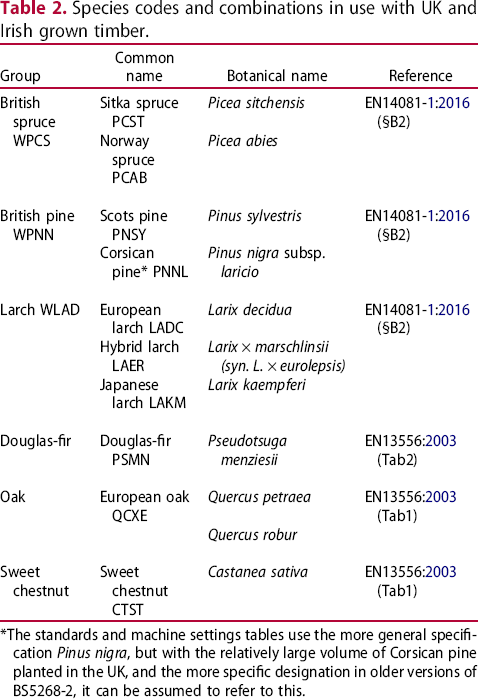
*The standards and machine settings tables use the more general specification Pinus nigra, but with the relatively large volume of Corsican pine planted in the UK, and the more specific designation in older versions of BS5268-2, it can be assumed to refer to this.
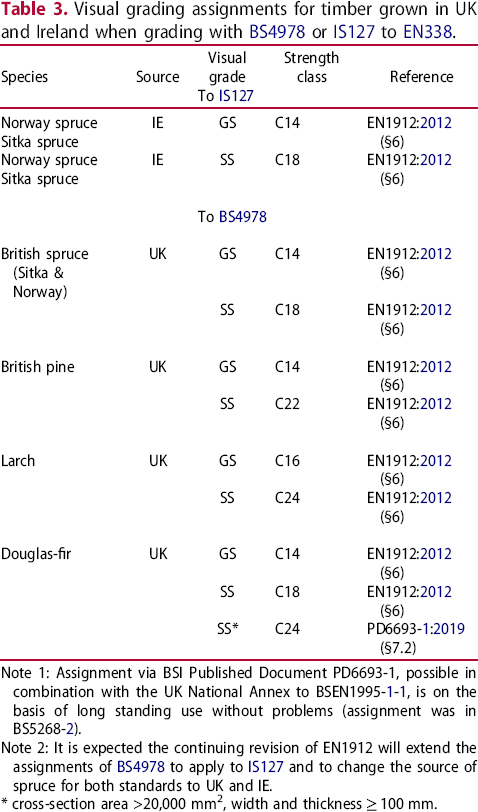
Note 1: Assignment via BSI Published Document PD6693-1, possible in combination with the UK National Annex to BSEN1995-1-1, is on the basis of long standing use without problems (assignment was in BS5268-2).
Note 2: It is expected the continuing revision of EN1912 will extend the assignments of BS4978 to apply to IS127 and to change the source of spruce for both standards to UK and IE.
* cross-section area >20,000 mm2, width and thickness ≥ 100 mm.
Visual grading assignments when grading with BS5756.
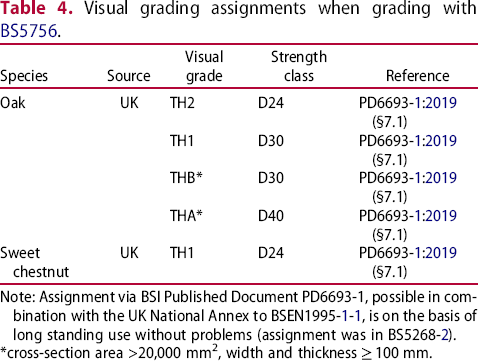
Note: Assignment via BSI Published Document PD6693-1, possible in combination with the UK National Annex to BSEN1995-1-1, is on the basis of long standing use without problems (assignment was in BS5268-2).
*cross-section area >20,000 mm2, width and thickness ≥ 100 mm.
Machine grading can be by machine control or output control. Output control requires the producer to periodically test batches of graded timber and, if necessary (by statistical procedures), adjust the grading machine settings to ensure grading proceeds correctly and efficiently. This method is not common in Europe, but it allows the use of any grading machine that meets the general requirements of EN14081. The much more common method is machine control, where settings are determined by previous testing and the grading machines of a certain model are expected to have identical performance. These settings are examined and approved by European Committee for Standardization (CEN) committee TC124/WG2/TG1 (‘TG1’), which consists of a panel of experts with sufficient experience to be able to identify potential problems separate from simple compliance with the standards. See http://blogs.napier.ac.uk/cwst/tg1/ for the latest additional rules and guidelines from TG1.
Typical average properties of UK and IE grown softwoods before grading (Of a batch of timber at 12% moisture content, with the EN384kh factor).

List of grading machines approved for machine control. In bold the machines with machine control settings available for UK and Ireland.
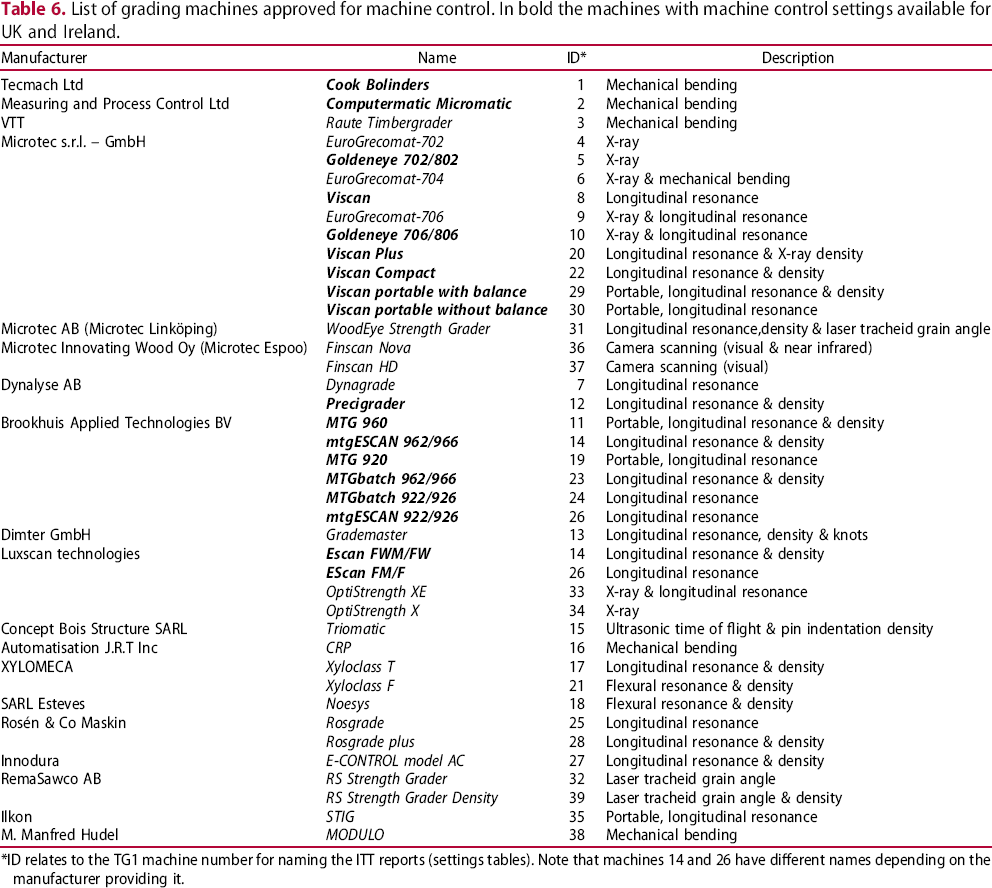
*ID relates to the TG1 machine number for naming the ITT reports (settings tables). Note that machines 14 and 26 have different names depending on the manufacturer providing it.
Machine settings for British spruce WPCS (Picea sitchensis, P. abies).
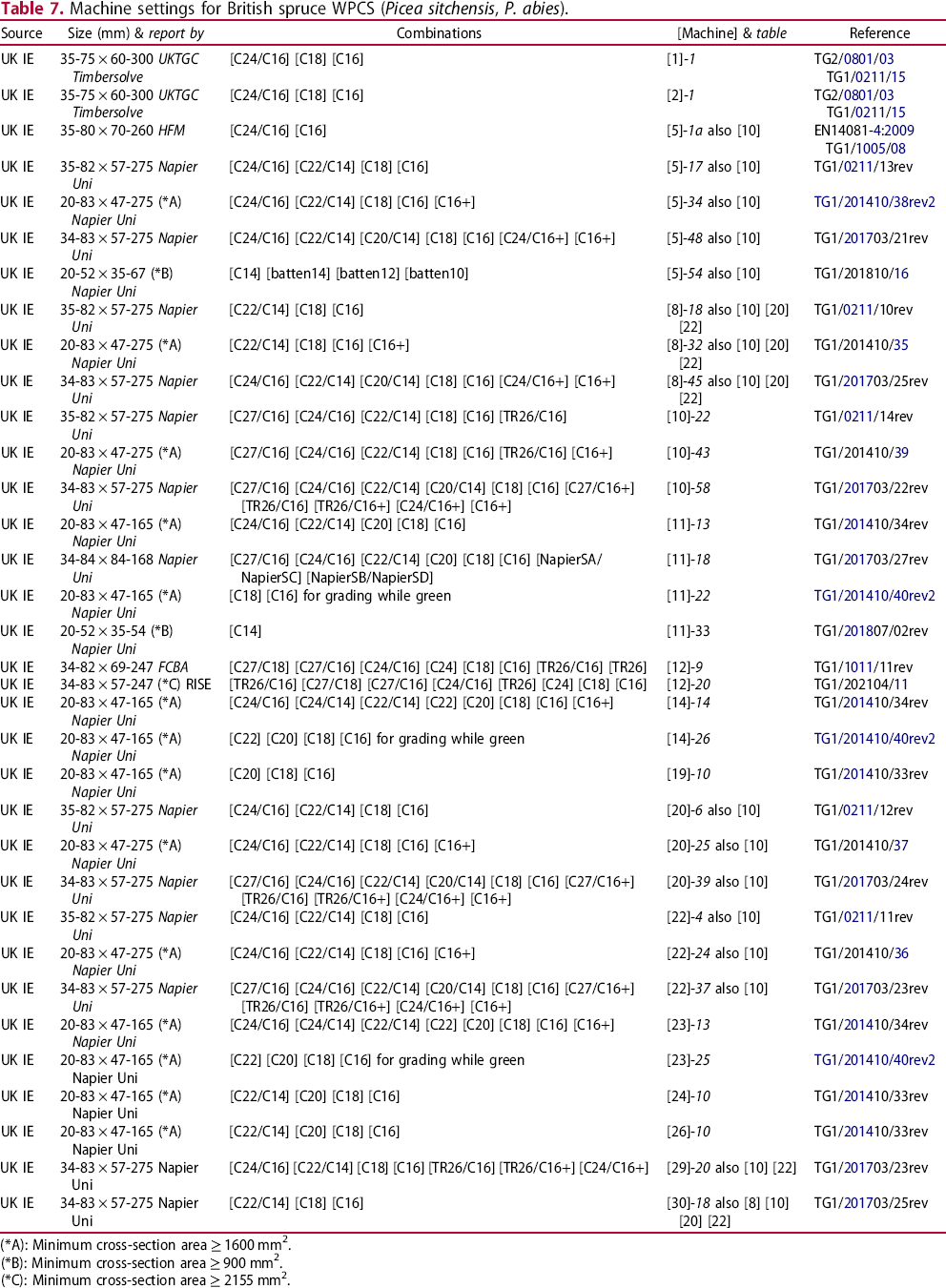
(*A): Minimum cross-section area ≥ 1600 mm2.
(*B): Minimum cross-section area ≥ 900 mm2.
(*C): Minimum cross-section area ≥ 2155 mm2.
Machine settings for British pine WPNN (Pinus sylvestris, P. nigra).

Machine settings for larch WLAD (Larix decidua, L. x eurolepis, L. kaempferi).
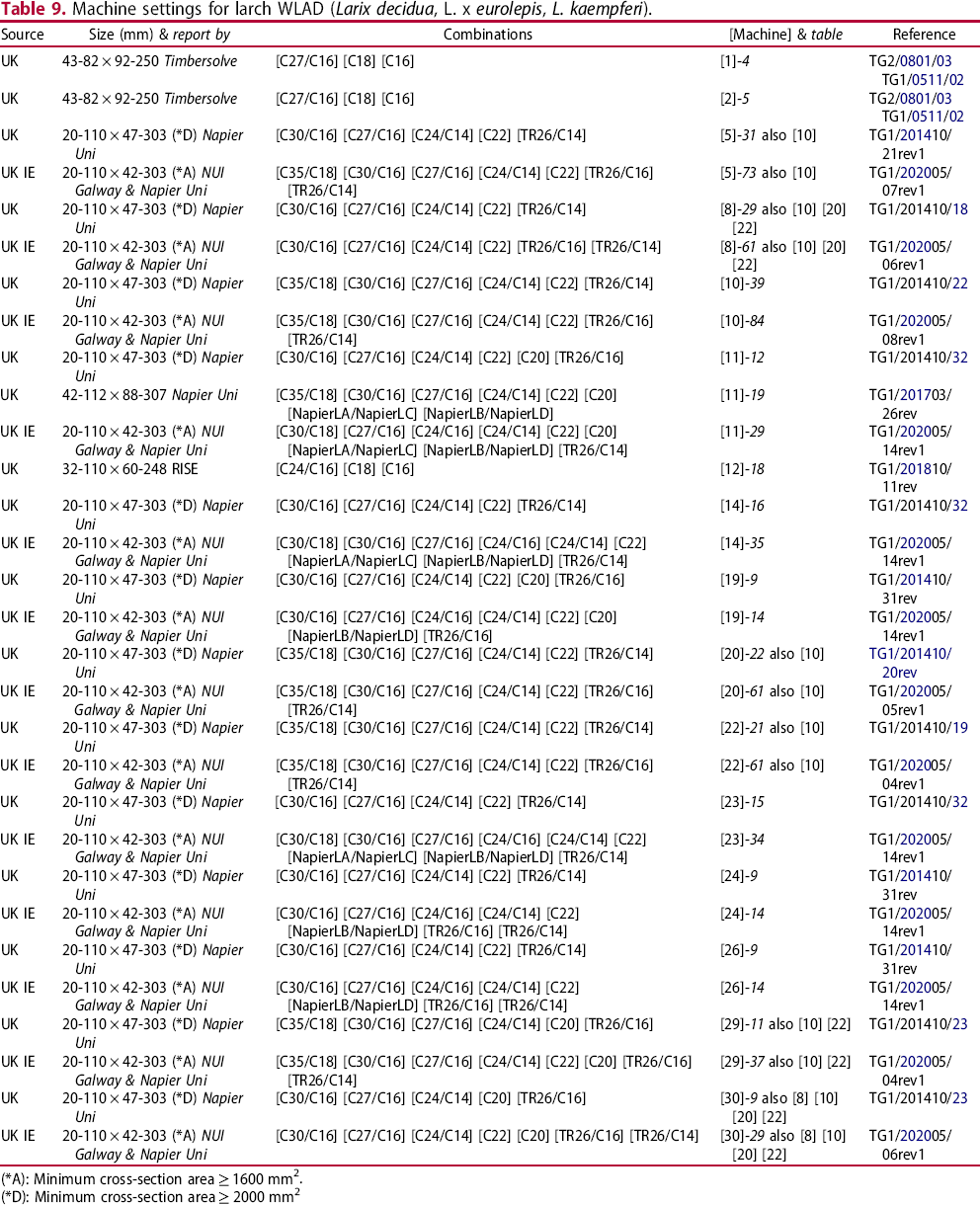
(*A): Minimum cross-section area ≥ 1600 mm2.
(*D): Minimum cross-section area ≥ 2000 mm2
Machine settings for Douglas-fir PSMN (Pseudotsuga menziesii).
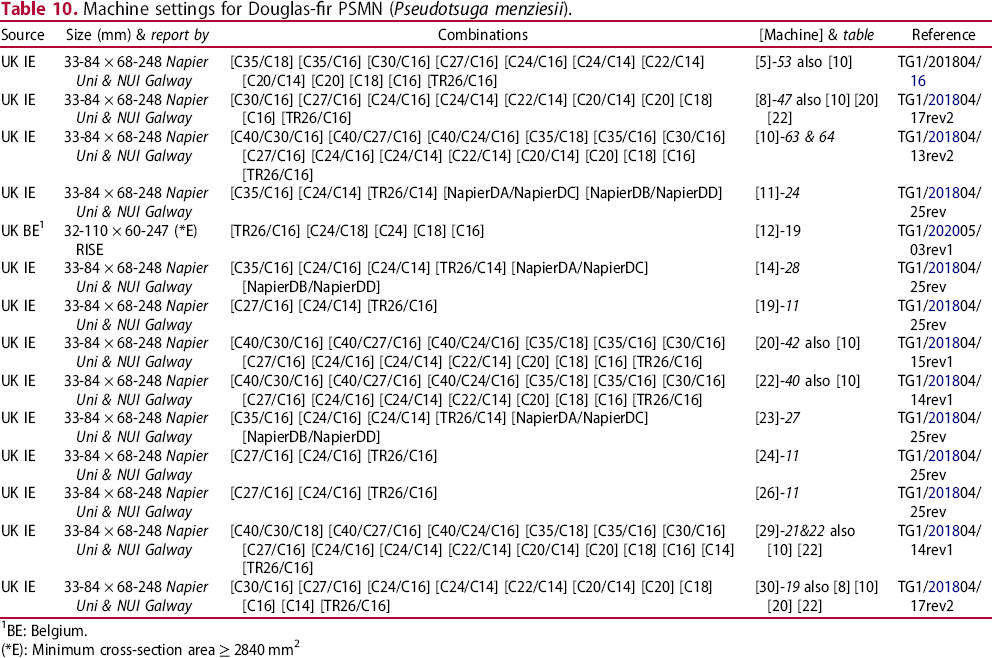
BE: Belgium.
(*E): Minimum cross-section area ≥ 2840 mm2
Certain machines can work in different modes, and use the settings approved for a different machine, typically from the same manufacturer. Machines from different manufacturers with proven performance equivalence, and agreement of the manufacturers, can also use the same settings. Note that machine grading is based on the assessment of the grade determining properties by methods summarised in Table 6. This is a separate route from visual grading, and parameters like knot size and ring width are not inherent in the definition of the strength classes, which are concerned with the actual characteristic properties. This means that machine grading will pass some pieces that fail visual grading rules and reject some pieces that pass visual grading. This is not incorrect grading, since grading is about the collective properties of the graded timber and not the properties of any particular piece. Visual grading and different grading machines will achieve the required collective properties of the graded timber by different sorting criteria.
Note also that the United Kingdom is officially GB in ISO3166-1, but sometimes appears in standards and settings tables as UK. UK is used in this paper as the more familiar abbreviation. In the context of growth areas, Northern Ireland is included with this use of the abbreviation GB.
Developments in grading
The timber industry is not oblivious to innovations, and the use of machines for timber quality assessment using acoustic principles is well known in the sector. Since UK and Irish grown timber is mostly grade limited by its stiffness, this technique also has potential for segregation of logs before processing and grading, and also means that strength grading can be carried out by relatively simple longitudinal resonance machines (Table 6) with comparable yields to those from more complicated machines (Gil-Moreno et al. 2019b).
The large-scale multi-partner research work of the Gradewood (Ranta-Maunus 2009 and Ranta-Maunus et al. 2011) and Gradewood Transition projects, the relative simplicity of this acoustic method, and the high repeatability of this kind of measurement, led to the inclusion, in the standard EN14081-2:2018, of fixed settings to grade two of the most important species in Europe: Norway spruce (Picea abies) and Silver fir (Abies alba) (the combination ‘spruce and fir whitewood’, WPCA), for the grade combinations C24/C18 and T14/T11 as well as for C24, C18, T14 and T1 as single grades. This means any approved grading machines measuring longitudinal resonant frequency can grade these two species within the specified limitations for timber size and additional requirements for operation and environment and without need for further approval by TG1. The settings cover most of the European countries, and therefore will typically result in lower yields than settings developed for the specific characteristics of a particular timber source. All longitudinal resonance based machines listed in Table 6 are able to use the EN14081-2 fixed settings tables. They do not have to be repeated in the machine's settings tables, although in some cases they are.
Software development is another important field of innovation, since modern machines are able to do more than sort by simple thresholds. Some manufacturers include, in their machines, functions that allow grading of pieces before splitting into smaller cross sections. More recently, an alternative to the common machine grading by machine control has also been added to EN14081-2; the adaptive settings method. This method uses information previously collected by the machine in the grading process, and aims to automatically adjust the settings, adapting to the variability in the incoming timber, and producing a more optimised balance of yield and safety. This is not implemented in any UK or Irish sawmills where it is unlikely to provide a grading advantage for a relatively uniform resource from a relatively small geographical area. Some sawmills instead optimise their production through log pre-grading, which can reduce rejects from grading and visual override by avoiding the processing of logs likely to give problems. Powerful log pre-grading approaches have the potential to cause issues for structural timber grading if they significantly change the resource compared to what the grading settings and assignments are based on, but research is being done to develop new grading approaches to adjust for that, e.g. Weidenhiller et al. 2021. Computer tomography (CT) scanning of logs also brings the potential to grade timber before it is sawn from the log in future (e.g. Fredriksson et al. 2017 and Olofsson et al. 2019).
Concluding remarks
Timber grading in Europe is fast developing, with new machines, updating of standards and processes, and new visual grading assignments and machine grading settings added regularly. There are grading machine settings for timber grown in the UK and Ireland, which exceed the commonly held expectations of what strength classes are possible. Not all the permitted settings have commercially viable yields, but there are some grading possibilities that open up more potential for wider, and more efficient, use of the domestic forest resource, especially as machine grading becomes more accessible to building fabricators.
Contact machine manufacturer or a Notified/Approved Body to obtain more information about grading settings tables, their limitations and yields. As things change, a supplement of this summary may be obtained from http://blogs.napier.ac.uk/cwst/tg1/
Footnotes
Acknowledgements
The majority of this work, which includes both wood properties research and standardisation support for the industry, is due thanks to the funders of SIRT (Strategic Integrated Research in Timber) and linked projects in the UK, and the WoodProps programme in Ireland. It is also built upon the work of many people, and particular thanks are due to Stefan Lehneke, John Moore, Steven Adams, Thomas Drewett, James Ramsay, Gregory Searles, Paul McLean, Andrew Lyon, Luka Krajnc, Conan O'Ceallaigh, Colm Walsh, Peter Fahy, and to colleagues at Forest Research, Teagasc and the University of Glasgow. The authors are grateful to grading machine manufacturers Microtec and Brookhuis, and in particular to Martin Bacher of Microtec for all his help over the years.
SIRT, and its allied projects, have received funding or significant in-kind support from the Scottish Higher Education Funding Council, Scottish Forestry, Natural Resources Wales, Forestry Commission England, The Scottish Forestry Trust, Adam Wilson and Sons, Balcas, BSW Timber, James Callander and Son, Confor, Euroforest, Howie Forest Products, James Jones and sons, John Gordon and son, Pontrilas Timber, Scottish Woodlands, UPM Tilhill, Glennon Brothers, Murray Timber Group, the Timber Trade Federation, the European Regional Development Fund, Scottish Enterprise and Coillte. Particular thanks are due to Andy Leitch for all his enabling work in recent years, and to John Kissock and Tony Fewell, and other members of the UK Timber Grading Committee for their key role in connecting the researchers to grading in industry.
WoodProps was funded by the Forest Sector Development Division of the Department of Agriculture, Food and the Marine, Ireland, and received significant in-kind support from Coillte, Murray Timber Group and ECC Timber Products. Additional funding was provided by the Higher Education Authority and the Department of Further and Higher Education, Research, Innovation and Science in Ireland.
Disclosure statement
No potential conflict of interest was reported by the author(s).