



Abstract
This study aimed to characterize the physical properties of goat fibers from some indigenous Ethiopian goat breeds. Ethiopia has different indigenous goat breeds, which are the livelihood of Ethiopian farmers and are mainly used as a source of meat, milk, fiber, hides, etc. The fiber samples were collected from Abergelle, Central Highland, and Western Lowland indigenous Ethiopian goat breeds. After shearing, scouring was applied for the removal of some impurities using ionic and non-ionic detergents and chemicals. In this study, fiber length, fineness, tensile strength and elongation, and fiber diameter were evaluated using scientific test-standard methods. The study results showed that the average tensile strengths of goat fibers obtained from Abergelle, Central Highland, and Western Lowland were 13.38, 13.31, and 13.26 cN/Tex, respectively. Similarly, the elongation percentage values were found between 22% and 24% and 32% and 34% in dry and wet conditions, respectively. The moisture regain and moisture content values ranged from 14.04% to 14.10% and 12.61% to 12.68%, respectively. The fiber length values were between 38 and 43 mm, with a diameter ranging from 18 to 21 μm. Even though there was a slight difference in some values of physical properties, the fibers obtained from each goat breed have satisfactory mechanical properties: good strength, fineness, elongation, moisture regain, and low density. Generally, this study proved that the goat fiber obtained from some indigenous Ethiopian goat breeds is a potential source of raw material for textile manufacturers and researchers.
Introduction
Ethiopia is known for its large and diverse livestock population in Africa, which makes a significant contribution to the country’s economy. Ethiopia has more than 51 million goats (CSA, 2020) identified into 12 breeds, namely: Afar, Abergelle, Arsi-Bale, Woito-Guji, Hararghe Highland, Short-eared Somali, Long-eared Somali, Central Highland, Western Highland, Western Lowland, Nubian, and Keffa.1,2 Goat breed classification is based on their differences in genetic makeup and physical characteristics.
Goats are among the livelihoods of Ethiopian farmers and are mainly used as a source of meat, milk, fiber, etc. Even though the country has huge potential for animal-sourced fibers, mainly wool and cashmere fibers, it is not yet exploited as a source of income. Most of the Ethiopian textile industries mainly process cotton and some man-made fibers. Even though there is no statistical data, Ethiopia has a big potential for animal fiber that is used for local as well as international markets.
Based on their source of origin, fibers in textile manufacturing are broadly classified into two categories: natural or synthetic fibers. Due to environmental concerns, the use of natural fibers has greater interest among researchers, manufacturers, and consumers. Natural fibers are known for their abundance, renewability, biodegradability, low cost, etc.3–6 Among natural fibers, animal fibers are the second most widely used fibers after plant or vegetable fibers, and they are known for their unique physical and chemical properties. 7 Cashmere, wool, camel hair, mohair, and yak hair are animal fibers.
Wool is an important natural protein fiber with distinct qualities such as resilience, moisture content, elasticity, etc. 8 It is made up of a protein compound known as keratin, which is the primary component of wool fiber. Wool’s structure has curls or crimps that give it a spongy feel and make it an excellent insulator for the user. Woolen fibers have long been utilized as an essential component for clothing and household textiles. In recent times, its utilization in technical textile applications has also increased. 9 The fiber properties of sheep wool might differ based on the type of sheep, age, grazing circumstances, etc. 10 Merino wool is one of the softest types of wool. These properties combine to make merino smooth and mild to the touch, ensuring that it does not irritate the skin. Mohair is another type of wool fiber derived from the hair of the Angora goat, which is smooth, resilient, etc. Mohair lengths, fineness, elasticity, tenacity, and clean mohair yield in both males and females were highly influenced by rangeland quality. 11 Yak hair is a type of animal fiber that is obtained from the undercoat of the yak. Compared to cashmere and camel fiber, it is the stiffest, shortest, and thickest fiber. In contrast, cashmere is the thinnest and somewhat shorter than camel hair, making it easier to spin finer-count yarns. 12
Cashmere is an animal fiber obtained from different goat breeds, like cashmere goats, pashmina goats and other breeds of goats. Naturally, many goat breeds produce cashmere fibers from their secondary follicles in the skin. However, the quality and amount of cashmere produced from breed to breed are different. 13 In the textile industry, cashmere is the most popular animal fiber, characterized by its softness, smoothness, and luster. Cashmere and wool fiber have similar physical and morphological characteristics. 14 Compared to wool fiber, cashmere is a finer fiber with unique characteristics like softness, smoothness, whiteness, luster, etc. 15 Cashmere fibers primarily come from Kashmir goats composed of α-keratin, with an outer surface of overlapping cuticle cells. 16
Due to its soft texture, smooth, elastic, uniform, warmth, and lightweight properties, cashmere fiber is a valuable raw material in the textile industry.17,18 However, it is a precious natural protein fiber called cashmere that is still in short supply every year.19,20 According to the quantum index of world trade, China is the largest cashmere fiber producer in the world.21,22 The annual cashmere fiber production in the world is around 15,000 tons. China and Mongolia are the major cashmere fiber producers in the world, with a 90% share. The rest of the cashmere fiber is produced by some Asian countries, like India, Iran, Nepal, Afghanistan, etc. 23
Cashmere fiber produced in India from a local goat called Changthangi is considered of superior quality. The fiber has 55–60 mm length and 12–1 μ diameters.24,25
The Yanshan Cashmere goat is a known breed in China that significantly contributes to the regional economy. Recently, Yanshan cashmere goats with crimped fibers have gotten greater attention from producers because of the greater yield of the fiber when compared with non-crimped fiber. 26 The secondary skin follicles are used to determine the shape, structure, and appearance of cashmere fiber. 26 To improve cashmere production and fiber quality many countries have done genetic research. 27 The Mongolian cashmere goat breeds are known for their elasticity, brightness, softness, and thin diameter. 28 Studies showed that the production of cashmere is increasing even though it is influenced by age, birth, sex, herd, etc.21,29 In general, cashmere fiber is an expensive natural protein-based fiber and is available in limited supply every year.30–32
The present study aims to investigate the potential of goat fiber from indigenous Ethiopian goat breeds and introduce it to the textile industry. In this study, some indigenous goat breeds were selected, goat fibers were collected, and the physical properties of the fiber were evaluated using scientific test-standard methods.
Materials and methods
Materials
The raw goat fiber samples were collected by shearing using clipper from phenotypically different goat breeds, namely, Abergelle, Central Highland, and Western Lowland. The fibers are collected in the spring season from male goat breeds with an age range of 3–5 years. 33 Figure 1 shows some of the indigenous Ethiopian goat breeds types. In this study, a total of 40 goats were selected for each breed type. The sites were selected based on goat production potential, breed differences, willingness, and cooperation of the farmer for the study. Fiber shearing has been done on the back, jaw, withers, and neck parts. Figure 2 shows the different body parts of goats used for fiber collection and Figure 3 shows the collected fiber samples.


Body part of goat for sampling.

Sample collected goat fibers.
After shearing the goat fibers from different body parts of goats, mixing and scouring were applied using ionic and non-ionic detergents and chemicals to remove some impurities like waxes, suint, cellulosic material such as straw and dried grass, dirt, and proteinaceous materials. 37
Methods
Fiber characterization
After scoring the goat fibers, the following tests were carried out: All specimens were conditioned before testing at the standard atmospheric conditions of 21 ± 1°C and 65 ± 2% (ASTM D1776-98). 38
Fiber length
To determine the length of cashmere fiber, 30 samples were randomly taken from each type of goat breed. Each fiber length was measured, and the average values were recorded.
Fiber fineness
Fiber fineness was determined according to the ASTM D 1577–07 standard test method. 39 For each breed type, 30 samples of fiber were randomly taken, and each fiber length was measured and weighed on an electronic balance. Finally, the single fiber fineness was calculated using the following equation (1). 39

Tensile strength and elongation
The tensile strength properties were determined using the Tinius Olsen H1KS single-fiber strength tester as per the ES ISO 5079:2020 standard. 40 The machine was equipped with a load cell of 20 kN, with a gauge length of 20 mm at a constant speed 15 mm/min. From each goat breed type, 30 samples were tested, and the average values were taken. The density of fiber evaluated by measuring the volume and weight of a representative sample of the fiber, and then combining these values to calculate density. 41
Fiber diameter measurement
The diameter of each single fiber was measured using an optical microscope. For each breed type, 30 samples were taken, and in each sample, 4 random points along the fiber length were measured.
Moisture regain and moisture content
To determine the amount of moisture and moisture regain, the sample was dried in an oven at 105°C until constant weights were obtained. 42 The samples were weighed on an electronic weighing balance before and after drying. A total of 20 samples were tested, and moisture contents and moisture regains were calculated using equations (2) and (3), respectively. 43


Result and discussions
Fiber length
In textile manufacturing, fiber length is the most important fiber characteristic, which significantly determines quality and spinning ability. 44 A longer fiber length is preferable because it can easily be processed and used to produce stronger yarn. The length of the cashmere fiber also has an impact on the quality of the yarn. The longer the fiber, the better the hand feel and anti-pilling resistance. 45 As shown in Figure 4, the lengths of fiber obtained from Central Highland, Abergelle, and Western Lowland were 43, 40, and 38 mm, respectively. Compared to Abergelle and Western Lowland, Central Highland’s goat breed has the highest fiber length. Similarly, the fiber length of Abergelle goat breeds is longer than that of Western Lowland goat breeds. The staple length of goat fiber can be affected by different factors, including environmental, climatic, season of shearing, breed differences, welfare of goats etc. 46 In general, the fiber length obtained from these three indigenous goat breeds was 38–43 mm, which can be used as a source of textile fiber.
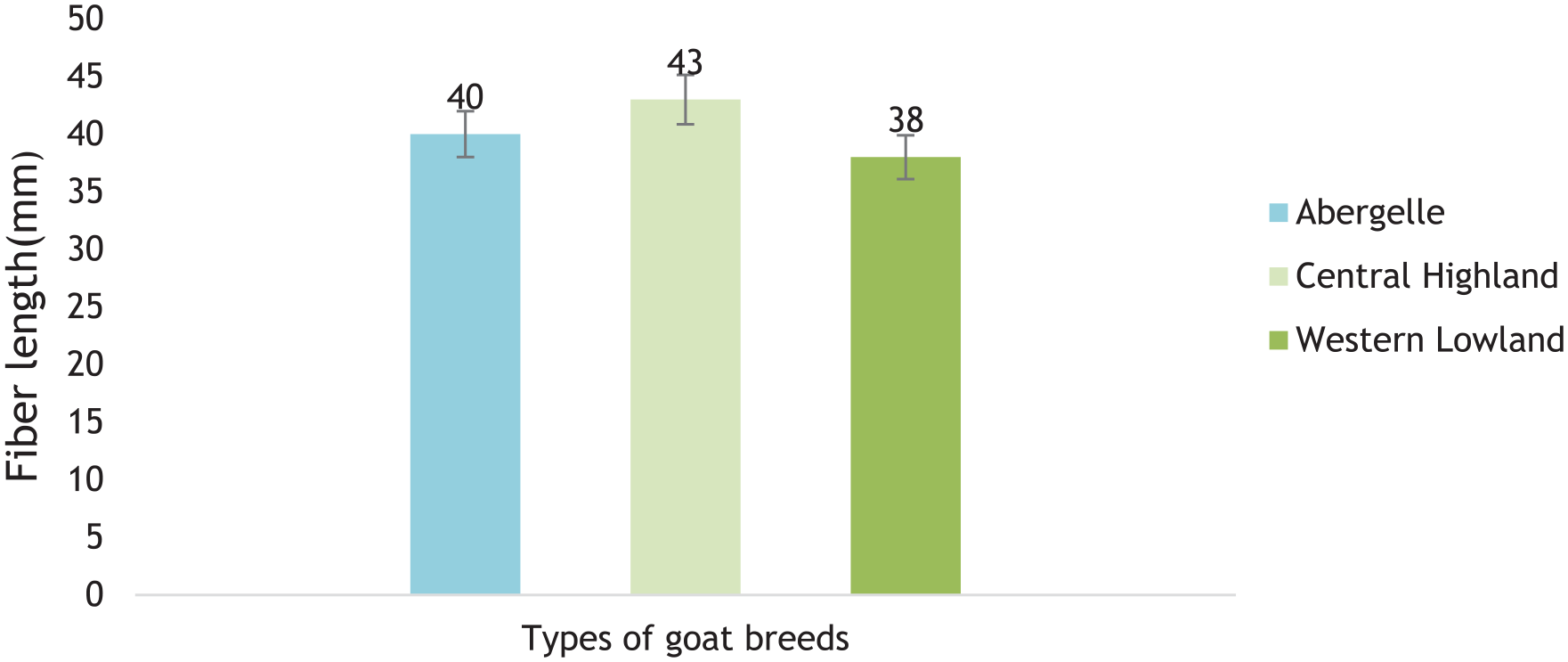
Fiber length three indigenous goat breeds.
Fiber fineness
Fiber fineness is one of the most important fiber characteristics that determine the density, performance, and applications of the fiber. Cashmere or goat fiber is known for its soft, fine, and lightweight properties. Cashmere fineness is an important metric for determining cashmere quality. The ability of cashmere fibers to retain air due to their fineness aids in the body’s insulation and warmth. Moreover, the longer fibers of cashmere give it a smoother, silkier texture and contribute to its durability compared to ordinary wool. 47 Based on the count formula, the fineness of the three goat breeds was determined. The mean value of the fiber fineness was 0.56, 0.52, and 0.61 Tex for Central Highland, Abergelle, and Western Lowland, respectively.
As depicted in Figure 5, Abergelle goat breeds have better fiber fineness than Central Highland and Western Lowland goat breeds. Comparatively, Western Lowland goat breeds have coarser fibers than Abergelle and Central Highland goat breeds. In general, the fineness of the fibers was slightly different for these three indigenous breed types. Fiber fineness can be affected by different factors like environmental factors, breed types, climatic conditions, the season of shearing, etc.

Fiber fineness of indigenous goat breeds.
Tensile strength and elongation
The tensile strength of a textile fiber shows its ability to resist stretching loads when applied in the longitudinal direction. The fiber tensile strength and elongation determine the application of a textile material. Cashmere fibers are more resilient than wool ones. The mechanical properties of cashmere and wool fibers differ because cashmere fiber has a higher degree of crystallinity than wool. 48
The average tensile strength of sample goat fibers obtained from Abergelle, Central Highland, and Western Lowland was 13.38, 13.31, and 13.26 cN/Tex, respectively. Similarly, the elongation percentages were 22% in dry and 34% in wet conditions, 24% in dry and 34% in wet conditions, and 22% in dry and 32% in wet conditions for Abergelle, Central Highland, and Western Lowland, respectively.
As shown in Table 1, the average tensile strength and elongation values of fibers obtained from three goat breeds, namely, Central Highland, Abergelle, and Western Lowland, had a slight difference. This slight variation in tensile strength and elongation is due to environmental and climatic conditions, breed differences, etc.
Comparisons of mechanical properties of sample goat fibers with wool fiber.

Fiber diameter measurement
The diameter of the fiber has a significant impact on the hand feel, style, stiffness, elasticity, and strength of the fiber. The finest and longest cashmere fibers, making it the best grade. The fibers’ length is between 34 and 36 mm, and their diameter ranges from 14 to 15.5 microns. 51 The diameter of a single goat fiber was observed using an optical microscope and the results were measured in micrometers. As shown in Table 2 the diameter of fiber for all phenotypically different goat breeds were slightly different. The average value ranges from 18 to 20 μm for Western Lowland 18.5–20.5 μm for Abergelle and 19–21 μm for Central Highland. Compared to the fiber diameter of Kashmir goats of China and Mongolia (14.5–16.5) the fiber diameters are higher or thicker, while a little bit similar to that of Iranian goat cashmere fiber which is 17.5–19.5 μm. 52 In general, the average fiber diameter values range from 18 to 21 μm which is thicker than China and Mongolia goat breed cashmere fibers.
Fiber diameter of indigenous Ethiopian goat breeds.

Moisture regains and moisture contents
Moisture regain refers to the amount of moisture that a textile material will absorb when exposed to a specific level of humidity. Whereas moisture content is the amount of moisture present in a textile fiber, it is also expressed as a percentage of the total weight of the fiber. The moisture content of textile fiber is an important characteristic that affects the physical and performance properties, comfort properties, etc.
Cashmere is the most absorbent textile material, with a moisture recovery rate of more than 15%. In terms of hygroscopicity, cashmere is clearly better than wool. 30 The absorbency of a textile fiber mainly depends on the physical and chemical structure of the fiber properties and the humidity of the environment. Due to the presence of its hollow structure inside the fiber, cashmere is more absorbent than wool fiber. 53
As shown in Table 3 the goat fiber obtained from three indigenous Ethiopian goat breeds had almost the same moisture regain and moisture content values.
Moisture regain and moisture content of some indigenous Ethiopian goat breed fibers.

Conclusion
In this study, the physical properties of goat fibers obtained from some indigenous Ethiopian goat breeds were evaluated. The fibers obtained from each breed have satisfactory mechanical properties, such as good strength, fineness, elongation, and moisture regain, and low density.
The average tensile strength and elongation value were found between 13.26 and 13.38 cN/Tex and 22% to 24% dry and 32%–34% wet conditions, respectively. The average moisture regain and moisture content values ranged from 14.04% to 14.10% and 12.61% to 12.68%, respectively. The fiber length values were 38–43 mm, with a diameter ranging from 18 to 21 μm. Some of the physical properties of indigenous Ethiopian goat breed fibers have similar properties to those of cashmere goat breed fibers.
In general, the study proved that some of the fiber obtained from indigenous Ethiopian goat breeds is a potential source of raw material for textile manufacturers.
This indicates that the Ethiopian indigenous goat breeds can be a source of income besides meat, milk, hide, and direct cash for goat-rearing enterprises, goat-owners, farmers, etc. Therefore, researchers and other concerned institutions should exploit the country’s animal resource potential as a source of textile material.
Footnotes
Acknowledgements
The authors would like to acknowledge the Ethiopian Institute of Textile and Fashion Technology, Bahir Dar University, Bahir Dar, Ethiopia for the support of this project.
Data availability
All data are included in the manuscript.
Declaration of conflicting interests
The author(s) declared no potential conflicts of interest with respect to the research, authorship, and/or publication of this article.
Funding
The author(s) received no financial support for the research, authorship, and/or publication of this article.

