



Abstract
Fibre grading systems are recognized as essential for both customers and the manufacturers of natural fibres. Identification or grading of fibre content in textiles and fibre industry has become extremely challenging even for experienced parties in the field. The increasing variety of fibres and blending techniques are the reason for this. Consequently, laboratory tests are very important for grading and verification. This research focuses on observing the surface structure of the banana pseudostem fibre in the light microscope, scanning electron microscope, fineness, strength, chemical solubility, burning behaviours, and grading for different banana varieties. Fibres and fibre bundles were inspected visually and tested. One of the focus of this research is to produce quantifiable observations such as general observation test and feeling test. So the quantitative method can lead to exploring the systemic connection between experimental observation and mathematical expression for the grading of banana fibres. Based on the testing results, a novel grading system was introduced for banana fibres varieties (Sri Lankan cultivar).
Introduction
The grading system of textile fibres are very important for processing fibres into specific purpose of textiles. The fibre grading test is a very notable factor for research and improvement. The identification of physical and chemical properties is required to find the composition of different fibres. 1 Bast fibres are commonly used as a textile material around the world. Nevertheless, the method of grading the different bast fibre species has been questionable. Banana (Musa spp.) is a bast fibre which has superior mechanical properties such as high strength, lightweight, slighter extension, solid humidity absorption quality, low density, appropriate stiffness, high disposability and biodegradability.2,3
Fibre extraction from banana psedostem and conversion of fibres into textile products are of recent origin. 4 Banana fibre products has raised considerable interest all over the world. 4
Banana is the most well-known delightful food in Sri Lanka and simple fruit to suit in any event. Banana is the most demanded fruit amongst different economic class customers in grocery stores. The most ordinarily known banana is the cavendish assortment, which is one of the highly produced varieties. 4 These varieties can be seen with skin hues, for example, ruddy purple, yellow, green and silver. The size of varieties varies from length of 3 to 40 cm. 5 Perming, 2013 referred by Ratnasinghe, 2002 notices six popular varieties in Sri Lanka. Amongst them, farmers specified Embul, Kolikuttu, and Seenikehel as the most widely recognized. AA, AAA, AB, AAB, ABB, AAAA, AAAB and AABB genomic banana varieties groups are found in Sri Lanka and its report on IBPGR (International Board for Plant Genetic Resources). Ambul and Seeni are becoming within the genome type of AAB and these are coming under Mysore group. Kolikuttu, Suwendel, Rathkehel and Puwalu are becoming within genome type of AB and these are coming under the kolikuttu group. Anamalu, Embon or Ambun, and Nethrampalam are becoming within the genome type of AAA and these are coming under the Cavendish group. Alukehel, Atamuru, Hambanpuwalu, Marathamana, Mondon and sambel are becoming within genome type of ABB and these are coming under the Plantain varieties or cooking varities. 6 M.acuminata and M.balbisiana varieties of banana are edible prime varieties. 7
The chemical composition of the banana fibres attracted the attention of many investigators in the past. The structural properties of banana fibre were investigated by a limited number of researchers. Identification of physical (strength, longitudinal and cross-sectional appearance, handle, absorbency, elasticity, drapability etc.,) and chemical properties (resistant to alkalis, acids and other specific chemicals, burning nature etc.) of the fibre are very important for the fibre grading system. 8 Analyzing the properties of banana fibre is a prime requirement to determine the feasibility of utilizing of banana fibres as raw material in textile, fibre and handcraft industries.
Although several grading methods were used for other types of natural fibres it was not applied for banana fibres. 8 This research work is done to introduce a grading system for banana fibres. This grading system enables us to identify the qualities of the banana fibre varieties with relative ease.
In this study, banana pesudostem fibres were graded through both technical and non-technical test. Extracted banana fibre’s microscopic analysis, chemical solubility, strength, fineness and colour properties are technical test types. Observation, feeling and burning test are non- technical test methods. Technical test is more authentic than non-technical test due to its accuracy. 9 This research was restricted to the most popular variety of banana such as Kolikuttu, Rath kehel, Ambun, Alu Kesel and Poowalu.
Materials and method
Test specimen of banana varieties
Genome type AB (Kolikuttu group) of Kolikuttu, Rathkehel and Puwalu, Genome type AAA (Cavendish group) of Ambun and Genome type ABB (Plantain varieties or cooking verities) of Alukehel banana varieties were extracted from waste pesudostem of banana plant by using extraction machine. Banana stems were obtained from Kurunegala (North Western) geographical area for banana cultivations in Sri Lanka. Selected banana pesudostem were collected with lengths of 20 inches and banana fibres separated from waste pseudostem of the banana plant by using an extraction machine. Then the fibres were then thoroughly washed and sun dried. Dried samples were collected and loosely packed with polythene bags (to minimize the physical changes such as moisture and avoid to damages).
Conditioning
Extracted banana fibre were conditioned in 21 ± 1°C temperature and 65% ± 2% relative humidity standard atmosphere for the testing.
General observation test
One thousand banana fibres with three inch of length were tested. By touching and sensing the fibres gently in three rounds, and observing the colour, luster and crimp properties at room temperature and readings were recorded. Crimp percentage was calculated by measuring the length of banana fibre under low tension and length under a sufficient to straighten length of banana fibre Then, the percentage of crimp was calculated (The standard test method of ASTM D3937-81).
Feeling testing
One thousand banana fibres with three inch of length were tested. By touching and sensing the fibres gently in three rounds, and observing the rough, soft, and slippery of each fibre at room temperature.
Microscopic examination of the longitudinal view of the banana fibre
Optical microscope was used to study the surface (macroscopic feature) of the fibres. This microscope can display a beneficial magnification only up to 1000 to 2000 times.
Scanning electron microscopy examination of the longitudinal view of the banana fibre
The structure features of mechanically extracted banana fibres were examined used scanning electron microscopy. It is able to investigate internal structure of banana fibre. This type of electron microscope is possible to view the three dimensional external shape of the banana fibre.
Fineness of banana fibres
The fineness of banana fibre was very important to decides the number of fibres in cross sectional area. Fibre fineness expressed in micrometre (µm). Scanning electron microscope was used to test the diameter of banana fibres.
Single fibre strength of banana fibre
Single strength expressed as breaking strength or load, tenacity (breaking load per unit fineness). The fibre strength is determined by testing individual fibres. Electro mechanical Instron universal tensile tester instrument was used for the testing of single fibre strength.
Burning test method (Combustion, Smell and Residue)
Each fibre’s chemical components are different. 10 Therefore, they show various burning characteristics. Those characteristics can be used to identify each fibres. For the burning test, observer was observed the following steps.
a) Before touching flame
b) In flame
c) After leaving flame
d) Odour
e) Ash
Small tuft of fibres was burned and observed the burning behaviour under each of the above stages.
Chemical test or solubility test method (Acid or Alkali)
The fibres were treated with some specific chemical reagents (acid, alkali, bleaching agent, solvent) and recorded the effects of chemical solubility with each fibre variety.
Selection of chemicals
90% Formic acid (room temperature) or 20% HCl ( Room temperature), 5% NaOH, boil or 5% Sodium hypochlorite, 20°C, 60% H2SO4, 70% H2SO4, Dimethyl formamide 50°–60°C, and m-Cresol( boil).
Colour properties
Colour of fibres is generally a desired feature in handcraft, textile and apparel products. 11 The colour value identification is very important for textiles. The CIELAB system was universally accepted in the textile and apparel filed. 12 The colour values were obtained by using spectrophotometer. CIE L* a*b* colour values and hue of the fibre samples were measured by using spectrophotometer (Datacolour 600). CIELAB colour consists of three axis perpendicular to each other. The a* axis represents the red (+) –green (–) chromaticity coordinates and b* axis represents the yellow (+)-blue (-) chromaticity coordinates were assessed. The L* axis represents the (100) white-black (0) chromaticity coordinates were assessed. The h* represents hue angle colour parameters were assessed.
Fibre grading system
Banana grading system was designed based on five grading parameters with four corresponding grading points. Grading parameters are strength, fineness or coarser, colour, lustre and contamination of impurities. Grading points are one (1), two (2), three (3) and four (4). The banana fibre quality grading system was described as Table 1.
Banana fibre grading system.

Results and Discussions
General observation test
The general observation tests were made to investigate the difference between the two colour shades. It can be seen the number of dark colour banana varieties are puwalu, alukehel and rathkehel. Ambun and kolikuttu banana fibres was golden yellow in colour.
Figure 1 above clearly shows the visual differences among the banana pesudostem varieties. Figure 2 shows the visual differences among the banana fibre varieties.

Banana varieties stem sample.

Banana fibre samples.
The banana fibres lustrous and dullness properties
Lustre is the characteristic surface appearance of fibre. Ambun and kolikuttu banana fibres are golden yellow in colour and lustrous. This natural lustre enhances the value of banana fibres. The colour of Puwalu, Rathkehel and Alukehel banana off-white natural colour to cream and have little lustre effect.
Comparison of banana fibre’s low crimp with high crimp
Banana fibre are low crimp fibres and there is no different in crimp amongst the banana varieties.
Feeling test
Figure 3 shows the comparison between the banana fibre softness and roughness hand feeling results. The results indicate, Ambun and koliluttu fibres has soft surface in their nature and puwalu, rathkehel and alukehel fibre has rough surface.

Comparison between softness and rough of banana fibre’s varieties.
Microscope test results
Light microscope and scanning electron microscope were used to identify the bast fibres. 13 Five varieties of banana fibres were used in this study, which are following (1) Kolikuttu, (2) Rathkehel and (3) Puwalu, Genome type AAA (Cavendish group) of (4) Ambun and Genome type ABB (Plantain varieties or cooking verities) of (5) Alukehel.
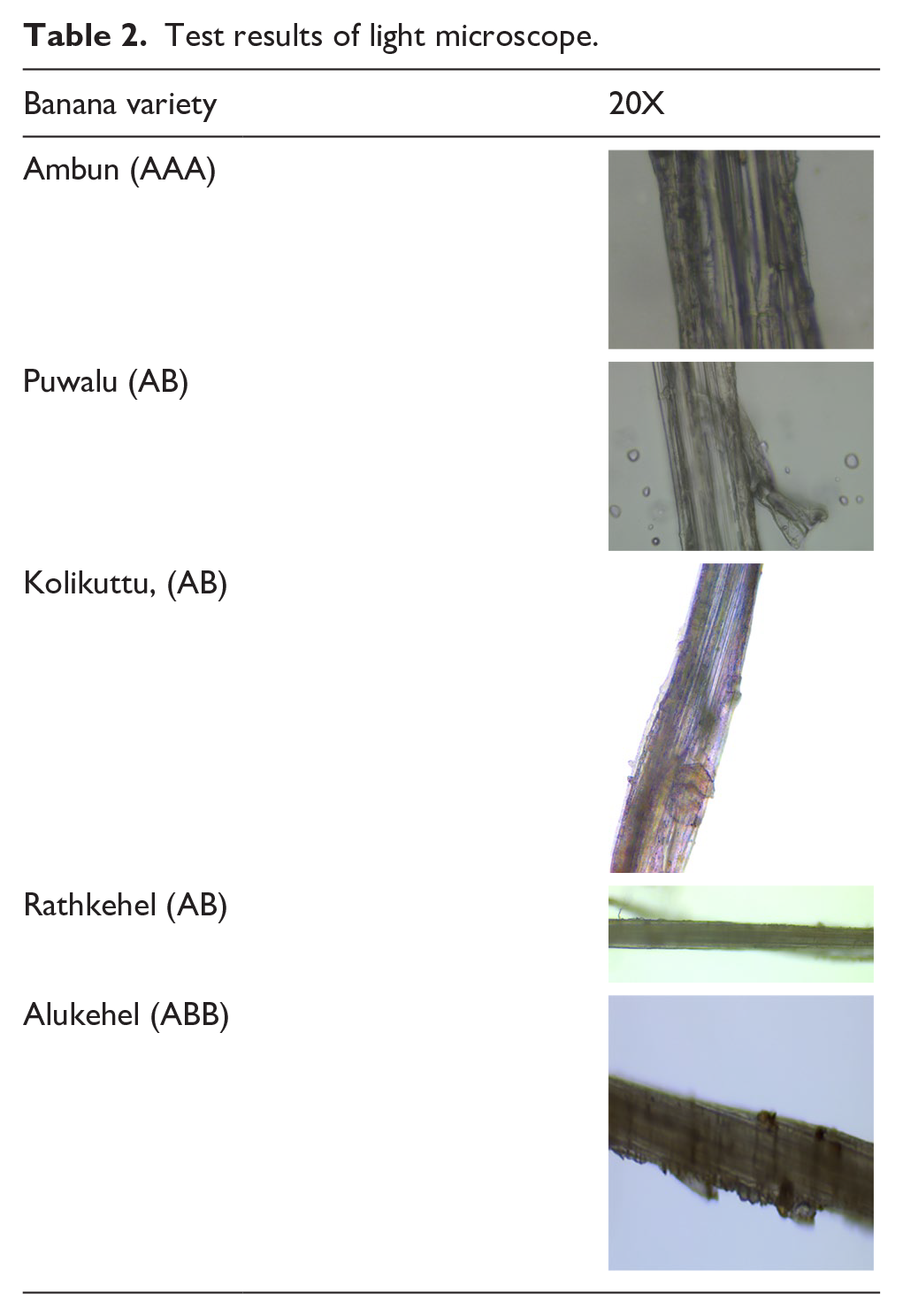
Initially these five varieties of banana fibres are microscopically examined under two different microscopes (light microscope and scanning electron microscope). However, there is no different in surface morphology (light microscope) amongst banana varieties. The microscopic and scanning electron microscope observations summarized in Tables 2 and 3.
Test results of light microscope.
Test results of Scanning electron microscope.

The structural features and fracture morphology of the banana varieties were analysed. The optical microscopy investigation of banana fibre displayed that it is a multicellular fibre, similar to other cellulose fibres. Variety wise fibres are not significantly different in surface morphology, and the surface is less clear, due to the impurities and debris. The ultimate fibres and their fibrils are not clearly visible.
Scanning electron microscopy image of five selected banana varieties as shown in Table 3. As per the observation of SEM images of Table 3 mechanically extracted fibres has an irregular surface and contains impurities. SEM image shows that, mechanically extracted banana fibre has an irregular surface and impurities and Puwalu banana fibre an average diameter was about 87.77 µm. Ambun banana fibre diameter was least value than other variety which is about 78 µm. kolikuttu banana fibre an average diameter was about 83.37 µm. Rathkehel fibre shows higher value of diameter among the banana variety which is about 214.4 µm. However, the fibre variety wise diameter was varying. Comparing with other common natural fibres, banana fibre diameter value was high. Hemicellulose, lignin and pectin bonding substances can be observed in the surface of banana fibre. Bonding substances can be observed in mechanically extracted fibre images. Mechanical properties of banana fibres impact on low micro-fibril angle and high cellulose content. 12
Table 3 shows that, Non – cellulosic fibrous materials were covered the fibre bundles and elementary fibres were not found in this structure. The fibres were appeared tube like structures and the structures were detected by scanning electron microscope.
Fineness of Banana fibres
Table 4 illustrations the outcomes of five types of banana varieties fibre diameter results. It was found that the finest banana fibre has a substantially greater strength. An examination of the data reveals that the largest value was 214.4 µm (Rathkehel fibre). The orders of diameter of banana fibres samples were found as Rathkehel >Alukehel >Poowalu >Kolikuttu >Ambun. The outcomes expose that Ambun banana (AAA Genome) of pseudostem has the minimum value of fineness (78 µm). The study findings showed that the fineness for all the cultivars to be less than 250 µm. Observation of fineness properties assumed that the diameter of fibres varies from one cultivar to the other due to cross-section. These outcomes describe that fibre from Rathkehel and Alukehel the cultivar was coarse and stiffer than other cultivars investigated.
Diameter results of five selected fibre varieties.
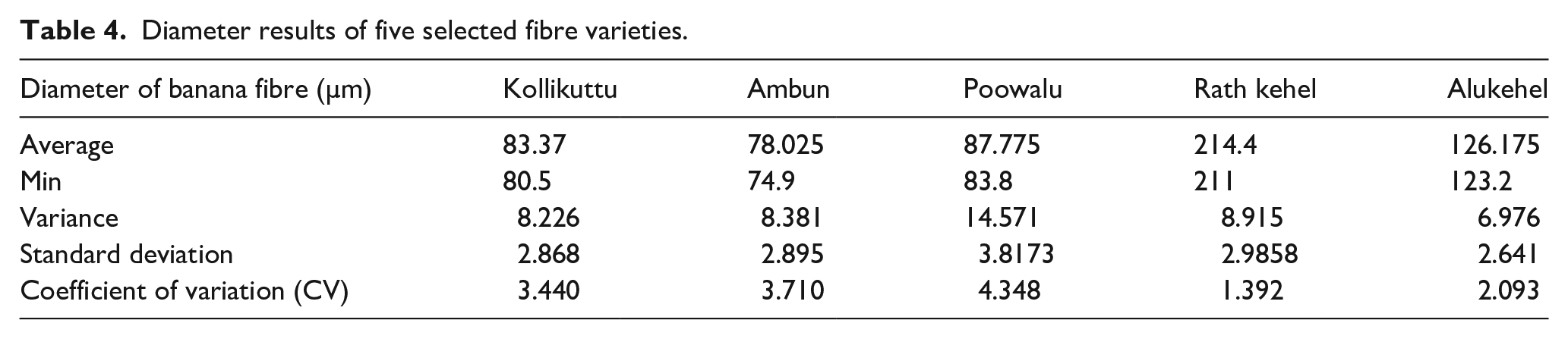
The method of calculating average, variance and standard deviation were used to introducing the statistics of fibre fineness (diameter) in Table 4.
Single fibre strength of banana fibres
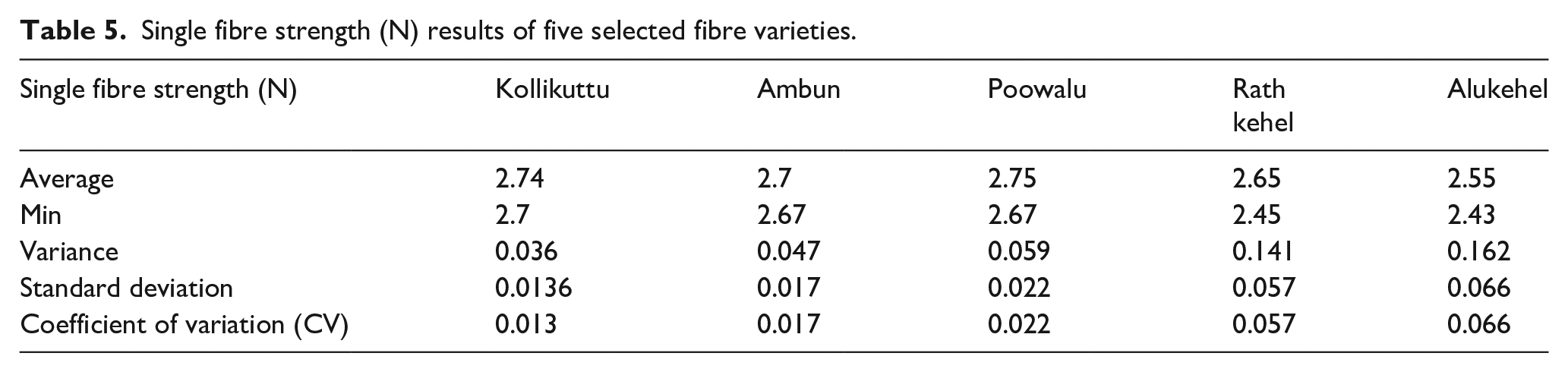
The method of calculating average, variance and standard deviation were used to introducing the statistics of Single fibre strength in Table 5. Rathkehel and Alukehel banana varieties variations of strength were so high compare to other varieties. The results reveal lower strength in Alukehel cultivar.
Single fibre strength (N) results of five selected fibre varieties.
Chemical analysis of banana fibres
Chemical resistance behaviour of banana fibre is similar to other cellulosic fibres; it is confirmed that banana fibres was soluble in 70% H2SO4 solution. Banana fibres were partially soluble in the 60% H2SO4.Strong alkali destroys banana fibres (Table 6) and burning behaviours of banana fibres are very similar to cellulosic fibres. High concentration of caustic soda treatments also resulted in fibre damages 14 . Caustic treatment also resulted in length shrinkage.
Results of chemical analysis of banana fibre.

Burning test of banana fibre
Banana fibre burning test results are similar to any other cellulose fibre behaviour. Table 7 determined there were no notable differences in the burning behaviour of banana varieties. This Table 6 helps to identify their burning characteristics and smell smoke, ash, etc. Banana fibres were burned quickly with yellow to orange colour flame and continue to glow. It was smells like burning paper and the ash is grey and soft. it was not leave any melted bead. All of the five varieties’ burning behaviours are similar to cotton fibre.
Burning test results of banana fibre.

Colour properties of banana fibre
Colour assessment method was used for grading of fibre quality based on fibre colour by using datacolour spectrophotometer. The colour of banana fibre affects the colour of the fibre textiles products. The colour of banana fibre varies according to the variety, from off-white natural colour to cream and have little lustre effect.
The Table 8 compares how banana varieties would affect the colour properties of fibres.
Colourimetric coordinates of banana fibre variety.

The order of hue difference (h*) of banana variety fibres were founds as Rathkehel > Ambun > Alukehel> Puwalu > kolikuttu. The order of the chromaticity coordinates difference (L*) of banana variety fibres were founds as Puwalu > Alukehel > Ambun > Rathkehel > kolikuttu. According to the Table 8, that the decrease in L value of the kolikuttu fibre indicates that the fibres have become darker in comparison to other varieties of banana fibres. Kolikuttu and rathkehel banana fibres were redder as the values of ‘a’ is negative. The decrease value of kolikuttu value of ‘b’ value shows that the fibre is in the yellower. Kolikuttu fibres show higher whiteness indicates compared to other banana fibres. 15 Puwalu and Alukehel fibres were darker than other variety of fibres.
Banana fibre quality and grading
According to the above test results, banana fibres were graded (Table 9). For the banana fibre grading process some of the factors are consider. Those are colour, length, fineness of fibre, lustre, strength and cleanness (contamination of impurities.). A strong fibre with good length, even colour and high lustre fibres were considered as good quality fibres. In Sri Lanka, each area produces different quality of fibre according to the variety, soil conditions, climatic, Irrigation (soil water content) and use of Fertilizer type (Table 10).
Grading points for banana variety.

Characteristics of banana fibre based on the different districts in Sri Lanka.

Grading of banana fibre
Golden yellow and dark in colour are two colour group which were present in banana fibres. Grades were determined from strength, colour and diameter range of banana fibre. Finally, this grading system indicates fineness, contamination of impurities, colour and strength of the fibres.
Conclusion
In this study, five (05) varieties of banana fibres were investigated, and the results show Ambun fibre is very soft and fine, golden yellow in colour. All five selected varieties of mechanically extracted fibres show coarser fibre in nature comparing with other natural fibres such as cotton. Lengthy fibres can be obtained from banana pesudostem. According to the results, there are no significant difference shown in their microscopic appearance, chemical solubility and burning behaviour for the selected banana fibre varieties but there were differences observed in colour, strength and diameter in the test results. The colour of banana fibre varies according to the variety, from off-white natural colour to cream and have little lustre effect. Long lustrous fibres will usually produce lustrous yarn. Banana fibres were graded according to strength, fineness or diameter and colour properties. The grading system presented in this paper enhances the process of categorising the banana fibre varieties based on their qualities. The grading system also helps in the process of selecting the correct fibre to the relevant industry.
Footnotes
Acknowledgements
The authors acknowledge with thanks the Ministry of Industry and Commerce, Sri Lanka for the technical support and necessary facilities for this research.
Declaration of conflicting interests
The author(s) declared no potential conflicts of interest with respect to the research, authorship, and/or publication of this article.
Funding
The author(s) received no financial support for the research, authorship, and/or publication of this article.
