



Abstract
Seam pucker is a common problem in sewing. It not only affects the appearance of product, but also affects product performance. The purpose of this study is to quantify the complex dynamic interactions between fabric performance, sewing process parameters and seam pucker. In order to solve the problem of shirt seam pucker, this study selected four kinds of shirt fabrics, three kinds of polyester sewing threads, three kinds of stitch density and four kinds of seam types for experiments. Through unitary regression analysis, the subjective and objective evaluation results are consistent. Further analysis the results of objective experiment revealed that fabric performances, seams type, sewing thread and stitch densities all have impact on seam pucker. Meanwhile also find out the sewing process parameters for the four fabrics when the seam shrinkage’s were smallest, so it’s helpful for the apparel enterprises to improve seam quality. Multiple linear regression analysis of experimental results show that fabric performances has the greatest influence on seam pucker, thickness, weight and warp density of fabric properties significantly affect seam pucker. And as the breaking elongation of sewing thread increases, seam pucker also increases. Stitch densities and seam type has the least affected on seam pucker, they affect the seam pucker by changing the extension of stitch and thickness of fabric at the seam, respectively. Seam type has greater impact on fabrics that are prone to seam pucker, seam type T1 get larger seam shrinkage than T4. Finally, the complex dynamic interactions was quantified and expressed through mathematical models.
Keywords
Introduction
Due to the needs of the workplace, social contact and other aspects, shirts are still an indispensable item in people’s daily life. The shirts with good texture and fine workmanship not only show their own personality, aesthetics, but also indicate their status. Therefore, people’s requirements for the quality of shirts, especially their appearance quality, are much higher than other clothing products. In order to maintain their competitiveness in the market, many shirt manufacturers have also established their own quality standards for shirts. However, in today’s shirt production process, many manufacturers are troubled by seam pucker, an important quality indicator of shirt appearance, they have made considerable efforts to improve the appearance quality of shirt.1–3 Seam pucker refers to the deformation of clothing fabrics along the seam after sewing or laundering. For example, the seam is uneven, the seam length is reduced, the seam is wrinkled, produces the ripple, the upper and lower two layers of fabric shift and so on belong to the seam pucker. 4 Seam puckering is used to measure the appearance along the seam line and it affects the customer’s opinion during the decision for the garment quality.
The seam pucker is caused by many factors, various researchers reported that seam puckering is usually caused by the fabric’s performance. Such as fibre composition, fabric structure, fabric thickness, fabric mechanical properties, etc.5,6 Through comparative experiments, Sülar et al. 7 believes that cotton fabrics are more prone to seam pucker than polyester fabrics. Liu et al. 8 revealed that silk fabrics are susceptible to unrecoverable deformation when subjected to external forces, so it is more likely to cause seam pucker. And among fabric properties, shear and flexibility which determine fabric deformation during the sewing process, are the main parameters besides fabric thickness, surface density, extensibility and formability. 9 In terms of fabric structure, seam pucker is more common in sewing lightweight woven fabrics as compared to heavy weight fabrics, and it is prominent on tightly woven fabrics.10,11 The findings of Abou Nassif 12 research revealed that as the weft density increases, the amount of seam pucker of plain, twill and satin fabrics also increases. In terms of fabric thickness, many studies have shown that the fabric thickness has an important effect on seam pucker, and as the fabric thickness increases, the in-surface compression of the fabric is improved, thereby reducing seam pucker.13–15 The mechanical properties of the fabric, such as the warp seam pucker of the thin silk fabrics decrease as the tensile modulus of the fabric increases, 16 the seam pucker of cotton fabrics increases with decreasing shear stiffness, 17 the seam pucker of fabric with smaller bending stiffness becomes more obvious.18,19 Other studies have shown that sewing process parameters are also the most direct factor affecting the degree of seam pucker, for example, the composition, shrinkage rate and elongation of the sewing thread will also affect the seam pucker,20,21 the pressure of the presser foot is higher than the critical buckling load of the fabric, and it is easy to cause seam pucker, 22 as the needle size increases, the seam pucker also increases. 23 Kim et al. 24 observed that seam pucker was most strongly affected by the stitch length, cotton and polyester fabrics reduce seam pucker as stitch density decreases, 25 the pressure of the main shaft of the sewing machine is reduced, the rotation frequency is increased, and the seam pucker is increased.26,27
There are two types of measurement and evaluation of seam pucker: subjective evaluation and objective measurement. In subjective evaluation methods AATCC photographic replicas is the most practiced today. Although the subjective evaluation method is relatively easy and intuitive, it is easily affected by the environment and the personal experience of the evaluator, leading to poor accuracy and stability of the test results. So objective methods like an increase in the fabric thickness, 28 seam shrinkage,29–31 image analysis,32,33 image feature extraction and so on have been used by researchers to evaluate seam puckering. 34
As it is mentioned above, many researchers have used different evaluation methods to examine the effects on seam pucker of different fabric performance and sewing process parameters in different papers. However, the complex dynamic interaction between fabric performance, sewing process parameters and seam pucker has not been quantified at present, which makes it impossible for intelligent production technology to completely solve the sewing quality problem in garment production, which requires further quantitative relationship between them. Therefore, this study chose shirt as the research object, and study on the pucker of the seams after sewing and the seam in the shirt with the top stitch but without the interlining, the relationship among fabric performance, seam type, sewing thread, stitch density and seam pucker was discussed and quantified by using four fabrics, three sewing threads and four seam types to make samples, and multiple linear regression is used to analyse the experimental results, accurately find out the influence degree of each factor on the seam pucker, and establish the relevant mathematical model.
Experimental method
Materials
Four types of common shirt fabrics were chosen for the study. The thicknesses of the fabric, the warp and weft density are respectively determined by standards GB/T 3820-1997 (Determination of thickness of textiles and textile products) and GB/T 4668-1995 (Textile-Woven fabric-Determination of number of threads per unit length). Weight is the mass per square meter of fabric, the details of the fabric parameters are given in Table 1.
Structural properties of reference fabrics.

Three kinds of polyester staple yarn sewing threads were used in the experiment. The breaking strength and elongation at break of the sewing thread are determined by standard GB/T 3916-2013 (Determination of single-end breaking force and elongation at break using constant rate of extension), and determination of sewing thread linear density by GB/T 4743-1995 (Determination of linear density by the skein method). The details of sewing thread parameters are given in Table 2.
Properties of sewing thread.

Sample preparation
According to the research, four kinds of seam types in the shirt with the top stitch but without the interlining are selected in the experiment. The seam type and rows of stitches, the numbers of fabric layers are shown in Figure 1. The samples are sewn with 301 stitches, S1 = 4/cm, S2 = 5/cm, S3 = 6/cm stitch density and other factors that are commonly used in the shirt sewing process by enterprise.

Seam types.
Seam pucker evaluation
First, subjective and objective evaluation of the experimental results, the subjective evaluation mainly adopts AATCC 88B-2014 standard method and the average of the results was calculated, the seam shrinkage was used for objective evaluation of seam pucker, then analyse the correlation between the subjective and objective evaluation results, and finally further analyse the objective evaluation results.

W is seam shrinkage, Ls is length of initial sample, LO is length of sewn sample.
Multiple linear regression analysis of variance
Determine the impact of fabric performances, seam type, sewing thread, stitch density on seam pucker through multiple linear regression analysis, and a mathematical model is used to express the dynamic relationship between them.
Results and discussion
Univariate regression analysis of subjective and objective evaluation of seam pucker
The AATCC photographic grading of seam puckering is show in Table 3, the seam shrinkage is show in Figure 2.
Seam puckering grades according to the AATCC photograph patterns.

Grading 5: very less or zero puckering; 4: less puckering; 3: medium puckering; 2: high puckering; 1: very high puckering.
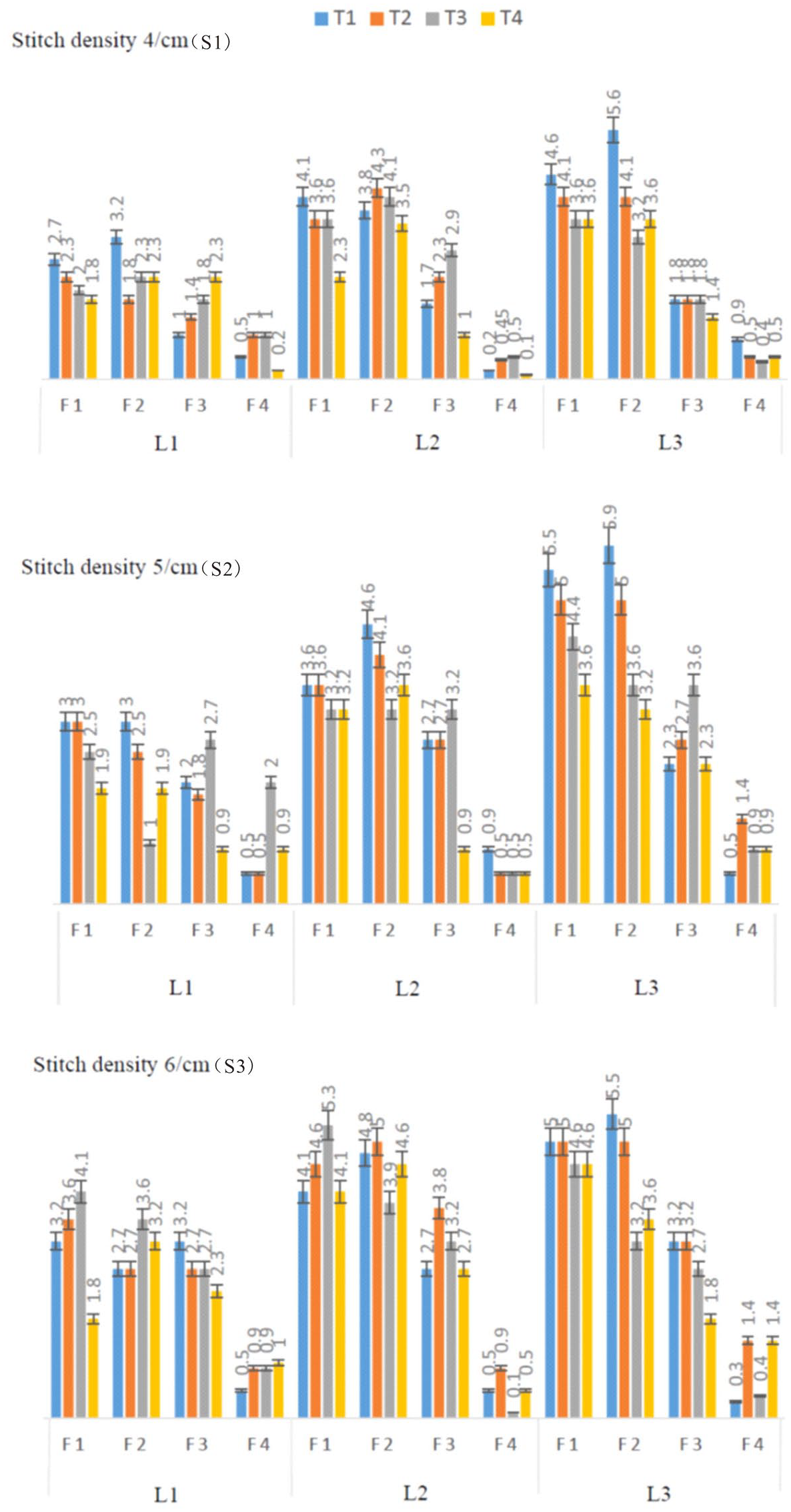
The seam shrinkage of samples.
In order to verify the consistency of subjective and objective evaluation, the objective evaluation value of the orthogonal experiment of four fabrics was taken as the independent variable (x) and the subjective evaluation as the dependent variable (y) to conduct unitary regression analysis. In the analysis results, Pearson correlation coefficient R = −0.970 indicates that the subjective and objective evaluation results are significantly correlated. The regression equation is,

adjusted R2 = 0.941, the significant value is detected as p = 0.000 < 0.05, it shows that the established regression equation is meaningful and there is a high consistency between subjective evaluation and objective evaluation of seam pucker.
Effect of fabric on seam pucker
It can be seen from Figure 2 that when the stitch density is 4/cm, the fabric F1 is sewn with the seam type T4, sewing thread L1, the seam shrinkage is the smallest and is 1.8. When using seam type T1 sewing thread L3, the maximum shrinkage of the seam is 4.6. Fabric F2 has the smallest seam shrinkage when using seam type T2 sewing thread L1 and is 1.8, and the largest seam shrinkage got when using seam type T1 sewing thread L3 and is 5.6. For fabric F3, when using seam type T1 sewing thread L1 and seam type T4 sewing thread L2, the seam shrinkage is the smallest and is 1. When seam type T3 sewing thread L2 is used, the seam shrinkage is the largest and is 2.9. When fabric F4 uses the seam type T4 sewing thread L2, the seam shrinkage is the smallest and is 0.1, and when uses the seam type T2 sewing thread L1 and the seam type T3 sewing thread L1, the seam shrinkage is the largest and is1. In this way, in the case that the stitch density is 5/cm and 6/cm, the sewing process parameters of these four fabrics when the minimum and maximum value of the seam shrinkage are obtained is shown in Table 4.
Effect of fabric on seam pucker.
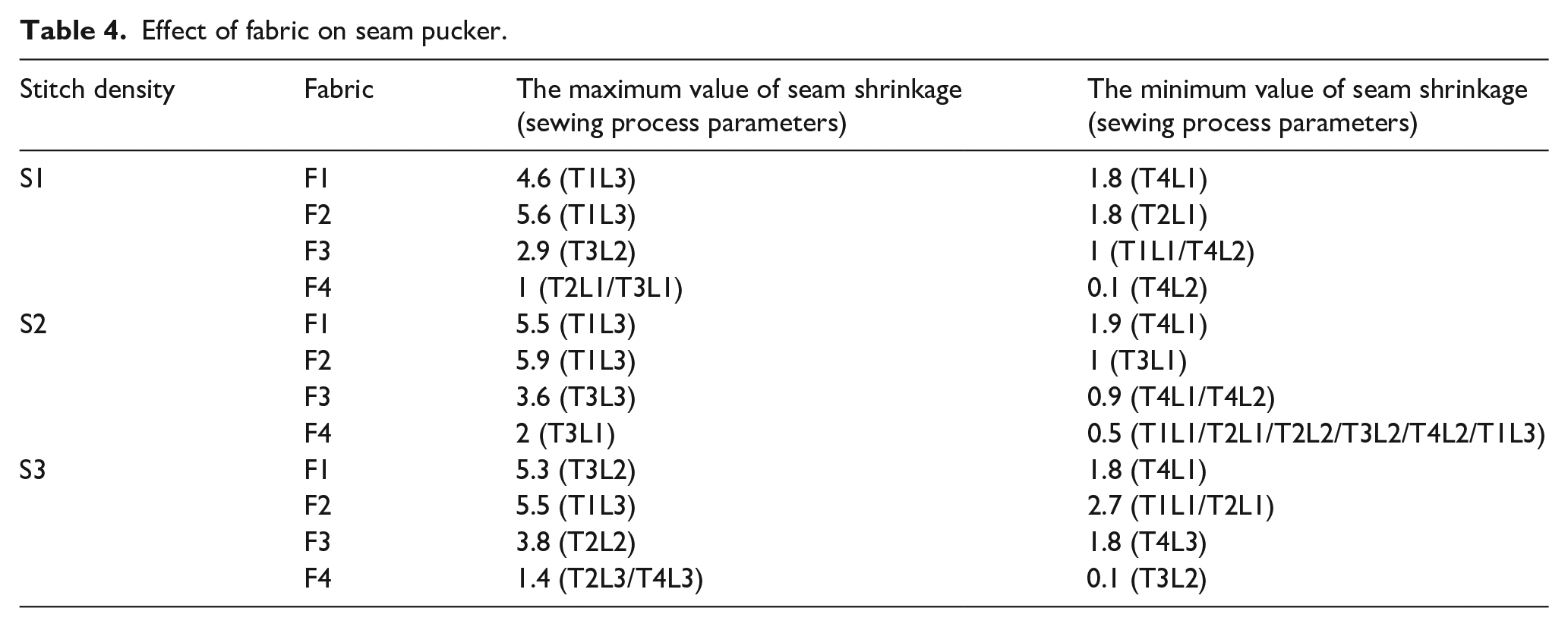
It can be seen from Table 4 that no matter what kind of stitch density is used, the seam shrinkage of fabric F4 is the smallest, followed by fabric F3, F1 and F2 have similar seam shrinkage and larger than fabric F4. In Table 1 the warp density, weft density, weight and thickness of the fabric F4 are much larger than the other three fabrics, it can be inferred that the amount of seam pucker may be related to the warp density, weft density, weight, thickness and weave type of the fabric. Table 4 also show that the seam shrinkage of different fabrics changes with the sewing process parameters. For example, when the fabric F1 uses a stitch density of 5/cm, seam type T1 and sewing thread L3, the maximum shrinkage of the seam is 5.5, when using a stitch density of 4/cm or 6/cm and the seam type T4 sewing thread L1, the minimum seam shrinkage is 1.8. Under different sewing process parameters, the seam shrinkage of the same fabric can be reduced from 5.5 to 1.8. This indicates that the degree of fabric seam shrinkage can be effectively improved by changing the sewing process parameters, such as seam type, sewing thread and stitch density, while keeping the fabric characteristics unchanged. Table 5 shows the sewing process parameters of each experimental fabric when the maximum and minimum values of seam shrinkage are obtained.
Sewing process parameters of experimental fabrics when the maximum and minimum values of seam shrinkage were obtained.

Effect of sewing thread on seam pucker
Figure 2 shows that when the stitch density is 4/cm and the sewing thread is L1, the fabric F2 has the largest seam shrinkage is 3.2 when using the seam type T1, and the fabric F4 has the smallest seam shrinkage when using the seam type T4 and is 0.2. When using sewing thread L2, the seam shrinkage of fabric F2 is the largest when using seam type T2 and is 4.3, and the seam shrinkage of fabric F4 is the smallest when using seam type T4 and is 0.1. When using sewing thread L3, the seam shrinkage of fabric F2 is the largest when using seam type T1 and is 5.6, and the seam shrinkage of fabric F4 is the smallest when using seam type T3 and is 0.4. According to this method, when the stitch density is 5/cm and 6/cm, the maximum and minimum of the seam shrinkage obtained when using the sewing thread L1, L2, L3, and the detailed fabric and seam types are shown in Table 6.
Effect of sewing thread on seam pucker.

It can be seen from Table 6 that when the stitch density is 4/cm, the maximum value of the seam shrinkage obtained when three sewing threads are used for sewing shows the law of L3> L2> L1. The same conclusion was obtained when the stitch density is 5/cm and 6/cm. From the above, it can be seen that sewing thread also affects seam pucker, among which the seam pucker caused by L3 is the largest. By comparing the performance of the three types of sewing thread, it shows that the breaking elongation of the grey thread L3 is the largest. It can be inferred that breaking elongation has an effect on seam pucker, and the higher the breaking elongation of sewing thread is, the more likely it is to cause seam pucker. From the combination of the fabric and seam, it can be seen that when the fabric F2 uses the seam type T1 and the fabric F1 uses the seam type T3, the seam shrinkage is easy to occur, and when the sewing thread L3 is used, the seam shrinkage is the largest, minimal seam shrinkage was obtained with sewing thread L1. However, the minimum value of the seam shrinkage does not show the above rule, and only the fabric F4 has the smallest seam shrinkage regardless of the seam type, sewing thread or stitch density.
Effect of stitch density on seam pucker
It can be seen from Figure 2 that when the seam type is T1 and the stitch density is S1, S2, S3, the seam shrinkage of the fabric F2 are the largest when the sewing thread L3 is used and are 5.6, 5.9, 5.5 respectively. Fabric F4 has the smallest seam shrinkage when using sewing thread L1, L3 and is 0.5, 0.5, 0.3 respectively. When the seam type is T2 and the stitch density is S1, S2, S3, the fabric F2 uses the sewing thread L2 and L3, and the fabric F1 uses the sewing thread L3, the seam shrinkage is the largest and is 4.3, 5, 5 respectively. Fabric F4 has the smallest seam shrinkage when using sewing thread L1 and L2 and is 0.45, 0.5, and 0.9 respectively. When the seam type is T3 and the stitch density is S1, S2, S3, fabric F2 uses the sewing thread L2, and fabric F1 uses the sewing thread L2 and L3, the seam shrinkage is the largest and is 4.1, 4.4, 5.3 respectively. Fabric F4 has the smallest seam shrinkage when using sewing thread L2, L3 and is 0.4, 0.5, and 0.1 respectively. When the seam type is T4 and the stitch density is S1, S2, S3, fabric F2 uses the sewing thread L2 and L3, and fabric F1 uses the sewing thread L3, the seam shrinkage is the largest and is 3.6, 3.6, 4.6 respectively. For fabric F4, when the sewing thread L2 is used, the seam shrinkage is the smallest and is 0.1, 0.5, and 0.5 respectively, the details are shown in Table 7.
Effect of stitch density on seam pucker.

Table 7 shows that when the seam types are T2, T3 and T4, the maximum value of seam shrinkage shows a tendency that it increases as the stitch density increases. When the seam type is T1 and the fabric F2 uses the sewing thread L3, no matter what stitch density is used, the seam shrinkage is larger than other fabrics, and S2 > S1 > S3. When the seam type is T4 and the fabric F1 uses the sewing thread L3, the seam shrinkage is also the largest, and S3 > S1 = S2. When the seam type is T2, T4, the minimum value of seam shrinkage will increase with the increase of stitch density. When the seam type is T1, T3, the minimum seam shrinkage obtained by using S2 stitch density is greater than by using S3 stitch density. The seam shrinkage of fabric F4 is still the smallest. When the sewing thread L2, the seam type T3 stitch density S3 and the seam type T4 stitch density S1 are used, the minimum seam shrinkage is 0.1. In short, in some cases as the stitch density increases, the seam shrinkage tends to increase. In other cases, the effect on seam shrinkage varies depending on the fabric, seam type, and sewing thread. Under the influence of many factors, it is difficult to grasp the law of the effect of stitch density on seam shrinkage.
Effect of seam type on seam pucker
In Figure 2, among the four seam types, when the stitch density is S1, fabric F1 uses the sewing thread L3, and when the fabric F2 uses the sewing thread L2, L3, the maximum seam shrinkage is obtained, and is 3.6, 5.6, 4.3, 4.1 respectively. For fabric F4, when using sewing thread L2 and L3, the obtained seam shrinkage is the smallest, and is 0.2, 0.45, 0.4, 0.1 respectively. When the stitch density is S2, fabric F1 uses the sewing thread L3, fabric F2 uses the sewing thread L2 and L3, the maximum seam shrinkage is obtained, and the maximum values are 4.4, 3.6, 5.9 and 5. For fabric F4, when using sewing thread L1, L2, and L3, the minimum seam shrinkage is obtained, and the minimum value is 0.5. When the stitch density is S3, fabrics F1 and F2 use the sewing thread L2 and L3, the maximum seam shrinkage is obtained, and is 5, 5.3, 5.5, 4.6 respectively. For fabric F4, when using sewing thread L1, L2 and L3, the minimum seam shrinkage is obtained, the minimum values are 0.9, 0.1, 0.5 and 0.3.
In Table 8, it shows that under these three stitch densities, the maximum value of the seam shrinkage obtained using the seam type T1 is the largest, the maximum seam shrinkage obtained by the seam type T2 and T3 is close, and the maximum seam shrinkage obtained by the seam type T4 is the smallest. From the combination of the fabric and the sewing thread, it can be seen that when the fabrics F1 and F2 use the sewing thread L2 and L3, the seam shrinkage is the largest. For fabric F4, when the stitch density is S2, the seam type has no effect on the minimum value of the seam shrinkage, both are 0.5. It can be concluded from the above that the seam type has a greater impact on such fabrics that are prone to seam shrinkage, such as F1 and F2, and with seam type T1 having the largest seam pucker and seam type T4 having the smallest, but for fabrics that are not prone to seam shrinkage, such as F4, the impact is small.
Effect of seam type on seam pucker.

Quantification of experimental results
From the analysis of the above experimental results, it can be known that the fabric performances, seam type, sewing thread and stitch density all affect the seam pucker. In order to more accurately identify the factors affect the seam pucker, multiple linear regression analysis was used to analysis of factors affect the seam pucker, in the analysis process first convert the weave type and seam type into dummy variables, so that transform the categorical to quantitative, finally performed regression analysis, and the result is shown in Table 9. In Table 9, it shows that the thickness of fabric in fabric properties is significantly correlated with seam pucker and the Pearson correlation coefficient is -0.770. Followed by the weave type, fabric weft density, fabric weight, fabric warp density with Pearson correlation coefficient −0.731, −0.705, −0.686, −0.660, respectively. Linear density, breaking strength, breaking elongation of sewing thread are also significantly related to seam pucker, with p < 0.05. Stitch density and seam type has little influence on seam pucker with Pearson correlation coefficient 0.189, −0.153, respectively.
Correlation of the factors and the seam pucker.

Statistical significance <0.05.
Multiple linear regression model was applied to clearly express the relationship between seam pucker and the influencing factors, prediction level of the model is 0.869 (R2 value), and according to the regression equation significance test, the significant value is detected as p = 0.000 < 0.05, it reveals that the relation between dependent and independent variables is significant at 95% significance level. Linear equation was established and Table 10 shows coefficients of the regression equation as follows:
Coefficients. a

Dependent variable: Seam pucker percentage.

Y is the seam pucker coefficient; X1 is fabric thickness; X2 is fabric weight; X3 is fabric warp density; X4 is breaking elongation of sewing thread; X5 is stitch density; X6 is seam type.
It can be seen from the model that the fabric thickness and weight and the fabric warp density in the fabric performance are significantly related to seam pucker. The weight and thickness of the fabric F4 in Table 1 are much larger than other fabrics, so its seam pucker is relatively small. The weight and thickness of the fabrics F1 and F2 are similar, so the amount of seam pucker is also close. Because when sewing fabrics with a larger weight and thickness, the yarn in the fabric has enough space to accommodate the sewing thread, and a large frictional force will be formed between the sewing thread and the fabric. So after sewing, the seam is not easily deformed. And in the garment production process, most parts are sewn along the warp direction, because the warp direction of the fabric is not easily deformed, the density of the warp direction directly determines the stability of the fabric in the warp direction, which must also have an impact on seam pucker.
The influence of the breaking elongation of sewing thread on the seam pucker is also significant. Among the three types of polyester sewing threads, the grey thread L3 has the highest elongation at break. In the case of the same fabric, seam type and stitch density, the seam sewed with it also has a large amount of seam pucker. Because the breaking elongation of the sewing thread is large, it will be stretched due to a large force during sewing, and it will be shortened due to reduced stress after sewing, causing seam pucker. Followed by stitch density, it will affect stitch elongation and stitch strength, thus affecting the level of seam pucker. The smallest effect is the seam type. Different seam types, the number of layers of fabrics sewn during the sewing process are different, which also results in different seam thickness, therefore, with the increase of the number of fabric layers in the seam, the friction between the fabrics at the seams increases, and the amount of seam pucker will decrease accordingly. But for thicker fabrics, because the fabric itself has enough friction, it is not easy to cause seam pucker, so the change of seam type has less influence on seam pucker.
Conclusion
In this study fabric performances, seams type, sewing thread and stitch densities all have an impact on seam pucker. Through multiple linear regression analysis of the experimental data, it was found that the fabric performances has the greatest influence on the seam pucker, followed by the sewing thread, stitch densities and seam type has the least affected. The establishment of a multivariate linear regression model further quantified the relationship between them.
The properties of the fabric have a certain effect on the seam pucker. It can be seen from the regression model that the fabric thickness, weight, warp density significantly affect seam pucker and with Pearson correlation coefficient −0.770, −0.686, −0.660, respectively. Weight and thickness fabric, it has enough space to accommodate the sewing thread, and a large frictional force will be formed between the sewing thread and the fabric, so as the thickness and weight of the fabric increase, the amount of the seam pucker will decrease. And in the garment production process, most parts are sewn along the warp direction, so the density of the warp direction also have an impact on seam pucker.
Sewing thread is another important factor which influences the seam pucker, especially the breaking elongation of sewing thread on the seam pucker is more significant. According to the experimental results, the greater the breaking elongation of the sewing thread is, the more obvious of the seam pucker.
According to the regression analysis, stitch density and seam type are also related to seam pucker, but has little influence on seam pucker with Pearson correlation coefficient 0.189, -0.153, respectively. When the seam type is T2, T3 and T4, the maximum value of seam shrinkage appears to increase with the increase of stitch density. The seam shrinkage obtained by using the seam type T1 is the largest, seam type T4 is the smallest. Seam type has a greater impact on fabrics that are prone to seam shrinkage, such as F1 and F2, but for fabrics that are not prone to seam shrinkage, such as F4, the impact is small.
By analysing the combination of seam type, sewing thread and stitch density when the four kinds of fabrics obtain the maximum and minimum values of seam shrinkage, it shows that in the case where the characteristics of the fabric cannot be changed, especially for fabrics that are prone to seam shrinkage, by properly selecting the seam type, sewing thread and stitch density, the degree of seam shrinkage can be effectively reduced.
In conclusion, identify and quantify the relation between seam pucker, fabric performances, seam type, sewing thread and stitch density, and find out the sewing process parameters that can effectively reduce the seam shrinkage of fabric, this is helpful for apparel manufacturers to control the sewing quality of shirt products, which is conducive to the further improvement of intelligent production technology. In the present research of the seam pucker of shirt fabric, only research on the pucker of the seams in the shirt with the top stitch but without the interlining, for further studies, it will be beneficial to compare the seam pucker of the seam with interlining and without interlining.
Footnotes
Declaration of conflicting interests
The author(s) declared no potential conflicts of interest with respect to the research, authorship, and/or publication of this article.
Funding
The author(s) disclosed receipt of the following financial support for the research, authorship, and/or publication of this article: This paper was supported by 2020 Fujian Social Science Planning Project (No. FJ2020C049).
