



Abstract
The objective of present research is to analyze the impact of knitted fabric structures, sewing thread types and stitch types on seam strength, seam slippage, seam pucker, and seam efficiency on quality of garments. Seams are basic necessities in the manufacturing of garments. In general, seam performance has an enormous impact on the garment quality. Seam and stitch types have a positive effect on the quality and appearance of garments. Seams of the garment must be durable and smooth. Stitch and seam types and stitch and seam parameters should be chosen according to the garments and fabrics (single jersey, rib, and interlock) Seam production of a garment also depends on structural and mechanical properties of the fabric such as strength, extensibility, protection, durability, appearance, and efficiency of the seams. The performance of seams also depends on the sewing conditions like size of needle, sewing thread tension, stitches per inch and lastly on the proper working and maintenance of the stitching machine. An experimental design was employed for the analysis which includes two types of sewing thread and four classes of stitch. The results exposed that differences existed between the two dissimilar threads in relation with seam quality Polyester-wrapped threads with a polyester filament core thread shows better seam strength, seam slippage, seam puckering and seam efficiency. It is noted that seam efficiency increases with seam angle and sewing needle type. It has been found that small ball point needle type exhibits poor seam efficiency but an improvement in efficiency has been observed with Medium ball point needle type and conical point needle type for all three knitted fabrics.
Introduction
Good seams are essential factors in garment quality. The characteristics of a properly constructed seam are its strength, elasticity, durability, stability and appearance, which depend on the type of seam and the stitches per unit length of the seam, the thread tension and the seam efficiency of the fabric. The most important features expected from a garment are its performance, durability, serviceability, esthetic, and conformance. Design and esthetic appearance is very important for customers. Pattern, color, and fabric structure affect the design and esthetic appearance of a garment. Seam quality is also measured by seam size, seam slippage strength, and seam strength the findings given by Das and Alagirusamy
1
the Fitting is a crucial factor of wearing comfort. The fitting comfort of the garment in use mainly depends on the elasticity of the seam. Stitch type, seam type, sewing thread type and stitch density affect the fitting comfort of the garment. The most important features expected from a garment are its performance, durability, serviceability, and esthetic and conformance findings given by Bubonia.
2
It is therefore very important to select appropriate seam and stitch types in terms of fitting comfort, Consumers want that the apparel must fit to their bodies. Size of the garment does not be large or small to their bodies Wear by Song.
3
Fitness is directly related to the pattern design, sizing, fabric structure. and seams used to contour curves of the body. There are different fit-types for garment items that range from the slim and form-fitting to oversize and
Seam and stitch types are one of the most important elements in joining the patterns and giving a form to the garment. Seam and stitch types directly affect the quality, comfort and fitness of the garment. Choosing a stitch or seam type that is not suitable for a garment reduces the quality, comfort and fitness of the garment. Appearance and performance of the seams are dependent upon the stitch and seam types, stitch densities, sewing machine settings and quality of sewing threads. Seam performance of a garment depends on fabric structural and mechanical properties and strength, extensibility, security, durability, appearance and efficiency of the seams, the findings of American Society for Testing and Materials. 5 The tensile characteristics of seamed fabric changes with the change of fabric bias angle of stitching and stitch densities. Some of the seams on a garment are not subjected to high levels of stress or extension in use, like the shoulder seams on a jacket. In contrast, some seams, such as arm joint seams and seams at the crotch area of the trousers are subjected to high levels of stretching in wear. Therefore, high strength seams are preferred in these areas. 6 Stitch type 201 is formed with two needle threads which pass through the material in the same perforations from opposite directions without interlacing or interloping. Stitch type 200 has five different subgroups. Stitch type 301 is formed with two threads, one needle thread and one bobbin thread. Loops of needle thread are passed through the material and interlaced with the bobbin thread. Needle thread is pulled back so that the interlacing was midway between surfaces of the materials being sewn. Stitch type 300 has 16 different subgroups. 7 Stitches in the 6–8 per inch range convey a more primitive quilting style, suitable for heavy thread or utility quilts. Stitch 10–12 per inch is considered normal for most quilting styles and yields the best stitch quality as well. Longer stitch lengths create needle flex and increase tension changes and average stitch length is 2.5 mm. This is the typical setting 8 on a straight stitch like lockstitch has length but not width. The standard range for a lockstitch is stitch length 2.5 mm and stitch width 0. A zig-zag stitch or over lock stitch has length and width. The middle range of the stitch length for a zig-zag stitch is 2.5 mm and stitch width is 3 or 4 mm. Decorative stitches also have both length and width. 9 The durability of the seam can be measured in terms of seam efficiency. Stitch efficiency can be optimized through various factors, such as fabric structure, seam type, type and density of stitches and the selection of sewing threads and needles. Seam efficiencies of 60%–80% are common but efficiencies between 80% and 90% are more difficult obtaining from garment seams. Low seam efficiency values indicate that the sewn fabric is damaged during sewing.
The findings given by Thilagavathi and Viju 10 Seam performance of a garment also depends on structural and mechanical properties of the fabric and strength, extensibility, security, durability, appearance, and efficiency of the seams. Seam strength and seam efficiency should be tested to determine the effect of sewing parameters on sewing performance. 11 Many researchers found that fabric quality parameters like fabric density, fabric thickness, tensile strength, extensibility, bending rigidity and shear rigidity have extreme effect on quality of seam the statement given by Hati and Das. 12 During the stitching, fabric may be damaged by a sewing needle mechanically. In the case of mechanical damage, the yarns of the fabric are broken or fragmented. Such damages may be apparent immediately after stitching but frequently will not appear until after the product has been used, that is, when seams have been subjected to some form of tension, stress, strain, deformation, or after successive cleaning. 13 Seam slippage, seam grinning, and seam pucker are important seam defects, which influences the appearance of the garment. Seam defects are usually caused by improper selection of seam parameters and fabric properties in the garment production. 14 Thermal and mechanical damages affect the esthetics and performance of the garment, appropriate sewing needle size according to the sewing thread ticket number and fabric weight should be selected to prevent mechanical seam damages. Stitch and seam types and seam parameters must be selected correctly in order to obtain a quality seam. The results were obtained by Gurarda. 15 The novelty of this research is to analyze the Seam strength, Seam slippage, Seam puckering, and Seam efficiency performance on esthetics appearance of the garments, Stitch and seam types and seam parameters must be selected correctly in order to obtain a good quality garments.
Materials and methods
Materials
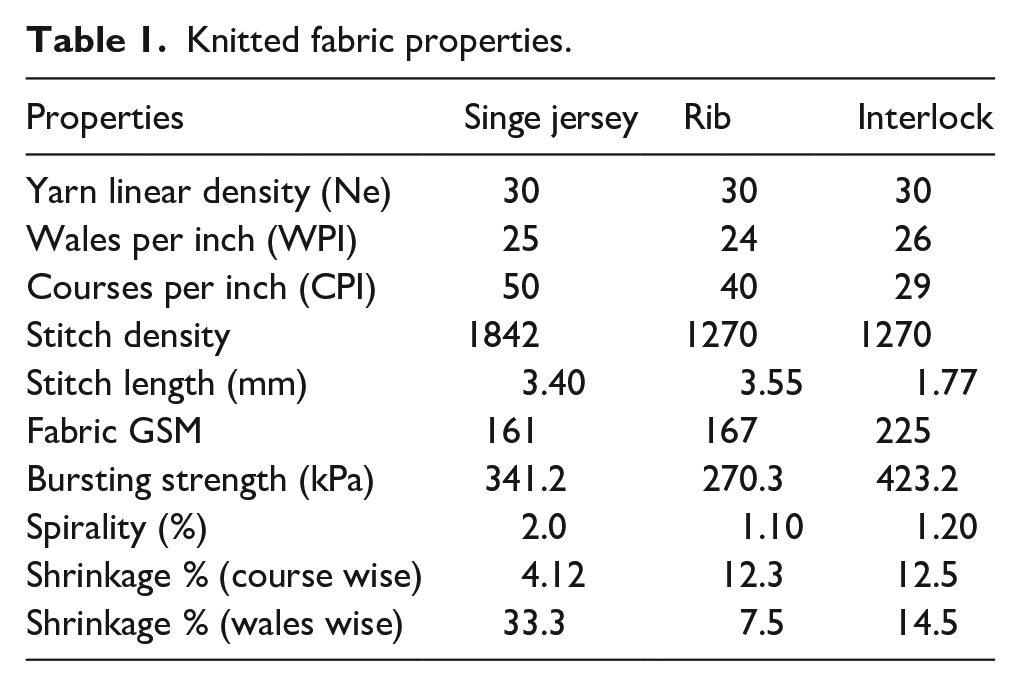
Single jersey, rib and interlock weft knitted fabrics have been used for the investigation. The details of fabric sample properties are given in Table 1. Before starting the sewing process, all the fabric samples are conditioned for 24 h at standard temperature (27 ± 2°C) and relative humidity (65 ± 2%). In order to measure the seam strength and seam slippage tests, 10 specimens for single jersey, rib and interlock weft knitted fabrics have been taken and each of size 4″ × 14″ were prepared for samples of each fabric type shown in Figures 1 to 3. Half of the specimens were prepared with the long dimension parallel to the course and the others with the long dimension parallel to the wales. For the seam puckering test, 10 specimens each of 15″ × 15″ were prepared for each fabric type. After washing and rinsing, both specimens and dummy pieces were removed from the washing machine and were placed in the automatic tumble dryer immediately. The temperature of the tumble dryer was set to about 70°C. The time of 30 min was taken for tumbling. Afterward, the specimens were removed from the tumble dryer, half of the specimens were prepared with a seam sewn with single needle lockstitch at the middle and the others parallel to the course, each selected fabric was sewn by different sewing threads. The Singer 831 over lock sewing machine was used to prepare the specimens for seam puckering test. It was required to over lock the specimens; A Juki DDL-5550-6 single lockstitch sewing machine was used to prepare the seamed specimens. The hook mechanism carries the upper thread entirely around the bobbin case, so that it has made one wrap of the bobbin thread. Then the take-up arm pulls the excess upper thread (from the bobbin area) back to the top, forming the lockstitch. This carry out ensures all the specimens were sewn at the same speed. Moreover, all the specimens were on the same sewing machine to eliminate the experimental variables posed by different settings of machines. Seam Efficiency in sewn fabrics is the ratio of seam strength to fabric strength’ is defined as seam efficiency as percentage of the ratio between the seam and fabric strength. Seam strength refers to the pounds required per square inch of seamed fabric before its rupture.
Knitted fabric properties.

Plain seams of single jersey, rib, and interlock weft knitted fabrics.

Super imposed seams of single jersey, rib, and interlock weft knitted fabrics.

Edge finished seams of single jersey, rib, and interlock weft knitted fabrics.
Methods
The seam strength and seam slippage tests were performed with reference to ASTM D434-95: Standard Test Method (ISO 13936-1&2) for Resistance to Slippage of yarns in knitted fabrics using a Standard Seams. The Instron Model 1026 Tensile Testing Machine was used to measure the seam strength and seam slippage it has been carried out at the textile technology laboratory, Ethiopian Technical University. It was equipped with jaws suitable for a grab test. To achieve uniform and equal tension, the auxiliary clamps were attached to the machine at 3″ (7.5 mm) apart. The seam puckering test was performed with reference to AATCC 88B-1975 (R1978) Appearance of Seams in Wash-and-Wear methods after Home Laundering. The whole washing and drying procedures were repeated four more times. After completing the whole washing and drying procedures, the specimens were conditioned under the standard atmosphere for 2 days. The seam efficiency (%) = Seam strength/Fabric strength × 100. based on ASTM standard 1683-04 to measure the efficiency of Seams for all the developed samples.
Scanning electron microscopy
Morphological analysis was performed as per the ASTM D 256 Standard using a JEOL SEM apparatus, on cryogenically cracked surfaces of weft knitted seam samples. The produced seam samples have cracked surfaces after tensile testing are tested using a scanning electron microscope (SEM) JEOL JSM-6480 LV. Figure 4 Shown in SEM micrographs of a cracked surface of weft knitted fabrics samples tensile test.

Seam strength and Seam slippage of knitted fabrics.
Results and discussion
The Tables 1 and 2 present the results of different knitted fabrics properties and specification of sewing threads it has been clearly mentioned and explained the various properties and significant of the knitted fabrics and sewing threads.
Specification of sewing threads.

Tables 1 and 2 present the results of different knitted fabrics properties and specification of sewing threads. It has been clearly mentioned and explained the various properties and significance of the knitted fabrics and sewing threads.
The sewing threads of a fabric begin to pull away from the stitching in a seam. It has created a laddered effect at the seam, and eventually the fabric has broken down completely. The stitches of the seam remain intact; it is the fabric on either side of the seam that tears. Knitted fabrics tend to suffer more from seam slippage than woven fabrics because of the floats in the knit structure and the interlocking nature of the knitted loops.
Influencing of seam puckering
In order to investigate the relationship between fabric properties and seam pucker, all specimens with different fabric structures were sewn with constant sewing parameters and machine settings. The specimens were tested in both the Course and Wales directions. For the seam puckering test, the average grade of seam pucker is presented in Table 3. In Figure 5, it can be observed that in plain single jersey, rib and interlock fabrics, the average grades of seam pucker are fluctuating with the fabric weight in both the course and Wales directions. Among the three fabrics under investigation, the medium weighed fabric exhibits the poorest seam puckering grade. In addition, the seam puckering grades of single jersey fabrics course and wales direction were 1.70%–1.80% and 1.88%–2.64% for and in the wales direction are higher than those in the course direction. The same finding was obtained by Malek et al. 16 in rib structure fabric; the average grades of seam pucker are directly proportional to the fabric weight in both the course and wale directions. This means the heavier the fabric, the higher the seam puckering grades of rib structure fabrics course and wales direction were 2.42%–2.51% and 2.51%–2.61%. The same results were explained by J & P Coats Ltd. 17 In addition, the seam puckering grades in the Wales direction are also higher than those in the course direction. In interlock knit fabric, the average grades of seam pucker are directly proportional to the fabric weight in both the course and wales directions. This means the heavier the fabric, the higher the seam puckering grade of interlock fabrics course and wales directions are 2.81%–2.91% and 2.90%–2.93%. In addition, the seam puckering grades of interlock fabrics is in the wales direction are higher than those in the course direction. There is a significant relationship between knit structure and seam pucker in both the course and Wales directions. It can be seen that interlock knit structure fabrics have the highest seam puckering grades in both directions, followed by rib and single jersey knit structure fabrics. The experimental results obtained by Sauri et al. 18
Seam puckering.

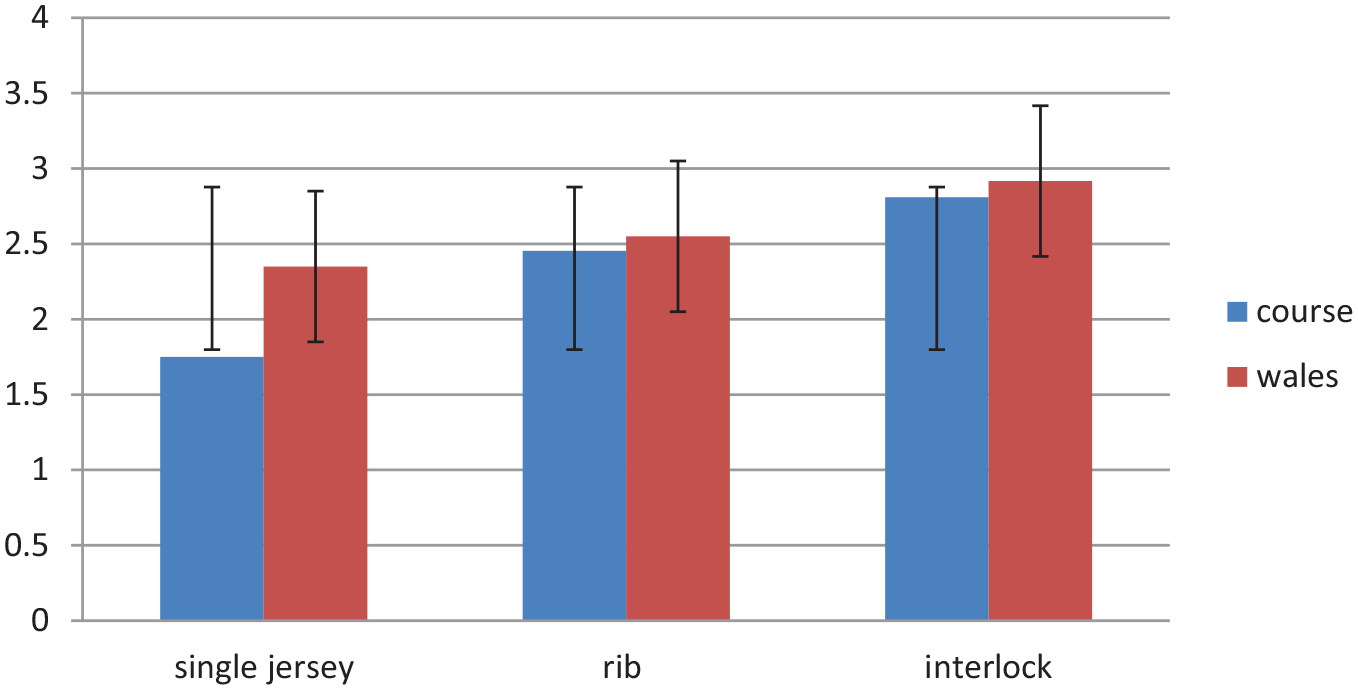
Seam puckering (%).
Influencing of seam strength and seam slippage of 30 Tex sewing threads
When a seam is stretched at right angle to its direction, seam opening normally occurs. In the experiments of seam strength and seam slippage, the opening behavior of Lockstitch Seam (Superimposed Seam Type – Plain Seam, Stitch Type − 301) under 50 kg loading was detected. These are seam slippage, sewing thread breakage and fabric breakage. The specimens were tested in both coarse and Wales directions. For seam strength and seam slippage tests, the types of seam failure and the average load of seam strength are presented in Table 4. From the results obtained, the causes of seam failure included the thread breakage, the fabric breakage and seam slippage. The Figure 6, 30Tex, Exposed the results that in single jersey knitted fabric, the seam strength is directly proportional to the fabric weight in the wales direction. As compared with single jersey and rib fabric, interlock fabric has less stitch length, more bursting strength and has highest fabric density knitted with similar count. This means the heavier the fabric, the greater the seam strength. However, this trend is not found in the course direction. Particularly, the seam strength of fabric weighed for different types of stitches is the average of 120.01 g/m2 is lower than that of 344.12 g/m2. The same findings was obtained by Padhye and Nayak. 19
Seam strength and seam slippage test (kPa).


30 Tex thread seam strength (kPa).
Influencing of seam strength and seam slippage of 40 Tex sewing threads
In addition, the Figure 7, 40Tex, it can be obtained that the seam strength of the fabric in the wales direction is found to be higher than that in the course except for the fabric weighed 281.32 g/m2. Based on the sewing thread 40s count, many factors affect the level of seam strength. These are knitted fabrics structure and properties, stress location of a garment, sewing thread type and construction, sewing machine tension, sewing needle type, stitch and seam types and stitch density influenced by the seam strength and seam slippage. The knitted rib structure fabric, has the seam strength is directly proportional to the fabric weight in both the course and wales directions. This means the heavier the fabric, the higher the seam strength. As the stitch length increases, the number of loops that share the load decreases, resulting in decreasing seam strength. Sewing thread of linear density 60 Tex shows highest seam strength for over edge type of stitch in all fabrics as compared to 30 Tex and 40 Tex. The rib knitted fabric seam and seam slippage was showed in the average weighted on 178.45250–312.76 g/m2. In addition, the seam strength of the fabric in the wales direction is higher than that in the course except for the fabric weighed is 287.45 g/m2. There is a significant relationship between loop structure of fabric and seam strength in both the course and Wales directions. The same results were obtained by Pavlinic et al. 20

40 Tex thread seam strength (kPa).
Influencing of seam strength and seam slippage of 60 Tex sewing threads
The interlock knitted fabrics 60 Tex, it is also shown that seam strength is relatively higher in the seam parallel to the wales direction, while Figure 8 shows that seam strength is relatively higher in the wales direction. The interlock knitted fabric seam and seam slippage was showed in the average weighted on 320.19–432.45 g/m2 actually, the effect of seam directions on seam strength was previously studied by Domingues et al., 21 Who stated that seam direction (course or wales) relates to highly significant differences in seam strength, as compared with single jersey and rib knit structures this trend could be justified by the inter looping between fabric yarns and sewing thread. The seam along the wales direction of interlock fabrics has greater loop structure between fabric yarns and sewing thread. The seam strength of the interlock fabric in the wales direction is higher than that in the course except for the fabric weighed is 378.185 g/m2. It can also be seen that the seam breaking load of all specimens in each fabric loop structure was apparently increasing with fabric weight in both the course and wales directions. In general, for each fabric loop structure, the yarn Tex of course and wales yarns were proportionally increasing from the lightest to the heaviest fabrics. Generally, this explanation was supported by Stylios and Lloyd 22 and Gedilu et al. 23

60 Tex thread seam strength (kPa).
Influencing of seam efficiency of knitted fabrics structure
Seam efficiency to measure the strength (durability) along the seam line. Durability is defined as necessary to satisfactory seam’s functional performance, and efficient seams are assumed to be more durable than weak ones. The results revealed from the Table 5 & Figures 9 to 11 single jersey, rib and interlock knitted fabrics, the seam efficiency are directly proportional to the fabric weight in the wales direction. As compared with single jersey, rib and interlock fabric has less stitch length, more bursting strength and has highest fabric density knitted with similar count. It can be observed that all mentioned stitch types have highest seam efficiency in double jersey interlock weft knitted fabric compared to single jersey and rib fabric. The sewing threads of 30s, 40s, and 60s Tex count on seam efficiency percentage in single jersey, rib and interlock knitted fabrics average were 86.18%, 86.17%, and 96.13%. Among all sewing threads 60 Tex thread shows higher seam efficiency. The linear density of sewing thread also shows a considerable effect on seam efficiency. It is concluded that seam efficiency increases with increasing the linear density of sewing thread due to the more fibers incorporated in the coarser sewing thread. It was also found that an over edge type of stitch gives higher seam efficiency. This may be due to the fact that during stitching operation some Flexibility at the seam occurs at low needle thread tension under sudden stress. The same experimental analysis has been taken by the Sauri et al. 18
Seam efficiency (%).


30 Tex thread seam efficiency (%).
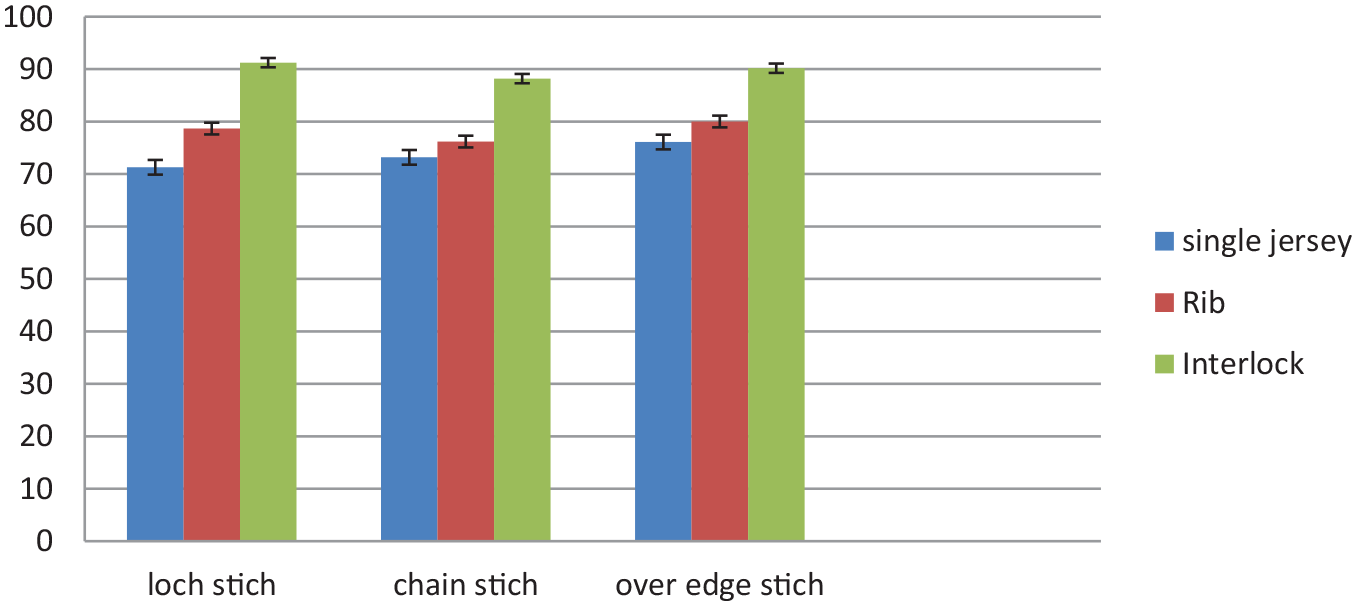
40 Tex thread seam efficiency (%).
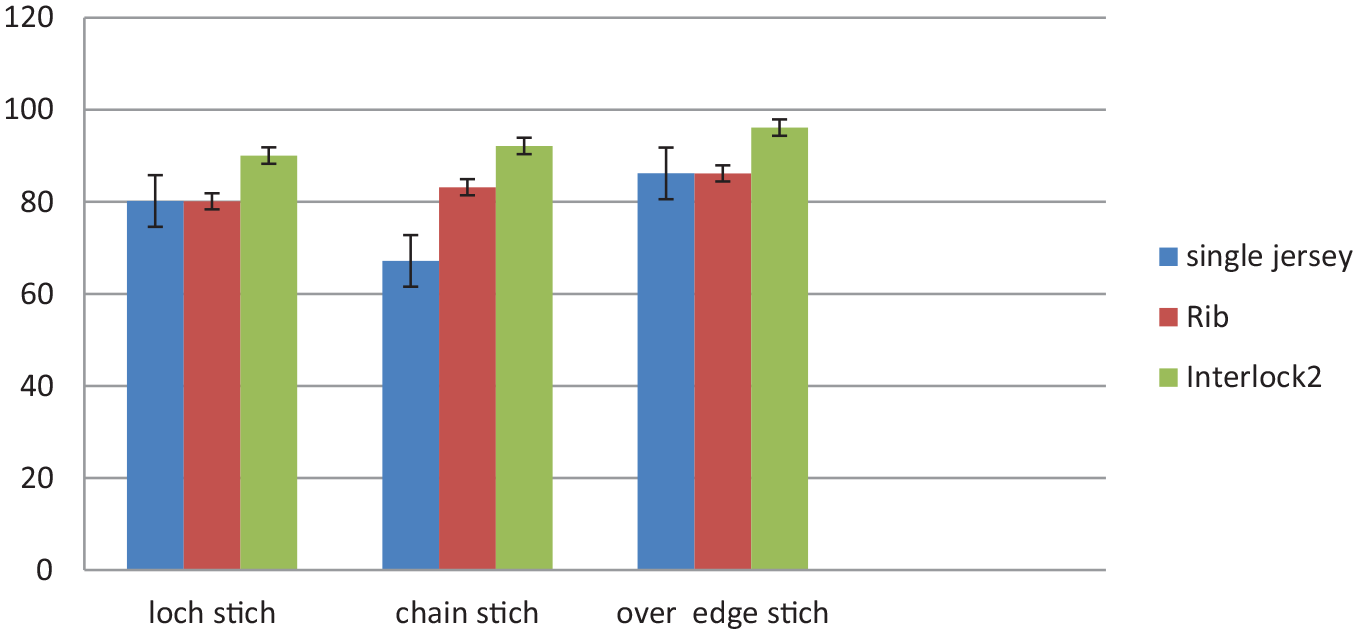
60 Tex thread seam efficiency (%).
SEM analysis
The seam direction can also affect the seam quality. It has found that seam slippage is higher for seams in the Wales direction than for seams in the coarse direction of fabric density. Seam slippage occurs more readily for fabrics with a low density (i.e. loosely constructed fabrics) because such relatively open (loose) fabric constructions allow the threads a greater freedom of movement. The SEM Figure 4 it can be observed that the cotton weft knitted fabrics generally have a high density and cohesion, with compact and/or strongly interlaced yarns, which makes yarn separation during seam slippage more difficult. This makes it more difficult for the yarns to separate or slip, and therefore reduces seam slippage potential. The similar experimental analysis was obtained by Sauri et al. 18
Conclusion
For a comprehensive analysis to understand the effect of fabric types, sewing thread, stitch types and needle size, needle type and seams on seam performance, the influence of these parameters on diverse weft knitted fabrics have been investigated. It has been observed that all three parameters have a significant impact on seam strength and seam efficiency. It is also observed that 30Tex cotton and single jersey fabrics have lower seam strength as compared to 40 Tex interlock knitted cotton fabric. With an increase in seam angle and needle size, seam strength is known to decrease. The experimental result shows that for 40 Tex sewing thread interlock cotton fabrics the seam efficiency ranges between 91.23% and 90.05%, while for single jersey and rib cotton fabrics the seam efficiency is varying between 80.18% and 78.67%. The seam efficiency of 100% weft knitted fabric decreases with a rise in seam angle but for both single jersey/rib and rib/interlock fabrics a reverse trend is observed. Also, a decrease in the seam efficiency is observed with increase in sewing needle size. It has been found that small needle type exhibits poor seam efficiency, but an improvement has been observed using medium ball point size needle and conical point needle. From the results it was concluded that a different stitching thread has showed different results on seam strength, seam puckering and seam efficiency. Types of fabric and their structural properties have significant effect on seam strength and seam efficiency. Higher strength of thread is prone for giving higher seam strength shows better functional performance of seam. Seam strength increases with the increase in sewing thread linear density. Interlock fabric seam strength is found more for all three stitch classes than other fabrics, particularly found more for over edge stitch. SEM analysis of the produced seam samples has influenced the fabrics structural behavior.
Footnotes
Declaration of conflicting interests
The author(s) declared no potential conflicts of interest with respect to the research, authorship, and/or publication of this article.
Funding
The author(s) received no financial support for the research, authorship, and/or publication of this article.
