




Abstract
The stability of breast plays an important role in the comfort of women’s movement. Women with sagging breasts are faced with more displacement due to the weakened breast internal support. The purpose of this study is to measure the dynamic 3D displacement of sagging breasts. Because of the sagging breast particularity, it is difficult to obtain all the data accurately by the traditional photoelectric capturing system. In this paper, multiple 3-Axes accelerometer sensors are used to measure the acceleration value of the specific points. Besides, the sensors integrated with 3-axes gyroscope which can collect the gyro data at the same time. The obtained accelerometer and gyroscope data will be transferred to the body coordinate from the sensor measuring coordinate. MATLAB will be used to analyze the collected data, and 2D and 3D point Cloud will be carried out. The maximum amplitude and whole picture of trajectory will be calculated, and the dynamic moving results of breast will have a general comparison of different points. The whole picture of sagging breast moving status can help bra designers improve wearing comfortable sensation, and the study can offer a new method for reference.
Introduction
According to the surveys, more than 56% women have breast uncomfortable issues while taking exercise.1 The pulling breast ligaments is the main cause of painful feeling, which prevent some women away from sport.2,3 Sport improves human physical health and will reduce the risk of some disease. There will be 20%-30% risk lower of having breast cancer, if women always join into exercise. 4
In the process of walking or running, the main factors affecting breast displacement are breast shape and weight,5–7 exercise intensity,8,9 and sports bra design.10,11 In the previous studies, subjects about female breast displacement usually choose young women with larger breasts, no history of pregnancy or breast surgery.12,13 Some authors even clearly pointed out in the article which subjects who had the experience of nurturing children and suggested that the age, fertility, breastfeeding status of subjects should be strictly controlled.7,13 However, with the growth of age, 14 especially after childbirth and breastfeeding, 15 women’s breast will experience obvious relaxation, sagging, and other changes. According to a questionnaire survey of 250 middle-aged women, the vast majority of women said that they were facing the problem of sagging breast, and among the satisfaction evaluation of breast enlargement, skin relaxation, and accessory breast, the average satisfaction of breast sagging was the lowest. 16 Due to the changes in the structure of breast, the sagging breast has less support than young healthy breast, and the restrictive force on breast movement will gradually decrease.17,18 At the same time, due to the lack of adequate support, sagging breast are more prone to displacement in the process of movement. 19 If it is not properly protected, excessive displacement will further strengthen the sagging of the breast and bring more discomfort. Therefore, it is very important to measure and analyze the 3D displacement of breast in women with sagging breast. The traditional Photoelectric technology need every test point visible, but some interest points is unvisible. In order to overcome this issue, this paper take out a creative method and a related demo system to verify the results.
Experimental
The traditional photoelectric 3D capture experiment obtains the kinematic parameters of breast by collecting the 3D coordinates of the reflective marking points during exercise,19–21 as shown in Figure 1. For women with sagging breast, the reflective markers are located below the breast and cannot be photographed, which means that the overall data of the breast cannot be collected. It also can be seen from the Figure 1 that: Firstly, the experimental method is not acceptable for testers with strong privacy (Privacy restriction); Secondly, the requirements for the experimental site are higher because multiple cameras need to be set up (Site restriction); Third, it can only perform in situ activities, but not applicable to highly mobile sports (Exercise types restriction).

Traditional photoelectric movement capturing diagram.
Therefore, a 3D displacement measuring system is designed for sagging breast by wearable technology. It does not need photograph to capture data and could record the 3D acceleration data of any position of sagging breast in real motion state. The terminal computer will synchronously acquire and store every sensor data, which will be processed off-line by MATLAB. Basic algorithm is using bandwidth filters to pre-filter noise, and integral twice to obtain the final displacement data, which will be used to evaluate the wearing comfortable.
In this article, the MEMS Sensor MPU6050 from TDK company was used as measuring sensor, which integrated with 3-axes accelerometer, gyroscope, and thermal sensors. MPU6050 dimension is 4 mm × 4 mm × 0.9 mm, and the first demo sensor PCB size is 15 mm × 11 mm. 20 Besides the top layer sensor MPU6050, one ARM chip 32F030F4P6 was designed on the bottom layer, which is used to acquire the raw data and transfer the coordinate from chip to human body. If the measuring system will be productization, the sensor board can be more compact, and the dimension will smaller than 10 mm × 8 mm. The measuring system basic functionalities decomposition as Figure 2 shown, including sensor block, data acquisition block, data processing, and analysis block.

Measuring system basic functionalities decomposition.
In order to speed system prototype theoretical verification and performance analysis, the prototype system using wire transmission to simple the developing. The architecture of measuring system prototype as Figure 3 shown, including below items,
Sensor module as Figure 4 shown, including MPU6050 and ARM chips, which were responsible for measuring and data coordinate transform processing.
Data transmission module as Figure 5 shown, including sensor module UART protocol to USB, and USB hub to host computer.
Data Storage and Processing as Figure 6 shown, including host computer received and stored multiple sensor’s data synchronously, meanwhile host computer did the filter and processing procedures, which were decided by the different applications.

Prototype measuring system architecture diagram.

Sensor module.

Sensor with transmission modules.

USB hub to PC.
Following alpha measuring system will simplify the sensing module and transmit data via wireless protocol. The architecture of alpha measuring system as Figure 7 shown, and the improvements are as follows,
Sensor module, including MPU6050 chip, which was responsible for measuring.
Data processing and transmission module, including single ARM chip, which was responsible for data collection, coordinate transform, packaging and transmission via Bluetooth.

Alpha measuring system architecture diagram.
The measuring system can be deployed easily on human body or clothes, in this paper the measuring system will be implemented directly on sagging breast to test its dynamic movement, the detail layout and acquisition software were shown as Figure 8.
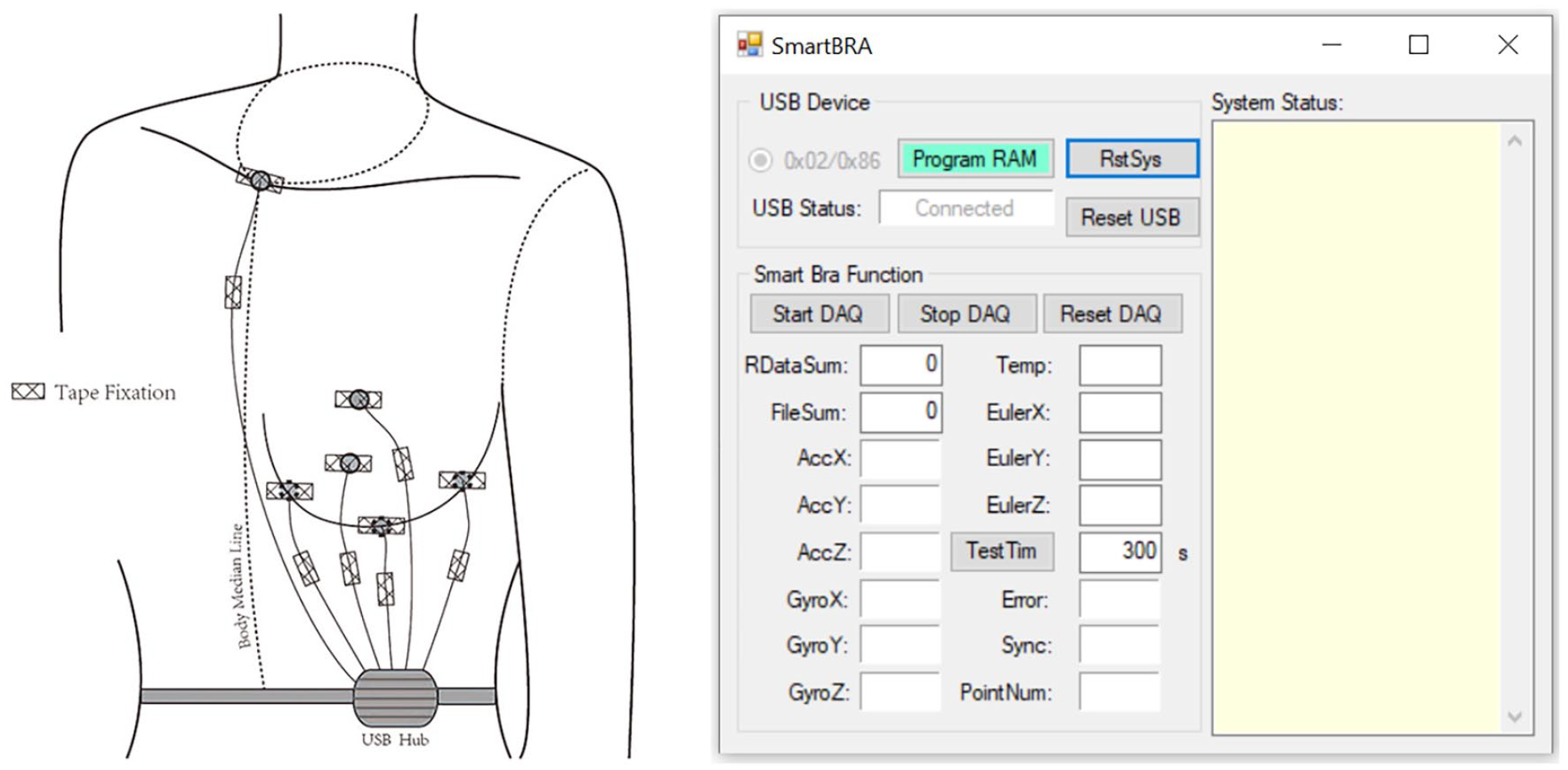
Deployment of measuring sagging breast and related software.
Measuring solution performance analysis
MPU-6050 can be set to 4 different sensing range with different resolution, 20 and noise analysis of MPU-6050 is shown in Table 1. It can be found that the output data resolution of the sensor is very high, but the real signal is drowned in the noise. The measurement sensitivity that can be achieved is not better than 400 μg/√Hz. According to the movement characteristics of the human body, the movement frequency of ordinary people is not over 10 Hz, so the actual measuring sensitivity is only 1.264 mg sensitivity with a bandwidth of 10 Hz.21,22
MPU6050 accelerometer noise theoretical analysis.

Besides, the accelerometer is fixed on the bra or measured object, and the fixed method can’t be guaranteed as 100% stiffness, so it will bring vibration noise due to the incomplete connection. The amplitude of these noises is much smaller than the actual deformation amplitude of the sports chest. Stick the sensor on a static table to collect 1000 points of data for 5 s at 200 Hz sampling rate. The analysis results of the measured noise and DC bias was shown as Figure 9.

Single sensor raw data mean and STD value calculation.
The measuring results of five sensors was shown as Figure 10, which was consistent with the analysis results of one single sensor.

Noise comparison of five accelerometer sensors.
The MPU-6050 used in this paper was set to 200 Hz sampling rate to meet the actual motion and acceleration collecting requirements. There are DC offset and high-frequency noise of discretized sampled data, if the original data is directly integrated to the position, that will inevitably bring the cumulative effect due to the DC offset. So it is necessary to reduce the noise of the original data, especially using a digital band-pass filter to bypass high-frequency noise and DC offset. Measuring system acquired raw data at a sampling frequency of 200 Hz, which can be re-sampling down to 20 Hz, which can further reduce the sampling noise.
Results and discussion
Real testing scenario
The subjects in this paper were female with sagging breast and the breast size was 75 C, and their basic information as Table 2 shown.
Basic information of five subjects.

The experiment was approved by university, and the subjects signed an informed consent to participate in the experiment. The running speed was required to maintain as about 10 km/h and keep at least 10 min.
In the testing scenario, one base point and five interested points were selected to measure the breast dynamic moving. At present, the commonly used reference points are clavicle midpoint, 23 acromion, 13 and sternal notch point,8,24 etc. Considering that the measurement is not only the relative displacement in the vertical direction but also the three-dimensional displacement, it is necessary to consider the rotation, forward inclination, and bending of the trunk. The base point is selected as the suprasternal point, which is located in the middle of the human clavicle as Figure 11 shown. The base point is close to the breast, in the same skeleton system with breast and all measurement points. In the process of human motion, there is no relative motion between the base point and the trunk, so it can effectively filter the whole human body motion and obtain the local motion variation of the breast.
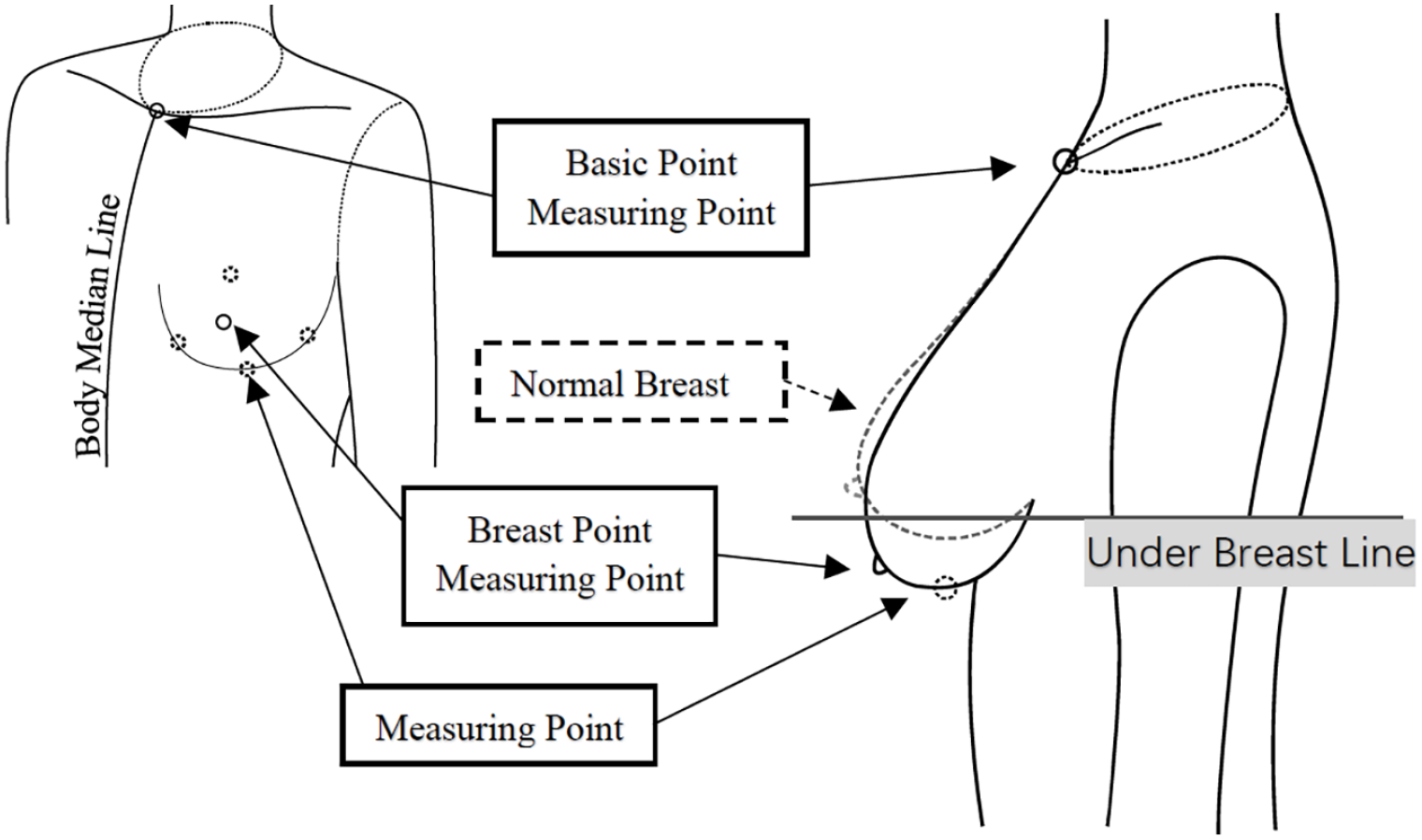
Basic and interested points layout.
The interested points are breast point B (Nipple Point) and B1(Up-mid Point), B2(Left-mid Point), B3(Right-mid Point), B4 (Down-mid Point), the B1–B4 is in the middle from the breast point to the breast boundary, as Figure 12 shown. If the model has a serious pendulous breast, the breast should be raised slightly and then marked and measured.

Position of interested points.
Data analysis of single experimental subject
The raw data from sensors is acceleration data, which need be integrated twice to be the displacement data. The basic integrating calculation process is shown as Formula 1, Formula 2, Formula 3 and Formula 4.
1. Acceleration differential value between measuring points and base point.

Formula 1. Differential acceleration calculation
Where,
X,Y,Z is the Axis direction of body coordinate; p is body coordinate flag; A is acceleration flag; m is the sensor ID, m=1 is the base sensor, m=2 is the B point sensor, m=3 is the B1 point sensor, m=4 is the B2 point sensor, m=5 is the B3 point sensor, m=6 is the B4 point sensor; n is the time ID from 1 to n, if we sampling for 10 seconds @ 200Hz, time ID is from 1 to 2000, Δt=0.005s.
2. Velocity integration by acceleration
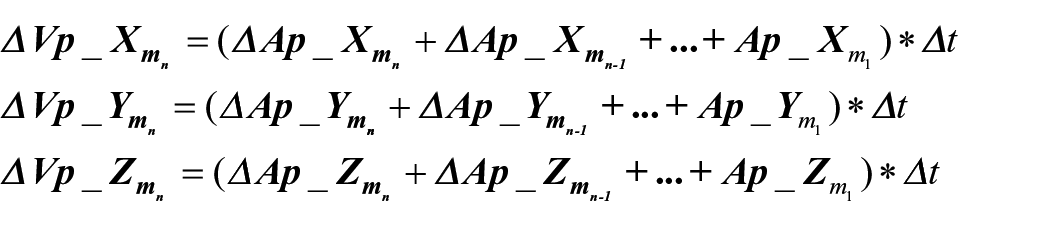
Formula 2. Velocity integration calculation
where,
Δt is 1 cycle time value, if sampling rate is 200Hz, then Δt is 0.005s.
3. Velocity differential value between measuring points and base point
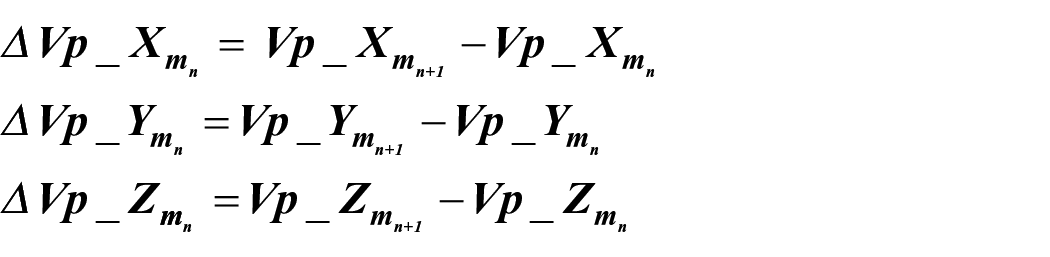
Formula 3. Differential velocity calculation
where,
4. Displacement integration by velocity

Formula 4. Displacement integration calculation
Where,
After calculation, then plot the 3D cloud points and two-dimensional motion outline of the moving phase. The results were shown in Figures 13 to 15.
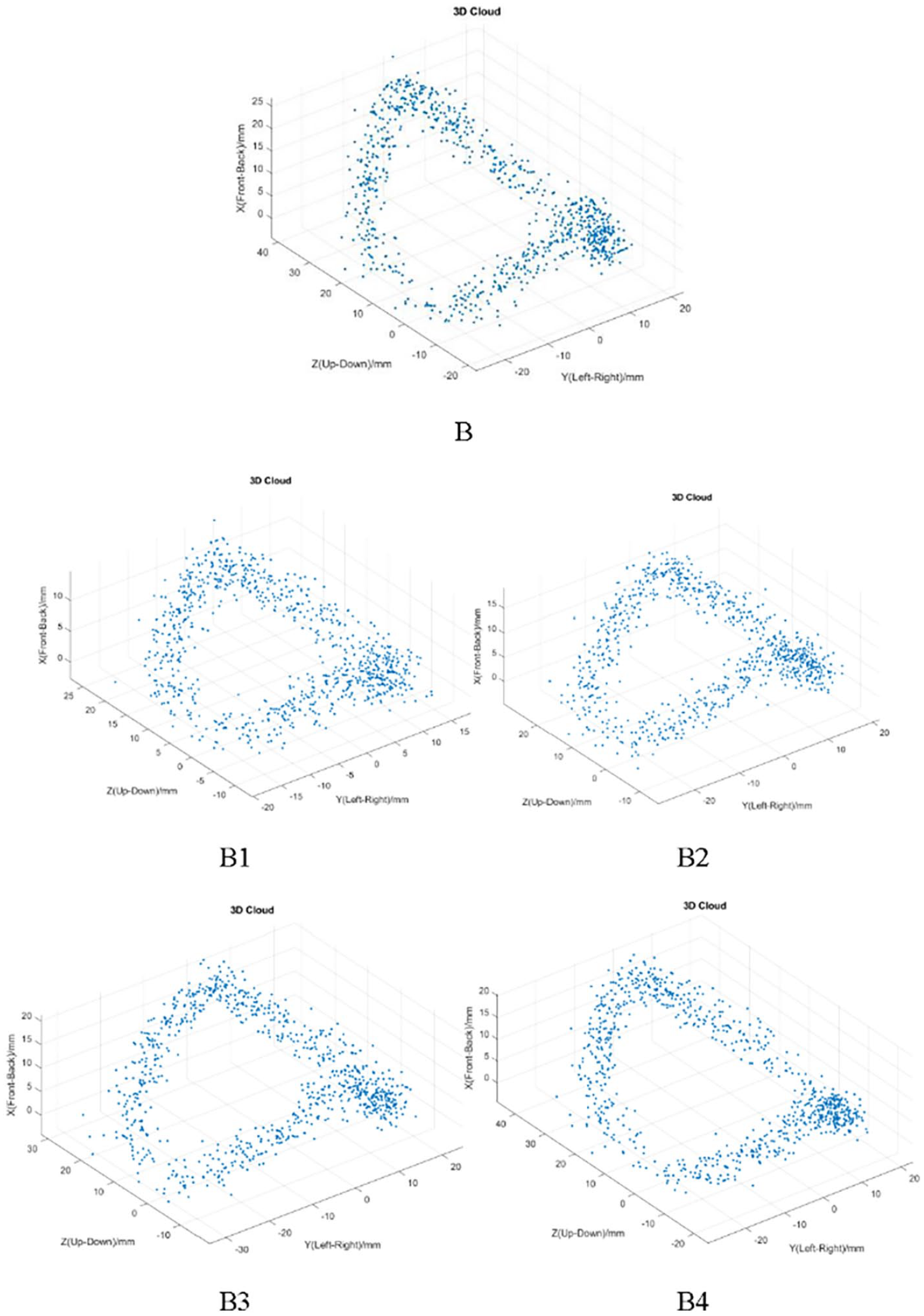
3D displacement processing and presentation.

X–Z displacement processing and presentation.
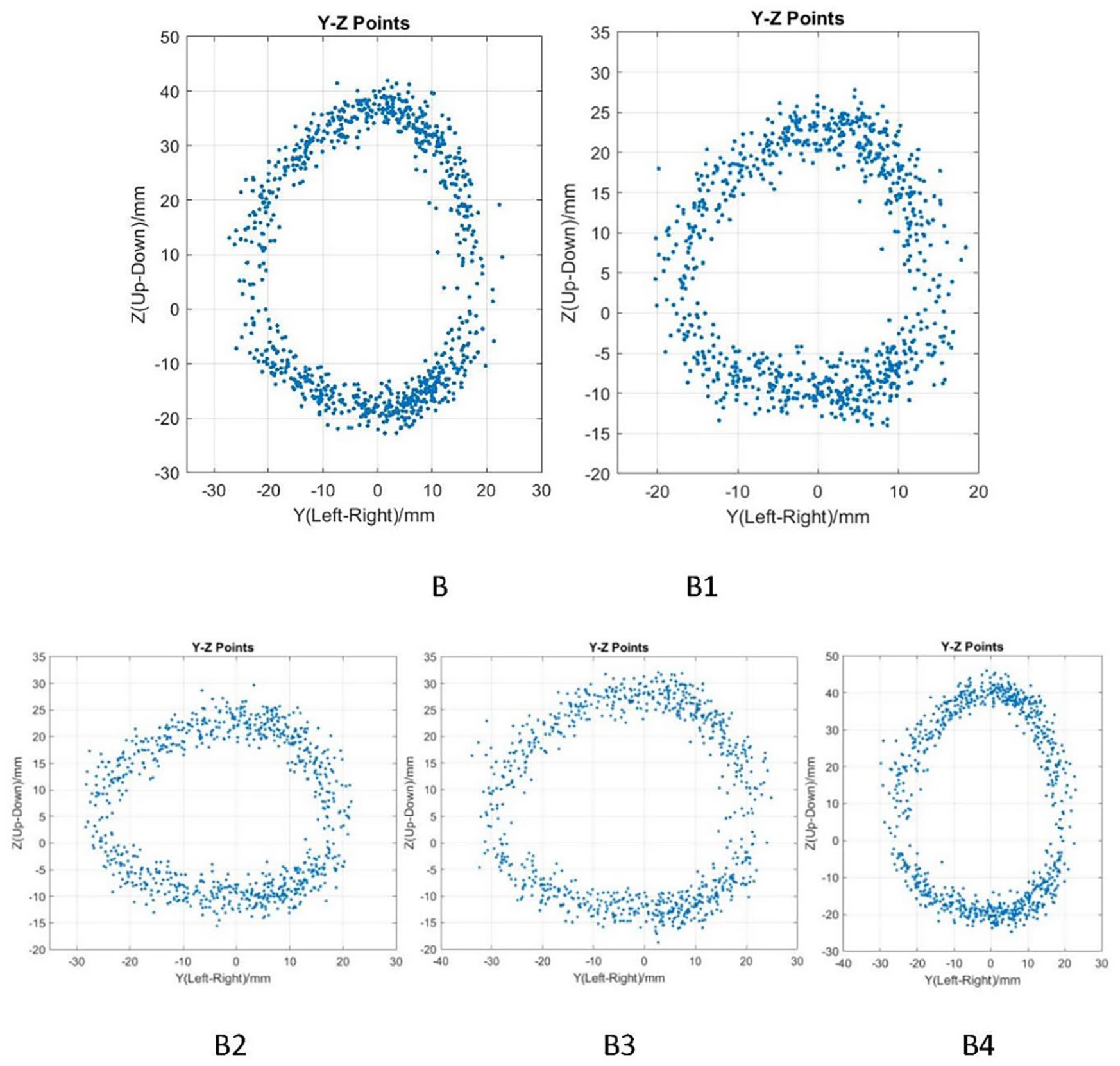
Y–Z displacement processing and presentation.
The five test points on the breast as Figure 8 shown almost cover the important positions of the whole breast, which can provide a good reference of the sagging breast movement. The displacement of five points was shown in Figure 13 via 3D cloud points. From the 3D cloud points, the significant difference of displacement amplitude can be observed, and the motion characteristics of each position are not the same. Among them, the displacement of point B1 is significantly smaller than the other points in the three directions. In the study of breast characteristics during exercise, most scholars1,4,5,7–10 pay the main attention to the movement of nipple point, because the displacement paths of all the marked points of young healthy breast are similar, 24 and the 3D displacement of the nipple is larger than that of other points. Therefore, the displacement of nipple point could be used to represent the displacement of all other points on the breast in the previous studies.19,20,25
As shown in Figure 14, in the upward and downward direction, B4 > B > B3/B2 > B1, the displacements of B2 and B3 are close, and the displacement of B4 is slightly larger than B. In previous studies,25,26 in the upward and downward direction, at the same running speed, the young health breast, point B > B3 > B1 > B2, due to the limitation of measurement, the bottom measurement was excluded, so the position of point B4 was not marked.
As shown in Figure 14, in the forward and backward direction, B > B4 > B3/B2 > B1, the displacements of B2 and B3 are close, and the displacement of B4 is slightly small than B.
As shown in Figure 15, in the left and right direction, B3 > B2 > B > B4 > B1. The amplitudes of B2 and B3 in the left and right direction of sagging breast are significantly larger than B. The displacement of B4 is close to B, and some scattered points are slightly larger than B.
Data analysis of multi-experimental subjects
During the exercise, the data of five experimental subjects were collected by the multiple 3-Axes accelerometers acquisition system. The maximum amplitude deviation value was calculated from different coordinate axis directions during each exercising circle. Summing the data to get the mean value, and then the data were statistically analyzed as shown in Figure 16.

The data analysis of multi-experimental subjects.
Due to individual differences, the movement trends of each measuring points of experimental subjects are not the same. For the sagging breast, in general, in the upward and downward direction, the displacement of point B and point B4 is the largest; in the left and right direction, the displacement of point B2 and B3 is significantly greater than point B; in the forward and backward direction, the displacement of point B is the largest. Therefore, the nipple point cannot represent the movement of the whole breast. Multiple positions on the breast should be tested when studying the movement of sagging breast.
In some directions, the maximum displacement point is not the nipple point, that’s because the sagging breast is losing support effective from muscle and skin. During exercising, the sagging breast will be changed as different shapes because of different moving status, which has different acceleration. The measuring system discussed in this paper can offer a new way to research the breast moving features.
On the other hand, if we measure the displacement of sagging breast when wearing sports bra, the traditional photoelectric 3D capture experiment measures the displacement of reflective stickers attached to the outside of the sports bra, not the breast displacement. An important feature of sagging breast is soft and easily deformable, so when they fixed in the sports bra, it is difficult to determine the position of the external reflection point of the sports bra. If the position of the reflection point is not accurate, it is easy to produce deviations, and interfere with the accuracy of the experiment. And the displacement of the breast is not the same as that of a sports bra, because there is also displacement and friction between the breast and the sports bra. In this paper, the measurement points were still on the women’s breast, not on the sports bra, which were more accurate. However, the current measurement system is only in the experimental stage, the sensor and the main control unit need to be connected by cables. The sports bra is usually tight and wrapped, so after wearing, the experimenter probably has a certain foreign body feeling in the process of the experiment. Later studies will be further optimized to improve the comfort during the measurement process.
Conclusions
Due to the special physiological characteristics of female sagging breast, this paper proposes a dynamic 3D displacement measurement method based on multiple 3-Axes accelerometers measuring system. The 3D accelerometer is integrated with 3D gyroscope, which converts the acquired data into the human body coordinate system. In addition to the measurement points, the base point is added to obtain the relative displacement. After processing the data by MATLAB, we found that the movement characteristics of each part of the sagging breast are different. In the vertical direction, the displacement of the Down-mid Point B4 is as large as Nipple Point B, sometimes even larger than Nipple Point B; in the left and right direction, the Left-mid Point B2 and Right-mid Point B3 has a larger displacement than Nipple Point B. So, the nipple point cannot represent the movement of the entire sagging breast.
Footnotes
Declaration of conflicting interests
The author(s) declared no potential conflicts of interest with respect to the research, authorship, and/or publication of this article.
Funding
The author(s) received no financial support for the research, authorship, and/or publication of this article.
