




Abstract
Energy harvesting using piezoelectric materials finds attention of researchers due to miniaturisation. Polyvinylidene fluoride (PVDF) is one such polymeric material with high piezoelectric and pyroelectric properties and hence is used for sensors, actuators, energy harvesting and biomedical devices. This study reports electrospinning of PVDF/Ag nanoparticles (AgNP) nanofibre mats for energy harvesting. Nanofibre mats were prepared by adopting voltage (20 kV), flow rate (1.5 mL/hour) and tip to collector distance (19 cm). The fibre mats were characterised using Fourier-Transformed Infrared Spectroscopy (FTIR), X-Ray Diffraction (XRD) and Scanning Electron Microscopy (SEM). FTIR and XRD results showed 11.84% and 36.36% increase in β-phase and crystallinity, respectively, due to the addition of 1.5 wt. % AgNP to PVDF. SEM micrographs showed decrease in bead formation and increase in fibre diameter from 40 nm to 355 nm due to the addition of AgNP. Sensitivity and voltage output were studied. The fibre mats were used for development of a miniature burglar alarm system, and its response to the applied pressure was tested.
Introduction
Energy harvesting using piezoelectric materials is an emerging alternative source of energy. Polyvinylidene fluoride (PVDF) is commonly used as a potential material to harness piezoelectricity in the form of nanofibre mats because of its superior thermal stability, chemical resistance, biocompatibility and robust mechanical properties.1–3 PVDF exists in five different crystalline conformations, out of which α, β and γ-phases are commonly focused for study. Research is mainly concentrated on enhancing the β-phase in PVDF.4–6 The α-phase commonly exists as a normal datum. It is non-polar in nature and is least electroactive amongst the three phases. This is because of TGTG' conformation which has no charge induced even when pressure is applied to deform the crystal. In contrast, β-phase has highest electroactive property due to its molecular conformation in the crystals. β-phase exists in TTTT conformation which aligns all the fluorine atoms in one direction. This induces charge when the crystal is deformed by an external force causing voltage difference and flow of current. 7
The β-phase of PVDF can be enhanced for obtaining piezoelectric property for energy harvesting. This can be achieved by converting the non-polar α phase to the electroactive β-phase. There are different methods of converting α-phase to β-phase. They include high temperature stretching on different axes, use of polar solvent and dispersion of nanofiller. The nanofiller material and fabrication process decide the properties of the film or nanofibre mats.
Electrospinning is a simple but versatile process for producing nanofibres of diameter ranging from submicron to nanometres by applying high voltage.8–17 Electrospinning aids alignment of PVDF molecules resulting in enhancement of β-phase and degree of crystallinity. The alignment is due to three forces, namely, shear force, electrostatic force and mechanical stretching. Electrospinning not only eliminates the need of poling but also enhances β-phase.
Use of nanofiller is one of the easiest and effective methods of enhancing the β-phase of PVDF. Efforts have been made to study the effect of AgNP on the properties of PVDF.18–20 Structure and mechanical properties of films are greatly influenced by AgNP content in PVDF. 21 Interaction between AgNP and CF2 dipoles of PVDF results in electroactive β-phase which enhances its performance and conductivity.22–23 Ag nanowires are considered as potential dopants in PVDF because of low cost and good dispersion properties. 24
Efforts have been made to investigate polymorphism and dielectric properties 25 of PVDF. The studies were mainly focussed on enhancing sensitivity of pressure sensors and effect of AgNP on thermal, mechanical and piezoelectric properties of PVDF/AgNP nanofibre mats.26–27 Percolation effect of AgNP with respect to electric and dielectric properties was studied.28–30 Literature [18–30] on PVDF/AgNP nanofibres mats indicates increase in piezoelectric coefficient, crystallinity and mechanical properties due to the addition of AgNP in PVDF. However, there is still scope for studying effect of AgNP on electrical and piezoelectric properties of nanofibre mats for energy harvesting.18,27,31,32 Also, comprehensive studies on quantifying crystallinity and demonstration of piezoelectric effect are scarce. This study reports fabrication and characterisation of PVDF/AgNP electrospun nanofibre mats and effect of AgNP on β-phase, crystallinity and fibre diameter. The electrospun nanofibre mats were tested for voltage output and pressure sensing using a burglar alarm system.
Experimental details
Materials and process
PVDF pellets (weight average molecular weight, Mw = 3.03 x 10⁵, density: 1.78 g/cm3) of Kynar 740 grade (Arkema), AgNP (average particle <100 nm, Sigma Aldrich, USA), N, N-dimethylformamide (DMF, Vasu Chemicals Ltd. Bengaluru), and acetone of grade AR/ACS (LOBA CHEMIE) were used to fabricate nanofibre mats.
Solution containing 7 g of PVDF and 22 mL of DMF was prepared by magnetic stirring at 60oC for 2 hours. Solution of 1.5 wt. % AgNP in DMF and acetone in weight ratio of 2:3 was prepared. The two solutions were mixed by stirring at 70°C for 2 hours using magnetic stirrer and ultrasonication for 20 minutes. The solution was electrospun by applying 20 kV, 1.5 mL/h flow rate and tip to collector (drum type) distance 190 mm using the set-up shown in Figure 1. Electrospinning apparatus used for fabrication of nanofibre mats.
Characterisation of nanofibres
The nanofibre mats were characterised using Fourier-Transformed Infrared Spectroscopy (FTIR-Agilent Technologies, Cary 600-series, CMTI, Bangalore) and X-ray diffraction (XRD—Shimadzu 7000XRD) to study phase transformation and β-phase. Morphology of the nanofibre mats was studied using Scanning Electron Microscope (SEMX—VEGA 3 LMU, TESCAN, magnification range 2.5x to 10E5x and resolution 8192 x 8192 pixels). Pressure sensitivity of the nanofibre mats was tested using an oscilloscope.
Results and discussion
Fourier-transformed infrared spectroscopy
Figure 2 shows FTIR spectra of PVDF and PVDF/AgNP nanofibre mats. The absorbance peaks were obtained in wavelength 400 to 1600 cm−1 for computing β-phase. The relative amount of β-phase in the film was calculated using the Lambert–Beer equation (1). Table 1 presents F(β) of PVDF and PVDF/AgNP nanofibres based on FTIR peaks and equation (1) FTIR spectra of nanofibre mats. F(β) of PVDF and PVDF/AgNP nanofibre mats.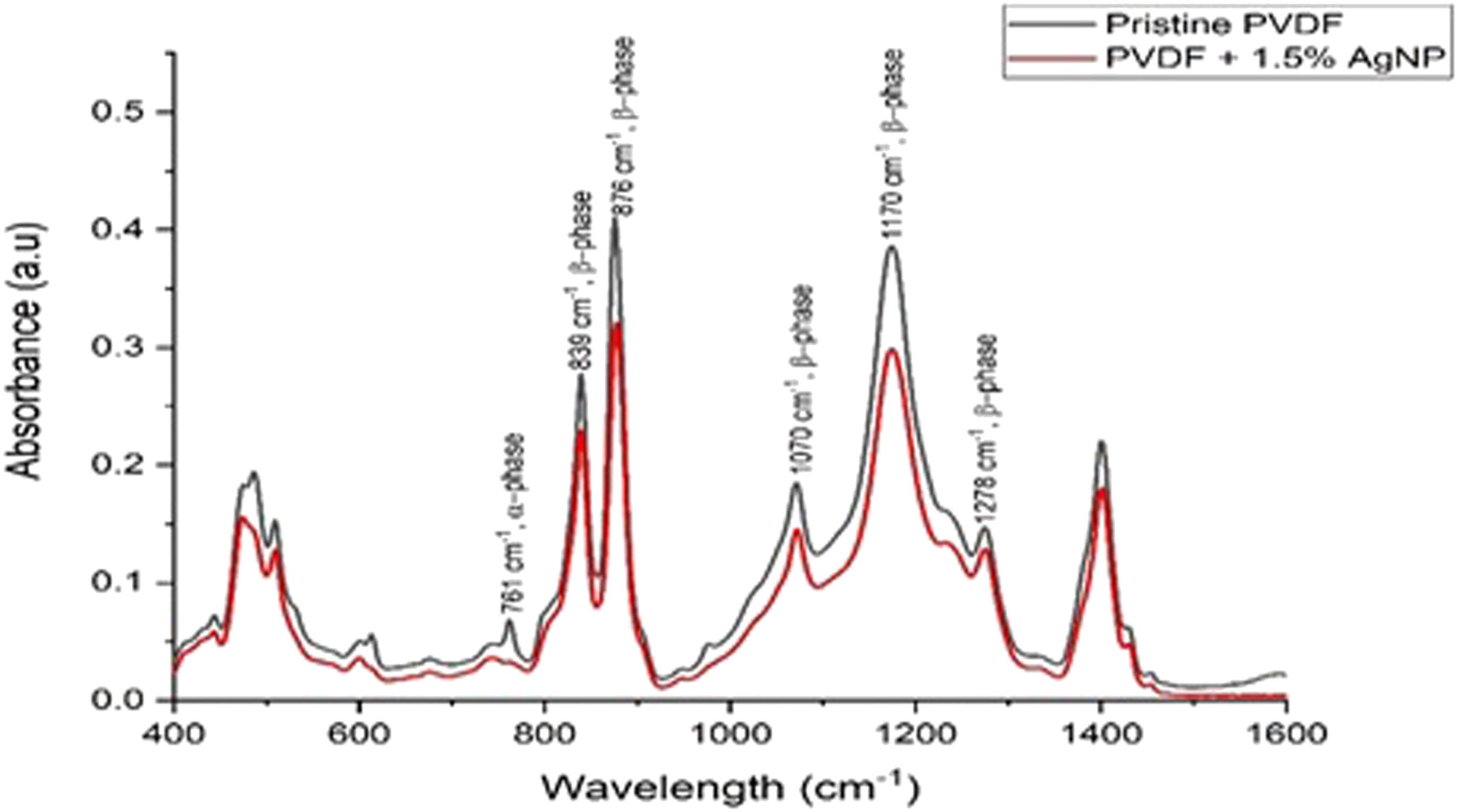


X-Ray diffraction
XRD was studied for crystal structure. Intensity vs. 2θ plots (Figure 3) were analysed for crystalline α-phase and β-phase of PVDF/AgNP. XRD plots of nanofibre mats.

Degree of crystallinity of nanofibres.

Sc is the sum of areas of crystalline peaks.
Sa is the sum of areas of amorphous peaks.
Scanning electron microscopy
Effect of AgNP on the microstructure of nanofibres was studied using SEM. The fibre mats were gold sputtered for SEM studies. Micrographs of PVDF (Figure 4(a)) revealed presence of beads and fibre diameter ranging from 37 nm to 53 nm. Micrographs of PVDF/AgNP (Figure 4(b)) revealed reduction in beads and fibre diameter from 160 nm–355 nm. Micrographs of 
Pressure sensitivity of polyvinylidene fluoride/Ag nanoparticle nanofibre mats
Pressure sensitivity of the nanofibre mats was studied using oscilloscope DSO Teledyne LeCrony wavesurfer 3054 Hz. Figure 5 shows amplitude versus time for the applied pressure. Sensitivity of PVDF/AgNP nanofibre mats.
Burglar alarm application
Piezoelectricity is the phenomenon in which electrical energy is generated by a substance when pressure is applied. β-phase of PVDF shows piezoelectric behaviour because its molecular dipole moments are oriented such a way that when pressure is applied, crystal structure undergoes reorientation building up accumulation of electrons on one side and its deficit on the other side (Figure 6) which produces electric current. Voltage was measured with the help of an oscilloscope. Applied pressure causing electron rich surface on one side and electron deficient on the other7.
Electricity generated due to the pressure applied on nanofibre mat opens wide applications and one such application is burglar alarm (Figure 7). For this application, the fibre mat was sandwiched between GFRP laminates and used as a pressure sensing device at the instance of presence of a burglar. This causes the nanofibre mat to send a voltage signal to a processor which can be programmed to trigger an alarm. The AC signal is converted to DC by employing a full wave rectifier. Arrangement of mats and the connections made in alarm system.
Nanofibre mat is considered as input AC voltage source as shown in the circuit (Figure 8). Ends of the source are connected to full wave bridge rectifier. The rectified signal is then taken to the Analogue input pin A0 of the Arduino and the other wire is grounded. Circuit diagram for alarm system.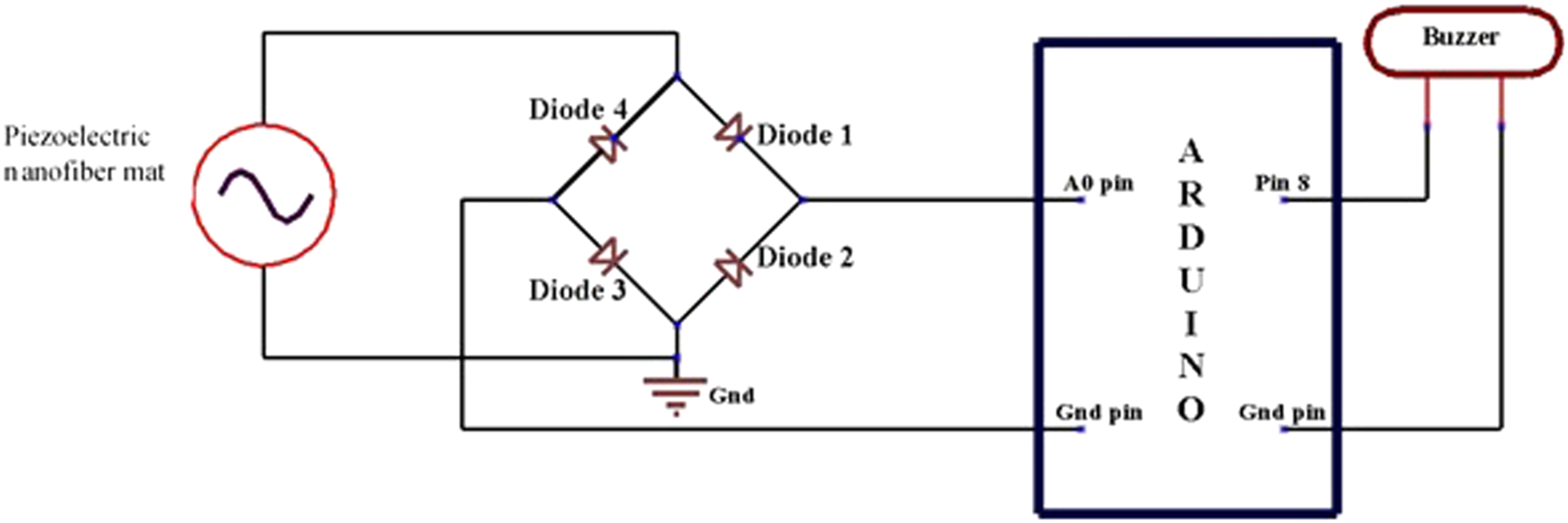
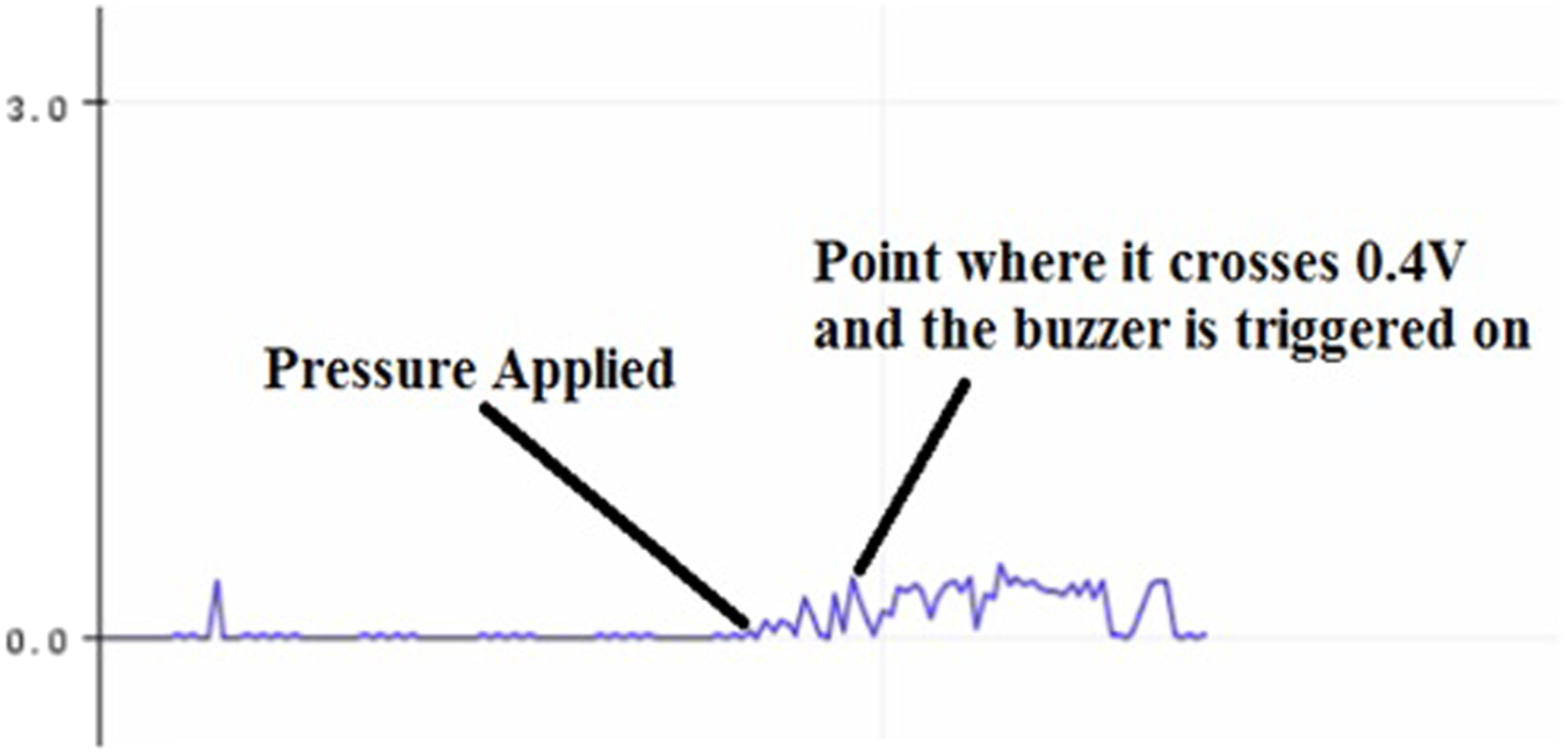
In the Arduino of Figure 9, it is initially coded such that it can only sense voltage from A0 pin and display it on the serial monitor. Voltage generated for the applied pressure is displayed on the serial monitor of the Arduino. Voltage output varied from 0.2 V to 1 V. A Buzzer is connected to Digital Pin 8, and its negative terminal is grounded. To keep the Arduino sensitive to even smaller pressure, a cut-off DC voltage of 0.4 V (indicated in Figure 10) was selected as threshold to trigger an alarm. The fibre mat was gently tapped and ringing of the alarm was heard. Burglar alarm system actual circuit. Voltage generated for the applied finger pressure.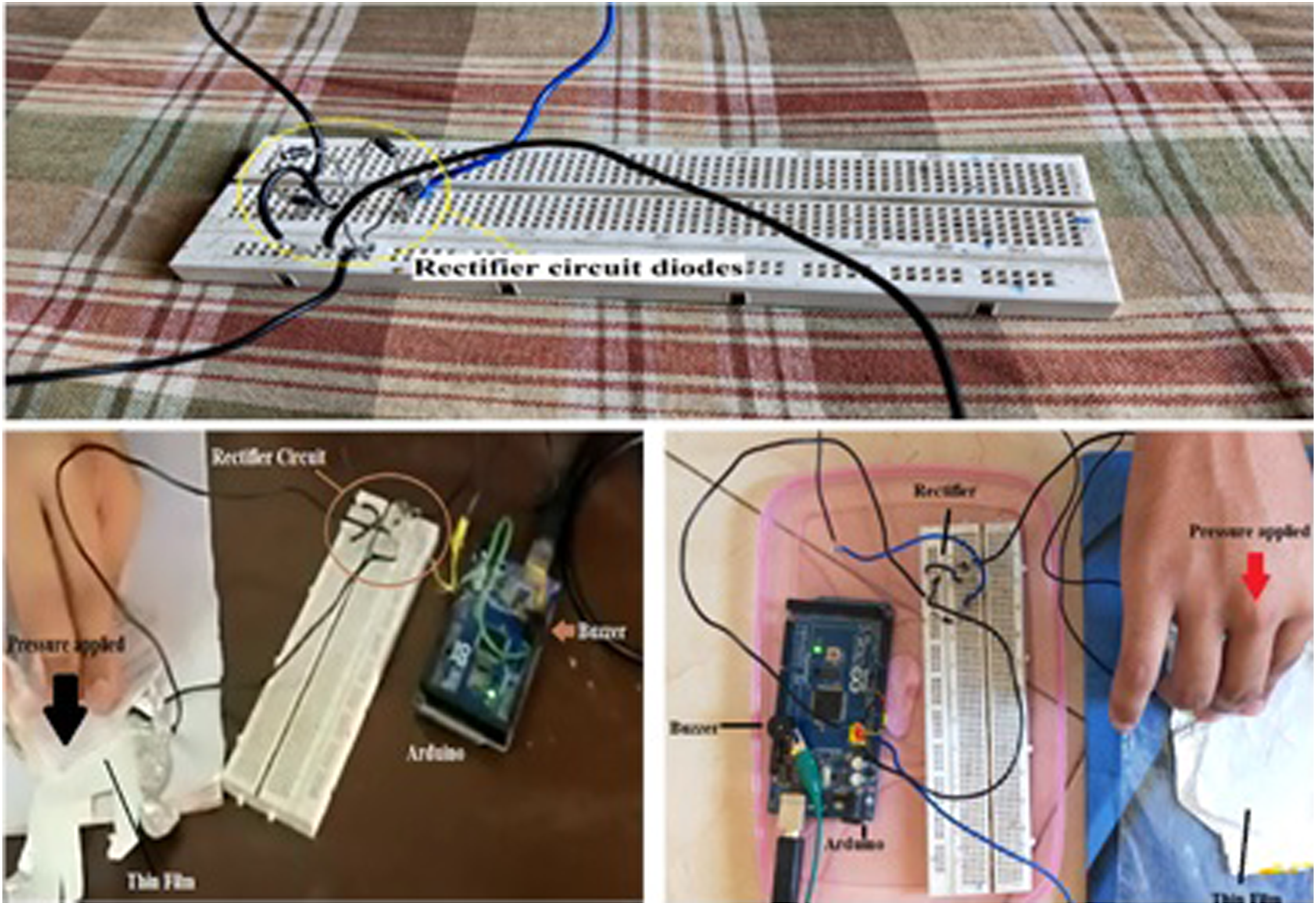
Conclusion
PVDF/AgNP nanofibre mats were electrospun employing 20 kV applied voltage, 1.5 mL/hour flow rate and 190 mm tip to collector distance. FTIR results showed an improvement in β-phase from 76% to 85% due to the addition of 1.5 wt. % AgNP. Crystallinity increased from 55% to 75% which is evidenced from XRD results. SEM micrographs showed decrease in beads in the fibre mats due to the addition of AgNP. The fibre mats were employed in a miniature burglar alarm system which was tested for its response to applied pressure.
Footnotes
Declaration of conflicting interests
The author(s) declared no potential conflicts of interest with respect to the research, authorship, and/or publication of this article.
Funding
The author(s) received no financial support for the research, authorship, and/or publication of this article.
