



Abstract
The adoption of Cleaner Production (CP) consists in taking preventive actions of one or more Cleaner Production practices; the most common are the reduction of emissions, efficient use of water, energy, and reuse of waste. This research identified in the literature 31 Cleaner Production practices and, through a survey in multinational textile industries and verified by specialists, was identified and evaluated the level of implementation of each Cleaner Production practices and link them to small, medium and large companies, so, this was the aim of this research. This study used statistical test analysis of variance. The main results were that small companies are motivated to implement Cleaner Production practices solely to reduce costs, and some small companies do not even know the concept of Cleaner Production. Medium-sized companies receive pressures to implement Cleaner Production practices to develop an environmental management system and participate in the competitive exportation market. In addition, ultimately, large companies have levels of implementation of the Cleaner Production practices significantly higher than small- and medium-sized enterprises due to the need to continually invest in their brand to increase market share. Efficient use of water is a Cleaner Production practice adopted by large- and medium-sized companies. These results enable business executives to perform benchmarking using levels of implementation of Cleaner Production practices according to the company size.
Introduction
The Council of the United Nations Environment Programme (UNEP) of 1989 is known as the first time when the term Cleaner Production (CP) was used. Its goal was to minimize risk to humans and the environment by analyzing all stages of the product life cycle. 1 New attempts of complementing and updating the term CP have been carried out, and a more recent and expositive definition is focused on the preventive measures to reduce and prevent the generation of emissions and resources, improve economic and environmental gains, efficient use of raw materials, water and energy, recycling, reuse of waste, and the benefits for occupational health.2,3
The classification of a company by size is subjective; there are several variables that can be considered. A company may be small when considering the number of employees and large according to its billing. When considering the number of employees as a criterion for classifying the company size, it is noticeable that there is no default. This study will apply the most-used criteria in the literature; thereby, considering small companies as those with up to 50 employees, medium-sized companies as having up to 250 employees, and large companies as having more than 250 employees.4,5 The textile industry is responsible for a significant portion of all water and air pollution, a large part of which is due to inadequate waste disposal of chemical materials and toxic metals that traditional production processes still use extensively.6,7 As a result of this type of scenario, the World Commission on Environment and Development (WCED) has highlighted the importance of present and future generations to effusively seek sustainable development through cleaner technologies. These expectations are present in the textile sector.1,8 This essay is based on the applications of CP practices in the work developed in a mining company in Brazil, 9 in the education industry in the United States, China and Latin America, 10 and in the metalworking sector in Brazil. 11
The Brazilian textile sector is very relevant to the country’s economy. There are more than 32,000 companies, and 80% are small and medium sized. The sector employs more than 1.7 million Brazilians, mostly women. In 2012, the textile sector generated 56.7 billion dollars, representing 6% of the total production cost of the manufacturing industry. Brazil is the fourth largest producer of blue jeans and occupies the same position in the production of knitwear, representing the fifth largest textile industrial park in the world; however, the Brazilian textile sector is concerned with its recent loss of competitiveness. Although the country is a major producer and consumer of textiles and apparel products, its participation in global trade in 2010 was lower than 0.5%, this number is rising due to exportation, but it is still modest. 12
Research in this field does not address profoundly the relation of each CP practice to small, medium, and large companies.13,14 Only a portion of the studies used analysis of variance (ANOVA),13,15 and no research calculates the level of implementation of CP practices. Small enterprises have difficulty in applying CP practices due to regulation problems from government 16 and the necessity to improve incentive policies. 17 In addition, small companies do not have capital for investment, and obtaining loans involves bureaucracy and interest rates.18,19 The employees are not capacitated, 20 there is no culture of management indicators, 10 and the clean technologies are expensive. 21 Consequently, the implementation of CP practices in small businesses are slower and often are not sustainable for the company, this scenario is also common in the medium-sized companies 22 that have the capacity to make small investments; however, if the return is not in the short term, the companies decide not to invest.23,24
Although small- and medium-sized enterprises (SMEs) have difficulty implementing CP practices, the company size may not be a critical factor if it has an institutionalized environmental consciousness,25,26 if it is engaged in maintaining the ISO14001 certification,27,28 if it targets economic benefits,29,30 or if it applies procedures related to project management. 15 Large companies must comply with the environmental laws,9,26,31 to obtain certifications and export to countries that require products to have ecolabeling.25,32 In Brazil, companies of all sizes need to overcome an economic crisis that is occurring. High interest rates and an unstable political environment 15 comprises the scenery of the Brazilian textile industry.
Therefore, no studies were identified in the literature that related CP practices with the size of the companies with a focus on obtaining the level of implementation, thus the objective of this article is to identify and calculate the level of implementation of each of the analyzed CP practices and relate to the small, medium, and large multinational enterprises in the textile sector located in Brazil. So, the following research question is suggested: what are the levels of implementation of CP practices in small, medium, and large multinational enterprises in the textile sector located in Brazil? In order to answer this question, this research is divided into the following sections: introduction, literature review, methodology, results, discussion, and conclusion.
Literature systematic review about CP practices
CP practices approximate sustainable development to companies, as the environmental management system is robust, the results of a successful implementation are environmental and economic gains and the consolidation of an environment-conscious culture instilled in the employees.2,33 A systematic review of the literature allowed to identify 31 different CP practices presented in Table 1. We identified CP practices related to the conscious use of resources by reducing waste and decreasing consumption; depending on the maturity of the company, it was observed that it is possible to apply practices such as these without investments. We identified CP practices related to the operations and routine of production, such as the substitution of machines and reducing transportation inside the plant. Aligned with these CP practices, we also identified changes in the design of the products and involvement with the production schedule. Finally, we identified CP practices related to supplier selection, employee awareness, and dissemination of recycling centers. Therefore, it was observed that the CP practices considered could be used by companies of different segments, types of production, sizes, levels of maturity, and localization.
CP practices.

CP: Cleaner Production.
CP practices by company size
Nineteen studies were identified that defined CP practices, approached SMEs and used quantitative analyses. A literature review analyzed the National Cleaner Production Centers (NCPC) as a strategy to promote the application of CP practices by the UNEP and the United Nations Industrial Development Organization (UNIDO) with emphasis on SMEs around the world. The qualitative analysis of the study identified that there are differences in the policies adopted by the countries with NCPCs and, therefore, management problems are usually the cause of lack of success in the implementation of CP practices. 43 A similar result was found in a case study in a small French metal finishing company that presented, by means of statistical tools, 15 criteria that are aligned with the CP practices and with best available techniques (BAT) of the metal finishing sector, which also proposed an evaluation considering financial, environmental, social, and technical aspects. However, the difficulty in evaluating the results was identified as a barrier to the implementation of CP practices by SMEs. 38
In Australia, a documentary analysis observed 10 companies that applied CP practices with governmental incentives. Data such as periods for the return on investment (ROI) and the types of applied technologies were submitted; however, the analysis highlighted that the SMEs failed to apply CP practices because they did not consider continuous training and self-assessment routines in the companies. 44 Still in Australia, the same author continued the studies on the implementation of CP practices considering the span between the years of 1996 and 2004, when environmental laws were revised and became stricter. Data on the progress of companies over the years were presented, such as adherence to the program of implementation of CP practices and progress of action plans; however, it established that small companies are more resistant in applying CP practices, even when receiving incentives. 16
In Asia, a survey conducted in China with 65 questionnaires answered by SMEs considered 20 barriers to the implementation of CP practices identified in the literature. The presented data categorized the barriers in four large groups, and it was concluded that the main barriers are policy related, such as lack of government incentive and negligent environmental inspecting. 17 In turn, a case study in a small Chinese mining company found in the application of CP practices a way to compensate for the environmental impacts resulting from the extraction process of rocks. As environmental laws became stricter, the company needed to identify indicators that would enable assessment of the performance of the application of the CP practices. They selected 30 indicators that went through the process of analytical hierarchy and analysis of the degree of fuzzy adhesion to measure which were the most relevant to present the environmental performance of the company. 45 A similar line of reasoning was followed by a survey conducted in Malaysia that obtained 107 set of questionnaires answered and analyzed via statistical test, the CP practices more relevant to companies. It also analyzed the relationship of CP practices with the type of company property, type of product, certifications, period with ISO14001 certification, number of employees, and companies that perform development of new products. The main results were that, in Malaysia, the electrical and electronic engineering industries are the most significant to the CP practices, they are the most engaged in deploying management systems and they are the industries with the highest number of companies with the ISO14001 certification. 13
In the Americas, a documentary analysis collected information from 972 SMEs that applied CP practices in Mexico. The focus of the analysis was the economic gains obtained through the reduction of water consumption, raw material, and reduction of material waste. Statistical linear regressions enabled us to identify that the sum of the benefits enabled the neutralization of the environmental impacts equivalent to a city of 40.000 inhabitants. 14 Still in Mexico, a survey observed the implementation of CP practices in 177 SMEs stimulated by 14 companies experienced in the application of CP. The most relevant benefits for companies and for the supply chain were analyzed and pondered through the use of statistics, and the main gain was the approximation between the SMEs and the leading companies, cooperating to change the design of products in favor of better use of natural resources and raw materials and, consequently, cost reduction. 35 Similar conclusions were observed by a multiple-case study carried out in four SMEs of the metalworking sector in Brazil, analyzing the averted environmental impacts and the economic gains obtained by applying CP practices, quantified results were presented and compared to the performance of each company. They found that calculating the expected ROI stimulates the SMEs to apply the CP practices. 11
Studies that defined CP practices in SMEs were identified in the literature; however, they did not utilize quantitative analysis to present the results, demonstrated by the case of a literature review establishing that if the company is engaged with the application of CP practices, the size of the company is no longer a relevant factor. 25 This same finding in SMEs was observed in a documentary analysis on smart cities in Asia. 26 A literature review that analyzed the theoretical application of CP practices identified that adherence to laws and pressure performed by other companies is the main factors that, similar to large companies, stimulates SMEs to apply CP practices. 22 A study of multiple cases performed with five small companies in the Southeast Asia region established that it is possible to initiate the application of CP practices with different objectives, such as water saving and reduction of energy consumption. 46 However, a literature review has identified that SMEs in developing countries have difficulties in investing to implement CP practices, even with the support of UNEP and UNIDO. 47 With the same perspective, a review of the literature developed in Brazil evaluated why the CP practices are not widely used. The lack of financial resources and lack of skilled labor were identified as leading barriers to SMEs. 20 Even so, case studies have demonstrated the application of CP practices in SMEs with reduction of environmental impact and economic gains, as is the case of a company in the furniture industry in Brazil, 48 a company in the food sector in Canada 49 and a company in the metallurgical industry in Brazil. 50
Six studies on large companies have defined CP practices and used quantitative analyses. In Africa, a multi-case study in five automotive companies in South Africa proposed a framework through descriptive statistics, to analyze the application of CP practices from the perspective of technology management. It established that large companies are able to apply and maintain CP practices better than SMEs because they have more financial resources to implement new technologies. 51 However, a relevant consideration was presented in a paper from Asia, where a documentary analysis studied the CP practices in large companies in a region of China, utilizing quantity of companies installed and per capita income of the region, and found that the government incentives only result in the application of CP practices if environmental laws are stricter and better regulated by the government. 52 Still in China, a case study in a large water and sewage treatment plant measured the environmental benefits of applying CP practices and determined that efficient use of resources improves the efficiency of the process 53 regardless of the government incentives. In addition, CP practices stimulate the adoption of clean technologies and ISO14001 certification, which concluded a survey conducted in Turkey that analyzed quantitatively the most relevant CP practices for the large companies. In this case, 25 CP practices were considered, and the main benefits were analyzed from the point of view of the companies. 34 Similar results were observed in the Americas, where a case study of a large publishing company in Brazil analyzed 136 projects already implemented and identified that 32 of these obtained economic, social, and environmental gains. These gains were measured individually, and their benefits for the company were analyzed, such as compliance with environmental standards, cost reduction, and adoption of new technologies. 39 On the contrary, a study was also identified in the literature which, although addressing the definition of CP practices and considering a large company, did not use a quantitative analysis. It is the case of a study that demonstrated the application of CP practices in water purifiers considering the whole life cycle, exemplified by a large company in Brazil that uses the business model of servitization for this type of product. 54
In general, there are studies addressing the concepts of CP practices in small-, medium-, and large-sized companies, which analyzed hundreds of applications of CP practices; 14 considered the relevance of dozens of CP practices for companies; 34 and analyzed the relationship between some CP practices and the size of companies. 13 However, no research that examined the level of implementation of CP practices in relation to the size of the company was identified in the literature. From this gap, the following hypothesis was developed:
H1: The level of implementation of CP practices is affected by the size of the companies.
Our research identified 10 studies that considered companies of all sizes, defined CP practices and used quantitative analyses. A multiple-case study analyzed the relationship between CP practices and ISO14001 certification in five companies of different sizes in Australia, establishing that the ROI ranged from 3 to 30 months due to energy reduction, reduction of water consumption, reduction of packaging, among other factors. 55 Similar results were observed in Europe, where a multi-case study evaluated the application of CP practices in 10 companies in Portugal taking part in a program to stimulate sustainable production, and the main results were the decrease in waste generation and pollutant emissions, along with the ROI in less than 3 years. 56 However, a survey carried out in Spain conducted a statistical model analysis defining 25 barriers for the proactive application of CP practices in 240 companies and determined that large companies are more engaged with the reduction of emissions. 31 This same angle is pursued in a survey held at universities of all sizes in the United States, Latin America and China, analyzing the educational programs that approached concepts of CP and sustainable development, in which data such as time of the program’s existence, content, level of exposure, practical involvement, among others were presented, and one of the conclusions of the study was that SMEs face significant obstacles to apply CP practices for lack of skilled labor, low quality of data collection, absence of performance indicators, unstable finances, and low investment capital. 10 However, a relevant consideration has been addressed in a survey conducted in companies of all sizes in Brazil that obtained 258 answered questionnaires in order to quantify the relationship between CP practices, organizational performance and environmental sustainability considering a model of variables, one of the results presented was that the companies interested in the analyzed constructs seek mainly to obtain economic gains; therefore, it was identified that the size of the company is not a relevant factor for the implementation of CP practices. 30 In addition to the economic gains, another relevant consideration was presented by another survey conducted in Brazil that considered 52 companies, the relationships between ISO14001 certification and the application of CP practices were analyzed and with descriptive statistics, it was possible to verify that companies of all sizes that had the ISO14001 certification were concerned about staying certified due to the strategic benefits achieved; therefore, CP practices were applied regardless of the size of the company. 27 Finally, another relevant consideration, again in Brazil, a survey analyzed 238 companies in order to measure the relationships between strategic drivers for the business, maturity in project management, success in the implementation of CP practices, and the size of the company in the analysis. The integrated model presented established that companies that were identified as mature in project management succeeded in applying CP practices without the company’s size affecting the results; however, it was also found that this characteristic was more commonly observed in large companies than in SMEs. Thus, weak organizational structures made it difficult to apply CP practices. 15 However, a small African company managed to compete equally with a large European company holding the largest market share of a personal hygiene product, possible through the application of CP practices, this case study used data and graphics to compare the two companies and presented the economic gains, the reduction of the environmental impact, and the social benefits offered to the local population. 57
Studies that defined CP practices and considered companies of all sizes were identified in the literature; however, they did not utilize quantitative analysis, for example, a review of the literature that analyzed the concepts of CP and sustainable consumption to identify a new model more attractive for companies, the study remarked that the application of CP practices by large companies achieve perceptible changes; however, small firms only achieve punctual and temporary improvements. 58 On the contrary, a case study in a small Brazilian mining company analyzed the application of CP practices and considered programs of incentives and behaviors of other companies in the sector, and therefore, it was concluded that the size of the company is not a relevant factor if the company is engaged in achieving sustainable performance. 9
Essentially, there were studies in the literature which concluded that the size of the company does not directly influence the implementation of CP practices by the companies;9,15,26,30 however, some studies in the literature found that large companies are able to apply CP practices more efficiently than in relation to SMEs.10,58 Still, none of the studies analyzed the level of implementation of the CP practices in relation to the size, and in view of this gap, the following hypothesis was developed:
H2: Large companies have a higher level of use of CP practices compared to small- and medium-sized companies.
Seven studies that defined CP practices and used quantitative analyses were identified in the literature; however, they did not address the size of the companies. A survey developed in China analyzed the relationship between CP practices and the financial performance of companies through a structured model and statistical analysis. The main results were the identification of a positive relationship between the financial benefits for companies and CP practices with low investment cost and the positive relationship between non-financial benefits and CP practices with high investment cost. 42 A review of the literature developed a strategic model for the application of CP practices in conjunction with the plan–do–check–act (PDCA) cycle. The model was tested in a multinational beverage company in Brazil, and the results obtained were the reduction of waste and improvement in production efficiency. Economic gains were presented through the reduction of the quantity of discarded cans in the process. 37 A survey conducted in Brazil obtained 1123 questionnaires answered and analyzed the relationship between environmental awareness, a set of CP practices, social responsibility, and ecological innovations, with sustainable consumption, considering age group of respondents, analysis of variance was used as statistical model and confirmed the positive relationship between CP practices, environmental awareness, and age. 41 A review of the literature analyzed the benefits and difficulties of applying the CP practices in the last 10 years. The leading benefits such as waste reduction and emissions and efficient use of resources were quantified, and the main difficulties were identified as unavailability of credit, unqualified labor, and lack of guidelines by the government. 40
Studies that defined CP practices and did not address the size of the companies and did not utilize quantitative analyses were identified. A review of the literature analyzed the CP practices applied by the companies with a focus on environmental protection and compared the evolution of these applications from the adoption of clean technologies to a projection of the application of CP practices linked to changes in attitudes and culture. 1 A review of the literature analyzed how CP practices can collaborate with the promotion of industrial ecology as in the process of development and redesign of products. 2 A case study in a Brazilian company manufacturer of water purifiers related the CP practices with the benefits of adopting a business model related to the circular economy—the company uses the model of servitization to provide a service of leasing and maintenance of water purifiers. 36
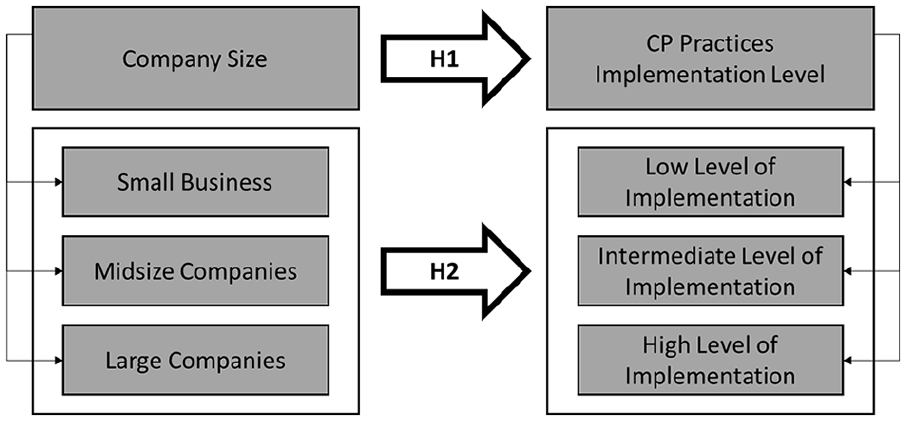
The size of the company and the level of implementation of the CP practices are important in the considerations about the variables of the theoretical research model. According to the literature review and the research hypothesis that this study seeks to confirm, Figure 1 describes the conceptual model of this study.
Conceptual model.
The constructs of this study are represented by the size of the company and consequently the small, medium, and large companies, in addition to the level of implementation of the CP practices and the low, intermediate, and high levels of implementation.
Methodology
Research methodology and data gathering procedure
This study conducted a systematic review of the literature using five research bases, Science Direct, Emerald, Wiley, Taylor & Francis, and Scielo, gathering a total of 1229 studies through the combination of the term “cleaner production” with the keywords “practices” that resulted in 258 studies, “principles” that resulted in 77 studies, “program” that resulted in 177 studies, “scheme” that resulted in 34 studies, “actions” that resulted in 124 studies, “tools” that resulted in 210 studies, “techniques” that resulted in 171 studies and “activities” that resulted in 178 studies. After a first analysis of the titles, abstracts, and keywords, 71 studies were selected, which presented the concepts of CP practices and, therefore, were subjected to a systematic analysis of content. This stage of the process enabled the categorization of the studies in two important groups: studies that addressed the definition of at least one CP practice and studies that considered the size of the company and cited the term CP practices, respectively 18 and 35 studies in each group. However, it was observed that 10 studies were categorized in both groups; therefore, 43 studies were considered relevant for this study. When studying the relationship between the CP practices and the size of the companies, it was observed that four studies addressed exclusively small companies, 15 studies did not distinguish between small- and medium-sized companies, 6 studies addressed large companies, 10 studies addressed all sizes of companies, and 8 studies did not address the size of companies. The direction taken from the initial research to the categorizations of the studies was possible due to content analysis and the determination of theoretical constructs. 59
This study used the survey method to identify the CP practices most implemented by multinational companies in the textile sector in Brazil to consider the endogenous and exogenous aspects, as well as the ease of researchers to this type of companies. Number of employees was considered to determine the size of each company. The research instrument was validated via a pilot test with the emphasis on the interpretation of the questionnaire and the quality of the data; adjustments were made considering the suggestions of the respondents. In addition, a face validity test was performed through three specialists in the Brazilian textile sector, and the 31 CP practices identified in the literature regarding the relevance and applicability in the Brazilian textile sector were evaluated, it was also verified if any CP practices were not considered. The result of the face validity test was that only 20 CP practices should be considered in this study. 60
It is worth noting that 11 CP practices were dismissed, as they are unrelated to the Brazilian textile sector, such as increasing the recycling capacity of the product (P8), which is a practice that was not considered applicable because textile products are usually composed only of yarns. Accordingly, another dismissed practice was the disassembly efficiency (P9). Recycling centers (P12), reverse logistics (P17), and product collection (P22) were not considered because there is already a culture of reprocessing production residues in textile companies, including for non-woven and defibered industries. The use of recyclable packaging (P25), improvements in product flow (P19) and the design of logistics networks (P21) were not considered because there is a wide variety of machine models in operation in Brazil, including aged machines and from manufacturers who are no longer active in the sector. In addition, there are no established standards or for the large industrial parks of the textile sector, they are regionalized. The environmental effects of the use of products (P20) and increase the durability of products (P18) is little relevant for the textile industry because the products must accompany the fashion trends.
In order to evaluate the CP practices most implemented by multinational companies in the textile sector in Brazil, the survey method was adopted through the application of structured questionnaires considering the 5-point Likert-type scale to determine the level of implementation of each of the CP practices for small, medium, and large enterprises, this way, it was possible to analyze patterns, identify the relationships between variables, and perform statistical analyses. 59 In addition, this study opted to use the survey method to support the defined hypothesis tests, since this method is suitable for quantitative research applications. The survey method requires the fulfillment of three stages: delimitation of the research universe and determination of the sample size, performing pre-tests to verify the validity and reliability of the research and data instrument, application of the survey in the sample universe and delimited sample. 60
Data analysis procedure
The analysis of the collected data was performed first through the observation of the data quality, shortly after the relationship between variables was analyzed and, finally, the necessary treatments in the data. 61 The comparison of CP practices with company size was performed through ANOVA in order to test hypothesis H1 and verify if the size of the company affects the level of implementation of PC practices. Next, a descriptive statistic was performed to calculate each level of implementation of CP practices for small, medium, and large companies in order to test hypothesis H2.
The assumption for the realization of ANOVA is the confirmation of normality and homogeneity of the variances of the research variables. To test the normality of CP practices, the values of skewness and kurtosis were evaluated, a variable is normally distributed when the skewness values are situated between −1.0 and +1.0, and kurtosis values are below 2.0. To test the homogeneity of CP practices, the Levene test was performed. 62
From the results of the tests, it was possible to select the ANOVA to observe the level of implementation of CP practices in relation to the size of the companies. ANOVA is a statistical method capable of testing the equality of two or more population averages from the sample analysis of variance. 63 The interpretation of the data resulting from the level of implementation is straightforward, as the interval from 1 to 5 was considered; therefore, the highest values represent the highest levels of implantation, just as the smallest values represent the lowest levels of implantation.
Results
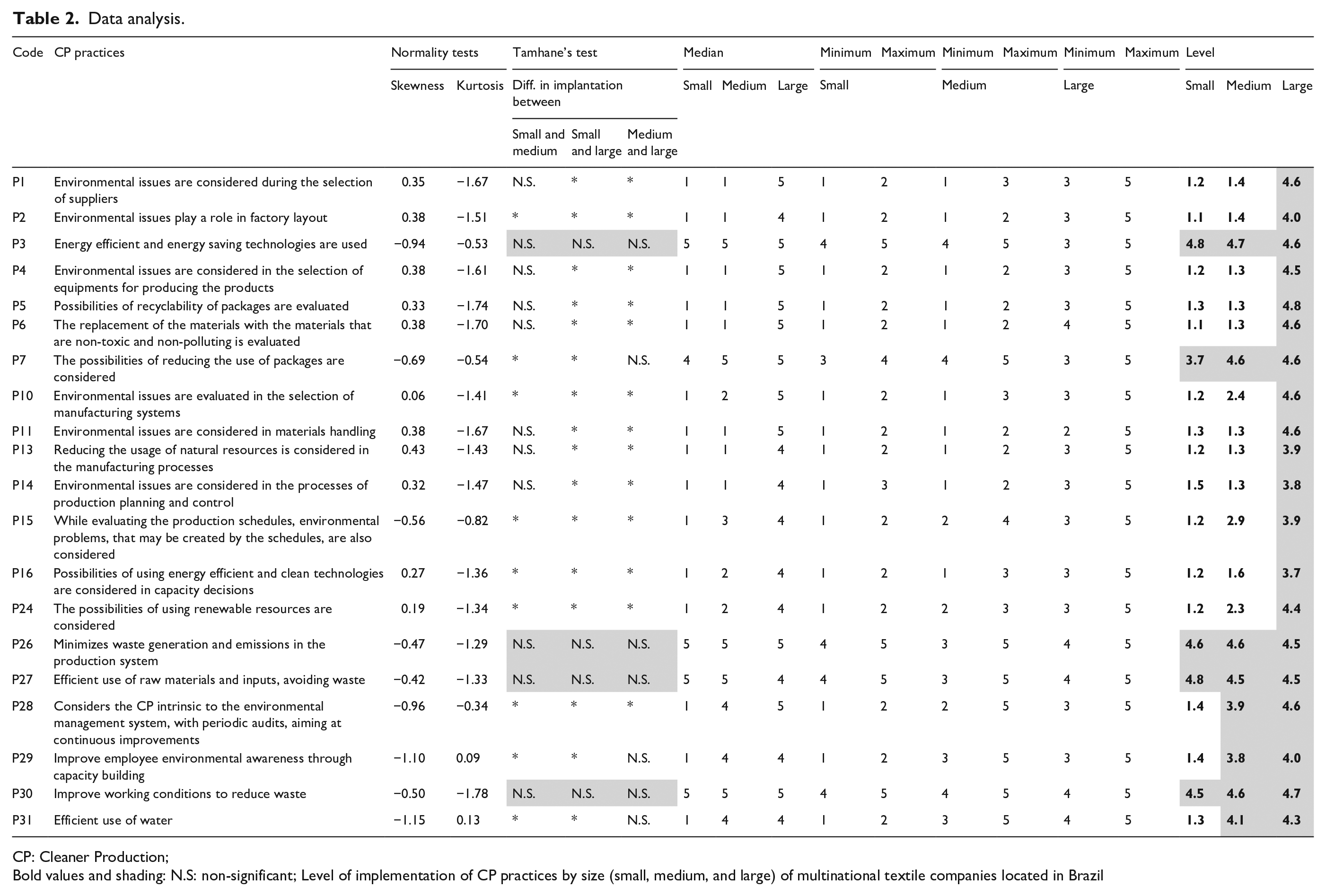
The distribution of data collected from CP practices was tested for normality by analyzing the values of skewness and kurtosis, as described in Table 2. The normality of the entire data sample was confirmed, and each of the selected CP practices was subsequently confirmed.
Data analysis.
CP: Cleaner Production;
Bold values and shading: N.S: non-significant; Level of implementation of CP practices by size (small, medium, and large) of multinational textile companies located in Brazil
The analysis of the results enabled us to reasonably accept that CP practices present a normal distribution since most of the skewness values were in the range described, even though some values exceeded the limits, they were still close to the ideal scores. In relation to the kurtosis values, all were distributed within the interval considered satisfactory.
The results of the Levene test to test the homogeneity of variances revealed that 50% of the variables were different, this way, to compare the level of implementation of the CP practices as a function of the size of the companies, ANOVA followed by Tamhane test was performed, since the assumption of homogeneity of the variances was violated, in addition, the groups presented different sample size.
The Tamhane test analyzed the significance of the level of implementation in relation to the size of the companies for each of the CP practices; therefore, each CP practice that was identified as non-significant (N.S.) for each of the three sizes of companies simultaneously represented the lack of relationship between the practice of CP analyzed and the size of the companies. Thus, the results revealed that small, medium, and large companies are concerned with the efficient use of energy (P3), the minimization of the generation of waste and emissions (P26), the efficient use of raw materials and inputs (P27) and the improvement of the conditions of work to reduce waste (P30), since these CP practices are part of the routine of all companies, as they are related to cost reduction in production processes, regardless of size and, in most cases, more motivated by economic than environmental benefits.
The comparison of the level of implementation of CP practices among small- and medium-sized companies in terms of significance enabled us to observe that more than 50% of the CP practices did not present symbolic differences in the level of implementation, implicating similarities between small- and medium-sized companies as to the levels of implementation of CP practices.
On the contrary, the comparison of the level of implementation of CP practices among small and large companies in terms of significance enable us to observe that 80% of the CP practices presented substantially different levels of implementation, therefore identified a noticeable difference between small and large companies regarding the levels of implementation of CP practices.
Finally, the comparison of the level of implementation of the CP practices between medium and large companies as to the significance enabled us to observe that 65% of the CP practices presented significantly different levels of implementation; therefore, a significant difference was identified between medium and large companies regarding the levels of implementation of the CP practices.
Thus, it is possible to admit that the H1 hypothesis was confirmed, that is, the level of implementation of the CP practices is affected by the size of the multinational textile companies in Brazil. The comparison of the level of implementation of the CP practices as a function of its size was also tested in a multivariate approach, the results of the Pillai test were 19,005 to F = 75,419, indicating CP practices differ according to the size, corroborating confirmation of the H1 hypothesis.
In order to test the hypothesis H2, calculations were elaborated with descriptive statistics, and the results determined the levels of implementation of each CP practice for small, medium, and large multinational companies in the textile sector in Brazil. It is worth noting that the levels of implantation vary from 1 to 5 and its interpretation is straightforward, that is, the higher its value, the higher the level of implementation, in the same way that, the lower its value, the lower the level of implementation.
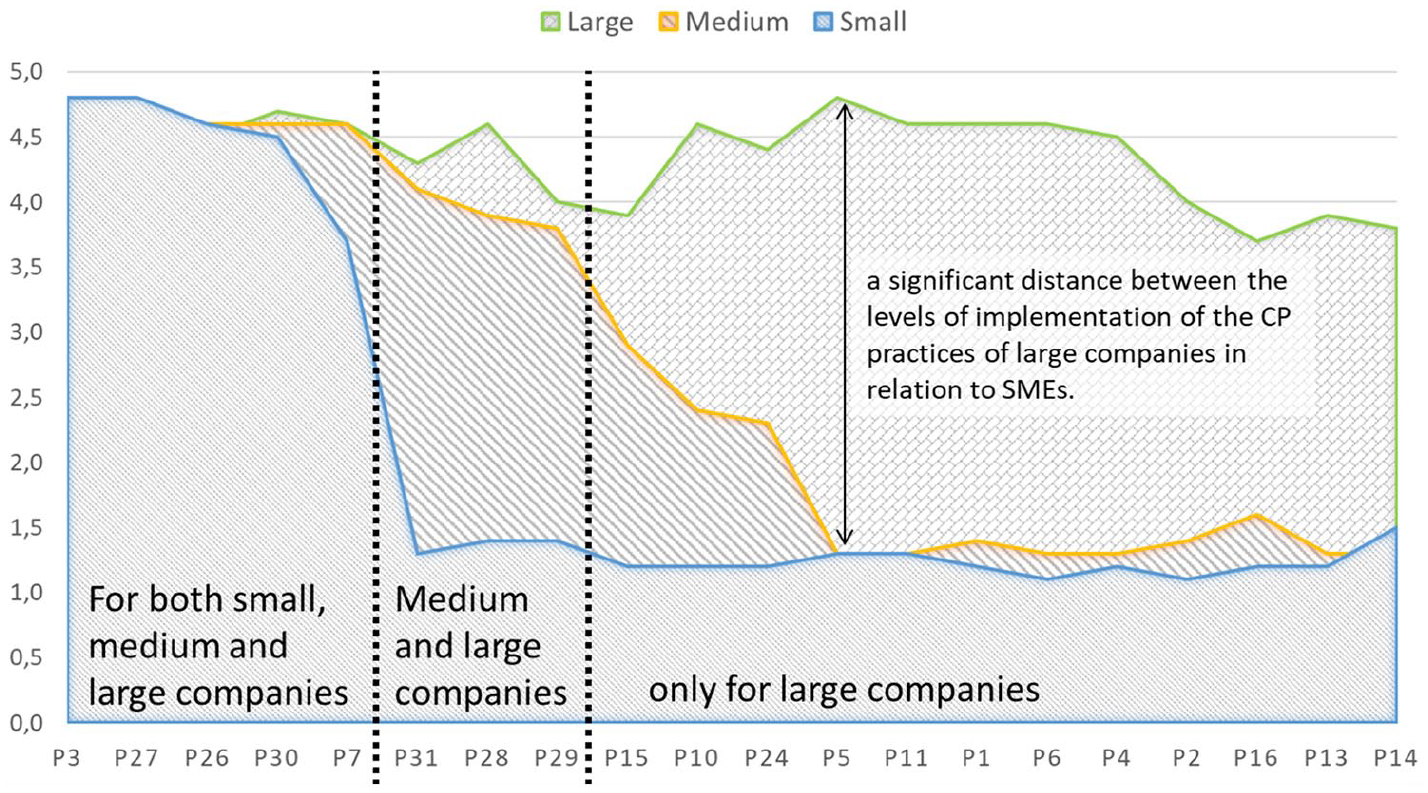
The analysis of descriptive statistics validated the results of the Tamhane test, in other words, that SMEs apply common CP practices, such as the efficient use of energy (P3), minimization of waste generation and emissions (P26), the efficient use of raw materials and industrial inputs (P27) and the improvement of working conditions to reduce waste (P30). Moreover, the reduction in the use of packaging (P7) was identified as being a CP practice applied by SMEs and, in the same way as previous CP practices, the correlation with cost reduction and economic benefits is the main business motivation.
It is pertinent to mention the level of implementation demonstrated by SMEs in the minimization of waste generation and emissions (P26), in addition to the motivation to obtain economic benefits. These data indicate that SMEs comply with some of the main Brazilian environmental laws. This is the case of resolution number 313 of the National Environmental Council (CONAMA) of the Brazilian Ministry of the Environment (MMA), which guides the control of harmful waste to public health and the environment, 64 as well as the 436 resolution of CONAMA, which establishes emission limits for atmospheric pollutants by industries. 65 In most cases, small businesses only meet these environmental laws if needed because they are interpreted as unnecessary costs (Figure 2).
Assessing the implementation level of Cleaner Production practices in relation to company size.
On the contrary, medium-sized companies need to develop an environmental management system and an audit plan (P28) to ensure compliance with environmental laws, as medium-sized companies receive pressure from the marketplace and stakeholders to obtain environmental certifications; however, medium-sized certified companies stand out in relation to competition, improving their qualifications to win disputes for the right to participate in large supply chains. Thus, the medium-sized companies also stand out for their interest in training employees (P29) with a focus on interpreting and meeting environmental requirements, in addition to interpreting and implementing the items contained in the BAT of the textile industry and widely used in Europe, applied by medium-sized Brazilian multinational companies with a focus on complying with European environmental requirements for exporting their products. Finally, as presented in Figure 2, medium-sized companies demonstrate efficient use of water (P31) motivated by cost reduction due to decreased consumption, or compliance with Brazilian environmental laws that control the disposal of pollutant loads of industrial effluents as is the case with CONAMA’s resolution number 357. 66
However, it was observed that large companies have high levels of implementation of all CP practices, as well as a significant distance between the levels of implementation of the CP practices of large companies in relation to SMEs (Figure 2). These results can be explained by some characteristics of large companies: the ability to develop complex projects that need large investments in order to improve productivity and profit margins resulting in environmental benefits is aligned to the possibility of recycling or reuse of materials and packaging since the product design (P5), use of cleaner and efficient energy technologies (P16), and reduction of the use of natural resources (P13); the need to have its brand recognized by the consumer market as eco-friendly to stand out in relation to its competitors is aligned with considering the environmental issues in the layout of the factory (P2), in the selection of equipment (P3), in the selection of manufacturing systems (P10), material handling (P11), production planning (P14), besides the substitution of toxic materials (P6) and the use of renewable resources (P24). The fulfillment of international requirements and the BAT in the textile sector with the aim of obtaining important export contracts of its products to countries with more advanced environmental legislations is aligned with considering environmental issues during the selection of suppliers (P1) and consider the production program on the timeline for the resolution of environmental problems (P15). Therefore, the high levels of implementation of all CP practices by large companies demonstrate an organizational maturity and an environmental culture rooted in employees, allowing to verify the perpetuity of the CP practices applied, therefore, it can be admitted that hypothesis 2 (H2) was confirmed.
Therefore, small businesses only implement CP practices if it is to reduce costs, sometimes without even knowing they are applying CP practices. Midsize companies are under pressure from large companies to implement CP practices in order to participate in product export contracts. Large companies implement CP practices to comply with international environmental standards. An important point is that there is a significant gap between the levels of implementation of PC practices between small and medium enterprises and large enterprises.
Discussion
Small multinational companies in the textile sector in Brazil have financial problems due to lack of capital and the difficulty of access to credit to invest in technologies and trainings. In addition, Brazil is undergoing a period of economic crisis, with high interest rates, retraction of the regional market and reduction of consumption. Thus, the implementation of CP practices by small companies is fully motivated by cost reduction, and a few small companies apply CP practices without awareness of the environmental benefits. Most small companies meet environmental requirements only during an inspection by the government, as they interpret that meeting these environmental requirements only generates costs, taking advantage of the inefficient government supervision of compliance in small companies. This is corroborated by the research by Shi et al. 17 that used the survey method in China and obtained 65 questionnaires answered by SMEs and concluded that the main barriers to deploying CP practices are related to policies, such as lack of government incentive and negligent environmental supervision. Research by Van Hoof and Lyon 14 conducted in Mexico with SMEs, through the method of documentary analysis, evaluated 1934 projects developed by 972 SMEs stimulated by a governmental program, concluding that the economic benefits and environmental aspects of the application of CP practices are positively related to the size of the company; however, only some CP practices were considered. The research by Vieira and Amaral 20 in Brazil identified the barriers to implant CP practices and overcoming strategies through a literature review, concluding that small companies need more stimuli and subsidies to apply the CP practices with commitment. The research of Oliveira Neto et al. 11 analyzed the economic and environmental benefits of the application of CP practices in a study of multiple cases which was carried out in four SMEs in the metalworking industry in Brazil, concluding that calculating the ROI stimulates the SMEs to apply the CP practices. Burritt et al. 46 did a multiple-case study and analyzed the application of CP practices by five small companies in the southeast Asian region and established that the motivating factor for small companies to apply CP practices is cost reduction, evidenced by the case of the company that had difficulty in meeting the most basic requirements of local labor laws, allowing the conclusion that environmental laws were rarely met. The studies approach the relationship of small companies with the various CP practices superficially, meanwhile, the results of this study reveal that small multinational companies in the textile sector in Brazil are motivated solely by cost reduction, promoting awareness in small businesses that it is possible to reduce costs and obtain environmental benefits with little or no investment, as is the case of the efficient use of energy (P3), minimization of waste generation and emissions (P26), the efficient use of raw materials and inputs (P27), improvement of working conditions to reduce waste (P30) and reduction of the use of packaging (P7).
The medium-sized multinational companies of the textile sector in Brazil use the CP practices with a focus on cost reduction, similar to small companies, but with an important distinctive feature, medium-sized companies have the ability to perform on-the-spot investments, in addition, the market and stakeholders pressure medium-sized companies to obtain environmental certifications that allow their products to be part of a large supply chain that will result in the exportation of a final product. In this way, medium-sized enterprises begin to invest in the qualification of their employees for the development of an environmental management system and for the interpretation of international requirements. Laforest et al., 38 through a case study developed in France, presented 15 indicators related to the CP practices and with BATs of the metal finishing sector concluding that application of CP practices aligned with BAT result in positive changes in the indicators that considered the financial, environmental, social, and technical aspects. The research by Van Hoof and Thiell 35 analyzed the implementation of CP practices in 177 SMEs in Mexico stimulated by 14 large companies experienced in the application of CP; through a survey it was possible to determine that the main benefit was the approximation between the companies, which resulted in the reduction of costs due to more efficient use of natural resources, especially water. The research by Yusup et al. 13 analyzed the relationship of CP practices with several characteristics of the companies in Malaysia. The survey method was used, and it was verified that the implementation of the most relevant CP practices for companies is related to having a management system and ISO14001 certification. The studies addressed the CP practices in SMEs without distinguishing the SMEs, and the use of statistical analysis aimed at the implementation level of CP practices for SMEs was not demonstrated, while the results of this study have established that the medium-sized multinational companies in the textile sector in Brazil are engaged in applying CP practices to reduce costs, including making small investments. Medium-sized companies are motivated in obtaining environmental certifications and complying with international standards to possibly participate in major product export contracts, stimulating employee training. Although a similarity was initially identified at the level of implementation of the CP practices by SMEs, there is evidence justifying that medium-sized enterprises are more advanced in the application of CP practices than small companies due to the ability to make investments, advantage in the implementation of an environmental management system and identification of the need for training of employees, this being an important contribution to theory. These results are relevant to managers and directors of the medium-sized companies in order to directly present the CP practices with the highest level of implementation. Finally, this study determined that the level of implementation of CP practices is affected by the size of companies (H1).
Large multinational companies in the textile sector in Brazil demonstrated high levels of implementation of all CP practices, and it is important to observe that there is a significant gap between the levels of implementation of CP practices by large companies and the levels of implantation of CP practices by SMEs. Large companies have the capacity to make large investments in their processes to obtain economic, environmental, and social benefits. Sometimes the ROI is not carried out in the short term, but large companies opt to invest with the prospect of customers realizing their engagement with sustainability; therefore, large companies invest both to gain economic benefits and to value their brand and stand out for new consumers. An important motivator factor for large companies to apply CP practices is the need to obtain international environmental certifications, these certifications allow their products to be exported even to countries with the most rigid environmental laws, such as European countries, leading medium-sized companies that supply for large companies to seek environmental certifications and, consequently, to apply CP practices. This finding can be corroborated by Yüksel 34 who used a survey to study the most relevant CP practices for the major companies in Turkey and found that CP practices stimulate adoption of clean technologies and ISO14001 certification. Wasserman et al. 39 identified that the CP practices resulted in economic, environmental, and social benefits for a large publishing company in Brazil. Pandey and Brent 51 analyzed the application of CP practices in five automobile companies in South Africa and found that large companies are able to apply and maintain CP practices better than SMEs because of the financial capacity to invest in clean technologies. Murillo-Luna et al. 31 used a survey to analyze 25 barriers for the proactive application of CP practices by 240 companies in Spain and found that large companies are more engaged with the reduction of emissions. Khalili et al. 10 used a survey to analyze the educational programs addressing the concepts of CP and sustainable development in universities in the United States, Latin America, and China and concluded that SMEs face more obstacles to applying CP practices than large companies. Severo et al. 30 conducted a survey with companies in Brazil to analyze the relationship between CP practices, organizational performance, and environmental sustainability, it was concluded that the size is not a relevant factor when companies apply CP practices intentioned in gaining economic benefits. de Oliveira et al. 27 conducted a survey in companies in Brazil to analyze the relationship between the application of CP practices and ISO14001 certification and found that the size of the company was not a relevant factor for the application of CP practices if the company had the certification ISO14001. Therefore, the studies addressed CP practices in large companies and also related the application of CP practices with the size of companies, emphasizing the characteristics that distinguish the large SME companies regarding the application of CP practices and emphasizing the characteristics that stimulate CP practices in companies of all sizes. Thus, the studies analyzed addressed the CP practices in large companies and the relationship between CP practices and the size of the company. Some studies considered the characteristics of SMEs that hinted the application of CP practices in relation to large companies, and there are also studies that identified characteristics that helped SMEs to apply CP practices and to equalize to large companies, but no studies were identified that analyzed the level of implementation of CP practices considering the size of the enterprises, so, this being an important contribution to theory. Therefore, the results of this study enabled us to see that large multinational companies in the textile sector in Brazil have higher levels of implementation of CP practices when related to SMEs, highlighting the significant distance between the large and SMEs, indicating that the employees of large companies incorporated the environmental culture implanted along the application of CP practices. These results are also relevant for executives of large enterprises to recognize, in a quantified manner, that their companies influence the implementation of CP practices in medium-sized companies, stimulating the qualification of suppliers and compliance with environmental laws, in addition to confirming that large multinational companies in the textile sector in Brazil can serve as benchmarking for other companies as to application of CP practices. It is worth noting that employee training was considered important for large companies, demonstrating that environmental culture is positively related to people’s awareness, offering a contribution to society. Finally, this study showed that large companies have a higher level of use of practices compared to SMEs (H2).
Conclusion
This article establishes that it was possible to identify, by means of statistical data and tests, the level of implementation of each of the CP practices considered for small, medium, and large multinational companies in the textile sector in Brazil, in addition to have been observed that these results contribute to theory and practice. This article brings awareness of the fact that some small companies implement CP practices solely motivated by cost reduction, verifying that some small companies do not acknowledge the concepts of CP and its environmental benefits, occurring due to the financial problems that small businesses face, aligned with the lack of access to credit lines and the country’s economy retraction scenario. Medium-sized companies are also motivated by the economic benefits resulting from the implementation of CP practices. With the ability to make small investments, medium-sized companies can initiate the process of modernizing their production system by adopting cleaner technologies. A strategically important factor for medium-sized enterprises is to win the dispute to supply its products in large supply chains with the objective of exporting the final products to developed countries, thus the medium-sized companies receive pressure from large companies to develop an environmental management system and, consequently, to implement other CP practices and invest in training their employees. The large companies also apply CP practices motivated by economic benefits; however, the environmental and social benefits are also considered and influence in decision making, the ability to make large investments and the necessity to be recognized by customers as a brand that invests in sustainability induces large companies apply all CP practices extensively. Associated with the need to export their products to countries with stricter environmental laws, the large companies also invest in the qualification of their employees for the continuous application of CP practices and establish an environmental culture. This article evidences the level of implementation of each of the CP practices considered for companies of different sizes, so the managers and owners of small companies can invest in the efficient use of energy (P3), minimization of waste generation and emissions (P26), the efficient use of raw materials and inputs (P27), improvement of working conditions to reduce waste (P30) and reduction of the use of packaging (P7), since these CP practices are related to the reduction of costs. The managers and directors of medium-sized companies can invest in CP practices that are related to cost reduction; however, they require the need for small investments, as is the case of efficient use of water (P31)—it is worth noting that the textile industry is responsible for a significant portion of the pollution of freshwater around the world—the development of an environmental management system and an audit plan (P28) and the training of employees (P29) are investments made by medium-sized companies in order to obtain environmental certifications that allow the participation in large contracts for supplying materials. The executives of large companies can see that all CP practices are related to the implementation of an environmental culture, and obtaining international environmental certifications, in addition, large companies develop projects with economic, environmental, and social benefits that result in the improvement of the company’s image with its customers and stakeholders. It is noteworthy that the levels of implementation of the CP practices of large companies were much higher than the levels of implementation of the CP practices of SMEs, concluding that there is a large gap between the large- and medium-sized enterprises and an even greater gap between the large and small businesses.
This study has limitations, mainly due to considering only multinational companies in the textile sector in Brazil, resulting in findings applicable only to this industry. Future research may expand this study considering a larger number of sectors or countries, following the methods and statistics presented for the validation of the results in order to generalize the findings to a broader scale. In addition, this research can be continued from high-level CP practices for a given enterprise size to explore the challenges, barriers, and benefits of this deployment. It is worth mentioning that the number of employees was considered to categorize the different sizes of companies. Future research may consider other criteria such as company revenues, and it is important to say that there is room for further research that presents the results of monetized CP practices.
Footnotes
Declaration of conflicting interests
The author(s) declared no potential conflicts of interest with respect to the research, authorship, and/or publication of this article.
Funding
The author(s) disclosed receipt of the following financial support for the research, authorship, and/or publication of this article: The authors are grateful to CNPq (National Research Council) - Research funding in Productivity—PQ-2 12/2017—in the field of Production and Transportation Engineering—Process: 308193/2017-2—for funding the study.
