



Abstract
Three-dimensional textile fabrics are used as the reinforcing phase of the textile structural composites, and their geometry affect the physical and mechanical properties of composites. Based on the curvature and directions of the fiber tows in three-dimensional textile fabrics, four representative geometric units are proposed, namely, the orthogonal geometric unit, the curved geometric unit, the skew geometric unit, and the uniform distribution unit, respectively. Other units are the combinations or derivations of these representative geometric units. The relationship and performance characteristics of these representative geometric units are discussed in section “The relationship of RGUs.” The structural features of three-dimensional textile fabrics are illustrated on the mesoscopic scale, and the models are established to predict the geometric properties. The concepts of fabrics with stable structure, flexible structure, elastoplastic structure, and uniform structure are proposed. The fiber volume fractions and elastic characteristics of different structural fabrics are discussed. The classification of three-dimensional textile fabrics is conducive to investigate the relationship between geometry and property, forming a technical system and providing a theoretical basis for the selection of three-dimensional structural textile composites with different performance.
Keywords
Introduction
Three-dimensional (3D) textile structural composites have attracted increasing attention in various branches because the textile fabrics as the reinforcing phase show the excellent mechanical properties. 1 Textile fabrics were made up of multiple fiber tows which were distributed in multidirection and closely interweaved through different processing. 2 Textile structural composites could be divided into two-dimensional (2D) and 3D textile structural composites according to the fiber tows in the thickness direction of textile fabrics. 3D textile fabrics have been used as the reinforcing phase of the textile structural composites, and their geometry influenced the physical and mechanical properties of the composites. 3 3D textile composites, overcoming the low interlaminar mechanical properties of laminar composites, have become an important branch of high-performance composites. 3D textile fabrics could be classified based on various parameters depending on the fiber sets, fiber orientation and interlacements, and micro–meso unit cells and macro geometry. 4 In practice, the classification of 3D textile composites was mainly based on the process, but the same fabrics could be obtained by different processes. The classification could not possess the universality and generality. Therefore, a new technical system of 3D textile composites needs to be proposed to be convenient for the machine learning 5 and topological material analysis. 6
The classification of 3D textile fabrics is conducive to understand the relationship between geometries and properties, forming a technical system, and providing a theoretical basis for the selection of composites with different properties. According to the manufacturing techniques basically developed from the traditional textile process, the 3D fabrics mainly include 3D woven fabrics, 3D knitted fabrics, 3D braided fabrics, and 3D stitched fabrics. 7 The classification of 3D fabrics used as basic ballistic structure was outlined; it contained 3D noninterlaced fabric, multistitched 3D woven fabric, 3D fully interlaced woven fabric, 3D orthogonal woven fabric, multiaxis 3D woven fabric, 3D braided fabric, and 3D nonwoven fabric. 3 By describing the textile fabrics with point group and space group, the geometric structures of fabrics could be derived and classified reasonably and effectively, so that the types of the textile preform were no longer limited to process distinction.8–10 The advanced 3D spacer composites were classified based on the different factors depending on the orientation of the yarn, the yarn sets, and the geometry. 11
Based on the aforementioned classification method, the meso-structure and mechanical properties of 3D textile fabrics have been extensively studied in recent decades. Multiaxis 3D woven fabrics were divided into the following four categories: fully interlaced 3D woven, 3D orthogonal woven, multiaxis fully interlaced 3D woven, and multiaxis 3D woven. The unit cell of the multiaxis 3D woven preform was described, and the in-plane properties of multiaxis 3D woven fabrics were proposed.4,12 3D orthogonal layer to layer and through the thickness woven structures with different interlocking patterns, used as fabrics in green composites, were investigated. 13 Based on the type of interlacement patterns, yarn orientation, and number of yarn sets, 3D braided fabrics were divided into three categories, namely, 3D braid, 3D axial braid, and multiaxis 3D braid, which were noninterlaced inside.14–16 Based on the space group theory, the geometric structure of the braided composites could be deduced and provided a systematic and effective mathematical method for the development of textile fabrics. It could enrich the varieties of 3D braided materials and optimize the performance of the braided composites.17–19 However, fabrics with the same structure could be realized by different processes, which could hardly meet the development requirements of high-performance composites according to process classification. In addition, it is not conducive to the construction and research of the relationship between geometries and properties.
Numerical models on different length scales were developed that capture the mechanical properties of fabrics and their composites. 3D textile composites possessed the periodic microstructure, and the macroscopic mechanical properties of composites were affected by geometric factors such as fiber volume fraction, shape, and distribution of composites. 20 The representative volume method and the asymptotic homogenization method were two numerical methods for predicting the equivalent mechanical properties of periodic materials. 21 Therefore, scholars at home and abroad have done a lot of research on the models. Models of 3D woven composites were classified into continuum macro-scale approaches and discrete models. 22 The studies relevant to the structural modeling of 3D braided fabrics have been classified into three types, that is, mechanical equivalence models, unit cell geometrical models, and yarn geometrical models. 23 Meso-geometric models which directly influenced the precision of numerical results were also elaborated.24–26 Although many kinds of models and calculation methods were proposed, it could not form a technical system without the characteristics of universality and unification.
The aim of this study is to propose a new method to classify the 3D textile fabrics. The representative geometric units (RGUs) are deduced based on the curvature and direction of the fiber tows in 3D textile fabrics. The category of RGUs is conducted, and the relevance and performance characterizations are elaborated. The fiber volume fraction of each unit is predicted. The concepts of 3D fabrics with stable structure, flexible structure, elastoplastic structure, and uniform structure are defined. The stiffness matrix or flexibility matrix of fiber tows in 3D textile fabrics is calculated using the average method. The conversion of these structural fabrics is analyzed. Based on the theoretical analysis, the stable structure of 3D angle-interlock woven (3DAW) fabrics is proposed.
RGUs
Representative volume element is a mathematical concept, and the scale of macroscopic level is relative to that of mesoscopic level. 27 For different materials, the size and length of representative volume element are different. 3D textile fabrics are kinds of fiber bundle collections with periodicity and symmetry. The representative volume element is usually used to discuss the meso-geometric structure and mechanical properties of the 3D textile fabrics. In this part, the RGUs have been classified. The fiber volume fraction of each RGU was deduced.
In view of the numbers, distribution, interweave mode, and the complexity of fiber tows in 3D textile fabrics, the RGUs have been divided into four types, namely, the orthogonal geometric unit, the curved geometric unit, the skew geometric unit, and the uniform distributed unit (as shown in Figure 1). The shape of each RGU is postulated to hexahedron, and set U as the volume of RGU. It can be obtained by formula (1)

where l, w, and h are the length, width, and height of hexahedron, respectively.
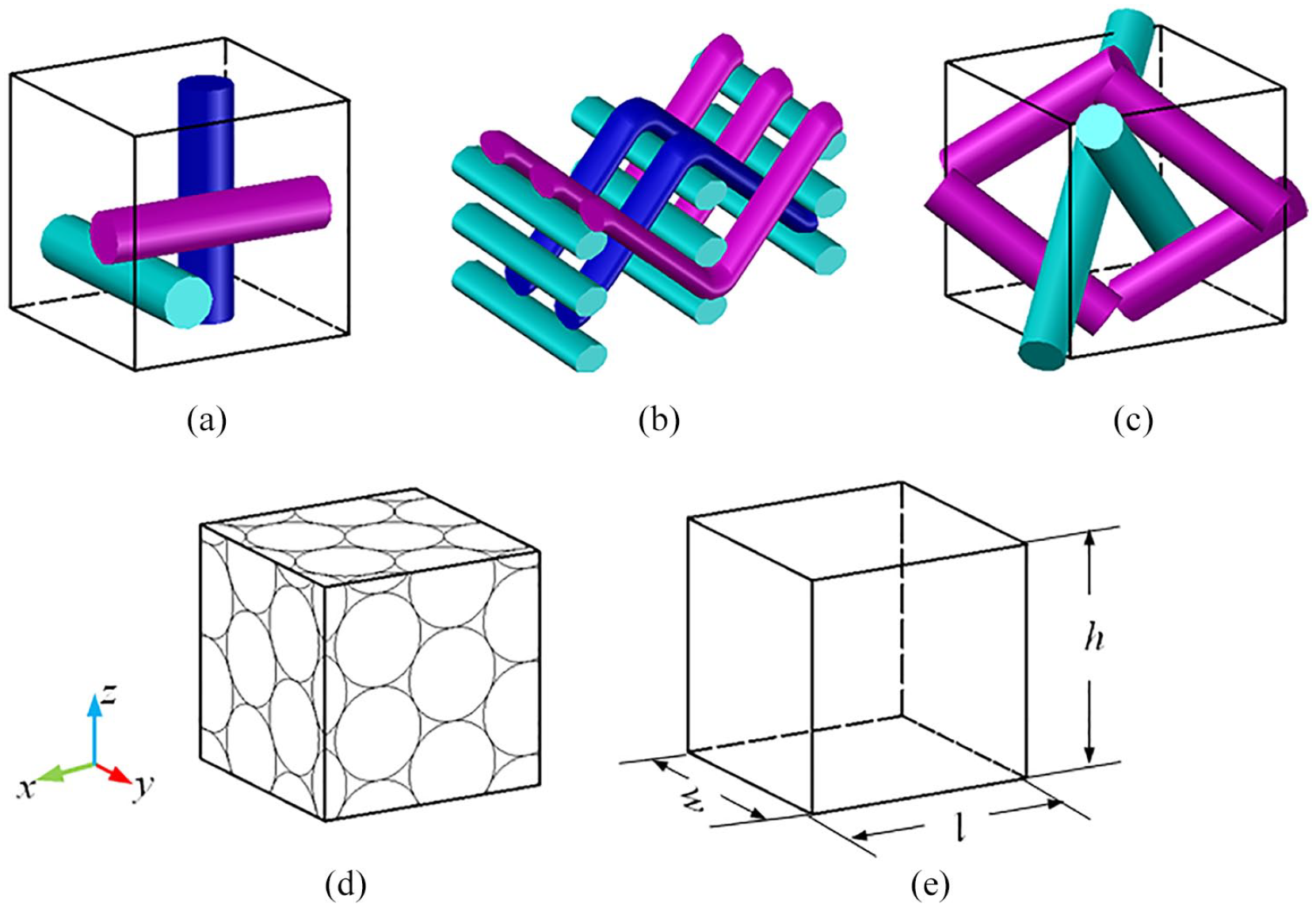
The representative geometric units: (a) the orthogonal geometric unit, (b) the curved geometric unit, (c) the skew geometric unit, (d) the uniform distributed unit, and (e) hexahedral unit.
The orthogonal geometric unit
The fiber tows in the orthogonal geometric unit are along the Cartesian coordinates. As shown in Figure 1(a), the fiber tows in the RGUs are supposed to be straight. In the internal RGUs of the 3D orthogonal woven fabrics, the directions of the fiber tows are mainly distributed in the three axis directions. The fiber tows could be divided into three groups according to the axes, and the angle between each two groups is 90°. The fiber tows along the z direction are perpendicular to the x-directional fiber tows in the xoz plane. Meanwhile, the z-directional fiber tows are perpendicular to the y-directional fiber tows in the yoz plane. There are no other types of fiber tows except these three groups.
The ablation-resistant and heat-resistant properties of composites are positively correlated with the fiber volume fraction of 3D textile fabrics. The cross-sectional shape of fiber tows in orthogonal geometric unit is complicated. To simplify the calculation and simulation process, as shown in Figure 2, the cross-sectional shapes of these three groups fiber tows are supposed to be rectangle. 28 Fiber volume fraction refers to the volume of reinforcing fiber tows per unit volume of composites. The fiber volume of the orthogonal unit can be calculated by formula (2)

where Sl, Sw, and Sh are the cross-sectional area of each group fiber tows separately; nl, nw, and nh are the numbers of each group fiber tows.

Schematic diagram of the orthogonal geometric unit.
Finally, the fiber volume fraction of the orthogonal geometric unit can be obtained by formula (3)

where
The curved geometric unit
The curved geometric unit mainly contains the curved fiber tows, and the proportion of fiber tows could be adjusted adaptively to suit the unit size. Figure 1(b) shows a kind of curved geometric unit, and the unit contains the curved fiber tows, including or excluding straight fiber tows. To analyze the properties of the curved fiber tows, the cross-sectional shape was supposed to be circular, 29 elliptical,30,31 runway, 32 polygon, 33 and convex lens. 34 No matter what the shape changes, the cross-sectional area remains unchanged. Deformation coefficient k is introduced to describe the change extent of cross section, namely, the aspect ratio. The value of deformation coefficient can be obtained by formula (4)

where a and b are the length and width of cross section separately.
In order to predict the fiber volume fraction of the curved geometric unit, the length of curved fiber tows must be calculated. The length of curved fiber tows in the unit is supposed to be three parts. Let l1 and l3 express the length of arc segments, and β is the central angle of l1 and l3. l2 expresses the length of line segments, α expresses the fiber direction, as shown in Figure 3. Many assumptions are established to analyze the meso-geometric structure of the curved fiber tows. The axis shape is regarded as regular shapes, such as arc, sinusoid, and irregular shapes.26,35,36 The volume of the curved fiber tows can be obtained by formula (5)

where Sc and nc are the cross-sectional area and number of curved fiber tows in unit.

The geometric parameters of curved fiber tows.
The type of fiber tows in the curved geometric unit must contain the curved fiber tows, and it may contain one or more group fiber tows in the orthogonal geometric unit. Then, the fiber volume in the curved geometric unit could be calculated according to formula (2). According to the aforementioned formulas, the fiber volume fraction of this type unit could be finally deduced. As shown in formula (6), it varies with the value of k and α

where
The skew geometric unit
The fiber tows in the skew geometric unit are assumed that the distributions are in a straight line and form a certain angle in 3D space. A kind of the skew geometric unit is shown in Figure 1(c), and the number of fiber tows is uncertain. The representation of single fiber tows in 3D space coordinate is illustrated in Figure 4, and the geometric parameters of the single fiber tows are explained. The directional angles of single fiber tows in the global coordinate system are set as α′ and β′. The local coordinate system is o′-123, the length direction of fiber tows is along 1-axis, and the transverse isotropic plane of fiber tows is the o′-23 plane. The angle between 1-axis and x-axis is β′, and α′ is the angle between the fiber tows projection on the yoz plane and y-axis. The length of the single fiber bundle is ls, which is a function with geometric parameters.
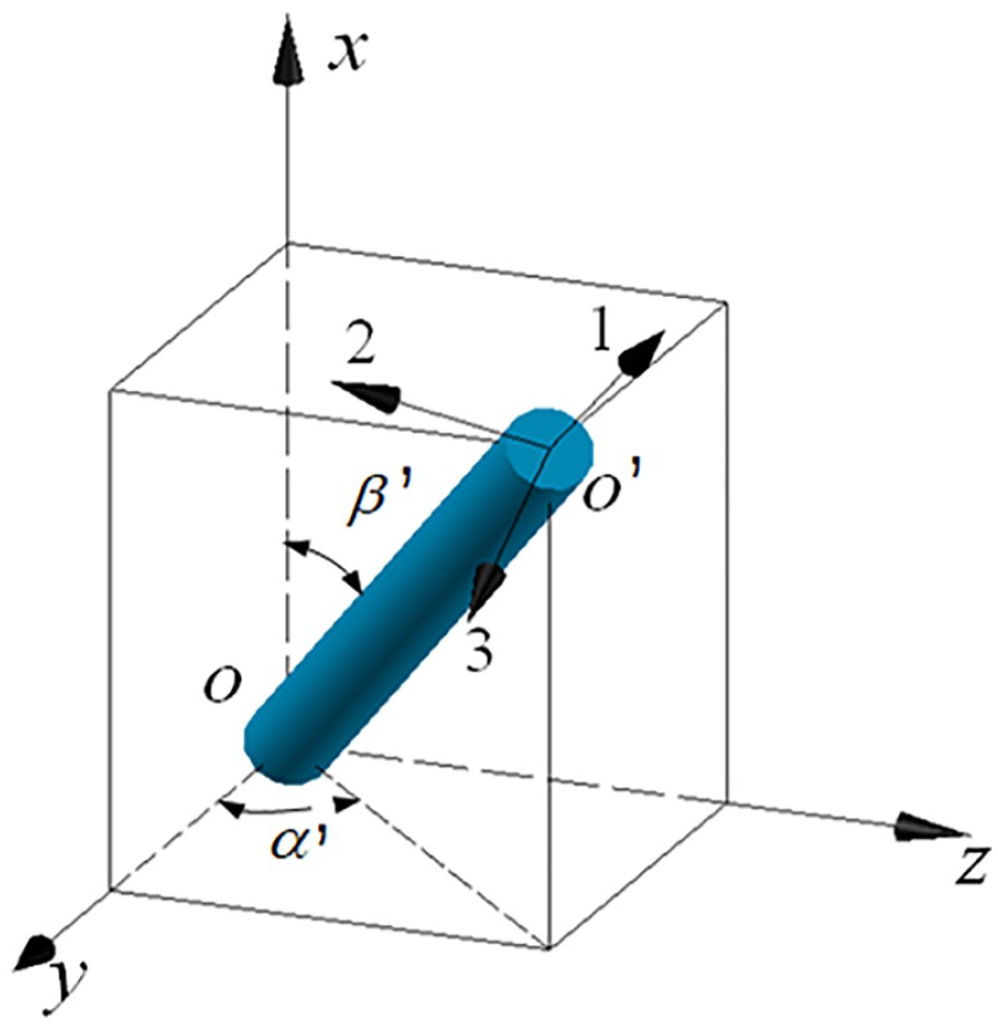
The single fiber tows in the global coordinate system.
For any fiber tows in 3D space, it could be assumed to be transversely isotropic composites. The length of single fiber tows could be deduced by the geometric parameters, as well as the other fiber tows in this unit. The unit could be regarded as the combination of single fiber tows. The cross-sectional shape of fiber tows is supposed to be different geometrical shapes, including circle, oval, triangle, rectangle, diamond, hexagon, and octagon. But the fiber volume fractions of 3D textile composites have no significant difference under the various shapes. The volume of fibers in the skew unit can be calculated by formula (7)

where Ss is the cross-sectional area of fiber tows; ns is the number of fiber tows.
According to the aforementioned formulas, the fiber volume and geometric parameters of the skew geometric unit could be predicted by formula (8). Its value depends on the directional angle of fiber tows

The uniform distributed unit
The fiber tows in the uniform distributed unit are assumed that the distributions are unordered in 3D space. As shown in Figure 1(d), the distribution of fiber tows in any direction is equal. The fiber volume fraction of the uniform distributed unit could be obtained by overall average. Its value relates to the process and parameters of whole composites.
The relationship of RGUs
The meso-structure and transformation of the fiber tows affect the performance of 3D textile fabrics, which in turn affect the properties of reinforced composites. According to the geometric properties of textile fiber tows, the relationship of these RGUs is discussed in this section. The connections of the possible units in 3D textile fabrics and these RGUs are discussed. The features of each unit are discussed.
The properties of fiber tows in fabrics are mainly characterized by the directions and curvatures of the textile fiber tows. As shown in Figure 5, two coordinate axes express the two properties of the fiber tows in fabrics. In the horizontal axis, the direction of the fiber tows is from unidirectional to multidirectional. The property of the fiber tows in the vertical axis is from low curvature to high curvature.

The connection of RGUs.
The orthogonal geometric unit is distributed in the quadrant of unidirectional fiber and low curvature. Obviously, the performance of fiber tows in the orthogonal geometric unit presents less orientation and low curvature. The fiber tows in the orthogonal geometric unit are perpendicular to each other, and “pin-and-column” consolidation can distribute the external force evenly and transmit it to the internal unit. The curved geometric unit possesses high flexibility owing to the curved fiber tows in the unit. Therefore, this type of unit could be distributed in the quadrant with multidirectional and high curvature. The length of warped segments could be changed by the external force, and the shape is response to the variation in line fiber tows. The unit could be difficult to recover when the external force removed, and the unit showed a “high flexible and high strain” feature. The skew geometric unit is arranged in the quadrant with multidirectional and low curvature. Straight fiber tows in the skew geometric unit bend under external pressure, and the external load transferred to diagonally distributed fiber tows in the unit. The interlacing point in the unit is easy to deform. The unit has low plasticity and high elasticity features. The uniform distributed unit shows the characterizations of high curvature and multidirectional. The characterization of this unit is isotropic elasticity and independent of direction.
In addition to these RGUs, the other unit types also existed in 3D textile fabrics. The other unit types can be regarded as the combinations or derivations of these units. The other units are composed of two or more aforementioned units. As shown in Figure 6, the final unit is obtained by the two types of RGUs. The other units in 3D textile fabrics can be regarded as the “genomic assemblies” of basic characteristics of these RGUs. The shape of cross section is multiple, and the same type fiber tows represent consistency. The fiber volume fraction affects the properties of 3D rectangular textile composites, and the value of assembled units can be predicted based on the aforementioned formulas.
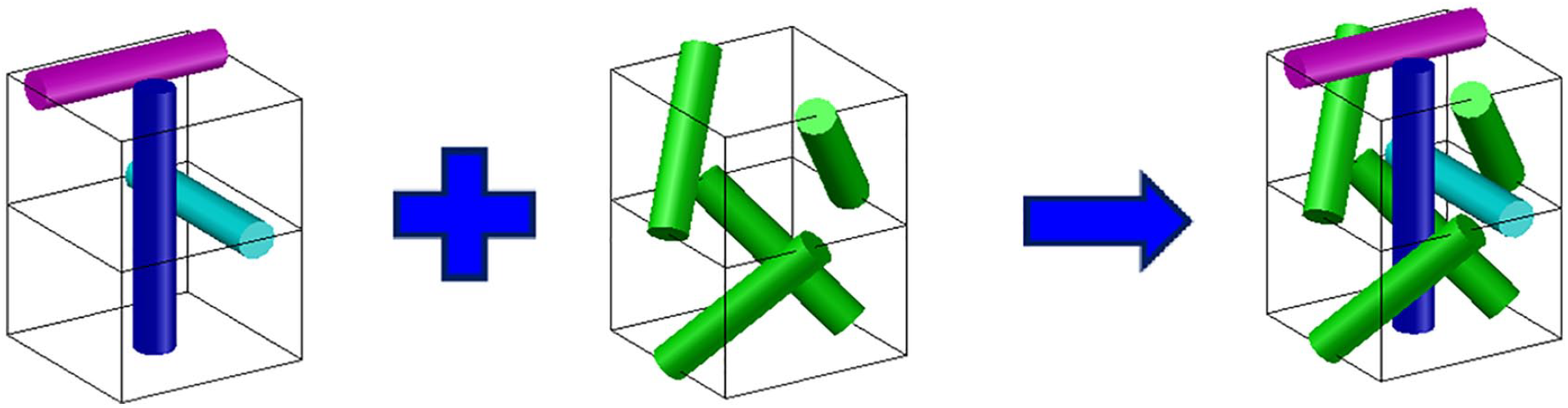
The genomic assemblies of RGUs.
3D textile fabrics
Four categories of structural fabrics are defined in this section. The structural fabrics corresponding to RGUs are discussed. The connection of the units and fabrics is studied. The representative fabrics are introduced to further explain the classification of 3D textile fabrics. The stiffness matrix or flexibility matrix of these structural fabrics is deduced, which laid the foundation for predicting and simulating the mechanical properties of the composites reinforced by these fabrics.
The relevance of RGUs and 3D textile fabrics
3D textile fabrics are composed of the relevant geometric units, as shown in Figure 7. According to the combination of RGUs, the fabrics finally decide the relevant mechanical properties. 3D textile fabrics can be divided into four main categories: the fabrics with stable structure, flexible structure, elastoplastic structure, and uniform structure. The representative structural fabrics, such as 3D orthogonal fabrics, angle-interlock fabrics, four-step braided fabrics, and nonwoven fabrics, are introduced to elaborate the classification method accurately. The properties of these fabrics are corresponding to the relevant units. The stable structural fabrics are constituted by orthogonal geometric unit, presenting the properties of high strength and low strain. The flexible structural fabrics show the “high flexible and high strain” features. The elastoplastic structural fabrics which compose of the skew units have low plasticity and high elasticity features.

The relevance of RGUs and fabrics.
The stiffness/flexibility matrix of fiber tows in fabrics
In order to predict the elastic properties of the relevant composites, the flexibility matrix or stiffness matrix of fiber tows in 3D rectangular textile fabrics need to be calculated. The elastic constants of 3D textile composites can be deduced based on the different mechanical analysis models.
1. Single fiber tows
The single fiber tows in 3D textile composites are supposed to be transversely isotropic materials. As shown in Figure 4, the global coordinate system o-xyz and the local coordinate system o′-123 are expressed. The o′-23 coordinate plane is isotropic and the 1-axis is perpendicular to the o′-23 coordinate plane. The stiffness matrix of single fiber tows in 3D space is [C]. The Hamiltonian stress transformation matrix [A] is introduced to realize the transfer of the stiffness or flexibility matrix of the fiber tows from the local coordinate system to the global coordinate system.
36
The stiffness matrix

2. The stable structure
In orthogonal geometric unit, the three groups of fiber tows are straight, and the stiffness matrixes are illustrated in formula (10)
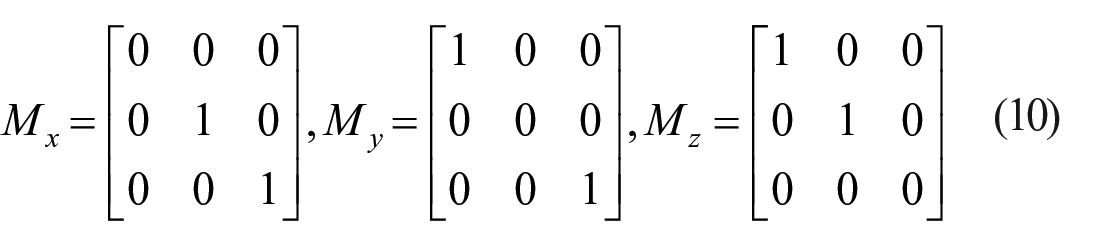
The stable structural fabrics are mainly formed by the orthogonal geometric units. As the representation of these fabrics, 3D orthogonal fabrics are linearly arranged. The symmetry structure and straight fiber tows of the fabrics lead to the excellent mechanical properties of the composites. The angles between the coordinates can be obtained obviously. The orientation angles of the fiber tows along the x-axis are

where Vl, Vw, and Vh are the fiber volume fractions of each group fiber tow.
3. The flexible structure
The flexible structural fabrics are mainly constituted by curved geometric units. The flexibility matrix of fiber tows in these fabrics can be deduced using the average method. The average flexibility matrix of curved fiber tows can be calculated based on the volume average of arc and line segments. The flexibility matrix of line segments [S] l can be obtained by formula (12)

where
The average flexibility matrix of arc segments [S] a can be calculated by formula (13)

where
The average flexibility matrix of curved fiber tows can be deduced by formula (14)

where Vl and Va are the proportion of line segments and arc segments.
The stiffness matrix can be obtained by formula (15)

The flexible structural fabrics combine with or without the straight fibers. The proportion of curved and the straight fiber tows are Vp and Vq separately. The global stiffness matrix of fiber tows in flexible structural fabrics can finally be obtained by formula (16)

4. The elastoplastic structure
The elastoplastic structural fabrics are composed of skew geometric units. The fiber tows form the points of intersection, and the distribution of the points response the elastic–plastic property. The distribution of the structural fabrics presents certain regularity, and the number of fiber tows in the unit can be increased or decreased. Formula (17) can calculate the stiffness matrix of the fiber tows in the elastoplastic structure

where
5. The uniform structure
The mechanical properties of this unit are assumed to be isotropy. Based on the volume average of matrix and fiber materials, the stiffness matrix or flexibility matrix of the uniform distributed unit could be derived. There are only two independent elastic constants.
The relationship of 3D textile fabrics
The mechanical properties of 3D textile composites are mainly decided by the geometric structure of the fabrics. There is a certain relationship among these structural fabrics, as shown in Figure 8. The fabric in the initial statement is the flexible structure, and the curved fiber tows in the fabrics have the larger curvature. With the increase in force, the curved fiber tows gradually straighten up to the straight fiber tows in the elastoplastic structure. Finally, the fabrics are turned to the stable structure.

The relationship of 3D textile fabrics.
Application
The traditional 3DAW fabrics cannot maintain the original state due to the yarns lateral sliding and second deformation. The initial modulus of 3DAW fabrics is small and cannot conform to the designed value. In order to optimize the properties of fabrics, a stable structure of 3DAW fabrics is proposed based on the aforementioned theoretical analysis.
The RGU of traditional 3DAW fabrics is shown in Figure 9(a), and the unit has high curvature and high porosity. The dimensions of this unit can be easy to change under the external force. It exhibits extremely “high flexibility.” In order to obtain the stable fabrics of the traditional 3DAW fabrics, the stable unit is deduced as shown in Figure 9(a). The curvature and directional angle of fiber tows in the stable unit have been optimized to enhance strength and decrease strain.

The RGU in 3DAW fabrics: (a) the traditional structural unit and (b) the stable unit.
Based on the deduced unit, the stable structural fabrics can be obtained with the feasible process. As shown in Figure 10, the traditional 3DAW fabrics have the high curvature and high porosity, and the stable structure of 3DAW fabrics can be deduced based on the traditional ones.

The comparison of 3DAW fabrics: (a) the traditional structure and (b) the stable structure.
Structural stability of 3DAW plate-preform is superior to traditional woven plate-preform. Both the preforms are obtained by woven processing. Test sample fiber tow is quartz, and the matrix is epoxy resin BP-251. The characteristic parameter of the warp fiber bundle is 190Tex×4, which is arranged for 35 layers; the laminated fiber tow is 190Tex×7, which is arranged for 36 layers. The parameters of both widths are 450 mm. The number of preform pitch is all the same. The results are described as follows:
The size of traditional 3DAW plate-preform is 450 × 450 × 30 mm3 and its pitch is 3.75 mm. While the size of the stable 3DAW plate-preform is 513 × 450 × 27.9 mm3 and its pitch is 4.28 mm.
The fiber volume fractions of two kinds of preforms are measured using the Quick Weighing method: the traditional 3DAW plate-preform is 47.25%, while the stable preform is 47.50%.
The intersection angle of RGU adjacent side in the traditional 3DAW plate-preform is approximately 90° and its connection to the center of laminated fiber tows is out of line. The intersection angle of RGU adjacent side in the stable 3DAW plate-preform is 37.5° steadily, and its woven yarns are arranged regularly (shown in Figure 11).

3D woven plate-preform of the stable structure.
The results show that the fiber volume fraction of 3DAW plate-preform is bigger than the traditional ones. The intersection angles of fiber tows in 3DAW plate-preform are small. These properties will keep the structure and properties of the composites stably in the process of permeating matrix.
Conclusion
The classifications of 3D textile fabrics are reviewed in this article, but the various methods are difficult to systematize and develop the high-performance composites. A new method to classify the fabrics is proposed, and four RGUs have been identified. The geometric structures and properties of these units are discussed, respectively. The relationship of these RGUs has been studied based on the properties of fiber tows. In this article, the relevance of the RGUs and 3D textile fabrics is analyzed. The definition of fabrics with stable structure, flexible structure, elastoplastic structure and uniform structure has been identified. The geometric structures of the aforementioned fabrics have been discussed, and the stiffness or flexibility matrix of the RGUs is predicted. The stable 3DAW fabrics are obtained based on the theory analysis. The geometric structure and parameters of the fabrics are compared with the traditional 3DAW fabrics.
The structural characteristics of other 3D textile fabrics could be regarded as the assembly of these RGUs. The future research direction is aimed to obtain the new structural textile fabrics to satisfy the demand in engineering, and the related properties will be studied with the topological methods. Applied research on basic features of new preforms will be carried out. The influence of basic characteristics of RGUs on the properties of composite process will be studied. The relationship between the basic characteristics of RGUs and the mechanical properties of materials will be further discussed. 3D woven fabrics without z-directional fiber tows, such as 3D plain, 3D strain, and 3D twill-type preform architectures, will be classified, and it might be the extension of the proposed four types.
Footnotes
Declaration of conflicting interests
The author(s) declared no potential conflicts of interest with respect to the research, authorship, and/or publication of this article.
Funding
The author(s) received no financial support for the research, authorship, and/or publication of this article.
