




Abstract
The three-dimensional textile composites have excellent advantages of impact resistance, owing to their more integral microstructure and higher interlaminar shear strength than those of laminated composites. The composites are frequently used under impact loading in the practical application. Researches on the impact behaviors can help in the development and optimization of design for textile structural composites. In this review, the development and features of three types of textile structures, including weaving, knitting, and braiding have been introduced respectively, and the current and future potential applications of these kinds of textile structural composites have been described. The impact tension behaviors and the damage mechanisms of textile structural composites have been introduced. The finite element analysis and frequency domain analysis which to reveal the tensile damage mechanisms of textile structural composites under high strain rates also have been investigated. Furthermore, the future development of impact tension behaviors of textile structural composites is also introduced in this review.
Introduction
Textile structural composite is a kind of composite whose reinforcement is textile fabric (includes two-dimensional and three-dimensional) and matrix is resin. Comparing with the conventional materials such as steel and wood, textile structural composite has some excellent features, for example, high specific strength, light weight, high specific stiffness, good fatigue resistance, excellent anisotropy, and more excellent material structure designability, especially the three-dimensional textile structural composite has much outstanding interlaminar strength, shear strength, high damage tolerance resistance, and great energy absorption property under impact loading. This kind of composite is easier to be processed and takes less time to be manufactured. Textile structural composite can be widely used in the aircraft, high-speed vehicle, and ballistic protection materials due to its light weight and high strength properties. Because the three-dimensional textile structure composite has whole reinforcement structure and the fiber bundles through the thickness, this kind of composite has extremely high fracture toughness, delamination resistance, and damage tolerance. The reinforcement can be net-shape manufactured; therefore, the textile structural composite can be employed to manufacture the special-shaped structures of special parts with one-step molding technology. This method can avoid the structure defects in the usage of conventional joint materials. Furthermore, because the fabrics have various types and are easy to be utilized to manufacture the complex shape structures, the textile structural composites have excellent advantages to make the complex shape structures compared with other kinds of composites. As a result, the multifarious variety of microstructure can be designed to optimize the impact resistance property of textile structural composite.
Three-dimensional textile structural composite has been widely used in the aerospace, astronautics, protection and vehicle manufacture, etc. The composite often suffers impact loading in the practical application. The stress wave that is produced in the impact processing transmits in the composite material at the speed of
Advance and advantages of textile structural fabrics and composites
Two-dimensional textile structural composite
Composite has a long history in the human’s life. Thomas Hancock operated the flax, hemp, cotton, and wool as the reinforcement to manufacture the composites in the 19th century. From 1920s, Boeing Company operated the textile structures to reinforce the wings of plane, and GE Company also employed textile structures to make the nose cone shape C/C composites [1]. Figure 1 is the two-dimensional woven, knit and braid structures.
The two-dimensional (a) woven, (b) knit, and (c) braid structures.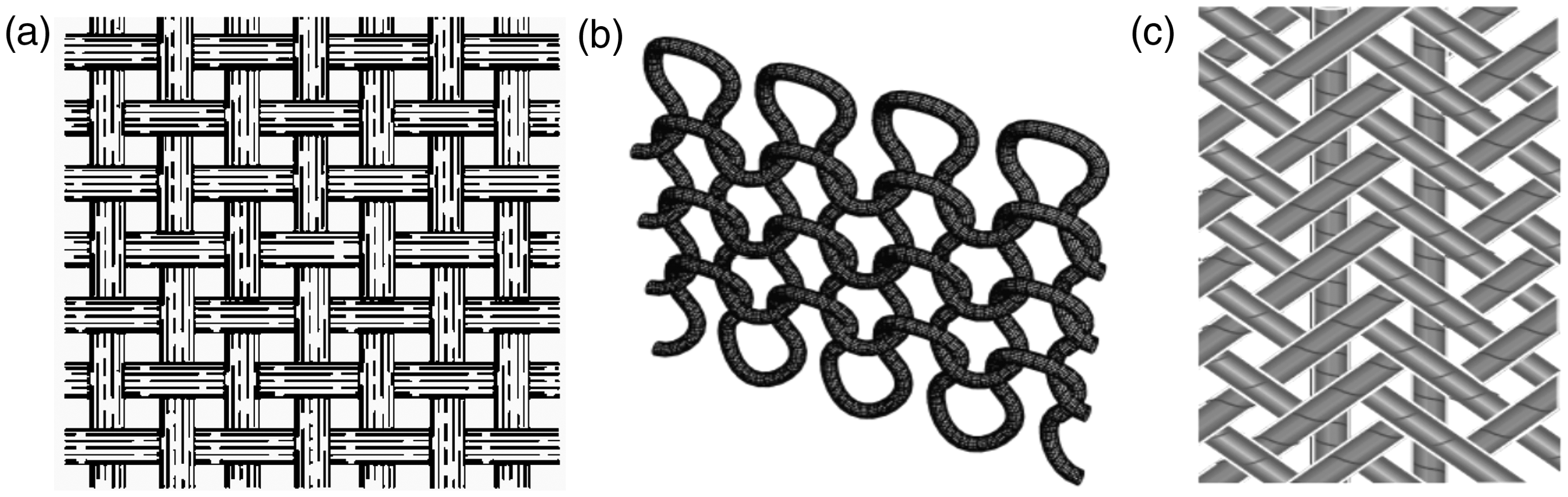
Production of plain weave fabric was the largest in all kinds of fabrics that it accounted for 70% of all two-dimensional fabrics in 1989 [2]. Plain weave fabric has a simple structure and it is the most stable in all orthogonal woven fabrics. Plain weave fabric has served as the reinforcement to manufacture laminar composites for a long time. However, only the warp yarns and weft yarns can sustain the loading for the two-dimensional woven fabric, therefore, the impact resistance and shear resistance of plain weave fabric are rather poor [2]. The tensile property of twill weave is poorer than that of plain weave. However, the satin weave fabric has better mechanical property than plain and twill weave fabric when being served as the reinforcement of composites [3].
To improve the mechanical property of weave fabric which serves as the reinforcement of composite, biaxial weave fabric and multiaxial weave fabric are invented. Curiskis et al. [4] applied the first patent about biaxial weave fabric manufacturing method. However, the structure of biaxial weave fabric is loose and its anisotropy and in-plane shear resistance is rather poor. Then the triaxial weave fabric was invented, which weaved by three groups of fiber bundles with 60° [5]. The triaxial weave fabric is quasi-isotropic and has higher in-plane shear stiffness and better integrity.
In order to improve the impact resistance and shear resistance properties of weave fabric-reinforced composite, Mohamed [6] overlapped the plain weave fabric with various orientation angles to manufacture the laminar composite. This composite has better mechanical property; however, the two-dimensional laminar structure is overlapped by manual work, which is labor-intensive and high cost. Fabric prepreg which is used to make the laminar composite needs refrigerated preservation. It is high-cost and long-term produced. Furthermore, it is difficult to design the complex shape parts with the laminar composite. Therefore, the two-dimensional laminar composite is limited seriously to be applied in practice. At the same time, the impact-resistance and in-plane shear resistance properties are not very good, and the poor mechanical property through thickness also restricts the development of two-dimensional fabric laminar composite.
In 1960s, two-dimensional braided structure textile was employed as the reinforcement of composite with the development of winding technology. At the same time, braided structure is also the first three-dimensional textile structure reinforcement. With the development of composite, two-dimensional braiding technology also improved quickly, and braided structure is very good at manufacturing the complex shape composite [4].
Two-dimensional knitted structures have been served as the reinforcements of composites since 1990s [7–9]. Their loop structures can make large deformation under loading; therefore, they can be easily used to manufacture the complex shape parts which have excellent strength and mechanical properties. The current industrial knitted machine can manufacture the high-performance jersey fabric and mesh fabric. Knitted structures are used frequently as the reinforcement of composite because of their net-shape/quasi net-shape and extremely complex structure [10]. The mechanical property of knitted fabric is influenced by the various knitted structures. The strength and stiffness of knitted structural composite are better than fiber layer-reinforced composite, but poorer than weaving structural and braided structural composites. However, knitted structural composite has the best isotropy and excellent delamination resistance stiffness which is five times than the weaving structural composite. Since it has outstanding properties, knitted structural composite has been employed in the medical domain such as artificial joint [11].
Leong et al. [8] prepared the glass fiber/resin weft-knitted structural composite. The results indicated that weft-knitted structural composite had poorer tension and compression properties, but it had better energy absorption property. Khondker et al. [12] observed the impact behaviors of glass fiber/epoxy resin weft-knitted structural composite. They found that the types and parameters of knitted yarns had obvious influence on the impact property of composite, and the knitted structural composite with higher stitch density had better impact resistance property. Falconnet et al. [13] indicated that knitted structural composite had extreme interlaminar fracture toughness, and complex knitted structural composite had higher release rate of critical strain energy.
Three-dimensional woven structural composite
Three-dimensional woven structural composites have been studied from 1960s [7]. However, the research has been developed quickly from 1980s, because scientists found that laminar composites were difficult to manufacture aircraft structures with complex shapes, and the impact resistance of laminar composites was rather poor [7]. These defects of laminar composites forced researchers to find better textile structures which have many advantages. Therefore, three-dimensional weaving structural composites have been developed quickly during the past decades.
Firstly, three-dimensional weaving structural composites can compose the integral component with complex geometrical shape. The materials consumption, materials joints, and the production cost can be reduced. However, the two-dimensional prepreg lamina can only be used to manufacture plane or plane with small curvature. Furthermore, current two-dimensional weaving machine can produce the three-dimensional woven fabric after simple modification; the lower production cost also promotes the three-dimensional weave fabric to operate widely.
Secondly, change in the types of connection yarns through thickness can produce different structure three-dimensional woven fabric. The most popular kinds are three-dimensional orthogonal woven fabric and three-dimensional angle-interlock woven fabric (3DAWF), which have different connection forms through thickness. Three-dimensional woven fabric can be produced by some functional fibers, such as carbon fiber, glass fiber, and basalt fiber. Various kinds and fineness of fibers can be chosen as the warp yarns, weft yarns, and connection yarns to produce three-dimensional woven fabric with different properties.
Because of the fixed action of connection yarns through thickness, the interlamination damage processing can be retarded. Therefore, three-dimensional woven composites have higher impact resistance [14] and higher damage tolerance under low velocity impact [7]. These are the great advantages which precede the two-dimensional fabric structural composites. Chou et al. [15] found that the impact energy absorption can be improved 60% due to the implementing of three-dimensional carbon fiber woven structural composite. Figure 2 shows the two kinds of woven structures.
Two kinds of woven structures: (a) three-dimensional orthogonality weave fabric, (b) three-dimensional interlock angle weave.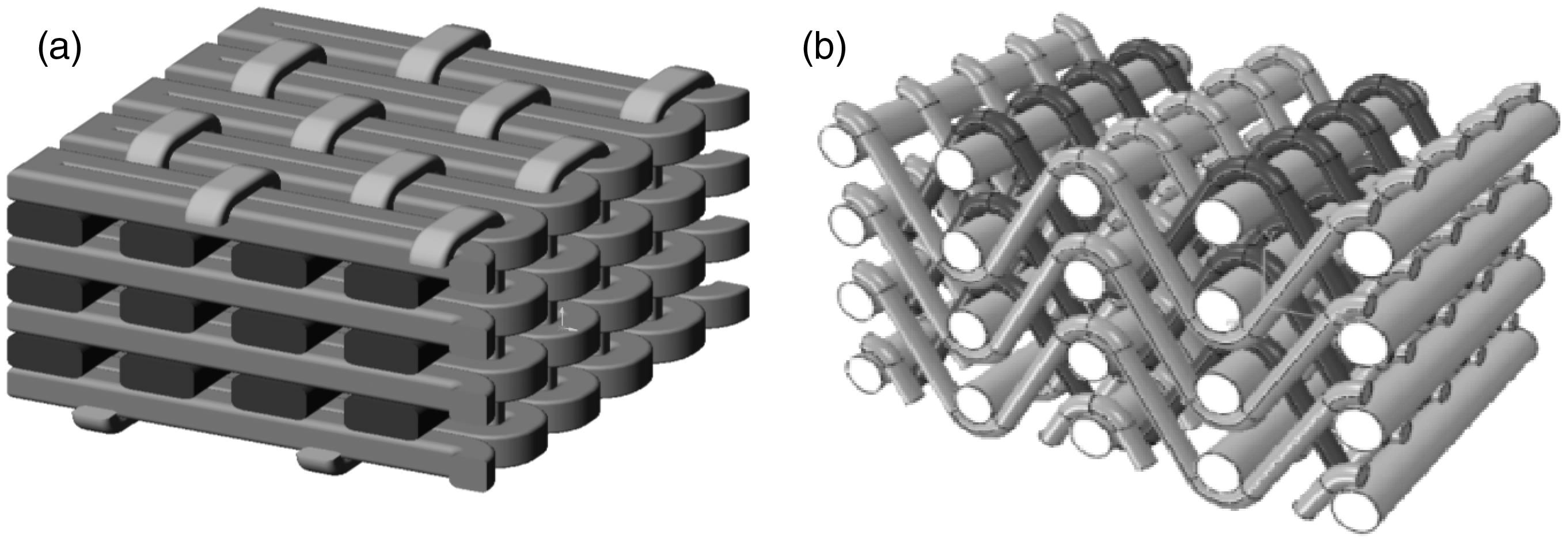
Three-dimensional weave structural composites have greater advantages than two-dimensional composites; however, the in-plane yarns (weft or warp yarns) are arranged only along 0o and 90o directions in three-dimensional structure. Therefore, the anisotropy, shear resistance, and torsion resistance of woven fabrics are poor. Their defects are the serious limit to the applications of three-dimensional weave structural composites. Wong [16] found that three-dimensional weave structural connection by sandwich honeycomb plate can reduce the stress concentration of joint heads.
The other reason of limiting the application of three-dimensional woven structural composites is that the in-plane properties and failure mechanism are still not clear. Various kinds of fibers can be employed to produce different structural composites; however, only the compression and tension properties of three-dimensional orthogonal woven structural composite and three-dimensional angle-interlock woven structural composite produced by glass fibers and carbon fibers are studied until now. Research on other kinds of fiber-reinforced woven structural composites is not reported. The lack of research data limits the development of three-dimensional woven structural composites. At the same time, three-dimensional woven structural composites in equal fiber volume content with two-dimensional woven structural composites express poorer in-plane mechanical property. The stiffness of three-dimensional woven structural composites is similar with laminar, because the crimp of connection yarns through thickness, tension, and compression strength is 15–20% lower than laminar [7].
The mechanical property of three-dimensional woven structural composites is not so excellent, but this kind of composite has much higher energy absorption than two-dimensional woven fabric composites.
Three-dimensional braided structural composites
Three-dimensional braided structure is the first textile structure employed to reinforce the three-dimensional textile structural composites and is also the most popular textile structure which has been studied. In the end of 1960s, the three-dimensional C/C braided composite was invented to replace the high temperature metal alloy on rocket engine, which lightened the rocket engine weight by 30–50% [17]. Ko [18] invented the whole manufacture process of three-dimensional braided composite in 1987. Popper [19] presented the two-step method to make the three-dimensional textile structure in 1987. Li et al. created the four-step [20] and six-step [21] method to manufacture the three-dimensional textile structure in 1988. Kostar and Chou [22] presented the several-step method to braid the three-dimensional textile structure. Brookstein [23] developed the three-dimensional interlock braided structure. Three-dimensional braided structures have excellent formability, moldability, torsion stability, and structure stability. They can be manufactured into any complex geometrical shape parts, where many mechanical processing and joint can be left out. At the same time, three-dimensional braided composites have rather high delamination resistance and impact damage tolerance [24–28]. Three-dimensional braided composites were developed quickly during recent decades because their manufacture process and mechanical properties are much better than two-dimensional laminar composites. However, the measurement of three-dimensional braided composites is limited by the braiding machine. The large-scale braiding machine has still not been widely used until now and only few three-dimensional braiding machines can be produced commercially, therefore, the production cost of three-dimensional braided composites is still high [29].
Verpoest et al. [30,31] developed three-dimensional sandwich braided fabric to reinforce the composite in 1990s. Epstein [32] created the whole forming reinforcement, which could produce the quasi mesh shape reinforcement. Li et al. developed a series of three-dimensional braided structures such as three-dimensional square structure [33] and three-dimensional five directions structure [34] after 2000. Crane and Camponeschi [35] found that the tension and compression properties of three-dimensional braided composites were lower, because most of fiber bundles were curve and they were not along the forced direction. They also found that the braiding angle and fiber bundles size in three-dimensional composites had obvious influence on the Young’s modulus and strength of composites. Figure 3 shows several kinds of three-dimensional braided structures.
Some kinds of three-dimensional braid structures: (a) three-dimensional four-direction, (b) three-dimensional five-direction and (c) three-dimensional six-direction.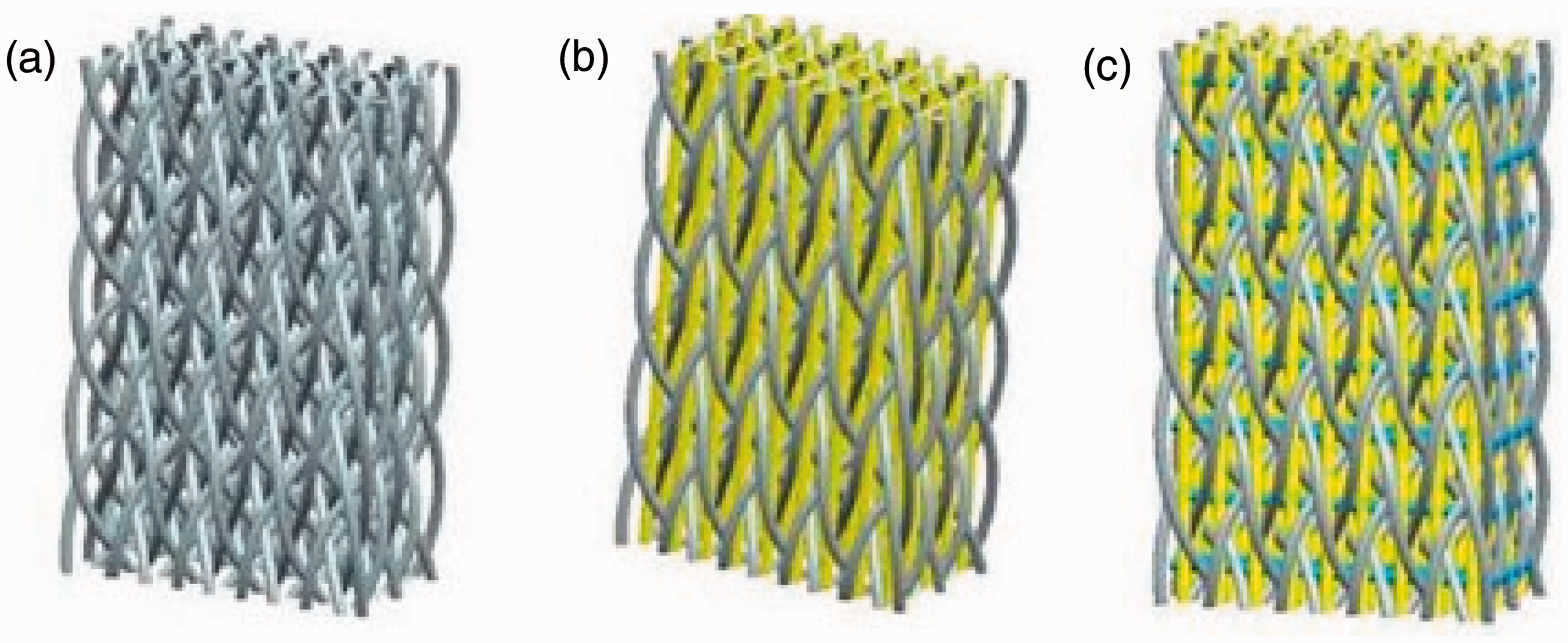
Three-dimensional knitted structural composites
Two-dimensional knitted fabrics have large flexibility along any directions, their entirely deformability is high, but the stiffness and strength are rather poor. Furthermore, yarns are also easily damaged during the knitting process, which decreases the mechanical properties of knitted structural composites. To improve their mechanical property, the reinforced fibers and yarns were inserted into the two-dimensional knitted fabric to manufacture the three-dimensional knitted fabric. Figure 4 shows some kinds of knitting structures.
Some kinds of knit structures: (a) biaxial warp-knitted structure, (b) multiaxial warp-knitted structure, (c) multiaxial weft-knitted structure and (d) warp-knitted space structure.
Verpoest et al. [36] developed the three-dimensional knitted sandwich structure to serve as the reinforcement of composites in 1990s. Two surface layers are connected with stem integrally in this structure. The tear between surface layers and stem also could be reduced. Knitted sandwich structure fabric was produced by two-needle bed Rachel warp-knitted machine. Each needle knitted the two surface layers at the same time. The two-needle bed can produce surface layers with various structures and properties according to special requirements.
Verpoest et al. [36] and Philips and Van Raemdonck [37] found that knitted sandwich structure composites had higher energy absorption ability; however, their compression property and stiffness were lower. Epstein and Nurmi [38] produced the three-dimensional near-net-shape knitted structure by adding needle on the knitted flat machine and controlling needle selection and motion. Robinson [39], King et al. [40], and Sheffer [41] operated this technology and produced T-shape joint and cone and so on.
Multilayer multiaxial knitted structures are used most widely during all kind of three-dimensional knitted structures. Reinforced yarns are inserted into the loop along schedule directions in this structure. In multilayer multiaxial knitted structures, fibers and yarns are arranged straightly; therefore, the strength and stiffness of fibers can be shown completely. At the same time, the structural fabric can be reinforced along multidirection and knitted by any kinds of yarns. This fabric has better design and mixed knitting, and many kinds of fiber materials can be chosen to manufacture this kind of fabric and the property of fiber materials can be shown completely. This structure also has better shear resistance and tear resistance property. Multilayer multiaxial knitted structures consist of warp-knitted structure and weft-knitted structure. Multilayer multiaxial warp-knitted (MMWK) fabric has more excellent dimensional stability and smaller extensibility [42,43].
MMWK fabrics have been developed from 1970s. They are widely used in many areas for their excellent properties. MMWK fabrics are formed by more than one layers of parallel no-crimp yarns along various directions and then knitted by the loops. The yarn layers or fiber layers can be parallel or interlaced. These knitted processing can be achieved in the warp-knitted machine with weft insertion devices, which include bias weft insertion and vertical weft insertion. Because all of yarns are straight, the mechanical properties of yarns can be utilized as much as possible. Therefore, they can suffer much more loading than other structural textiles such as weaving. MMWK fabrics have features as following, firstly, the orientations of layers can be changed; secondly, there are eight layers in maximum according to the mechanical property requirements; thirdly, the production efficiency is rather high and production cost is low; lastly, they are excellent in mechanical properties such as higher tensional strength and elasticity modulus.
Du and Ko [44], Hu et al. [45], and Jiang and Ko [46] analyzed the tension, bend, and other mechanical properties of MMWK fabric. The results showed that inserted yarns in the structure fabric had obvious influences on the mechanical property of fabric. Dexter and Hasko [47] found that impact compression strength ratio of multilayer multiaxial knitted composites could be improved by 80% than laminar composites. Kang and Kim [48] compared the impact energy absorption and impact damage tolerance between MMWK composites and woven laminar composites. The results indicated that MMWK composites had smaller delamination area and higher delamination energy than laminar composites. Compared with laminar composites, multilayer multiaxial knitted composites had higher tension [49,50] and compression strength, higher strain damage resistance [51], higher fracture toughness [43], and impact resistance [52]. Sun et al. [53] discussed the impact compression property of MMWK composites. The results indicated that these composites had obvious strain rates effect, and composites were shear failure under high strain rates and compression deformation under quasi-static compression. Liu et al. [54] studied the transverse impact of three-dimensional bias-axial spacer weft-knitted composites under various speeds. They found that the composites could absorb more impact energy under higher impact velocities. Ye et al. [55] researched the cushion property of three-dimensional spacer warp-knitted composites. The results indicated that the composites had excellent elastic resilient property. Pandita et al. [56] observed the impact tension behaviors of multilayer weft-knitted composites and they found that composites only had bend failure due to the entire performance of knitted structure. Peled et al. [57] analyzed the adhesion property between fabric and matrix of various warp-knitted composites under tension. The results indicated that the adhesion property of composites includes large loop structures that were much better than others. Liu et al. [58] tested the impact compression property of bias-axial weft-knitted composites; they found that the compression strength and failure strength had obvious strain rates effects.
Compared with other textile structures, three-dimensional knitted structure has lower production cost and higher production efficiency [59]. Besides, these structural composites also have extremely high impact resistance and damage tolerance properties [59,60]. Therefore, three-dimensional knitted structure composites play a leading role in the manufacturing of wind energy devices, aircraft, and vehicle [61,62].
Advances in the impact tension properties of textile structural fabrics and composites
Impact tension research significance of textile structural composites
Textile structural composites have been used increasingly in aeronautics, astronautics, protection and vehicle, and other areas. They often suffer from high-speed impact loading such as impact tension and impact compression during the practical applications [63]. Reports show that the mechanical properties of textile structural composites under impact loading and quasi-static loading are quite different [64]. When textile structural composites are suffering from static or quasi-static loading, stress has enough time to transfer and tend to balance static in the matrix and fibers because of the velocity of loading transmission. However, when textile structural composites are suffering from impact loading which means the loading time is extremely short, and the size of loaded parts along loading direction is large enough, stress wave effect will be noticed obviously in the transmission process of stress wave. The transmission velocities of stress wave are different in the reinforcement with various structures, components, and sizes. Therefore, stress distributions are unbalanced in the composites during a short time. The composites can be damaged, which is hard to predict. Because textile structural composites are anisotropic, the tension modulus and compression modulus, tension strength and compression strength along one direction are also different. The mechanical property analyses of textile structural composites are rather difficult. It is known that the isotropy materials such as metal can absorb energy with elastic and plastic deformation under impact loading. However, the plastic deformation property of textile structural composites is rather poor. They can only deform and fail with the decrease of material strength and stiffness due to the large area cracks. Their failure models include fiber breakage, fiber pullout, matrix crack, shear between fibers and matrix, etc. Multiple failure models can be happened at the same time during the impact loading process, and their damage mechanism is rather complex. Furthermore, because the structures of textile structural composites are complex and their components and manufacture technology are also rather various, the dynamic mechanical properties such as modulus and strength material parameters are difficult to analyze under different strain rates. It is very helpful to design the impact resistance composites under the investigation of the mechanical property of textile structural composites under impact loading.
Advantages on the impact tension equipments
Impact tension property of materials attracts more researchers’ attentions. The equipments are also being developed and improved. When textile structural composites are loaded under quasi-static, stress has enough time to distribute in the fibers and matrix because transmission velocity of loading is lower. However, it is rather different when textile structural composites are suffering from loading. Stress wave cannot be distributed completely due to the high transmission velocity of loading in the material. At the same time, the physical properties of fibers and matrix are different. Therefore, the mechanical property of textile structural composites should be studied with stress wave.
The development of Hopkinson bars.
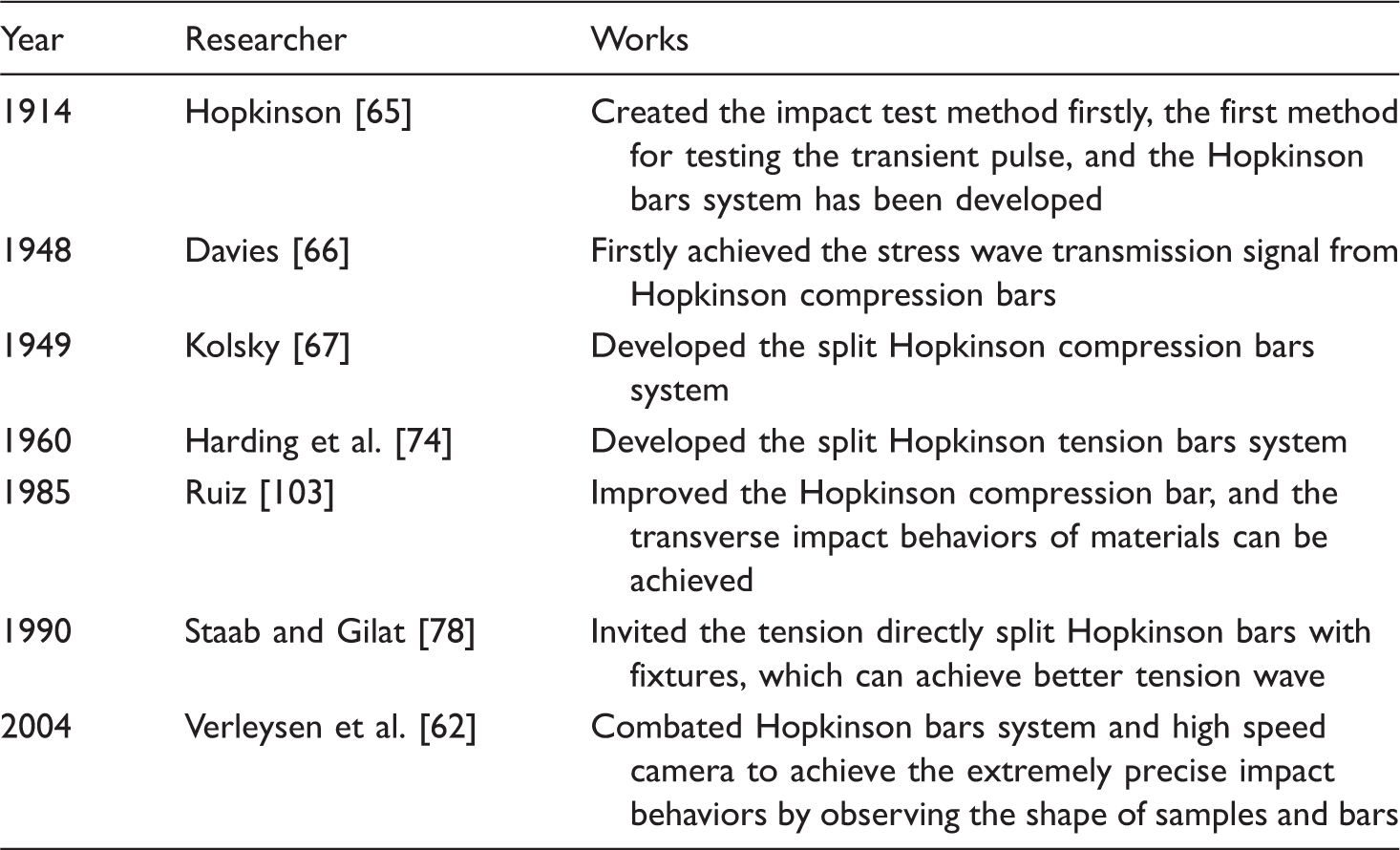
The Hopkinson bars have been implemented to investigate the dynamic mechanical property of textile structural composites such as compression, tension, shear, and torsion.
Advance on the impact tension of textile structural composites
Hopkinson compression bars are mainly employed to test the impact compression property of materials, while the impact tension tests are very few. There are two reasons: firstly, the main research objects such as metal and its alloy which have symmetrical tension and compression property, the impact tension property can be investigated by the impact compression property. Secondly, the impact tension tests still have the technical difficulties. However, the impact tension property is very important to research due to the wide applications of composites with anisotropy and different tension and compression property. Impact tension is one of the important mechanical properties of composites. Research on the impact tension property of composites under various strain rates can contribute to the engineering design and practical applications of composites. The impact tension behaviors of textile structural composites have been investigated systematically by researchers with the advanced experimental equipments.
Lifshitz and Rotem [69] analyzed the strain rates effect of glass fiber/epoxy resin composite. They found that tensile strength of composite could increase by three times, and modulus could improve by 50% under high strain rates. Davies and Magee [70] studied the tension impact property of glass fiber/polyester resin composite at strain rates between 0.001 and 1000 per second. The results showed that composite was strain rates sensitive and tension strength could increase by 55% under high strain rates. Daniel [71] investigated dynamic property of boron fibers/epoxy composite, glass fibers/epoxy composite, graphite fibers/epoxy composite, and Kevlar fibers/epoxy composite under high strain rates. They found that tension modulus and tension strength of Kevlar composite increased by 20% when strain rates increase from 0.0001 to 27 per second, but other fiber composites do not have strain rates sensibility. Daniel et al. [72] and Chamis and Smith [73] tested the mechanical property of graphite fibers/epoxy composites under strain rates of 100–500 and 0.001–381 per second, respectively. The results indicated that graphite fibers/epoxy composites were not strain rates sensitive. Harding [74,75] tested the impact tension behaviors of carbon fiber composite under strain rates between 0.001 and 1000 per second in 1982, and under strain rates between 30 and 400 per second, respectively, in 1983. Peterson et al. [76] found that the elasticity modulus and strength of glass fiber/polyethylene maleic anhydride composite could improve by 50–70% when strain rates increase from 0.001 to 10 per second. Chocron Benloulo et al. [77] investigated the impact tension property of aramid and polyethylene woven fabric-reinforced composite from experimental and finite element analyses in 1995. The stress–strain curves had obvious strain rates effect. Staab and Gilat [78] researched dynamic mechanical property of glass fiber/epoxy composite under high strain rates in 1995. They found stress and strain both could increase obviously, however, glass fibers had better strain rates effect and the strain rates effect of composite was influenced by glass fibers. Powers et al. [79] found that modulus of carbon fiber/epoxy composite could increase by 20% under higher strain rates, but strength and strain had no obvious changes, which indicated that carbon fibers were not strain rates sensitive. Barre et al. [80] investigated the impact tension behaviors of glass fiber/phenolic aldehyde composite and glass fiber/polyester composite in 1996. The results showed elasticity modulus and strength of composites with different matrix had obvious strain rates effect. Hilet et al. [81] studied the dynamic mechanical property of carbon fiber laminar composite and observed the fracture cross section with optical microscope and scanning electron microscope in 1997. They found shear damage was the main failure model under high strain rates. Benloulo et al. [82] tested the dynamic mechanical behaviors of aramid woven fabric/polyethylene composite with Hopkinson bars. The results indicated that failure stress increased with strain rates growed and the failure strain decreased. The results also showed polyethylene was more strain rates sensitive than aramid fibers.
Okoli and Smith [83] compared the failure models of glass weave/epoxy composite at various strain rates in 1998. They found the failure models were brittle damaged under any strain rates, however, the fibers were pulled out, and fibers dominated the failure models under quasi-static loading. The matrix was damaged, and matrix dominated the failure models under high strain rates loading. Lifshitz and Leber [84] found tension strength and modulus of glass weave composite increase when strain rates grow. Bai et al. [85] analyzed the dynamic mechanical property of glass fiber/high density polyethylene composite under high strain rates in 2000. They found composite was strain rates sensitive, and Young’s modulus and tension strength increased with strain rates. Todo et al. [86] tested the impact tension behaviors of carbon fiber and glass fiber weave composites at strain rates of 0.01–40 per second, respectively. The results indicated that tension strength, tension modulus, and failure strain were improved with strain rates increased. Okoli [87] observed the energy absorption of glass woven composite under high strain rates tension, and they found energy absorption increased with strain rates; the failure models were pullout of fibers at quasi-static and damage of matrix at high strain rates loading. Gilat et al. [88] made the impact tension test of carbon fiber composite along various directions in 2002. They found the tension stiffness was strain rates sensitive along various directions, but stress only increased little. Besides, the strain rates sensibility of strain along various directions also was different. Ochola et al. [89] found the impact tension of 48 layers glass fiber and carbon fiber composites was strain rates sensitive. Zhou and Mallick [90] investigated the dynamic mechanical property of glass fiber/nylon 66 composite in 2005. The results showed elasticity modulus and tension modulus increased with strain rates, which indicated fiber-reinforced thermoplasticity composite also was strain rates sensitive. Sun et al. [91] found the influence of strain rate on the uniaxial tensile behavior of four-step three-dimensional braided composites. The results indicated that the tension behaviors had obvious strain rates effect. Rong et al. [92] studied the impact tension property of MMWK composite along various directions in 2006. They found failure stress and failure strain along different directions increased with strain rates, and the failure stress at high strain rates was much higher than that under quasi-static loading. The results indicated that composite was strain rates sensitive, which is shown in Figures 5 and 6.
Tension stress–strain curves of MMWK composite under various strain rates [92]. Fracture morphology of MMWK composite under impact tension [92].

The failure stress and absorption comparison of textile structural composites under high strain rate tension.

The impact tension properties of textile composites have been investigated by many researchers, however, the researches still mainly focus on fiber-reinforced composites and simple textile structural composites like weaving structure. We should pay more attention on impact tension property of three-dimensional textile structural composites, especially three-dimensional complex textile structural composites.
Research significance of impact tension properties of textile structural composites
Finite element method (FEM) has been applied in wider areas with the progress of computer technology. FEM has been the main technology of numerical simulation. Textile structures are rather complex. Otherness of each sample is very obvious, and the impact tension process of textile structural composite is extremely short. Therefore, dynamic mechanical property research of textile structural composite with experimental method is imperfect. However, operating FEM to simulate the impact tension process of composite has more advantages. Firstly, FEM simulation has good repeatability, which cannot be influenced by random factors. Secondly, FEM simulation can realize the ideal condition for experiments by conditional definition. Thirdly, FEM simulation can achieve the whole damage process and get the changing of physical quantities. The dynamic mechanical properties can be understood more deeply with development of FEM.
The quasi mechanical property of textile structural composite has been investigated a lot. Chen et al. [101] developed the effect of elasticity property of three dimensional braided composite with volume stress average method in 1995. Tan et al. [102] built the three-dimensional macroscopic and microscopic FEM analyses model to predict the failure strength of three-dimensional orthogonal woven composites in 2000. Hou et al. [103] simulated the damage process of fiber-reinforced composite under high strain rates with LS-DYNA3D software in 2000 and predicted the failure mechanism of composite with improved failure criterion. Tang and Postle [104–106] developed the fiber volume fraction model of three-dimensional braided composite based on its microstructure to predict the mechanical property of composite in 2000. They also predicted the elasticity modulus of composite with mathematics model and FEM model, and simulated the bend and tension processing of composite. Kermanidis et al. [107] simulated the tension property of laminar composite with stress analyses, failure analyses, and degradation analyses by operating ANSYS software with failure analyses subroutine in 2000. They also predicted the residual strength and residual stiffness after tension failure of composite. All above predict mechanical properties and failure mechanism of fiber-reinforced composites from meso-scale. Stress changes of composites under complex loading situation can be forecasted accurately based on this method and it is especially meaningful for composites applications. However, because the mechanics research progress is slow, the mechanical research on laminate which is the representation of fiber-reinforced composites is ripe, yet the static state mechanics and impact mechanics of complex structural textile composites are under slow progress. Thus, the application of meso-scale mechanism analyzing in this field is still under restrictions. Nevertheless, it is difficult to use the method to observe the damage and failure process.
After 2002, the impact processing of composites began to be studied by researcher. Kostopoulos et al. [108] simulated the dynamic response of composite helmet under impact loading with LS-DYNA3D software in 2002. The simulation results indicated that shell composite had lower shear property and higher energy absorption property, the FEM models are shown in Figure 7.
The FEM models of composite helmet [108].
Wang et al. [109] simulated the quasi-static tension and compression of glass fiber-reinforced composites with ABAQUS software incorporated linear elasticity and progressive failure criteria in 2004. Bing and Sun [110] investigated the impact compression processing of carbon/epoxy composites with FEM in 2005. Tessitore et al. [111] discussed the tension property of noncrimp fabric from microstructure with improved FEM analyses in 2006. Tasdemirci and Hall [112,113] simulated the impact compression processing of glass fiber composite from microstructure with FEM and discussed the mechanical property of composite during the damage processing in 2006.
Ji and Kim [114,115] simulated the low-velocity impact property of three-dimensional orthogonal woven composite with multiscale FEM models in 2007. They also investigated the influence of microscopic geometry on the volume and yarns of reinforcement. Song and Shahwan [116] studied the mechanical property of two-dimensional triaxial braided composite with FEM from micromechanics in 2007. They employed ABAQUS software to investigate the axial compression property of composite and observed the influence of fiber bundles axial property and geometric imperfections on the compression strength. Ji et al. [117] simulated the damage processing of three-dimensional orthogonal woven composite under ballistic penetration with ABAQUS software incorporating subroutine. Foo et al. [118] analyzed the low-velocity impact processing of sandwich composite with improved energy balance model incorporating three-dimensional analytical model in 2008. Johnson et al. [119] simulated the impact damage processing of oceanic composite with ABAQUS software incorporating subroutine in 2009. Li et al. [120] simulated the dynamic property of three-dimensional inter-lock woven composite under ballistic penetration with FEM and investigated the influence of mesh cutting methods on the velocity of ballast in 2010. Karakuzu et al. [121] simulated the impact property of glass fiber composite with ABAQUS software incorporating subroutine of SDIMPACT in 2010. They found the simulation was good agreed with experimental through comparing the fracture morphology and stress-strain curves. Applying meso-scale FEM can observe the whole damage and failure process of composites. Meanwhile, the failure modes under different loading can be inspected. Then it has guiding significance for the design and optimization of composites. However, every single component of the composite is needed to be mesh generated in meso-scale FEM, which makes it difficult in analyzing the complex structural textile composites. The complexity of the structure makes it harder to generate the meshing, and the calculation would still be more difficult. Thus, there is a necessity for a more powerful computer (super computer).
There are lots of references about the impact damage processing simulation of composites with FEM, however, most of them focus on the impact compression and ballistic penetration. Only few of them are on the damage processing simulation of textile structural composites under impact tension. López-Puente and Li [122] simulated the tension, shear, and compression of woven composites under various strain rates with FEM in 2012; they found the experimental and simulation results agreed well. It might be the first reference on the impact tension investigation of textile structural composites with subroutine FEM. Hou et al. [123] investigated the tensile behaviors of 3DAWF under high strain rates tension from experimental and finite element analyses in 2012. Hou et al. [124] also studied the testing and numerical simulation of impact tension property of three-dimensional woven fabric under high strain rate states. Ma et al. [125] simulated the impact tension processing of CWK composite with subroutine FEM, which is shown in Figure 8.
Tensile damage evolution of CWK composite under strain rate of 2137/s along 45° direction [125].
Impact tension analyses of textile structural composites in frequency domain
The failure mechanisms and the mechanical behavior at high strain rate loading understandably become much more complex than the situations under static and quasi-static cases. The heterogeneous microstructures of the composites and the difference of stress wave speed in fibers and matrix further complicate any attempt of analysis. All of these render difficultly if it is impossible to establish a continuum constitutive equation for dynamic response of composite materials to characterize the tension impact behavior of composite precisely is extremely difficult. Firstly, it is very difficult to know the failure details in the damage processing for the highly complex textile structure of composite. Secondly, the wave propagation speed in the matrix and the reinforcement is various, especially among the fibers, thus, the stress wave can cause various failure behaviors at the same time in the different parts of composite. Therefore, it is extremely difficult and imprecise to observe the tension impact behavior details of composite only in time domain.
To study the dynamic mechanical property of composite in frequency domain not only can help us to find new information hidden in time domain, but also can afford us a new view to analyze the dynamic behavior of composite. In the past decades, many scientists have tried to explore the mechanical property of composite via frequency domain analysis. De Groot et al. [126] studied the real-time frequency determination of acoustic emission for different fracture mechanisms in carbon/epoxy composites. They concluded that the failure mechanisms could generate frequencies between those of matrix failure and fiber fracture. Fang et al. [127] discussed the cracking behaviors and stresses release in titanium matrix composites by using acoustic emission, and the results showed that different damage behaviors could be found through the frequency and amplitude distributions. Bussiba et al. [128] investigated the fracture characterization of C/C composites under various stress modes by monitoring both mechanical and acoustic responses. They analyzed the acoustic emission waves by using fast Fourier transform (FFT) and revealed the various characteristic frequencies in damage stages. Ramirez-Jimenez et al. [129] identified the failure modes in glass/polypropylene composites by means of the primary frequency content of the acoustic emission event, and they also used FFT to plot on a power spectrum graph to differentiate the waveform and found that there was a relation between micromechanical events and specific frequencies. Sung et al. [130] monitor the impact damages in composite laminates using wavelet transform and the results showed that the different damages could be characterized in various frequency areas. White et al. [131] explored the damage detection in repairs using frequency response techniques. They found the damage could be readily detected through changes in frequency response for both types of repair. However, these studies were implemented via signal frequency from outside devices such as acoustic emission and X-ray, etc. Recently, Gu and Chang [132] used the fast Fourier transition method to discuss the energy absorption features of three-dimensional braided rectangular composite under various strain rates compressive loading in frequency domain. Sun et al. [133] characterized the system dynamic behaviors of three-dimensional textile structural composites such as angle-interlock woven composite, MMWK composite, and four-step braided composite as discrete system in frequency with Z-transform theory, and obtained the relations between the strain rates and system stability. Sun and Gu [134] studied the dynamic compressive behaviors of three-dimensional angle-interlock woven composite by Fourier transform and wavelet packet analysis and results showed that impact energy concentrated on the low-frequency region.
Ma et al. systematically investigated the damage mechanism of CWK composite from frequency features via FFT [135], Hilbert–Huang transformation [136], and system function analyses [137]. They found the frequency features in details from various aspects. For the FFT, the tensile behaviors of the CWK composite under the quasi-static and high strain rate tension were compared and analyzed in the frequency domain using the FFT method. The results showed that the tension behavior, amplitude spectrum, and phase spectrum of the CWK composite were strain rate sensitive. The CWK composite can absorb higher energy in a specific frequency range, which is shown in Figure 9.
Amplitude spectrum of the CWK composite [135].
For the Hilbert–Huang transformation, the stress versus time history was decomposed into Intrinsic Mode Functions (IMFs), then the considered IMFs were Hilbert transformed and the frequency–time spectra and marginal frequency spectra were obtained. The results showed that the frequency–time spectra and marginal frequency spectra were regularly varied with various strain rates and different directions. These phenomena indicated that the tension impact processing could be revealed in time domain and frequency domain simultaneously, and the damage models also could be characterized by corresponding frequency bands, which is shown in Figures 10 and 11.
Hilbert-Huang Transform (HHT) spectra for impact tension at various strain rates [136]. Frequency distributions for impact tension at various strain rates [136].

For the system functional analyses, analyze and compare the tension behaviors of the CWK composite in frequency domain by both the Laplace transform theory and Z-transform theory. Z-transform plays an important role in the discrete-time signals analysis for a linear time-invariant system, just like the Laplace transform for the continuous time signals. For the system of composites, it is more stable and a smaller strain or deformation will happen, in other words, the composite is more structurally stable and the material can absorb higher energy through composite deformation. For the engineering application of the composite, the composite is much better when it is more stable.
Under the assumptions of the continuous system and the discrete system of the CWK composite, the transfer equations were obtained for analyzing the relationships between the input signals (strain-time history) and the output signals (stress-time history). The amplitude, phase response, and the composite system (continuous or discrete) stability from the Laplace transform and Z-transform were compared to find the difference of the continuous system and the discrete system. We hope such a study can help us to understand the strain rate sensitivity and tensile impact behavior of three-dimensional textile structural composites in the frequency domain via the Laplace transform and the Z-transform methods, which is shown in Figure 12.
Pole distributions of the continuous system at various strains [137].
Conclusions
Textile structures include weaving, knitting, and braiding which are the three basic performs. Compared with conventional two-dimensional fabric, three-dimensional textile structural composites have become more and more popular nowadays due to their high performance structures such as high strength-to-weight ratio and high resistance to corrosion and abrasion. These kinds of composites often are used under impact loading in the practical applications. Three-dimensional braiding is the first kind of textile structure which is employed as the reinforcement of composites, this kind of composites has high failure stress and failure strain under high strain rate impact tension. Three-dimensional weaving including orthogonal woven fabrics and angle-interlock woven fabrics is widely used to prepare the composites, which are obviously strain rate sensitive. Three-dimensional knit can be employed to manufacture the complex shape structural and high energy absorption composite due to its excellent deformability.
Despite the three-dimensional textile structural composites have wide variety of demonstration components and high impact resistance properties, these materials currently have few commercial application, which are used in some top fields like aeronautics and astronautics areas. Only the multiaxial warp knitting fabrics are used widely in the wind power and plane manufacture in the past five years. Designing the high performance fabrics and their composites with high impact damage tolerance, high impact resistance is the further key research. At the same time, the damage mechanism of textile structural composites under impact also is the other key research. These researches include:
Designing of novel three-dimensional textile structures which have higher impact damage tolerance and higher impact resistance. Furthermore, the manufacturing process of textile structures should be simpler and the manufacturing cost also should be lower. Interfacial properties between textile reinforcement and resin. Improving the interfacial properties by chemical and physical methods to modify the fiber surface and increase the impact resistance of textile structural composites. Impact features of textile structural composites under various extreme weathers which include extreme high temperature and extreme low temperature environments. Researchers can provide the theory to expand the applications of textile structural composites.
Footnotes
Funding
The authors acknowledge the financial supports from the National Science Foundation of China (No. 11302085), the National Science and Technology Support Program of China (No. 2012BAF13B03) and the Fundamental Research Funds for the Central Universities (No. JUSRP1043).