



Abstract
Preparation of hydrophobic cotton fabric based on the self-assembly method was proposed. The cotton fabric was modified with 3-(methacryloyloxy)propyltrimethoxysilane and grafted with trifluoroethyl methacrylate and dodecafluoroheptyl methacrylate through free radical polymerization reaction. The objective of this research work was to investigate the effect of fluorine monomer with different chemical structure deposited on cotton fabric on the hydrophobic property. The chemical structure, surface topography, and surface wettability of the fabrics were characterized by Fourier transform infrared spectroscopy, scanning electron microscopy, and water contact angle experiments, respectively. The results showed that the as-prepared fabrics exhibited water contact angle of above 140°. It was noticed that the fluorocarbon chain length of a modifier and its chemical structure could strongly affect the hydrophobic property of the modified fabrics, and the increase in fluorine atoms caused an increase in the water contact angle values.
Keywords
Introduction
Cotton is a kind of favorable natural plant fiber material with various excellent properties of flexibility, environment friendly, biodegradability, low cost and density, and high mechanical stability.1–5 This is due to its outstanding combined properties which is required in various applications.6,7 However, its various applications were restricted due to the high hydrophilic property. 8 During the past few decades, some researchers have treated cotton fabric with special materials to overcome the drawback.9–14 Hydrophobic surfaces have drawn great attention due to the water-repellent, anti-sticking, and self-cleaning properties.15–17
It is known that the wettability of water on a solid surface is determined by the surface energy of a material. 18 Meanwhile, decreasing the surface energy will usually increase the hydrophobicity of the material. 19 The hydrophobic property can be implemented by coating a surface with a water-repellent material. 6 In recent decades, there were numerous surface modification techniques that were used to control wettability and adhesion on the substrate surfaces, such as physical vapor deposition, chemical vapor deposition, and sol–gel method, which can be used for surface modification.20–22 Among these methods, a promising strategy is the chemical surface modification.23,24,23–26 Fluoropolymers were considered as one of the most popular hydrophobic materials, which have attracted much attention because of their excellent physical and chemical properties.25–28 They were used widely when chemical resistance and stability at high or low temperatures were required. In addition, the low surface energy accounts for water repellency of fluorocarbon-based polymers.28–30 These special properties result from the fact that C–C bonds are strengthened by the incorporation of fluorine atoms into the materials.
Many research works have been published on hydrophobicity. However, it is necessary to investigate the chemical structure for selecting an adequate modified material. So, in the present work, cotton fabric as the substrate was modified with 3-(methacryloyloxy)propyltrimethoxysilane (MPTMS) and grafted with trifluoroethyl methacrylate and dodecafluoroheptyl methacrylate through free radical polymerization reaction. The hydrophobic properties of the modified fabrics were correlated with their chemical structures. The influence of fluorine monomer with different chemical structure deposited on cotton fabric on the hydrophobic property was investigated. The schematic illustrations for the preparation of hydrophobic cotton fabric and surface hydrophobicity are presented in Figure 1. The results presented in this work shed some new light for selecting an adequate modified material according to chemical structure.

(a) Schematic illustration for the preparation of hydrophobic cotton fabric. The cotton fabric was modified with MPTMS and grafted with trifluoroethyl methacrylate and dodecafluoroheptyl methacrylate through free radical polymerization reaction and (b) surface hydrophobicity after modification.
Experimental
Materials
Analytical reagent grade MPTMS was purchased from Aladdin Industrial Inc., Shanghai, China. Analytical reagent grade trifluoroethyl methacrylate and dodecafluoroheptyl methacrylate were obtained from Harbin Xuejia fluorine silicon Chemical Co., Ltd (), n-Hexane, toluene, ethanol, and azobisisobutyronitrile (AIBN) were obtained from Sinopharm Chemical Reagent Co., Ltd, China, and used as received without further purification. Deionized water was used in all preparations. Fabrics used were commercially available cotton fiber, and the specification data of cotton fabric are 40s × 40s and T110 × 90.
Modification of fabric with MPTMS
The cotton fabric used as a substrate was cut into 2 × 5 cm2 pieces, and they were placed in a 250-mL beaker with 100 mL ethanol by ultrasonic cleaning for 10 min. Then, they were ultrasonically cleaned in 100 mL deionized water for 10 min. A piece of clean fabric was immersed in a 1 mg/mL MPTMS n-hexane solution (20 mL) for 24 h at ambient temperature. Finally, the modified cotton fabric was washed with n-hexane and deionized water to remove the residuals, and then dried at 60°C for 12 h.
Polymerization of MPTMS-modified fabric and fluorine monomer
The modified cotton fabrics with MPTMS were placed in a 250 mL 3-neck flask equipped with a reflux condenser and a Teflon-coated stirrer with a constant stirring rate of 150 r/min. Trifluoroethyl methacrylate and dodecafluoroheptyl methacrylate were grafted with MPTMS using AIBN as the initiator through free radical polymerization reaction. In the polymerization process, 10 g of fluorine monomer was placed into the flask and dissolved in 100 mL of toluene. Subsequently, 0.4 g of AIBN was added to the solution and then heated up to 80°C to initiate the polymerization. The fabrics were taken out of the polymerization solution after 1 h and washed with toluene to remove the residuals repeatedly. Finally, the polymer-grafted fabrics were further dried at 60°C for 12 h. The chemical formula of the reaction is shown in Figure 1.
Test of abrasion stability
The abrasion durability was performed with a dry crocking method according to the GB/T 3920–2008 standard. Each of the modified fabric was fixed on a dynamic disk which was brought into contact with an abradant superjacent. The unmodified fabric was used as the abradant, and the abradant was fixed on a separate motionless disk. The dynamic disk moved to and fro with a loading pressure of 5 kPa, in which the movement rate was 200 mm/min and the reciprocate stroke was 40 mm.
Characterizations
The chemical structures were investigated by a Nicolet 170SX Fourier transform infrared (FTIR, Nicolet, 170SX, Wisconsin, USA) spectroscopy. Scanning electron microscopy (SEM) images were obtained on a scanning electron microscope (SNE-3000M, SEC Ltd., Korea). Thermogravimetric (TG) analyses were performed in TG/DTA6300 equipment (Seiko Instruments Co., Ltd., Japan). Samples were heated from 30°C to 500°C at a heating rate of 20°C/min under an air atmosphere. Contact angles were measured on an OCA50 machine (Data-Physics, Germany) at ambient temperature. The average value of five measurements performed at different positions on the same sample was adopted as the contact angle. All the photos were taken using a Canon camera.
Results and discussion
FTIR spectroscopy analysis
The MPTMS-modified cotton fabrics were grafted with trifluoroethyl methacrylate and dodecafluoroheptyl methacrylate through free radical polymerization reaction, respectively. All the reactions were carried out under similar experimental conditions varying the reaction times only. To examine chemical structures FTIR spectroscopy was used (Figure 2). As shown in Figure 2, the spectra of modified fabrics showed the band associated with stretching vibration of symmetrical and asymmetrical bonds C–H originating from CH2 groups were 2846 and 2948 cm−1, respectively. The stretching vibration of symmetric and antisymmetric C–H bonds derived from the group CH3 was 2975 and 2894 cm−1, respectively. The vibration peak appeared at about 1744 cm−1, which was assigned to the C=O stretching vibrations after modification. The peak appeared at about 1416 cm−1 could likely be assigned to a C–O stretching vibration. Moreover, the obtained spectra presented characteristic bands from stretching vibration of C–F bonds, in the range of 1000–1400 cm−1, indicating a successful modification process as expected.

FTIR spectra of cotton fabric: (a) modified with MPTMS and grafted with trifluoroethyl methacrylate at different times and (b) modified with MPTMS and grafted with dodecafluoroheptyl methacrylate at different times.
Analysis of SEM morphology
The morphologies of the untreated and treated cotton fabrics are investigated in Figure 3. Figure 3(a) represents the SEM image of untreated fabric, it shows the smooth surface of textile fibers. However, when polymer was applied on the textile fabric surface, the fiber roughness was observed as indicated in Figure 3(c) and (d). The results reflected that the fiber surface was wrapped by polymer chains. Furthermore, the surface roughness of fabric could increase with the increase in reaction time according to the further clarified in high magnification of SEM image. This morphological behavior of polymer chains ensured the properties of hydrophobicity for modification fabric.
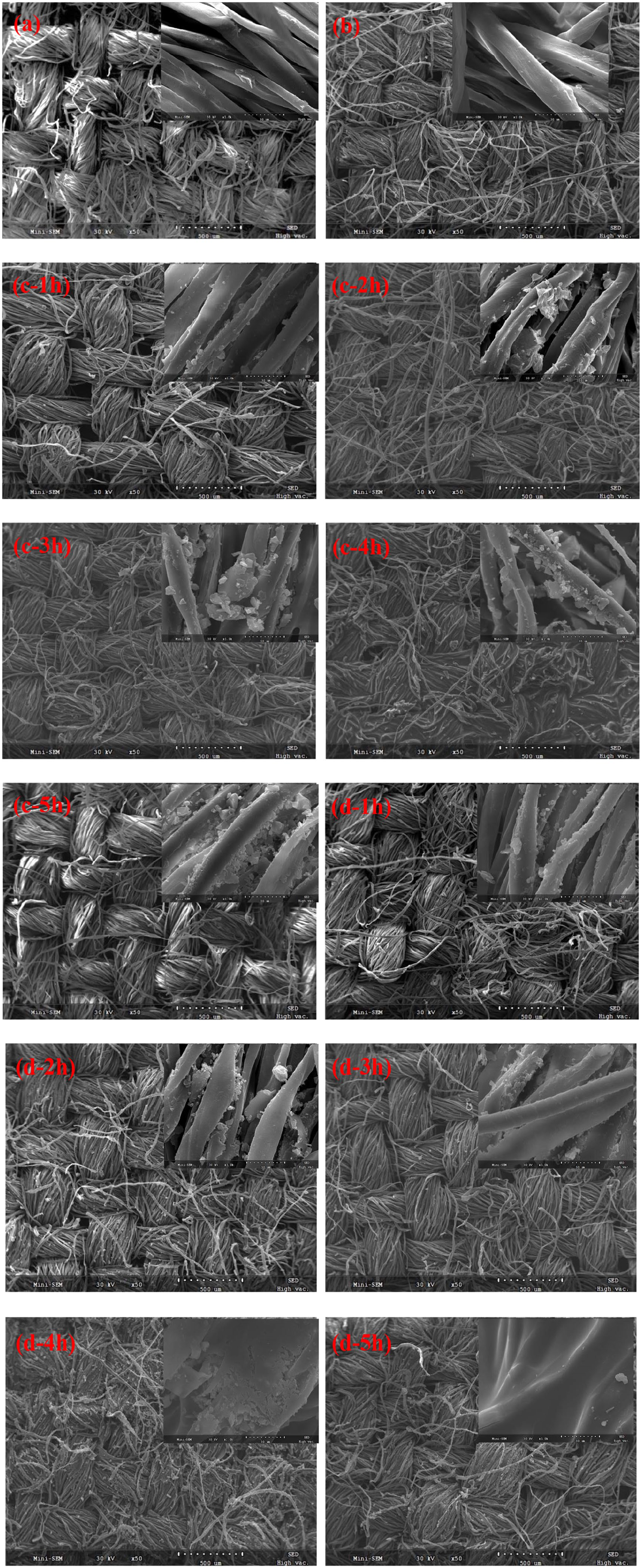
SEM images of cotton fabric: (a) the cotton fabric as substrates before modifying; (b) the cotton fabric after modifying with MPTMS; (c) MPTMS-modified cotton fabric grafted with trifluoroethyl methacrylate at different times of 1–5 h; and (d) MPTMS-modified cotton fabric grafted with dodecafluoroheptyl methacrylate at different times of 1–5 h. Inset: a partial enlargement of the fiber.
Thermal analysis of fabrics
The thermal stabilities of the untreated and treated cotton fabrics were performed, and the results are shown in Figure 4 and Table 1. Figure 4 represents TG curves of cotton fabric before and after modifying (Figure 4(a)) MPTMS-modified cotton fabric grafted with trifluoroethyl methacrylate at different times of 1–5 h and (Figure 4(b)) MPTMS-modified cotton fabric grafted with dodecafluoroheptyl methacrylate at different times of 1–5 h. As shown in Figure 4, the blank sample decomposed started at 300°C with one decomposition step which could be attributed to the decomposition of cellulose chains of cotton fabric. Furthermore, the thermal decomposition of modified fabrics mainly occurred in the range of 200°C–450°C with two distinguishable weight loss zones. The modified fabrics showed initial mass loss below 100°C, which is assigned to trapped moisture in the coated samples. The first decomposition step temperature was reduced to 200°C, which was due to the decomposition of fluorine polymers that existed in the coating layer, and this resulted in an increase in second decomposition step temperature than the control sample’s (Ton > 321°C), as indicated in Figure 4 and Table 1. This was reflected in increase in the temperature at which maximum weight loss (Tmax ⩾ 443°C) was obtained for the modified fabrics (Table 1). The results indicated that thermal stability of the modified fabric was improved compared to that of the untreated one, and the fluorine polymer was successfully grafted onto the surface of fabric.

The TG curves of cotton fabric before and after modifying: (a) MPTMS-modified cotton fabric grafted with trifluoroethyl methacrylate at different times of 1–5 h and (b) MPTMS-modified cotton fabric grafted with dodecafluoroheptyl methacrylate at different times of 1–5 h.
Thermal characteristic data.

MPTMS: (methacryloyloxy)propyltrimethoxysilane; c–g: MPTMS-modified cotton fabric grafted with trifluoroethyl methacrylate at different times of 1–5 h; c’–g’: MPTMS-modified cotton fabric grafted with dodecafluoroheptyl methacrylate at different times of 1–5 h.
Temperature at 20% weight loss.
Onset decomposition temperature of main peak.
Temperature at maximum weight loss.
Analysis of hydrophobicity property
The study of water-repellent property which results in self-cleaning property for textile is very important. The surface wettabilities of the cotton fabrics before and after modifying have been evaluated by the contact angle measurement (Figure 5). Figure 5 represents the contact angle properties of cotton fabrics before and after modifying (Figure 5(a)) MPTMS-modified cotton fabric grafted with trifluoroethyl methacrylate at different times of 1–5 h and (Figure 5(b)) MPTMS-modified cotton fabric grafted with dodecafluoroheptyl methacrylate at different times of 1–5 h. As shown in Figure 5, it can be seen that the unmodified fabric had a good hydrophilic property and water contact angle (WCA) recorded 0°. However, when fluorine polymers were applied to modify fibers, they displayed hydrophobic behavior (WCA > 140°) owing to the low surface tension. It is important to note that, in the case of fabrics modified with fluorinated compounds, the values of WCA increased with increasing number of carbon atoms in the chain of fluorinated modifiers. WCA values of the dodecafluoroheptyl methacrylate polymer-modified fabrics were higher than that of trifluoroethyl methacrylate polymer-modified fabrics. This is due to the presence of fluorine molecules with larger size of C–F groups in the carbon skeleton, and the wrapping of the coating layer on the surface changed their surface morphology and surface energy, and the more the number of fluorocarbon groups, the smaller the surface free energy.

The contact angle properties of cotton fabrics before and after modifying: (a) MPTMS-modified cotton fabric grafted with trifluoroethyl methacrylate at different times of 1–5 h and (b) MPTMS-modified cotton fabric grafted with dodecafluoroheptyl methacrylate at different times of 1–5 h. Inset: the image of a water droplet (2 μL) on the fabric.
The hydrophobic photographs of the cotton fabric before and after modifying are shown in Figure 6. The cotton fabrics modified with fluorinated compounds showed a higher WCA compared to unmodified ones. When water droplets were dripped on the modified fabric surfaces, the water droplets maintained almost perfect spheres, without wetting the fabrics. The hydrophobic properties had no obviously increase with increasing polymerization time of fluorine monomer.
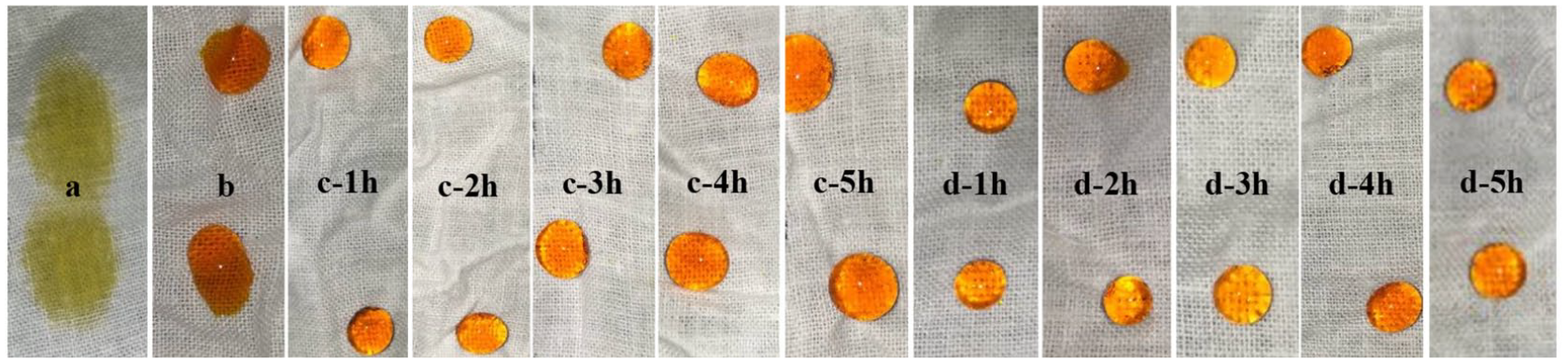
The hydrophobic photographs of the cotton fabric before and after modifying: (a) the cotton fabric as substrates before modifying; (b) the cotton fabric after modifying with MPTMS; (c) MPTMS-modified cotton fabric grafted with trifluoroethyl methacrylate at different times of 1–5 h; and (d) MPTMS-modified cotton fabric grafted with dodecafluoroheptyl methacrylate at different times of 1–5 h.
Durability of abrasion
The cotton fabric displayed hydrophobicity after modification with fluorinated compounds, and the durability performance of fabric was closely related to its surface wettability. So, the test of anti-frictional property is necessary, which was investigated with a dry crocking method according to the GB/T 3920–2008 standard. The results of WCA values for the modified cotton fabric after 100 abrasion cycles are shown in Figure 7. The results indicated that the modified fabric still maintained hydrophobic after being treated with 100 cycles, and the WCA value had a slight change, which suggested that the modified fabric was durable to withstand mechanical abrasion without apparently changing the hydrophobicity.

The change in water contact angle for the modified cotton fabric after 100 abrasion cycles: (a) modified with MPTMS and grafted with trifluoroethyl methacrylate at different times and (b) modified with MPTMS and grafted with dodecafluoroheptyl methacrylate at different times.
Tensile properties
The mechanical properties of unmodified and modified fabrics are evaluated and tabulated in Table 2. The tensile strength and elongation of unmodified fabrics were 419.05 N and 11.5%, respectively. It is noticed that the tensile strength enhanced in the case of fabrics modified with fluorinated compounds. Meanwhile, elongation was reduced compared to that of unmodified fabrics as indicated in Table 2, which indicates a decrease in fabric elasticity. That might be due to the modification of fluorinated compounds on the fiber surface. It is noticed that the tensile strength was enhanced slightly with an increase in polymerization time for trifluoroethyl methacrylate or dodecafluoroheptyl methacrylate. This enhancement in tensile strength observed might be due to the existence of much more fluorinated compounds with the increase in polymerization time.
Mechanical properties of the cotton fabric before and after modifying.

a: the cotton fabric as substrates before modifying; b: the cotton fabric after modifying with MPTMS; c: MPTMS-modified cotton fabric grafted with trifluoroethyl methacrylate at different times of 1–5 h; d: MPTMS-modified cotton fabric grafted with dodecafluoroheptyl methacrylate at different times of 1–5 h.
Conclusion
In summary, preparation of hydrophobic cotton fabric based on the self-assembly method was proposed. The cotton fabric was modified with MPTMS and grafted with trifluoroethyl methacrylate and dodecafluoroheptyl methacrylate through free radical polymerization reaction. The influence of fluorine modifiers on hydrophobic property of the obtained surface was investigated. The presence of fluorine molecules with C–F groups in the carbon skeleton lowered the surface free energy of these hydrophobic surfaces. The results showed that the as-prepared fabrics exhibited a WCA of above 140°, and the values of WCA increased with increasing number of carbon atoms in the chain of fluorinated modifiers. Furthermore, it was also durable to withstand mechanical abrasion without apparently changing the hydrophobicity. So, the method could be a promising candidate for the preparation of hydrophobic fabric.
Footnotes
Declaration of conflicting interests
The author(s) declared no potential conflicts of interest with respect to the research, authorship, and/or publication of this article.
Funding
The author(s) disclosed receipt of the following financial support for the research, authorship, and/or publication of this article: The authors gratefully acknowledge the financial support of the National Natural Science Foundation of China (grant no. 51703130), Zhejiang Provincial Natural Science Foundation of China (grant no. LY18E080018), and the International Science and Technology Cooperation Project of Shaoxing University (grant no. 2019LGGH1004).
