



Abstract
Physical activity is associated with stress urinary incontinence (SUI). The genetic causality of this association remains unclear. This study used the Mendelian randomization (MR) method to explore the potential causal relationship between physical activity and SUI risk using heavy do-it-yourself (DIY), light DIY, strenuous sports, walking for pleasure, and other exercises as proxies. We selected single nucleotide polymorphisms associated with physical activity from published genome-wide association studies (GWAS). Statistics of SUI come from the GWAS database. MR estimation was performed using the inverse variance weighting method, the MR-Egger method, and the weighted median method. Sensitivity analyses were performed using Cochran’s Q test, MR-Egger intercept, MR-pleiotropy residuals, outlier methods, leave-one-out analysis, and funnel plots. The results showed that there was a causal relationship between heavy DIY and SUI (OR = 0.9712, 95% confidence interval [0.951, 0.9918], p = .006), while no significant causal relationship was found between other physical activities and SUI. These findings were robust across multiple sensitivity analyses. This MR study demonstrates the causal relationship between heavy DIY and SUI, helping doctors and researchers better recommend preventive and treatment measures to patients, while also providing specific directions for improving their lifestyle in men and women suffering from SUI.
Introduction
Stress Urinary Incontinence (SUI) is a condition characterized by the involuntary leakage of urine during activities that increase intra-abdominal pressure, such as coughing, sneezing, running, or lifting heavy objects (Abrams et al., 2002; Tabei et al., 2024). SUI is common in women, especially in postmenopausal women and those who have experienced childbirth. Men may indeed experience SUI in middle and old age, especially in the following situations: prostate surgery, bladder, or urethral problems, obesity, and neurological disorders. SUI significantly impacts the quality of life, including psychological distress, social embarrassment, and limitations in physical activity (Jacome et al., 2011; Sekula et al., 2016; Wikander et al., 2022). Research suggests that physical activity may influence the occurrence of SUI. Physical activity can strengthen the pelvic floor muscles and function, potentially reducing the occurrence of urinary incontinence (Jorasz et al., 2022; Vesting et al., 2024). The effects of different types and intensities of physical activity on SUI remain unclear. For example, some studies have found that high-intensity physical activity may increase the risk of SUI, while moderate-intensity activity may have a protective effect. In addition, daily activities such as heavy do-it-yourself (DIY) tasks and leisurely walking are also considered to have potential impacts on SUI (Khowailed et al., 2020; Kim et al., 2022; Yang et al., 2019).
Mendelian randomization (MR) is a method that utilizes genetic variation to assess causal relationships between exposures and outcomes. Because genetic variation is randomly allocated at conception and independent of confounding factors, MR can effectively reduce common confounding and reverse causation issues in traditional observational studies (Levin & Burgess, 2024). MR utilizes genetic instrumental variables related to the exposure (such as physical activity) to infer the causal effect of that exposure on the outcome (such as SUI).
Although there is preliminary evidence of an association between physical activity and SUI, the underlying causal relationship has not been definitively verified through genetic methods. Understanding this causal relationship is of significant importance for the prevention and treatment of SUI. If a specific type of physical activity is confirmed to have a causal protective effect against SUI, it can provide patients with specific lifestyle guidance to improve their health status and quality of life. This study aims to utilize MR methods to explore the causal relationship between physical activity, particularly heavy DIY activities, and SUI. By analyzing genetic variation related to physical activity, we aim to assess its causal effect on SUI, thereby providing scientific evidence for the prevention and treatment of SUI.
Materials and Methods
Study Design
This study employs MR methodology to investigate the causal relationship between physical activity (including heavy DIY activities, light DIY activities, high-intensity exercise, and leisurely walking) and SUI. The MR approach utilizes genetic variation as an instrumental variable, thus circumventing the confounding biases and reverse causation issues commonly encountered in traditional observational studies, thereby providing more robust causal inferences (Figure 1).

An Overview of the Study Design
Data Source
We selected single nucleotide polymorphisms (SNPs) from published genome-wide association studies (GWAS) that are significantly associated with different types of physical activity, such as heavy DIY activities (e.g., weeding, lawn mowing, carpentry, and digging), light DIY, high-intensity exercise, and leisurely walking. Summary statistics data for different types of physical activity were extracted from the public online database (IEU OpenGWAS project: https://gwas.mrcieu.ac.uk/). We examined the causal relationship between SUI and five different intensities of physical activity: heavy DIY (197,006 cases, 263,370 controls), light DIY (236,244 cases, 224,132 controls), vigorous exercise (47,468 cases, 412,908 controls), walking (329,755 cases, 130,621 controls), and other exercises (222,470 cases, 237,906 controls). The statistical data for SUI came from GWAS databases, covering large-scale patient and control group data. The data we used included the incidence rate of SUI, epidemiological characteristics, and other information, which were derived from multiple independent GWAS studies, ensuring the breadth and reliability of the data (Table 1).
Details of the GWAS Included in the MR

Note. GWAS = genome-wide association studies; MR = Mendelian randomization; SNPs = single nucleotide polymorphisms; DIY = do-it-yourself; SUI = stress urinary incontinence.
Instrument Variable Selection
We selected SNPs significantly associated with physical activity as instrumental variables. The selection criteria for instrumental variables are based on the following principles: (a) Relevance: Instrumental variables are significantly associated with physical activity (p < 5 × 10⁻⁸). (b) Independence: Instrumental variables are genetically independent (i.e., LD r2 < .01). (c) Exclusion of pleiotropy: SNPs with pleiotropic effects should be excluded as much as possible, meaning these SNPs primarily affect physical activity rather than other pathways influencing SUI (Levin & Burgess, 2024; Sekula et al., 2016). Based on the assumptions of MR analysis, SNPs used as instrumental variables should be closely related to the exposure. Therefore, if the F-statistic (F = R2 (N − k − 1)/k(1 − R2), N = sample size, k = number of instrumental variables, R2 = variance explained by instrumental variables) is significantly greater than 10, weak instrumental variable bias may be excluded (Borges et al., 2022; Gupta et al., 2017).
Statistical Analysis
MR Estimation Methods
To estimate the causal relationship between physical activity and SUI, this study employed various MR analysis methods to ensure the robustness and reliability of the results. These methods include the inverse variance weighting (IVW) method, the MR-Egger method, and weighted median (WM) method. Each method has its unique strengths and can complement each other’s shortcomings, thereby providing a comprehensive assessment of causal effects. The IVW method estimates the causal effect between exposure (physical activity) and outcome (SUI) by weighting the average effect size of each SNP (Lin et al., 2021). In this approach, each SNP is assigned a weight based on the inverse of its variance, meaning that SNPs with more precise effect estimates (i.e., smaller standard errors) are given greater weight. This method assumes that the selected SNPs are valid instruments, with strong associations to physical activity and no pleiotropy, thereby providing the most accurate estimate of the causal relationship between physical activity and SUI. By aggregating the effect sizes across multiple SNPs, the IVW method leverages the full information available to estimate the overall causal effect, making it a robust tool for causal inference in genetic epidemiology. The MR-Egger method estimates causal effects and detects and corrects for instrumental variable pleiotropy. Pleiotropy refers to the situation where SNPs influence the outcome not only through the exposure pathway but also potentially through other pathways (Bowden et al., 2016). The MR-Egger method tests and corrects for pleiotropy by regressing the intercept term (Egger intercept). The WM method estimates the causal effect based on the median of instrumental variable effect estimates, and the weights are correlated with the precision of each SNP’s effect size. The WM method in MR estimates causal effects by using the median of the effect sizes of instrumental variables. This approach is particularly robust when some instruments are ineffective or subject to pleiotropy. Unlike traditional methods that use the average effect size, the WM method is less sensitive to outliers or invalid instruments, providing reliable estimates as long as more than 50% of the instruments are valid. Each instrumental variable is weighted by the precision of its effect estimate, and the median of these weighted values is used to estimate the causal relationship. This method is valuable for ensuring robust causal inferences, especially in the presence of potential pleiotropy or weak instruments.
Sensitivity Analysis
To ensure the robustness and reliability of MR analysis results, this study conducted various sensitivity analyses. Cochran’s Q test was used to detect heterogeneity among instrumental variables. Significant heterogeneity among instrumental variables may indicate diversity in their effects or uncorrected pleiotropy. If the Q statistic is significant, it suggests the presence of heterogeneity among instrumental variables, which may require further examination and correction for pleiotropy. MR-Egger intercept was used to assess and correct for pleiotropy in instrumental variables (Li et al., 2022). MR-Egger regression is a method to detect multinomial effects by examining the intercept term in the regression model. Significant deviations of the intercept term from zero indicate the presence of multidirectional effects, suggesting that the instrumental variables may influence the results through pathways other than the expected exposure. These findings emphasize the need to consider multidirectional effects to avoid biased causal inferences. MR Pleiotropy RESidual Sum and Outlier (MR-PRESSO) method was used to detect and correct for outliers and pleiotropy in instrumental variables. MR-PRESSO identifies outliers and multidirectional anisotropy in the instrumental variables by identifying SNPs with significant multidirectional effects and outliers and then removes these problematic SNPs from the analysis. By doing so, MR-PRESSO helps ensure that causal estimates remain robust and more accurately reflect the true underlying causal relationships (Verbanck et al., 2018). Leave-One-Out Analysis evaluates the impact of each instrumental variable on the overall causal effect estimate by sequentially excluding each instrumental variable. This method can detect whether individual instrumental variables significantly affect the overall result. Procedure: Each instrumental variable is excluded one at a time, and the causal effect estimate is recalculated to observe changes in the results. Funnel plot is used to visually display the distribution of instrumental variable effect sizes and detect potential bias. By plotting the scatter plot of each instrumental variable effect size against its standard error, bias and heterogeneity can be identified. Through the above various sensitivity analysis methods, this study ensured the robustness and reliability of MR results, providing a more comprehensive assessment of causal effects.
Results
The MR analysis results for physical activity and SUI are depicted in Figure 2. Sensitivity analysis results are summarized in Tables S2 and S3. The MR estimate indicates that heavy DIY activities are a protective factor for SUI (OR = 0.9712, 95% confidence interval [0.951, 0.9918], p = .006). There is no causal relationship observed between SUI and the other four types of physical activity. Cochran’s Q test did not detect heterogeneity (IVW, Q = 35.04 [df = 17], p = .0937; MR-Egger, Q = 25.03 [df = 16], p = .069), and according to the MR-PRESSO test, no outliers were found. Both MR-Egger and MR-PRESSO indicate no horizontal pleiotropy (MR-Egger intercept does not differ from zero, p = .929; MR-PRESSO global test p = .115). Figure 3 illustrates a scatter plot of the MR analysis for the causal effect of physical activity on SUI. Based on the leave-one-out plot (Figure S1), no SNP significantly influences the causal effect between heavy DIY and SUI, and the funnel plot exhibits overall symmetry (Figure S2). The F-statistic for the heavy DIY instrumental variable is 35.0, far exceeding 10. We can conclude that heavy DIY is associated with SUI, and this causal effect is reliable and robust.
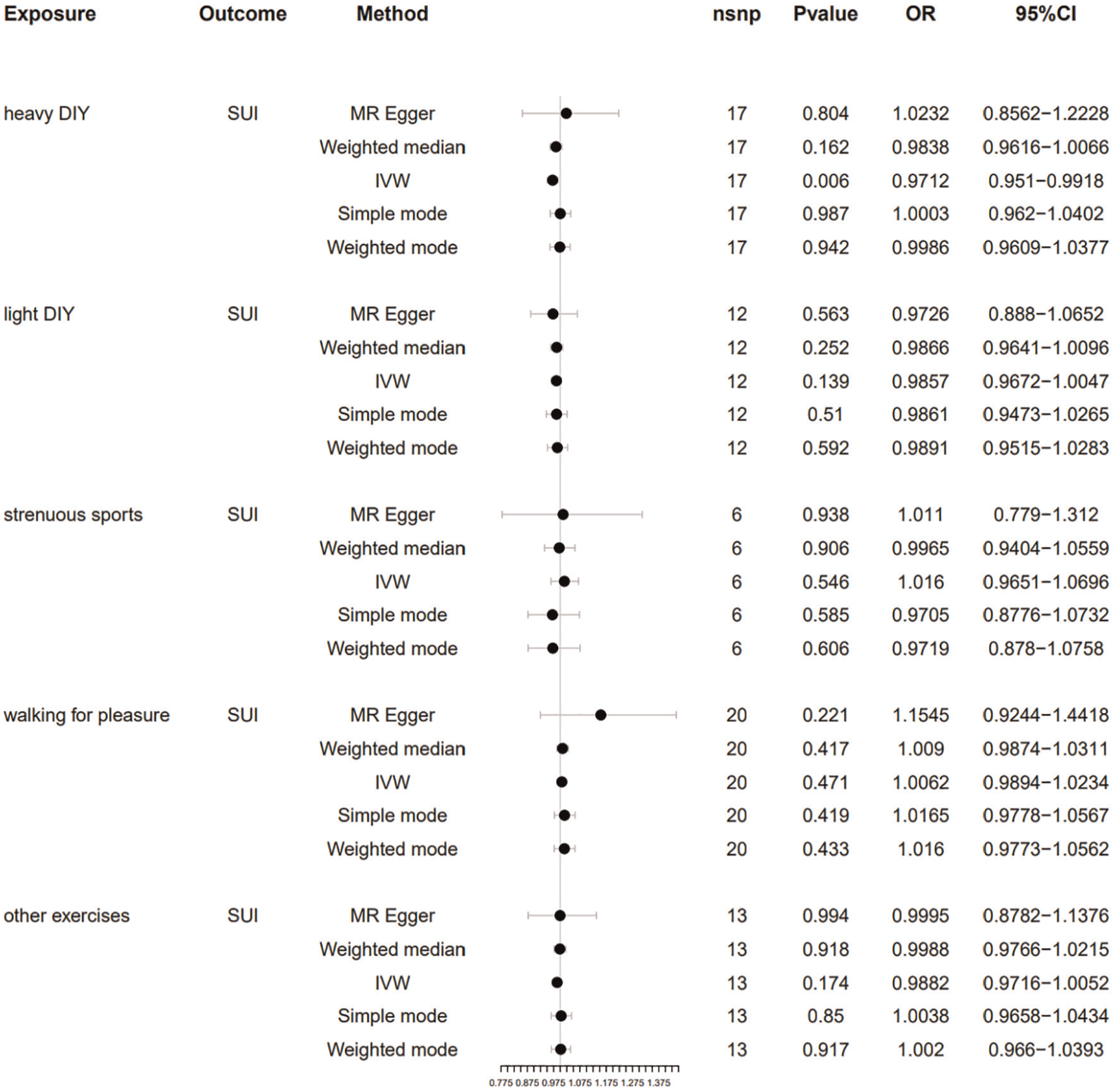
MR Results for Association of Physical Activity and SUI
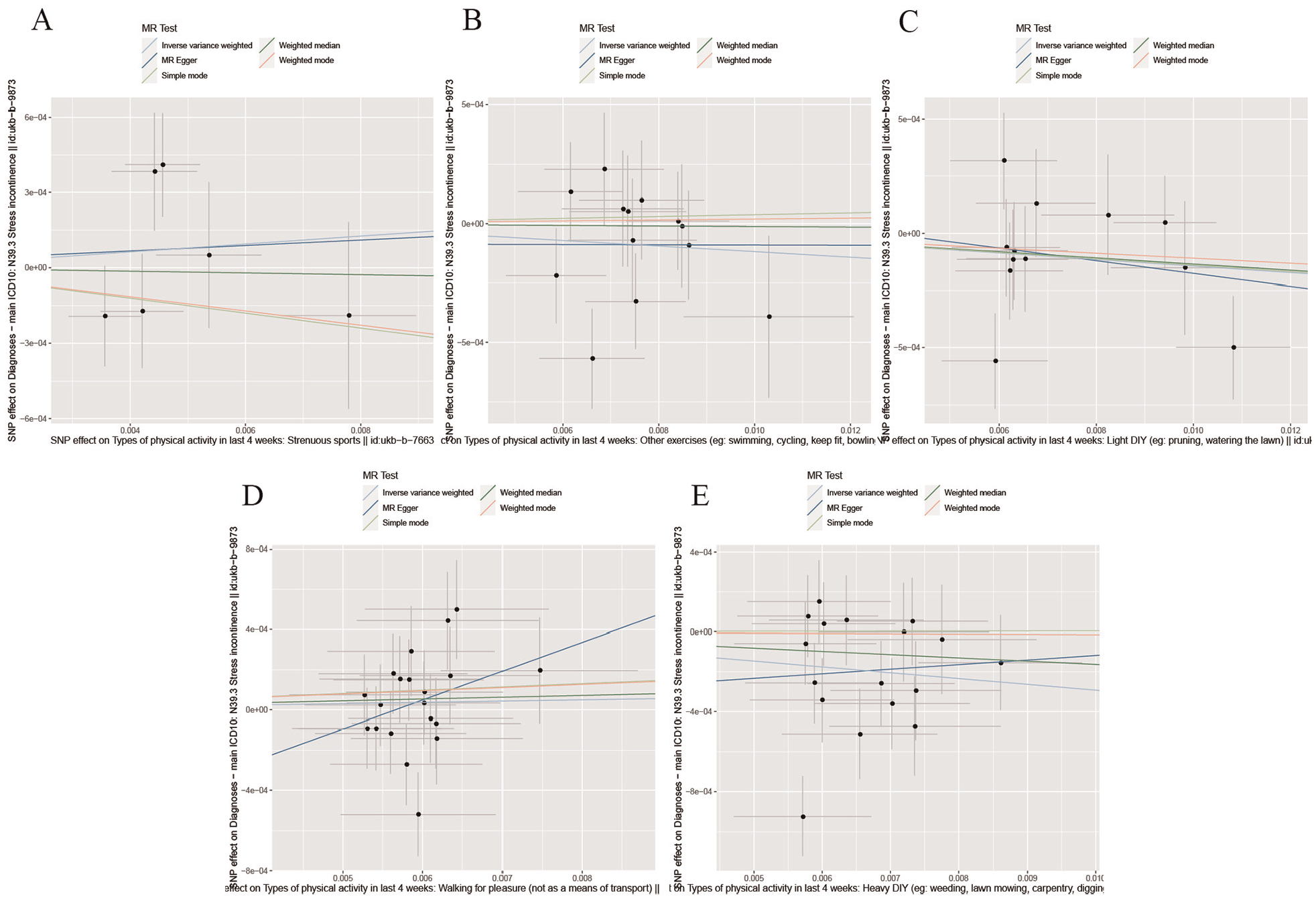
Scatter Plot of the Association Between Physical Activity and SUI. (A) Heavy DIY; (B) Light DIY; (C) Strenuous Sports; (D) Walking for Pleasure; (E) Other Exercises
Discussion
This study utilized MR methodology to explore, for the first time, the causal relationship between different types of physical activity and SUI. The results of the study showed a significant causal relationship between heavy DIY activities and SUI, while other types of physical activities, such as light DIY, high-intensity exercise, and leisurely walking, showed no apparent correlation with SUI. This finding holds significant clinical and public health implications, providing a new perspective for the prevention and treatment of SUI.
The findings of this study are consistent with some existing research results. Previous studies have also indicated that high-intensity physical activity can enhance pelvic floor muscle function and reduce the risk of urinary incontinence. This study provides more robust causal evidence through MR methodology, eliminating the influence of confounding factors and reverse causality commonly encountered in traditional observational studies (Elliott-Sale et al., 2022; Hagen et al., 2020). Interestingly, this study did not find a significant causal relationship between high-intensity exercise and SUI, which may be related to the definition of high-intensity exercise and the activity levels of the participants. Further research could explore the effects of different types of high-intensity exercise on SUI in more detail. Heavy DIY activities may exert a protective effect against SUI through various pathways (McDermott et al., 2021; Ungvari et al., 2023). First, heavy DIY typically involves high-intensity physical labor, such as lifting heavy objects and prolonged physical exertion, which significantly exercises the pelvic floor muscles and core muscle groups, thereby enhancing bladder control. In comparison, activities such as light DIY and leisurely walking have lower intensity, potentially providing insufficient stimulation to the pelvic floor muscles to achieve the same preventive effect. In addition, the duration and frequency of heavy DIY activities may be higher, further enhancing the exercise effect on the relevant muscle groups (Bo et al., 2019; Mottola et al., 2018). Individuals who regularly engage in heavy DIY activities may have better overall physical fitness and stronger pelvic floor muscles, which could explain the significant reduction in SUI risk observed in this group (Grgic et al., 2021; Kazeminia et al., 2023; Lista-Paz et al., 2023; Lundberg et al., 2022).
In this study, MR revealed a significant causal relationship between high-intensity DIY activities and SUI. Several potential mechanisms may explain this association: (a) Improved pelvic floor muscle strength: Engaging in high-intensity DIY activities often requires exertion of physical strength and endurance, which helps strengthen the pelvic floor muscles. Strengthening the pelvic floor muscles is essential for maintaining bladder control and preventing SUI, especially during activities that increase intra-abdominal pressure, such as lifting or bending (Bo & Nygaard, 2020). (b) Increased physical activity and overall health: High-intensity DIY activities are often high-intensity physical tasks that can improve cardiovascular health, muscle tone, and overall physical health. Studies have shown that regular physical activity can improve pelvic floor health by promoting blood circulation, strengthening muscle function, and reducing the risk of diseases such as SUI (Kleinloog et al., 2023). (c) Improved neuromuscular coordination: The physical tasks associated with high-intensity DIY activities may improve neuromuscular coordination and proprioception, thereby enhancing control over bladder function. This may reduce the risk of SUI by improving the body’s ability to respond to physical movements and changes in abdominal pressure. These mechanisms, either acting independently or synergistically, may contribute to the observed protective effects of high-intensity DIY activity against the development of SUI. Further studies are needed to explore these pathways in more detail and confirm the underlying biological processes (Jones et al., 2021).
This study has several strengths. First, the MR method uses genetic variation as an instrumental variable, avoiding the confounding bias and reverse causality issues present in traditional observational studies (Birney, 2022). Second, the application of various sensitivity analysis methods ensures the robustness and reliability of the results. However, this study also has limitations. First, the selection of instrumental variables may affect the accuracy of the results. Although we attempted to select SNPs that are significantly associated with physical activity and independent, the pleiotropy of genetic instrumental variables may still influence the results. Secondly, sample size limitations may affect the significance testing of the relationship between other types of physical activity and SUI. Future studies should expand the sample size to include other ethnicities and further optimize the selection of instrumental variables to validate and extend the results of this study. Subsequent addition of other physical activities that are not significantly related to SUI will fill the gaps of this study. The next step of research can also conduct more detailed experiments on different age groups to verify the long-term effects of “heavy DIY” activities on SUI.
The results of this study hold significant clinical and public health implications. First, heavy DIY activities, as a common form of physical activity in daily life, can be considered an effective measure for preventing SUI. Physicians can recommend heavy DIY activities to patients at risk of SUI based on the results of this study, helping them improve their quality of life. In addition, this study highlights the critical role of physical activity type and intensity in preventing SUI. Future intervention measures should focus on high-intensity physical activities involving the pelvic floor muscles to achieve more effective SUI prevention.
Conclusion
In this study, the MR method revealed a significant causal relationship between heavy DIY activities and SUI. This discovery offers a new perspective and scientific basis for the prevention of SUI. Future research should further explore the preventive effects of different types of physical activity and validate the results of this study.
Supplemental Material
sj-docx-1-jmh-10.1177_15579883251336056 – Supplemental material for Heavy DIY Activities as a Potential Preventative for Stress Urinary Incontinence
Supplemental material, sj-docx-1-jmh-10.1177_15579883251336056 for Heavy DIY Activities as a Potential Preventative for Stress Urinary Incontinence by Kai Liu, Xiaogang Lian, Ting Wang and Zhu Tao in American Journal of Men's Health
Footnotes

Ethical Considerations
Not applicable.
Consent to Participate
Not applicable.
Consent for Publication
Not applicable.
Funding
The author(s) disclosed receipt of the following financial support for the research, authorship, and/or publication of this article: National Sports Administration Technology Service Project Project Number: HT2023-14
Conflicting Interests
The author(s) declared no potential conflicts of interest with respect to the research, authorship, and/or publication of this article.
Data Availability
Data are available from the corresponding authors.
Supplemental Material
Supplemental material for this article is available online.
References
Supplementary Material
Please find the following supplemental material available below.
For Open Access articles published under a Creative Commons License, all supplemental material carries the same license as the article it is associated with.
For non-Open Access articles published, all supplemental material carries a non-exclusive license, and permission requests for re-use of supplemental material or any part of supplemental material shall be sent directly to the copyright owner as specified in the copyright notice associated with the article.
