



Abstract
The 1,000-m run is a key component of university physical fitness assessments. Effective supplementation strategies to enhance performance and recovery in this test remain underexplored. This study aimed to evaluate the effects of caffeine (CAF) and beetroot juice (BJ) on 1,000-m performance and used SHapley Additive exPlanations (SHAP) analysis to identify key influencing factors. A randomized crossover design compared the effects of CAF (6 mg/kg body weight), BJ (70 mL providing 6.4 mmol of
Introduction
The 1,000-m run is a critical component of Chinese university physical fitness assessments, serving as a measure of both aerobic and anaerobic capacities (B. Li et al., 2022; Tao et al., 2024; Zhai et al., 2022). Achieving optimal performance in this test requires effective strategies to enhance physical capacity and manage recovery within a limited timeframe (Hurst et al., 2020; S. Ma et al., 2024). Dietary supplements have shown promise in supporting high-intensity exercise performance and recovery, yet their interaction with other performance determinants remains insufficiently understood (Guest et al., 2021; X. Ma et al., 2021). In particular, it is crucial to assess whether recovery strategies can restore performance after a short recovery period, which is common in high-intensity exercise protocols. Therefore, exploring the effects of different dietary supplement strategies, including their impact on recovery and subsequent performance, is crucial for advancing physical fitness assessments.
Caffeine (CAF) supplementation has been extensively studied for its acute ergogenic effects, particularly in aerobic and anaerobic activities such as sprinting and endurance-based efforts (Diaz-Lara et al., 2023; Guest et al., 2021; Lara et al., 2021). When consumed at doses of 3 to 6 mg/kg body weight approximately 60 min before exercise, CAF has consistently demonstrated meaningful improvements in physical performance, making it a suitable strategy for enhancing 1,000-m run outcomes (Guest et al., 2021). Similarly, beetroot juice (BJ), rich in dietary nitrates, enhances exercise performance by increasing nitric oxide (NO) levels, which improve blood flow, muscle contraction efficiency, and mitochondrial function (Domínguez et al., 2018; Garnacho-Castaño et al., 2024; Zoughaib et al., 2024). These effects are particularly relevant to high-intensity efforts like the 1,000-m run, as BJ reduces aerobic energy cost and enhances performance at anaerobic threshold intensities, thereby delaying fatigue during sustained efforts (Pinna et al., 2014; Raúl Domínguez et al., 2017). Despite these findings, current research largely focuses on the isolated effects of CAF and BJ, with limited understanding of how these dietary supplement strategies interact with other determinants of performance. This gap highlights the need for a comprehensive approach to evaluate the multifactorial influences on 1,000-m outcomes.
Current research on the combined use of CAF and BJ remains inconclusive, with conflicting evidence regarding their synergistic effects on repeated high-intensity exercise (Gilsanz et al., 2024; Lane et al., 2014; Tallis et al., 2022). While some studies suggest potential benefits in recovery and fatigue management (Ramirez-Campillo et al., 2022), others report limited or no additional improvements beyond their isolated effects (Berjisian et al., 2022). Furthermore, existing studies often overlook the multifactorial nature of performance determinants, which include physiological, nutritional, and environmental variables (Exel & Dabnichki, 2024; Han et al., 2020; Malsagova et al., 2021; Nieman, 2021). Understanding the relative importance and interactions among these factors is crucial for optimizing performance strategies.
This study aims to investigate the combined effects of CAF and BJ supplementation on 1,000-m running performance and recovery, with a focus on identifying the relative importance of various performance determinants. Using a randomized crossover design, participants underwent four supplementation conditions while comprehensive data were collected, including physiological, nutritional, and behavioral indicators. SHapley Additive exPlanations (SHAP) analysis was employed to quantify the relative importance of factors influencing performance. This method allows for a detailed assessment of how each factor contributes to the prediction of the outcome, providing interpretable insights into the model’s decision-making process (Cakiroglu et al., 2024; Prendin et al., 2023; Yang et al., 2021). It is hypothesized that the combined supplementation enhances performance more effectively than single interventions. SHAP analysis is expected to identify key factors influencing performance, providing insights into optimizing dietary supplement strategies. The findings are expected to enhance the understanding of performance optimization strategies in 1,000 m running, providing practical guidance for improving outcomes in physical fitness assessments among university students.
Methods
Participants
This study recruited 25 male participants and informed consent was obtained from them. All participants were healthy, non-physical education major undergraduate students. Screening was conducted using the Physical Activity Readiness Questionnaire (PAR-Q) (Schwartz et al., 2021), resulting in 23 participants who met the inclusion criteria. A total of 20 participants successfully completed the exercise protocol (Table 1). Approval from the institutional ethics committee was obtained, and the study was carried out in accordance with the 1964 Declaration of Helsinki.
Statistical Description of Basic Subject Information

This study employed a randomized, controlled, crossover design. Each participant underwent four experimental conditions, with a one-week washout period between trials. The randomization process was carried out using simple randomization, ensuring an unbiased allocation of the dietary supplement strategies. The four experimental conditions differed in the dietary supplements provided.
Dietary Supplement Strategies
The dietary supplements used in this study included BJ, CAF, placebo (PLA) capsules, and PLA drink. BJ was administered as a beverage containing 70 mL of BJ (providing 6.4 mmol of
Each participant underwent four experimental conditions in a randomized crossover design, with a one-week washout period between each trial. In the CAF group, participants consumed a 70 mL PLA drink 120 min prior to exercise, followed by CAF (6 mg/kg body weight) 60 min before exercise. In the BJ group, participants consumed 70 mL of BJ 120 min prior to exercise, followed by a PLA capsule 60 min before exercise. The BJ + CAF group (BJ + CAF) involved the same 70 mL of BJ intake 120 min before exercise, followed by CAF 60 min prior to exercise (6 mg/kg body weight). In the PLA group, participants consumed 70 mL of PLA liquid 120 min prior to exercise, followed by a PLA capsule 60 min before exercise.
Exercise Protocol
The exercise protocol included a baseline assessment of participants’ physical performance, measured through left-hand grip strength and average vertical jump height. These tests were conducted prior to the first 1,000-m run to establish baseline physical fitness levels. Following the first 1,000-m run, participants rested for 20 min. After the recovery period, left-hand grip strength and average vertical jump height were measured again, followed by the second 1,000-m run to evaluate re-exercise capacity. Standardized encouragement was provided throughout all performance tests.
Experimental Process
One week prior to the formal experiment, participants visited the laboratory to familiarize themselves with the exercise and dietary supplementation protocols. They were instructed to maintain their usual diet, physical activity, and sleep patterns during the 48 hr preceding the experiment, and to record these parameters. On the day prior to the experiment (Figure 1), participants were provided with a Huawei Band (J. Li et al., 2024) to record nighttime sleep duration. On the experimental day, participants arrived at the laboratory at 7:30 AM. Baseline measurements were collected, including resting heart rate (Polar H10; Muggeridge et al., 2021), blood lactate (Lactate Scout 4; Molinaro et al., 2023), left-hand grip strength, and average vertical jump height. A questionnaire was administered to record alcohol and tobacco usage frequency over the past 30 days (Hamilton et al., 2011). Anthropometric data, including height, weight, and body fat percentage (InBody 700; Hurt et al., 2021), were also recorded. Nighttime sleep duration was verified using data from the wearable device. At 8:00 AM, participants consumed BJ or a PLA drink. At 9:00 AM, they ingested CAF capsules or PLA capsules. The first 1,000-m run commenced at 10:00 AM. Immediately following the run, heart rate and blood lactate levels were measured, with subsequent measurements taken every 5 min during a 20-min recovery period. After recovery, left-hand grip strength and average vertical jump height were reassessed. Participants then performed a second 1,000-m run to evaluate re-exercise capacity.

The experimental process of this study.
Shapley Additive Explanations Analysis
To conduct feature importance analysis, a multilayer perceptron (MLP) model was chosen, and SHAP analysis was applied. The input variables include anthropometric measurements (Body Fat Percentage, Weight, Height), Age, Nighttime Sleep Duration, Nutritional Strategy, Average Vertical Jump Height Before Exercise, Grip Strength Left, Resting Heart Rate, Time Since Last Meal, Alcohol Consumption in the Last 30 Days, and Smoking Frequency in the Last 30 Days. The output variable is 1,000-m running performance.
Body Fat Percentage, Weight, and Height are significantly correlated with athletic performance, with lower body fat and higher muscle mass enhancing both sprinting and endurance tasks (Brocherie et al., 2014). Age influences muscle metabolism, with younger individuals showing better endurance due to more efficient oxidative metabolism (Armstrong et al., 2015). Nighttime Sleep Duration is crucial for recovery, and daytime naps after sufficient sleep can improve endurance performance and reduce fatigue (Boukhris et al., 2024). Average Vertical Jump Height Before Exercise reflects neuromuscular efficiency and power, both of which are critical for running performance (Boullosa et al., 2020). Grip strength serves as a general indicator of muscular strength and can indirectly impact endurance performance (Cronin et al., 2017). Stronger grip strength is associated with better overall fitness and may enhance running performance through improved muscular coordination and endurance (Huebner et al., 2023). “Time Since Last Meal” affects performance by influencing glycogen availability and energy levels (Hawley & Burke, 1997). A shorter period since the last meal may lead to lower energy availability, while a longer fasting period may promote better fat utilization during endurance tasks (Burke et al., 1996). Resting Heart Rate is a measure of cardiovascular fitness, with lower resting heart rates often linked to superior endurance performance (Pereira et al., 2019). Alcohol Consumption in the Last 30 Days negatively affects endurance by impairing recovery, hydration, and muscle function (Barnes, 2014). Smoking Frequency in the Last 30 Days is associated with reduced cardiovascular efficiency and endurance performance due to its impact on oxygen transport and lung capacity (Sadaka et al., 2021).
The MLP model was designed with a single hidden layer comprising 64 neurons, utilizing ReLU as the activation function. Hyperparameter optimization determined the learning rate to be 0.01 and the weight decay parameter to be 0.0001, ensuring effective regularization. The model was trained for up to 1,000 iterations, with early stopping applied to prevent overfitting. Standardized input features were used to enhance training efficiency and model performance. Model evaluation metrics included mean squared error (MSE), root mean squared error (RMSE), and mean absolute error (MAE), ensuring a comprehensive assessment of predictive accuracy. The dataset was split into training and testing sets, with 20% of the data allocated to the test set. The SHAP analysis was performed using the test set data to assess the model’s feature importance.

where yi is the actual value,

RMSE is the square root of MSE, providing an error metric in the same unit as the original data.

MAE calculates the average absolute difference between the actual and predicted values, treating all errors equally regardless of their magnitude.
The SHAP method was applied to quantify the contribution of each input variable to the model’s output. SHAP values provide an interpretable measure of feature importance by decomposing the model’s prediction into contributions from individual features, allowing for a comprehensive assessment of their influence on performance. SHAP values are computed as:

where f(x) is the model output, Φ0 is the base value, and Φi represents the contribution of the i-th feature.
Result
Exercise Performance and Repeated Exercise Capacity
A repeated-measures analysis of variance (ANOVA) was conducted to evaluate the effects of time and dietary supplement strategies on 1,000-m running performance, left-hand grip strength, and average vertical jump height. However, no meaningful main effects or interaction effects of time and dietary supplement strategies were observed for grip strength and vertical jump height. For the 1,000-m running, the results revealed a significant main effect of time (F = 16.511, p < .001, partial η2 = .178) and nutritional strategy (F = 8.092, p < .001, partial η2 = .242). Additionally, there was a significant interaction between time and nutritional strategy (F = 13.508, p < .001, partial η2 = .348). Simple effect analysis (Table 2) revealed notable effects of dietary supplement strategies on 1,000-m performance, with marked effects of time points observed across all groups except the CAF.
Results of Simple Effects Analysis for Performance.

Note. BJ = beetroot juice; CAF = caffeine; PLA = placebo
For the first 1,000-m run (Figure 2), the CAF + BJ group demonstrated significantly better performance compared to the PLA (p < .01), while no meaningful differences were observed among the other groups. During the second 1,000-m run, the CAF + BJ group outperformed both the PLA and BJ (p < .01), and the CAF exhibited significantly better performance than the PLA (p < .01). Within-group comparisons between the two runs indicated a significant decline in performance in the BJ and PLA following the 20-min recovery period (p < .01), whereas the CAF + BJ group showed a significant improvement (p < .01). No notable difference was observed between the two performances in the CAF.
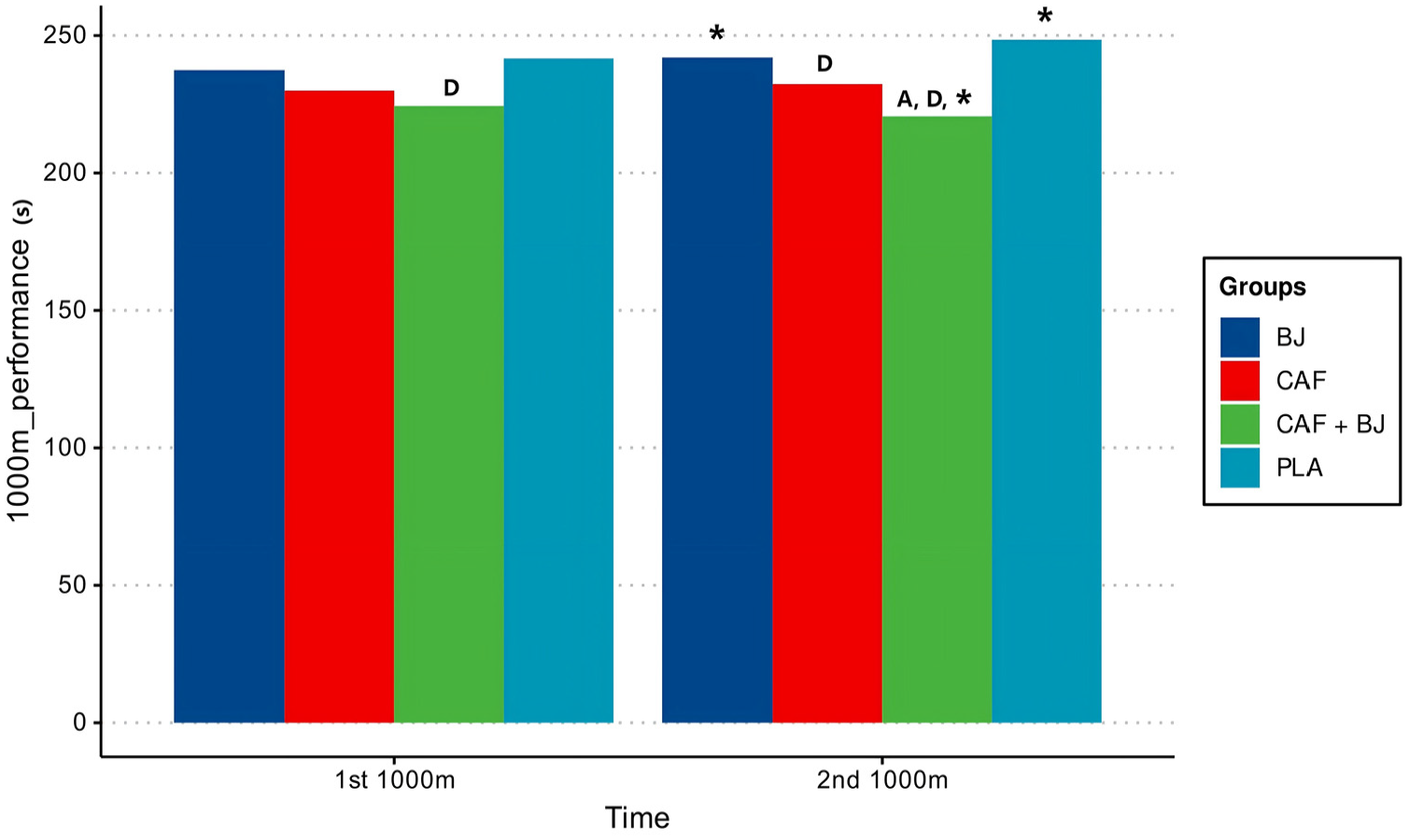
One thousand-meter running performance across two trials for different nutritional strategy groups. Uppercase letters (A, D) indicate significant differences compared to the BJ group and PLA at the same time point, respectively (p < .01). Asterisks (*) denote significant differences in performance within the same group compared to the first 1,000-m run (p < .01).
Postexercise Heart Rate Response
The analysis of postexercise heart rate revealed a significant main effect of time (F = 14,638.616, p < .001, partial η2 = .999) and nutritional strategy (F = 10.647, p < .001, partial η2 = .296), as well as a significant interaction between time and nutritional strategy (F = 23.517, p < .001, partial η2 = .556). Simple effect analysis (Table 3) indicated significant effects of both tie and nutritional strategy on postexercise heart rate (p < .01).
Results of simple effects analysis for heart rate.

Note. BJ = beetroot juice; CAF = caffeine; PLA = placebo.
Pairwise comparisons showed that heart rate declined significantly across all nutritional strategy groups at all five postexercise time points (p < .01). Postexercise heart rate remained higher in both the CAF + BJ and CAF, with the CAF + BJ group showing the highest values (Figures 3 and 4). From immediately to 20 min postexercise, the heart rate in the CAF + BJ group was significantly higher than that in the BJ and PLA at various time points and was significantly higher than the CAF immediately postexercise (p < .05).
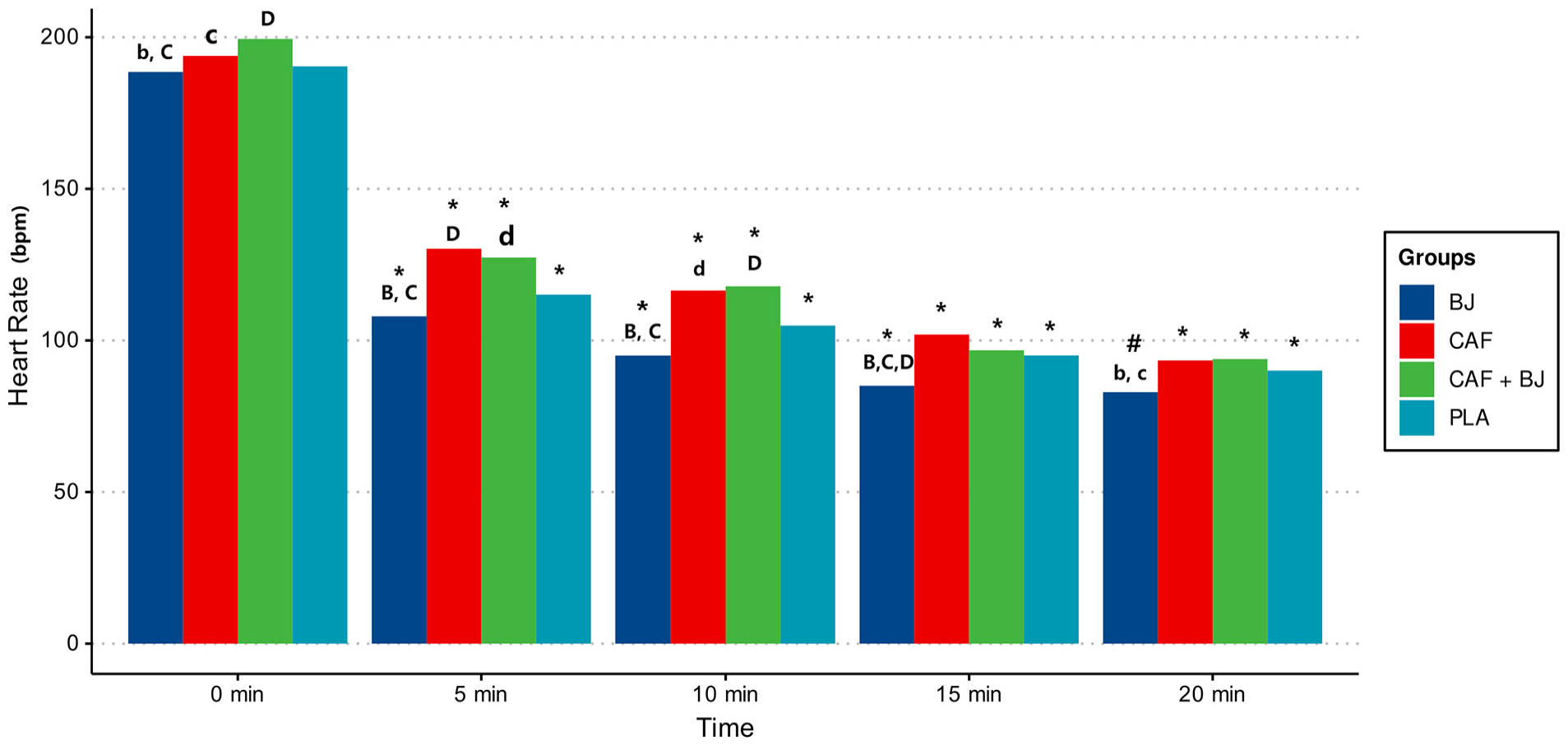
Postexercise heart rate at different time points across nutritional strategy groups. Uppercase letters (B, C, D) indicate significant differences compared to the CAF, CAF + BJ, and PLA, respectively (p < .01). Lowercase letters (b, c, d) denote significant differences compared to the CAF, CAF + BJ, and PLA, respectively (p < .05). Asterisks (*) indicate significant differences compared to the previous time point within the same group (p < .01), while the hash symbol (#) indicates p < .05.

Postexercise blood lactate levels at different time points across nutritional strategy groups. Uppercase letters (B, C) indicate significant differences compared to the CAF and CAF + BJ, respectively (p < .01), while lowercase letters (b) denote significant differences compared to the CAF (p < .05). Asterisks (*) represent significant differences in blood lactate levels compared to the previous time point within the same group (p < .01).
Postexercise Blood Lactate Response
Postexercise blood lactate levels demonstrated a significant main effect of time (F = 528.959, p < .001, partial η2 = .967) and nutritional strategy (F = 274.827, p < .001, partial η2 = .255), with a significant interaction between time and nutritional strategy (F = 15.884, p < .001, partial η2 = .459). Simple effect analysis (Table 4) indicated significant effects of both factors on postexercise blood lactate levels (p < .01).
Results of simple effects analysis for blood lactate.

Note. BJ = beetroot juice; CAF = caffeine; PLA = placebo.
Pairwise comparisons revealed that blood lactate levels declined significantly over time in all four nutritional strategy groups (p < .01). The CAF consistently exhibited significantly higher blood lactate levels than the BJ across all postexercise time points (p < .01) and was significantly higher than the PLA (p < .01) at three time points (10, 15, and 20 min postexercise). Compared to the CAF + BJ, the CAF also displayed significantly higher levels at 10, 15, and 20 min postexercise (p < .01). The CAF + BJ exhibited significantly higher blood lactate levels than the BJ immediately postexercise only.
Shapley Additive Explanations Analysis
The MLP model demonstrated effective convergence over 1,000 iterations, as shown by the declining loss values for both training and testing datasets (Figure 5). The model’s performance metrics indicated good predictive accuracy, with an MSE of 1,101.21 s2, an RMSE of 33.18 s, and an MAE of 27.33 s.
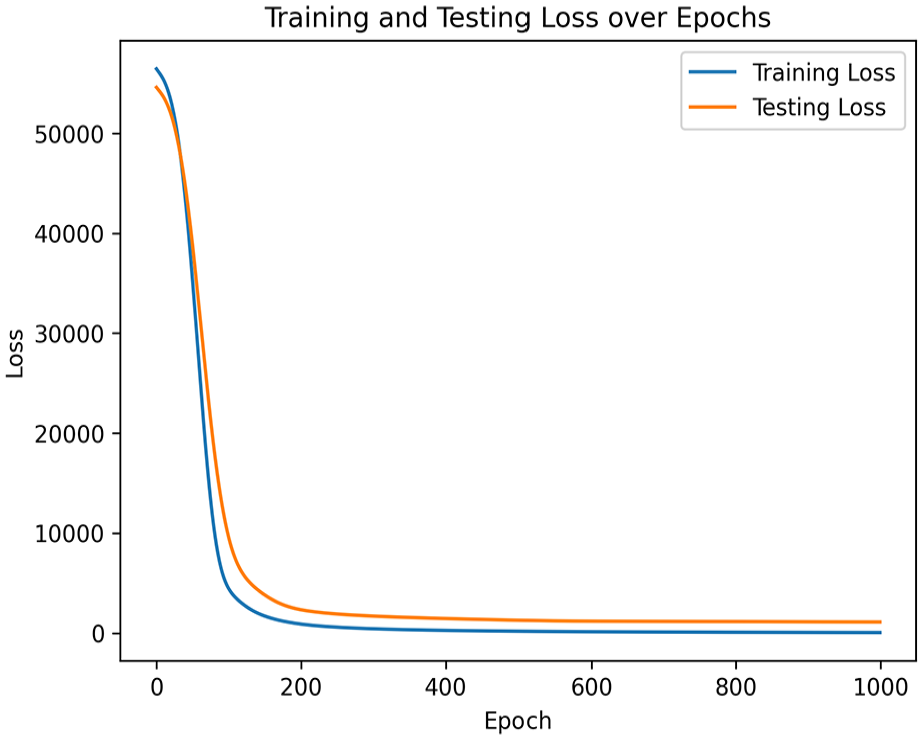
Training and testing loss over epochs of MLP (MSE).
The SHAP analysis (Figure 6) quantified the contributions of individual features to the predicted 1,000-m running performance. The SHAP analysis identified body fat percentage as the most influential factor, followed by weight and age. Nutritional strategy and nighttime sleep duration ranked next, with moderate contributions from grip strength, average vertical jump height, and resting heart rate. Smoking and alcohol consumption had the least influence on 1,000-m running performance. Further analysis revealed distinct patterns in the influence of these features. Body fat percentage had a predominantly negative effect, with higher levels linked to slower performance. Weight demonstrated mixed effects, depending on its interaction with other factors. Similarly, age exhibited a negative trend, with older participants showing reduced performance. Nighttime sleep duration presented a mixed influence, generally contributing positively to performance but showing diminishing returns at higher values.

SHAP summary plot for feature contributions. Each data point represents individual participant data from the MLP model test set. Features are ranked by their average SHAP values, with color indicating the feature value (red: high, blue: low). Positive SHAP values indicate a positive contribution to the prediction, while negative values indicate a negative contribution.
Discussion
The results of this study demonstrate that the combined supplementation of CAF and BJ effectively enhances both initial and repeated 1,000-m running performance, particularly outperforming PLA and BJ alone after a short recovery period. This improvement is accompanied by elevated heart rate responses and moderate postexercise blood lactate levels, suggesting a synergistic effect between CAF and BJ on maintaining physiological readiness and metabolic output. In contrast, the BJ and PLA experienced a meaningful decline in performance following recovery, highlighting the limited efficacy of BJ alone in supporting repeated high-intensity exercise. Additionally, while CAF supplementation improved second-run performance relative to PLA, its inability to further elevate performance across runs underscores the importance of the combined ergogenic effect observed in the CAF + BJ. The SHAP analysis highlights the multifactorial nature of 1,000-m performance, emphasizing the critical roles of physiological traits, such as body fat percentage and weight, alongside modifiable factors like nutritional strategy and sleep duration. These findings underscore the interplay between inherent characteristics and external interventions in shaping performance outcomes.
Previous studies have explored the effects of combining CAF and nitrate supplementation on exercise performance. Ramirez-Campillo et al. (2022) demonstrated that the co-ingestion of BJ and CAF improved mean power output and accelerated recovery following high-intensity exercise compared to single supplementation or PLA. Raúl Domínguez et al. (2017) highlighted the ergogenic effects of BJ on cardiorespiratory endurance, demonstrating its ability to enhance blood flow, gas exchange, and mitochondrial efficiency, ultimately improving performance at various distances and intensities. However, the review also noted potential interactions with other supplements, such as CAF, which could undermine the benefits of BJ. This aligns with this study’s findings, where BJ alone failed to sustain repeated high-intensity performance, while its combination with CAF resulted in meaningful improvements, suggesting that the concurrent use of CAF may mitigate some of the limitations of BJ in repeated exercise contexts.
In contrast, a systematic review and meta-analysis by Gilsanz et al. (2024) found no additional performance or physiological benefits of CAF and nitrate co-supplementation over their isolated ingestion. However, this study revealed that CAF + BJ significantly improved both initial and repeated 1,000-m performance, particularly during the second run, where it outperformed both PLA and BJ alone. These findings suggest that the ergogenic benefits of CAF and BJ may be context-dependent, with a synergistic effect evident under specific conditions, such as repeated high-intensity efforts. The effectiveness of BJ in enhancing repeated high-intensity exercise performance remains inconsistent, with its role in recovery and fatigue mitigation requiring further clarification. Previous studies have explored the effects of BJ on intermittent and repeated high-intensity exercise. Domínguez et al. (2018) reported that BJ supplementation could improve performance during short-term intermittent efforts, potentially due to enhanced phosphocreatine resynthesis and muscle shortening velocity. However, Clifford et al. (2016) demonstrated that while BJ improved recovery of reactive strength and jump performance, it had limited effects on repeated sprint performance and oxidative stress. These findings align with this study, where the BJ group experienced a notable decline in performance following recovery, highlighting the limited efficacy of BJ alone in supporting repeated high-intensity efforts.
The results of this study indicate that while CAF supplementation enhances repeated high-intensity exercise performance, its effects are limited in sustaining improvements across multiple bouts. Mielgo-Ayuso et al. (2019) demonstrated that CAF improves repeated sprint ability and jump performance, yet it does not significantly reduce perceived fatigue or muscle damage, suggesting its ergogenic effects may be constrained under sustained exertion. Similarly, Glaister et al. (2008) reported that CAF supplementation significantly enhances performance during multiple sprint running, reinforcing its role in improving short-term repeated efforts. These findings align with this study, where CAF improved second-run performance but failed to prevent performance plateau across repeated high-intensity runs, highlighting its limited efficacy in maintaining prolonged exercise capacity.
Higher body fat percentage was negatively associated with performance, while the effect of weight varied depending on its interaction with other factors. This aligns with findings that increased lower-limb skinfold thickness is correlated with slower running times across multiple distances in elite runners, emphasizing the role of adiposity in hindering athletic performance (Arrese & Ostáriz, 2006). Similarly, a reduction in fat mass index (FMI) has been shown to predict improvements in running speed, highlighting the critical influence of body composition on endurance outcomes (Genton et al., 2019). Together, these findings underscore the complex interplay between body fat distribution and running efficiency.
Performance decline with age was evident, reflecting a negative association between age and 1,000-m running outcomes. This result is supported by evidence that age-related physical decline is influenced by mitochondrial and nuclear genome interactions, with mitochondrial-encoded MOTS-c shown to enhance physical capacity and mitigate age-related declines in both animal and human studies (Reynolds et al., 2021). Moreover, lifelong endurance exercise has been found to attenuate age-related declines in VO2max, maintaining higher aerobic capacity and physical performance in active individuals compared to the general population (Valenzuela et al., 2020).
Nighttime sleep duration and nutritional strategy emerged as notable contributors to 1,000-m performance, underscoring the importance of recovery quality and targeted interventions. Walsh et al. (2021) demonstrated that inadequate sleep duration and poor sleep quality adversely impact athletic performance, highlighting the need for individualized sleep strategies. Similarly, Baranwal et al. (2023) emphasized that maintaining 7 to 9 hr of quality sleep improves both physical and mental health, with consistent sleep hygiene practices enhancing recovery and performance.
The findings of this study have practical implications for improving performance in repeated high-intensity efforts, such as the 1,000-m run, which is widely used in physical fitness assessments for university students (S. Ma et al., 2024). The SHAP analysis highlighted the multifactorial nature of performance, emphasizing the notable roles of body composition, age, sleep quality, and dietary supplement strategies. These results underscore the importance of tailoring interventions to address both physiological and lifestyle factors. The observed benefits of combining CAF and BJ supplementation, coupled with the identification of key performance determinants, offer a data-driven framework for developing targeted strategies to delay fatigue and enhance exercise capacity. These findings can inform individualized approaches for athletes, coaches, and fitness practitioners, supporting the integration of nutritional and recovery interventions into broader physical fitness programs. Future research should further explore the complex interactions among these factors, leveraging advanced analytical methods such as metabolomics to deepen the understanding of performance optimization mechanisms.
Conclusion
This study aimed to investigate the combined effects of CAF and BJ supplementation on 1,000-m running performance and recovery, with a focus on identifying the relative importance of performance determinants. Using a randomized crossover design, physiological, nutritional, and behavioral data were collected and analyzed through a machine learning-based approach incorporating SHAP analysis.
The results demonstrated that the CAF + BJ supplementation significantly improved both initial and repeated 1,000-m running performance, particularly after a short recovery period, outperforming PLA and BJ alone. CAF enhanced second-run performance but failed to sustain improvements across runs, while BJ exhibited limited efficacy in maintaining repeated high-intensity performance. The SHAP analysis further identified body fat percentage, weight, and age as the most influential factors affecting 1,000-m performance, with nutritional strategy and nighttime sleep duration also playing meaningful roles. These findings provide additional insights into the relative importance of physiological and lifestyle factors, complementing the observed experimental results and highlighting key areas for targeted interventions to optimize performance.
