



Abstract
This study employs two-sample Mendelian Randomization (MR) analysis to investigate the causal relationship between light DIY activities and prostate cancer. We used single nucleotide polymorphisms (SNPs) associated with light DIY activities obtained from published genome-wide association studies (GWASs) and summary-level genetic data related to prostate cancer from published GWAS. The primary analysis was conducted using the inverse-variance weighted (IVW) method for two-sample MR analysis. Cochran’s Q statistic was used to assess heterogeneity, MR-Egger was employed to detect horizontal pleiotropy, and “leave-one-out” analysis was performed for sensitivity analysis. Given the presence of heterogeneity, the random-effects IVW method was used for the primary analysis. The random-effects IVW results indicated a positive causal relationship between participation in light DIY activities and the risk of prostate cancer (odds ratio [OR] = 1.024, 95% confidence interval [CI]: 1.001–1.048; p = .039). The weighted median (WM) method results supported this finding (OR = 1.025, 95% CI: 1.003–1.048; p = .024). Participation in light DIY activities may slightly increase the risk of prostate cancer. This finding emphasizes the need to carefully consider the types and intensities of physical activities when making public health recommendations and personal lifestyle choices.
Introduction
Prostate cancer is one of the most common malignant tumors among men worldwide, with its incidence and mortality rates steadily rising globally, particularly notable in North America, Europe, Australia, and the Caribbean regions. According to the latest statistics from the International Agency for Research on Cancer, prostate cancer ranks second in incidence among male cancers globally, only behind lung cancer (Bergengren et al., 2023; Siegel et al., 2022). Despite significant advancements in medical treatments in recent years, effective prevention strategies and early diagnosis remain crucial for reducing the burden of prostate cancer. Existing research has extensively explored the associations between lifestyle factors, such as physical activity, dietary habits, and weight management, with various cancer risks (Fakhri et al., 2022; Hoxha et al., 2024; Lopez-Plaza et al., 2022). There remains significant inconsistency and uncertainty regarding the specific impact of different types and intensities of physical activities on prostate cancer risk. In-depth studies on the potential impact of lifestyle factors on prostate cancer risk, particularly focusing on daily activities, have become an important public health issue.
Among the various lifestyle factors, physical activity has become a focal point of research due to its significant health benefits. Nevertheless, existing research on the relationship between light physical activities (e.g., household gardening activities, such as pruning and watering the lawn, collectively referred to as light DIY activities) and prostate cancer risk shows significant inconsistencies. As a form of moderate-intensity physical activity, light DIY activities may indirectly influence the risk of developing prostate cancer through mechanisms, such as hormonal regulation, inflammatory pathways, or immune function (Friedenreich et al., 2021; Jochem et al., 2019; Kerr et al., 2017). Although the association between physical activity and prostate cancer risk has been widely discussed, most related studies have adopted traditional observational research designs, which to some extent limit the clear determination of causal relationships. This study will specifically focus on light DIY activities, such as pruning and watering the lawn, which are common in daily life but have been less studied. This approach not only helps us understand more precisely how different types of physical activities specifically affect health but provides scientific evidence for formulating more targeted public health guidelines.
The Mendelian Randomization (MR) method uses genetic variants as instrumental variables (IVs) to evaluate the causal relationships between specific exposures and health outcomes, offering a new perspective to address the issue of confounding factors in traditional studies. Through this method, this study aims to explore the potential causal link between light DIY activities and prostate cancer risk. The use of MR not only enhances the robustness of causal inference but holds the promise of providing new scientific evidence for prostate cancer prevention strategies. This method will help elucidate how daily light physical activities influence the mechanisms of prostate cancer development through genetic pathways, thereby providing theoretical support for the formulation of evidence-based health interventions.
Methods and Data
Study Design
As illustrated in Figure 1, this study aims to explore the role of light DIY activities in prostate cancer. We used summary data from genome-wide association studies (GWASs) and conducted MR analyses on single nucleotide polymorphisms (SNPs) for two samples. To minimize bias in our study results, we ensured that the MR analysis met three key assumptions: (1) the selected IVs are significantly associated with the exposure (light DIY activities); (2) the IVs are not related to any potential confounders; (3) the IVs affect the outcome (prostate cancer development) only through the exposure (Mukamal et al., 2020).
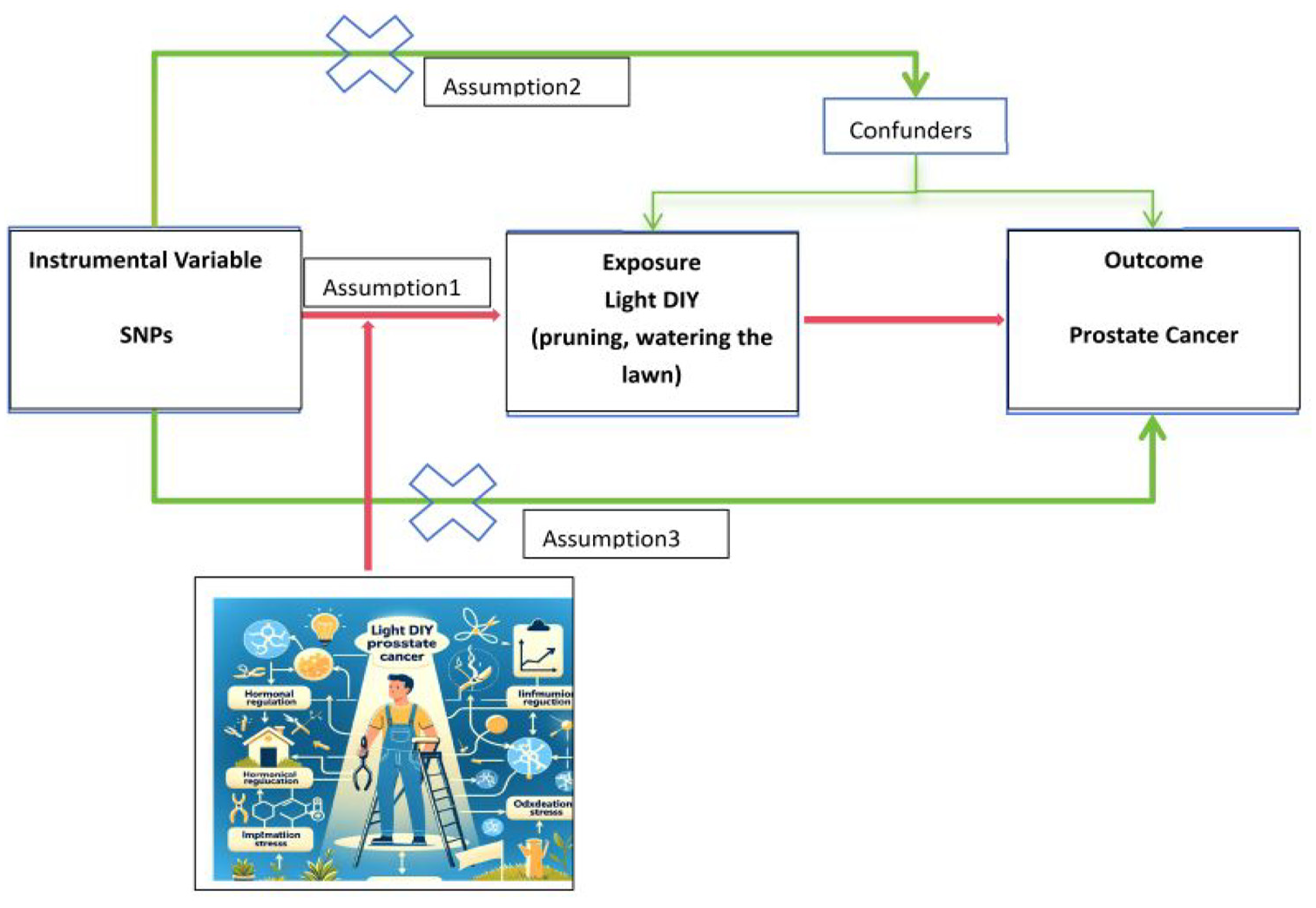
Explore the role of light DIY activities in prostate cancer
Data Sources
The data for light DIY activities used in this study were derived from published UK Biobank data, comprising 460,376 participants and 9,851,867 SNPs. GWAS summary statistics for prostate cancer were obtained from the UK Biobank database, involving 462,933 participants and the same number of SNPs. Since this study is based on publicly available database information, it does not require additional ethical approvals or informed consent.
Selection of Appropriate IVs
To ensure that the selected IVs meet the three core assumptions of MR studies, we adopted a series of rigorous screening steps. First, we identified independent SNPs significantly associated with light DIY activities (p-value < 5 × 10⁻⁸) from the GWAS data. Second, we used the PLINK software clumping method to exclude SNPs with high-linkage disequilibrium (r2 < .001, kb = 10,000) (Marsh, 2022). If the target SNP was not found in the outcome GWAS, we sought substitute SNPs with high-linkage disequilibrium (r2 > .8). Finally, we harmonized the exposure and outcome datasets, removing ambiguous SNPs with inconsistent alleles and those with intermediate allele frequencies (Kaplan et al., 2021).
MR Analysis
In this study, we applied various complementary MR methods to validate the robustness of our experimental results, including inverse-variance weighting (IVW), MR-Egger regression, weighted median (WM), simple mode, and weighted mode methods. On detecting heterogeneity, we employed a random-effects model to mitigate the impact of heterogeneity on the results. In addition, we used the WM method to adjust for potential biases arising from the traditional mean approach. The IVW method was used as the primary analytical tool (Zuber et al., 2020), while the WM and MR-Egger methods served as supplementary analyses to explore potential biases due to invalid IVs or pleiotropic effects (Burgess et al., 2019). For ease of interpretation, we converted the beta values of the experimental results to odds ratios (ORs) and calculated the 95% confidence intervals (CIs).
Sensitivity Analysis
To ensure the reliability and robustness of our study results, we employed multiple sensitivity analysis methods. First, we assessed the potential horizontal pleiotropy of the IVs using the MR-Egger regression method; the intercept term in this method represents the average pleiotropic effect of the IVs (Bowden & Holmes, 2019). In addition, we conducted the MR Pleiotropy RESidual Sum and Outlier (MR-PRESSO) test, which not only detects horizontal pleiotropy but also corrects for its influence by removing outliers and evaluating whether the causal effect changes significantly before and after the removal of these outliers (Wu et al., 2020). The assessment of heterogeneity was conducted using Cochran’s Q statistic, which effectively detects the degree of heterogeneity in the analysis. To further test the robustness and consistency of our results, we performed a leave-one-out analysis. This method involves sequentially removing each IV and recalculating the results to detect the influence of any single IV on the overall analysis (Mainali et al., 2024). All sensitivity analyses were performed using the “TwoSampleMR” and “MR-PRESSO” software packages. The comprehensive use of these methods ensures the reliability of our analysis results, reduces potential biases, and strengthens our research conclusions.
Results
In this study, we explored the potential causal effect of light DIY activities on prostate cancer. Cochran’s Q test revealed some heterogeneity (Cochran’s Q = 25.859; p = .007), but MR-Egger regression analysis did not indicate significant pleiotropy (Egger intercept = −0.0002; p = .601). This suggests that while there is some heterogeneity, the validity of the IVs is not severely compromised. Given the presence of heterogeneity, we employed the random-effects IVW method for the primary analysis. The results from the random-effects IVW method indicated a positive causal relationship between participation in light DIY activities and the risk of prostate cancer (OR = 1.024, 95% CI: 1.001–1.048; p = .039). The WM method results supported this finding (OR = 1.025, 95% CI: 1.003–1.048; p = .024), further enhancing the credibility of the analysis.
In addition, the results from other supplementary analysis methods were consistent with the primary analysis, which further strengthens our confidence in this causal relationship (see Figure 2). The leave-one-out analysis demonstrated that the results were reliable and stable at all levels (Figure 3). The symmetry in the funnel plot distribution (Figure 4) indicated no significant bias among the SNPs included in the analysis, supporting the overall robustness of the analysis.

Scatter Plot of the Association Between Light DIY and Prostate Cancer

Leave-One-Out Test Plot of MR Analysis

Funnel Plot of MR Analysis Results
Discussion
This study applied MR analysis to investigate the potential causal relationship between light DIY activities and the risk of prostate cancer. The results showed that light DIY activities had a small but statistically significant positive causal effect on prostate cancer risk (OR = 1.024, 95% CI: 1.001–1.048; p = .039), indicating that individuals who engage in light DIY activities have a 2.4% higher risk of prostate cancer compared to those who do not participate in these activities.
The findings of this study suggest that light DIY activities may be a factor in increasing the risk of prostate cancer. This observation is consistent with some previous epidemiological studies, which reported a potential link between light physical activity and a slightly increased risk of prostate cancer. Other studies have not found a significant causal relationship between the two (De Nunzio et al., 2023; Moore et al., 2016; Pernar et al., 2018). These discrepancies may arise from differences in the definitions of activity types and the heterogeneity of the study populations.
Light DIY activities may influence prostate cancer through various biological mechanisms. First, light DIY activities, such as gardening, while being low-to-moderate intensity physical activities, may affect prostate cancer risk by modulating hormone levels in the body. Specifically, male hormones such as testosterone and dihydrotestosterone (DHT) play crucial roles in the development of prostate cancer (Perreault et al., 2023; Zouhal et al., 2022). Although the specific mechanisms and the impact of activity intensity are not fully understood, some studies suggest that moderate-to-high intensity physical activity can lower circulating testosterone levels, while the effect of light activity is less pronounced (Cupka & Sedliak, 2023). This may explain why light DIY activities are associated with a slight increase in prostate cancer risk, potentially due to insufficient intensity to significantly regulate relevant hormone levels. Chronic inflammation is considered an important factor in cancer development, including prostate cancer. Physical activity is thought to reduce systemic inflammation by lowering levels of inflammatory markers. For example, light-to-moderate intensity activities have been shown to decrease the levels of C-reactive protein and interleukin-6 (Huang et al., 2023; Isanejad et al., 2023; Querido et al., 2022). The anti-inflammatory effects of light DIY activities might be weak, possibly insufficient to provide cancer prevention benefits. Further research is needed to determine their effects at different activity intensities. In addition, the intensity and type of activity may affect oxidative stress levels and potential DNA damage. Although moderate exercise is known to enhance antioxidant defense mechanisms, excessive or insufficient activity may lead to the accumulation of free radicals, increasing the risk of DNA damage and mutations, which are key drivers of cancer development (Alizadeh Pahlavani et al., 2022; Han et al., 2022; Kim et al., 2021). The regulatory effect of light DIY activities in this regard is complex and may depend on activity frequency and duration. Finally, light DIY activities might be associated with certain lifestyle choices, such as outdoor activities and healthy dietary habits, which could themselves influence prostate cancer risk. Individuals engaging in these activities may adopt healthier lifestyle choices in other areas, such as reduced smoking and alcohol consumption and better sleep quality. These combined factors might further complicate the relationship between light DIY activities and prostate cancer risk (Ballon-Landa & Parsons, 2018; Carmack Taylor et al., 2006; Hackshaw-McGeagh et al., 2015).
Despite employing an MR design to reduce the impact of confounding factors, this study has several limitations. First, the selection of genetic IVs may be constrained by the available genetic data, which could affect the generalizability of the results. Second, although the statistical results are significant, the effect size is relatively small, suggesting the need for further validation in larger samples and diverse populations. In addition, the data used in this study primarily come from the individuals of European ancestry, and thus the applicability of the results to other races and ethnic groups remains to be confirmed.
Conclusion
This study indicates that participation in light DIY activities may slightly increase the risk of prostate cancer. This finding underscores the need to carefully consider the types and intensities of physical activities when making public health recommendations and personal lifestyle choices. Given the significant threat prostate cancer poses to men’s health, the results of this study provide a scientific basis for developing evidence-based prevention strategies. Future health guidelines should more precisely differentiate between different types and intensities of physical activities to optimize their benefits for prostate health. Understanding how various physical activities affect prostate cancer risk will aid in offering more personalized and effective preventive recommendations.
Footnotes
Acknowledgements
The authors thank the PGC and FinnGen consortium for sharing the summary-level GWAS data.
Declaration of Conflicting Interests
The author(s) declared no potential conflicts of interest with respect to the research, authorship, and/or publication of this article.
Funding
The author(s) disclosed receipt of the following financial support for the research, authorship, and/or publication of this article: This work was supported by the 2023 Beijing Municipal Commission of Education Connotation Development-Talent Team-2022 Teaching Master Teachers (Project Code:145123004) and the study of functional training methods to improve balance and control in IQ-foil windsurfers (Contract number:378).
Data Availability Statement
The original contributions presented in the study are included in the article, and further inquiries can be directed to the corresponding author.