



Abstract
This study aimed to compare the effects of an acute bout of small-sided soccer game (SSG) and sprint exercise on attention, mood, and enjoyment in untrained adolescent boys. Eighteen adolescent boys aged 13–15 years participated in a counterbalanced order intervention: 1—No-training control condition (CONTROL), 2—SSG (SOCCER), and 3—Repeated sprint (SPRINT) sessions. Before and after the sessions, all participants completed the revised d2-test of attention and a mood assessment (i.e., Brunel mood scale [BRUMS]). Rating of perceived exertion (RPE) and perceived enjoyment (i.e., physical activity enjoyment scale) were evaluated after each session. A 3 × 2 repeated measures analysis of variance with contrast-coded test was used to analyze the data. Attentional test performance increased from pre- to post-exercise intervention for both SOCCER and SPRINT (main effect of Phase, F = 40.81, p < .001, ηp2 = 0.48), compared with the CONTROL. BRUMS scores did not change for any of the interventions. RPE was significantly lower after SOCCER compared with SPRINT (t = 3.05 [3.20–7.18], p < .001, ηp2 = 0.46). SOCCER was perceived to be significantly more enjoyable compared with SPRINT (p = .03) and CONTROL (p < .001). To conclude, an acute bout of exercise based on SOCCER or SPRINT exercise was beneficial for adolescent boys’ attention, with significantly better enjoyment reported after the SOCCER session, whereas we did not observe any mood effects.
Introduction
Presently, prevailing patterns in exercise-cognitive research strongly suggest that engaging in immediate physical activity proves beneficial for cognition, specifically enhancing attention capabilities (de Sousa et al., 2019). Physical activity has significant benefits for the elderly, as it helps slow down cognitive deterioration associated with aging (Tanaka et al., 2009). Increased cognitive abilities, including attention, have a profound impact on adolescence, influencing the growth and development of the pediatric population. It is believed that optimal cognitive functioning during these stages leads to better psychosocial adjustment, improved environmental adaptation, and greater performance in various academic and social tasks (Lubans et al., 2016). The effect of physical activity on cognitive functioning varies depending on the tested cognitive performance, age, exercise type, intensity, duration, and participants’ fitness (Chang et al., 2012; de Sousa et al., 2019). Although positive findings are frequently and clearly documented in samples of children and adults, research involving adolescents is relatively uncommon, and the effects are less consistent. For instance, Budde et al. (2008) and Hogan et al. (2013) identified improved attention performance following an acute bout of aerobic exercise. However, Hogan et al. (2013) and Stroth et al. (2009) reported no such effect after the same type of exercise. In addition, Altermann and Gröpel (2023) demonstrated that attentional test performance was improved following endurance, strength, and coordination exercise programs. The majority of studies investigating the perceptual and cognitive responses to acute exercise bouts have primarily focused on simple physical activities such as walking, jogging, and coordination exercises (Hillman et al., 2009; Kao et al., 2018). Little is known about the acute consequences of sports participation even though few studies have demonstrated promising preliminary findings (Ishihara et al., 2017; Lind et al., 2019). Team sports, in particular, and sports in general, demand decision-making and complex motor control in dynamic environments, fostering collaborative social relationships. Team sports are motivating and emotionally exciting compared with traditional exercises (Hammami et al., 2017a; Lind et al., 2019).
During the decade 2013–2023, research has emphasized the health benefits of repeated sprints and small-sided soccer games (SSG) (i.e., a form of soccer where the number of players on each team is reduced from the standard 11 players per side to a smaller number, such as 5v5 [five players on each team] or 6v6 [six players on each team]), for inactive adults, encompassing both healthy participants and patients (Hammami et al., 2017a; Krustrup et al., 2010). First, SSG holds the potential to elicit higher exercise intensities with reduced perceived effort compared with continuous exercises (Hammami et al., 2017b). This supports its application as a means to promote health and elevate physical activity levels among inactive adults. Soccer ranks as the most popular team sports globally, and SSG (such as 3v3, 5v5) offer a viable alternative that is well suited for school settings and playgrounds (Krustrup et al., 2010). The simplicity of implementing SSG at schools, combined with high levels of participation among boys and girls, irrespective of prior soccer experience or body mass index, further highlights its potential (Bendiksen et al., 2014; Lind et al., 2019). SSG present a fitting activity to foster positive experiences and active engagement. Repeated sprint exercises constitute a training approach that triggers substantial neuromuscular and metabolic stress, with significant involvement of the aerobic system, while being relatively similar to SSG (Glaister, 2008). It offers an appealing training strategy in contrast to continuous aerobic running or cycling exercises, which are often perceived as more monotonous (Gharbi et al., 2014).
Considering that adolescents experience frequent external distractions, researchers need a deeper understanding of how to effectively enhance their capacity to concentrate. One potential approach is through engaging and motivating physical activities, such as SSG (Budde et al., 2008). As of September 2023, little is known about the attention, mood, and enjoyment responses to recreational soccer in untrained adolescents. As interest in the health benefits of recreational soccer training continues to grow, this study aims to investigate the acute effects of SSG and sprint on attention, mood state, enjoyment, and perceived exertion in a group of healthy but sedentary adolescent boys.
Population and Methods
Participants and Sample Size
The study was conducted using a randomized counterbalanced design in January and February 2023 in the region of Zaghouen, Tunisia. Adolescent boys between the ages of 13 and 15, hailing from the same region and school, were recruited on a voluntary basis through a school announcement. Selection was made according to their availability within their respective schedules. To be included, all participants had to be healthy, not suffering from any kind of acute or chronic diseases, and not receiving any medical treatment. Participants had not to be involved in regular physical activity for at least 2 years except for their school physical education program. All participants indicated that they had prior experience playing soccer, either at school or in informal settings such as the street. In addition, 30% of the participants reported that soccer was not their preferred sport. All participants were fully informed of the risks and discomforts associated with the experimental procedures and their parents signed informed consent providing authorization to participate in the study. The protocol of the study conformed to the declaration of Helsinki for human research, and the study was approved by the Ethical Committee of the Faculty of Medicine of Sousse, Tunisia.
The sample size was appraised using the standard deviation (SD) and accuracy of estimate (d) based on the study conducted by Altermann & Gröpel (2023) comparing different acute exercise interventions on concentration performance during the d2 test. The appraised sample size gives a sample of 20 participants. The assumption of 20% for the non-inclusion gives a revised sample of 25 participants.
Procedure
The present study followed a within-group counterbalanced design, including three experimental interventions and two different times of assessment. Before and immediately after each session, all participants underwent a cognitive performance test (d2 test) (Brickenkamp et al., 2002) and filled in the mood questionnaire, the Brunel mood scale (BRUMS) (Terry et al., 2003). The rating of perceived exertion (RPE) (Borg et al., 1998) and physical activity enjoyment scale (PACES) (Motl et al., 2001) were assessed after each intervention.
Participants completed all the intervention sessions in a counterbalanced order on different days. A minimum resting period of 48 hr and a maximum of 60 hr were allotted between each pair of sessions, in accordance with the school schedule. The three sessions were counterbalanced to eliminate the potential confounding factor of order-related learning effects. The sessions included a resting control session (CONTROL), a SSG session (SOCCER), and a repeated sprint running session (SPRINT). Both exercise sessions started with brief dynamic warm-up (5 min: jogging plus active dynamic stretching) followed by an exercising session (20 min). The CONTROL session consisted of a 25-min indoor-rest period. During this session, students remained seated in the classroom, and were encouraged to review their school lessons or engage in reading activities (i.e., books). Students had the option to choose books from the school small library, and they were free to select books of their preferred difficulty level. A physical education teacher supervised the students during this activity. All sessions and measurements were performed at the same time of day (Jarraya & Jarraya, 2019), and at ambient temperature ranging from 11 to 18 °C.
Anthropometric and Maturity Assessment
Body mass and height were measured under standard conditions with minimal clothing. Age at peak height velocity (PHV) was used as an indicator of maturity, representing the time of growth spurt during adolescence. The PHV was calculated using sex-specific equations based on anthropometric measures (i.e., body mass, height, leg length, sitting height; Mirwald et al., 2002).
SSG Session
During the SOCCER session, participants performed two sets of SSG using a 5v5 or 6v6 format, interspersed with two minutes of passive rest in-between (approximately 25 min total times, [Hammami, et al., 2017b]). The pitch size increased from 30 × 15 m to 40 × 20 m. Participants were asked to maintain high exercise intensity during each training session and to avoid intensive or forceful contact and movements to prevent injuries. Participants were consistently provided with verbal encouragement and instructions to ensure they sustained a high level of intensity throughout the games. In addition, there was an ample supply of soccer balls readily accessible to minimize any disruptions in play caused by the need to retrieve the ball. This proactive approach aimed to maintain the flow and intensity of the games.
Repeated Sprint-Running Session
Participants performed three sets of five repetitions of 40-m sprints with a 180° change of direction (20+20 m [Buchheit et al., 2007)). Twenty seconds of recovery were allowed between sprints and 4 min between the sets. The session lasted approximately 25 min, including the warm-up duration.
Attention Assessment
Attention was measured with the revised d2-test of attention (Brickenkamp et al., 2002). Participants’ task was to search each row of letters for d’s with two dashes either above or below them and cross them out while refraining from responding to seductively similar stimuli (e.g., a d with three dashes, or a p with two dashes). Each row consisted of 57 items, and participants had a time limit of 20 s per row. They were instructed to work as fast and accurately as possible (Altermann & Gröpel, 2022).
The d2 test’s outcomes were concentration performance and the total number of errors. Concentration performance is measured by the number of correctly crossed-out d2-symbols minus the number of incorrectly crossed-out symbols. The total number of errors is computed as the number of errors made by participants in not being able to properly identify a d2 symbol, plus the number of errors made by incorrectly crossing out symbols that are not d2. Of note, if the concentration performance increased post-intervention compared with pre-intervention, the level of visual attention is considered good, and the inverse holds for the total number of errors (Altermann & Gröpel, 2022).
Rating of Perceived Exertion
At the end of each session, participants were administered the RPE scale. The latter ranged between 0, indicating “no perceived effort” (i.e., rest) and 10, indicating “maximal perceived effort” (i.e., “the most stressful exercise ever performed” (Borg, 1998)).
Physical Activity Enjoyment Scale
Enjoyment level after each intervention was evaluated using a modified and validated PACES (Motl et al., 2001). This questionnaire includes 16 items concerning different aspects of enjoyment, which are rated according to a 5-point Likert-type scale. The sum of scores was used for analysis.
Mood Assessment
An Arabic language version of the modified BRUMS was used to assess mood state (Terry et al., 2003) and involved participants responding to the question “How do you feel right now?” immediately at the end of each session. BRUMS is divided into six sub-scales with a total of 24 items: namely, fatigue, anger, vigor, confusion, depression, and tension. The items are graded on a 5-point Likert-type scale (from 0 = not at all to 4 = extremely), and the raw score of each sub-scale, consisting of four relevant items, ranges from 0 to 16.
Statistical Analysis
Descriptive statistical analyses were conducted by calculating the means and standard deviations for each of the parameters under study. The normality of data distribution was verified by carrying out the Shapiro–Wilk test, which was preferred over other statistical tests, given the small sample size utilized in the present investigation. Paired Student’s t-tests and ANOVA or their non-parametric versions, based on the normality of data, were conducted to identify differences, if any, (
All statistical analyses were performed by means of the commercial software SPSS version 24.0 (IBM, Armonk, NY, USA). Only those results with p-values <0.05 were considered statistically significant.
Results
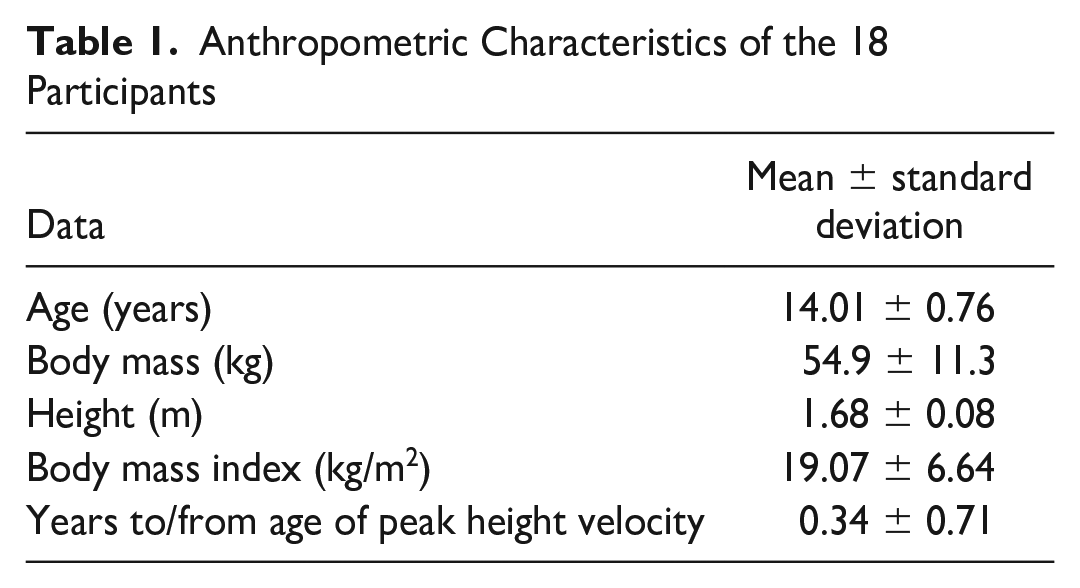
A total of 25 untrained adolescent boys started the experimentation, and only 18 participants completed all testing sessions, and were included in final analysis. Characteristics of the 18 participants are presented in Table 1.
Anthropometric Characteristics of the 18 Participants
SOCCER was perceived to be more enjoyable compared with CONTROL (diff = 12.45, p = .003, [3.68–21.21] and SPRINT (diff = 9.63, p = .05, [−0.18 to 19.43]. (F = 7.05, p = .003, ηp2 = 0.28).
Participants reported higher RPE during the SPRINT intervention compared with SOCCER (t = 3.05 [3.20–7.18], p < .001, ηp2 = 0.46).
Attentional scores of the intervention and control conditions are displayed in Table 2. Concentration performance score increased significantly from pre-intervention to post-intervention for both SOCCER and SPRINT conditions (main effect of Phase, F= 40.81, p < .001, ηp2 = 0.48), with no significant change in CONTROL. There was a significant interaction, F = 3.14, p = .05, ηp2 = 0.12, indicating that the improvement in concentration varied across conditions. The main effect of the conditions on concentration performance was not significant.
Attention Performance During the d2 Test Pre- and Post- Each Intervention (N = 18)

Note. Data were mean ± standard deviation. CONTROL = no-training control condition; SOCCER = 2—small-sided soccer games; SPRINT = repeated sprint session; ANOVA = analysis of variance; p = phase; η2 = effect size; G = group; P × G = phase × group interaction.
Significantly different from pre-intervention (p < .05).
Total error score decreased significantly from pre-test to post-test for both SOCCER and SPRINT conditions (main effect of Phase, F = 16.96, p < .001, ηp2 = 0.30), with no change for CONTROL. There was a non-significant interaction, F = 1.53, p = .22, ηp2 = 0.07 or condition effect on total error score (F = 1.99, p = .15, ηp2 = 0.09).
For BRUMS scale, all sub-scales, including anger, confusion, depression, fatigue, tension, and vigor, did not significantly change among phases (pre-to post-intervention) under the different conditions (all the p-value >0.05 for Phase, group, and interaction effects) (Table 3).
Brunel of Mood Sub-Scales Pre- and Post-Intervention (N = 18)

Note. Data were mean ± standard deviation. CONTROL = no-training control condition; SOCCER = 2—small-sided soccer games; SPRINT = repeated sprint session.
Discussion
To the best of the authors’ knowledge, this is the first study evaluating acute selective attention responses to a sport activity in untrained adolescent boys. We identified that an acute bout of exercise based on SOCCER and SPRINT was beneficial for attention in untrained adolescent boys. We observed better enjoyment and lower exertion after the SOCCER session, with no effects on the mood.
Effects on Attention and Mood
Nowadays (i.e., year 2023), adolescents experience frequent external distractions (Stawarczyk et al., 2014), which calls for school interventions to promote the ability to concentrate in school students (Altermann & Gröpel, 2023; Budde et al., 2008). During the last decade (i.e., 2013–2023), a growing body of research has reported the positive effects of organized SSG training on health indicators and physical fitness (Hammami et al., 2017a). Although there is evidence demonstrating the efficacy of SOCCER training as a strategy to improve health status, specific research about the acute perceptual and attentional responses is scarce, especially in the pediatric populations. Knowledge of the effects of exercise training on such parameters is crucial to improve health-oriented physical activity interventions, especially concerning sedentary participants. This would inform school managers and teachers to better incorporate SSG exercise-related breaks into their school plans and improve the physical education curriculum.
We further demonstrated that both the SOCCER and SPRINT sessions significantly improved concentration performance and total errors as compared with the control. It has been reported that sports, in general, and team sports specifically require decision-making and complex motor control in a dynamic environment, which additionally involve collaborative social interactions (Hammami et al., 2017b; Lind et al., 2019). At the same time, they can be motivating and emotionally stimulating, and these could be key factors influencing the cognitive improvements and may explain the current findings (Diamond & Ling, 2019). The present results are somewhat in line with earlier studies demonstrating a positive effect of acute exercise on cognitive function and attention. For example, it has been demonstrated that both moderate- and high-intensity exercise increase cognitive function after acute aerobic, strength, and intermittent exercises (Alves et al., 2012; Dupuy et al., 2018). Our results align with some findings suggesting acute improvements in response time-based indices of inhibitory control after high-intensity SSG (Lind et al., 2019).
The present study did not identify any significant changes in any sub-scale of the BRUMS test assessed for the three conditions. In general, literature reports evidence that regular participation in physical activity has beneficial physiological and psychological effects (Frith & Loprinzi, 2018, Loprinzi & Kane, 2015). It has been demonstrated that acute resistance exercise and moderate intensity exercise were able to improve the mood state assessed by the BRUMS testing (Znazen et al., 2021, 2022). In our study, the absence of significant change in mood after both exercises could be explained by some reasons. First, one previous study has speculated that individuals may derive greater positive mood changes pre- to post-exercise when they are permitted to self-select the duration and intensity of aerobic exercise (Annesi, 2003). Second, long-term engagement in physical activities performed at moderate intensities is suggested to facilitate the durability of enhanced mood states, beyond effectual responses to repeated bouts of higher intensity exercise (Annesi, 2003). Finally, 30 min of exercise’ session duration may be insufficient to induce mood changes, and this warrants further investigation.
Effects on Exertion and Enjoyment
Although both exercises significantly improved selective attention, the SOCCER condition was significantly better at increasing PACES scores and was associated with a significantly lower RPE. It has been reported that motivation represents an important component to start doing physical activity; it is the first step and is particularly important in children and adolescents because they are strongly influenced by motivation and enjoyment of physical activity (Seabra et al., 2013). Recreational soccer training has been acknowledged as an effective tool for enhancing adherence to physical activity in untrained individuals. It represents a social activity that produces larger improvements in maximal oxygen uptake than continuous moderate-intensity endurance running or strength training (Milanović et al., 2015).
Our findings suggest that SOCCER was superior to SPRINT exercise and should be considered as an effective strategy for replacing traditional continuous exercise regimens, in order to counteract the lack of motivation, which is a key component in physical inactivity. Our results also suggest that the inferior fatigue perception during SOCCER is related to a higher level of enjoyment in practicing soccer than performing repeated sprints. Differences in fatigue perception could possibly be due to either physiological issues, such as the proportion of aerobic-anaerobic metabolism, or a combination of physiological and motivational aspects, such as the existence of goals to score and collective competition. Obviously, further research is warranted to evaluate these speculations.
The present study has five limitations. First, our results should be interpreted considering the “limited” sample size. Second, the lack of neuropsychological functions assessment variables beyond performance on the d2-test makes it difficult to issue a generalized statement of changed cognitive functions. However, the d2-test performance, as used in the current study, is known to be a measure of response inhibition and executive functions (Lendt et al., 2002) and to be related to school performance (Brickenkamp et al., 2002). Third, it is conceivable that the observed enjoyment effects may be attributed to the self-selection of participants within this study. Consequently, this could potentially restrict the extent to which the findings can be generalized. Fourth, the incentive for participating in this study was the opportunity to contribute to research in the field and potentially make a positive impact on the understanding of the subject matter. Since there have not been a specific monetary or material incentive, participants may have been motivated by a sense of curiosity, the desire to help advance knowledge. The final limitation pertains to the potential influence of the attention restoration theory (Hartig et al., 1991), which posits that individuals can enhance their concentration abilities after spending time in a natural environment or even by observing natural scenes. In our study, as the reading activity was conducted indoors and the physical exercise was performed outdoors, it is conceivable that being in the outdoor environment might have boosted attention without any direct correlation to physical exercise. Existing evidence supports the idea that being in a natural setting can indeed produce this attention-enhancing effect (Hartig et al., 1991). This limitation raises the possibility that the observed improvements in attention might be attributed, at least in part, to the natural surroundings rather than solely to the exercise component of the study.
Practical Recommendations
SSG are a feasible alternative that is well suited for school settings, with variations naturally occurring in school playgrounds during break times. SSG are easily implemented in school settings, and active participation is generally high both for boys and girls irrespective of prior soccer experience and body mass index. In addition, our results support the request for more short bouts of exercise in schools with a focus on SSG, as acute, as well as long-lasting positive effects on health and cognitive improvement, have been demonstrated. The provision of a daily physical education lesson would be justified, as adolescents seem to benefit from sport not only physically but also cognitively.
Conclusion
Our study demonstrated that an acute bout of exercise based on SSG or SPRINT exercise was beneficial for adolescent boys’ attention, as assessed with the d2 test, with significantly better enjoyment reported after the SOCCER session. However, no mood effects were observed.
Footnotes
Acknowledgements
The authors would like to thank all the participants and adolescents who participated in the present study. Furthermore, the authors extend their heartfelt appreciation for the invaluable support rendered by the language model, ChatGPT, in enhancing and refining the scientific prose of this article (Dergaa et al., 2023).
Declaration of Conflicting Interests
The author(s) declared no potential conflicts of interest with respect to the research, authorship, and/or publication of this article.
Funding
The author(s) received no financial support for the research, authorship, and/or publication of this article.
Ethical Approval
The Ethical Committee of the Faculty of Medicine of Sousse, Tunisia. Ref: CEFMS (178/2023).
