



Abstract
The study explored the clinical efficacy of a type 5 phosphodiesterase inhibitor (PDE5i) combined with Ziyin Baihuo granules in the treatment of patients suffering from erectile dysfunction (ED) with yin deficiency and fire-hyperactivity syndrome. A total of 163 patients with erectile dysfunction were divided into observation and control groups. The observation group took tadalafil (Cialis) and Ziyin Baihuo granules orally, and the control group took only tadalafil orally, for 12 weeks. An additional 40 healthy people were selected as a normal group for comparison of the sex hormone levels before and after treatment of the participants in the erectile dysfunction group. After treatment, the symptoms of dry throat and tongue, tidal fever and night sweats, liking cold and avoiding heat, and waist pain showed significant improvement in the observation group (p < .05). Compared with before treatment, the clinical indexes of erectile function in the control group and the observation group were improved after treatment (p < .05). After treatment, Ziyin Baihuo granules combined with tadalafil restored the abnormal indexes of blood (p < .05) in the observation group. Our research shows that PDE5i combined with Ziyin Baihuo granules could effectively improve erectile function.
Keywords
Introduction
The most commonly used treatment for erectile dysfunction (ED) is small daily doses of a type 5 phosphodiesterase inhibitor (PDE5i). Although the inbibitors’ clinical efficiency ranges between 75% and 80% (Wang et al., 2019), they are not completely effective and their side effects can impact the therapeutic effects in some patients (Lowe & Costabile, 2012). The combined application of traditional Chinese and Western medicines is often used in clinical practice to improve the treatment of ED and to reduce the incidence of side effects (H. S. Li et al., 2015). The rational application of traditional Chinese medicine (TCM) requires the correct dialectic. The First Affiliated Hospital of Zhengzhou University employs modern medical testing and traditional Chinese medical syndromes to observe the curative effects and blood biochemical changes resulting from a PDE5i (Cialis) combined with Ziyin Baihuo granules in the treatment of males with ED related to yin deficiency and fire-hyperactivity syndrome, thereby exploring diagnoses based on the combination of traditional Chinese and modern Western medicines. A report on this process follows below.
Materials and Methods
Study Design
The study was a randomized, double-blind, controlled trial of a PDE5i combined with Ziyin Baihuo granules in the treatment of ED. The study was approved by the Medical Ethics Committee of the First Affiliated Hospital of Zhengzhou University (No. 2022-KY-0148-002). The 163 patients with ED due to yin deficiency and fire-hyperactivity syndrome according to TCM diagnosis were randomly assigned to treatment for 12 weeks with tadalafil and Ziyin Baihuo granules orally (96 patients) or tadalafil only (67 patients). All participants signed informed consent.
Clinical Data
A total of 163 patients with ED due to yin deficiency and fire-hyperactivity syndrome were identified from February 2018 to January 2020 at the First Affiliated Hospital of Zhengzhou University, China. The age of the participants ranged from 18 to 45 years, with an average of 29.09 ± 6.60 years. The course of the disease was 0.5 to 6.4 years, with an average of 2.8 years. An additional 40 healthy individuals were selected as normal controls; the age range in this group was 21–38 years with an average of 28.46 ± 5.20 years. General data differences between the two groups were not statistically significant (p > .05) and were comparable. This study was approved by the Medical Ethics Committee of the First Affiliated Hospital of Zhengzhou University (No. 2022-KY-0148-002).
The Case Selection Criteria
Patients with ED who met the following criteria were recruited (H. J. Li, 2011):
(1) A 5-item version of the International Index of Erectile Function (IIEF-5) score ≤21; (2) male, aged between 18 and 45 years; (3) having a fixed sexual partner; (4) the course of disease ≥12 weeks; (5) a peak systolic velocity (PSV) of the corpus cavernosum of the penis <30 cm/s, or an end-diastolic velocity (EDV) >5 cm/s, based on penile Doppler ultrasound; (6) normal sexual desire.
Criteria for TCM Syndrome Types
Based on the syndrome differentiation, yin deficiency and fire-hyperactivity syndrome are presented as including the following: (1) the primary syndrome presents as lassitude in the loins and legs and liking cold; (2) the secondary syndrome presents as vertigo, tinnitus (or deafness), dry mouth and throat, tidal fever and night sweats (or acute fever), emaciation, insomnia and forgetfulness, loss of hair and teeth, and spermatorrhea; (3) a red, dry tongue with little or no coating and a thready, rapid pulse.
Patients with ED who met the following criteria were recruited for the study:
(1) Renal yin deficiency and fire-hyperactivity syndrome symptoms: one of the primary TCM syndrome types, among which liking cold and avoiding heat is present, as well as at least two secondary syndromes for a yin deficiency and fire-hyperactivity syndrome diagnosis; (2) the diagnostic criteria for ED; (3) all patients provided written informed consent to participate in the study.
The exclusion criteria were as follows:
(1) Patients who were not treated and examined according to the established experimental protocol; (2) patients who use any drug/related treatment method with a therapeutic effect that was also included in this experiment; (3) patients who were allergic or intolerant to the drug; (4) patients with incomplete data affecting their effective evaluation; (5) regarding the noted exclusion criteria, patients were eliminated if one term was met.
Randomization and Blinding
Eligible participants were randomly administered with the corresponding drug for 14 days. Randomization was generated centrally using an interactive web-based response system. The independent drug administrators received group information based on a random number, and then they assigned the study drug to the nurses. The mixture of drugs was prepared by the nurses in a separate room. Photophobic brown infusion bags and infusion devices for both groups were visually inspected by the pharmacy to ensure identical appearance. All the nurses had experience in performing this task and signed a confidentiality agreement concerning patient allocation. The participants, as well as all the members of the study and the health care team, were blinded to the study drug assignment. Data analysis was performed by a researcher who was blinded to patient allocation.
Obtaining the Ziyin Baihuo Granules
Ziyin Baihuo granules were used in this study (comprising medlar, Rehmannia root, chiretta, Anemarrhenae, Phellodendri Chinensis cortex, Salvia miltiorrhiza, Salvia Chinensis, Alismatis, Polyporus tuberaster, and Plantago seeds), as well as more than 20 additional traditional Chinese medicines. Production process: After washing the TCM at room temperature, it was dried for 4 h at 70°C, mixed into a powder, screened using a 1,000-mesh sieve, and sterilized by Co 60 radiation (after packaging) in a 15 g/bag for oral consumption in boiled water (encapsulation).
Administering Methods
This study is a randomized controlled trial. One hundred sixty-three patients were randomized in the observation group of 96 cases and the control group of 67 cases. The 67 cases in the control group received oral tadalafil (Cialis, Lilly; 5 mg × 14 tablets per box, taking a total of 2 boxes per patient), once per day for one course of treatment over 4 weeks. For the 96 cases in the observation group, Ziyin Baihuo granules were added (15 g once per day, mixed with boiling water) for one course of treatment over 12 weeks. As ED is a chronic condition, 12 weeks of treatment is the shortest period for treatment.
The medication was taken regularly for 12 weeks. Concurrently, we provided oral health education to patients and issued health manuals instructing them to stop smoking and consuming alcohol, maintain their regular routines, rest, control their weight, exercise regularly, and so on.
Detection Index
The testosterone (T), estradiol (E2), cortisol (CORT), thyroid-stimulating hormone, free thyroxine (FT4), free triiodothyronine (FT3), and inducible nitric oxide synthase (iNOS) concentrations were determined for all three groups. Subjects in the observation and control groups were assessed once before treatment and at 12 weeks of treatment, respectively. Fasting venous blood samples were taken from patients in the morning. The T, E2, CORT, FT4, FT3, nitric oxide (NO), nitric oxide synthase (NOS), and iNOS measurements were performed using a testosterone (TESTO) test kit (H090; Shanghai Ruichu Biotechnology, Ltd., China), an E2 test kit (H102; Shanghai Ruichu Biotechnology, Ltd.), a CORT test kit (H094; Shanghai Ruichu Biotechnology, Ltd.), an FT4 (FT4; H225; Shanghai Ruichu Biotechnology, Ltd.), a free FT3 kit (H224; Shanghai Ruichu Biotechnology, Ltd.), and an NO determination kit (enzyme method; A012-1; Shanghai Ruichu Biotechnology, Ltd.). The NOS was detected using a total test kit (R200995; Shanghai Ruichu Biotechnology, Ltd.). The iNOS was tested using an iNOS test kit (XY-(SJH)-11004; R&D Systems, USA). All assays were performed according to the kit instructions.
Efficacy and Safety Evaluation
Observation Index
The observation index before and after treatment was formulated according to the guidelines for the clinical research of new drugs in TCM (Zheng, 2002). The symptom types of TCM and clinical manifestations were also recorded before and after treatment; these included a dry throat and tongue, tidal fever and night sweats, liking cold and avoiding heat, waist pain, dry stools, scanty yellow urine, dysphoria with feverish sensations in the chest, palms and soles of the feet, a red tongue with a thin coating, and a thready, rapid pulse.
Efficacy Indicators
All selected subjects were tested for the following indicators before and after treatment: (1) IIEF-5 score—full recovery of erectile function; total score ≥22 after drug administration, a significant effect indicating a total score increase of ≥5, a positive effect indicating a total score increase of 2–4, no effect indicating a total score increase of ≤1; (2) Erection Hardness Score; (3) hemodynamic parameters of the corpus cavernosum of the penis (PSV, EDV, RI [resistance index]); (4) the frequency of a morning erection; (5) duration of and erectile hardness during sexual intercourse. Participants were followed up once a month during the period. The follow-up process included checking whether participants experienced adverse reactions to the medication, whether the medication was taken regularly, and whether they had experienced an improvement in their sex life.
Safety Observations
We observed participants’ routine blood indicators, liver function, renal function, and fasting blood glucose levels before and after treatment, as well as any adverse reactions after treatment.
Statistical Analysis
The SPSS Statistics 20.0 software program was used to conduct statistical analysis. The two sets of binary data were compared using a chi-square (χ2) test or Fisher’s exact probability method, depending on the study conditions. Because the measurement data did not conform to a normal distribution, paired or unpaired Mann–Whitney U tests were adopted; p < .05 indicated statistical significance.
Results
Patients’ Characteristics at Baseline
The 96 patients in the observation group were 18 to 45 years old, with an average age of 28.09 ± 6.50 years. The disease course was between 0.5 and 6.1 years with an average of 2.7 years. The 96 cases included 23 cases of mild ED (23.9%), 54 cases of moderate ED (56.3%), and 19 cases of severe ED (19.8%). The 67 patients in the control group were 20 to 46 years old with an average age of 30.5 ± 6.90 years. The disease course was between 0.5 and 6.4 years with an average of 2.9 years. Among the control group, participants were 17 cases of mild ED (25.4%), 38 cases of moderate ED (56.7%), and 12 cases of severe ED (17.9%). There were no differences in the general clinical data between the two groups (p > .05).
Comparison of Efficacy Between the Two Groups
After 12 weeks of treatment, of the 96 patients 90 cases were completed in the observation group and six cases were shed (shedding rate of 6.3%). In the control group, 57 cases were completed and 10 cases were shed (shedding rate of 14.9%). The shedding rate in the control group was higher than that in the observation group (14.9% vs. 6.3%). Total efficacy was 71.9% in the control group and 85.6% in the observation group. The difference was statistically significant (χ2 = 4.091, p < .05). The results are presented in Table 1.
Comparison of Efficacy Between the Two Groups.
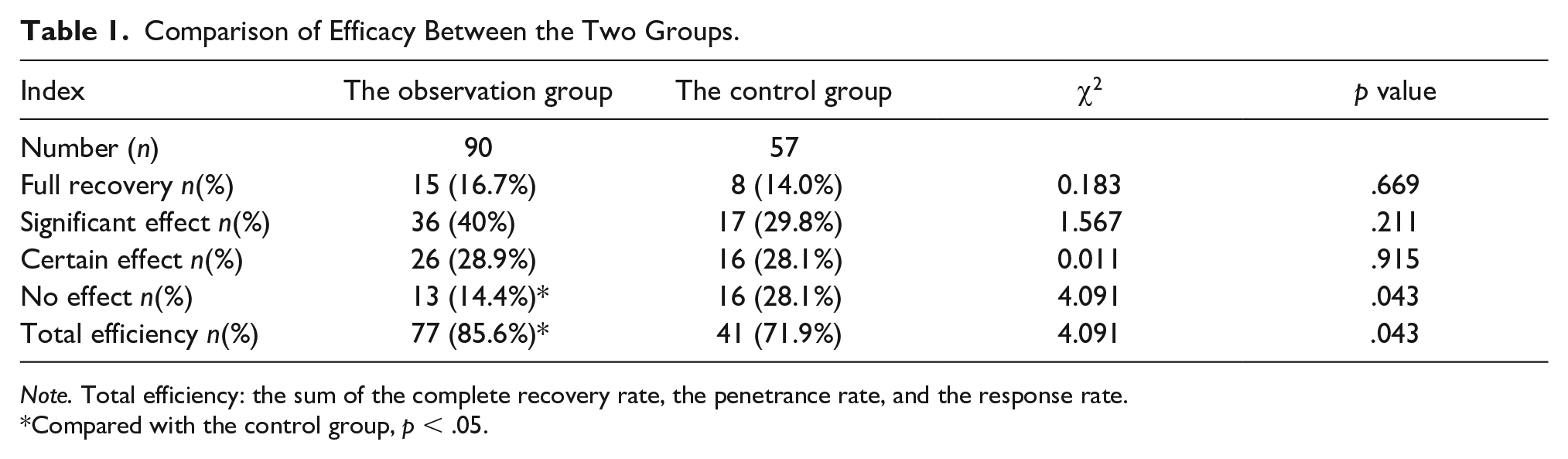
Note. Total efficiency: the sum of the complete recovery rate, the penetrance rate, and the response rate.
Compared with the control group, p < .05.
Comparison of Incidence of Clinical Symptoms of Yin Deficiency and Fire-Hyperactivity Syndrome in the Two Groups Before and After Treatment
Before treatment, there was no significant difference in the clinical symptoms of yin deficiency and fire-hyperactivity syndrome between the two groups (all p > .05). After treatment, the symptoms of dry throat and tongue in the observation group decreased significantly from 35.4% to 17.8% (χ2 = 7.353, p < .05). The symptoms of tidal fever and night sweats decreased significantly from 51% to 11.1% (χ2 = 34.197, p < .05). The symptoms of liking cold and avoiding heat decreased significantly from 88.5% to 38.9% (χ2 = 33.104, p < .05). The symptom of waist pain decreased significantly from 12.5% to 8.9% (χ2 = 0.631 p < .05). There was no significant improvement in the symptoms of dry stools and scanty yellow urine (all p > .05). In contrast, the clinical symptoms of yin deficiency and fire-hyperactivity syndrome were not significantly different in the control group before and after treatment (all p > .05). Ziyin Baihuo granules have a positive effect on the improvement of clinical symptoms of yin deficiency and fire-hyperactivity syndrome (Table 2).
Comparison of Incidence of Clinical Symptoms of Yin Deficiency and Fire Hyperactivity in the Two Groups Before and After Treatment.

Note. Compared with before treatment *p < .05. Compared to the control group #p < .05.
Comparison of Clinical Indicators Between the Two Groups Before and After Treatment
Compared with those before treatment, the clinical indexes of erectile function in the control group and the observation group showed improvement after treatment (all p < .05). The comparison between the groups after treatment showed that the time of sexual life, IIEF-5, PSV, and EDV indexes of the observation group were better than those of the control group. It is speculated that Ziyin Baihuo granules assist tadalafil in the treatment of ED (Table 3).
Comparison of Clinical Indicators Between the Two Groups Before and After Treatment (M ± SD).
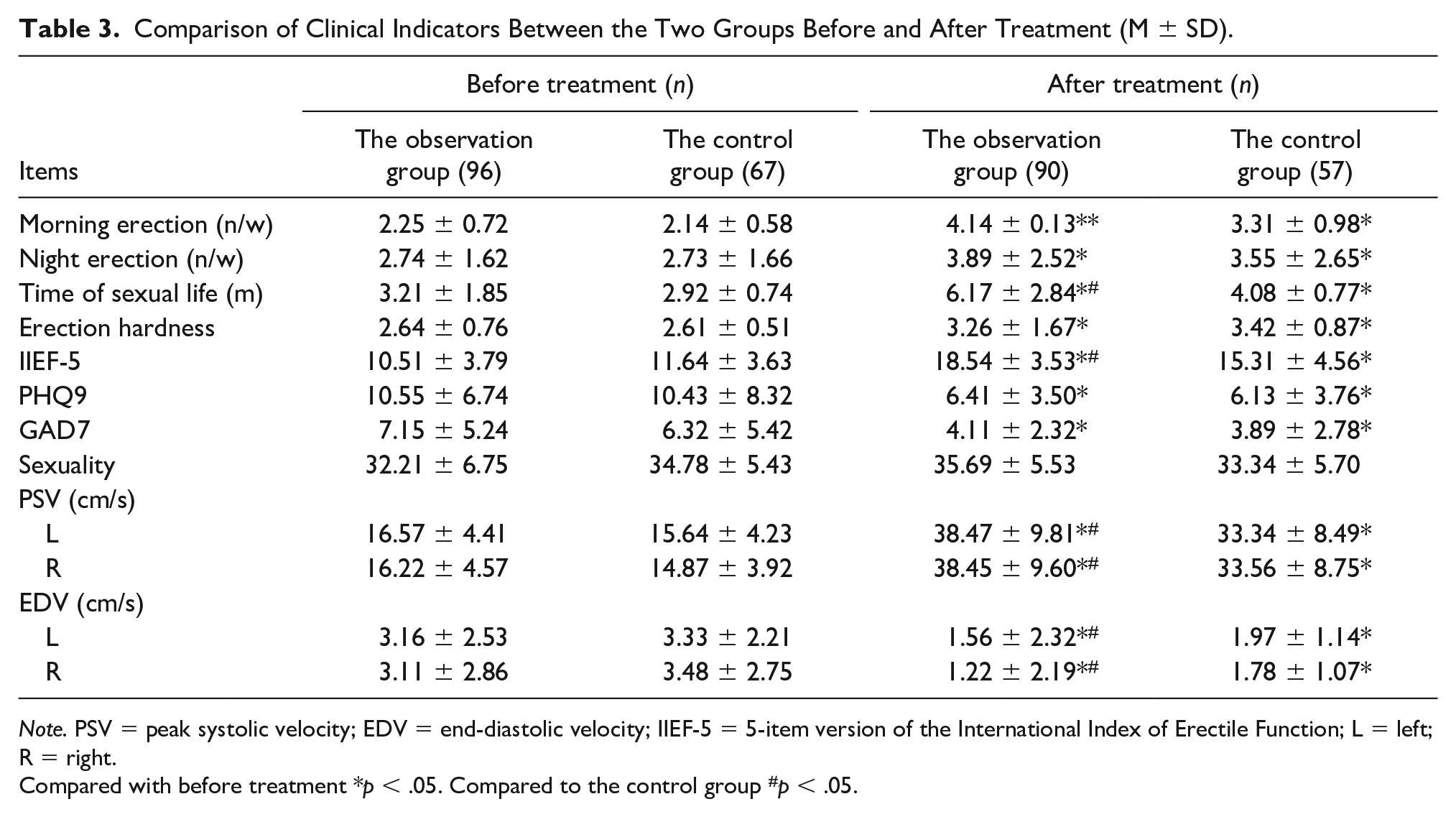
Note. PSV = peak systolic velocity; EDV = end-diastolic velocity; IIEF-5 = 5-item version of the International Index of Erectile Function; L = left; R = right.
Compared with before treatment *p < .05. Compared to the control group #p < .05.
Comparison of Blood Biochemical Metrics Between the Two Groups Before and After Treatment
Compared with the healthy subjects, the blood biochemical indexes of CORT, NO, and iNOS in patients with ED were abnormal and were generally upregulated (p < .05), The estradiol and testosterone levels were not significantly different between the two groups before and after treatment (all p > .05). After treatment, the abnormal value of blood biochemical indexes did not recover in the control group that was treated with tadalafil only. In the observation group, Ziyin Baihuo granules combined with tadalafil restored the abnormal indexes in the blood (allp < .05) (Table 4).
Comparison of Blood Biochemical Metrics Between the Two Groups Before and After Treatment and the Normal Group (M ± SD).

Note. CORT = cortisol; FT4 = free thyroxine; FT3 = free triiodothyronine; NO = nitric oxide; iNOS = inducible nitric oxide synthase; NOS = nitric oxide synthase.
Compared with before treatment &p < .05. Compared to the control group #p < .05. Compared to the normal group *p < .05.
Discussion
As one of the earliest types of PDE5i, tadalafil (Cialis) administered in daily small doses can effectively improve vascular endothelial cell function, increase blood flow in the corpus cavernosum of the penis, and improve the frequency of morning erection, erectile hardness, sexual intercourse duration, erectile function index, and clinical symptoms in patients with ED (Bansal et al., 2018; Huang et al., 2010; Wang et al., 2019). Patients’ blood flow parameters related to the corpus cavernosum of the penis (PSV, EDV) can be significantly regulated (Wang et al., 2019), which was confirmed in our study. However, in recent years, Chinese medicine syndrome–type surveys of male diseases reported that the incidence of yin deficiency and fire-hyperactivity syndrome was most prevalent (Chen et al., 2020) and affected the treatment outcomes of patients. Patients experienced symptoms that included preferring cold and avoiding heat, a dry throat and mouth, tidal fever and night sweats, dry stools, and scant, yellow urine. Some patients also experienced pain in the waist. The typical TCM diagnosis includes a red tongue with a little or thin white coating and a thready, rapid pulse. Some symptoms of yin deficiency and fire-hyperactivity syndrome are quite similar to the clinical side effects of a PDE5i, particularly a dry throat and mouth and nose spray fire (Wang et al., 2019; Wang et al., 2020a). With the application of a PDE5i, yin deficiency and fire-hyperactivity syndrome are more obvious.
By measuring the iNOS, NO, NOS, T3, T4, T, E2, and CORT scores in 163 patients with yin deficiency and fire-hyperactivity syndrome, we found that there was no difference in levels of sex hormones, thyroxine, NO, and NOS scores compared with 40 patients in the control group; however, iNO score and CORT levels were significantly higher in the test group compared with the control group, indicating that the occurrence of TCM clinical symptoms in patients with yin deficiency and fire-hyperactivity syndrome was associated with elevated iNO and CORT levels, which was consistent with the findings of existing studies (Moreira et al., 2000; Wang et al., 2020b). Previous study has shown that the incidence of reduced testosterone level (200 ng/dL < T < 400 ng/dL) in ED patients is only 7% (Aversa et al., 2019), which can explain that there was no statistically significant difference in testosterone and estradiol of patients before and after treatment.
As a subtype of NO, iNO is caused by body-tissue stress following harmful stimulation in vitro and in vivo (e.g., inflammation, hypoxia, toxic, high temperature, and harmful gases). An increase in iNO concentration will have a strong peroxidation effect (Shang et al., 2001); therefore, excessive iNO in the corpus cavernosum of the penis can make the cavernosal endothelial cell peroxidase to produce aldehyde products, which will have a toxic effect on the cavernosal endothelial cells (Todorovic et al., 2021). NO has a vasodilation effect, which typically leads to patients experiencing dry mouth and throat (Snodgrass et al., 2010). Elevated CORT will accelerate the body’s metabolism and lead to excessive sweating, which can cause scrotum dampness and other symptoms. As an inhibitor of PDE5, a PDE5i can improve the NO concentration in vivo and aggravate the symptoms of yin deficiency and fire-hyperactivity syndrome defined in TCM.
Our study has several limitations. A major limitation was that all the participants were from hospital departments in China, which may limit its application to other countries. Another limitation was the lack of a placebo control group. This may lead to doubts about the efficacy of Ziyin Baihuo granules. In the future, we will improve the experimental design to verify the accuracy of this study.
The ability of traditional Chinese drugs to reduce iNO and resist oxidation has been confirmed (Cheng et al., 2013; Han et al., 2017; Tan et al., 2017). According to experimental animal studies, the Anemarrhenae and Phellodendri Chinensis cortices effect a two-way regulation on glucocorticoids, have a protective function on the hypothalamic-pituitary-adrenal cortex (Diao et al., 2016), and help to reduce CORT secretion in vivo. In the present study, using Ziyin Baihuo granules, the blood concentration of iNOS and CORT in patients was reduced, and correspondingly, the symptom incidence of yin deficiency and fire-hyperactivity syndrome was also significantly reduced. Salvia miltiorrhiza in Ziyin Baihuo granules can reduce blood viscosity, expand blood vessels, improve blood microcirculation (L. Li & Zheng, 2020), further improve microcirculation and blood flow in the corpus cavernosum of the penis in ED patients, and also increase the oxygen content in the corpus cavernosum to improve the function of vascular endothelial cells.
Conclusion
A PDE5i, combined with Ziyin Baihuo granules, can improve the efficacy and decrease the incidence of clinical side effects of a PDE5i and increase the treatment effectiveness of patients.
Supplemental Material
sj-xlsx-1-jmh-10.1177_15579883221134753 – Supplemental material for Analyzing the Clinical Efficacy of a Type 5 Phosphodiesterase Inhibitor Combined With Ziyin Baihuo Granules in the Treatment of Erectile Dysfunction
Supplemental material, sj-xlsx-1-jmh-10.1177_15579883221134753 for Analyzing the Clinical Efficacy of a Type 5 Phosphodiesterase Inhibitor Combined With Ziyin Baihuo Granules in the Treatment of Erectile Dysfunction by Rui Wang, Wen-Gong Sun, Tian-Biao Zhang, Tao Zheng, Kun-Long Lv, Yong-Hao Nan and Wei-Xing Zhang in American Journal of Men's Health
Footnotes
Author Contributions
Conceptualization, W.R., and S.W.G.; Methodology, Z.T., and L.K.L.; Investigation, Z.T.B., Z.T., and L.K.L.; Writing—Original Draft, All Authors; Writing—Review & Editing, All Authors; Resources, Z.T.B. and N.Y.H.; Supervision, Z.W.X.
Declaration of Conflicting Interests
The author(s) declared no potential conflicts of interest with respect to the research, authorship, and/or publication of this article.
Funding
The author(s) received no financial support for the research, authorship, and/or publication of this article.
Ethics Approval
This study was conducted in accordance with the Declaration of Helsinki. This study was conducted with approval from the Ethics Committee of The First Affiliated Hospital of Zhengzhou University on January 3, 2018.
Consent to Participate
Written informed consent was obtained from all participants.

Supplemental Material
Supplemental material for this article is available online.
Availability of Data and Materials
All data generated or analyzed during this study are included in this published article.
The data that support the findings of this study are available from the corresponding author upon reasonable request.
References
Supplementary Material
Please find the following supplemental material available below.
For Open Access articles published under a Creative Commons License, all supplemental material carries the same license as the article it is associated with.
For non-Open Access articles published, all supplemental material carries a non-exclusive license, and permission requests for re-use of supplemental material or any part of supplemental material shall be sent directly to the copyright owner as specified in the copyright notice associated with the article.
