



Abstract
It is important to understand the role of social determinants, such as gender, in suicidal ideation. This study examined whether conformity to specific masculine norms, particularly high self-reliance and emotional self-control, moderated the relationship between psychological distress and suicidal ideation for men. The other norms explored were those pertaining to behavioral–emotional or social hierarchy status aspects of masculinity, and whether they moderated the psychological distress–suicidal ideation relationship for men and women. The Conformity to Masculine Norms Inventory, the Kessler Psychological Distress Scale, and the Suicidal Ideation Attributes Scale were administered to an Australian community sample in an online survey (n = 486). As predicted, higher psychological distress was associated with higher suicidal ideation. Self-reliance enhanced the relationship and was the only moderator among men. High self-reliance levels might be an important indicator of risk, which can be used when assessing and working with men who are hesitant to openly discuss suicidal ideation with clinicians. For female participants, higher endorsement of behavioral–emotional norms and lower conformity to social hierarchy status norms appear to increase suicide risk in the presence of psychological distress. Our findings suggest that high self-reliance is of particular concern for men experiencing psychological distress. It is also important to consider the roles of masculine norm endorsement in the psychological distress–suicidal ideation relationship among women.
Keywords
Suicide is a cause of death strikingly patterned by sex (Hunt et al., 2006). It has been argued that higher numbers of completed suicides in men can be explained by the use of more lethal and/or violent methods, impulsivity, and substance abuse (Hunt et al., 2006). In a psychotherapeutic context, the aforementioned behaviors are recognized as reactions to intolerable internal states, which need to be addressed to prevent suicide (Yager & Feinstein, 2017). Cibis et al. (2012) proposed that men might have a stronger intent to die which explains more lethal behavior when suicidal. Cibis et al. (2012) emphasized the importance of addressing other factors that are beyond the choice of method and impulsivity such as social isolation and traditional masculine gender roles. It is likely that social rather than biological differences account for suicide rate discrepancies highlighting the need to explore the role of gender.
Suicidal ideation is when individuals intentionally think about terminating their lives as an escape from emotional pain (Tryggvadottir et al., 2019). It begins with negative thoughts about the self that are persistent and difficult to ignore, which can then develop into the desire to be dead, contemplating death, and thoughts of planning to suicide (Tryggvadottir et al., 2019). Suicidal ideation has been identified as a relevant risk factor for suicide attempt (Chamberlain et al., 2009). Active suicidal ideation encompasses an individual having specific suicidal thoughts with a conscious desire to inflict self-harm with death as an outcome, and often a suicide plan is involved (Harmer et al., 2021). According to American National studies, 3.3% of Americans actively consider suicide every year (van Orden et al., 2010). In contrast, passive suicidal ideation encompasses a more general desire to die but with an absence of direct self-harming thoughts and without a suicide plan per se (van Orden et al., 2010). The desire for death with passive ideation is via more “accidental” means such as a general lack of self-care that might lead to accidents or illness (van Orden et al., 2010).
There is research suggesting that ideation and its risk factors are distinct from those factors associated with suicide attempts (van Orden et al., 2012). May and Klonsky (2016) determined that effectively all factors, such as depression and hopelessness, do not significantly differentiate suicidal attempters from those having suicidal ideation. Montemarano et al. (2018) state that 20% of individuals with suicidal ideation go on to attempt suicide, 34% develop a suicidal plan, and 72% of people who do make a plan go on to attempt suicide.
Psychological Distress and Suicidal Ideation
Chamberlain et al. (2009) reported that individuals scoring highly in psychological distress were 77 times more likely to have suicidal ideation than individuals whose psychological distress was low. Psychological distress is a mental health condition generally characterized by concurrent depression and anxiety symptoms, along with somatic manifestations and other medical conditions, including unexplained syndromes (Arvidsdotter et al., 2015). Psychological distress includes a range of experiences that can be expressed as mild symptomology to more severe psychiatric conditions (McLachlan & Gale, 2018). Individuals living with psychological distress can experience demoralization and pessimism about the future, anguish and stress, self-deprecation, and social withdrawal and isolation (Arvidsdotter et al., 2015). In a longitudinal study by Handley et al. (2013), higher psychological distress was significantly associated with suicidal ideation across all three time points. The study explored the predictors of suicidal ideation in a rural sample and concluded that psychological distress was a significant predictor, with results showing that every one-point increase in psychological distress increased the odds of future suicidal ideation by a factor of 1.3 (Handley et al., 2013). A study by Puuskari et al. (2018) determined that high levels of psychological distress differentiated suicidal patients from nonsuicidal in a sample of adolescents who presented at the emergency department for intoxication. It is clear that distress is linked to suicidal ideation, and that this relationship is likely influenced by other factors such as gender.
The Gender Paradox
Despite there being considerably more men than women completing suicide, there are more women than men reporting suicidal ideation (Scourfield & Evans, 2015). This discrepancy is known as “the gender paradox” (Scourfield & Evans, 2015). Annual data from the Australian Institute of Health and Welfare (2021) reported that the rates for suicidal ideation were 2.7% for women and 1.9% for men in the 12 months before administration of the survey. This paradox may reflect male under-reporting of ideation, and gender differences in help-seeking behavior due to perceived availability of social support (Canetto & Sakinofsky, 2010). Central to these explanations is that the link between distress and ideation may be different for men and women due to differences in gender norms and expectations. This study investigates the moderating role of masculinity in the distress–ideation relationship.
Traditional hegemonic masculine norms are cultural role expectations that are internalized by those who adopt them, either consciously or unconsciously, influencing the individual’s thoughts, beliefs, and behaviors (Smith et al., 2008). Some examples of traditional masculine norms are being strong, invulnerable, emotionally self-controlling, and averse to weakness, and entail an emphasis on self-reliance, control, and independence (Yousaf et al., 2015). In particular, rigid adherence to the traditional masculine norms of self-reliance and emotional self-control have been reported to be barriers for men to seek help when experiencing psychological distress (McDermott et al., 2018). Men may under-report suicidal ideation due to adhering to and upholding traditional masculine norms such as emotional self-control and self-reliance (Canetto & Sakinofsky, 2010). Indeed, in Coleman et al.’s (2020) study, it was identified that men who scored highly in traditional masculine norms also scored highly in suicidal ideation and were 2.4 times more likely to die by suicide than men who did not strongly identify with traditional masculine norms. Adding complexity to the paradox, McDermott et al. (2018) postulated that conformity to masculine norms may be problematic for individuals regardless of gender and that women report the same positive associations as men when they adopt masculine stereotypes. Zamarripa et al. (2003) reported that men and women had similar detrimental effects such as depression and anxiety from strong adherence to certain masculine norms including emotional self-control.
The Current Study
Adherence to traditional masculine norms is a known risk factor for many health problems, yet researchers have rarely included suicidal ideation as one of the adverse health outcomes (Möller-Leimkühler, 2003). Research suggests that men are more susceptible to suicidal ideation when experiencing high levels of psychological distress (Chamberlain et al., 2009). By addressing the relationship between masculinity and suicidal ideation, this study aims to shed more light on the factors that contribute to more men than women committing suicide. The expectation based on current literature is that psychological distress will predict suicidal ideation, but that this association will be stronger for those higher in conformity to hegemonic masculine norms, and in particular emotional self-control and self-reliance.
Based on the literature and arguments presented above, the following hypotheses are proposed:
An exploratory aspect of this study is to observe the potential effects of the other masculine norms measured by the Conformity to Masculine Norms Inventory (CMNI-30; Levant et al., 2020) as potential moderators of the psychological distress–suicidal ideation relationship for both men and women.
Method
Participants
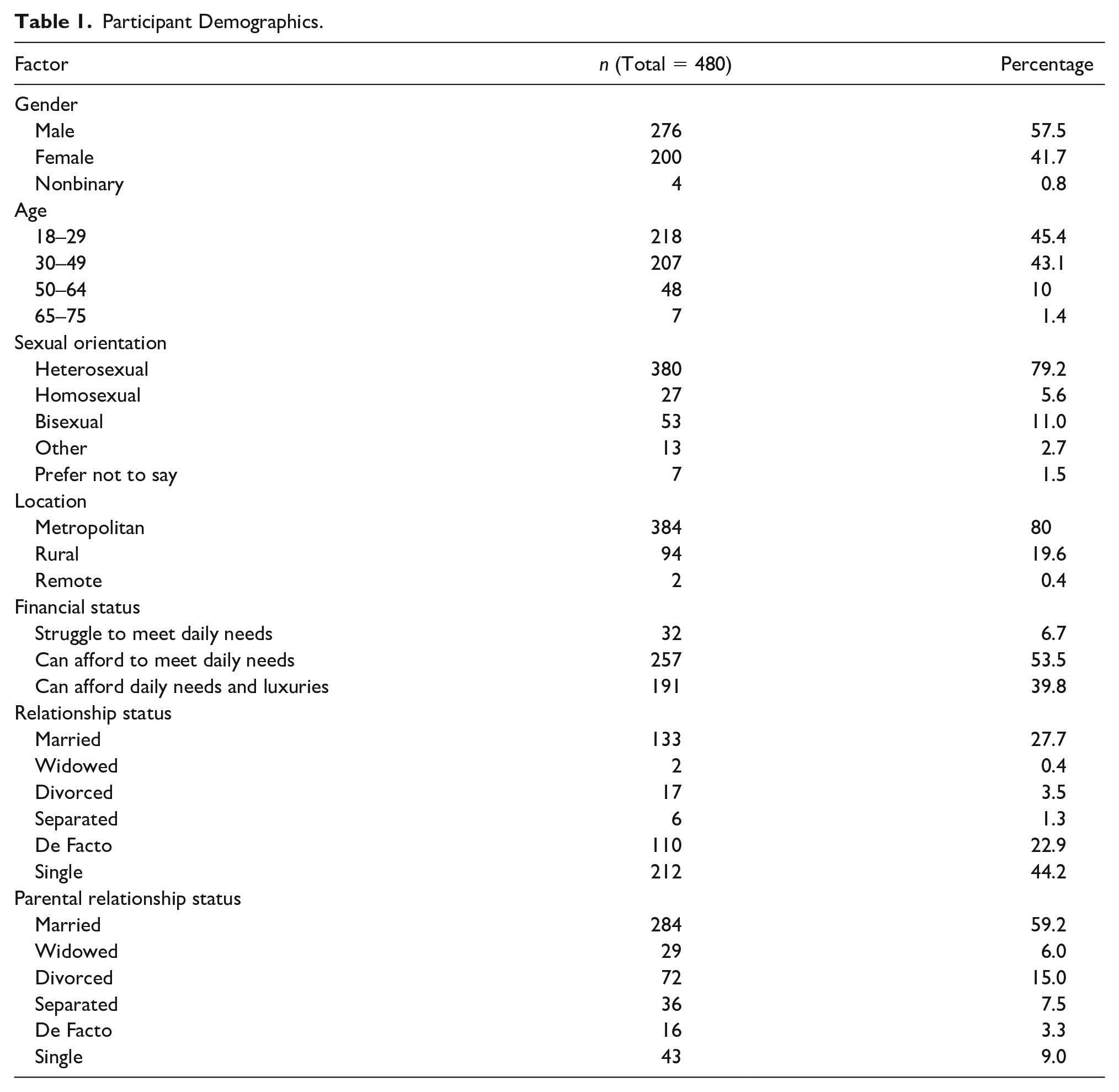
A total of 486 Australian adult participants were recruited via Prolific (Table 1). Six were removed for missing data, leaving 480 valid participants (200 female, 276 male, 4 not specified). The four participants who reported “other” as their gender were included in H1 only, despite our recognition of their overall contributions.
Participant Demographics.
Measures
Kessler Psychological Distress Scale
The Kessler Psychological Distress Scale (K10; Kessler et al., 2002) is a 10-question measure of psychological distress and is widely used in population health surveys and clinical settings. The K10 (Kessler et al., 2002) uses a 5-point Likert-type scale ranging from 1 (none of the time) to 5 (all of the time) to rate the statements, and a total score is calculated from the sum of all item ratings. The statements relate to the frequency of thoughts, feelings and behaviors over the past 4 weeks. Cronbach’s alpha coefficients for the K10 indicate strong internal consistency (α = .93) (Kessler et al., 2002) and within Australia the scale has been validated as a mental health screening tool (Andrews & Slade, 2001). Internal consistency in this study was excellent (α = .93).
The Suicidal Ideation Attributes Scale
The Suicidal Ideation Attributes Scale (SIDAS; van Spijker et al., 2014) is a 5-question, self-report measure of the frequency and controllability of suicidal ideation, the distress experienced from ideation, suicide attempts, and the level to which ideation interferes with daily life over the past month. The SIDAS (van Spijker et al., 2014) uses a 10-point Likert-type scale to measure the statements, and the anchor labels depend on the statement (0 = never/no control/not close at all/not at all, 10 = always/full control/made an attempt/extremely). The total score is calculated as the sum of the five items, and therefore can range from 0 to 50, with higher scores indicating a higher presence of suicidal ideation with the highest risk scoring >21 (van Spijker et al., 2014). SIDAS has demonstrated strong internal consistency (α = .91), and convergent validity with the Columbia Suicide Severity Scale on frequency (r = 0.61), duration (r = 0.50), and controllability of suicidal ideation (r = 0.44; van Spijker et al., 2014). Internal consistency in this study was strong (α = .80).
Conformity to Masculine Norms Inventory
The CMNI-30 (Levant et al., 2020) is a 30-item self-report measure that assesses conformity to specific masculine norms rather than a measure of general masculine norm conformity. It is measured using a 6-point Likert-type scale ranging from 0 (strongly disagree) to 5 (strongly agree). There are 10 separate dimensions: winning, emotional control, risk-taking, pursuit of status, primacy of work, violence, power over women, playboy, self-reliance, and heterosexual self-presentation. Subscale totals are recommended to be used rather than an overall total (Levant et al., 2020), which this current study executed. It was observed in this study that subscales could be grouped into two conceptual groups as follows: behavioral–emotional masculine norms comprised of emotional self-control, self-reliance, violence, and risk-taking; and social hierarchy masculine norms comprised of winning, pursuit of status, heterosexual self-presentation, and power over women. The CMNI-30 is a short form version of the full 94-item inventory (CMNI; Mahalik et al., 2003). CMNI-30 was developed because the previous short forms had only moderate reliability and internal consistency (Levant et al., 2020). Internal consistency in this study was acceptable for men and women respectively as follows: emotional control (α = .90; α = .91), winning (α = .73; α = .73), playboy (α = .83; α = .81), violence (α = .75; α = .68), heterosexual self-presentation (α = .92; α = .89), pursuit of status (α = .70; α = .71), primacy of work (α = .83; α = .84), power over women (α = .84; α = .70), self-reliance (α =.76; α = .76) and risk-taking (α = .85; α = .86).
Procedure
Approval to conduct this project was granted by the Victoria University Human Research Ethics Committee (approval number HRE21-051). Following this, offers to participate were advertised via the Prolific online platform, which contained the title, a brief description of the study, and the pay rate of the study (approximately US$4.63 based on a mean finish time of 18.52 min). If participants agreed to participate, an individual identifier code and a direct link to the Qualtrics online survey was provided. Upon entering their individual identifier code, participants were shown an information statement summarizing the aims of the study, confirming that participation was voluntary and anonymous, and identifying potential risks of participation. Participants were provided with contact information for free telephone helplines on every page of the survey should they experience distress. At the bottom of this information page, participants were asked to check a box confirming they had read and understood all the information provided and that they consented to participate in the survey. Participants confirming their consent were then taken to the main survey. Demographic questions were presented first, followed by the K10 (Kessler et al., 2002), SIDAS (van Spijker et al., 2014), and the CMNI-30 (Levant et al., 2020) questionnaires.
Design and Assumption Testing
A quantitative, cross-sectional design was used. Data analysis was conducted in SPSS Statistics version 27, with the moderation analyses performed using Model 1 in the PROCESS macro version 3.5 (Hayes, 2018), with 5,000 bootstrapped samples. Moderation analysis was performed to determine whether the direct relationship between psychological distress and suicidal ideation was moderated by the 10 risk factors of masculinity for men and women. All relevant statistical assumptions were tested prior to the main analyses. Multivariate outliers were found with Mahalanobis distances exceeding the critical value of chi-square with three predictors for 19 of the 20 analyses in the range of 1 to 4 outliers for each analysis. In every case, the corresponding Cook’s distance fell within the acceptable range (i.e., < 1), which indicates these outliers were not influential values. The decision was made to include these outliers. All other statistical assumptions were met, such as the tests of multicollinearity (Variance Inflator Factor < 10 and tolerance >0.1), the independence of errors (Durbin-Watson between 1 and 3), and the normal distribution of residuals despite the observation of slight deviations from normal. A degree of heteroscedasticity was observed for the standardized residuals plotted against the standardized predicted values; yet this is explained by the distribution of suicidal ideation scores being highly skewed by most having low scores. It was decided to proceed with the moderation analyses. All analyses conducted in this study are reported.
Results
Table 2 presents the mean values for all variables in male and female participants. Compared with men, women had lower scores on all variables other than psychological distress. These differences were significant for the playboy, violence, heterosexual self-presentation, power over women, and risk-taking variables.
Mean Values of Major Variables.
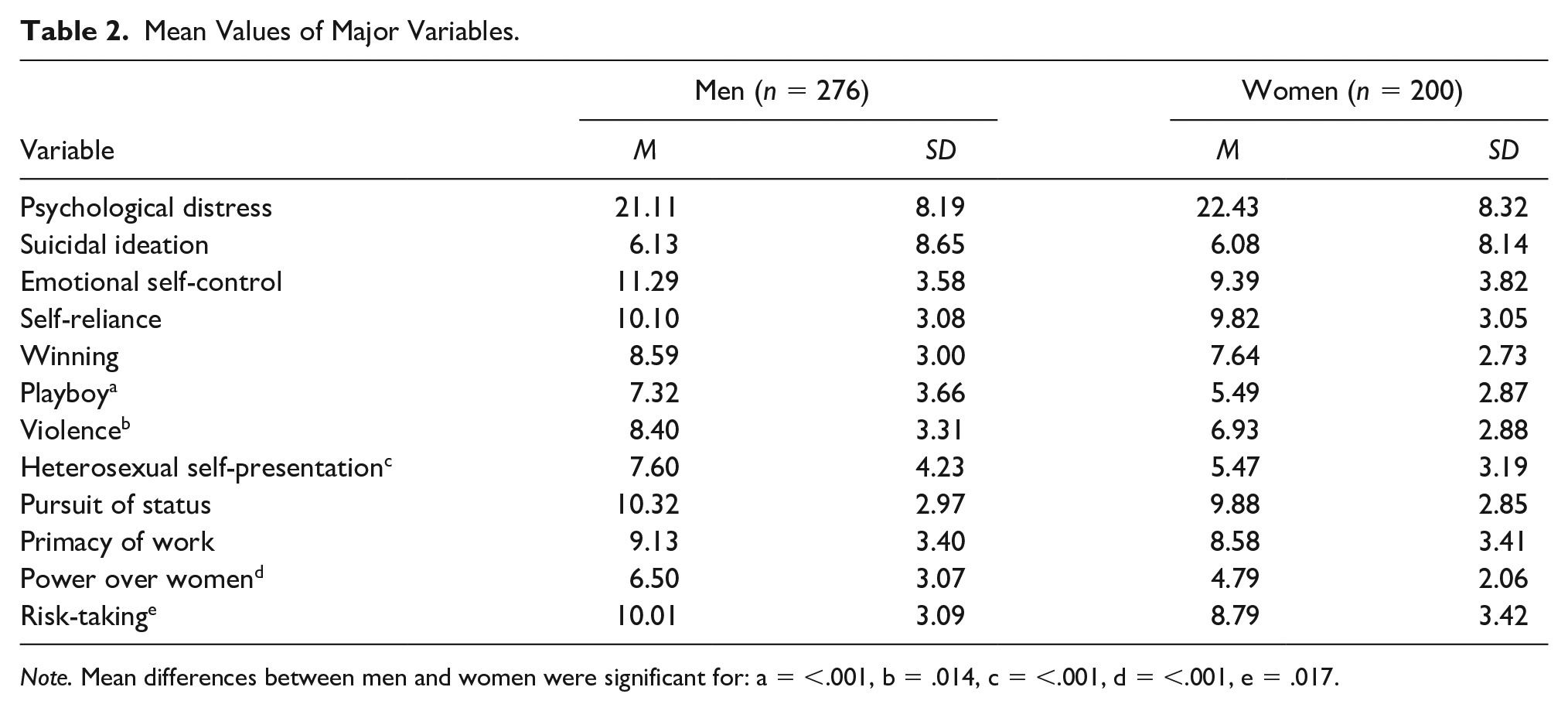
Note. Mean differences between men and women were significant for: a = <.001, b = .014, c = <.001, d = <.001, e = .017.
Table 3 presents the Pearson correlations between all the major variables. A large significant and positive relationship was observed for suicidal ideation and psychological distress. A large significant relationship was also observed for suicidal ideation and self-reliance, as well as for psychological distress and self-reliance, and both were positive. The correlation between suicidal ideation and risk-taking was also significant and positive. Most of the masculinity norms were positively and significantly correlated.
Pearson Correlations Among Major Variables.

p < .05. **p < .01.
The statistics in Table 4 pertain to the interaction of each listed moderator with psychological distress. Due to the large number of analyses, for the sake of brevity, only the key findings regarding moderation effects are shown. Psychological distress was a significant independent predictor of suicidal ideation in every model. The B values ranged from 0.591 to 0.682, with p values <001. Every model accounted for a significant proportion of the variance in suicidal ideation (refer to Table 4 for the R2 values for each model).
Moderation Regression Models of Masculinity Factor Predictors With Psychological Distress.
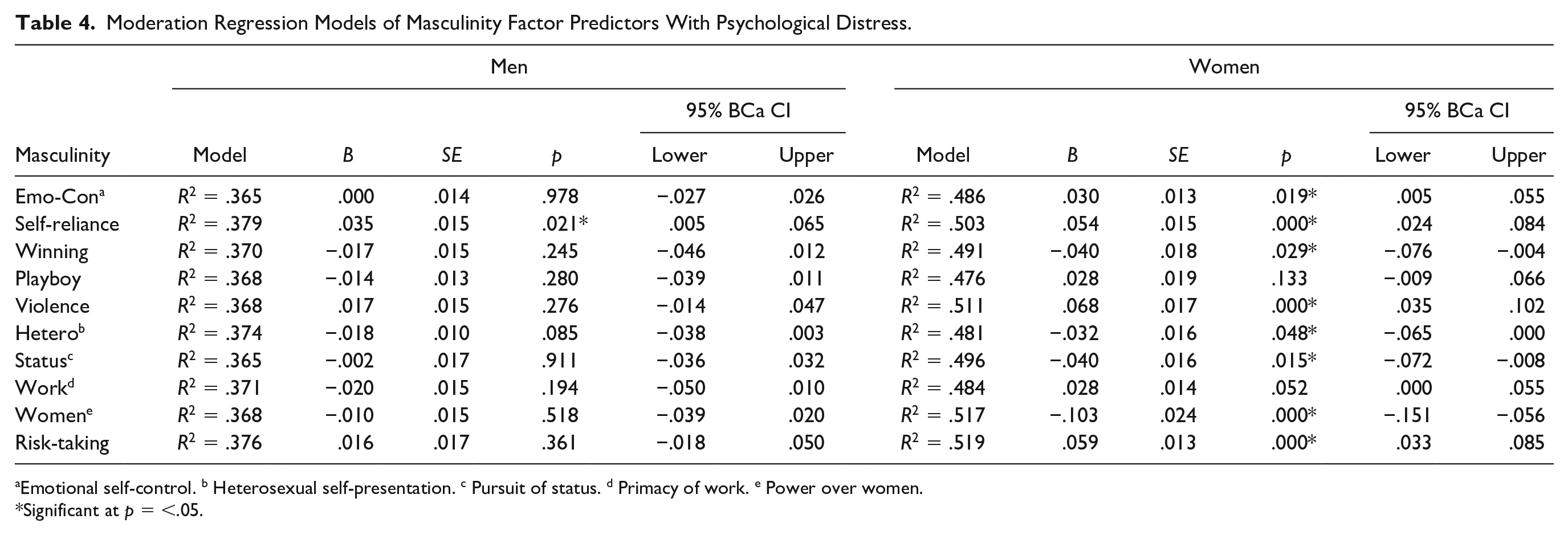
Emotional self-control. b Heterosexual self-presentation. c Pursuit of status. d Primacy of work. e Power over women.
Significant at p = <.05.
For men, self-reliance was the only masculinity factor to moderate the relationship between psychological distress and suicidal ideation, and the association was stronger for higher levels of self-reliance. Simple slopes analysis revealed that the association between psychological distress and suicidal ideation was significant at each level of self-reliance (see Figure 1).

The Moderation Effect of Self-Reliance on the Psychological Distress–Suicidal Ideation Relationship for Men.
For women, the masculinity factors of emotional self-control, self-reliance, violence, and risk-taking enhanced the relationship between psychological distress and suicidal ideation, with the association stronger for higher levels of the moderators. Simple slopes analysis revealed that the association between psychological distress and the moderators was significant at each level of the moderators (see Figure 2).

Moderation Effect of (A) Emotional Self-Control; (B) Self-Reliance; (C) Violence and (D) Risk-Taking on the Psychological Distress–Suicidal ideation Relationship for Women.
The masculinity factors of winning, heterosexual self-presentation, pursuit of status, and power over women buffered the relationship between psychological distress and suicidal ideation for women, with the association stronger for lower levels of the moderators. Simple slopes analysis revealed that the association between psychological distress and suicidal ideation was significant at each level of the moderators (see Figure 3).

Moderation Effect of (A) Winning; (B) Pursuit of Status; (C) Heterosexual Self-Presentation and (D) Power Over Women on the Psychological Distress–Suicidal Ideation Relationship for Women.
Discussion
This study examined whether conformity to masculine norms is a risk factor for suicidal ideation. It was proposed that adherence to masculine norms would enhance the psychological distress–suicidal ideation relationship for men, in particular the masculine norms of self-reliance and emotional self-control. The hypotheses were partially supported. As expected, there was a strong positive relationship between psychological distress and suicidal ideation for all genders (Chamberlain et al., 2009; Handley et al., 2013; Puuskari et al., 2018). H2 was supported with self-reliance moderating the relationship of psychological distress and suicidal ideation for men. This suggests that conforming to self-reliance norms has a compounding effect on suicidal ideation when distress is also high. This may be due to this masculine norm being incompatible with a distressed state, leading to thoughts of suicide as a way out (Tryggvadottir et al., 2019). Surprisingly, emotional self-control did not moderate the relationship between psychological distress–suicidal ideation for men. This contrasts with the current body of literature identifying emotional self-control as a barrier to professional help-seeking and is therefore a risk factor for suicidal ideation (McDermott et al., 2018). Moreover, none of the other masculinity facets moderated the distress–ideation relationship for men.
Our exploratory analyses revealed that for women, 8 of the 10 masculinity factors moderated the psychological distress–suicidal ideation relationship. Interestingly, four were enhancing and four were buffering in their effects. Emotional self-control, self-reliance, violence, and risk-taking enhanced the psychological distress–suicidal ideation relationship, which means that women who adhere more strongly to these norms are at higher risk of suicidal ideation when experiencing high psychological distress. These norms are representative of behavioral–emotional aspects of masculinity. The results of this study reflect that endorsement of stereotypical masculine behavioral and emotional norms increases the likeliness of suicidal ideation when experiencing psychological distress for women. Previous research suggests that culturally normative masculine behaviors such as stoicism, emotional invulnerability, violence, and risk-taking act as barriers for men in seeking professional help and have been identified as risk factors for psychological distress and suicidal ideation (Canetto & Sakinofsky, 2010; Coleman et al., 2020; Mahalik et al., 2003; Pirkis et al., 2017). The impact of conformity to masculine norms in women is a relatively unexplored area of research, although McDermott et al. (2018) reported that women who adopt stereotypically masculine cognitions and behaviors tend to report the same positive correlates as men. However, this is the first study to demonstrate that conformity to masculine norms can contribute to suicidal ideation in women.
The masculinity factors of winning, heterosexual self-presentation, pursuit of status, and power over women buffered the relationship of psychological distress–suicidal ideation for women. Therefore, it was the women who adhered less strongly to these norms who were at higher risk of suicidal ideation when experiencing psychological distress. Collectively, these norms are reflective of individual status within the social hierarchy. Previous research suggests that the adoption of masculine norms that promote individual social status acts as disease prevention factors for men (Salgado et al., 2019), with this study suggesting that the opposite applies to women. A possible explanation for this is that a lack of endorsement to certain dominant cultural norms leads to adverse mental health outcomes (Mahalingam & Jackson, 2007). This can be especially relevant for those in a subordinate social position (Mahalingam & Jackson, 2007). However, this finding warrants further investigation.
When comparing the mean scores of men and women, as expected, men scored more highly than women on all masculinity factors. Despite this, masculine norms had a more broadly influential moderating effect for women. This is perhaps due to the women in contemporary society who adhere more to masculine norms deviating further from what is culturally expected of them as women. Yet, the mean scores for psychological distress and suicidal ideation were approximately equivalent, which contradicts the Gender-Paradox theory and evidence from the extensive body of literature (Australian Institute of Health and Welfare, 2021; Scourfield & Evans, 2015).
Overall, the results of this study are intriguing and partially at odds with current literature on masculine norm adoption. The interpretations of the current results are speculative, and therefore pave the way for a more comprehensive investigation of contemporary gender norms and their influence. It is possible that gender is becoming more nebulous and less closely aligned with biological sex, and gender research is being called to keep up with the dynamic and diverse adoptions of gender today. Perhaps researchers need to start thinking more broadly and inclusively about societal gender norms and their impacts on all members of society.
Limitations
This study was cross-sectional so causation cannot be inferred. The CMNI-30 (Levant et al., 2020) used in this study was originally intended for men only, despite it being used extensively in binary-gendered populations (McDermott et al., 2017, 2018). Future research expanding on this study could apply a construct of conformity to masculine norms designed especially for women and inclusive of all genders, which might require a change in the conceptualization of masculinity. The existing literature confirms that men are known to under-report or misinterpret symptoms of psychological distress, therefore it is important to consider that this study may not have accurately captured levels of psychological distress among men (Cavanagh et al., 2016). To elucidate the former statement, future research could include a clinical sample of men with confirmed suicidal ideation and psychological distress for replication of these findings.
A further limitation is that we did not compare different sexual orientations. The proportion of sexual minority individuals was relatively small in this study, thus sexual orientation could not be included as an additional variable in the analyses. Research has consistently reported an elevated risk of suicide attempt and completion among sexual minority individuals, particularly gay and bisexual men (see Plöderl & Tremblay, 2015, for a review), so future research should consider exploring sexual orientation in the context of how masculinity norms influence the psychological distress–suicidal ideation relationship.
Implications and Conclusions
This study contributes meaningfully to the current body of literature on the impacts of conformity to masculine norms. First, it identifies high self-reliance as a risk factor for suicidal ideation among men who are experiencing psychological distress. Second, this study generates awareness that for women high in distress, masculine norms can influence suicide ideation. We suggest that adhering to norms of self-reliance increases suicidal ideation when distress is high, particularly for men. High self-reliance might be an important indicator of risk, which should be considered when assessing and working with men who are hesitant to openly discuss suicidal ideation with their clinician. For women, higher endorsement of behavioral–emotional masculine norms and lower conformity to social hierarchy status norms appears to increase suicide risk in the presence of psychological distress. That adherence to masculine norms appears to be more important in the distress–ideation pathway for women than men requires further investigation.
Footnotes
Author Contributions
All authors contributed to the study’s conception and design. Material preparation and data collection were performed by Laura Griffin. Data analysis was performed by Laura Griffin and Warwick Hosking. The first draft of the manuscript was written by Laura Griffin, Warwick Hosking, and Peter Gill. All authors commented on and contributed to previous versions of the manuscript, and all authors read and approved the final manuscript.
Availability of Data and Material
On request from the corresponding author.
Declaration of Conflicting Interests
The author(s) declared no potential conflicts of interest with respect to the research, authorship, and/or publication of this article.
Funding
The author(s) disclosed receipt of the following financial support for the research, authorship, and/or publication of this article: This research was supported by funding by College of Health and Biomedicine, Victoria University.
Compliance With Ethical Standards
The project reported in this article was formally reviewed and approved by the Victoria University Human Research Ethics Committee (Ethics applications ID: HRE21-051).
