



Abstract
The present study examined whether previous findings linking masculinity constructs and health behaviors applied to a relatively recent health risk behavior for men, the consumption of energy drinks. In addition, it also examined whether self-identifying as a jock and being a member of a fraternity would moderate the relationships between masculinity constructs and energy drink consumption. A total of 589 men completed measures of three masculinity constructs (endorsement of traditional masculinity ideology, conformity to masculine norms, and gender role conflict), energy drink consumption, jock identity, and fraternity membership, in addition to a demographic questionnaire. Age, endorsement of traditional masculinity ideology, and conforming to the masculine norms of risk taking and primacy of work were identified to be significant predictors of energy drink consumption. Furthermore, jock identity moderated the relationship between the endorsement of traditional masculinity ideology and energy drink consumption whereas fraternity membership moderated the relationship between conforming to the masculine norm of violence and energy drink consumption. Limitations, implications, and potential future directions are discussed.
Keywords
Approximately one third of all the deaths in the United States might be prevented by the widespread adoption of health promotion behaviors and avoidance of health risk behaviors (Danaei et al., 2009). However, recent research suggests that American men do not fully engage in such prevention efforts. Compared with American women, men engage in fewer preventive health behaviors, consume more alcohol, and use more tobacco products (Garfield, Isacco, & Rogers, 2008). Such findings have elevated the profile of men’s health in public health discourse (Addis et al., 2007; Baker, 2001; Bonhomme, 2007). Research on the variables that influence men’s health behaviors is thus of considerable importance.
Masculinity Constructs and Health Behaviors
Recent research on men’s health behavior has examined its relationship to masculinity constructs (Levant, Wimer, & Williams, 2011; Levant, Wimer, Williams, Smalley, & Noronha, 2009). This work has conceptualized masculinity using the social constructionist Gender Role Strain Paradigm (Levant, 2011; Pleck, 1995), in which masculinity is viewed as a gender role, defined by a set of social norms. The norms of masculinity have been delineated in various ways but usually include the avoidance of femininity, dominance, toughness, self-reliance, restrictive emotionality, and risk taking (Levant, 2011). However, as Connell and Messerschmidt (2005) point out, masculine roles and norms are contingent on varying social/contextual factors and are fluid rather than static or fixed. In this theoretical perspective, masculinity has long been viewed as a risk factor for men’s health behaviors because it is thought to incentivize risky practices. One of the major theoreticians on masculinity and health risks (Courtenay, 2000) observed that “the social practices that undermine men’s health are often signifiers of masculinity and instruments that men use in negotiation of social power and status” (p. 1385).
The masculinity constructs used in recent research on men’s health behaviors include (a) the endorsement of traditional masculinity ideology, which refers to one’s beliefs about how men should or should not behave (Levant et al., 2007); (b) conformity to masculine norms, which reflects a man’s self-assessment of the degree to which he conforms to the traditional norms of masculinity (Mahalik et al., 2003); and (c) masculine gender role conflict, which refers to the conflict that a man experiences while conforming to the traditional norms of masculinity (O’Neil, Helms, Gable, David, & Wrightsman, 1986). Contrary to long-standing views that masculinity is only associated with health risk behaviors (see Harrison, 1978), recent studies indicate that some of these masculinity constructs are associated with health promotion behaviors and thus could be considered protective health buffers, whereas others are associated with health risk behaviors (Levant et al., 2009; Levant et al., 2011; Levant & Wimer, 2012).
Energy Drinks
The consumption of energy drinks such as Red Bull, Monster, and Full Throttle is a growing health risk behavior that particularly affects young men in the United States (Miller, 2008; West et al., 2006). Energy drinks are beverages purported to boost mental or physical energy, which contain large amounts of caffeine. Many also contain sugar or other sweeteners, herbal extracts, and amino acids, and may or may not be carbonated. Young people comprise the largest market for energy drinks (Seifert, Schaecter, Hershorin, & Lipshultz, 2011), accounting for approximately $2.3 billion in sales per year and growing (Rath, 2012). Although energy drinks have been consumed since as early as 1962 when a bottled energy drink known as Lipvitan-D was introduced in Japan (Roberson, 2005), energy drink consumption among Americans has increased exponentially since Red Bull was introduced in 1997. The drinks are particularly problematic in the United States because of lax regulatory requirements in comparison with many other countries (Reissig, Strain, & Griffiths, 2009). For example, the U.S. Food and Drug Administration does not require the actual caffeine content in an energy drink to be displayed on the label whereas many other countries do.
The aggressive marketing and increased use of energy drinks along with a lack of regulations in the United States has led to an increased occurrence of caffeine toxicity and poisoning (Babu, Church, & Lewander, 2008). Health problems associated with excessive consumption of caffeine include anxiety, restlessness, insomnia, tachycardia, tremors, psychomotor agitation, and even death in a few cases (Reissig et al., 2009). Reissig et al. (2009) noted that most of the research on caffeine intoxication has focused on coffee use and so there is a need for more research specifically focused on energy drinks.
Three health risks associated with energy drink consumption are of particular concern: dehydration during athletic involvement, the combination of energy drinks with alcohol, and an increased likelihood of engaging in violence. Energy drinks are dangerous when consumed before or during excessive physical exertion because of the diuretic nature of caffeine (Fogger & McGuinness, 2011). In other words, energy drinks exacerbate dehydration, so combining the drinks with athletic activity can be very dangerous, even fatal. This danger is worsened by the misunderstandings surrounding this issue, as energy drink marketing campaigns tend to focus on extreme sports such as snowboarding and rock climbing even though it is not advisable to consume such drinks before or during these physical activities (Miller, 2008). Such marketing campaigns lead many people to misunderstand the difference between dehydrating energy drinks and rehydrating sports drinks such as Gatorade (Fogger & McGuinness, 2011).
Regarding energy drinks mixed with alcohol, a major danger of this inadvisable behavior is that caffeine reduces one’s perception of alcohol intoxication but does not concurrently reduce the cognitive and motor impairment associated with alcohol intoxication (Marczinski & Fillmore, 2006). Thus, individuals do not feel as drunk as they really are and so they are more likely to engage in dangerous activities such as operating a motor vehicle. Finally, excessive caffeine consumption via energy drinks is linked with a greater likelihood of engaging in aggression and violence (Kuhns, Clodfelter, & Bersot, 2010). One reason for this is that energy drinks, especially when combined with alcohol, facilitate longer involvement in late nighttime situations in which individuals have more opportunities to engage in problematic behaviors such as fighting.
Masculinity, Energy Drink Use, Jock Identity, and Fraternity Membership
There is a small amount of research on the relationships between masculinity constructs and the health risk behavior of using energy drinks, which is reviewed next. Roberson (2005) discussed how energy (or “genki”) drinks are intimately related with masculinity in Japan. He particularly focused on how the marketing of energy drinks targets traditionally masculine men. Roberson argued that energy drink advertising campaigns created an association between the use of such drinks and traditional masculinity, which may promote greater energy drink use among men seeking to enhance their sense of their own masculinity or their masculine image to others.
Energy drinks have also been studied in relationship to masculinity constructs and the “toxic jock” phenomenon. Miller (2008, 2009a, 2009b) distinguished between the “athlete” identity and the “jock” identity. Of the two, the jock identity was reported to be more closely associated with engagement in risky health-related behaviors, including energy drink consumption (Miller, 2009b). Jock identity involves assigning a low priority to academics, focusing on personal glory rather than team achievement, and behaving in a cocky and aggressive manner. Jock identity appears to tap a form of hypermasculinity as it relates to sport and was positively correlated with a modified version of the Conformity to Masculine Norms Inventory (CMNI; Mahalik et al., 2003) that used only five subscales (Playboy, Winning, Dominance, Risk Taking, and Violence). Miller (2008) also reported that energy drink use was positively associated with the modified CMNI, and that the modified CMNI mediated the relationship between jock identity and energy drink consumption.
Although no known study has focused on the relationship between fraternity membership, masculinity, and energy drinks there have been many studies implicating fraternity membership with other substance use problems. For example, DeSantis, Webb, and Noar (2008) reported that fraternity members are significantly more likely to use stimulant drugs than fraternity nonmembers. Energy drinks such as Red Bull were not included in their study, but they are technically a stimulant drug so their findings may well apply to energy drinks. Chauvin (2012) reported that fraternity members are significantly more likely to engage in binge drinking than nonmembers, and Cashin, Presley, and Meilman (1998) reported that fraternity members consume more alcoholic drinks, drink heavier, and suffer more negative substance-related consequences than students who are not affiliated with a fraternity. In short, fraternity membership appears to be a risk factor for many substance use behaviors, so it would make sense that it would also be associated with energy drink consumption.
The Present Study
Since previous research has identified links between some masculinity constructs and the consumption of energy drinks, the next step is to conduct a more comprehensive examination of a range of masculinity constructs in order to identify the specific masculinity constructs that may be linked with energy drink use and to assess whether some masculinity constructs may act as health protective factors, whereas others act as risk factors, as has been reported with other research on men’s health behavior (Levant et al., 2009; Levant et al., 2011). Miller (2008, 2009a, 2009b) argued that further studies examining the relationships between jock identity and various health compromising behaviors are needed. In addition, studies have demonstrated that being a member of a fraternity is associated with an elevated risk of substance abuse behaviors. However, no known study to date has examined the interplay between fraternity membership, masculinity, and energy drink consumption.
The purpose of the present study was to investigate the links between three masculinity constructs (endorsement of traditional masculinity ideology, conformity to masculine norms, and gender role conflict), the consumption of energy drinks, jock identity, and fraternity membership. The investigators were interested in determining if the previously demonstrated links between these masculinity constructs and health behaviors also applied to the recent health risk behavior of energy drink use. Using data collected as part of a larger study that tested a multiple mediation model of the links between these three masculinity constructs and general health behaviors (Levant & Wimer, 2012), the present study analyzed the relationships between the consumption of energy drinks, three masculinity constructs, jock identity, and fraternity membership.
Since health risk and health promotion behaviors are negatively correlated (Levant et al., 2011), it was first hypothesized that the pattern of relationships between energy drink use and the masculinity constructs would be of the opposite sign from that reported for a closely related health promotion behavior, avoidance of substance use. Prior research (Levant et al., 2011) reported positive correlations between the avoidance of substance use and the Winning and Emotional Control subscales of the CMNI (Mahalik et al., 2003) and the Success/Power/Competition subscale of the Gender Role Conflict Scale (GRCS; O’Neil et al., 1986), indicating that these masculinity scales acted as protective factors. In addition, this prior research (Levant et al., 2011) reported negative correlations between the avoidance of substance use and the Male Role Norms Inventory–Revised (MRNI-R; Levant et al., 2007), the CMNI Playboy, Risk Taking, Self-Reliance subscales, and the GRCS Restrictive Emotionality subscale, indicating that these masculinity scales acted as risk factors. However, from what little is known, energy drink use appears to be a unique form of substance use, tied more to enhancing performance than to experiencing a “high,” so the present investigators did not predict a reversal of the exact pattern of the avoidance of substance use results. Furthermore, given the paucity of research on masculinity and energy drink use, there was insufficient information to predict which masculinity constructs would be associated with energy drink use. Hence, this hypothesis is also associated with an exploratory question in regard to which specific masculinity constructs would be associated with energy drink use. The prediction was that if correlations were identified between the same masculinity construct and both the avoidance of substance use and energy drink use, those correlations would be of opposite signs—one will be positive and the other will be negative.
Second, it was hypothesized that the endorsement of jock identity and fraternity membership will moderate any relationships identified between energy drink consumption and the masculinity constructs. Since jock identity is associated with aversive health risk behaviors, it would make sense to expect that the extent to which one self-identifies as a jock would strengthen the relationship between masculinity constructs and energy drink consumption. As for fraternity membership, given the previous research that reported fraternity membership to be a risk factor for substance use problems it would make sense to expect that fraternity membership status would strengthen the association between masculinity and energy drink consumption.
Method
Participants
A total of 589 men participated in the study. Most participants identified as White/European American (76.7%), yet 7.8% identified as Asian/Asian American, 5.6% as Black/African American, 4.6% as Latino/Hispanic, and 4.1% identified as other races or ethnicities. Ages ranged from 18 to 63 years, with a mean of 23.01 years (SD = 1.13). The median age was 20 years, and the modal age was 18 years. Participants were single and partnered in almost equal measure: 39% were not currently dating anyone and 19% were engaged in casual nonexclusive dating; whereas 27.5% reported dating one person exclusively and 12.4% were married/partnered/engaged. In response to the question “Whether or not you are sexually active, would your preferred partner be . . . ?” most participants (88.5%) selected “always female,” 8.1% selected “always male,” and 3.1% selected either “usually female but sometimes male,” “equally likely to be either,” or “usually male but sometimes female.” Most participants reported that the highest degree they completed was high school/GED (86.9%), 9.2% reported bachelor’s degree, and 3.5% reported either a master’s or doctoral degree. The median family/household income was $60,001 to 80,000. In terms of self-identified socioeconomic status, most (46.9%) identified as middle class. Finally, in regard to religion, most participants identified as Christian (57.7%).
Procedure
The study was approved by The University of Akron and The Pennsylvania State University institutional review boards. Participants were recruited through several methods. Undergraduate student participants were solicited from psychology courses at the two universities, and offered extra credit for their participation in the study, which was posted at an online survey site. Community participants were solicited by contacting a number of websites and Internet forums of potential interest to men. The first page of the survey provided the informed consent information, and participants who consented clicked “yes” and were taken to the survey. On completion of the survey, participants were provided with an educational briefing on the study. Once they clicked “done,” they were then directed to the incentive fulfillment page, which directed those recruited from a university to the extra credit page, and those recruited from the Internet were entered into a raffle for a $200 gift card to the retailer of their choice. The incentive fulfillment, extra credit, and raffle pages were not linked to their answers on the survey, thus keeping their answers to the survey completely anonymous.
The survey consisted of 170 questions and was presented in the following order: Demographic Form, MRNI-R, CMNI-46, Gender Role Conflict Scale–Short Form (GRCS-SF), Health Behavior Inventory-20, and the Index of Energy Drink Consumption (IEDC). It took approximately 25 minutes for participants to complete the survey.
Measures
Demographic questionnaire
This questionnaire inquired about gender, age, race/ethnicity, relationship status, sexual orientation, highest degree completed, family/household income, socioeconomic status, and religion.
Male Role Norms Inventory–Revised
The MRNI-R is a 53-item measure of traditional masculinity ideology, with items (e.g., “A man should be able to perform his job even if he is physically ill or hurt) rated on a 7-point Likert-type scale (1 = strongly disagree to 7 = strongly agree), and with higher scores indicating higher levels of endorsement of traditional masculinity ideology (Levant et al., 2007; Levant, Rankin, Williams, Hasan, & Smalley, 2010). None of the items are reverse-scored. Seven subscales assess individuals’ endorsement of different dimensions of traditional masculinity ideology. However, due to multicollinearity among the subscales, the total scale score was used in the analyses, which is obtained through the averaging of scores on all 53 items. Levant et al. (2010) reported evidence for the factor structure, reliability of the total scale (.96), and convergent, divergent, and concurrent validity. The alpha in present study was .97.
Conformity to Masculine Norms Inventory–46
The CMNI-46 (Parent & Moradi, 2009) is a shortened version of the CMNI (Mahalik et al., 2003). The CMNI-46 assesses conformity to nine masculine norms: Winning (six items, alpha in present study = .86), Emotional Control (six items, alpha in present study = .87), Primacy of Work (five items, alpha in present study = .78), Risk Taking (five items, alpha in present study = .80), Violence (six items, alpha in present study = .82), Heterosexual Self-Presentation (six items, alpha in present study = .90), Playboy (four items, alpha in present study = .80), Self-Reliance (five items, alpha in present study = .84), and Power Over Women (four items, alpha in present study = .85). Responses to items (e.g., “In general, I will do anything to win”) are made on a 4-point scale (0 = strongly disagree to 3 = strongly agree). CMNI-46 subscales yielded large positive correlations with their parent CMNI subscale (r range = .89-.98). Eighteen items are reverse-scored. Cronbach’s alpha coefficient for the total scale was .88, and that for subscales ranged from .77 to .91 (Parent & Moradi, 2009). Coefficient alpha for the total scale in the present study was .90.
Gender Role Conflict Scale–Short Form
The GRCS-SF (O’Neil, Wester, Vogel, & Danforth, 2011), derived from the GRCS (O’Neil et al., 1986) is a 16-item instrument that assesses the degree to which “rigid, sexist, or restrictive gender roles result in personal restriction, devaluation, or violation of others or self” (O’Neil, Good, & Holmes, 1995, p. 167). The GRCS-SF, like the GRCS, has four subscales: Success/Power/Competition (four items, alpha in present study = .76), Restrictive Emotionality (four items, alpha in present study = .84), Restrictive Affectionate Behavior Between Men (four items, alpha in present study = .84), and Conflict Between Work and Family Relations (four items, alpha in present study = .82). Participants used a 6-point Likert-type scale (1 = strongly disagree to 6 = strongly agree) to rate their level of agreement or disagreement with statements intended to measure instances of male gender role conflict (e.g., “Affection with other men makes me tense”), with higher scores indicating higher levels of conflict. None of the items are reverse-scored. O’Neil et al. (1986) reported 4-week test–retest reliabilities for the GRCS subscales ranging from .72 to .86, and O’Neil et al. (1995) reported coefficient alphas for the GRCS ranging from .75 to .90 and evidence for construct validity. O’Neil et al. (2011) reported that the GRCS-SF subscales yielded large positive correlations with their parent GRCS subscale (r range = .90-.96). Coefficient alpha for the total scale in the present study was .86.
Index of Energy Drink Consumption
The IEDC included two items from Miller’s (2008) energy drink questionnaire. These items were (Item 1) the number of days an energy drink was consumed over the past 30 days and (Item 2) the average number of drinks consumed on those days. Both items used 7-point Likert-type scales. For Item 1: 1 = 0 days, 2 = 1-2 days, 3 = 3-5 days, 4 = 6-9 days, 5 = 10-19 days, 6 = 20-29 days, 7 = 30 days. For Item 2: 1 = I do not consume energy drinks, 2 = 1, 3 = 2, 4 = 3, 5 = 4, 6 = 5, 7 = 6 or more. The IEDC raw scores were obtained by averaging the scores on these two items. The resulting raw scores were skewed and kurtotic, so a log transformation was performed on the raw scores and the log-transformed scores were used as the IEDC. Following Miller’s (2008) questionnaire, there was also an open-ended question that asked about one’s preferred brand of energy drink.
Jock identity
Following Miller’s (2008) questionnaire, there were two items that described aspects of jock identity: (a) “I tend to see myself as a jock” and (b) “Other people tend to see me as a jock.” These two items were measured on 7-point Likert-type scales (1 = strongly disagree to 7 = strongly agree). Higher scores indicated higher levels of endorsement of jock identity. The jock identity raw scores were obtained by averaging the scores on these two items. The resulting raw scores were skewed and kurtotic so a log transformation was performed on the raw scores and the transformed scores were used as the measure of jock identity.
Fraternity membership
Fraternity membership was measured by a dichotomous item asking about whether or not the participant is a member of a fraternity. Scores for fraternity membership were 1 = not a member and 2 = member.
Results
Data Cleaning and Descriptive Statistics
The data were thoroughly screened before conducting statistical analyses to ensure the accuracy of the data file. A total of 743 participants began the survey. After eliminating those who did not complete it and those who identified their sex as female or transgender, the final sample included 589 men, for a completion rate of 80.2%. There were missing data as some participants did not respond to every item. No discernible patterns were identified by visually inspecting the missing data, which suggested that they were missing at random. With a small percentage of data points missing in a random pattern from a large data set, the problem is less serious, according to Tabachnick and Fidell (2007). Nonetheless, a conservative approach was taken, and missing values were replaced using SPSS-19’s linear trend at point method. Descriptive statistics (means and standard deviations), alpha coefficients, and bivariate correlations of study variables are presented in Table 1. With regard to energy drink use, 307 participants (52.1%) reported that they did not consume energy drinks and 233 (39.5%) reported that when they did consume energy drinks, they drank only 1. However, there were some who reported heavier use: 49 (8.3%) reported drinking more than 2 per day and 5 (0.8% reported drinking more than 6 per day. Of the participants who did report energy drink use, 106 selected Red Bull as their favorite brand, 102 selected Monster, 21 selected Rockstar, 12 selected Full Throttle, and 52 participants listed another brand. It should also be noted that 28.5% of the participants strongly disagreed with both items tapping jock identity, and only 8.2% of the participants reported that they were members of a fraternity.
Means, Standard Deviations, Cronbach’s Alphas, and Bivariate Correlations of Study Variables.

Note. N = 589. IEDC = Index of Energy Drink Consumption; MRNI-R = Male Role Norms Inventory–Revised; CMNI-46 = Conformity to Masculine Norms Inventory-46; GRCS-SF = Gender Role Conflict Scale–Short Form; Jock ID = jock identity; Frat = fraternity membership. Scores for the IEDC range from 1 to 7, with higher scores indicating greater health promotion behavior. Scores for the MRNI-R range from 1 to 7, with higher scores indicating greater endorsement of traditional masculinity ideology. Scores for the CMNI-46 range from 0 to 3, with higher scores indicating greater conformity to traditional masculine norms. Scores for the GRC-SF range from 1 to 6, with higher scores indicating greater gender role conflict. Scores for jock identity range from 1 to 7, with higher scores indicating higher levels of endorsement of jock identity. Scores for fraternity membership were 1 = not a member and 2 = member.
p < .05, two-tailed. **p < .01, two-tailed.
Hypothesis 1
It was hypothesized that if correlations were identified between the same masculinity construct and both the avoidance of substance use and energy drink use, they would be of opposite signs. This hypothesis was tested using multiple regression analysis, using SPSS Version 19. Given the potential for overlap between the three masculinity measures, the data were examined for multicollinearity using the variance inflation factor. In a trial run of the regression analyses using subscale scores of the three masculinity measures as predictors and the IEDC as the outcome, 10 subscales had variance inflation factor values higher than 2.50. Hence, the following scales were omitted from the analysis: all seven of the MRNI-R subscales (substituting the total scale score of the MRNI-R), two subscales of the CMNI-46 (Power Over Women, Heterosexual Self-Presentation), and one subscale of the GRCS (Restrictive Affectionate Behavior Between Men). The remaining 11 masculinity scales were used as predictors in the analysis.
A multiple regression analysis (using the Enter method) was conducted to examine the association of the 11 masculinity scales with the IEDC. Two demographic variables were significantly correlated with the IEDC, age and sexual preference. Hence these were treated as control variables, and were entered in the first model, which resulted in an adjusted R2 of .017, R2 change of .020, F(2, 585) = 5.98; p = .003. For the second model, the 11 masculinity scales were entered, which resulted in an adjusted R2 of .069, R2 change of .070, F(11, 574) = 4.01; p < .001. The results are shown in Table 2, where one can see that age, MRNI-R, CMNI-46 Risk Taking and Primacy of Work subscales were significant predictors in the final model. Age was negatively related to scores on the IEDC, meaning that age acted as a protective factor for energy drink consumption. On the other hand, scores on the MRNI-R and CMNI-46 Risk Taking and Primacy of Work subscales were positively related to scores on the IEDC, meaning that these facets of masculinity acted as risk factors for energy drink consumption. There was also a trend for the CMNI-46 Violence subscale (p = .052) to be positively related to IEDC scores.
Multiple Regression Analysis of the Prediction of IEDC Scores Using 10 Subscale Scores of the CMNI-46 and the GRC-SF and the Total Scale Score of the MRNI-R.

Note. N = 589. MRNI-R = Male Role Norms Inventory–Revised; GRCS-SF = Gender Role Conflict Scale–Short Form; IEDC = Index of Energy Drink Consumption; CMNI-46 = Conformity to Masculine Norms Inventory-46; C-Risk = CMNI-46 Risk Taking subscale; C-Work = CMNI-46 Primacy of Work subscale; C-Viol = CMNI-46 Violence subscale. Only the significant results and one trend are reported from this analysis.
Thus, support was identified for the first hypothesis, which stated that where correlations were found between the same masculinity construct and both avoidance of substance use and energy drink use, they would be of opposite signs. The relationships between the MRNI-R and the CMNI-46 Risk Taking subscale and avoidance of substance use were both negative, whereas their relationships with the IEDC were both positive. As regards the exploratory part of this hypothesis, in contrast to the findings with avoidance of substance use, the IEDC was not identified to be correlated with the CMNI Winning, Emotional Control, Playboy, and Self-Reliance subscales, nor with the GRCS Success/Power/Competition and Restrictive Emotionality subscales. On the other hand, the IEDC was identified to be associated with the CMNI Primacy of Work and Violence subscales, which were not associated with the avoidance of substance use.
Hypothesis 2
The hypothesized moderators, one continuous and one dichotomous variable (Jock Identity and Fraternity Membership, respectively), were tested with hierarchical multiple regression, following the procedural recommendations of Frazier, Tix, and Barron (2004) and Aiken and West (1991) to center the continuous variable and set up a dummy variable for the dichotomous variable, then enter the predictor and all the moderator variables in the first step, and then enter all the interaction terms in the second step. The plan was to determine, through five sets of hierarchical multiple regression analyses, which (if any) of the hypothesized moderator variables had a significant moderating effect on the relationships between one of the predictors and the outcome. The predictors were the significant predictors identified in the testing of Hypothesis 1: age, MRNI-R, and the CMNI Risk Taking, Primacy of Work, and Violence subscales. The criterion was the IEDC. The moderators were tested together in each analysis. The significant results are shown in Table 3, where it can be seen that jock identity moderated the relationship between the MRNI-R and the IEDC, and that fraternity membership moderated the relationship between the CMNI-Violence subscale and the IEDC.
Hierarchical Multiple Regression Analysis Testing of Effects of Two Moderators (Jock Identity and Fraternity Membership) on the Relationship Between the Significant Predictors (Age, MRNI-R, and the CMNI Risk Taking, Primacy of Work and Violence Subscales) and the Criterion (IEDC).
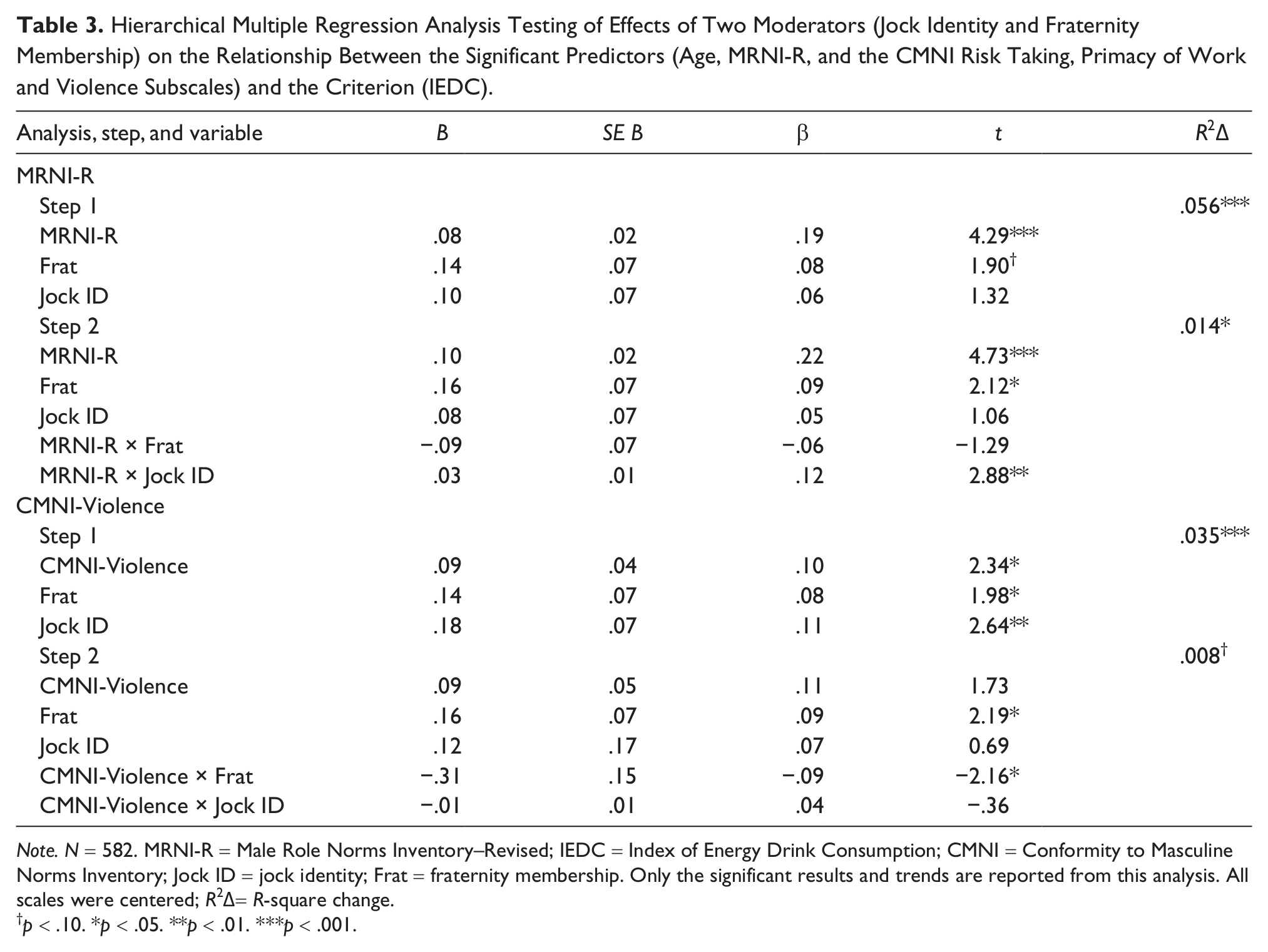
Note. N = 582. MRNI-R = Male Role Norms Inventory–Revised; IEDC = Index of Energy Drink Consumption; CMNI = Conformity to Masculine Norms Inventory; Jock ID = jock identity; Frat = fraternity membership. Only the significant results and trends are reported from this analysis. All scales were centered; R2Δ= R-square change.
p < .10. *p < .05. **p < .01. ***p < .001.
Post hoc probing using simple slopes analysis, following the procedures outlined by Aiken and West (1991), was conducted to assess the significant interactions that resulted from the first set of analyses. Linear regression was used to test whether each slope of the regression of predictor on criterion, conditional on either a high value (1 SD above the mean), or a low value (1 SD below the mean) of the continuous moderator (jock identity), or on whether the dummy variable was scored 0 or 1 in the case of the dichotomous moderator (fraternity membership), was significantly different from zero. In Table 4, it can be seen that the slopes of the relationships between energy drink use and the endorsement of traditional masculinity ideology for both the high and low values of jock identity were significantly different from zero, with low jock identity having a steeper slope, contrary to the prediction. High jock identity thus appears to attenuate the positive linear relationship between energy drink use and the endorsement of traditional masculinity ideology. In Table 5, it can be seen that the slope of the relationship between energy drink use and conformity to the masculine norm of violence was significantly different from zero for fraternity nonmembers whereas it was not for fraternity members, contrary to the prediction. Thus, fraternity membership appears to flatten the positive linear relationship between energy drink use and conformity to the masculine norm of violence reported among nonmembers, since the negative slope of this regression was not significantly different from zero.
Post Hoc Probing With Simple Slopes Analyses of Effects of a Moderator (Jock Identity) on the Relationship Between the Predictor (MRNI-R) and the Criterion (IEDC).

Note. MRNI-R = Male Role Norms Inventory–Revised; IEDC = Energy Drink Consumption.
Post Hoc Probing With Simple Slopes Analyses of Effects of a Moderator (Fraternity Membership) on the Relationship Between the Predictor (CMNI Violence subscale) and the Outcome (Energy Drink Consumption).
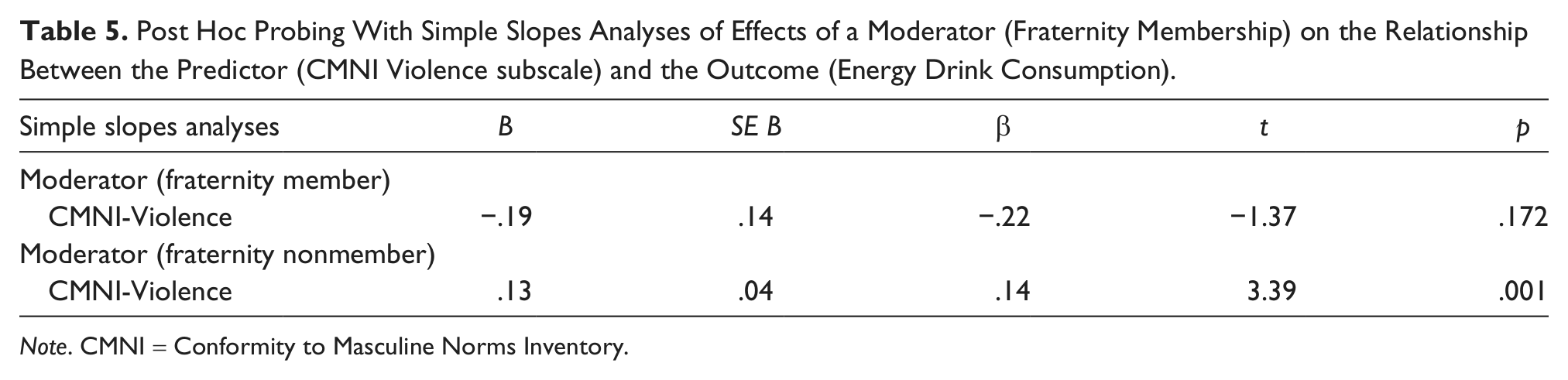
Note. CMNI = Conformity to Masculine Norms Inventory.
Discussion
Summary and Discussion of Results
Hypothesis 1 was supported. Where significant correlations appeared between the same masculinity constructs and both avoidance of substance use and energy drink use, they were of opposite signs. The correlations between the MRNI-R and the CMNI-46 Risk Taking subscale and avoidance of substance use were both negative, whereas their correlations with energy drink use were both positive, which indicates that these masculinity constructs functioned as risk factors in both the avoidance of substance use and the consumption of energy drinks. In regard to the exploratory part of this hypothesis, the IEDC was not associated with the six other scales that were associated with the avoidance of substance use, but it was positively associated with the CMNI-46 Primacy of Work and Violence subscales, scales that were not associated with the avoidance of substance use. This suggests that the interrelationships between masculinity constructs and energy drink consumption may differ considerably from those between masculinity constructs and other substance use.
The MRNI-R and three CMNI-46 subscales (Primacy of Work, Risk Taking, and Violence) appear to be health risk factors for energy drink consumption. These results are similar to those of Miller (2008), who used a modified version of the CMNI that included the Playboy, Winning, Dominance, Risk Taking, and Violence subscales (the latter two of which were among the significant predictors in the present study), and reported that energy drink consumption was positively associated with the modified CMNI. Thus, the existing research shows that the previously demonstrated links between masculinity constructs and health risks (Levant et al., 2009; Levant et al., 2011) also apply to the recent health risk behavior of energy drink use. However, contrary to prior research, none of the masculinity scales served as protective buffers for energy drink consumption. Finally, age was negatively associated with energy drink use, indicating that it acts as protective buffer, in which older men consume fewer energy drinks than do younger men. Age has been reported to be negatively related to the endorsement of traditional masculine norms (Levant & Richmond, 2007), indicating that as men get older, they tend to endorse masculine norms less. Indeed, in the present study, age was negatively correlated with MRNI-R and CMNI-Primacy of Work scores.
Hypothesis 2 was partially supported. Jock identity and fraternity membership moderated two relationships: Jock identity moderated the relationship between the MRNI-R and the IEDC, and fraternity membership moderated the relationship between the CMNI-Violence subscale and the IEDC. Post hoc probing identified that the slopes of the relationships between the IEDC and the MRNI-R for both the high and low values of jock identity were significantly different from zero. When jock identity scores are high, the positive linear relationship between the IEDC and MRNI-R is attenuated, so that there is less increase in the use of energy drinks per unit increase in MRNI-R, as compared with when jock identity scores are low. These results are surprising, as it was predicted that high scores on jock identity would strengthen the positive linear relationship between the IEDC and MRNI-R. There are several possible explanations for these results. First, they may be because of the fact that energy drinks are not intended for use with athletic activities as noted by Miller (2008). Perhaps athletes, even those with a jock identity, are more aware of the dangers associated with energy drink consumption and athletic activity than they were several years ago. Relatedly, those high in jock identity see themselves as ultracompetitive and thus may be less willing to consume drinks that may negatively affect their performance through dehydration. A third potential explanation of the current study is that, unlike Miller (2009a), the present study did not delineate the difference between being a jock and being a traditional athlete. Future studies should allow participants to endorse either being a jock, being an athlete, or neither rather than simply being a jock or not as was done in the present study, as jocks and athletes may have both endorsed the jock identity items.
In addition, post hoc probing identified that the slope of the relationships between the IECD and the CMNI-Violence subscale was significantly different from zero for fraternity nonmembers whereas it was not significantly different from zero for fraternity members. Essentially, then, members of fraternities do not show any relationship between the consumption of energy drinks and conformity to the masculine norm of violence. A potential explanation for this is simply that fraternity culture may be much more diverse and complex than was previously thought (Anderson, 2008). Much of the research demonstrating the adverse nature of fraternity membership was conducted in the 1980s (e.g., Martin & Hummer, 1989) or the 1990s (e.g., Cashin et al., 1998) and it is quite possible that times have changed and many contemporary fraternities may be aware of the problems and are making attempts to become more ethical and more responsible; hence, fraternity membership did not strengthen the association between masculinity and energy drink consumption. On the other hand, nonmembers have the usual linear positive relationship between the IEDC and the CMNI Violence subscale, which is congruent with prior research showing a link between energy drink consumption and violence (Kuhns et al., 2010).
The results of the present study are also congruent with those of Miller (2008), the only other study to examine energy drink consumption, masculine norms, and jock identity. A major implication of the present study is that masculinity norms appear to be associated only as risk factors with energy drink consumption, and not as protective buffers, as has been reported in prior research on general health behaviors. Hence, in regard to energy drink consumption, Harrison’s (1978, p. 65) warning—“The male sex role may be dangerous to your health”—fits the data. Although age appears to be associated as a protective buffer, it may well reflect the negative relationship between the endorsement of masculine norms and age. However, there are caveats, as the relationships between energy drink consumption, masculinity, and other factors appears to be quite complex. It is of interest that high jock identity and fraternity membership both attenuate the linear positive relationships between masculine norms and energy drink consumption, supporting the idea that gender roles and norms are fluid and contingent, in this case on jock identity and fraternity membership.
Limitations and Future Directions for Research
There are several limitations to the current study. First, given the correlational nature of the data, inferences cannot be made about causal relationships between predictors, moderators, and participants’ consumption of energy drinks. Future research might assess these relationships using experimental designs. Second, the majority of respondents in the investigation were young, European American, heterosexual, Christian men, raising concerns about the generalizability of the findings. Future research should attempt to replicate the present findings with a more diverse population in terms of age, race/ethnicity, sexual orientation, and religion. Third, as noted above, 52.1% of the participants reported that they did not consume energy drinks, 28.5% of the participants strongly disagreed with both items tapping jock identity, and only 8.2% of the participants reported that they were members of a fraternity. Hence these critical variables may have been underrepresented among the participants. Future research might attempt to correct for this by recruiting men who are more likely to consume energy drinks, identify as a jock, and be member of a fraternity. Finally, the self-report nature of the surveys introduces the possibility of bias due to socially desirable responding. A future study using a multimethod design (including the interviewing method) would strengthen evidence for these relationships.
One potentially fruitful area of future research on energy drinks would be to further explore Miller’s (2009a) empirically demonstrated delineation between jocks and athletes. Jocks may be susceptible to the dangers of energy drink consumption whereas athletes may not be. In addition, future research should examine the differences between “high-risk” and “low-risk” fraternities (DeSantis, Noar, & Webb, 2010) and how the two groups differ in terms of energy drink consumption and the requisite problems associated with energy drinks. In brief, “low-risk” fraternities are more inclusive and respectful whereas “high-risk” fraternities possess more traditional and monolithic attitudes toward masculinity, alcohol, sexual coercion, and so forth. Gidycz, Warkentin, and Orchowski (2007) discussed the issue of “mere membership,” meaning that merely being a member of a fraternity is not enough and researchers need to consider that fraternities are diverse and have differing contexts that are associated with varying degrees of risk. It is possible that many of the participants who reported being members of a fraternity in the present study may have been from “low-risk” fraternities, which may explain why the link between fraternity membership and conformity to the masculine norm of violence was only demonstrated for fraternity nonmembers. Finally, future researchers will want to consider the effects of ethnicity on energy drink consumption and the other factors examined in the present study, as West et al. (2006) reported that African American undergraduates are particularly vulnerable to the adverse consequences associated with energy drinks as they tend to consume significantly more sugar-sweetened beverages, including energy drinks.
Summary and Implications for Health Care Practice
The present study identified that age, endorsement of traditional masculinity ideology, and conforming to the masculine norms of risk taking and primacy of work were significant predictors of energy drink consumption. Furthermore, jock identity attenuated the linear positive relationship between the endorsement of traditional masculinity ideology and energy drink usage and fraternity membership flattened the linear positive relationship between conforming to the masculine norm of violence and energy drink consumption.
Readers who provide health care (including mental health care) to men should be aware of the growing dangers of energy drink consumption due to the combination of aggressive marketing and lax regulation, and to the susceptibility that men who endorse and/or conform to masculine norms may have to engaging in this risky health behavior. Although most of the participants either did not consume energy drinks or drank them in moderation, there were a small number of heavy users. Health care providers might enquire about usage to identify heavier users who might be at risk for the toxic effects of such use. Mental health counselors might find the masculinity measures used in this study, particularly the MRNI-R and the CMNI, useful for assessing clients’ endorsement of, or conformity to, masculine norms. There may be cases where discussing a client’s overall scores and/or responses to specific items may be of value in the mental health counseling process, particularly for heavy users of energy drinks.
Footnotes
Declaration of Conflicting Interests
The author(s) declared no potential conflicts of interest with respect to the research, authorship, and/or publication of this article.
Funding
The author(s) received no financial support for the research, authorship, and/or publication of this article.