




Abstract
In wireless sensor network, the storage amount of information is high, and the transmission and scheduling of control information is reasonable. The node communication model, network structure model, and energy consumption model are constructed. On this basis, the high-density data in wireless sensor network are scheduled to optimize the time for nodes to perform tasks. The nodes in the network are fully scheduled to control the generation time of packets in the network and the generation time of packets in the network. Experimental results show that in different iterations, the proposed method has lower node delay and node energy consumption, with values less than 0.2 and 2, respectively, and the maximum data fusion quality can reach 98, with high fusion benefits, so as to improve the transmission and scheduling efficiency and quality of high-density data in wireless sensor network.
Introduction
The rapid development of technologies and theories such as microelectronics, computers, embedded computing, communications, control, and radio frequency identification has led to the significant increase in the focus on the Internet of things in industry, academia, and governments.1,2 The Internet of things is the future direction of the network, and it is the focus of the world information industry after the mobile communication network, the Internet, and computers. The Internet of things is the information carrier obtained on the basis of the traditional telecommunication network. It can realize the interconnection and interconnection between ordinary independent physical objects and has three characteristics of intelligence, interconnection, and equipment.2,3 The Internet of things has been widely used in agriculture, defense and military, industrial manufacturing, logistics economy, health care, ecological and environmental protection, power grid, and food safety.3,4 Its terminal network is the wireless sensor network, which provides the way to perceive the world of the Internet of things in a large space–time scale. 5 Nodes have energy-limited phenomena in the network, and the main way to consume energy is data transmission. The main reason that affects the transmission delay of wireless sensor networks is data transmission scheduling. Therefore, it is necessary to study the data transmission scheduling method.
The work by Li 6 proposed to build optimization models including data transmission model and conflict resolution model with the goal of collecting network data in a short time. Through the imaging software, the scheduling tasks of different sizes in the wireless sensor network are obtained, and the genetic algorithm and the dynamic programming method are combined to solve the problem, and the transmission of high-density data in the network is realized. In this method, the energy consumed by the node transmission data is higher, but there is a problem of high energy consumption of the node. The work by Lin et al. 7 proposed to use the 0-k knapsack problem to replace the high-density data transmission and scheduling problem in the network. Based on the analysis of the structure characteristics of Fat-Tree, the operation rules, particle position, and particle velocity are determined. The data flow and scheduling model is constructed using the total difference value of the conflict flow in the two iterations as the objective function. The discrete particle swarm optimization algorithm is used to solve the data transmission scheduling model and realize the transmission scheduling of high-density data in the network. After scheduling by this method, there is the delay in the transmission of data in the network, and there is the problem of high node delay. The work by Chen et al. 8 considers the difference between communication-based overhead and computational overhead and considers the balance between the two. The processor is allocated based on the shortest completion time to achieve transmission and scheduling of high-density data. The data fusion quality of this method is low, and there is the problem of low convergence income. The work by Gu 9 determines the constraint conditions of scheduling resources, divides the state of resource data, and constructs a data scheduling model. The nodes are divided according to computing power, and the up-sorting value calculation method is used to sort the scheduling tasks in the wireless sensor network. The node that uses the shortest time to complete the scheduling task is selected as the distribution node to implement data transmission scheduling. This method has the problem of high energy consumption of nodes. The work by Zhang et al. 10 proposed a secure storage method of high-density information in network data transmission center based on compressed sensing. The high-density information of network data transmission is measured by compressed sensing, and the data compression is reconstructed by optimizing the measurement matrix of storage nodes and forwarding probability. Considering the digital characteristics of data storage, such as the use intensity and minimum transmission granularity, the fingerprint gradient in the process of compression and reconstruction of data storage is optimized to realize the flow separation of high-density information data. This method can realize high-density information efficient storage and reduce the information security storage delay under the premise of flow separation, but the calculation process is complicated and the delay is high.
To solve the problems in the above methods, a high-density data transmission scheduling method based on Wi-Fi is proposed. Wi-Fi is a short-range wireless technology11,12 used in offices and homes. Its advantages include wide coverage, fast transmission speed, low cost, and high data transmission efficiency. The node communication model, network structure model, and energy consumption model are constructed to clarify the key factors of data transmission, so as to improve the data transmission efficiency and reduce the time consumption. Wi-Fi technology is used to optimize the task execution time of nodes, improve the quality of data fusion, optimize the energy saving effect of data transmission, and realize the transmission scheduling of high-density data in wireless sensor network.
Materials and methods
Network model construction
Node communication model
The traditional node communication model can only deal with the data communication transmission between multiple nodes, which does not require high sending and receiving sensitivity of the nodes, but it will lead to inaccurate results of subsequent data processing. In this article, single-node data communication is the main research object to improve the transmission accuracy of high-density data on nodes. Suppose there is only one receiving node and sending node in the system. From the physical layer, whether high-density data can be efficiently transmitted between nodes depends on factors such as the receiving sensitivity of the receiving node in the wireless sensor network, the path loss of the signal in the network, and the transmitting power of the transmitting node in the wireless sensor network. 13 Based on the determination of various parameters of the node transceiver, the main reason for influencing wireless sensor communication between nodes is channel fading. 14
The free space propagation model is used to reflect the channel fading of space in the ideal medium. It is the relatively common ideal channel model. Let Pr(d) represents the fading function, and its expression is as follows

where
The attenuation function of the two-path ground reflection model is as follows

where
Based on the channel attenuation model, the communication between nodes in the wireless sensor network can be expressed as

When the value of
Network structure model
The wireless sensor network is usually composed of several sensor nodes and sink nodes. In the absence of other interference, the communication capabilities of the two nodes in the network can be described by the node communication model. The number of nodes in the network is large. If multiple nodes are sent at the same time, the nodes are likely to interfere with each other. Protocol models and physical models are often used to describe communication interference between nodes in wireless sensor networks.16,17
In the physical model, the data nodes sent at the same time are treated as sources of interference in the wireless sensor network channel. Considering the superposition of multiple node signals in the wireless sensor network, the given threshold or the size of the signal-to-noise ratio corresponding to the nodes determines whether the two nodes can communicate successfully in the wireless sensor network.

where
Energy consumption model
The traditional wireless sensor data transmission energy consumption model is too general in the concept of energy consumption and does not classify it, resulting in inaccurate energy consumption evaluation results. There are two types of energy consumption, namely, the energy

where b represents the number of bits acquired in a certain period of time. r represents the distance that the receiving node and the transmitting node exist in the wireless sensor network.
Suppose

The energy consumption of all nodes in the network can be divided into two parts, namely the energy consumed to send data and receive data.19,20 Assume that

According to the above analysis, for the data transmitted by the ancestor node, the nodes existing in the wireless sensor network can receive and forward. Suppose E represents the energy required for the node to receive and forward data in the wireless sensor network. The expression is as follows

where
It can be known from formula (6) that the distance does not affect the energy consumed by the node to receive data in the wireless sensor network, and the amount of data is the main reason that affects the energy consumption of the node receiving data.
According to the above analysis, the relationship between the length of the region, the total number of forwarding regions, and the distance between nodes satisfies the following formula

When 1 ≤ i < j, the energy

Combine formula (9) with formula (10) to get the following formula

Combining equation (5) with equation (11), the energy consumed by the node to transmit data in the wireless sensor network is obtained

The energy consumption of the data received by the node in the wireless sensor network can be directly calculated using equation (6), which is independent of the distance existing between the nodes.
The expressions for all nodes to forward and receive data X in the wireless sensor network are as follows

where
The data that other nodes forward in the network and the data that the node itself perceives in the network are the same as the total amount of data forwarded by the node and can be expressed by the following formula

The total amount of data received by node j in the wireless sensor network is equal to the total amount of data transmitted by node i to node j, so the matrix X main diagonal is symmetric. That is,
The energy consumption

When 1 ≤ i < Z − 1, the energy consumed by each node in the wireless sensor network needs to satisfy the following formula

Suppose T represents the lifetime of the wireless sensor network. The formula is as follows

High-density data transmission scheduling
Based on the node communication model, network structure model, and energy consumption model constructed in “Network model construction,” the high-density data transmission scheduling of wireless sensor networks is completed.
Virtual subnet
According to the node communication model, the network structure model, and the energy consumption model, the time during which each task is executed in the actual process is not necessarily the same. Virtual subnets are divided in wireless sensor networks based on factors such as task priority and execution time. The resulting virtual subnet is scheduled and optimized, 24 as shown in Figure 1

Virtual subnet division.
The execution time of the scheduled task in the wireless sensor network is not scheduling. The scheduling is to arrange the total amount of tasks in the wireless sensor network and the time when the data packet performs the task. The order in which tasks are executed can be scheduled according to the priority of the task in the wireless sensor network. In general, the priority of the task in the wireless sensor network can be determined by the shortest implementation priority algorithm or rate monotonic algorithm. The data frame format and execution time of the task in the same virtual subnet are the same, so the order in which the tasks are executed does not change the generation time and size of the data packet.25,26 This is used as the theoretical basis to realize the transmission scheduling of high-density data in wireless sensor networks.
Counting the total number of tasks at different times
According to the execution period of the task in the wireless sensor network, the total number of tasks to be executed in the virtual subnet node at different times is counted. Suppose n represents the total number of nodes present in the control network

If there are a total of m task cycles in the wireless sensor network, the order from small to large is as follows

In different task cycles, the total number of signals corresponding to node k is as follows

The different combinations of all tuples in the task period

where
It is assumed that

The column vector in the matrix

High-density data transmission scheduling
The cycle time of the common multiple task period
The signal nodes are arranged in at least a plurality of orders according to the total amount of data, thereby reducing the waiting time required in the optimization process.28,29 First, the node with the largest total number of signals is sent, and the sort order
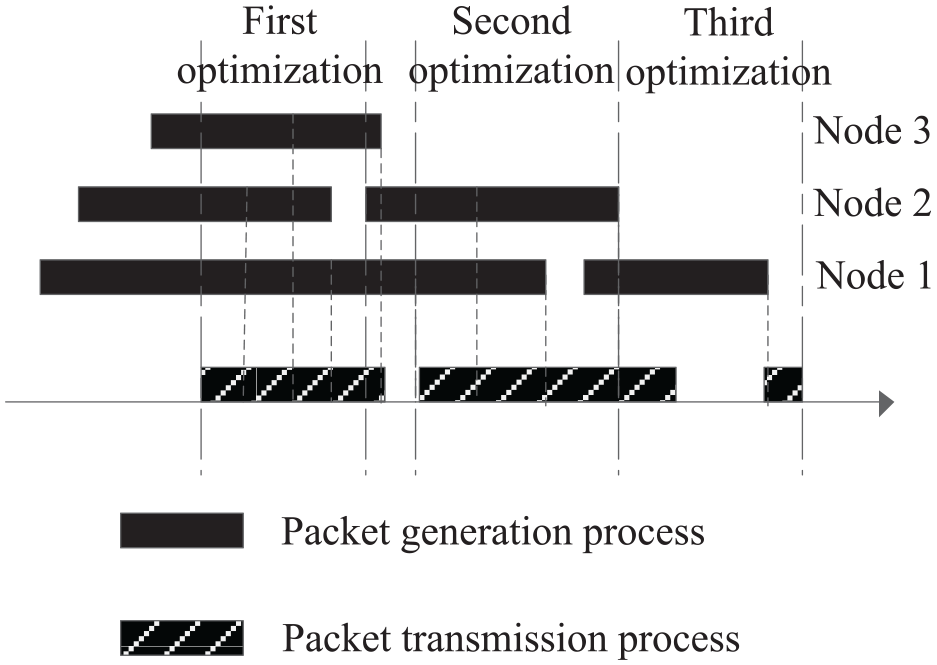
Task scheduling.
Assume that

Suppose

Suppose

Suppose

The first task of the packet is divided into the following two situations during the optimization process
When

When

If

The loop iterations (23)–(30) can obtain the scheduling schedule of the first task of the data packet in the public multiple task periods and realize the transmission scheduling of high-density data in the wireless sensor network.
Experiment and discussion
Windows 10 operating system is adopted to verify the overall effectiveness of the proposed method. The experimental environment is Matlab simulation platform, which is used for algorithm development, data visualization, data analysis, and numerical calculation of advanced technical computing language and interactive environment, which is very applicable to the experiment in this article. Literature by Aetesam and Snigdh, 5 Li, 6 and Lin et al. 7 were used as the experimental control group in the experiment, and the application effect of the proposed method was compared and tested. The time delay and energy consumption test indexes are selected to evaluate the performance of different methods.
Time delay
The test was carried out in different iterations, and the time delay of the four different methods was compared. The lower the time delay, the smaller the delay of the method, and the better the performance of the method. The test results are as follows:
Figure 3 shows that the time delay of high-density data transmission scheduling method based on Wi-Fi in wireless sensor network is within 0.2 s in multiple iterations, which does not affect the normal transmission of high-density data in wireless sensor network. The node transmission delay of the other three methods is higher than 0.5 s. The delay of node transmission in the other three methods is higher because the transmission and scheduling method of high-density data in the Wi-Fi-based wireless sensor network constructs the node communication model before scheduling high-density data. According to the node communication model, the characteristics of nodes transmitting data in wireless sensor networks are studied, and the time delay of nodes transmitting data is reduced.
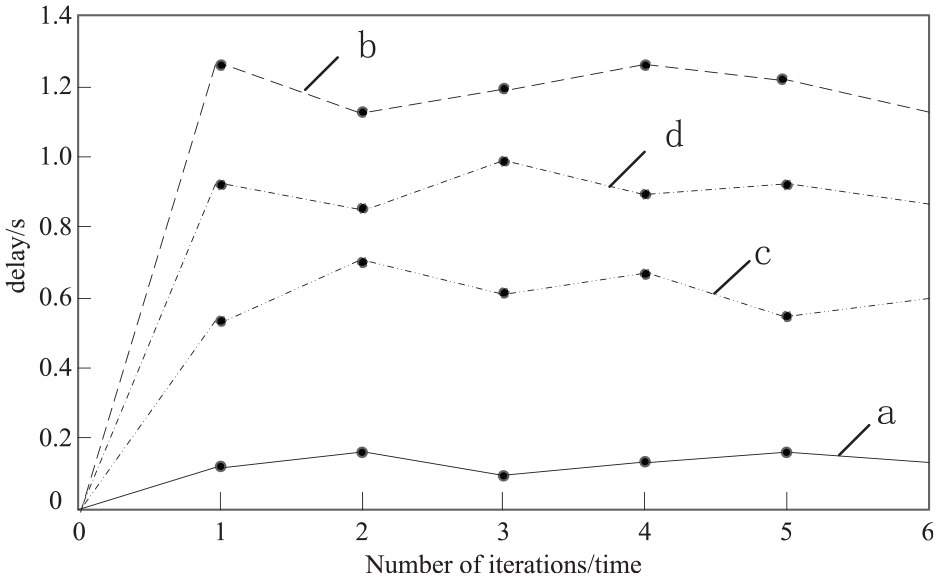
Time delay for four different methods.
Energy consumption
Let a represent the energy consumption coefficient of the node, and value is in the interval [0,10], which can better measure the energy consumption coefficient of different methods. The higher the energy consumption coefficient, the more energy consumed by the node in transmitting data in the wireless sensor network.
As can be seen from Figure 4, the energy consumed by the node transmission data of the high-density data transmission and scheduling method in the Wi-Fi-based wireless sensor network is lower than the energy consumption of the above three methods. This is because the method builds a node energy model and sets node energy constraints, which reduces the energy consumed by nodes to transmit high-density data in wireless sensor networks.

Discussion
Based on further validation of Wi-Fi wireless sensor network, high-density data transmission scheduling method is found effective; through integration benefits of wireless sensor networks based on Wi-Fi density data transmission scheduling method and three methods of literature, fusion income represents the quality of data fusion in wireless sensor network, the quality of data fusion with parameter B, value within the interval [0100], the higher the value represents the higher the quality of data fusion, and four different methods of test results as shown in Figure 5.
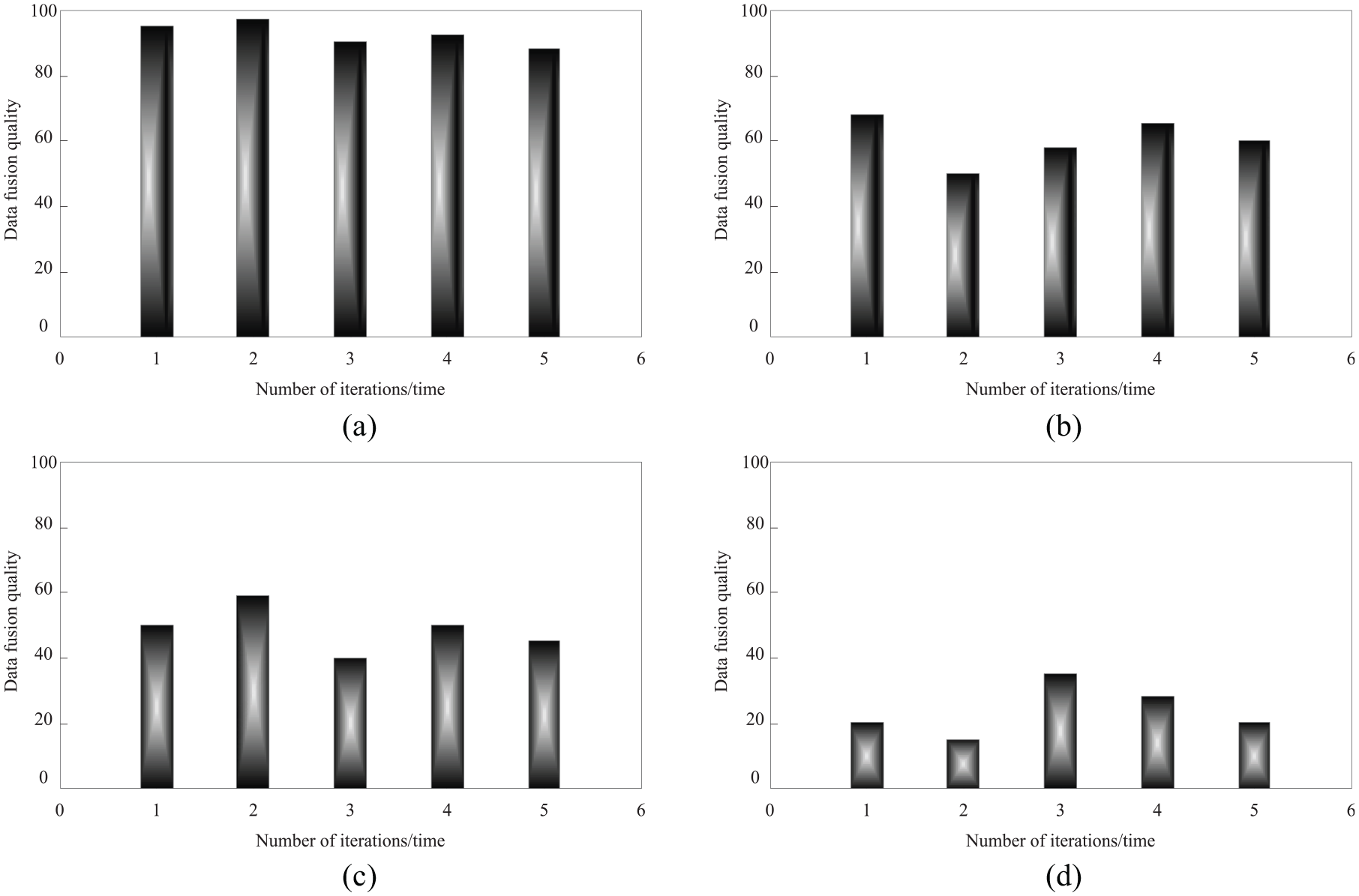
As can be seen from Figure 5, the Wi-Fi-based wireless sensor network high-density data transmission scheduling method has higher data fusion quality. In the five iterations, the data fusion quality value is higher than 80, which is much higher than the fusion quality value of the other three methods. Because the method controls the generation time of the data packet in the network when scheduling high-density data packets, this ensures that the generated data packets can be transmitted immediately. This solves the problem of data collision and queuing delay in the network, and improves the quality of the transmitted data, thereby improving the quality of data fusion.
Conclusion
The main function of wireless sensor network is to collect and transmit data, so the transmission and scheduling of data is the key problem of wireless sensor network. The current data transmission scheduling method has the problems of high node delay, high node energy consumption, and low fusion benefit. Therefore, a wireless sensor network high-density data transmission scheduling method based on Wi-Fi is proposed. This method constructs node communication model, network structure model, and energy consumption model before dispatching high-density data; fully considers the process of packet generation and transmission in wireless sensor network; and optimizes the time of node task execution, thus reducing node delay. The nodes in the network are fully scheduled to control the time of packet generation in the network, which further reduces the consumption of energy consumption. The transmission scheduling of high-density data in wireless sensor network is realized. Experiments show that the proposed method has low node delay, low energy consumption, and high fusion benefit, which not only provides a new idea for data transmission scheduling in wireless sensor networks, but also lays a foundation for the development of wireless sensor networks. In the future study, network conflict, packet delivery rate, packet discard rate, and other aspects will be further compared to improve this study.
Footnotes
Handling Editor: Wei-Chang Yeh
Declaration of conflicting interests
The author(s) declared no potential conflicts of interest with respect to the research, authorship, and/or publication of this article.
Funding
The author(s) disclosed receipt of the following financial support for the research, authorship, and/or publication of this article: This research was funded by National Key R&D Program, grant number 2018YFF01014304, and Xinjiang Uygur Autonomous Region University Joint Fund (XJEDU2019Y049, XJEDU2019Y057).
