




Abstract
In wireless sensor networks powered by battery-limited energy harvesting, sensor nodes that have relatively more energy can help other sensor nodes reduce their energy consumption by compressing the sensing data packets in order to consequently extend the network lifetime. In this article, we consider a data compression technique that can shorten the data packet itself to reduce the energies consumed for packet transmission and reception and to eventually increase the entire network lifetime. First, we present an energy consumption model, in which the energy consumption at each sensor node is derived. We then propose a data compression algorithm that determines the compression level at each sensor node to decrease the total energy consumption depending on the average energy level of neighboring sensor nodes while maximizing the lifetime of multihop wireless sensor networks with energy harvesting. Numerical simulations show that the proposed algorithm achieves a reduced average energy consumption while extending the entire network lifetime.
Keywords
Introduction
Wireless sensor networks (WSNs) typically consist of numerous sensor nodes, which accomplish their task over a specific field. Each sensor node is capable of sensing, processing, and communication using its own sensor, processor, and wireless transceiver. It usually monitors some surrounding environmental phenomena, collects the sensing data, and forwards the data toward a designated sink node, which is responsible for data storage and analysis. These WSNs have been widely deployed in real environments 1 in order to provide information gathering to users for better understanding of the environment.
In many applications of WSNs, a large number of sensor nodes with a limited battery capacity should be deployed at remote places that are difficult to access. Due to the limited battery capacity, sensor nodes should be energy-efficient to extend their lifetime. Many studies have focused on achieving the maximum utilization with limited energy. In El Gamal and colleagues,2,3 energy-efficient scheduling algorithms have been proposed and studied, in which the energy for wireless data transmission is minimized by varying the packet transmission time. Pal et al. 4 have proposed a balanced cluster-size clustering algorithm in order to extend the lifetime of WSNs. The proposed algorithm has improved the cluster quality while providing a lower death rate of the sensor nodes. In Sankarasubramaniam et al., 5 a fixed frame-size optimization for energy efficiency has been proposed. A study of the feasibility of forward error correction in WSNs has also been carried out. In He, 6 many multipath routing algorithms have been introduced to guarantee the network latency and energy efficiency. Oh and Chae 7 have suggested grid-based solutions, however, which are based on unrealistic assumptions. As a promising technology for overcoming the limited battery capacity, energy harvesting in WSNs has also been studied.8–10 By gathering energy from the environment to extend the lifetime of the sensor nodes, the network connectivity can be sustained longer. Gunduz et al. 9 have provided mathematical tools and analytical models for designing reliable communication systems with energy harvesting. In particular, energy harvesting from a radio-frequency (RF) signal in a relay network is considered in Nasir et al. 10 Given the structure of a sensor-relay-destination node, a relay node is capable of harvesting energy from the RF signal transmitted by the sensor node, and the harvested energy is used to forward data to the destination node.
A sensor node usually performs three operations, which are sensing, processing, and data communication. It was reported in Anastasi et al. 11 and Medeiros et al. 12 that among the three operations, the data communication is the most energy-consuming operation in most cases. For this reason, many researchers have studied to reduce the energy consumption for data communication in WSNs mainly by two approaches: duty-cycling and in-network processing. In the schemes based on duty-cycling approach, the energy is saved by coordinating the schedules of wakeup/sleep time at sensor nodes. Meanwhile, in-network processing-based schemes, such as data aggregation and data compression, mainly attempt to reduce the amount of data to be transmitted.
As one effective way to reduce the amount of data to be transmitted, data compression has been actively researched.12–19 Using an appropriate compression method for sensing data, sensor nodes can transmit and receive smaller-size data packets. As a result, the energy consumption for data transmission at sensor nodes can be significantly reduced. In Kimura and Latifi, 20 Srisooksai et al., 21 and Razzaque et al., 22 a detailed comparative survey is provided on various data compression approaches for energy efficiency in WSNs. Kimura and Latifi 20 presented four types of feasible data compression schemes that are used for WSN nodes with limited resources. Srisooksai et al. 21 and Razzaque et al. 22 provided a comprehensive review of data compression algorithms for WSNs, classified the compression algorithms into several categories such as distributed source modeling, transform coding, source coding, and compressive sensing, and compared them with respect to various performance metrics such as the compression performance and amount of power consumption.
As one of the applications for data compression, we consider multihop WSNs, in which packets generated from a source node are relayed by intermediate nodes and travel toward the destination node along a multihop wireless path. The nodes along the multihop path are able to perform data compression in order to reduce their energy consumption for transmission. As the packet is relayed toward the destination node from the source node, the length of the packet becomes smaller by data compression, which leads to a gradual decrease in the energy consumption.
In this article, we consider the energy savings using data compression in order to extend the lifetime of multihop WSNs. A sensor node transmits and receives a smaller-size packet using data compression so that it can reduce its energy consumption. We also consider battery-operated sensor nodes, which are rechargeable by energy harvesting. Depending on the environment, for instance, the amount of sunlight, the energy harvested at each node can be different as time goes by, resulting in an unevenness in the energy levels among the sensor nodes. In order to decrease the average energy consumption of sensor nodes and extend the lifetime of the networks, we propose a data compression algorithm considering the average energy level of the sensor nodes within the next m hops. The compression level for each sensor node is determined such that the difference between the magnitude of its own energy level and the average energy level of the sensor nodes in next m hops is reduced. Numerical results from a simulation of the proposed algorithm verify that the network lifetime is significantly increased while reducing the average energy consumption.
The remainder of this article is organized as follows. An overview of related works is presented in section “Related works.” In section “Energy consumption model,” we describe the energy consumption model and formulate the amount of energy consumed at each node. We then propose an algorithm to extend the network lifetime using data compression in section “Proposed decision scheme for compression.” The simulation results are presented in section “Performance evaluation,” and section “Conclusion” concludes this article.
Related works
There has been a significant amount of work on the data compression for energy conservation in WSNs. We briefly summarize the related work into two categories, standalone compression at a single node and cooperative compression among multiple nodes.
Standalone compression at a single node
The data compression schemes in this category focus on the compression process carried out at a single sensor node without exchanging energy information with other nodes.12–16 The main purpose of these schemes is to achieve the increase in the compression ratio of data packets, that is, how much the data packet size can be reduced. Mercelloni and Vecchio13,14 have proposed a simple lossless entropy compression (LEC) algorithm for temperature and relative humidity sensing data. LEC algorithm exploits the characteristics of high correlation between consecutive data measured by a sensor node. To compress the measured data, LEC algorithm first computes the differences of consecutive measured data and divides them into a small number of groups. These groups are then entropy encoded using a small, fixed dictionary table based on Huffman coding, resulting in the compression ratio of around 67%. Since LEC algorithm can be implemented using a small, fixed dictionary, it requires low memory, but the data resolution is very limited. Marcelloni and Vecchio
12
have proposed a more improved lossless compression method based on Huffman coding, called lightweight data compression. Compared to LEC that always uses the same dictionary, this method utilizes a reference dataset to generate a dictionary under measurement. With the modest computational and memory requirements, it achieves a higher compression ratio compared to LEC, which varies between 46% and 82%. Some lossy data compression methods have also been researched.15,16 In contrast to lossless data compression, lossy data compression tolerates a certain level of inaccuracy induced by the data compression, but the significantly higher compression ratio can be provided. Capo-Chichi et al.
15
have proposed a lossy data compression algorithm called K-RLE,where K is a parameter of precision and RLE means run-length encoding. The main idea of K-RLE algorithm is that the consecutive sequence of the same bits b or bits in the range [
Cooperative compression among multiple nodes
The data compression methods presented in this category focus on how sensor nodes cooperatively compress the data packets transmitted on the network by sharing the network information such as the position of each node or the spatial correlation between sensing data at different sensor nodes.17–19 In Tavli et al., 17 an optimal data compression scheme was formulated as an optimization problem that maximizes the minimum lifetime of the sensor nodes in order to increase the network lifetime. It is assumed that each node can compress and decompress raw data with multiple compression levels. The energy consumption was modeled by introducing two types of virtual nodes that perform data compression and decompressions. Because of computation complexity of solving the optimization, the authors proposed a heuristic approach, which enables the nodes farther away from the base station to always compress their data and those closer to the base station not to compress data. Incebacak et al. 18 have considered the data compression in a stealth mode of WSNs, where each sensor node has a different limited transmission power depending on its position in order not to be detected from adversaries. They proposed an optimization framework that jointly considers the network privacy preservation and the multi-level compression presented in Tavli et al. 17 in order to increase the network lifetime while retaining the network privacy. Five different compression strategies based on the multi-level compression have been compared to investigate the impacts of these strategies on the network lifetime in the stealth mode of WSNs. The data compression for delay-tolerant applications in WSNs has also been considered in Ali et al. 19 The authors have focused on both spatial and temporal correlations between the data collected by different sensor nodes over a long period of time. Accordingly, they proposed an adaptive hybrid compression (AHC) scheme that fuses both spatial and temporal compression in order to increase the compression ratio with a guaranteed data recovery accuracy.
Our proposed data compression algorithm falls into the second category because it utilizes the information from the other sensor nodes on the network to reduce the energy consumption and increase the network lifetime in WSNs. The proposed approach is distinct from existing methods in that it focuses on an energy-harvesting scenario of WSNs, in which the sensor nodes have significantly different amount of energy consumed and harvested at each node. In order to deal with this unevenness of energy, each sensor node gathers the usable energy levels of other sensor nodes and compare them with its own energy level when deciding how much it needs to compress data packets to support the other sensor nodes that are relatively lack of energy. Under the proposed method, all sensor nodes cooperate with other nodes to fairly consume their energy so that they are almost simultaneously exhausted and consequently the network lifetime is increased.
Energy consumption model
We consider multihop data transmission in a WSN, in which data packets are relayed by intermediate nodes, as shown in Figure 1. In our network topology, N nodes are randomly distributed in the network. Each node is battery powered with an energy-harvesting capability. Therefore, the energy level in the battery could be different among the sensor nodes in the same network because they are geographically distributed in an area and are exposed to different surrounding environments.

A multihop wireless sensor network.
We derive an energy consumption model for compressed data transmission in the multihop WSN. Let L be the length of a data packet. Each data packet consists of b blocks, and the block size is
Each node can compress a certain number of blocks among all blocks before it transmits the packet. For example, if a source node compresses x blocks among the total number of b blocks, a relay node receives a packet with (
Figure 2 shows the compression process of a data packet while the packet is relayed along a multihop path. The data packet is divided into smaller-sized blocks and can be compressed on a block-by-block basis. Each node performs data compression using a certain compression level and transmits the compressed data to its next node along a multihop routing path. For instance, in Figure 2, the source node compresses the first three blocks of the original data, and the remaining blocks are sequentially compressed by the following relay nodes. Finally, the nth node receives the reduced packet with the size of

Variation in the data length with compression at each node.
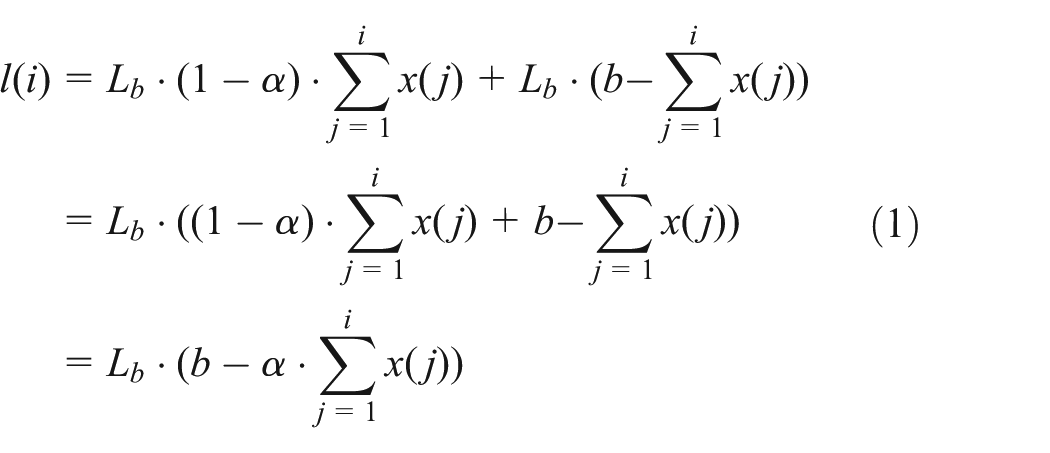
As the data packet begins to be compressed at the preceding nodes, the length
where
We derive the energy consumption at each node in a multihop network. Let

The first and second terms in equation (2) are the energies consumed for compression and transmission at the first node, respectively. Note that since we focus on how the energy consumption for packet transmission, compression, and reception affects the network lifetime, the energy consumed for other functionalities such as sensing and routing is not included in equation (2). Intermediate nodes receive a packet, compress it, and transmit the reduced-size packet. The energy consumption at the ith relay node for

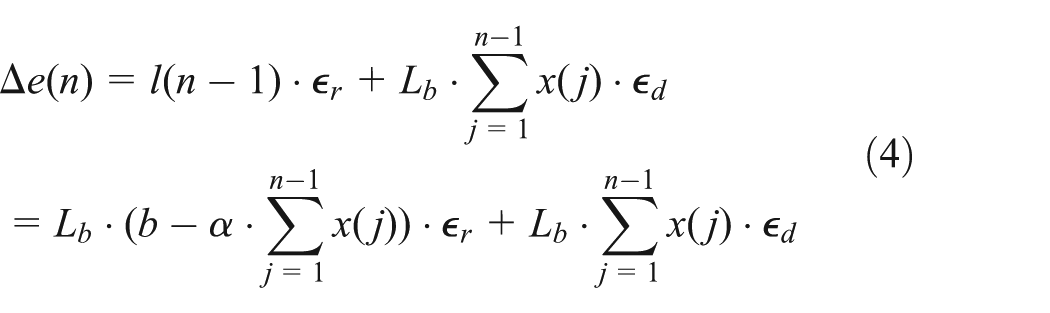
where each term represents the energies consumed for reception, compression, and transmission, respectively. The destination node receives the compressed packet and retrieves the original packet by decompressing it. The energy consumption at the nth node (destination node) is given by
where

Equations (2)–(4) can be represented in the matrix form given in equation (5). Then, the energy consumption for each compressed data transmission in a multihop network is simply written as follows

where
From equation (6), we derive a dynamic model for the energy consumption of multihop transmission. Let

where
Proposed decision scheme for compression
In this section, we consider the energy consumption using data compression for multihop data delivery. As a data packet is forwarded along a multihop path in WSNs, the packet length gradually becomes smaller by data compression, and then, the energies consumed for receiving and sending the packet at each node decrease. Here, we propose a scheme that determines the compression level of each node in order to minimize the energy consumption and to maximize the network lifetime.
Energy consumption minimization
First, we focus on the minimization of the sum of the energies consumed by the nodes along a multihop path. This problem is formulated as follows
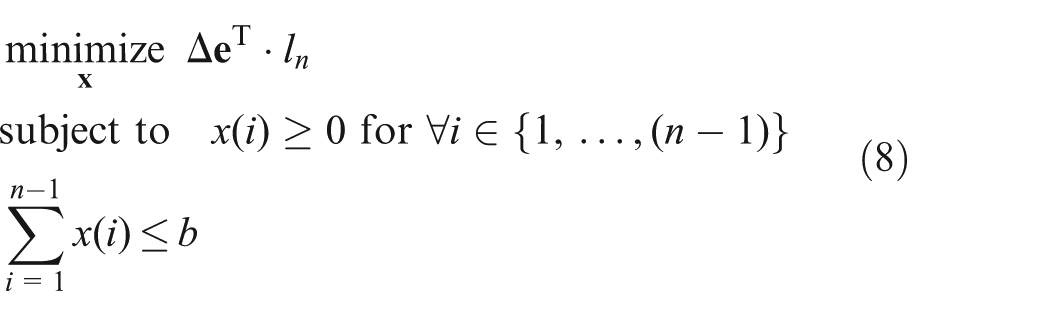
where
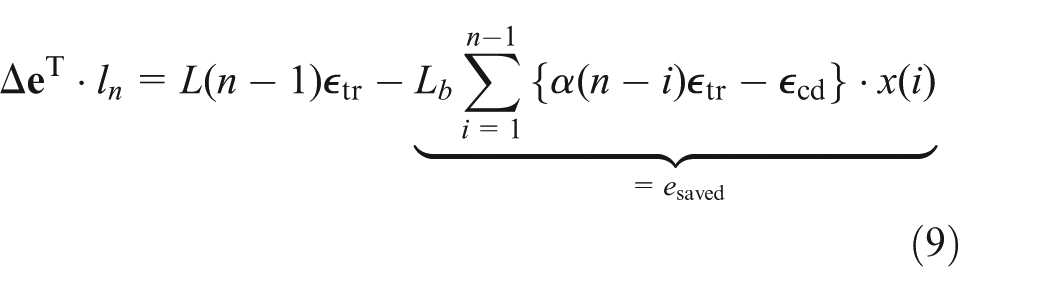
where

Hence, the optimal solution is obtained as
The above proposition implies that if
Network lifetime maximization
We now further consider the problem of maximizing the network lifetime. To this end, we need to consider the energy level of each sensor node for each packet transmission. The network lifetime can be defined differently depending on the type of applications. For example, it can be the instant when the first node exhausts all its energy, a certain portion of nodes die, the network is partitioned, or the loss of sensing coverage occurs. 23 Here, we adopt the first one, that is, if one of the sensor nodes runs out of energy, it is considered that the network lifetime ends.
In a given multihop path, there may exist an unevenness in the energy levels among the sensor nodes due to the unbalanced energy consumption for packet transmission or a different amount of recharged energy by energy harvesting at each node. Consequently, for each packet transmission, the problem of maximizing the network lifetime can be formulated as follows:

From equation (10), since
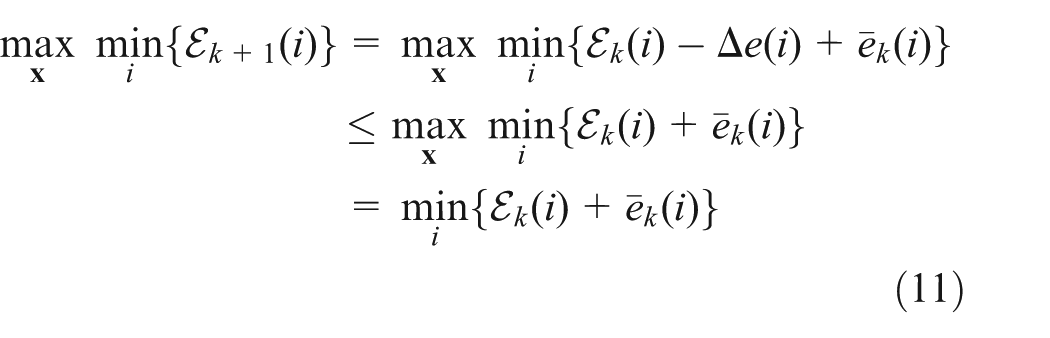
where
Hence, if we denote
Proposed m-hop averaging compression algorithm
Instead of solving the optimization problems, we propose a heuristic algorithm that determines an appropriate compression level

Here, we assume that each node can predict the amount of energy harvested and obtain the current energy levels of the next m nodes. Since the timeslot in which each packet transmission is carried out is very short (less than several milliseconds), the amount of energy harvested at each node during the time elapsed between two timeslots can be considered steady. Therefore, each node can predict the amount of energy to be harvested for this timeslot using an one-step-ahead linear prediction filter based on the amounts of energy harvested during a few previous timeslots. It is also possible to obtain the energy levels of the next m nodes with very little energy consumption for a small value of m (e.g. m = 1 or 2) because sensor nodes can piggyback the energy level on their data packets instead of using any extra control packets for energy information sharing.
Using the calculated average energy level in equation (12), the ith node determines the level of compression for each packet by comparing
Algorithm 1 shows the pseudocode for the proposed algorithm that determines

Performance evaluation
To evaluate the performance of our proposed algorithm, we considered a multihop WSN, in which N sensor nodes are randomly distributed. It is assumed that each sensor node is an IEEE 802.15.4-based MICAz device powered by two AA rechargeable batteries.24,25 Each node is also assumed to have 5 kJ (2.5 kJ per each AA rechargeable battery) as the initial energy. As reported in the MICAz datasheet,
24
the transmission range of RF transceiver in MICAz is between 75 and 100 m. Here, the average distance between sensor nodes is set to 80 m so that the adjacent sensor nodes are within the transmission range of each other. We also refer to the energy model in De Meulenaer et al.,
25
where the energy consumed for computation, transmission, and reception are 3.5, 600, and 670 nJ/bit, respectively. Each node is assumed to exploit bzip2 to achieve lossless data compression with compression ratio of 0.7 as discussed in Barr and Asanović.
26
For compression and decompression of one bit, it requires 116 and 31 instructions/bit, respectively. Based on the energy model and data compression above, the parameters used in our simulations are chosen as
Figure 3 shows an example of multihop WSN with 15 nodes and 3 data flows. We assume that one packet transmission from the source node to the destination node is completed within one timeslot, and in each timeslot, each node is recharged by energy harvesting that is determined by a Gaussian random distribution with a mean of 100 µJ and a standard deviation of 20 µJ. At every packet transmission, a source node and a destination node are randomly selected, and then, a multihop path from the source node to the destination node is determined by a routing algorithm. There exist a variety of routing algorithms for WSNs such as location-based routing, data-centric routing, QoS-based routing, and energy-aware routing by Goyal and Tripathy.
27
Here, we adopt the simplest one, shortest-path routing algorithm, to investigate the performance of the proposed data compression algorithm without being affected by any other conditions such as routing. We performed simulations of our proposed algorithm with three cases,

Multihop network topology with 15 nodes and 3 data flows.
We first evaluated the average energy consumption. Figure 4 plots the average energy consumption with respect to the number of nodes N in the network. The average energy consumption means the total energy consumption divided by N when one packet is transmitted from the source node to the destination node. Our proposed algorithm exhibits an average energy consumption that is roughly 120 µJ lower than that of the no-compression scheme regardless of the number of nodes. The first-node-all-compression scheme shows a much lower average energy consumption than our proposed algorithm because every node, except the first node, receives and transmits the fully compressed packet, which facilitates a lower energy consumption.

Average energy consumption with respect to the number of nodes.
In order to evaluate the network lifetime, we next measured the average network lifetime with respect to N for two cases, that is, without energy harvesting (Figure 5) and with energy harvesting (Figure 6). Here, if any one of the nodes runs out of energy, the network lifetime is considered to be finished, as mentioned in section. “Proposed decision scheme for compression.” Let us assume that the total number of timeslots means the network lifetime since the number of timeslots is equal to the number of possible packet transmissions. In both Figures 5 and 6, it is seen that our proposed algorithm exhibits the longest network lifetime, which is approximately 5·105 timeslots more than the no-compression scheme over a wide range of the number of nodes. On the other hand, the first-node-all-compression scheme shows the shortest network lifetime among the three schemes, even though it exhibits the lowest average energy consumption, as shown in Figure 4. This definitely implies that the one node that is frequently chosen to be the first node is exhausted much quicker than any other node.

Average network lifetime with respect to the number of nodes without energy harvesting.

Average network lifetime with respect to the number of nodes with energy harvesting.
We also examined the effect of energy recharging by energy harvesting on the network lifetime. As shown in Figures 5 and 6, energy harvesting with a Gaussian random distribution
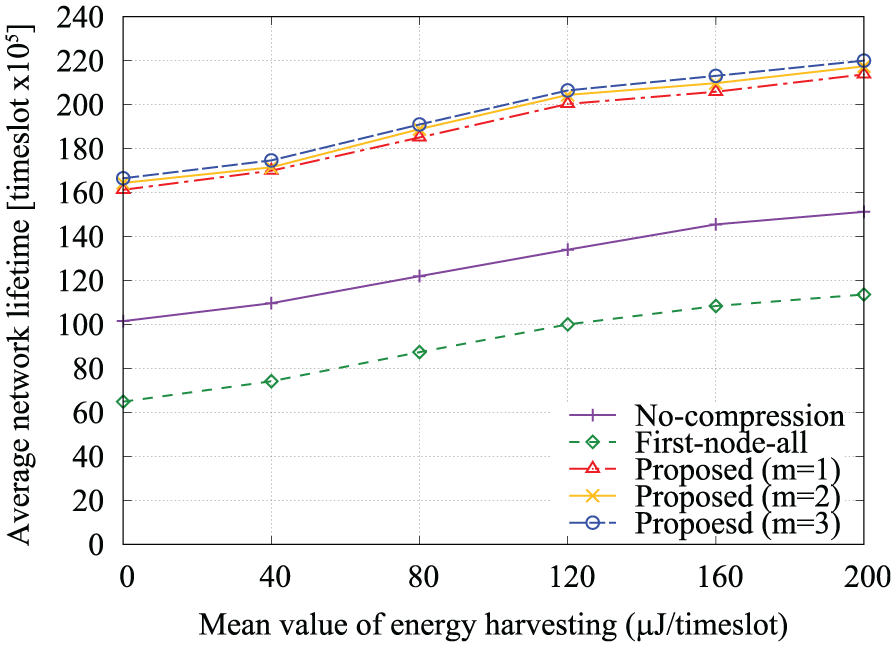
Average network lifetime with respect to the mean value of energy harvesting.
Finally, we evaluate the network lifetime performance of the schemes in a larger network. Figure 8 shows the average network lifetime with respect to the number of nodes varying from 20 to 120. The performance results verify that the proposed algorithm provides the longest network lifetime in the larger network environment regardless of the value of m. It is also observed that the network lifetime of every scheme proportionally increases as the number of nodes increases. This is because the probability that each node is involved in routing paths decreases as the number of nodes in the network increases. As a result, each node consumes less energy for receiving, compressing, and transmitting data packets.
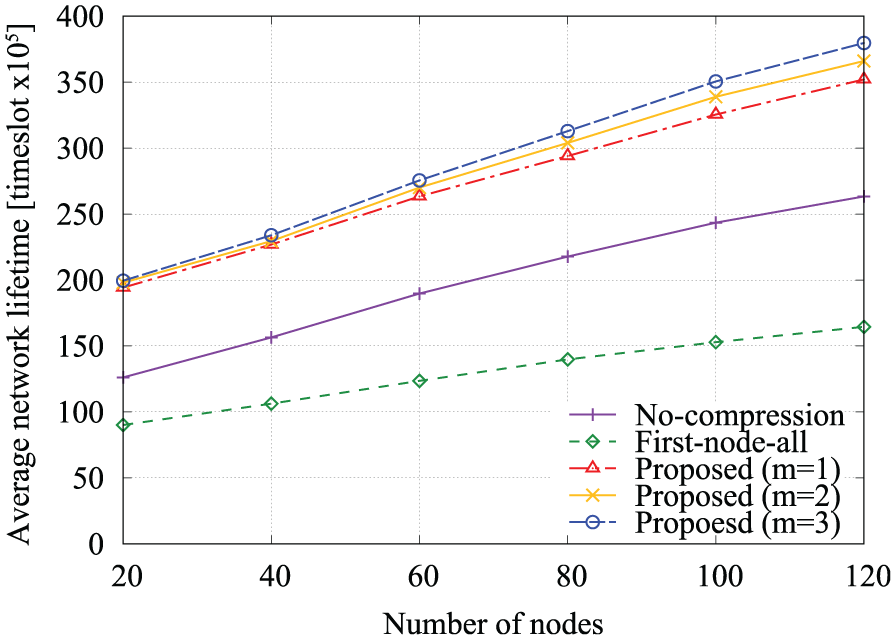
Average network lifetime with respect to the number of nodes in a larger network.
Through our numerical simulations, it is obvious that our proposed algorithm using data compression extends the network lifetime while reducing the energy consumption of WSNs. Furthermore, how to choose an appropriate value of m has been investigated. As shown in Figures 4–8, the performance differences between different values of m are not remarkable, even though the algorithm with a larger m, for instance,
Conclusion
In this article, we have considered energy savings for wireless sensor nodes that suffer from a limited battery capacity. For energy-harvesting WSNs that can be slowly recharged, we have proposed a data compression algorithm to decrease the average energy consumption while maximizing the network lifetime. As a data packet is relayed along the multihop path in the network, our proposed m-hop averaging compression algorithm determines the amount of packet to be compressed at each node by mainly considering the average energy levels of the next m nodes within m hops. Our extensive simulation results have verified that our proposed data compression algorithm achieves a considerable reduction in the energy consumption with a significantly extended network lifetime.
Footnotes
Academic Editor: Jemal Abawajy
Declaration of conflicting interests
The author(s) declared no potential conflicts of interest with respect to the research, authorship, and/or publication of this article.
Funding
The author(s) disclosed receipt of the following financial support for the research, authorship, and/or publication of this article: This study was supported by the Electronic Warfare Research Center at Gwangju Institute of Science and Technology (GIST), originally funded by the Defense Acquisition Program Administration (DAPA) and Agency for Defense Development (ADD).