




Abstract
With the rapid development of computer technology, image processing and automatic book recognition has become a very important and practical field, and this discipline has a broad prospect and great potential. The digital visión system is a multi-plane information análisis method basad on the human brain, which is applied to library identification problems by studying several regular changes in the distribution of objects themselves in two-dimensional space and three-dimensional position, in order to improve book quality and reduce costs. In addition, digital Reading devices have become an essential part of people’s daily learning life, and multimedia retrieval methods have also undergone radical changes, image processing is becoming more and more complex, and algorithms must become more efficient and reliable as the amount of computing increases to a certain level, so as to adapt to this fast and powerful data storage and query needs. Therefore, the tren is to improve the speed and reliability of computer systems. This paper discusses and proposes measures for the analysis and extraction, classification and sorting of library images.
Introduction
As network technology has progressed rapidly, the era of big data has arrived, and in this context, developing algorithms and solutions to address real-world problems has become a major research area. At present, most of the information stored in wireless multimedia is used in traditional parallel computing because, in the actual application process, there are many uncertainties that lead to unpredictable or difficult to eliminate these randomness brings unknown signal changes over time and nonlinear phenomena resulting in communication interruptions, transmission errors and other effects, making the algorithm inefficient and cannot meet the real-time processing requirements [1], thus limits the performance requirements needed to solve real-world problems based on existing methods and solutions. Network-based transmission of big data models can be a good solution to real-world problems. However, nonlinear algebraic equations it is still an abstract mathematical theory that is difficult to deal with due to the transformation relationship between uncertain variables that cause large changes in system performance parameters, which leads to a series of serious consequences such as solution bias estimation, so the study of how to achieve optimal transmission path optimization within a certain error range has become one of the most urgent problems to be solved [2].
In nonlinear algebraic equations, there are many kinds of algorithms to solve problems that conform to the scheduling rules. For example, multipath and Gaussian models under linear transformation, Kalman filtering, etc. For discrete format data, there are limitations in solving some complex problems due to its strong randomness and complexity, as well as its great computational effort and high operation time: it is impossible to obtain a specific constraint function; and because of these limitations, the optimal result cannot be obtained, or the optimal value cannot be reached in some solutions [3].
To address the challenges faced by the above-mentioned algorithm for nonlinear algebraic equations, the optimal solution is found by using certain rules in discrete data to find the optimal solution under random search conditions. A high degree of intelligence with guaranteed global and predictable outcomes can be achieved through the application of this algorithm to solve the traditional issues of minimum allocation schemes, high throughputs, and a high degree of intelligence. At present, data transmission in wireless multimedia is mainly realized through network communication, but due to the existence of inter-channel interference, bandwidth limitations, etc., a scheduling optimization model, in this case, can effectively solve the above problems [4].
Due to the advancement of wireless communication technology, analogy circuit-based implementations of digital interactive multiplex communication can no longer meet our demand for multi-channel multimedia network information storage and transmission, and nonlinear algebraic equations, as one of the most novel and challenging topics in a new era, have been proposed to study multiple nodes in linear space as a whole. However, because the linear space model is built on the basis of stochastic processes, the model itself has certain defects and uncertainties, which can lead to its inability to be applied to the real-life production field. At the same time, due to the problems of excessive wiring or long line length in the traditional wired network layout, how to effectively use the existing resources to achieve information sharing has become a popular research topic [6].
In this paper, we introduce a nonlinear model of optimal allocation method based on topology (dB) adaptive scheduling algorithm, ant colony control strategy, and genetic operator for the optimal solution of the scheduling scheme and verify the feasibility of the method through simulation. The method provides a feasible idea for solving the practical wireless multimedia big data transmission model problem and is effectively applied to the real-time processing process in other fields with high relevance and robustness [7].
This article reduces multimedia data transmission energy consumption to extend Wireless Multimedia Sensor Network (WMSN) lifespan. For the cost model, the optimum transmission radius of the transmitting sensor nodes and optimal Cluster Head (CH) selection at every round are combined with the energy consumption model. The suggested technique minimizes the cost function to identify the ideal transmission radius and CHs. The suggested technique is tested in a simulated WMSN environment against state of the art algorithms for increased network lifespan and sensor residual energy [8].
The study [9] used a sophisticated optimization approach to maximise network lifespan with low energy usage. The optimum transmission radius is obtained by optimizing the system parameter to send sensor data to sensor nodes within the range. The cub pool-linked lion algorithm (CLA) is proposed for this optimum selection. The cost function of the suggested model uses a range of 64–68. Considering the outcome.
Structure of neural network based on nonlinear function expansion.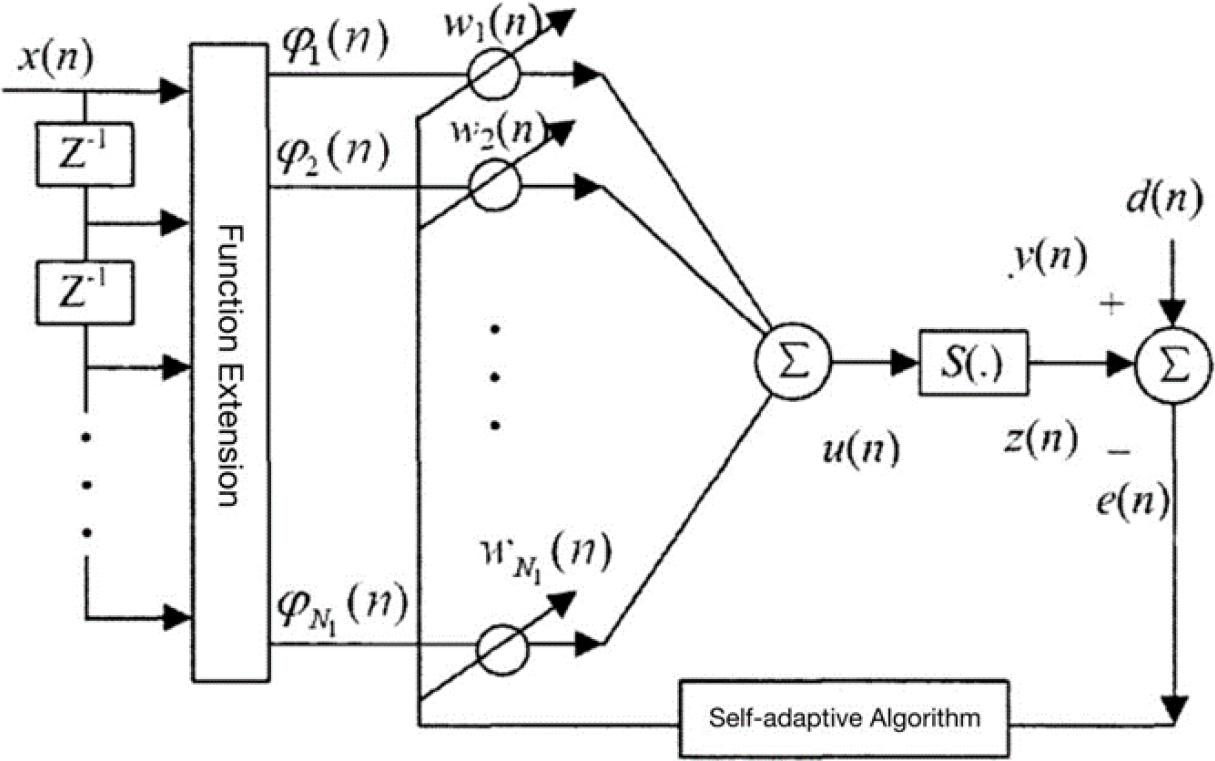
Neural networks based on the function extension
The structure of the function-based extended neural network is shown in Fig. 1.
The m-dimensional input signal
Expanded by a nonlinear function to generate a new N-dimensional vector space,
The corresponding weight coefficients are,
The output signal of the new linear combination of the input vector and the weight vector is
With the research on large-scale integration, there has been a great breakthrough in the data volume and processing power. However, since nonlinear polynomial equations are one of the complex problems in linear equation systems, a large amount of data, many structures, and a high degree of freedom requirements make the algorithm much more difficult; meanwhile, the orthogonal decomposition method can well solve the problems that are difficult to solve by traditional methods [13]. From the above analysis, it is suggested that the genetic algorithm is used for combinatorial optimization in order to combine theory and practice. The following theorems for the construction of neural networks based on orthogonal polynomial functions are the theoretical basis for the construction of orthogonal polynomial neural networks.
Theorem 1 [10]: If the function
then it can be expressed as a generalized Fourier series,
where
Theorem 2: If each excitation function in a neural network is a continuous function on some interval, then its generalized Fourier series can approximate that excitation function.
Theorem 3 [11]: assuming that there is only one hidden layer in the forward/recurrent multilayer network and the excitation functions of the neurons in the output layer are all linear functions if the excitation function of each neuron in the hidden layer is a continuous function, then both the forward/recurrent networks can be uniformly expressed as:
There are a variety of choices for the orthogonal polynomial
When the input is
where
Assume that
where the Legendre polynomials of order 0, order 1, and higher order polynomials are as follows:
Its higher-order recursive expression is given by:
Definition 1: In data transfer, the Map task transfer time is MDtt, and the Reduce task transfer time is
Definition 2: The execution time of Map task in data transfer is mEEt. The execution time of Reduce task is rEEt, and the execution time of Map task and Reduce task is predicted according to the BP neural network model in the previous section.
Definition 3: The following are the costs associated with the Map and Reduce tasks on data resources, in addition to the compute, storage, and transmission costs associated with public cloud computing:
The objective function
System model
Buffer-assisted relay system model.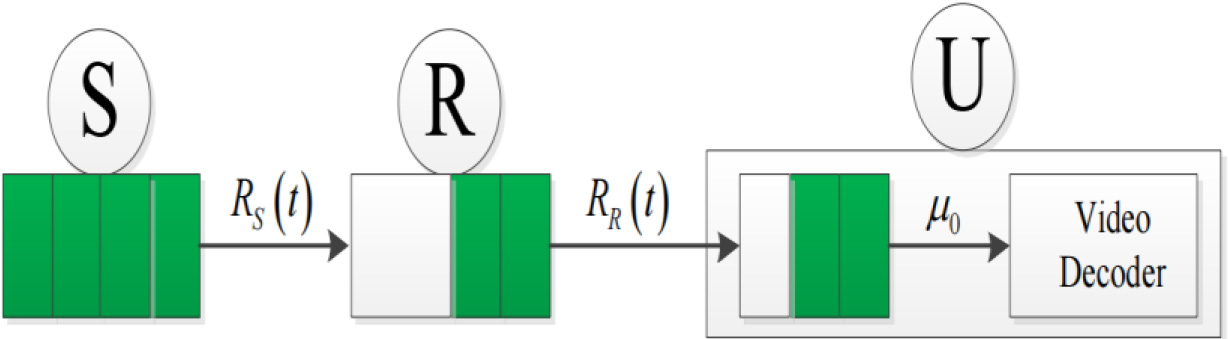
Our system model consists of a transmitting base station as the data signal source (Source), a relay station
The user terminal node, multimedia video service data from the source node is transmitted to the buffer assisted relay node. The source node and the user terminal node are not directly connected for signal transmission [14]. This relay system decodes the data and stores it in the queue buffer. In the buffer-assisted relay system, the data is sent in time slots, i.e., the signal transmission time slots between the transmitting base station and the relay system (S-R) and between the relay system and the mobile user terminal (R-U) are orthogonal in the time domain.
The leaving rate of the playback queue is the video decoding rate, i.e., the playback rate. However, the transmission of video data reaches the rate randomly, and this randomness is closely related to the channel fading. In a real system, the capacity of the playback cache is limited in size, denoted as BPl. Considering the reality that we can use a cache with a large enough capacity to store the queue data relative to the playback rate, we need to make the following assumptions.
Assumption 1: BPl is assumed to be large enough relative to the playback rate of the user terminal, so we can ignore cache overflow and packet loss. Similarly, we use BPl to represent the size of the relay cache capacity.
Assumption 2: We assume that the BR capacity in the buffer-assisted relay system is sufficiently large relative to the data transmission rate of the wireless channel and the playback rate of the user terminal, so we can disregard the buffer overflow and the data packet loss rate. In addition, it is assumed that,
If at time slot t, the (S-R) link sends data at the rate of Rs(t), when the (R-U) link does not send data, the power required by the base station to transmit the signal is expressed as,
In the above equation W denotes the system bandwidth, N0 is the additive Gaussian white noise power spectral density, and L represents the length of the bits contained in each packet. If at time slot t, the (R-U) link sends data at a rate where Rt is less than Qt, when the (S-R) link does not send data, the power required to transmit the signal is expressed as,
The dynamic equation of the buffer queue at the relay is expressed as follows:
In addition, the dynamic equation of the playback buffer queue the terminal node is expressed as,
At any time, the playback quality of multimedia video services degrades when the playback queue at the user terminal node is zero, so here we define the user QoS of the mobile terminal in terms of the probability of multimedia playback interruptions, expressed as the following equation:
The average transmit power of the source node of the base station can be expressed as,
The average power loss of the buffer-assisted relay node can be expressed as,
Our goal is to minimize the total average power loss of the communication system by selecting different transmit transmission links and controlling the communication data transmission rate on each time slot under the premise that the quality of service of user video services is guaranteed. So the final power loss optimization problem can be expressed as,
Queue state decomposition model.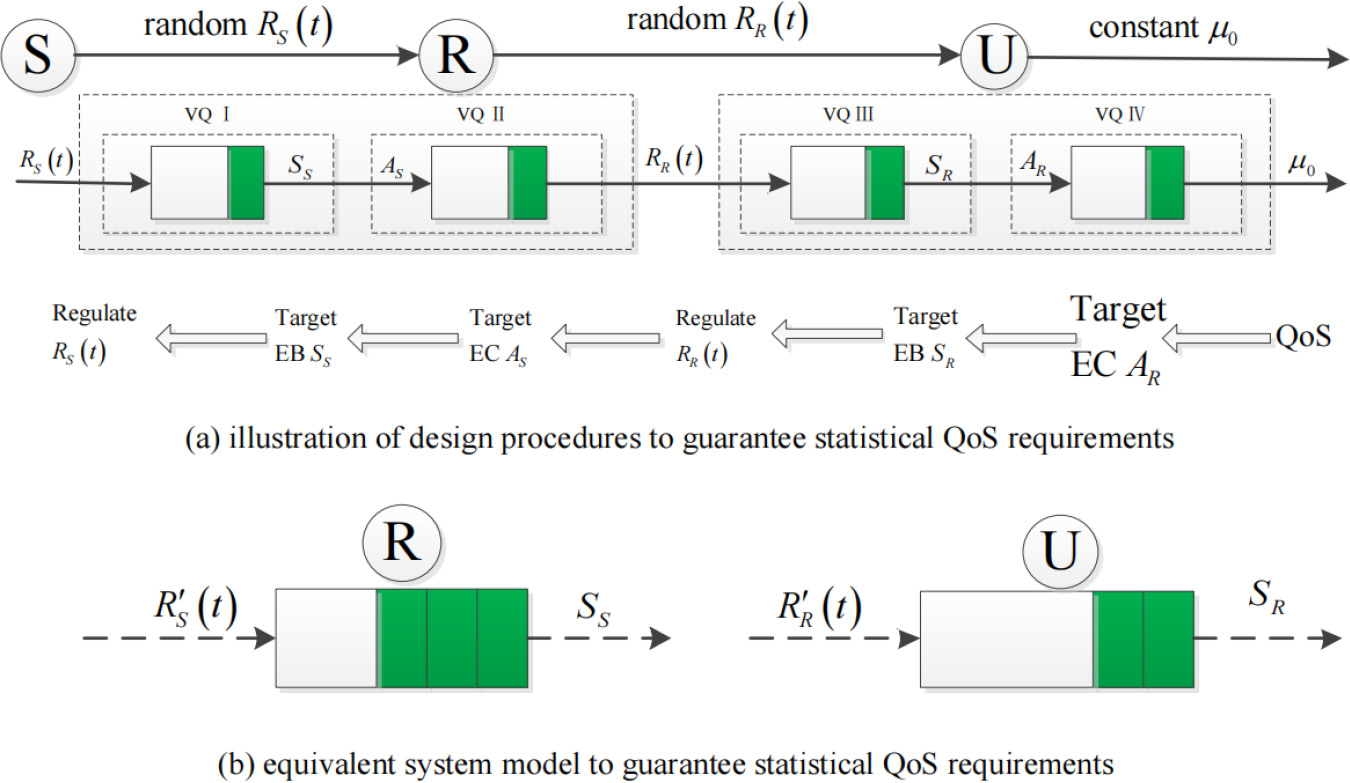
In order to guarantee the quality of service requirements, the buffer queue system can be decomposed into a four-part virtual queue system model, as shown in Fig. 3.
Theorem 1: A buffer assisted half duplex operating mode transmit system, if the demand for quality of service QoS, PrQoS, is given and assuming that the given PrQoS is sufficiently small, the efficient capability EC of AR and the efficient bandwidth EB of SS satisfy the following equation:
Here the probability that the VQ IV queue data is empty [32] has to be less than or equal to PrQoS to ensure that the user quality of service is guaranteed.
Proof 1: For a buffer-assisted half-duplex operation of a relay system, the transmission of data at the relay node requires two-time slots for completion of the transmission. Theorem 1 is inferred from the diffusion approximation method.
Corollary 1: In order to meet the quality of service requirements for multimedia data streaming services at the mobile user terminal node, the effective capacity EC at AS and the effective bandwidth EB at SS satisfy the following equation:
In order to satisfy the objective function Eq. (26), the probability that the queue will be empty at VQI must be less than or equal to the given PrQoS.
Proof: The following proof can be obtained directly from Corollary 1.
With the above concept, we design an algorithmic process to meet the quality of service requirements for multimedia data transmission. To guarantee the quality of service requirements, the buffer-assisted relay and source nodes need to be able to jointly adjust the actual data delivery rate according to Algorithm 1.4.
Algorithm 1: Transmission quality assurance algorithm flow for video data.
Step 1: Based on Theorem 1, the effective capacity EC of AR and the effective bandwidth EB of SR are set.
Step 2: Based on Corollary 1, set the effective capacity EC of AS and the effective bandwidth EB of SS.
Step 3: For each time slot t, jointly design the transmission rate to obtain
When the optimal desired transmission rate is obtained, both the source node and the buffer-assisted relay node transmit this result to the system controller, and we assume that the source node and the buffer-assisted relay node at the base station are controlled by the system controller. The link selection strategy for the system control output at the base station is given by the following equation:
When the transmission link is selected, the actual data transmission speed at time slot t is expressed as
As instructed by Eq. (33), the transmission link selection criterion proposed in this paper enables nodes to send data at a higher transmission rate in two cases: first, the channel state of the transmitting link is very good, in which case a higher transmission rate reduces the power loss; second, the virtual queue is about to become an empty queue. Based on the above two cases, choosing a higher rate link not only reduces power loss but also helps to avoid the virtual queue becoming empty and causing interruptions in data playback for multimedia video services.
Summary 1: The decomposition principle for the overall problem can be explained as a competitive process. In order to provide guaranteed quality of service requirements, user terminal nodes and buffer-assisted relay nodes compete to constitute their respective desired data transmission rates, which are determined based on their respective channel state information and queue state information.
As a result of the advent of big data, wireless multimedia transmission technology has become a research hotspot in the field of modern information and communication. Due to the socio-economic, technological progress, and other factors, as well as the continuous improvement of people’s requirements for mobile terminal performance, more and more advanced devices, tend to use high-performance low BER wired or outdoor digital signals for storage and management services. Meanwhile, as the 5G network and next-generation network access layer coverage expand, traditional big data transmission methods will be greatly challenged. How to use existing technologies and new wireless communication means to meet user needs has become one of the current research hotspots. To sum up, the design idea of the wireless multimedia transmission model is based on the architecture of three dimensions: data flow, communication, and control. Under these four dimensions, different perspectives of functions can be realized. In this paper, we analyzed the problem and solved it from multiple perspectives, and used the nonlinear equation adaptive scheduling algorithm to achieve the overall optimal performance.
Footnotes
Acknowledgments
This research study is sponsored by Innovation and Entrepreneurship Training Plan for College Students in Jiangsu Province. The name of the project is Analysis of Students’ Online Learning Behavior Based on Big Data Technology. The project number is 202012703015Y.