




Abstract
Flying ad hoc network is widely used in many military and civilian scenarios. Compared with mobile ad hoc network and vehicular ad hoc network, flying ad hoc network holds some special characteristics such as high mobility, long-distance communication, and sparse node-deployment, which cause an important challenge in the design of routing protocols. In this article, a velocity-aware and stability-estimation–based multi-path routing protocol is proposed for flying ad hoc network. The protocol is mainly composed of two important parts, which are the routing discovery mechanism and routing maintenance mechanism. In routing discovery process, the routing discovery request packet only can be forwarded by the reliable node, which is decided by the calculation of co-direction degree, then the routing overhead is reduced at some extent. Noticeably, the correlation of the survival duration between adjacent links is fully considered, which is very important to the path stability criteria. In routing maintenance progress, a path similarity and path remaining survival duration–based multi-path selection mechanism is proposed. The performance superiority of velocity-aware and stability-estimation–based multi-path routing protocol is also demonstrated by extensive simulations. The results show that velocity-aware and stability-estimation–based multi-path routing protocol is much better than other existing protocols in terms of network throughput, average delay of data transmission, routing overhead, and the convergence time of the routing discovery.
Introduction
The development and application of a large number of available low-cost wireless communication technologies and devices have laid the foundation for the development of small intelligent aircraft such as unmanned aerial vehicles (UAVs). Under this background, a new type of technology called flying ad hoc network (FANET) is generated. 1 FANET is widely used in various civil and military scenarios such as shoreline protection monitoring, post-disaster rescue, agricultural and yard monitoring, oilfield leakage monitoring, and aerial photography.2,3
However, FANET is fundamentally different from traditional mobile ad hoc network (MANET) from the following aspects. First, from the perspective of communication range, the communication distance between the nodes in FANET is usually tens of kilometers, while that between adjacent nodes in MANET is only tens of meters. Noticeably, the distribution of nodes in FANET is usually sparser than that of the traditional MANET. Second, from the perspective of communication effectiveness, more attention should be paid to the efficient processing and fast forwarding for data flow in FANET compared with MANET, which improves data transmission efficiency by minimizing the node data forwarding time. Third, from the perspective of communication reliability, due to the high mobility of the node and the complex and variable operating environment, the transmission link quality and stability are changed frequently and intermittently, which affects the end-to-end transmission of the data flow. Therefore, more accurate robustness and stability estimation of the link between the adjacent nodes is required for the transmission quality of traffic. The above-mentioned significant differences between FANET and MANET indicate that most of the mechanisms and protocols of traditional MANET may be not applicable to FANET directly.4,5 For example, a large amount of idle time and delay in data transmission will be generated when the RTS/CTS/DATA/ACK multiple handshake mechanism of the carrier sense multiple access with collision avoidance (CSMA/CA) protocol in the traditional short-range communication MANET is used in the FANET, which is unsuitable to long-distance communication and high mobility of FANET.
Routing is a simple term with complex tasks. Routing involves pathfinding, path selection, and decision regarding transmission, receiving, and forwarding of data. There are relatively high relative movements among multiple nodes in the FANET, where the rapid changes of network topology and link status may be caused. It has been shown that the mechanisms specifically designed for MANETs or vehicular ad hoc networks (VANETs) cannot be directly applied in FANETs due to the high mobility, sparse deployment, drastically changing network topology, intermittently connected communication links, and intentional jamming and disruption.
In light of these facts, many methods for link prediction have been proposed by researchers for overcoming the impact of high-speed node mobility on routing of FANET. Link reliability prediction and user mobility prediction have attracted much attention in solving these problems. For example, a simple and efficient link stability prediction model is proposed in J Xie et al. 6 The core idea of this model is that the stability of the link concerned is predicted through the calculation of the variance for the received data packet signal strength. However, the algorithm cannot be adapted into the fast topological change scenario of high dynamic FANET. The idea of link prediction is applied to the aeronautical communication network in N Baccour et al., 7 and packet Doppler shift is used as an index to measure the quality of inter-aircraft links. Although routing protocol operating in the FANET has seen tremendous research and implementation during the last few years, how to design a route suitable for FANET transmission requirement is a crucial task in the development and application of FANET.8,9
Motivation
Now, the motivation of this article is illustrated with a toy example, that is, the impact of speed perception and link reliability estimation on routing protocol design. The scenario shown in Figure 1 is the most common scenario in FANET applications. It is assumed that some node representing aircraft are deployed in the network randomly. The node that the traffic flow is transmitted is called the source node, the node that the traffic flow is received is called destination node, and other nodes where traffic flow is forwarded are called intermediate nodes. Traffic flows of source node, which is denoted by

Schematic diagram of routing and link lifetime affected by velocity.
Motivated by the toy example, a velocity-aware and stability-estimation–based multi-path routing protocol (VaSe-MRP) is proposed in this article, which is aiming at the achievement of the fast and reliable data transmission.
Contribution
The protocol is mainly composed of two mechanisms, that is, the route discovery mechanism and the path maintenance mechanism. Although the state of the art of routing protocols in FANET is briefly summarized in the form of classification first, comprehensively and systematically reviewing the related work is not the purpose of our article. Our main contributions are four aspects and are emphasized as follows:
First, a velocity-aware-based forwarding mechanism of next hop node is proposed in VaSe-MRP for the enhancement of the traffic forwarding effectiveness. As a result, the neighbor nodes are divided into reliable nodes and non-reliable nodes with the velocity vector information. Only the reliable node is selected as the next hop forwarding node.
Second, the correlation of the survival duration between adjacent links is fully considered from the perspective of the statistical characteristics of the remaining duration. Therefore, the theoretical error of the estimation for the path stability in existing method is eliminated.
Third, the path similarity and path remaining survival duration (PRSD)-based multi-path selection mechanism is proposed for the improvement of the transmission reliability or the effectiveness of the traffic flows. Whether the copy or different packets are transmitted with the selected multi-paths is decided according to the multi-path selection mechanism.
Finally, VaSe-MRP is simulated and compared with other existing protocols in terms of end-to-end throughput (ETH), average transmission delay, routing overhead (ROH), and convergence of the protocol under the situation that the node is moving in high velocity, where the superiority of Vase-MRP is demonstrated.
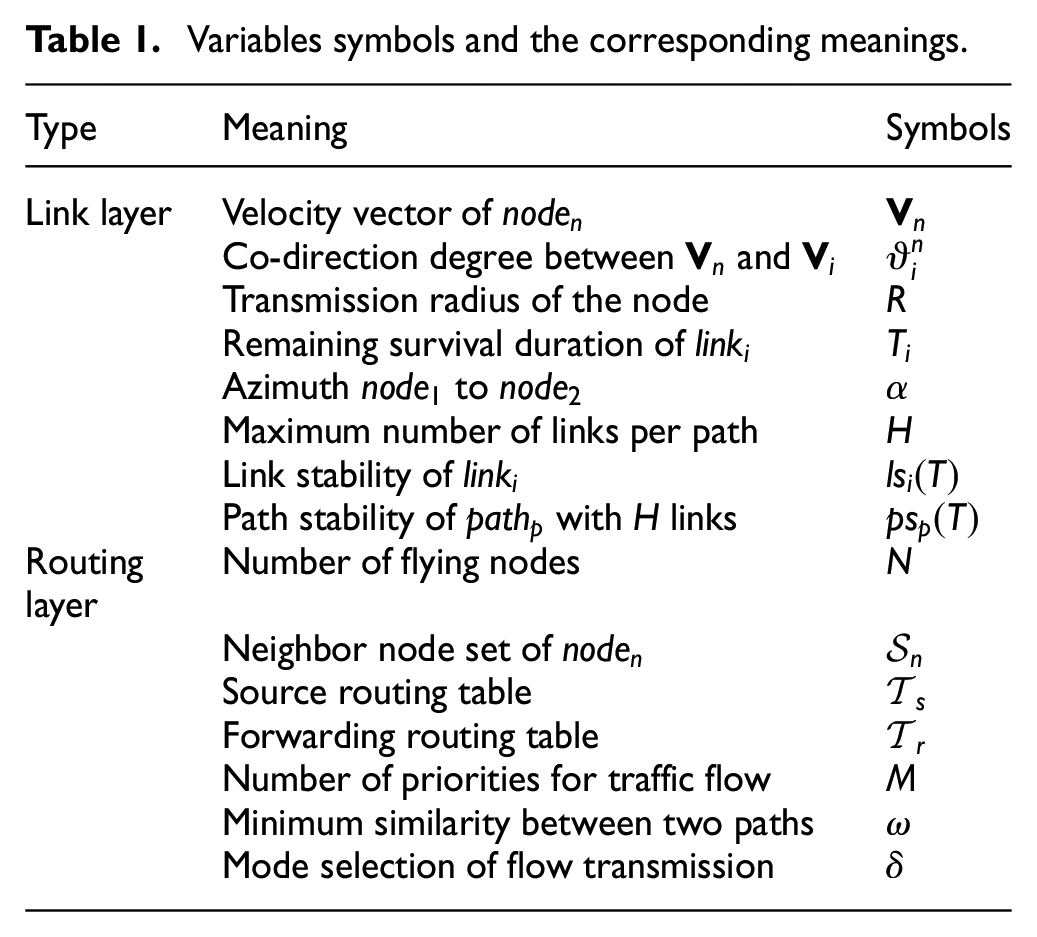
It should be noted that all the variables symbols and the corresponding physical meanings are summarized in Table 1 for the convenience of the following narration. The rest of the article is organized as follows. Prior routing mechanisms and protocols are summarized and analyzed from two perspectives in section “Related work.” The system model is described in section “System model.” The details of procedures of Vase-MRP are given in section “VaSe-MRP.” Simulation and results analysis are presented in section “Simulation and results.” Finally, the conclusion of this article and the potential improvement point of VaSe-MRP are summarized in section “Conclusion.”
Variables symbols and the corresponding meanings.
Related work
FANET is considered as a subclass from MANET and VANET; therefore, common ideas and strategies could be shared for data delivery. For the right functionality of data delivery, the techniques that are specifically designed for MANET and VANET have to be adapted to specific characteristics and challenges in FANET, for example, high mobility, sparse deployment, drastically changing network topology, intermittently connected communication links, and intentional jamming and disruption. In this section, we categorize and analyze existing routing protocols in FANETs. Previous studies on multi-hop routing of FANET can be divided into two categories, which are location-centered multi-hop routing and node-centered multi-hop routing, according to the selection criterion.
Location-centered routing protocol in FANET
Location-centered routing is also called geocasting routing, 10 and the precise location information of communication nodes should be obtained or predicted. In C Yin et al., 11 an on-demand routing protocol called reliability map routing is proposed. The routing with the longest reliability duration in the space rather than the closest one is quickly found by the protocol because the reliability and trustworthiness of nodes are geocasted in the whole space with low overhead. In Y Wang et al., 12 a more effective and reliable two-way geocasting protocol is proposed, in which the chances of successful message delivery are improved with two independent paths and a novel authentication mechanism. In H Rutagemwa et al., 13 a fountain code–based and greedy queue and location assisted routing protocol is designed. A power allocation and routing strategy is designed for the mitigation of effect on the overall network delay due to queue backlog. In L Gupta et al., 14 the new location participated in data transmission and path planning of UAV in FANET is modeled as a mixed non-linear integer programming problem, and a Hooke–Jeeves algorithm–based heuristic strategy is proposed to solve the problem. In K Sundar and S Rathinam, 15 a robust and reliable predictive routing protocol, which is based on fast updating mechanism for the estimation of three-dimensional (3D) intermediate nodes, is proposed for FANET. The omni-directional and directional transmission is combined in the protocol, and the unicast and geocasting routing are used synthetically. Consequently, the long-distance transmission and the track of topological changes are realized, the robustness of the protocol is fully guaranteed, and the path reconstruction and service interruption time are reduced. In F Hoffmann et al., 16 an adaptive communication protocol, which is mainly composed of location prediction–based directional medium access control (MAC) protocol and enhanced learning-based self-organizing routing protocol, is proposed in FANET.
It can be seen from the above-mentioned references that the local decision-making makes position-based routing protocols suitable in scenarios of large and highly mobile networks. Nodes do not have to explore the status of the whole network, store routing tables, or exchange control messages in the entire network.
Node-centered routing protocol in FANET
In a node-centric routing, the next hop can be selected on the basis of historical information and the prediction information. However, relatively few studies have used this type of routing. In Arafat and Moh, 17 the concepts and architecture of FANET, and the challenges of the node-centric routing design in FANET are systematically introduced. In M Hu et al., 18 a cross-layer architecture–based link-level and network-wide analysis model is proposed for FANET. It is shown in the analysis and the results that the communication performance and the delay-sensitive-supported applications can be significantly improved by the proposed cross-layer protocol architecture, which is based on the fast packet forwarding and multi-hop error control mechanism. In C Pu, 19 an improved optimized link state routing (OLSR), which is called predictive OLSR (P-OLSR), is designed for FANET, and the networking performance of P-OLSR is simulated and tested. In Z Zheng et al., 8 two different routing algorithms for ad hoc networks: OLSR and P-OLSR, which is an OLSR extension designed for FANETs, are compared. In G Gankhuyag et al., 20 a multiple QoS parameters–based routing protocol (MQSPR) is proposed for the improvement of the network performance between air nodes and surface nodes. Many factors such as path availability period, residual path load capacity, and path delay are considered in route selection of MQSPR. In addition, a broadcast optimization scheme aimed at minimized flooding is proposed. The main goal of MQSPR is to maintain long link duration, achieve path load balancing, and reduce end-to-end delay. On the basis of G Gankhuyag et al., 20 a protocol called FRUDP is proposed in Q Luo and J Wang. 21 The reliable user datagram protocol (UDP) and fountain code is combined in FRUDP for reliable and effective data transmission in FANET. In S Rosati et al., 22 a new routing protocol is proposed for FANET, it is shown in the simulation results that the performance of the proposed protocol is better than the typical location-centric routing protocol in terms of the packet delivery rate and end-to-end delay. In Gohari et al., 23 a jamming-resilient multi-path routing protocol is proposed, so that the overall network performance of FANETs is not interrupted by the intentional jamming and disruption, or isolated and localized failures. The protocol is composed with a combination of three major schemes, which are link quality scheme, traffic load scheme, and spatial distance scheme. In addition, a simple analysis model and numerical results are presented. In A Bujari et al., 24 a comparative analysis of the few node-centric routing protocols in the existing FANET is presented, and the system performance is also verified. A distributed priority tree-based routing protocol (DPTR) is proposed for the FANET in V Sharma et al. 25 The protocol uses the properties of a red–black (R-B) tree and formulates distributed routing trees by adding up certain rules in the formation of these trees. However, the protocol focuses more on solving the problem of network partitioning and relay node selection when ground ad hoc network and aerial ad hoc network coexist. In I Mahmud and YZ Cho, 26 a novel adaptive hello interval scheme, energy efficient hello (EE-Hello), based on available mission-related information is proposed, where the distance that a UAV needs to travel before sending a hello message is decided.
It can be seen from the above classification and comparison that the node-centric routing mechanism, where the historical information and the prediction information of the node are used, can select next hop node more effectively than the location-centric routing mechanism, where the real-time location information is used. Unfortunately, the effect of node velocity on link quality and the remaining life cycle of the path are not considered in the above node-centric related work. Therefore, a node VaSe-MRP is proposed in this article, so that the performance can be improved significantly in terms of network throughput, data transmission delay, ROH, and reliability of data transmission in case of high node mobility.
System model
In this section, the system-related models are introduced, that is, velocity-aware forwarding probability, path/link remaining survival duration, and path/link stability evaluation criteria, which are important parts for the route discovery mechanism and path selection mechanism described as follows. For the convenience of description, node that want to send traffic flow is called as source node, and the operation performed by the source node in the protocol is called source node operation. Node that is the destination of the traffic flow is called destination node, and the operation performed by the destination node in the protocol is called destination node operation. All other nodes, which are responsible for the data forwarding, are collectively called intermediate node, and the operation performed by intermediate node is called intermediate node operation.
Velocity-aware forwarding
It is assumed that there are

where “
Path/link remaining survival duration
In our article, link remaining survival duration (LRSD) and PRSD are very important to path selection for FANET. For the simple calculation, the assumption of the statistical analysis of LRSD and PRSD for the routing optimization strategy in D Kim and J Lee
27
is that multi-hop PRSD, which is denoted by

However, there are two preconditions for formula (2) to hold. The first precondition is that the remaining survival duration of each link on the path is independent statistically. The second precondition is that the number of hops of the path and the length of each link are large enough. As shown in Figure 2, the link between

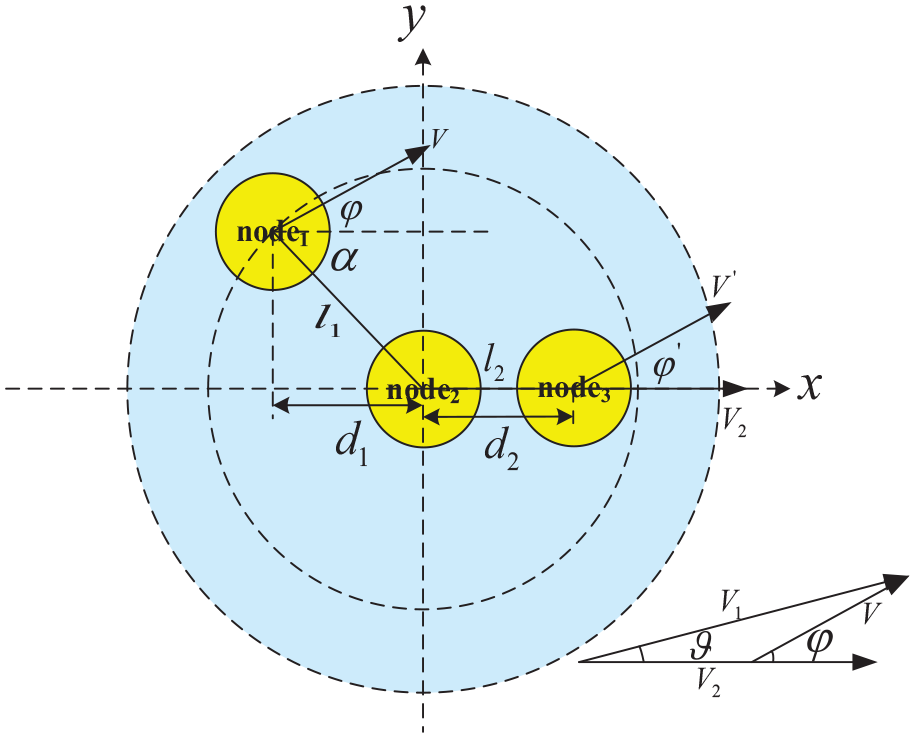
Relative velocity and spatial position relationship of
where

Furthermore, the cumulative distribution function (CDF) of

where
First, the LRSD correlation between adjacent links is considered. In other words,

However,

The functional correspondence between

For


It is shown from formulas (7)–(10) that although there are multiple random variables contained in the expressions of

Furthermore, the joint PDF between

It has been proved in Z Li and ZJ Haas
28
that formula (12) can give more accurate results than the derivation methods of

The joint CDF of LRSD for each link is given as

As can be seen, although the complexity of our theoretical analysis model is increased slightly than the results under the link independent condition, the analytical solution of formula (13) is easily obtained when the unified and simple mobility model (such as
Evaluation criteria of path/link stability
Based on the above-mentioned theoretical model, the definition of link stability and path stability are given as follows.
Definition 1
The probability that the LRSD of the link is not less than a specific time interval, which is denoted by

Definition 2
The probability that the PRSD of the path is not less than the specific time interval, which is denoted by

The rationality and advantages of the our definition are mainly embodied from the following two aspects. First, the mobility model is not limited when the mobility complexity of node is low. Second, the ability of validity maintenance for links or paths within a specified time is fully reflected. In addition, high estimation of path stability is leaded due to the neglection of the LRSD correlation between links, which is not conducive to the routing selection. This is also pointed out in Table 1 of Z Li and ZJ Haas. 28 Therefore, more accurate criteria of stability evaluation can be provided for the routing protocol with our new definitions.
After the above analysis, the impact of path stability on network performance is explained emphatically. The importance of path stability is mainly reflected in the following two aspects from the perspective of network layer:
First, the probability that the data are successfully transmitted through path

where
Second, the average number of transmission times required for a single data stream is obtained as

It is shown in formula (18) that the path stability is inversely proportional to transmission delay. In other words, the stronger the path stability, the smaller transmission delay, which further proves the importance of improving path stability.
VaSe-MRP
The detailed steps and operations of VaSe-MRP are presented in this section. In short, VaSe-MRP is mainly composed of two parts. The first one is the velocity-aware and link stability–based multi-path source route discovery mechanism, which includes the source node operation, the intermediate node operation, and the destination operation. It is corresponded to section “Route discovery.” The second part is the path stability and path similarity based multi-path selection mechanism and the backup path based route repair mechanism, which is corresponded to section “Multi-path maintenance.”
Route discovery
The main routing packets in VaSe-MRP are route discovery request packet (RDR, used for route discovery), route discovery answer packet (RDA, used for route response), route transmission data packet (RTD, used for pure data transmission) and route error packet (RER, used for routing failure report). All the packet formats are shown in Figure 3. The corresponding physical meaning of the field in various packets is explained as follows:

Various packets format in VaSe-MRP.
Source node operation
There are three types of packets that can be processed by the source node, that is, RER, RDA, and RTD. The flowchart of source node operations is showed as Figure 4.

Flowchart of source node operation.
When there is any data flow in the source node, which is denoted as
If the route discovery process is started by
If the RDA is received by
Intermediate node operation
There are four types of packets that can be processed by the intermediate node, that is, RTD, RDR, RER, and RDA. The flowchart of the intermediate node operation is shown in Figure 5.
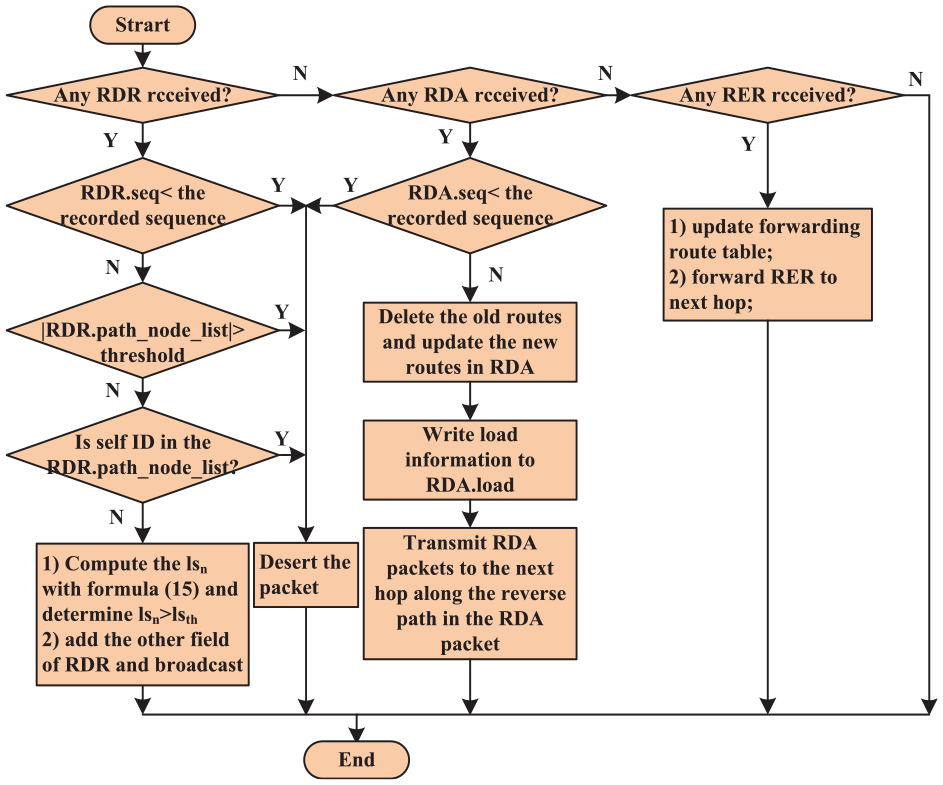
Flowchart of intermediate node operation.
If RDR is received by the intermediate node, which is denoted by
If an RDA is received by
If the RTD is received by
If the RER is received by
Destination node operation
There are two types of packets that can be processed by the destination node, which is denoted by

Flowchart of destination node operation.
If RDR is received by
If the RTD is received by
Multi-path maintenance
Source route maintenance and repair
During source route maintenance, there is a lifetime, which is denoted by
Multi-path selection
The multi-paths selection mechanism is the comprehensive consideration under the path stability and the path similarity, so that traffic flow with some priority is transmitted according to the selected multi-paths. It is assumed that there are

If the priority of the traffic flow which is waited for transmitting in

where
Simulation and results
In this section, the parameters used in protocol simulation and the parameters for the protocol performance analysis are introduced first, which is corresponding to section “Baseline description.” Then, the performance of VaSe-MRP is verified through extensive simulations and comparison with other two representative protocols, which is corresponding to the section “Result analysis.”
Baseline description
For the performance evaluation of the proposed algorithm, other reference protocols, which are called packet redundancy multi-path based on link lifetime estimation (PRMLE) mechanism
29
and link availability estimation based routing (LEBR) protocol,
30
were compared with VaSe-MRP on the NS-2 simulator. The core ideas and implementation of the three protocols can be seen from Table 2. The three protocols are mainly compared and analyzed from the perspective of the average convergence time (CT) of routing discovery, ETH of the network, the average transmission delay (ATD) of the data flows and ROH of the data flows, so the effectiveness and superiority of VaSe-MRP can be verified. LEBR is based on ad hoc on-demand distance vector (AODV) protocol. It is noted that there is only one hop information of the forwarding nodes is contained in the RDR and RDA packets of AODV. The local routing repair mechanism in PRMLE means that the data can be cached and the route discovery progress can be initiated by the intermediate node for a new path to the destination node when the stability of a link in the data transmission path is reduced. However, the route repair of the VaSe-MRP is performed by the
The core ideas and implementation of the three protocols.

VaSe-MRP: velocity-aware and stability-estimation–based multi-path routing protocol; AODV: ad hoc on-demand distance vector; BP: backup path; DSR: dynamic source routing.
Result analysis
Comparison of the CT in routing discovery
For the verification of the convergence speed of VaSe-MRP, the CT, which is the time that one route from
The following assumptions is made in simulation for the avoidance of the influence of settings from other layer on protocol performance evaluation. For example, communication back-off between nodes, transmission bandwidth allocation, delay of processing and routing table storage, and so on. First, the update time of RDR in each intermediate forwarding node is set to 10 ms. Second, the transmission time between adjacent nodes is 20 ms. Third, the receiving time, which including the multi-path selection time, of RDA at
The relationship between CT and

Convergence time of routing protocol versus number of nodes.
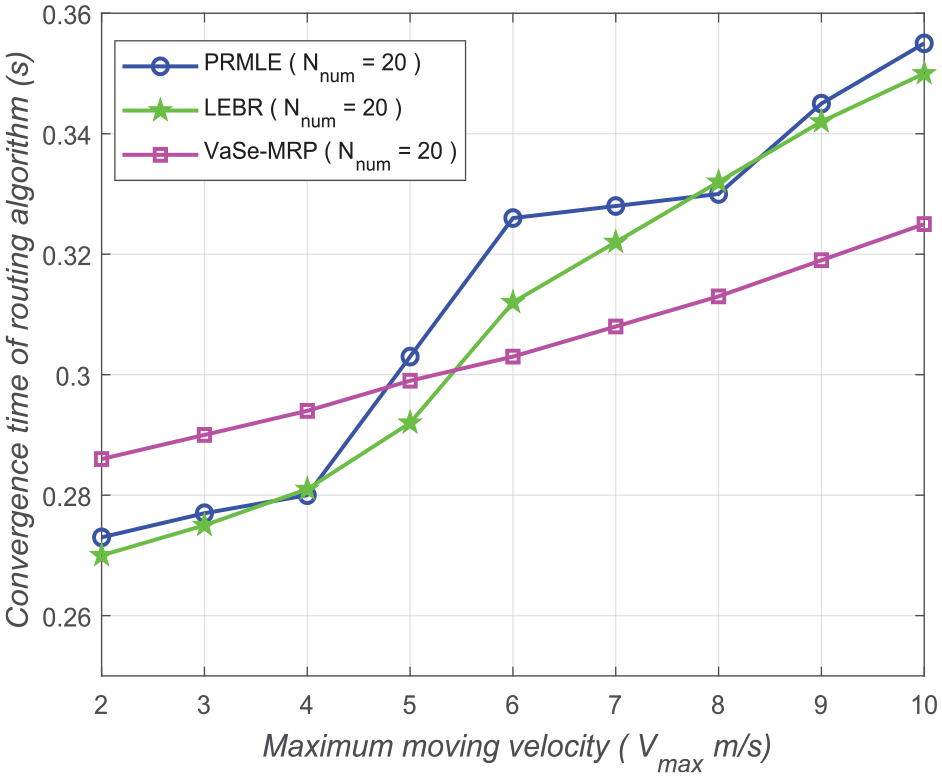
Convergence time of routing protocol versus maximum node mobility.
In summary, the convergence speed of the three routing protocols is equivalent when the network state is in a good state, that is, larger
Comparison of network performance parameters
The following settings are made in the simulation when the impact of VaSe-MRP on the overall performance of the network is verified. First, the influence of MAC layer and physical layer, such as transmission errors caused by channel fading or disorder, is not considered in the simulation. It is considered that the data are correct received when the data are transmitted to
The detailed simulation parameters used in this case are shown in Table 3. The expected transmission delay, which is denoted
Simulation parameters.

VaSe-MRP: velocity-aware and stability-estimation–based multi-path routing protocol.
Figures 9–11 are the curves trend of ETH, average data transmission delay, and ROH varied with the number of network nodes, that is,

Throughput versus number of nodes

Average delay of data transmission versus number of nodes

Routing overhead versus number of nodes
As can be seen from Figure 9, the ETH of VaSe-MRP is about 12% higher than that of other two protocols. The optimization effect of the ETH is most obvious when
Figures 12–14 are the curves trend of ETH, average data transmission delay, and ROH varied with the maximum moving velocity of the network nodes in the tree protocols, where the number of the nodes is given as

Throughput versus node mobility

Average delay of data transmission versus node mobility
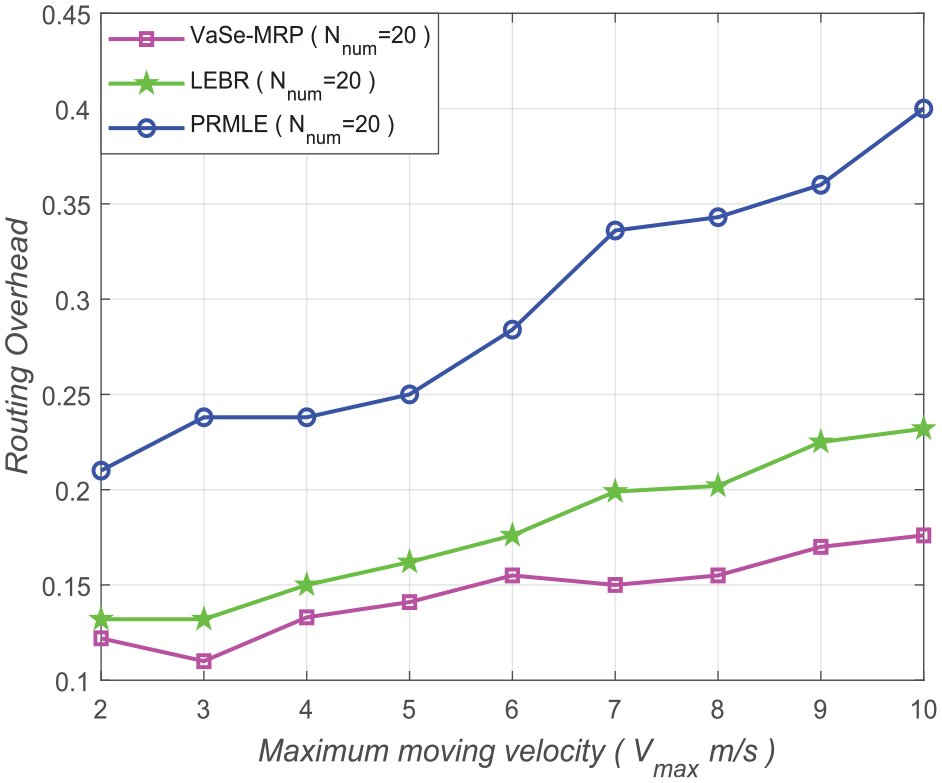
Routing overhead versus node mobility
In summary, the effectiveness and superiority of VaSe-MRP is fully verified with the simulation results from Figures 7–14. Compared with the existing protocols, the LRSD correlation between adjacent links is taken into account in VaSe-MRP, which is beneficial to establish more accurate and reliable stability evaluation criteria. As a result, the data flow is transmitted on paths that the duration is longer, and the adverse effects of high-speed mobility on data transmission is reduced effectively. There is much stronger adaptability in VaSe-MRP. Meanwhile, the much lower ROH is ensured significantly with the improved ETH and the shortened average delay of data transmission in VaSe-MRP, so that the reasonable trade-off between stability and resource utilization is obtained commendably.
Conclusion
Based on the analysis of the statistical characteristics of PRSD and the consideration of the LRSD correlation between adjacent links, a path stability evaluation criterion is presented in this article and then a VaSe-MRP is proposed. Compared with the existing related routing protocols, it is shown in the simulation results that the more stable evaluation criteria of the path stability and the faster convergence speed of the routing discovery, where the network topology is changed dynamic, are provided in VaSe-MRP, and the adverse impact of the increased mobility of nodes on data transmission is also reduced effectively. There is some certain reference significance in terms of evaluating the route stability, improving network throughput, shortening data transmission delay, and reducing ROH in VaSe-MRP.
However, the high-speed mobility of nodes and routing security requirements in FANET are not taken account in VaSe-MRP. This is also where the agreement needs to be improved and perfected in the future. The better network robustness and security will be presented in the improved VaSe-MRP. For example, if there is at least one path to destination node
Footnotes
Handling Editor: Daniel Gutierrez-Reina
Declaration of conflicting interests
The author(s) declared no potential conflicts of interest with respect to the research, authorship, and/or publication of this article.
Funding
The author(s) disclosed receipt of the following financial support for the research, authorship, and/or publication of this article: This work was supported in part by the National Natural Science Foundations of China (grant no. 61461023), Youth Natural Science Foundations of Gansu (grant nos 18JR3RA231, 1610RJYA021, and 1606RJYA271), Gansu University Research Project (grant nos 2016A-98, 2017A-104, and 2018A-124), Lanzhou Science and Technology Plan Project (grant nos 2017-4-101 and 2018-RC-31), Gansu Universities Innovation Ability Promotion Project (grant no. 2019A-144), Research Project of Innovation and Entrepreneurship Education Reform for Gansu Universities (grant no. 2019-26), Cooperative Education Project of Education Ministry (grant no. 201802048017), “Kaiwu” Innovation Team Support Project of Lanzhou Institute of Technology (grant no. 2018KW-01), and “Qizhi” Talent Cultivation Project of Lanzhou Institute of Technology (grant no. 2019QZ-03).
