




Abstract
Evidence theory is widely used in real applications such as target recognition because of its efficiency in evidential sensor data fusing. However, counter-intuitive results may be obtained in the situation when evidence highly conflicts with each other. Recent researches show that weighting the evidences with the consideration of its corresponding credibility is an efficient methodology. As a result, how to determine the weight is an important issue. In this article, a new divergence measure of BPA is proposed based on geometric mean of Deng relative entropy. The weight of each evidence is determined by the proposed divergence measure and information volume. Compared with the existing belief Jensen–Shannon divergence, the proposed method has a better performance in the convergence to the correct target. The result shows that the proposed method outperforms other related methods, giving the highest belief value 98.98% to the correct target.
Keywords
Introduction
Multi-sensor data fusion technology is widely used in real world,1,2 playing an important part in multi-sensor data fusing,3–5 decision-making,6,7 fault diagnosis,8–11 risk and reliability analyzing,12–16 failure mode and effective analyses,12,17 and pattern recognition.18,19
Due to the invertible influence from the bad weather or sensor fault, uncertain and inaccurate information may emerge and then cause an incorrect conclusion in decision-making. 20 To solve this problem, a great number of theories such as evidence theory, fuzzy set theory,21–25 D number,26–29 rough sets, 30 and some improved methods had been proposed.31,32 Dempster–Shafer evidence theory, 33 the basic theory in information fusion, is considered as an extension of Bayesian theory for an incomplete model without prior probabilities.
However, the counterintuitive results may be generated when fusing the highly conflicting evidences. 34 It is still an open issue about how to model and handle imprecise and uncertain information.35,36 Some modified and improved method are proposed26,31,37 to solve the problem of conflicting and inaccurate data fusing in real applications. 38 Scholars such as Murphy, 39 Zhang et al., 40 Wang and Deng, 41 Deng et al., 42 and Xiao43,44 have done a lot of researches in this field, and many of them believe that an effective way to solve this problem is to give different weights to different evidences by considering the credibility of different evidences other than revising the combining rule. Larger credibility shows more supports, and this evidence should be more important for the final decision.
How to determine the weight of each evidence is still an open issue. 45 An average approach is first proposed by Murphy 39 and then modified by weighted average. 46 If all the evidence is available at the same time, one can average the masses and calculate the combined masses by combining the average values multiple times. Recently, a new method for conflict management based on belief Jensen–Shannon divergence (BJS) is proposed 43 making use of the divergence among evidences and the uncertain degree 44 of evidence. In this article, the BJS divergence is proved as the arithmetic mean of two Deng relative entropies. Then, a new divergence measure of BPA is proposed based on geometric mean of Deng relative entropy. The proposed divergence measure, combined with the information volume, is used to determine the weight of each evidence. Finally, a new weighted evidence combination algorithm is developed. The application in target recognition is illustrated to show the efficiency of the proposed method.
The remainder of this article is organized as follows. Some preliminaries of D-S theory and Deng relative entropy are mentioned in section “Preliminaries.” A new method named belief relative entropy and the method to determine the weighted BPA is proposed in section “A novel divergence measure.” In section “Target recognition,” a case study in target recognition is used to show the effectiveness of this new method. Conclusions are given in the final part.
Preliminaries
In this section, Dempster–Shafer evidence theory, Deng entropy, and belief relative entropy are introduced.
Dempster–Shafer evidence theory
Dempster–Shafer evidence theory, as the extension of the Bayesian theory, is applied to deal with uncertain information with weaker conditions and greatly express the uncertain degree as well as combine pieces of evidence to obtain a more convincing evidence. In this section, some basic concepts and functions33,47 are introduced as follows.
Definition 1

The power set of

where
Definition 2
A BPA function m is a mapping of

which satisfies the following conditions

The mass
For the same evidence, the different

where
It is markable that K is the coefficient to measure the conflict between evidence in evidence theory, and the combination rules could not be used when
Belief entropy
Entropy is widely used in many applications.48–51 How to determine the entropy of a BPA is an hot issue.44,52–55 A novel belief entropy which is called Deng entropy56,57 is proposed to measure the uncertain information. 58 As the generalization of the Shannon entropy, 59 Deng relative entropy is an efficient method to measure the uncertain information. 60 When the belief value is allocated in the single element, Deng entropy degenerates to Shannon entropy. Given a BPA, its corresponding Deng entropy is defined as follows

In this article, the information volume 43 making use of Deng entropy is defined as follows

The greater Deng entropy of an evidence is, more information is contained and larger the information volume is. A large information volume of a body of evidence indicates that the evidence plays an important role for the final combining result.
Deng relative entropy
A new relative entropy named as Deng relative entropy61,62 is proposed in order to measure the divergence between different basic probability assignments (BPAs). Deng relative entropy is defined as follows 61

The Deng relative entropy is the generalization of Kullback–Leibler divergence.
63
When the BPA is degenerated as probability, Deng relative entropy is equal to Kullback–Leibler divergence. It is the average of logarithmic difference between mass function
An existing measure of BPA divergence
In Dempster–Shafer evidence theory, how to measure the discrepancy among bodies of evidences is still an open issue, thus different methods for divergence measure are proposed. An existing method proposed by Xiao 43 combines JS divergence with Dempster’s theories to get the divergence measure among different evidences. The novel method is named as BJS, the JS divergence Shannon entropy which is derived from the formation of BPA. BJS 43 is defined as follows

where

A novel divergence measure
There are three main works described in this section. First, the relationship between the BJS divergence in Xiao 43 and the arithmetic mean of Deng relative entropy is derived. Second, a new divergence measure of BPA is presented, based on geometry mean of Deng relative entropy. Third, a new weighted combination model is proposed.
The arithmetic mean representation of BJS
The definition of BJS 43 can be derived as follows
Given two BPAs m1 and m2 in the same frame of discernment, the BJS divergence between them is defined as

where
New divergence measure of BPA
Inspired by the arithmetic mean of Deng relative entropy shown as BJS, 43 a geometrical mean of Deng relative entropy is proposed as follows.
Definition 3
Given two BPAs m1 and m2 in the same frame of discernment, the BRE divergence between them is defined as
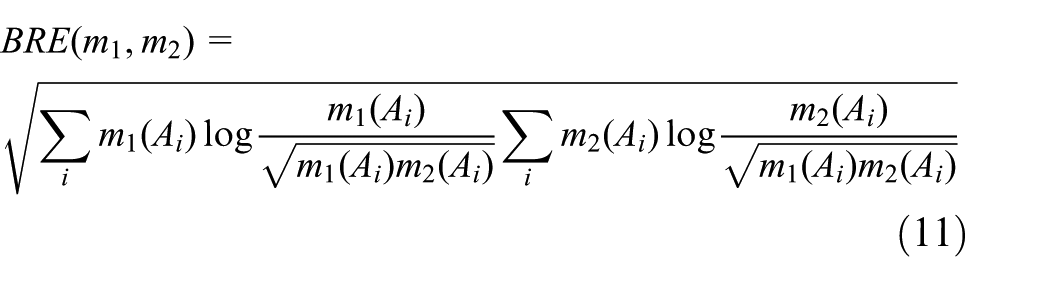
BRE divergence can be represented as the geometrical mean between
Example 3.1

From Example 3.1, we could know that the BRE between
Example 3.2

From Example 3.2, for the same BPA, its corresponding BRE is zero.
Example 3.3

As the parameter x varies from 0 to 0.5, the BRE between

BRE divergence with changing parameter x.
It is clear that when x increases from 0 to 0.5, BRE decreases gradually, dropping to 0 at
Weighted combination model
The flow chart of the proposed weighted combination model is illustrated and the detailed steps are shown in Figure 2 as follows.

The weighted combination model.
Calculate the divergence measure matrix
Use equation (11) to calculate the divergence measure matrix

where
Calculate the supporting degree of evidence
Calculate the supporting degree of the body of evidence of

Calculate the information volume of each evidence

where
Obtain the credibility of each evidence
Given an evidence

Obtain the final weight of each evidence
Normalize the credibility

Obtain the weighted average evidence and combine them
Weight the collected N pieces of evidence to obtain the weighted average evidence. Then, use Dempster rules to combine the weighted evidence

where
Target recognition
Evidence theory is widely used in real life in the data fusing process. 64 In this section, an application based on multi-sensor data in Zhang et al. 40 is given to show the efficiency of the proposed method.
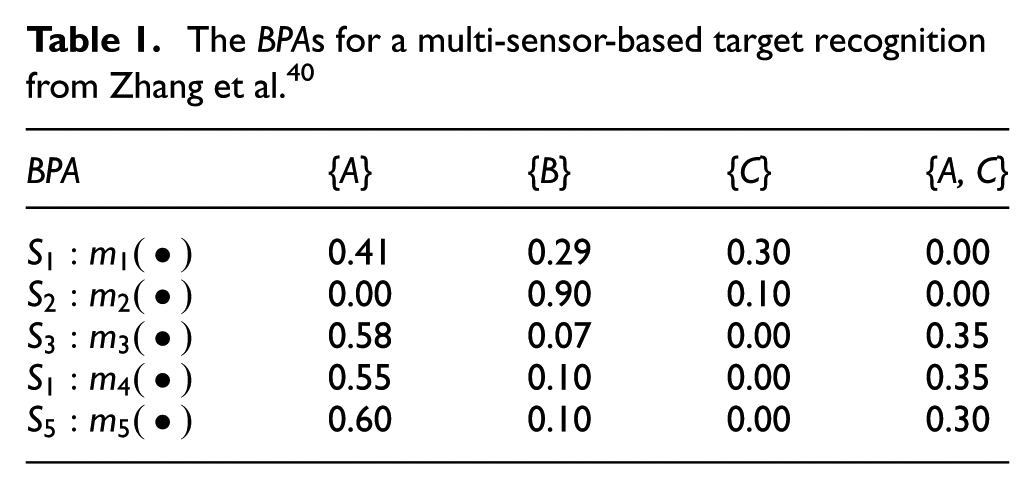
Assume that there are five sensors (evidence resources) in a target recognition system sending
The BPAs for a multi-sensor-based target recognition from Zhang et al. 40
The calculating steps
The steps of the proposed method are detailed as follows.
Step 1. Use equation (11) to obtain BRE divergence measure among pieces of evidences and then built the DMM

Step 2. Calculate the supporting degree of the body of evidence of


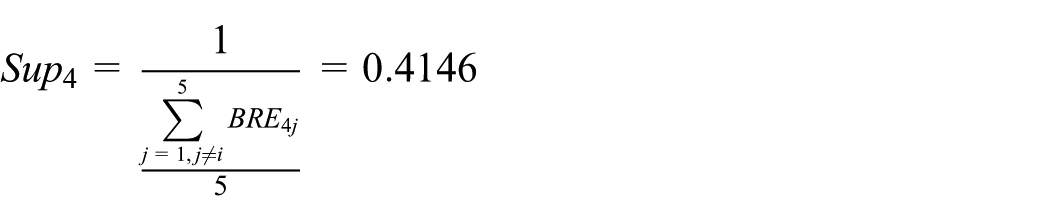

Step 3. Calculate the information volume of each evidence based on equation (7) as follows

Step 4. Given an evidence

Step 5. Normalize the credibility
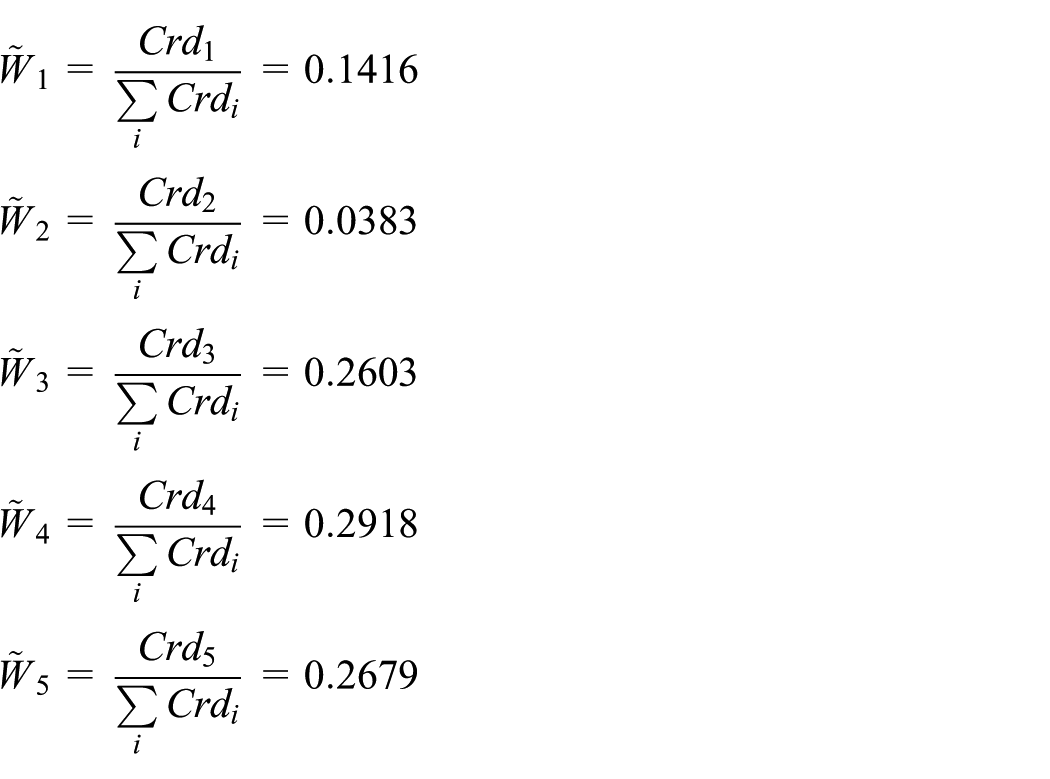
Step 6. Obtain the final average weight for each BPA based on equation (17) and weight of the collected N pieces of evidence using Dempster combination results. The average weight for each evidence is calculated as follows

If there are N number of evidences,
Result analysis and discussion
Comparing the results shown in Table 2, there are two remarkable points. First, applying Dempster combination rule recognizes the object C as the target, while other methods proposed identify A as the target. Second, the proposed method has the highest confidence to target A, showing the effectiveness of the proposed method in real applications. The method proposed by Murphy, 39 Zhang et al., 40 and Xiao 43 obtain the same results and the belief degree of them are not less than 96.20%, showing great improvement to Dempster’s method. Compared with the method based on the arithmetic mean of Deng relative entropy, 43 improvement of the presented method is shown in the accuracy of target recognition. The new method has the most accurate rate in target recognition, giving the highest belief degree of 98.98%. Compared to the belief value given by Xiao, 43 it seems that little improvement of 0.04% is demonstrated by the proposed method. However, this improvement is significant for this example and applications in the real world since the accuracy is quite high to nearly 99%, and other methods also advance in the same degree of precision.
Results of BPA and target in different methods.

Conclusion
In this article, there are two main distributions. First, the relationship between an existing divergence measure BJS and Deng relative entropy is demonstrated, and second, a new divergence measure BRE and the evidence combining the model making use of it is proposed. Inspired by the arithmetic mean of Deng relative entropy, namely, BJS, a geometrical mean of Deng relative entropy BRE divergence is presented. BRE divergence can be used to measure the supporting degree of evidences and then to determine the average weight of evidences. Furthermore, making use of BRE divergence and information volume which represents the uncertain degree of evidence, a new method is proposed to determine evidence weights, which is effective and feasible to handle the conflicting evidences. The case study in target recognition demonstrates the improvement of the accuracy of a target recognition system. The proposed divergence measure has the promising aspect in uncertain information processing, especially in evidential systems based on evidence theory.
Footnotes
Acknowledgements
The authors greatly appreciate the reviews’ suggestions and the editor’s encouragement.
Handling Editor: Daming Zhou
Declaration of conflicting interests
The author(s) declared no potential conflicts of interest with respect to the research, authorship, and/or publication of this article.
Funding
The author(s) disclosed receipt of the following financial support for the research, authorship, and/or publication of this article: This work is partially supported by the National Natural Science Foundation of China (Grant Nos 61573290 and 61503237).
