




Abstract
The supplier selection is a key component of the supply chain management. Existing methods for the supplier selection are based on analytic network process. They can handle the interdependence of decision attributes; however, these methods could not guarantee an optimal solution when given vague or incomplete input data. To deal with the uncertainties of input data, we propose methods combining analytic network process with Dempster–Shafer evidence theory. We demonstrate efficiency and accuracy of the proposed method in a numerical example. We demonstrate that the proposed method is flexible and effective in dealing with the supplier selection problem.
Keywords
Introduction
The supplier selection plays an important role in the manufacturing process. The companies have to work with different suppliers to carry out their activities so that the components and parts can be delivered on time. The supplier selection is a multi-criteria decision-making (MCDM) problem. A number of MCDM methods have been proposed,1,2 including analytic hierarchy process (AHP),3,4 analytic network process (ANP), 5 technique for order of preference by similarity to ideal solution (TOPSIS)6,7 and others. 8 The AHP is a structured technique for organizing and analyzing complex decisions, developed by Saaty9,10 in the 1970s. It focuses on comparing and evaluating different criteria toward the objective through constructing the hierarchical levels. The AHP does not perform well in situations when there are interactions and dependencies across the criteria at different levels. 11 The ANP 12 can overcome the limitations of AHP: it can deal quantitatively with the dependencies and interactions across the elements at various levels. To date, the ANP is the most common tool for tackling the selection problems.13,14
In the process of determining the optimal supplier, experts’ knowledge plays an important role. For example, in AHP, the comparison matrices are provided by many experts according to their knowledge. Based on experts’ evaluation, we are able to allocate the appropriate weight for the corresponding criteria. However, in many cases, uncertainties emerge in experts’ subjective and quantitative assessment. Moreover, in many situations, it is difficult for us to use a precise way to measure the performance of each decision alternative, especially when dealing with large systems. From this point of view, it is inevitable for us to handle the incomplete or vague information involved in many systems.
Many researchers attempted to solve the supplier selection problem under uncertain environment.15–18 Several techniques are proposed including fuzzy set and probability-based approaches. Among them, Dempster–Shafer (DS) theory is the most efficient tool capable for handling vague information.19,20 It is more general than probability and possibility theories and can be applied under uncertain situations even if limited or conflicting information is provided by experts. The basic operations of DS theory allow the users to combine the random and epistemic uncertainties in a more straightforward way without any assumptions. With the ability of coping with the uncertainty or imprecision embedded in evidence, DS theory is widely used in many applications, such as information fusion,21–23 target recognition24,25 and decision-making.26–30
We combine ANP and DS theory in a novel method named DS\ANP. Our method inherits advantages of the flexibility offered by DS theory for the incomplete and vague information and the modeling power of ANP. To the best of our knowledge, this is the first attempt to hybridize the ANP method with DS theory of evidence to solve the supplier selection problems.
This article is structured as follows. The literature review is provided in section “Literature review.” Section “Proposed method” details the proposed method. In section “Proposed method,” our methods are applied to a real-world case. The results of the analysis are discussed in section “Case study.” In section “Case study,” we discuss main findings and contributions. Further studies are proposed in section “Conclusion.”
Literature review
According to the current literatures, suppler selection is typically a MCDM problem. To date, various techniques, such as the AHP, ANP, fuzzy set theory, genetic algorithm, mathematical programming and simple multi-attribute rating technique, have been employed to deal with this problem. Most results on the supplier selection problem can be classified into two groups. The first one is mainly focused on the introduction of mathematical or quantitative decision-making approaches. The second one deals with the uncertain information contained in the supplier selection problem.
Due to the flexibility and simplicity of AHP, it has been very popular in the past decades.11,31–33 For example, Chan 34 combined an interactive selection model with AHP to handle the supplier selection process systematically and quantitatively. Yang and Chen 35 incorporated gray relational analysis to the AHP methodology to select the best suppliers for cooperation. Bei et al. 36 presented an AHP-based model to identify the most preferred supplier in manufacturing supply chain. Chan and Kumar 3 combined fuzzy set theory with AHP and presented a fuzzy extended AHP approach using triangular fuzzy numbers to improve the AHP method and to facilitate global supplier selection process. Chan et al. 37 and Lee 38 gave a brief review on the applications of fuzzy AHP. Shaw et al. 39 integrated fuzzy AHP with fuzzy multi-objective linear programming for selecting the appropriate supplier in the supply chain, addressing the carbon emission issue. Recently, Deng et al. 40 presented a new effective and feasible representation of uncertain information—D numbers, derived from AHP; the approach is proved to be efficient in studies of supplier selection and environmental impact assessment. 41
In recent years, applications of the ANP in supplier selection have increased substantially compared to AHP. Sarkis and Talluri 42 built an ANP-based supplier selection model by considering a series of factors including operational, tangible and intangible measures. Gencer and Gürpinar investigated ANP’s application in the supplier selection problem and carried out in an electronic firm. Wu et al. 43 proposed an integrated multi-objective decision-making process by using ANP and mixed integer programming to determine the selection of supplier. However, they did not take into account the imprecise or vague information involved in the supply chain systems. Vinodh et al. 44 presented a fuzzy analytic network process (FANP) approach and used it to select the supplier for an Indian electronics switches manufacturing company.
Efficiency of FANP is undermined by needs to rank fuzzy numbers and difficulties in obtaining the consistency in the fuzzy comparison matrices. The problems need to be addressed before it can be implemented directly into real-world applications. Kuo and Lin 45 combined ANP with data envelopment analysis (DEA) technique to overcome the deficiency of DEA: the users cannot set up criteria weight preferences. DEA technique is not capable of processing imprecise data or information in the process of determining the optimal decision alternative. Recently, Dou et al. 46 introduced a gray analytical network process–based (gray ANP–based) model to identify green supplier development programs that will effectively improve suppliers’ performance. The ANP-based model is mainly used to predict the performance of an enterprise in the long run, and its ability to handle the epistemic uncertainty might be jeopardized in many situations. In addition to the above, there are also many other approaches and the hybrid methods dealing with this open issues, for example, the mixture of FANP and fuzzy TOPSIS, 47 the integration of semi-fuzzy support vector domain description and cooperative coevolution (CC)-Rule method 48 and linear programming. 49
Since uncertainty is one of the features of real-world applications, many methods have been proposed to deal with this problem,50–58 such as fuzzy set theory59–61 and interval theory.62–64 For example, Amin et al. 65 integrated the fuzzy logic and triangular fuzzy numbers with SWOT (strength, weakness, opportunity and threat) in the context of supplier selection. Tao et al. 66 integrated DEA, AHP and TOPSIS with axiomatic fuzzy set (AFS) theory by combining the advantages of each method.
The fuzzy set theory and the interval theory require that a membership function under uncertain environment is constructed in advance. However, it is difficult to determine values of the membership function before making a decision. When dealing with real-world supply chains, it takes a substantial amount of time to conduct many experiments to calculate values of the membership functions. The interval theory and AFS theory bear the same deficiency. This is why these theories are not practical when real-world applications are concerned.
DS evidence theory is a novel tool capable of handling vague information. It has been applied in many fields of science and engineering to describe uncertainty: decision analysis, pattern recognition, risk assessment, supplier selection and others.19,52,67 For example, Beynon et al. 68 combined AHP with evidence theory and used it in multi-criteria decision modeling. Since then, DS/AHP has received great attention.11,69
Although there are abundant literatures about the selection of suitable supplier, to the authors’ knowledge, there were relatively few works which combined DS evidence theory and ANP to deal with this problem. By combing these two theories together, we take advantage of the flexibility offered by DS theory when dealing with incomplete and vague information and the modeling power of ANP.
Proposed method
First of all, we must identify criteria and sub-criteria for implementing the DS/ANP method. AHP is employed to build the initial weights associated with each criterion and sub-criterion. DS/AHP is used to construct the attribute’s basic probability assignment (BPA). By considering the dependencies and interactions across the criteria, we construct the super matrix formulated by the initial weights. Based on ANP, the weight associated with each attribute can be calculated. By using Dempster’s rule of combination, the performance of each supplier can be determined. The flowchart of the proposed method is shown in Figure 1.
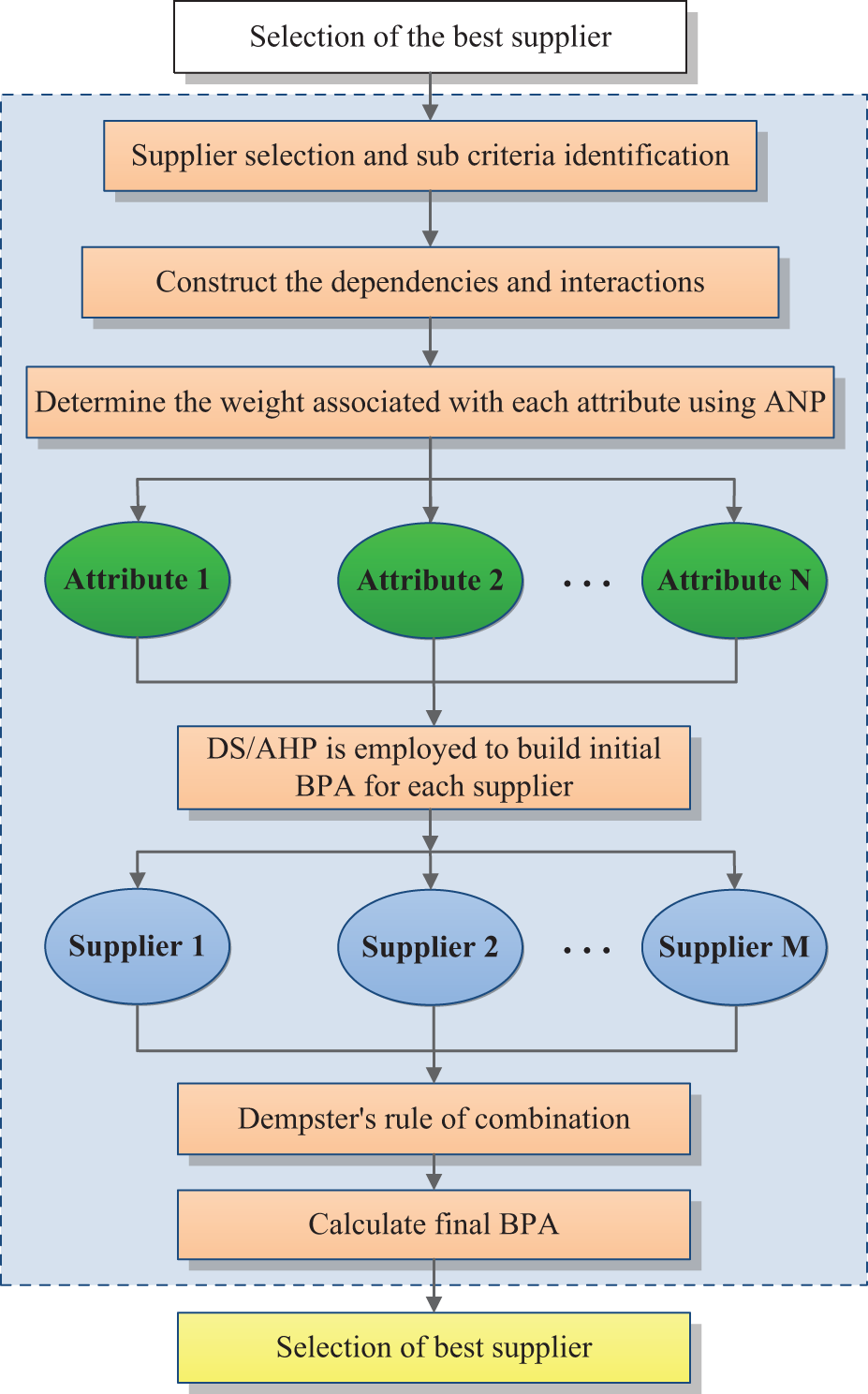
Flowchart of the proposed method.
Supplier selection and sub-criteria identification
To evaluate the performance of each supplier, we must identify all possible elements and factors to be inspected and assessed. We adopt the hierarchical structure for supplier selection, Figure 2, from Vinodh et al. 44 As can be seen in Figure 2, we have identified five criteria as the dimensions in the ANP model. These are business improvement (BI), extent of fitness (EOF), quality (Q), service (S) and risks (R). The second level consists of various attributes under different criteria. BI has four attributes: reputation of industry (ROI), financial strength (FS), managing ability (MA) and organization customers (OS). EOF has three attributes: sharing of expertise (SOE), flexible practices (FP), and diversified customers (DC). Q has three attributes: low defect rate (LDR), commitment to quality (CTQ) and improved process capacity (IPC). S also has three attributes: on-time delivery (OTD), quick responsiveness (QR) and supplier capacity (SC1). R has three attributes: supply constraint (SC2), buyer–supplier constraint (BSC) and supplier profile (SP). All the attributes and hierarchical structures are adopted from Vinodh et al. 44
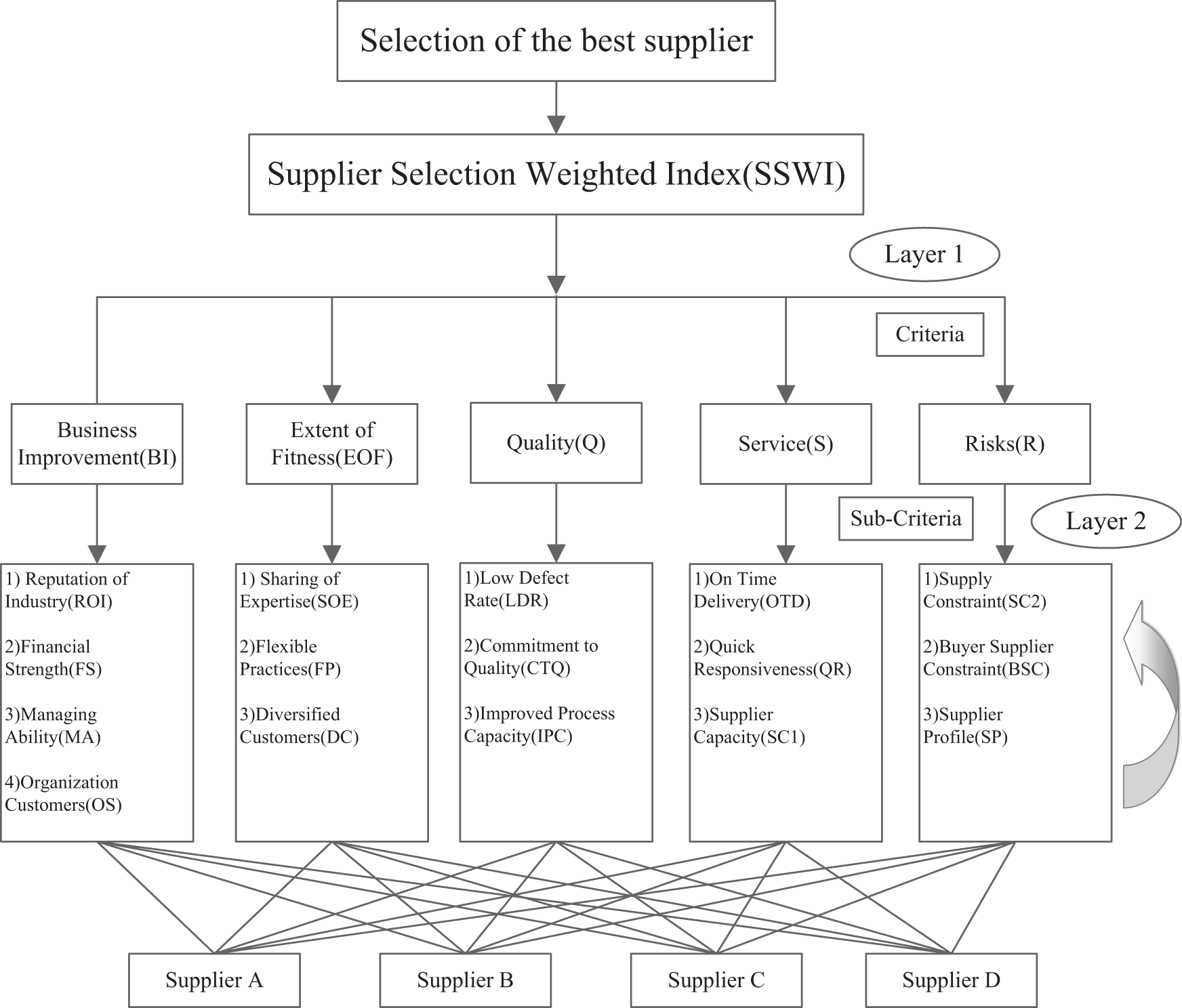
The hierarchical structure for the supplier selection.
In contrast to Vinodh et al., 44 we consider the interactions at the second level. A looped arc is used in the ANP model to show such interdependencies (see Figure 2). The alternatives that the decision-maker wishes to evaluate are shown at the bottom of the model. In this article, we take into consideration four decision alternatives: Supplier A, Supplier B, Supplier C and Supplier D.
Constructing the weight associated with each criterion and sub-criterion
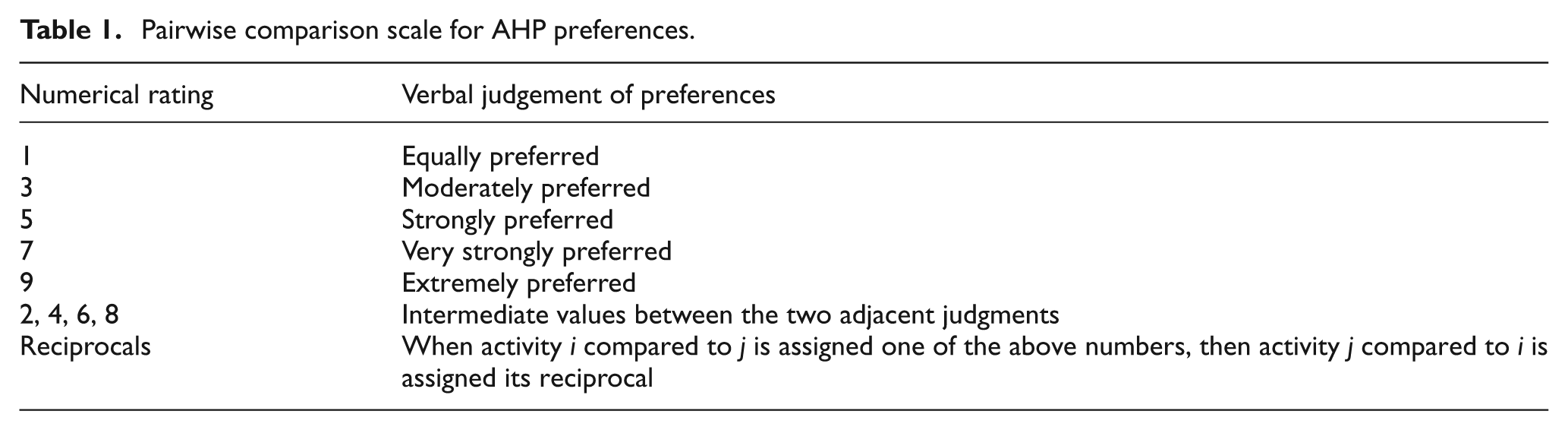
In this step, both AHP and ANP are used to construct the weights across the criteria. For the attributes in Layer 1, AHP 10 is employed to construct such weights. We build a series of pairwise comparisons to establish the relative importance of determinants in achieving the objectives. A ratio of scale 1–9 is used to compare any two criteria. Table 1 displays the pairwise comparison scale for AHP preferences. A score 1 means that these two elements are important equally, while a score of 9 denotes the overwhelming dominance of the element over the comparison element. If an attribute has weaker impact when compared with its comparison element, the range of the scores will be reversed from 1 to 1/9. In addition to this, an index called consistency ratio is built to check the consistency of the weights across all the criteria. These criteria are used to calculate the final supplier selection weighted index (SSWI).
Pairwise comparison scale for AHP preferences.
For the criteria in Layer 2, there are interdependencies among these criteria. Here, ANP is employed to calculate the weight of each sub-criterion. The pairwise comparisons are made to capture interdependencies among the sub-criteria. One such comparison is presented in Table 2. It gives the result of BI with ROI as the controlling attribute over other sub-criteria. As shown in Table 2, the ROI is the criterion important equally to FS, MA and OS.
Pairwise comparison matrix for the sub-criteria in Layer 2 under the ROI criteria.
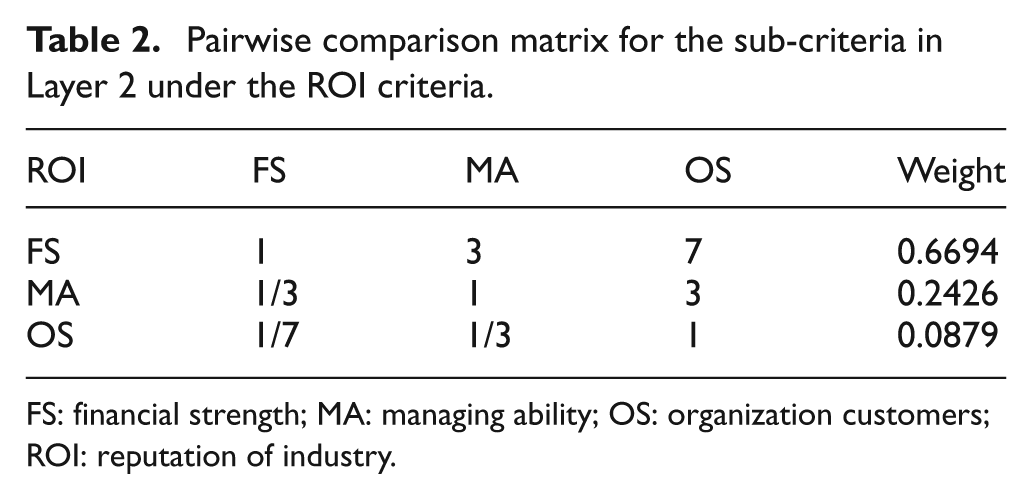
FS: financial strength; MA: managing ability; OS: organization customers; ROI: reputation of industry.
As can be seen from Table 2, FS has the maximum impact (0.6694) on the criteria BI over other attributes when ROI is treated as the controlling attribute. In a similar way, the other pairwise comparison matrices can be built. In ANP, the super matrix is formulated by such kind of pairwise comparison matrices, which allows us for the resolution of interdependencies across all the attributes. After the super matrix converges to a stable state, the relative importance measures for each attribute can be obtained. Different from traditional DS/AHP, we take into consideration the interactions and interdependencies existing in the supplier selection problem. DS/ANP is a generalization of DS/AHP, and it makes DS/AHP more flexible and more reasonable when dealing with the complex systems.
Building BPA associated with each criterion
In this step, DS/AHP is used to construct the BPA associated with each decision alternative. DS/AHP is proposed by Beynon et al., 68 which enables a measure of uncertainty and ignorance to be constructed. In DS/AHP, the decision-makers express their preference by comparing a group of decision alternatives to θ, while in AHP, by making pairwise comparisons between individual decision alternatives. For DS/AHP, the 5-unit scale is adopted as a basis for discriminating levels of knowledge. 70 Normally, p in this scale has the value of 0.2159.
Here, we give a brief introduction to the DS/AHP approach. For the ROI attribute, we build the following knowledge matrix as shown in Table 3. The values in the final column are the measures of groups of decision alternatives in each row with respect to θ. It can be noted that A, D viewed as extremely favorable when compared to θ.
Initial knowledge matrix for ROI criterion.
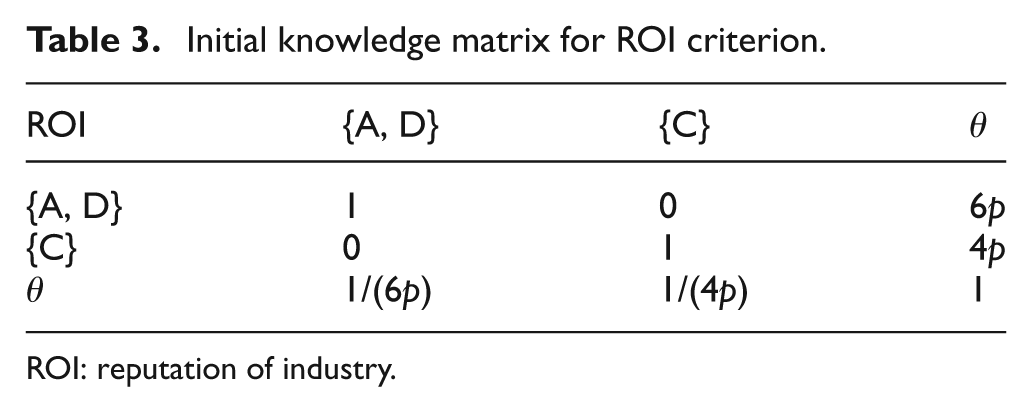
ROI: reputation of industry.
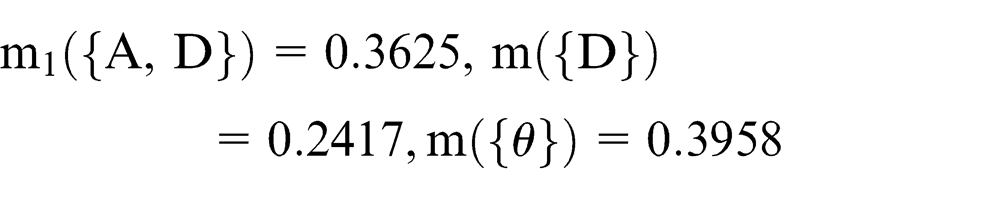
Following the method in Anderson, 71 we can construct the weights derived as the eigenvectors of the knowledge matrix, which are shown in Table 4. We treat these priority allocations as BPA. As a consequence, we have
Priority values for groups of decision alternatives and θ.
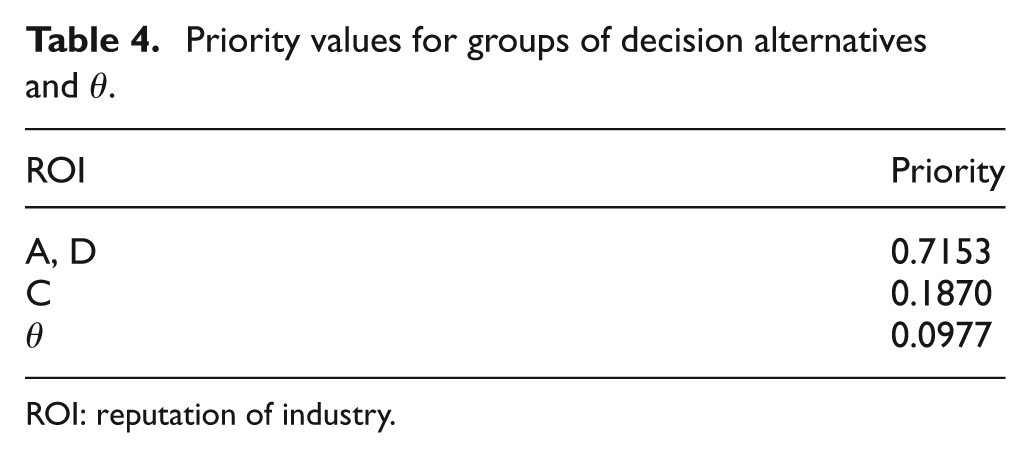
ROI: reputation of industry.
In the same way, we can construct the BPA for the other criteria. And thus, all the BPAs can be built.
Ranking all the suppliers
In the second step, by using ANP, we have calculated the weight for each attribute in Layer 2. In addition, the BPA associated with every criterion has been built. However, we do not combine them all together right now. At this step, we combine the weight and the BPA of every attribute.
Definition 3.1
Let U be the frame of discernment and
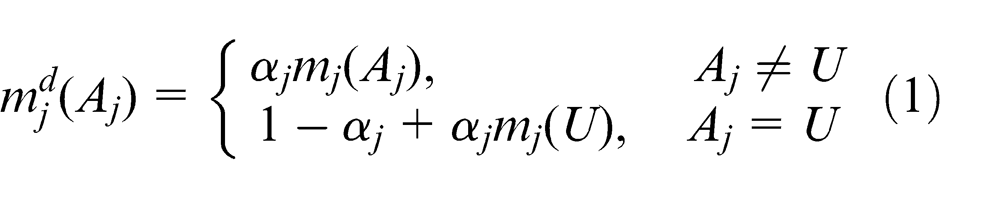
where mj is the BPA of focal element Aj.
By making full use the discount technique shown in Definition 3.1, we will apply the weight of each criterion into the corresponding BPA. According to Dempster’s rule of combination, the BPA associated with every attribute can be aggregated. In this way, the performance of each decision alternative can be calculated.
Case study
The case study has been implemented at Salzer Electronics Limited (hereafter referred to Salzer). 44 Salzer is a manufacturing company producing Cam operated rotary switches and a series of other products, which was founded in 1984. As shown in Figure 2, the best supplier can be determined based on the calculation of SSWI. SSWI is associated with five factors: BI, EOF, Q, S and R.
First of all, we construct the knowledge matrix for each criterion. Figure 3 shows the DS/AHP decision tree used to determine the supplier. For instance, for the attribute ROI, from Figure 3, it can be noticed that two distinct groups of decision alternatives ({A, D} and {C}) have been identified as being comparable with the frame of discernment Θ. Knowledge matrices of other criteria can be built in a similar way. Table 5 shows us the initial knowledge matrix for every attribute.
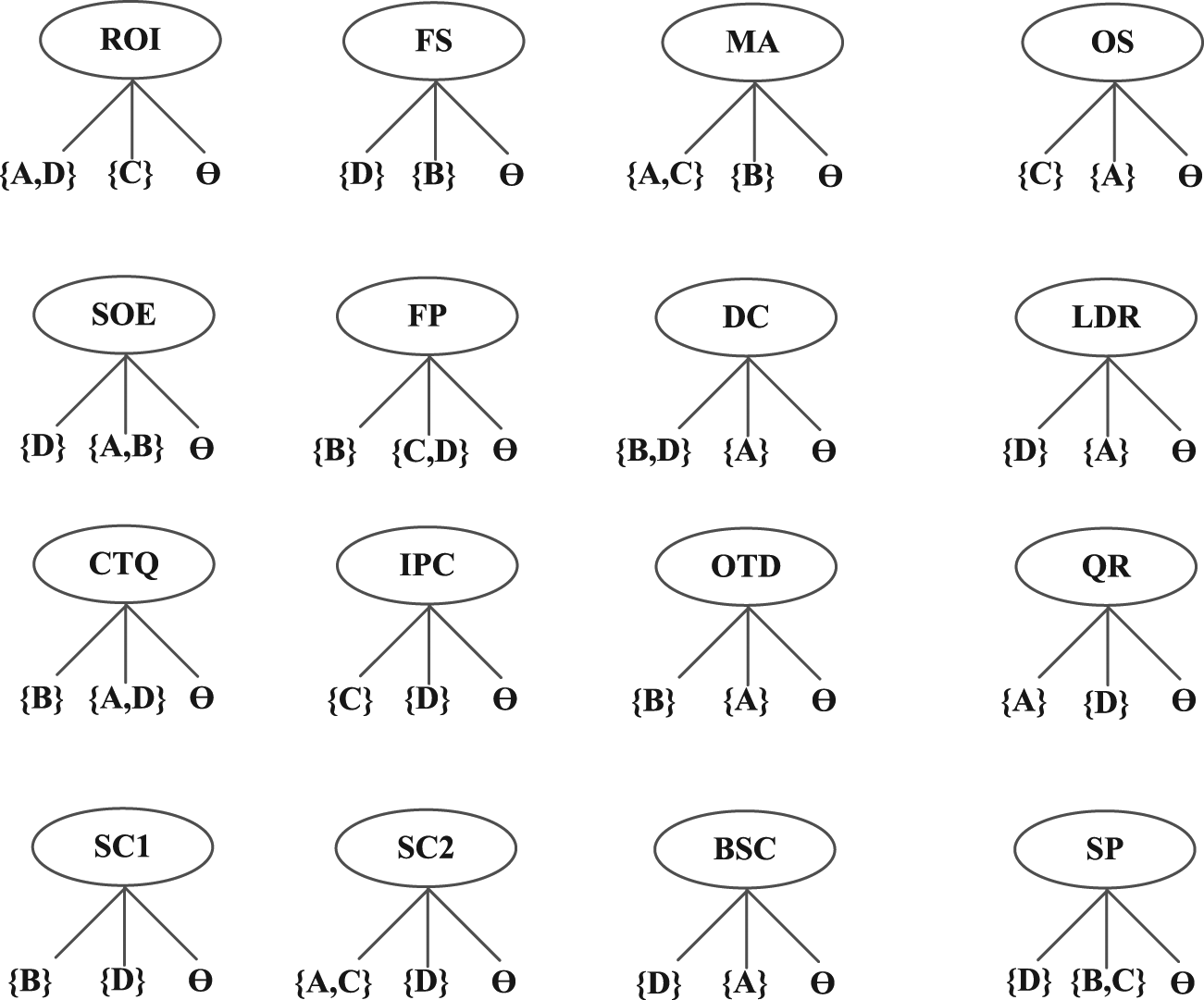
Decisions when only single criterion is considered.
Initial knowledge matrix for each attribute.
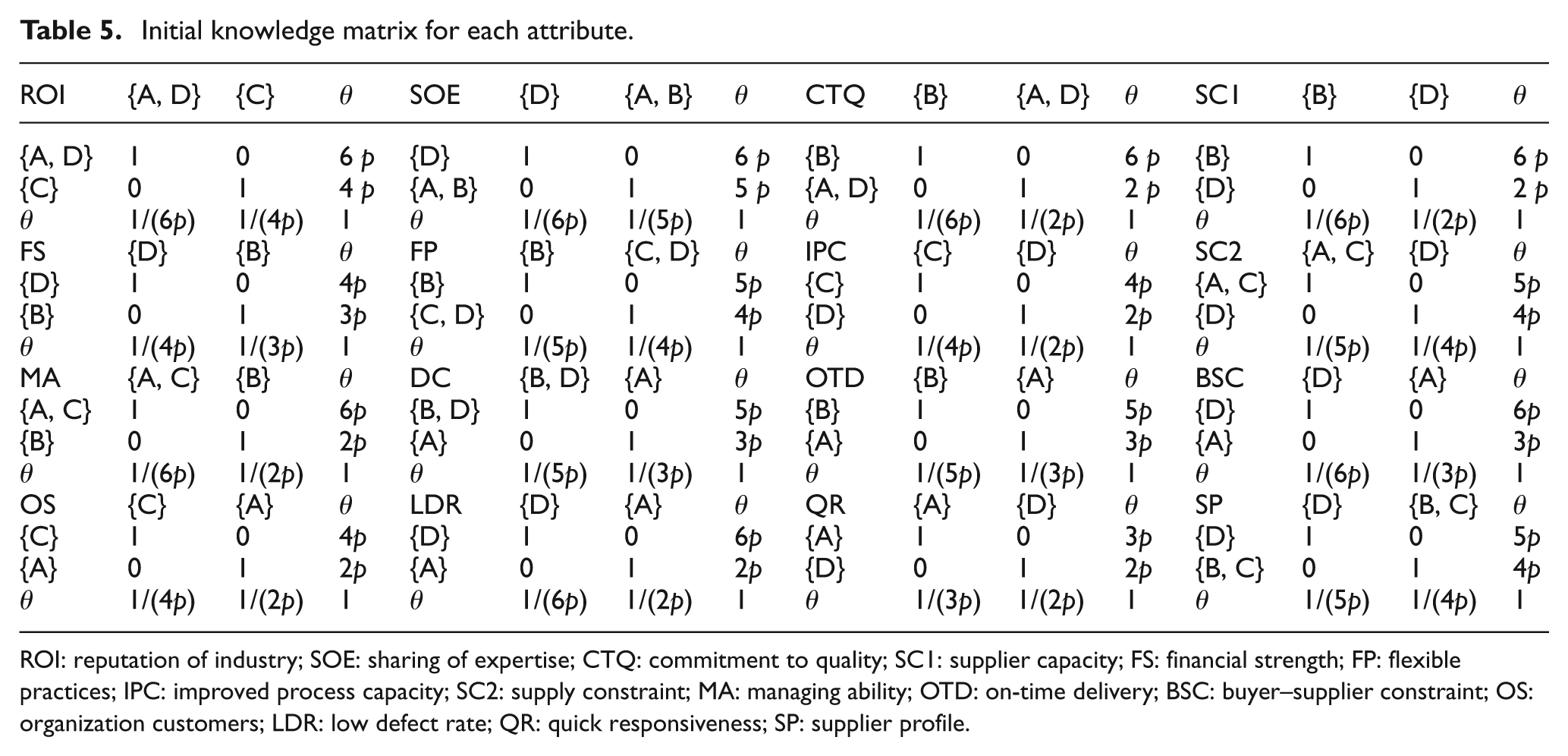
ROI: reputation of industry; SOE: sharing of expertise; CTQ: commitment to quality; SC1: supplier capacity; FS: financial strength; FP: flexible practices; IPC: improved process capacity; SC2: supply constraint; MA: managing ability; OTD: on-time delivery; BSC: buyer–supplier constraint; OS: organization customers; LDR: low defect rate; QR: quick responsiveness; SP: supplier profile.
Based on the data in Table 5, following the approach presented in section “Building BPA associated with each criterion,” we can construct BPA for each attribute shown in Table 6.
The initialized BPA associated with each attribute.
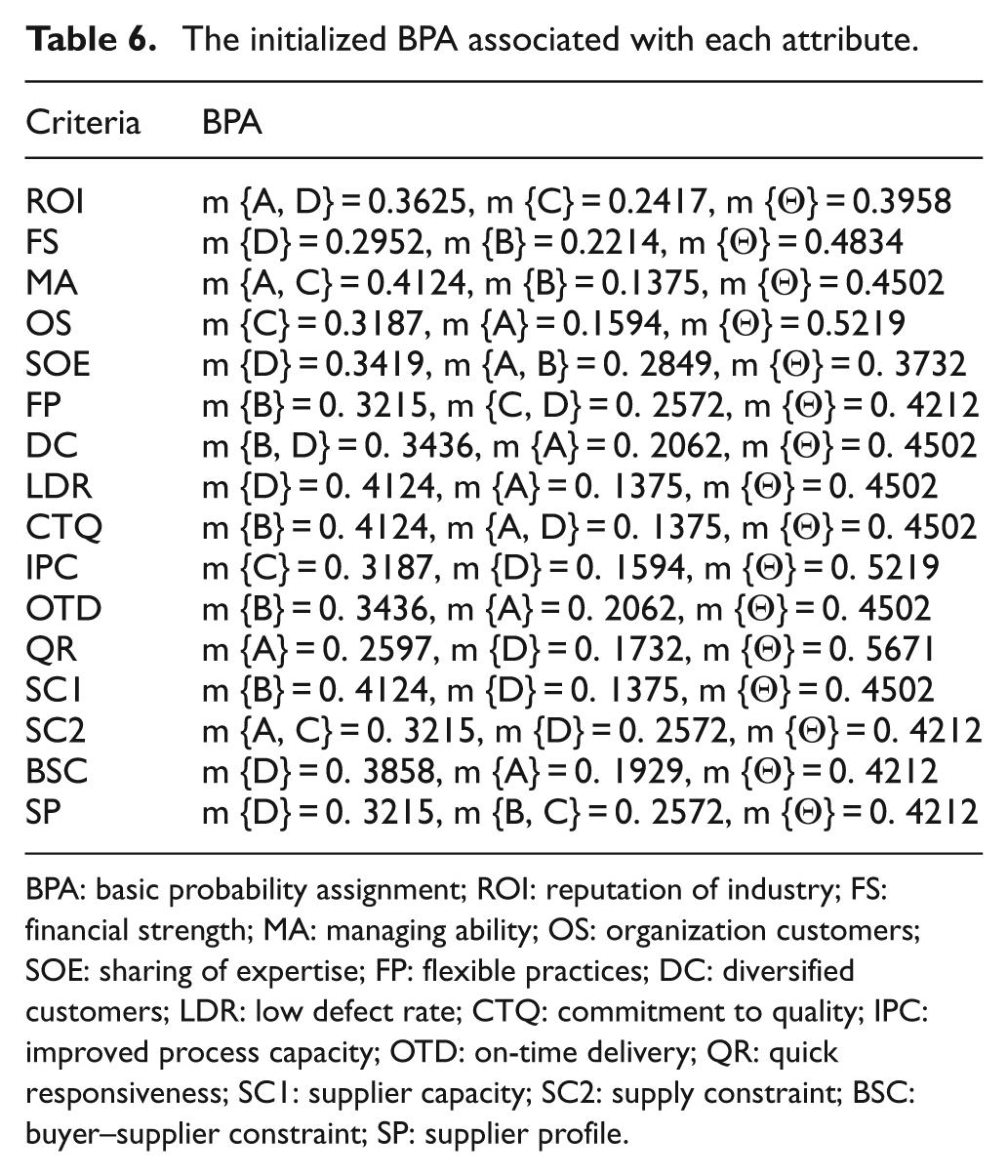
BPA: basic probability assignment; ROI: reputation of industry; FS: financial strength; MA: managing ability; OS: organization customers; SOE: sharing of expertise; FP: flexible practices; DC: diversified customers; LDR: low defect rate; CTQ: commitment to quality; IPC: improved process capacity; OTD: on-time delivery; QR: quick responsiveness; SC1: supplier capacity; SC2: supply constraint; BSC: buyer–supplier constraint; SP: supplier profile.
In what follows, the weight of every sub-criterion in Layer 2 is determined using ANP. In ANP, AHP is used to evaluate each criterion’s weight, which is introduced in detail in section “Constructing the weight associated with each criterion and sub-criterion.”Table 7 shows the judgment matrix of each criterion in Layer 2.
Pairwise comparison matrix for the sub-criteria in Layer 2 under different controlling criteria.
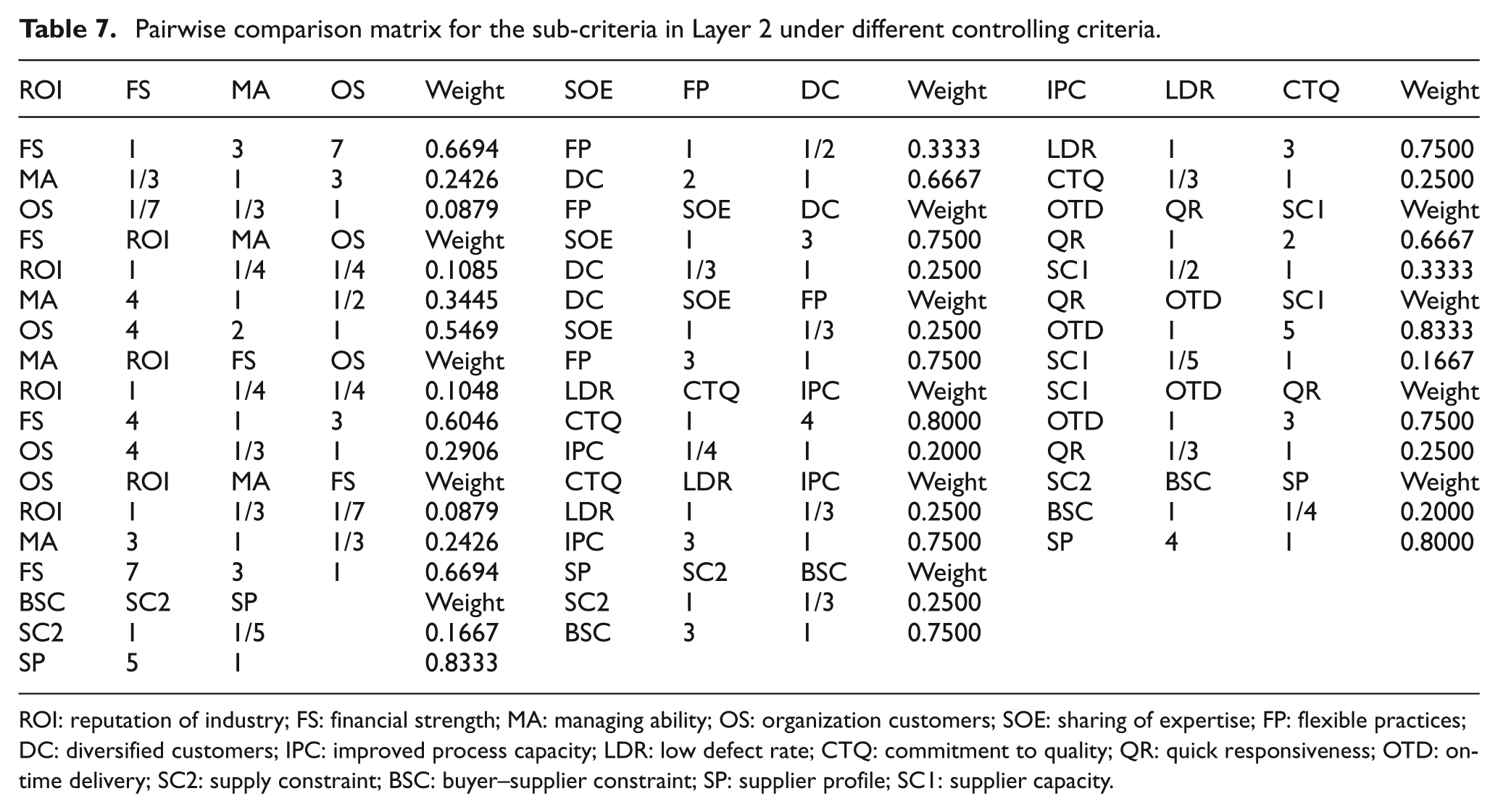
ROI: reputation of industry; FS: financial strength; MA: managing ability; OS: organization customers; SOE: sharing of expertise; FP: flexible practices; DC: diversified customers; IPC: improved process capacity; LDR: low defect rate; CTQ: commitment to quality; QR: quick responsiveness; OTD: on-time delivery; SC2: supply constraint; BSC: buyer–supplier constraint; SP: supplier profile; SC1: supplier capacity.
Next, the relative importance of each dimension for a determinant is obtained through a pairwise comparison matrix. Four such matrices can be formulated in the present case. The matrices for the criteria BI, EOF, Q, S and R are shown in Tables 8–10. As for the criteria in the first layer, their weights are shown in Table 11.
Pairwise comparisons for attributes BI and EOF.
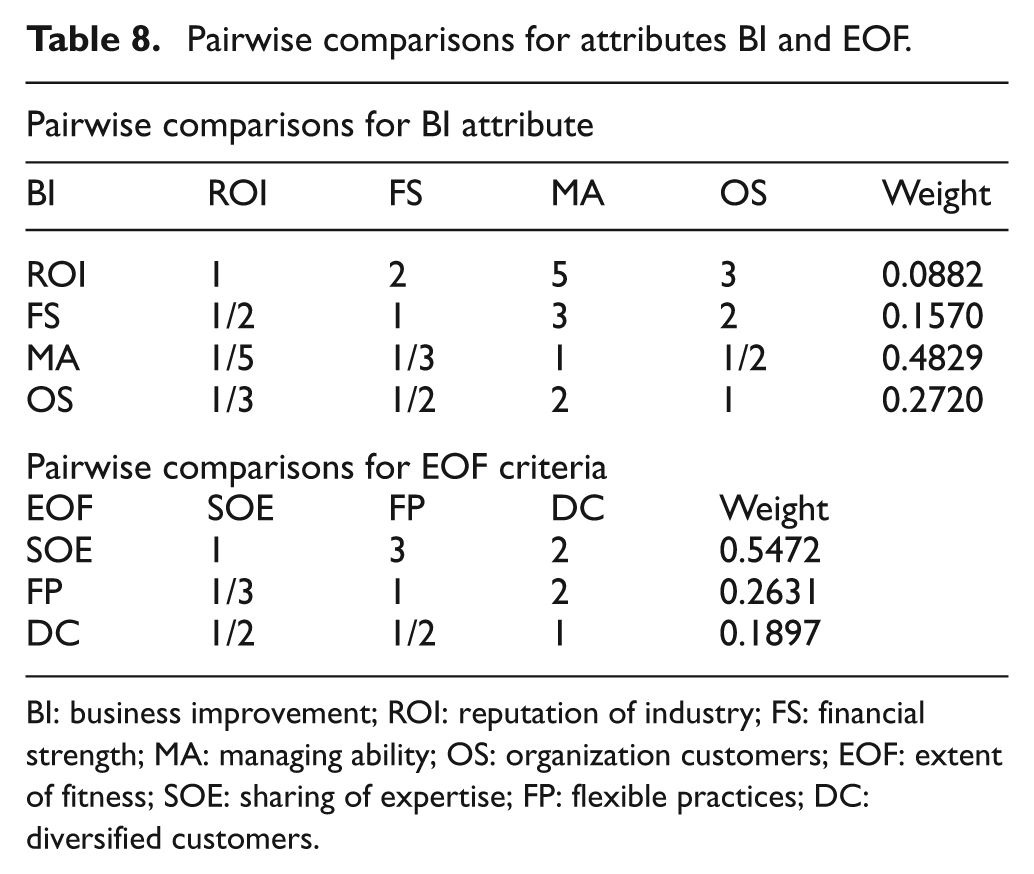
BI: business improvement; ROI: reputation of industry; FS: financial strength; MA: managing ability; OS: organization customers; EOF: extent of fitness; SOE: sharing of expertise; FP: flexible practices; DC: diversified customers.
Pairwise comparisons for attributes Q and S
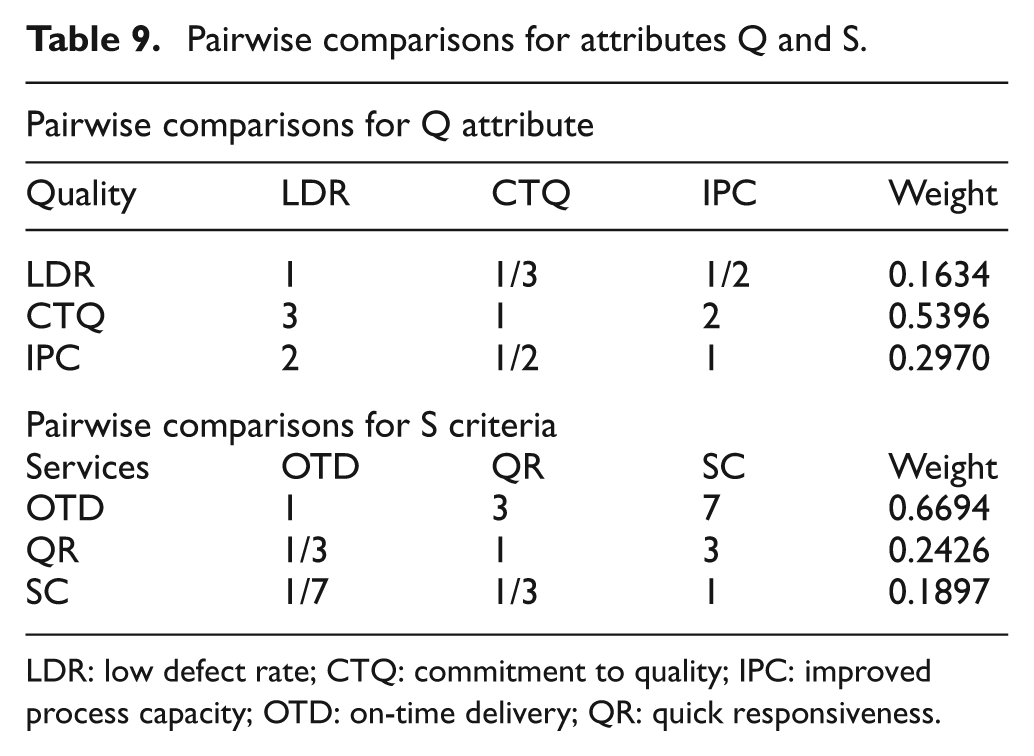
LDR: low defect rate; CTQ: commitment to quality; IPC: improved process capacity; OTD: on-time delivery; QR: quick responsiveness.
Pairwise comparisons for Risks (R) criteria.
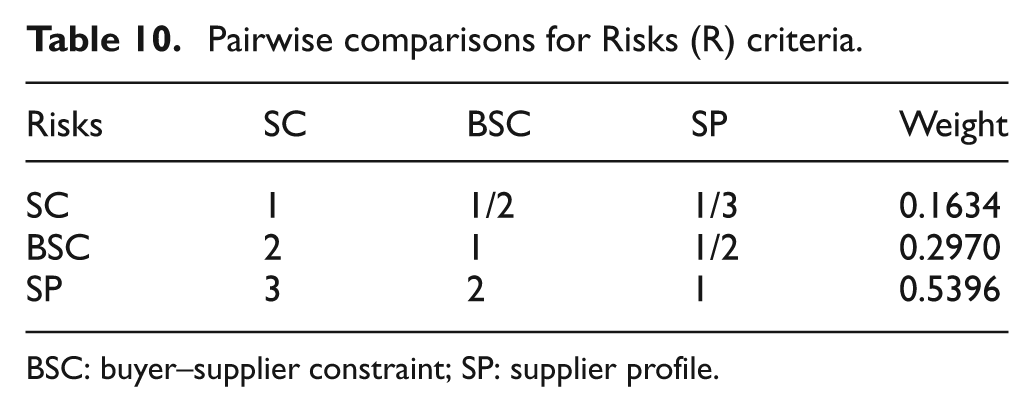
BSC: buyer–supplier constraint; SP: supplier profile.
Weight of each criterion in Layer 1 (CI = 0.0895).
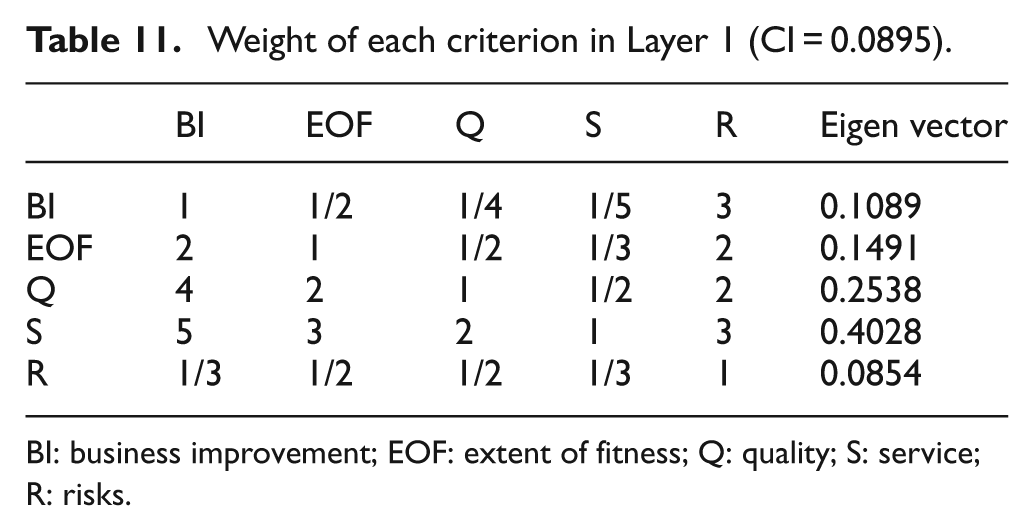
BI: business improvement; EOF: extent of fitness; Q: quality; S: service; R: risks.
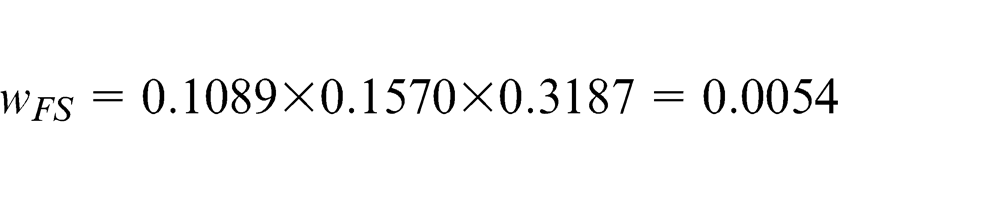
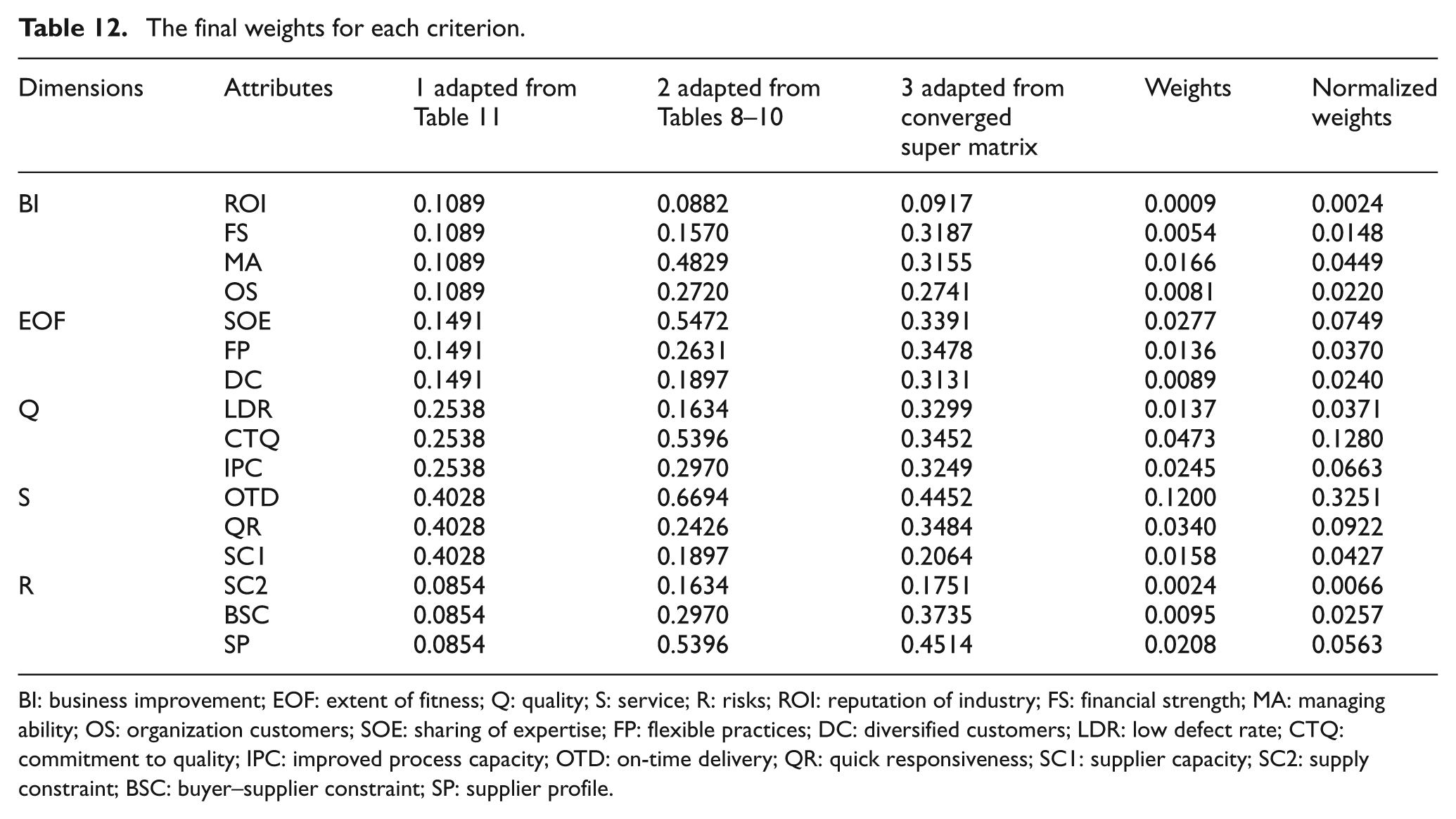
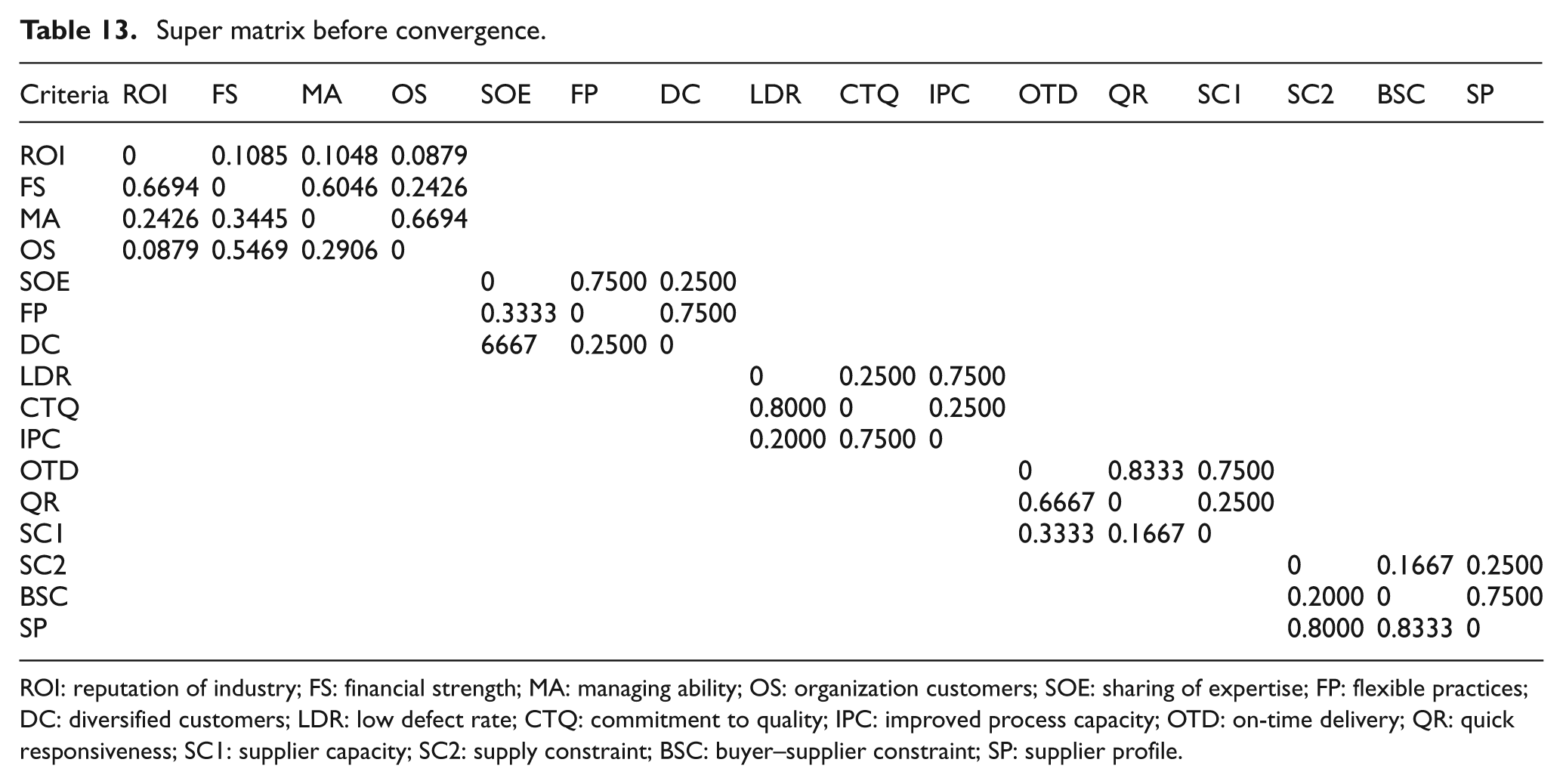
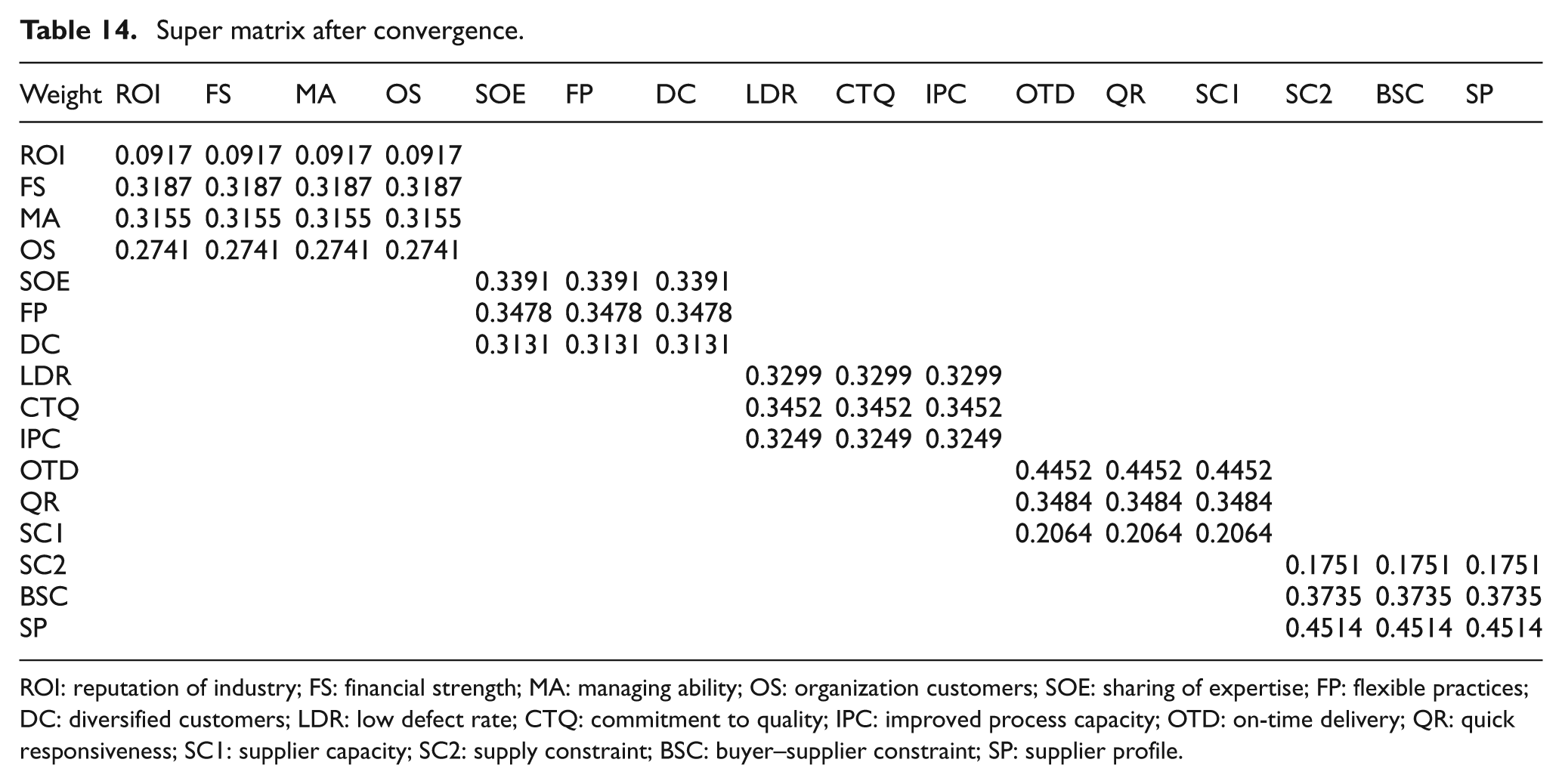
In what follows, the weights for each attribute can be built. The third column in Table 12 shows the weight associated with the criteria in the first layer, while the fourth column displays the relative importance of the attributes in the second layer. The data in the fifth column is adopted from the converged super matrix as shown in Tables 13 and 14. We obtain the weight associated with each attribute in the sixth column. For example, for the attribute FS, its final weight is calculated as follows
The final weights for each criterion.
BI: business improvement; EOF: extent of fitness; Q: quality; S: service; R: risks; ROI: reputation of industry; FS: financial strength; MA: managing ability; OS: organization customers; SOE: sharing of expertise; FP: flexible practices; DC: diversified customers; LDR: low defect rate; CTQ: commitment to quality; IPC: improved process capacity; OTD: on-time delivery; QR: quick responsiveness; SC1: supplier capacity; SC2: supply constraint; BSC: buyer–supplier constraint; SP: supplier profile.
Super matrix before convergence.
ROI: reputation of industry; FS: financial strength; MA: managing ability; OS: organization customers; SOE: sharing of expertise; FP: flexible practices; DC: diversified customers; LDR: low defect rate; CTQ: commitment to quality; IPC: improved process capacity; OTD: on-time delivery; QR: quick responsiveness; SC1: supplier capacity; SC2: supply constraint; BSC: buyer–supplier constraint; SP: supplier profile.
Super matrix after convergence.
ROI: reputation of industry; FS: financial strength; MA: managing ability; OS: organization customers; SOE: sharing of expertise; FP: flexible practices; DC: diversified customers; LDR: low defect rate; CTQ: commitment to quality; IPC: improved process capacity; OTD: on-time delivery; QR: quick responsiveness; SC1: supplier capacity; SC2: supply constraint; BSC: buyer–supplier constraint; SP: supplier profile.
After normalization, the weights are shown in the final column of Table 12. Next, according to the discounting operation shown in equation (1) and Dempster’s combination rule, we can build the performance for each decision alternatives. In order to demonstrate the efficiency of the proposed method, we have compared it with DS/AHP method proposed in Beynon. 70 Table 15 and Figure 4 show us the performance of each supplier. Note that Supplier B has the highest priority weight both in DS/AHP and DS/ANP approaches. In addition to this, there is a 22.55% level of combined uncertainty in the DS/ANP, while there is a 17.48% level of combined uncertainty in DS/AHP. Besides, from Figure 4, we can also find that the interdependencies and interactions across the criteria play a vital role in determining the performance associated with each decision alternatives. For example, for the decision alternative D, its priority weight in DS/ANP approach is less than in DS/AHP method by a degree of 16%.
The comparison results between DS/ANP and DS/AHP.
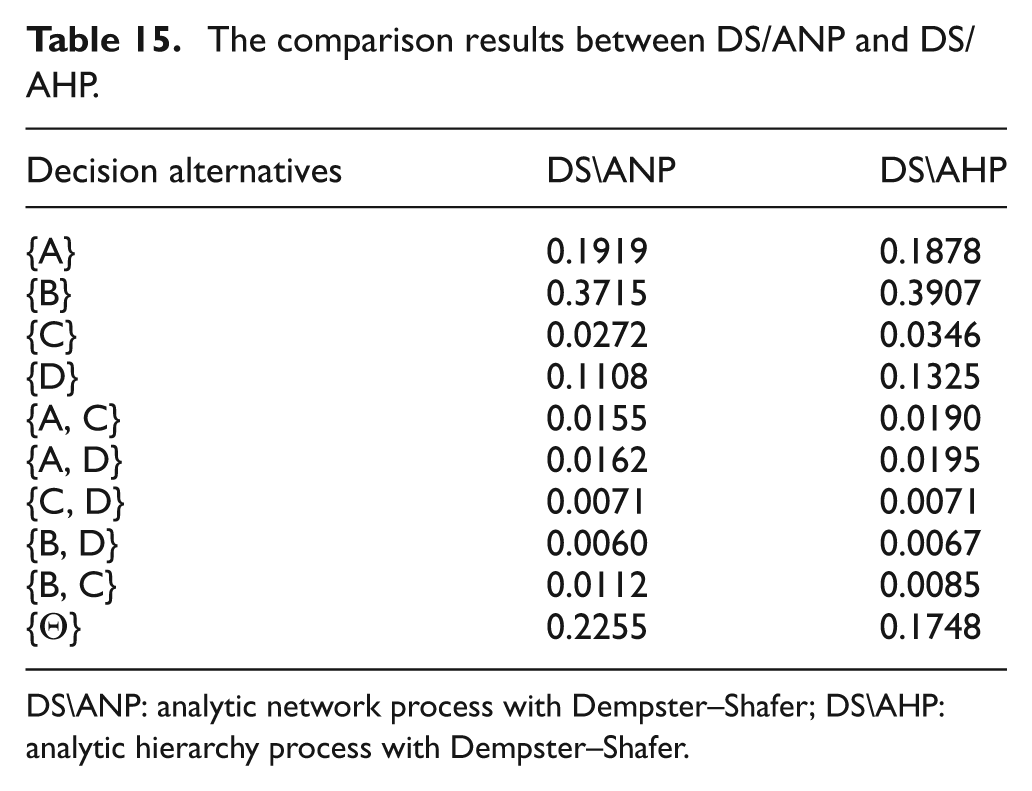
DS\ANP: analytic network process with Dempster–Shafer; DS\AHP: analytic hierarchy process with Dempster–Shafer.
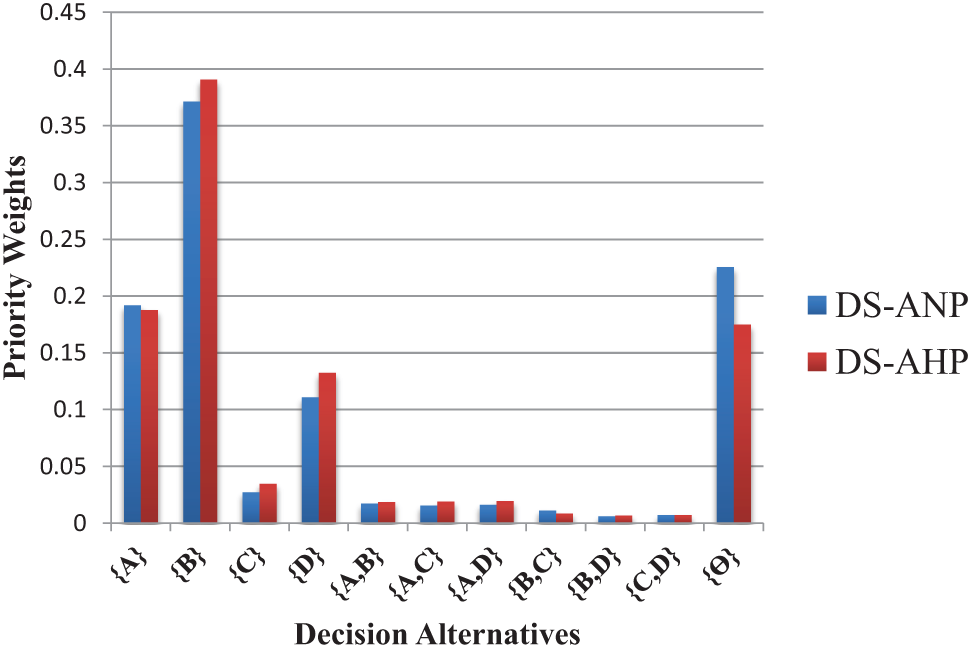
The comparison between DS/ANP and DS/AHP.
Conclusion
An ideal manufacturing requires efficient suppliers. To handle the independencies and the uncertain information on potential suppliers, we proposed a new method DS/ANP based on the ANP method and DS theory of evidence. To the best of our knowledge, this is the first attempt to deal with supplier selection in a manufacturing organization using the hybrid DS/ANP approach. The advantage of the proposed method is that it overcomes the shortcomings of AHP by considering the dependencies and uncertainty across the selection criteria and provides us with a simple and effective way for selecting the supplier. By quantitatively comparing our method with DS/AHP approach, we have shown that the proposed method provides a systematic and optimal tool of decision-making.
The proposed method provides a way for simplified modeling of complex MCDM problems. In addition to this, we can quantify many subjective judgments by taking advantage of the experts’ experience. The decision-making systems are becoming more and more complex nowadays, filled with imprecise and vague information. DS theory is good at capturing such kind of uncertain information, and it provides us with a flexible and effective tool to deal with the supplier selection problem under uncertain environment. Although the model has been verified on a small example, including four distinct decision alternatives and 16 attributes, it is capable for solving more complex problems. In future studies, we will demonstrate on large-scale data sets that the method proposed in this article could help us to reduce the risks of making poor investment decisions when dealing with complex networks of suppliers.
Footnotes
Acknowledgements
The authors are grateful to reviewers for their criticism and constructive comments.
Declaration of Conflicting Interests
The author(s) declared no potential conflicts of interest with respect to the research, authorship, and/or publication of this article.
Funding
The author(s) disclosed receipt of the following financial support for the research, authorship, and/or publication of this article: The work is partially supported by National Natural Science Foundation of China (grant no. 61174022); R&D Program of China (2012BAH07B01); National High Technology Research and Development Program of China (863 Program) (grant no. 2013AA013801); Science and Technology Planning Project of Guangdong Province, China (grant nos 2010B010600034, 2012B091100192); Business Intelligence Key Team of Guangdong University of Foreign Studies (grant no. TD1202) and the open funding project of State Key Laboratory of Virtual Reality Technology and Systems, Beihang University (grant no. BUAA-VR-14KF-02).