




Abstract
This article addresses a novel real-time locating system for localization of high-speed mobile objects in fading environments. The proposed locating system exploits time difference of arrival measurements based on ultra-wideband signals. However, the ultra-wideband signals cause a frequency-selective fading due to their short time duration, which induces severe inter-symbol interference. Moreover, high-speed objects cause fast fading due to large Doppler spread. Therefore, the fading cases considerably reduce the localization performance. The presented locating system relies on a new localization approach in order to overcome the fading issues, which utilizes a modification of extended Kalman filtering. Especially, the suggested locating method works well even in the zero time difference of arrival case, which occurs due to a very deep fading. Experiment results verify that the proposed real-time locating system gives excellent localization performance in severe fading environments. The results also exhibit that the presented locating system is superior to the conventional locating systems in the localization of high-speed mobile objects under fading environments.
Introduction
A lot of attention has been paid to real-time locating system (RTLS) for localization of high-speed mobile objects such as mobile robots or autonomous vehicles. Recently, the RTLS is considered a crucial component in the area of Internet-of-things (IoT) including machine-to-machine (M2M) and device-to-device (D2D) communications. 1 Especially, in the cases of M2M/D2D under cooperative communications, 2 the communication performance highly relies on the localization performance. If line-of-sight (LOS) signals are available in wireless channels, the RTLS usually exploits time difference of arrival (TDoA) from the LOS signals.3–6 Otherwise, the RTLS can utilize received signal strength (RSS) or direction of arrival (DoA).7,8 For accurate positioning, TDoA is considered a more desirable measurement in the RTLS. In wireless environments, the RTLS frequently utilizes the ultra-wideband (UWB) signals in order to considerably increase the resolution of TDoA measurements. Higher resolution leads to better localization performance in the RTLS. The UWB signals require very short time duration, which occupies very large bandwidth. 9 Especially, the IEEE802.15.4a specifies the standard of the UWB signals for the positioning. 10 When TDoA measurements are used, the RTLS relies on direct method3,5,11 or extended Kalman filter (EKF)4,12,13 The direct method exhibits the simplest calculation but renders poor locating performance if TDoA measurements are noisy. The EKF approach gives a fairly good performance even with noisy TDoA measurements. However, the EKF method is vulnerable to fading effects in UWB applications. Especially, the UWB signals exhibit frequency-selective fading due to the huge bandwidth. The fading causes inter-symbol interference (ISI), 14 which in turn reduces the accuracy of TDoA. In the case that mobile objects move with high speed, fast fading occurs due to large Doppler spread, 14 which also deteriorates the localization performance of the EKF.
This article presents a novel RTLS for localization of high-speed mobile objects in fading environments. The RTLS utilizes the UWB signals based on the IEEE802.15.4a in order to achieve TDoA measurements with high resolution. The RTLS relies on a proposed EKF approach in order to overcome the fading effects. The suggested EKF scheme is a modification of the conventional EKF technique. The modified EKF method includes a presented criterion. The criterion determines if the TDoA measurements are significantly distorted due to the ISI effects in the frequency-selective fading case. If the distortion is too severe, the corresponding TDoA measurements are excluded in the update process of the EKF. The exclusion significantly contributes to the robustness of the EKF to the frequency-selective fading effect. The modified EKF also includes a management technique for the zero-TDoA case. In the case of high-speed mobile objects, the fast fading sometimes causes a very deep fading, which leads to the zero-TDoA case. Any TDoA measurement is unavailable during the update process of the EKF in the zero-TDoA case. Sometimes, a tracking divergence occurs during the update process. The tracking divergence denotes a divergence of location estimates. In the case of tracking divergence, the location estimates are significantly deviated from the range of a track and never back to the range of the track. The suggested management method profoundly contributes to the divergence avoidance. Therefore, the proposed EKF version overcomes the weakness of the conventional EKF in fading environments.
Experiment results show that the novel RTLS gives excellent locating performance in severe fading environments. For the experiment of high-speed objects, the mobile objects move with the maximum speed of 60 km/h. The results exhibit that the modified EKF method outperforms the direct method and the conventional EKF approach in several tracks. They also confirm that the presented RTLS can accurately localize the high-speed mobile objects such as autonomous vehicles in fading environments.
In this article, the main motivations of our research are as follows:
Recently, autonomous vehicles have emerged as main applications in the area of consumer electronics.
Autonomous vehicle systems usually require real-time locating information for their proper operation.
This indicates that a locating system is required for localization of high-speed objects such as autonomous vehicles.
However, most locating systems focus on indoor localization or outdoor localization of low-speed objects.
Therefore, we propose a RTLS for localization of high-speed objects such as autonomous vehicles.
In addition, the main contributions of our research are as follows:
The proposed RTLS can considerably mitigate the frequency-selective fading and the deep fading effects, which leads to accurate localization of high-speed objects.
The proposed RTLS is also very robust to long-time zero-TDoA case due to a very deep fading.
Therefore, the proposed RTLS is very suitable for localization of high-speed objects such as autonomous vehicles.
Related works
The related works include two conventional location-estimation methods. The location estimations are based on direct method and EKF. To our best knowledge, the current positioning works are classified into the two conventional methods. The positioning works3,5,11 belong to one category: Direct method. In addition, the positioning techniques4,12,13 belong to the other category: EKF.
Many localization systems rely on TDoA-based UWB approaches for mobile objects. Note that the UWB techniques are also classified into the two conventional methods. However, most UWB methods focus on indoor localization.10,15 The UWB methods are just applicable to low-speed objects. Recently, a TDoA algorithm was analyzed for rapid moving target with UWB tag. 16 However, the algorithm is just an iterative version of the direct method. Moreover, this method is just applicable to the target moving on a straight line. This indicates that the UWB scheme 16 is not suitable for localization of high-speed objects such as autonomous vehicles. Unlike the UWB approaches,10,15,16 the proposed RTLS focuses on outdoor localization and is very suitable for localization of high-speed objects (including autonomous vehicles) moving on various long-distance tracks.
The conventional methods utilize TDoA measurements in order to locate targets. Figure 1 illustrates the service model for TDoA acquisition in generic RTLS. In the figure, the target is denoted as

where

The service model for TDoA acquisition in generic RTLS.
The direct method directly finds the target location

where

If equation (3) is divided by

If i is set to 1 in equation (4), the following equation can be found

If equation (4) is subtracted from equation (5), the following equation can be achieved

where

If i is set to 0 and 1 in equation (7), the corresponding equations can be expressed as follows


If equation (8) is subtracted from equation (9), the following equation can be achieved

If equation (8) is also subtracted from equation (7), the following equation can be achieved

where

where



In equations (13)–(15),
The EKF is frequently used for location estimation with noisy TDoA measurements. The EKF consists of prediction and update steps.
4
In the prediction step, a priori state vector

where

where

where

where E[ ] denotes the operator of ensemble average. From equation (19), the a priori covariance matrix

where

In the update state, the a priori state vector

where

where

where

In equation (24),

Using equations (22)–(24), the a priori state vector

Then, the a priori covariance matrix

where
At the next iteration, the a posteriori state vector
As indicated in equations (20) and (24), the performance of the EKF heavily depends on the accuracies of equations (21) and (25). Therefore, the EKF produces fairly accurate location estimates even with noisy TDoA measurements if
Proposed RTLS
System model
Figure 2 illustrates the system model for the proposed RTLS. In the figure, the system model consists of transmitters, receivers, one control server, and one locating server. In Figure 2, transmitters and receivers follow the IEEE802.15.4a specification.
18
Therefore, they utilize UWB signals. In the system model under consideration, each mobile object employs one transmitter for generation of the UWB signal. Therefore, each transmitter is attached on the corresponding mobile object for location estimation. For the positioning and the identification of each object, the corresponding transmitter generates the UWB signal and delivers the identification number, respectively. As depicted in Figure 2, the receivers collect the UWB signal and the identification number from each mobile object. Using the received UWB signal, each receiver finds the arrival time-stamp of the signal. The arrival time-stamp indicates the ToA measurement, which is denoted as

The system model for the proposed RTLS.
The UWB signals usually exhibit accurate ToA estimation of less than 3 ns, which indicates less than 1 m distance uncertainty. 19 In such case, the locating server of Figure 2 can employ the conventional method (direct method or EKF). However, the UWB accuracy (less than 3 ns) can just be achieved in the case of a stationary target under a single-path additive white Gaussian noise (AWGN) channel. 19 Therefore, the conventional locating method is unavailable in the case of high-speed mobile objects under a heavily fading channel. For accurate location estimation of high-speed mobile objects under fading environments, the modified EKF method is proposed in this article. Thus, the locating server of Figure 2 employs the modified EKF for the accurate location estimation.
Modified EKF
The modified EKF is also composed of prediction and update steps like the conventional EKF. The modified version follows the same prediction step as the conventional EKF since the covariance matrix of equation (21) is stationary in the location estimation. However, the covariance matrix of equation (25) is nonstationary in fading environments. Therefore, the update step is revised in order to deal with the nonstationary situation.
In the update state of the modified EKF,

where

where

where the expressions of
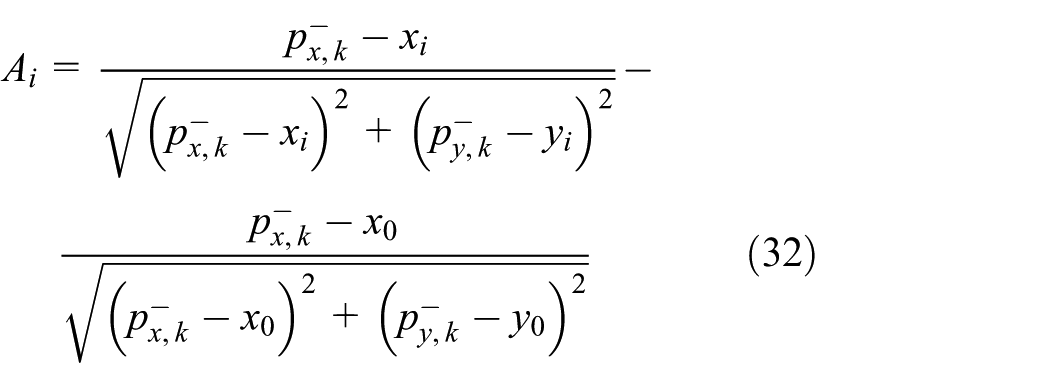
where
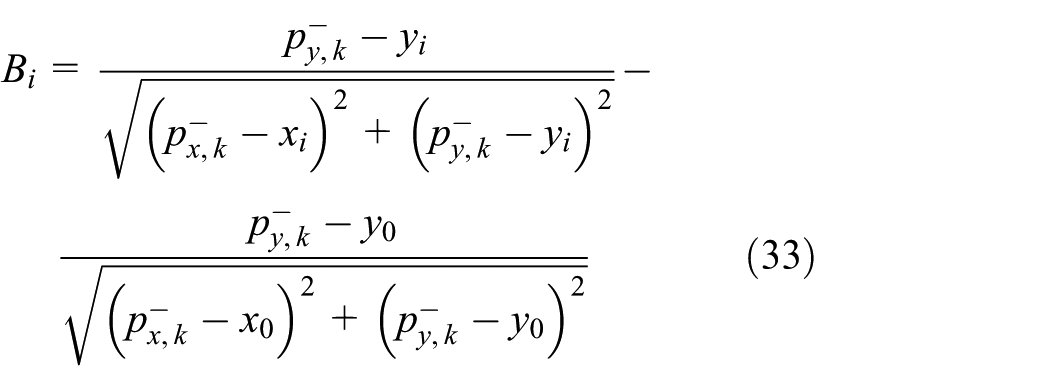
where
Since it is difficult to find the nonstationary covariance matrix

where

where

where
Sometimes, a very deep fading causes a zero-TDoA case. During the zero-TDoA duration, only the process value

As indicated in equation (37), if the zero-TDoA duration exceeds the predefined maximum duration
Experimental evaluation
Experimental evaluation exhibits the effectiveness of the proposed RTLS. For the experiment of high-speed objects, the mobile objects move with the maximum speed of 60 km/h. Each mobile object is equipped with the transmitter, which generates UWB signals. Figure 3(a) and (b) illustrates the transmitter and the receiver, respectively, for the RTLS. As illustrated in Figure 3(b), the receiver is installed on high tower, which increases the detection probability of the LOS component. The transmitter and the receiver follow the IEEE802.15.4a standard for the UWB signals. For reliable collection of the UWB signals, lots of receivers are installed around the experimental track, which is illustrated in Figure 4.

The transmitter and the receiver for the proposed RTLS: (a) transmitter and (b) receiver.

The receivers around the experimental track for reliable collection of the UWB signals.
Table 1 summarizes the experimental parameters for the proposed RTLS. The channel exhibits frequency-selective fading and fast fading because of large bandwidth (of UWB signal) and high speed (of mobile objects), respectively. For accurate localization of mobile objects, the transmitter of Figure 3(a) sends 30 UWB signals within 1 s. As indicated in Table 1, the number of the available receivers is larger than 50 in Figure 4. Table 1 also reveals that the control server generates 6 TDoA measurements using the received UWB signals. In other words, N is set to 6 in Figure 2. In this experiment, about 10 mobile objects move on the track independently.
Experimental parameters.

UWB: ultra-wideband; TDoA: time difference of arrival.
Figure 5 illustrates the various tracks for the experimental evaluation of the proposed RTLS. As shown in the figure, four types of tracks are used in this experiment. Figure 5(a) indicates the track whose distance is 1000 m. Figure 5(b) shows the track of 1200 or 1300 m. In Figure 5(c), the distance of the track is 1400 m. Figure 5(d) shows the track whose distance is 1700, 1800, 1900, or 2000 m. In Figure 5, S and G denote the starting position and the goal position (ending position), respectively.

The various tracks for the experimental evaluation of the proposed RTLS: (a) 1000 m, (b) 1200 or 1300 m, (c) 1400 m, and (d) 1700, 1800, 1900, or 2000 m.
Figures 6 and 7 exhibit the experiment results. In the figures, the proposed method is compared with the direct method and the conventional EKF. As stated in the “Related works” section, the current location algorithms3–5,11–13 can be classified into the direct method and the conventional EKF.

The comparison of the location estimates for the track of 1000 m in the cases of (a) the direct method, (b) the conventional EKF, and (c) the modified EKF.

The comparison of the location estimates for the track of 1200 m in the cases of (a) the direct method, (b) the conventional EKF, and (c) the modified EKF.
Figure 6(a)–(c) shows a comparison of the location estimates for the track of 1000 m (Figure 5(a)) in the cases of the direct method, the conventional EKF, and the modified EKF, respectively. As illustrated in Figure 6(a), the direct method produces a lot of estimation errors. In the figure, the dashed boxes enclose the erroneous estimates. The errors occur due to noisy TDoA measurements. Some estimates have large error differences (more than 200 m). As stated earlier, the frequency-selective fading significantly intensifies the noisy effects due to the ISI. This leads to the large error values. The conventional EKF mitigates the noisy effects. As shown in Figure 6(b), many erroneous estimates are corrected. However, the conventional EKF still produces noticeable distortions in the localization. This is due to the fact that the conventional EKF is susceptible to the nonstationary property of the covariance matrix
Figure 7(a), (b), and (c) exhibits a comparison of the location estimates for the track of 1200 m (Figure 5(b)) in the cases of the direct method, the conventional EKF, and the modified EKF, respectively. The direct method also generates many estimation errors due to noisy TDoA measurements in Figure 7(a). The noise effects of Figure 7(a) are more profound than those of Figure 6(a). The largest error difference is higher than about 400 m in Figure 7(a). As illustrated in Figure 7(b), the conventional EKF also corrects many erroneous estimates. However, more distortions exist in Figure 7(b) than Figure 6(b) since the TDoA measurements include more noisy effects as indicated in Figure 7(a). Figure 7(c) also shows that the modified EKF can completely compensate the noticeable distortions. Using the proposed method of equation (36), the modified EKF overcomes the vulnerability to the nonstationary property of the covariance matrix for TDoA measurements. For the track of 1400 m (Figure 5(c)), note that the experiment results are similar to those of Figure 7.
Figure 8 shows the location estimates for the track of 1800 m (Figure 5(d)) in the zero-TDoA case. Figure 8(a) exhibits the zero-TDoA case (which is highlighted using the dashed circle) as well as lots of erroneous estimates in the case of direct method. In Figure 8(a), TDoA values are unavailable for about 100 m, which indicates the time duration of about 6 s assuming the maximum speed (60 km/h) of the mobile object. In other words, a very deep fading continues for about 6 s in the figure. Even though the conventional EKF can correct many erroneous estimates, there are still distinct distortions as illustrated in Figure 8(b). Moreover, the zero-TDoA case is not fully corrected, which is highlighted using the dashed box in Figure 8(b). The incomplete correction leads to a discontinuity in the time axis as shown in Figure 8(c). The discontinuity misleads to false information that the mobile object can move with an extremely high velocity. Figure 8(d) displays the location estimates in the case that the modified EKF does not employ the proposed method of equation (37). As shown in the figure, a tracking divergence occurs due to the long-time zero-TDoA duration (about 6 s). Figure 8(e) exhibits the location estimates in the case that the modified EKF employs the presented approach of equation (37). This figure demonstrates that the proposed technique of equation (37) can completely avoid such a tracking divergence in the case of modified EKF under zero-TDoA situations.

The comparison of the location estimates for the track of 1800 m in the cases of the direct method, the conventional EKF, and the modified EKF: (a) direct method, (b) conventional EKF (x vs y), (c) conventional EKF (time vs x), (d) modified EKF: the case without the method of equation (37), and (e) modified EKF: the case with the method of equation (37).
Conclusion
This article proposes a novel RTLS for localization of high-speed mobile objects in fading environments. For the localization of mobile objects, the RTLS utilizes TDoA measurements, which are achieved using the UWB signals based on the IEEE802.15.4a. The new RTLS employs a presented EKF method, which is a modification of the conventional EKF scheme. The modified EKF considerably mitigates the frequency-selective fading and the deep fading effects, which causes severe ISI and zero-TDoA, respectively. For suppression of the frequency-selective fading, the modified EKF excludes the TDoA measurements in the update process if they are excessively deviated from the process values. For a long-time zero-TDoA case, the modified EKF conditionally utilizes the exclusion approach, which can avoid a possible tracking divergence.
Experimental evaluation shows that the proposed EKF approach (modified EKF) is superior to the direct method and the conventional EKF technique. For realistic evaluation of high-speed objects, the novel RTLS localizes the mobile objects with the maximum speed of 60 km/h in the various tracks. The experiment results show that the modified EKF completely compensates erroneous location estimates in the tracks. They also reveal that the presented EKF approach can eliminate a possibility of tracking divergence in the case of long-time zero-TDoA. The experimental evaluation confirms that the novel RTLS (which employs the modified EKF) is very suitable for localization of high-speed mobile objects under fading environments.
Footnotes
Handling Editor: Feng Hong
Declaration of conflicting interests
The author(s) declared no potential conflicts of interest with respect to the research, authorship, and/or publication of this article.
Funding
The author(s) disclosed receipt of the following financial support for the research, authorship, and/or publication of this article: This research was supported by Research Program through the National Research Foundation of Korea (NRF) (2017R1A2B4005105).