




Abstract
In order to reduce the influence of time-difference-of-arrival measurement error on localization accuracy of time-difference-of-arrival-based four-satellite localization, we first introduce the frequency-difference-of-arrival information to the existing four-satellite time-difference-of-arrival localization algorithm and propose a time-difference-of-arrival/frequency-difference-of-arrival joint four-satellite localization method. The time-difference-of-arrival/frequency-difference-of-arrival localization method can improve the localization accuracy significantly as compared with time-difference-of-arrival localization method. We also derive the geometric dilution of precision of four-satellite localization for precision factor analysis. The simulation results show that, as compared with time-difference-of-arrival localization, absolute position measurement accuracy has little influence on time-difference-of-arrival/frequency-difference-of-arrival localization accuracy. Under the same conditions, the localization accuracy of four-satellite time-difference-of-arrival/frequency-difference-of-arrival is better than that of four-satellite time-difference-of-arrival. And time-difference-of-arrival/frequency-difference-of-arrival localization improves the distribution uniformly of geometric dilution of precision regarding the diamond configuration.
Keywords
With the development of space technology, high-precision passive localization based on small satellite platform plays an important role in civil and military fields and has broad application prospects. 1 The development trend of space electronic reconnaissance technology is to increase the measurement information of target and adopt joint positioning method to improve localization accuracy and increase reconnaissance range. 2 In recent years, several time-difference-of-arrival (TDOA)/frequency-difference-of-arrival (FDOA) localization methods with two or three satellites have been developed.3–5 There are also literatures of multi-satellite TDOA/FDOA localization methods.6–9 Compared to the existing passive localization systems, four-satellite localization using TDOA/FDOA shows more flexible constellation configuration and higher accuracy. In this article, we first derive a four-satellite TDOA/FDOA joint localization algorithm, and then present a geometric dilution of precision (GDOP)-based localization error analysis, from which we give some useful conclusions for guiding the real application of satellite passive localization.
Principle of four satellites using TDOA
Suppose that the model of a three-dimensional TDOA localization system (as shown in Figure 1) consists of one main satellite and three sub-satellites.

Principle of four-satellite localization system using TDOA.
Based on the geometry between the target and four satellites, we can obtain

where

where

where

If the three sub-satellites are not in line with the main satellite,

Next, we analyze the accuracy of four-satellite TDOA localization algorithm as follows.
Differentiating
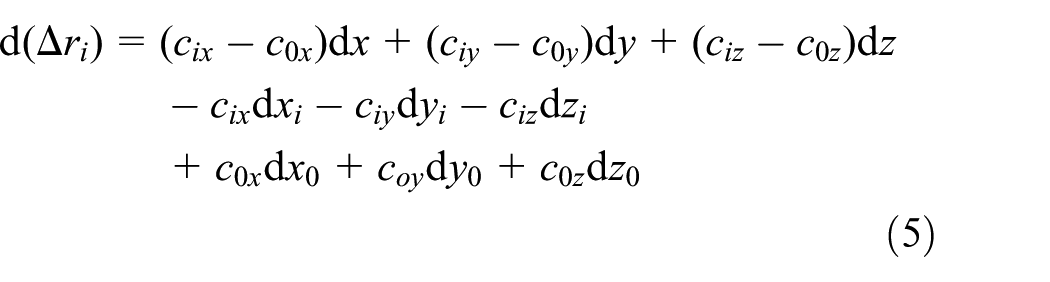
where

Let

We have

Since the main satellite has an error in measuring the arrival time of the radiation signal, the error exists in each time difference measurement. The measurement errors of each

where


Here,

The covariance matrix of the target radiation source position error can be written as
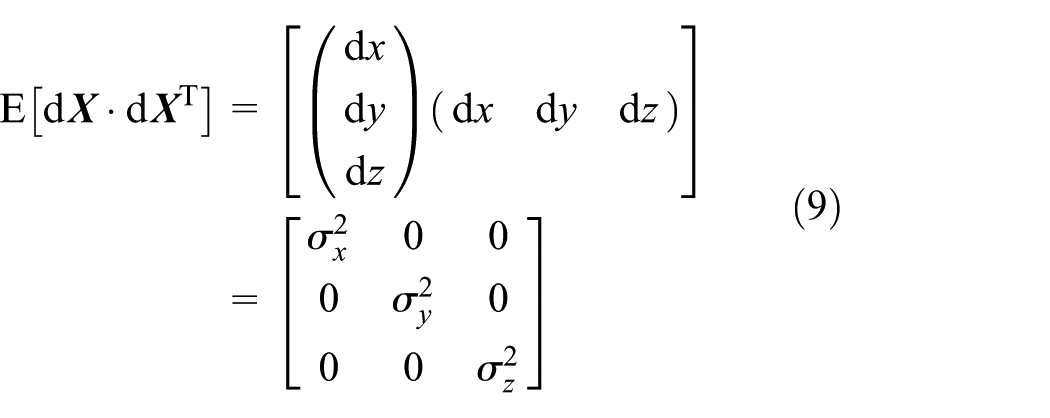
According to the definition of GDOP, the GDOP of TDOA localization in three-dimensional space can be calculated as

where
Principle of four-satellite TDOA/FDOA localization algorithm
The above TDOA localization algorithm can give high accuracy, provided that the TDOA measurement errors are small; however, we cannot obtain so small TDOA measurement error in a real environment. Hence, in order to reduce the influence of TDOA measurement error, we introduce the frequency difference measurement to TDOA equations. The four-satellite TDOA/FDOA localization algorithm can improve the localization accuracy significantly. We introduce the TDOA/FDOA joint localization method as follows.
Assume that the position of the target is


where
Using the first-order linear approximation expansion for

where

After transformation, we obtain

Divide the measurement accuracy of the sub-satellite position into measurement accuracy of absolute position and measurement accuracy of relative position. That is

where

Let

where
The positioning accuracy can be expressed as

We assume that the mean of the TDOA signal and the FDOA signal measurement accuracy is 0, and they are uncorrelated. We can obtain that
The absolute position measurement accuracy components
Comprehensively considering the measurement accuracy of relative position and the ranging accuracy, the correlation matrix of relative position measurement accuracy can be expressed as

where
The correlation matrix of speed measurement accuracy can be given by
Simulation results
Assume that the satellite orbit altitude is 200 km and the length of baseline is 60 km. We test Y, T, and diamond configurations. The measurement accuracy of time difference and frequency difference is 50 ns and 10 Hz, respectively. The measurement accuracy of speed is 1 m/s. The absolute position measurement accuracy is 150 m. The relative position measurement accuracy is 50 m. The GDOP distributions of TDOA localization and TDOA/FDOA localization are obtained by simulation, as shown in Figures 2–4.
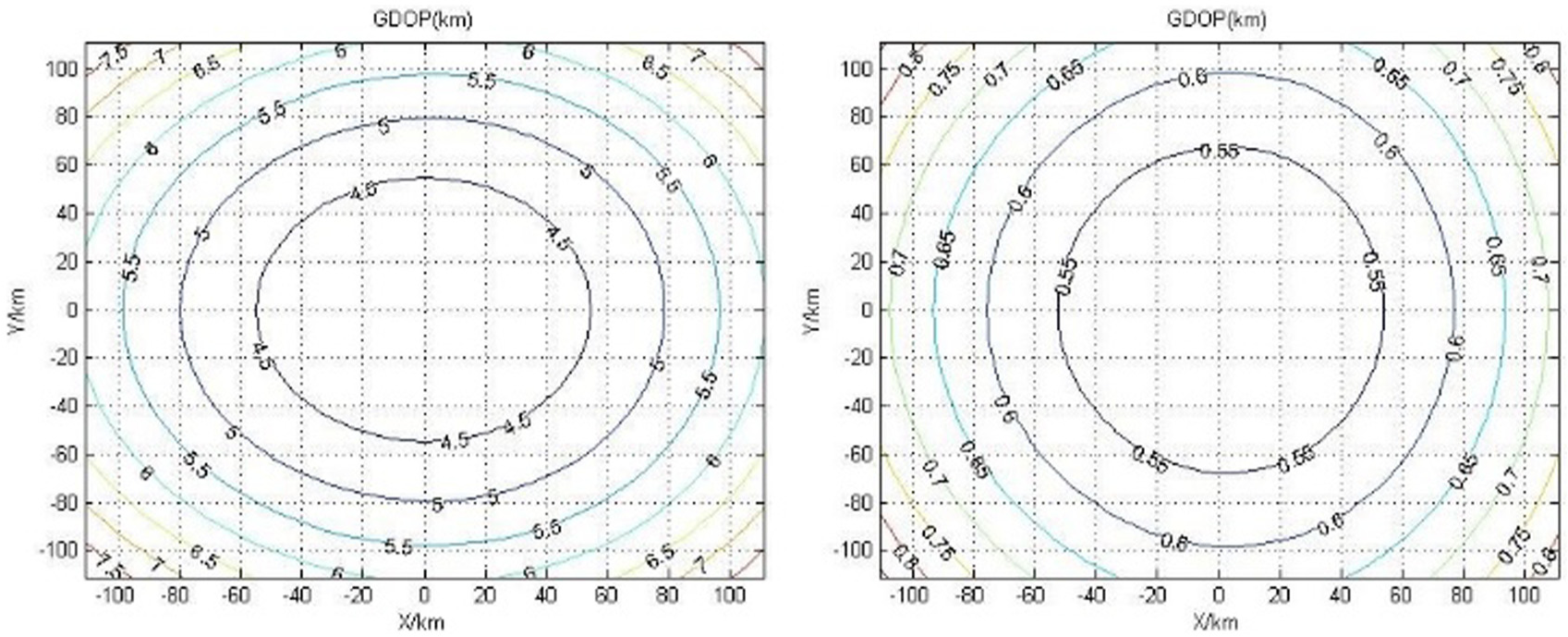
Y configuration; the GDOP distributions of TDOA localization (left) and TDOA/FDOA localization (right).
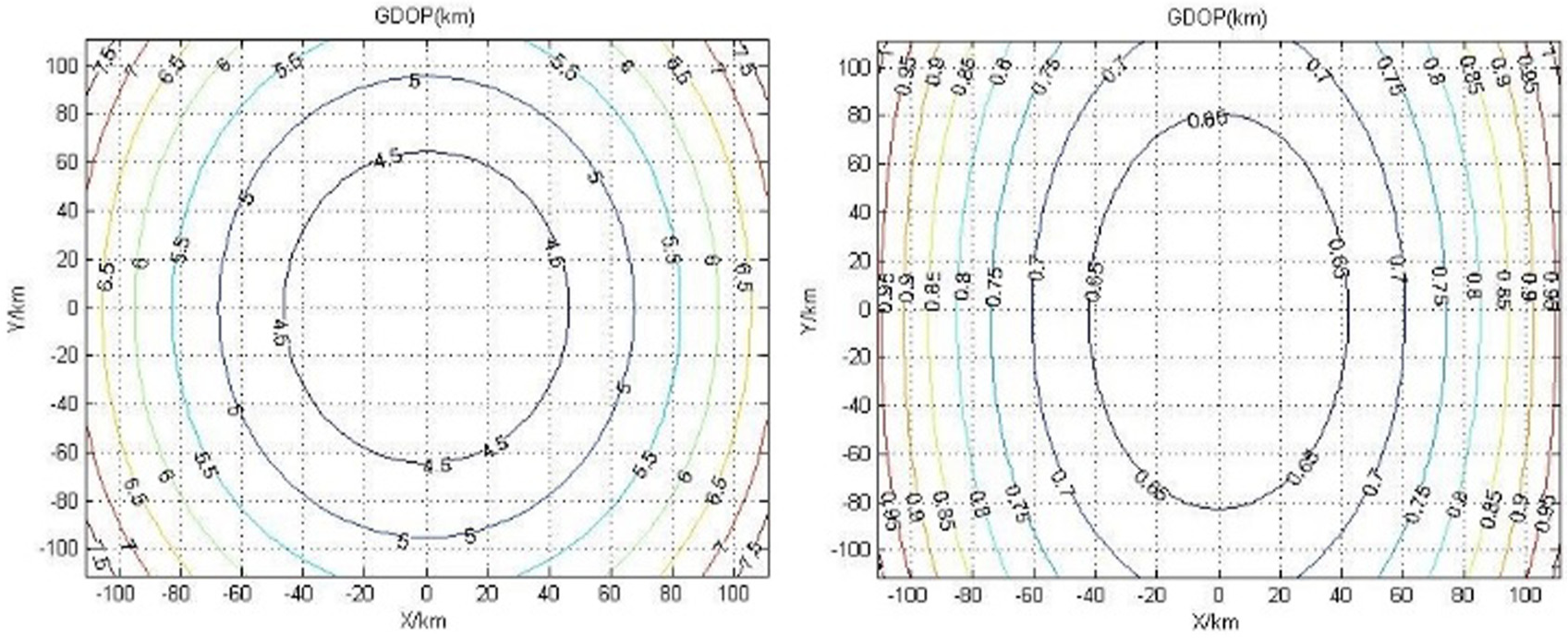
T configuration; the GDOP distributions of TDOA localization (left) and TDOA/FDOA localization (right).

Diamond configuration; the GDOP distributions of TDOA localization (left) and TDOA/FDOA localization (right).
Figure 2 shows that, regarding Y configuration, the accuracy of TDOA localization is 4.5 km at 58 km away from sub-astral point. But the accuracy of TDOA/FDOA localization is better than 0.55 km. Figure 3 shows that, regarding T configuration, the accuracy of TDOA localization is 4.5 km at 58 km away from sub-astral point. But the accuracy of TDOA/FDOA localization is better than 0.7 km. Figure 4 shows that, regarding diamond configuration, the GDOP distribution of TDOA/FDOA localization regards sub-astral point as center and uniformly distributed. But the TDOA localization of GDOP is unevenly distributed.
Assume that the accuracy of absolute position is in the range of 0–300 m. For Y configuration, we keep the remaining parameters unchanged. Taking a point 100 km away from the sub-astral point, the relationship of TDOA localization accuracy and TDOA/FDOA localization accuracy with the absolute position measurement accuracy is obtained, respectively, as shown in Figures 5 and 6.
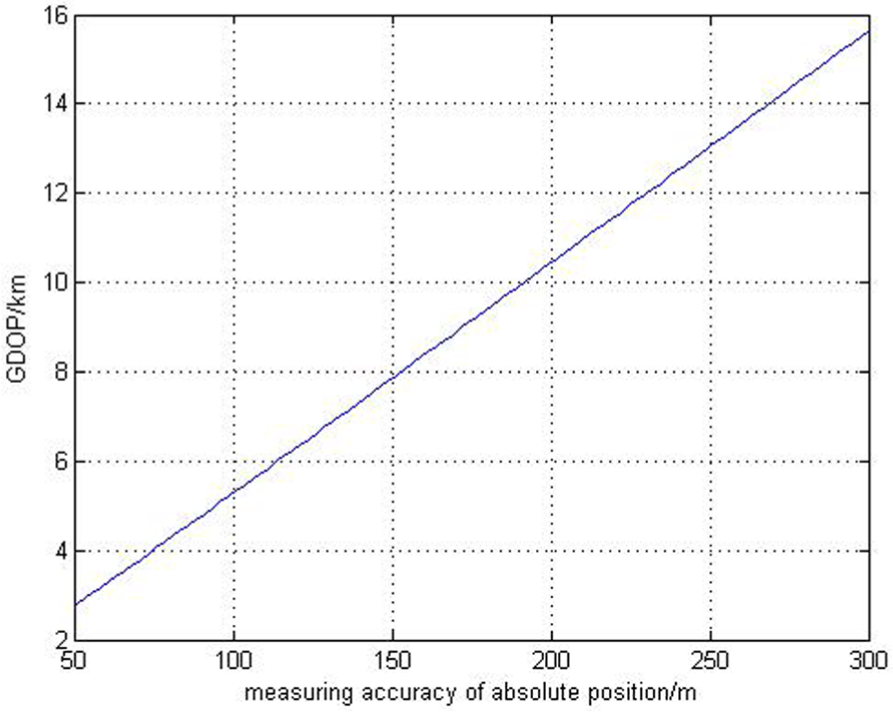
Relationship of TDOA localization accuracy with the absolute position measurement accuracy.

Relationship of TDOA/FDOA localization accuracy with the absolute position measurement accuracy.
Comparing Figures 5 and 6, the localization accuracy of the two algorithms will be improved with the increasing absolute position measurement accuracy. But the localization accuracy of TDOA is greatly affected by absolute position measurement accuracy. Absolute position measurement accuracy almost has very little effect on localization accuracy of TDOA/FDOA. Compared to TDOA localization, the effect is almost negligible.
Conclusion
The principles of four-satellite TDOA and TDOA/FDOA localization algorithm are analyzed, and the GDOP expressions of the two algorithms are deduced, respectively. Through simulation, conclusions are obtained as follows:
With the same parameters, TDOA/FDOA localization algorithm has better accuracy than TDOA localization algorithm.
For diamond configuration, compared to TDOA localization algorithm, TDOA/FDOA improves the GDOP distribution uniformity. It solves the problem of uneven distribution of diamond configuration and increases the engineering feasibility.
Compared to TDOA localization, the absolute position measurement accuracy of satellite has almost no effect on the localization accuracy of TDOA/FDOA, which reduces the localization error caused by unavoidable absolute position measuring factors.
Footnotes
Handling Editor: Zhaojie Ju
Declaration of conflicting interests
The author(s) declared no potential conflicts of interest with respect to the research, authorship, and/or publication of this article.
Funding
The author(s) disclosed receipt of the following financial support for the research, authorship, and/or publication of this article: This work has been supported in part by the National Natural Science Foundation of China under grant numbers 61371184, 61671137, 61771114, and 61771316, and the Fundamental Research Funds for the Central Universities (no. ZYGX2016J028).