



Abstract
The smart grid incorporates a two-way communication system between customers and the utility for advanced monitoring and intelligent control of supply and demand. Wireless multimedia sensor network can be treated as an organic supplement and a peripheral network in this two-way communication system. However, the challenging smart grid environment makes it difficult to achieve a high quality of service in wireless multimedia sensor network. This article proposes a prioritization mechanism that considers the heterogeneous characteristics of smart grid traffic. Specifically, an innovative channel allocation and traffic scheduling scheme, named the preemptive tidal flow queuing model, is presented. This scheme achieves differentiated services for diverse communication data when the wireless multimedia sensor network accesses the core network and ensures the performance for high-priority data at the expense of the performance for low-priority data. Simulation analyses show that the performance for high-priority messages can be reliably guaranteed and that the preemptive tidal flow queuing model satisfies the requirements for a wireless multimedia sensor network operating in the smart grid environment. This article offers three main contributions: the development of a prioritization mechanism specifically for a wireless multimedia sensor network in the smart grid environment, the proposal of the preemptive tidal flow queuing model, and the presentation of formulas and simulations to verify the performance of the preemptive tidal flow queuing model.
Keywords
Introduction
The smart grid is a new generation of power system in which various monitoring and actuating devices are employed. A smart grid autonomously monitors, diagnoses, controls, and efficiently operates the equipment used for power generation, distribution, and utilization.1–3 As the essential link that enables intelligence in a smart grid, a two-way communication infrastructure is required to exchange real-time information between utilities and consumers. 4
However, the question of how to simultaneously support a wide range of quality of service (QoS) requirements for numerous smart grid and legacy applications in this two-way communication infrastructure is an urgent problem to be solved. A typical smart grid communication infrastructure is illustrated in Figure 1. Because of their low costs for equipment and installation, rapid deployment, widespread access, and high flexibility, wireless communication network technologies play an extremely important role in the smart grid communication infrastructure,5,6 and a wireless multimedia sensor network (WMSN), which can serve as an organic supplement and peripheral network in the two-way smart grid communication system, may be the most widely used wireless communication network technology for this purpose. The QoS-aware performance of a WMSN is suitable for smart grid applications, and the intelligent collection of data from many widely distributed sensors and actuators can be effectively realized. As shown in Figure 1, home area networks (HANs) and neighbor area networks (NANs) are the most suitable application scenarios for WMSNs. In HANs and NANs, a tremendous number of sensors and actuators are used for last-mile data collection, and enormous amounts of sensor data must be collected and processed. All data should be collected by smart meters (SMs) and aggregated in data aggregation units (DAUs) through the Meter Data Management System (MDMS) core access network. WMSN technology offers flexible and scalable aggregation and processing procedures for the large amounts of data collected in a many-sensor environment. The performance requirements (such as delay and reliability) for different types of data in the smart grid environment can be widely divergent, which can pose a serious challenge in wireless communication; therefore, the introduction of a specialized QoS scheme for smart grid WMSNs is extremely important.
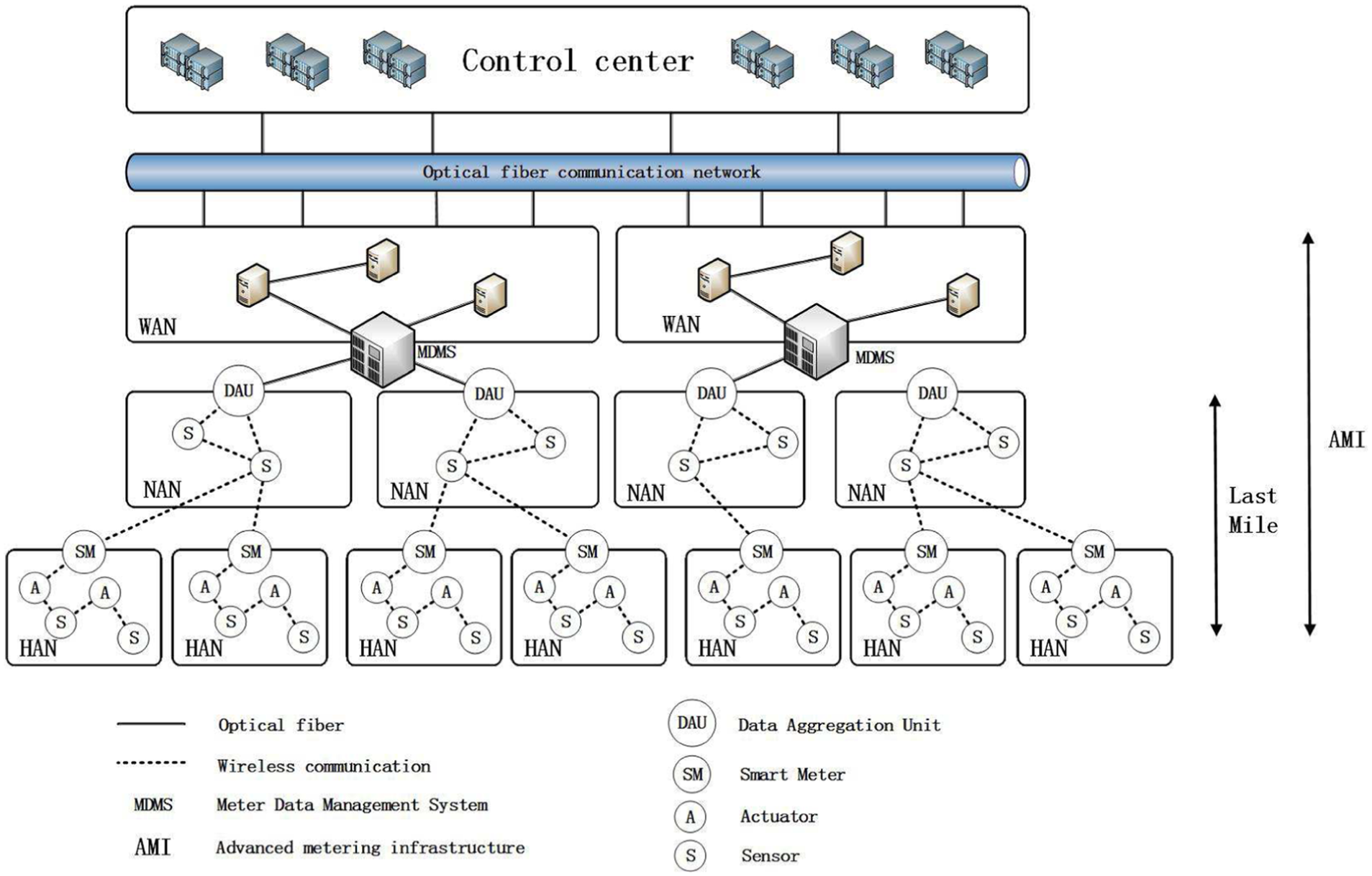
An overview of the smart grid communication infrastructure.
Numerous surveys have focused on the QoS problems faced in specific types of wireless communication networks, such as wireless mesh networks (WMNs), IEEE 802.11-based wireless local area networks (WLANs), and WMSNs. In the literature, QoS issues related to wireless sensor networks (WSNs) and WMSNs have been discussed widely. Azizi and Beghdad 7 focused on maximizing the bandwidth reserved for each sensor node in a WSN and proposed the spiral-based clustered with data aggregation (SBCDA) architecture approach, which combines data aggregation with the time division multiple access (TDMA) protocol, for improving connectivity in WSNs and avoiding inter-cluster collisions.
Magaiaa et al. 8 developed a new multi-objective approach to the WMSN routing problem that considers QoS requirements. Many recent studies have focused on energy efficiency, packet loss rate (PLR), and channel utilization efficiency.9–11 However, the critical factor of transmission delay in smart grid WMSNs has not been fully considered in these papers. Chen 12 proposed a self-stabilizing hop-constrained energy-efficient (SHE) protocol for constructing minimum-energy networks for hard real-time routing; the transmission delay in a WSN was quantified, and the delay requirement was met, but this system does not provide a means of prioritizing messages and thus cannot satisfy the needs of smart grid WMSNs. Malik et al. 13 analyzed the QoS features incorporated by the IEEE 802.11 standard and presented a systematic description of how to enhance the ability to provide high-QoS communication. As the authors stated, service differentiation and resource allocation play important roles in Internet QoS establishment, and similar ideas can be applied to WMSNs operating in the smart grid environment.
Regarding service differentiation, although standards such as IEEE 1646 14 do provide qualitative requirements for different priority levels (such as high, medium, and low), the relative priorities of individual smart grid applications are not made specified. Similarly, IETF RFC 4594 15 specifies qualitative priority requirements only for a few multimedia and enterprise applications. However, as described in Budka et al., 16 most network implementations support only three or four classes of services (other than the top class for network control traffic) to which the user classes of traffic are often mapped. Thus, traffic for many applications with diverse delay and priority requirements gets mapped to a single class and in return receives the same class-specific QoS treatment. In Deshpande et al., 17 priority values are assigned by the authors as their best estimates of the priorities of various applications based on the IEEE 1646 standard, IETF RFC 4594, and ITU-T Recommendations G.107 18 and G.114,19,20 combined with industry knowledge and engineering judgment. Priority ranks from 0 to 100 are assigned, with 0 indicating the highest priority and 100 indicating the lowest, which is a more suitable prioritization approach for the smart grid environment. In this article, the authors try to map more than one application to a QoS class and the corresponding queue in a smart grid network implementation. However, the authors fail to describe how to calculate the priorities of all applications.
Regarding resource allocation, there are two main architectural approaches that are used in wireless communication networks: integrated services (IntServ) and differentiated services (DiffServ). The DiffServ approach is typically the most suitable way to achieve a high QoS in a multi-priority system. In a typical DiffServ model, as analyzed in Demoor et al., 21 the high-priority packets in the communication system preempt all of the system’s resources, and all packets with lower priority must wait; however, when there are more than three levels of priority, the cascade affect will cause the performance of the medium-low level to be extremely poor, and the PLR for medium-low-priority messages cannot be guaranteed. Demoor et al., 21 Fan et al., 22 and Zhao et al. 23 made improvements to the DiffServ scheme for particular scenarios. Demoor et al. 21 studied a two-class priority queue to model a DiffServ router with Expedited Forwarding Per-Hop Behavior for high-priority traffic, and the queue with finite capacity for the high-priority (class-1) packets has been studied in order to model a DiffServ router with Expedited Forwarding Per-Hop Behavior for class-1 packets. The presented model takes the exact class-1 queue capacity into account allowing the determination of class-1 packet loss and its influence on the performance of the system. And the intelligent queue management algorithms improve system performance when the handled traffic exhibits redundancy. In Fan et al., 22 an integrated routing risk model is constructed, which takes into account the effects of unicast routing on DiffServ network risk consisting of the impacts of interrupted services on network users and path availability. With the objective of minimizing integrated routing risk, a novel controllable chaotic immune routing algorithm (CCIRA) is proposed. And a path generation method based on chaotic search and dynamic adjacency matrix is proposed, improving the generation efficiency of available solutions of routing optimization algorithms. By combining the integrated routing risk model and CCIRA, the system can be highly efficient and practical, and the performance of this routing algorithm is proved to be superior. Zhao et al. 23 presented a service-oriented multi-domain control scheme in an attempt to achieve multi-domain quality of transmission (QoT) and energy-aware routing and spectrum assignment (RSA) in DiffServ networks, thereby striking a better balance between QoT and energy efficiency and also improving the utilization of spectrum resources with an acceptable average setup delay. However, no DiffServ communication network cannot be used directly in a smart grid WMSN because of the characteristic complexity of the smart grid environment, as the QoS requirements in smart grid are more detailed and the communication environment is more diverse.
Although many of the technologies discussed above are broadly applicable to the issue of QoS in WMSNs, smart grid WMSNs present several unique challenges that motivate the development of new methods because of the complex difficulties that arise in the smart grid environment, such as dynamic changes in topology, connectivity problems, interference, and fading. The existing prioritization mechanisms can provide only a small degree of fixed priority partitioning, which is not suitable for the smart grid environment, and the traditional channel allocation and traffic scheduling schemes are not designed for the typical operation conditions of smart grid WMSNs. To improve the QoS of WMSNs operating in the smart grid environment, we propose a prioritization mechanism that is designed specifically for this scenario. Based on this mechanism, an innovative channel allocation and traffic scheduling scheme called the preemptive tidal flow queuing model (PTFQM) is developed. Formulas are derived and performance simulations are presented to prove that the proposed prioritization mechanism is suitable for the smart grid environment and that the PTFQM can ensure the QoS of high-priority data in terms of delay and PLR.
The key contributions of this work are as follows:
A suitable prioritization mechanism is proposed to partition large numbers of messages into their appropriate priority levels. The priority partitioning is flexible and adjustable; the number of QoS levels can be customized by the user or automatically generated according to the scenario.
An innovative queuing model is proposed, the inspiration for which is the concept of tidal flow (or reversible) lanes for road traffic. In this queuing model, the channel resources for one QoS level can be diverted to messages of another QoS level in the case of congestion in a higher-level channel; in this way, the QoS for high-priority messages can be reliably guaranteed.
A simple calculation method for two-dimensional finite-length Markov chains is proposed. The method is based on Laplace transforms and the “matrix method,” and the solutions to the equations can be acquired by solving a matrix, which is a simple and intuitive approach.
Simulation results show that the PTFQM achieves efficient service differentiation while treating all QoS levels fairly under various conditions.
The remainder of the article is organized as follows: in section “Prioritization mechanism,” we discuss the architecture of our prioritization mechanism. In section “PTFQM,” we first explain the source of inspiration for our queuing model, we then provide an overall description of the PTFQM concept, and finally, we use pseudocode and flowcharts to clarify the specific steps of the PTFQM. In section “Performance evaluation,” MATLAB simulations are presented to demonstrate the performance improvement achieved using our prioritization mechanism and the PTFQM. Finally, we present concluding remarks in section “Conclusion.”
Prioritization mechanism
As an area of research involving highly intelligent systems, a specialized prioritization mechanism for smart grid WMSNs is urgently needed to adapt to the corresponding application requirements and provide a basis for a priority queuing model. However, as previously mentioned, the traditional standards can provide only simple priority divisions and fail to satisfy the requirements of individual smart grid applications. Therefore, to address this need, we propose our innovative prioritization mechanism. The proposed mechanism integrates power load ratings with message priorities; based on a QoS measure, we can subdivide the QoS levels based on environmental needs, thereby making the mechanism better adapted for WMSNs in the smart grid environment. Based on insight from the literature, 24 the QoS levels are determined using both subjective and objective weights. This approach can automatically adapt to users’ preferences by means of subjective weight calculations and allows service performance requirements to be accurately evaluated through objective weight calculations. With the application of this approach to both message priorities and final priorities, the method enables a more reasonable prioritization mechanism that is able to balance both power load and message requirements. In Zhao et al., 23 the authors proposed a user-preference-adaptive subjective weight determination method (SWDM) and a service-potential-protective objective weight determination method (OWDM). The SWDM attempts to quantify user preferences and divide them into primary preferences and secondary preferences, based on certain restrictions, by calculating subjective weights related to individual preferences. The OWDM attempts to correct the one-sidedness of the priorities determined based on user preferences to achieve the best possible performance of the final results. This idea can also be applied in our prioritization mechanism using the SWDM to calculate the weight of the power load and using the OWDM to calculate the weights of a series of message attributes.
The system considered in this article is characterized as an information system

where I represents the information system, which, in this article, is the WMSN communication system in the smart grid environment; WS represents the set of services, which are the differentiated services in the WMSN; and A represents the set of attributes, which include the power load and all communication attributes. The power load, denoted by
An attribute value


where
and
Subjective QoS measure
The subjective measure is used to capture user preferences. As summarized in Table 1, the ratings for power loads are clearly defined in GB50052-95. Power loads are distinguished based on the requirements with regard to power supply reliability and the impact of power supply interruption. Based on these power load ratings, we can assign attribute values
Power load ratings.

Because the power load is the only attribute in the preferred attribute set
Proceeding a step further, the subjective QoS measure can be derived as

where
Objective QoS measure
In our method, objective weights are applied to both the power load and the message attributes. In the algorithm presented in Ma et al.,
24
objective weights are calculated based on rough set theory. This implementation of rough set theory provides an objective form of analysis and thus is superior to classical rough set theory. Definitions 1–4 are adapted from Miao and Fan
25
and can be used to derive the reference level

If

where

This means that when
Based on definitions 1–4, in the set of services

which reflects the distinguishing ability of

Furthermore, we can calculate the objective QoS measure of service

where
QoS utility function
The QoS measure used in this article combines the subjective QoS measure

In this article,
The density of the QoS levels can be determined by users based on the smoothness requirements for message classification. The source node needs to use this method to calculate the priority of the packet before sending it, and the calculation in this section can be the pre-processing of our QoS-aware queuing model. The next section presents the proposed innovative PTFQM queuing model, which uses this QoS level calculation as its standard for prioritization and is therefore capable of providing different services adapted to all QoS levels, thereby achieving differential information processing. For easy calculation, we set the QoS level as three, in the actual scene, the density of the QoS levels can be greater.
PTFQM
Model description and analysis
The PTFQM, the innovative model proposed in this article, is based on the QoS levels of the numerous sensor data exchanged in a smart grid WMSN, which can be determined using the prioritization mechanism presented in the previous chapter. This innovative model is applied when data are gathered from sensor nodes into an SM or are uploaded from SMs to a DAU. When such a large amount of sensor data converges on an SM or a DAU, there is an unavoidable bottleneck in the WMSN’s access to the core network, which is also the key to enhancing the QoS of the entire communication network. The PTFQM attempts to process multiple levels of sensor data at this bottleneck in accordance with their priorities to supply superior service for high-priority data at the expense of the performance for low-priority data.
The inspiration for the PTFQM comes from the concept of tidal flow lanes for road traffic. Because of the “tide phenomenon” observed in traffic, some sections of a road will experience congestion in only a single direction at a time, as the peaks in traffic in opposite directions occur at different times. In this situation, an approach called the tidal flow system can be adopted for traffic diversion in these road segments. When one direction of the road is congested, the control center can change a free lane in the opposite direction into a temporary lane in the congested direction by switching the traffic lights to inform vehicles of the change; this lane is the tidal lane. The different lanes on a road are analogous to the channel resources that carry messages of different QoS levels when data are gathered from sensor nodes into an SM or are uploaded from SMs to a DAU. The messages being transmitted from the WMSN to the core network can be regarded as vehicles on a road, and vehicles traveling in different directions can be regarded as messages of different QoS levels, which traditionally should not occupy each other’s channel resources. However, if a tidal flow lane is established, then the appointed lane can be used for vehicles traveling in the other direction during a one-way peak period to ease the corresponding one-way congestion. Similarly, in the PTFQM, messages of one QoS level can occupy channel resources that are usually allocated to another QoS level in the case of congestion.
The PTFQM can be described as shown in Figure 2. Suppose that there are a total of


A schematic diagram of the preemptive tidal flow queuing model.
The notation used to formulate the model is summarized below:
Mathematical formulation of the model
The PTFQM can be regarded as a Markov model. To solve the system, we first develop a mathematical model for it. To reduce the computational complexity, the mathematical model is structured for the case of a three-priority architecture, that is,
Channel 1 system
In this model, level

Because the service times for customers being served are exponentially distributed, the departure rate remains at
In this case, the steady-state distribution of the number of messages in the system and the normalizing condition can be computed through direct use of the formulas for an
The probability that a message will arrive at a full waiting room,

Using the generating function for the number of messages in the system, we can determine the average number of messages in the waiting room queue to be

The average number of messages in the server can be expressed as

Therefore, the average number of messages in the system is

We can use Little’s formula to calculate the average delay for level

Channel 2 system
Channel

The Chapman–Kolmogorov equations for the different states of the model (see Figure 3) are constructed as shown below:
1. Inactive state
The inactive state corresponds to the idle state of the server when neither priority nor non-priority customers are present in the system. The equation in this case is

2. Busy state
The busy state corresponds to the state of the server when it is busy serving messages. Depending on the number of customers present in the system, various cases can arise, as follows:
1. When there are no level


2. When both level




3. When there are no level


The state transition diagram for the channel 2 system.
For all states presented above, we have the normalizing condition

The transient solution to this system of equations can be obtained using the “matrix method.” The matrix method is a well-established technique for determining the solution to a set of differential equations. Before proceeding further, we define the transient-state probabilities in terms of


We denote the Laplace transforms of

Note that initially, at time

As the first step, we take the Laplace transforms of the equations to convert them into a differential-free form. After Laplace transformation, the set of differential equations (15)–(23) can be rewritten in matrix form as

Here

where
From equation (27), we obtain the following (cf. Jain et al. 26 )
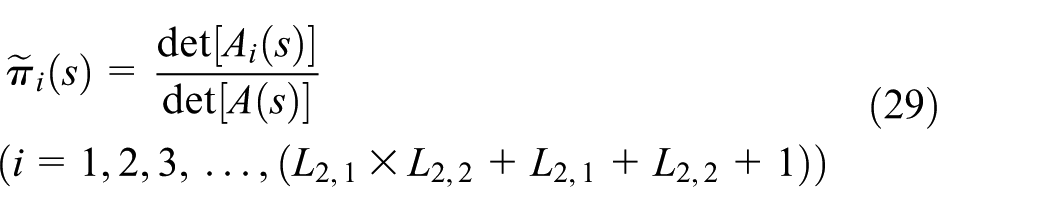
where

where


Upon taking the inverse Laplace transform of equation (30), the probabilities of the system states at any time
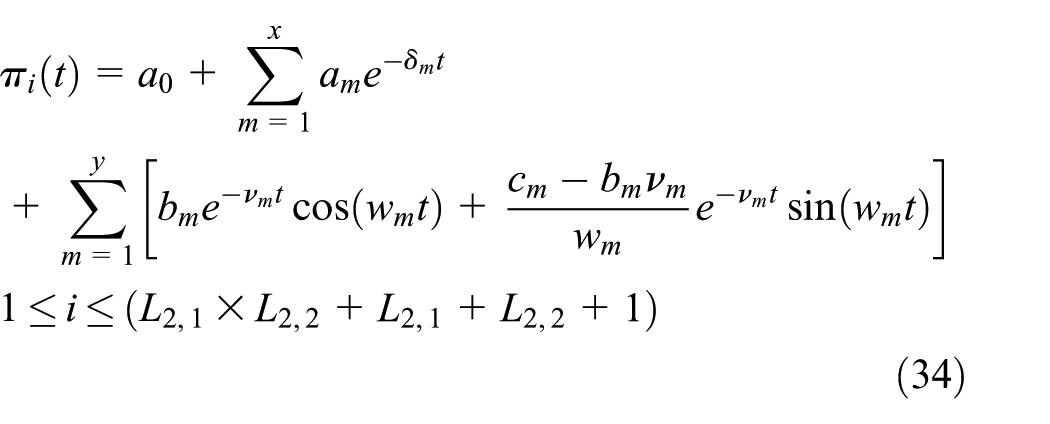
where
Let

The expected number of level

and the expected number of level

We can use Little’s formula to calculate the average delays for level
Channel 3 system
All three queues for messages of different levels on channel

Finally, level

Because all three queues are infinite, we can refer to Gross and Harris
27
to find that in the case of

where


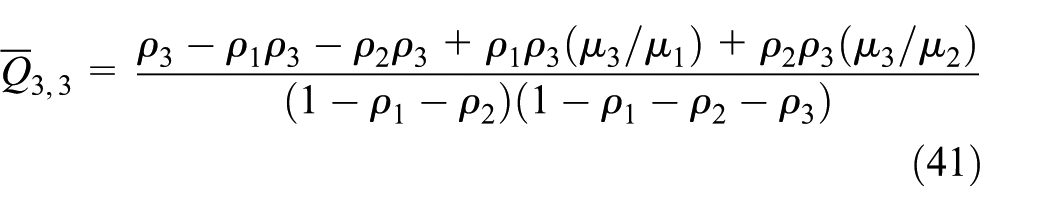
where
Using the average queue lengths and arrival rates given above, we can obtain the average delays for messages of the different levels in the channel
Performance analysis
The validity of the PTFQM can be best evaluated in terms of performance indices. Various indices, namely, average queue length, average delay, PLR, and throughput, can be used to judge the efficiency of the PTFQM. Some of these performance measures are as follows:
1. Average queue length
The average queue lengths in the different channel systems are elaborated in the previous sections and need not be reproduced here.
2. Average delay
The average delay for messages at level
Average delay for level

Average delay for level

Average delay for level

3. PLR
In the three-priority PTFQM system, packet loss occurs only for level

For an
Performance evaluation
In this section, we present numerical and analog simulations of the PTFQM. Both the numerical experiments and the simulation model were implemented using MATLAB to verify the proposed computational approach. Moreover, a comparison between the PTFQM, the non-preemptive queuing model (NP model), and the DiffServ model is presented to demonstrate the applicability and dependability of the PTFQM for a WMSN in the smart grid communication environment. By adjusting various parameters in the PTFQM system, we can learn how these parameters affect the performance of the system.
Verification of the numerical simulation
The default parameter values used to verify the numerical simulation of the system are provided below:
Figure 4 depicts the average delay for level

Comparison between the results of numerical and analog simulations.
Performance comparison with the NP model and the DiffServ model
Traditional queuing models, such as the NP model, use independent channels for messages of different priorities; each channel carries messages only of the corresponding priority, and when the number of messages surpasses the queue length of the corresponding channel, any further packets will be discarded. Meanwhile, in the DiffServ model, as described in Ward et al., 20 messages of any priority are served only if there are no messages of higher priority in the system, and the messages that are currently receiving service occupy all resources in the system; in other words, the system is a multi-priority single-server system, in which the messages of highest priority are serviced first and the FCFS principle is obeyed for messages at the same level. Figure 5 shows the results of a performance comparison between the PTFQM, the NP model, and the DiffServ model. The default parameter values in the PTFQM and the NP model are provided below:
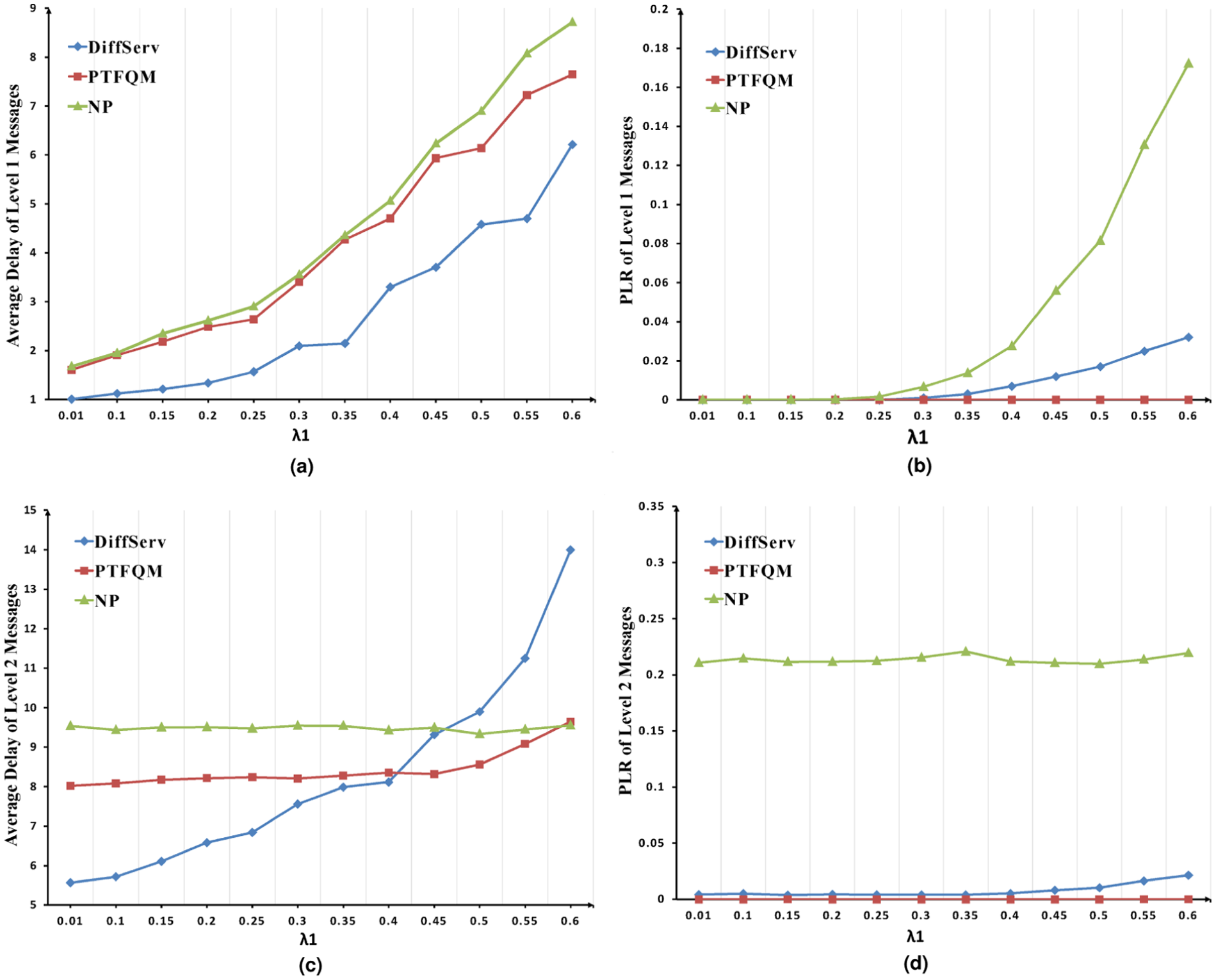
Performance comparison between the PTFQM and the NP model (Part I): (a) influence of
The parameters of the DiffServ model are different with regard to channel resources and service rates:
Figure 5(a) depicts the average delay for level
Figure 5(b) presents the comparison between the PTFQM, the NP model, and the DiffServ model in terms of the
Figure 5(c) depicts the average delay for level
Figure 5(d) shows the
Figure 6(a) presents the average delay for level
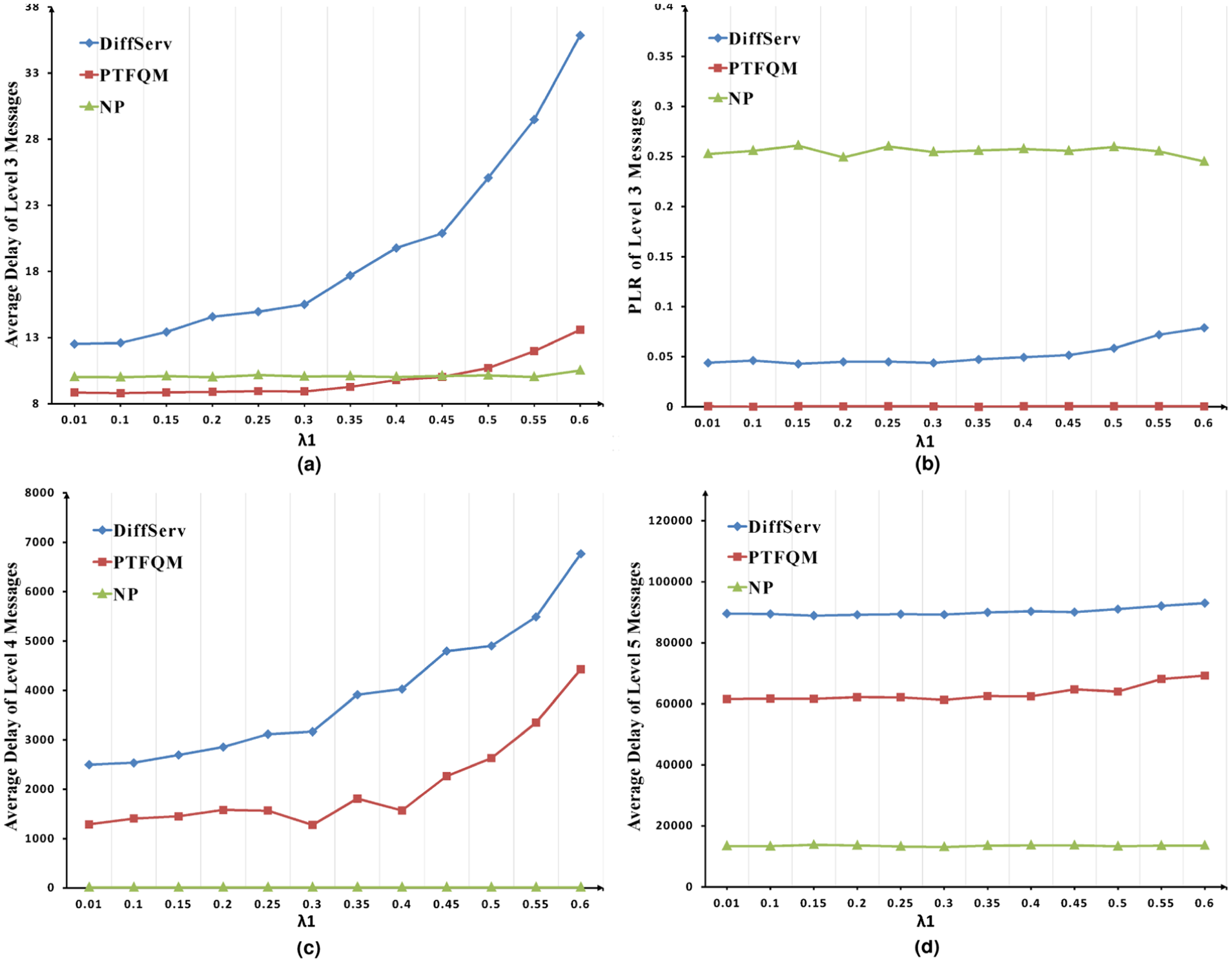
Performance comparison between the PTFQM and the NP model (Part II): (a) influence of
Figure 6(b) depicts the
Figure 6(c) shows the average delay for level
Figure 6(d) shows the average delay for level
These comparisons between the PTFQM, the NP model, and the DiffServ model show that the performance of the PTFQM in terms of the average delay and
Influence of parameters
Many parameters in the PTFQM can affect the performance of the system as a whole. Here, we analyze the influence of the queue length for level
To analyze the influence of
From Figure 7(a), we can see that the overall trends of
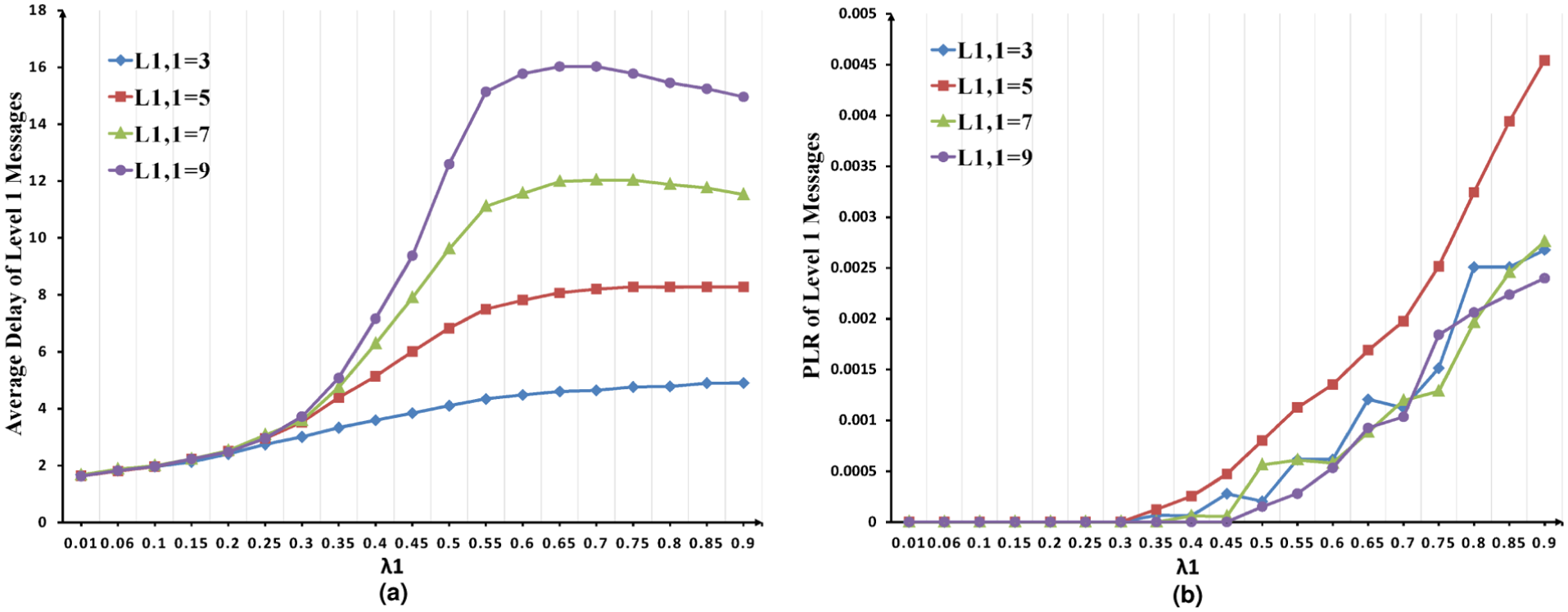
Influence of the parameter
Figure 7(b) shows that the effect of
With respect to the influence of
Average delays for various

Conclusion
In this article, we introduced the PTFQM, a new QoS-aware and hybrid-priority-based queuing model for the challenging wireless communication environment of the WMSN in smart grid. The proposed model can process multiple levels of information in accordance with their priorities, supplying superior service for messages of high priority while ensuring a certain degree of fairness for messages of low priority. To assign the appropriate priorities to the enormous amounts of data that are exchanged in the smart grid environment, we proposed an innovative prioritization mechanism, which serves as the foundation of the PTFQM. Using this prioritization mechanism, we can divide the data into subdivided QoS levels to obtain a prioritization scheme that is better adapted to the smart grid environment. The results of formula derivations and extensive simulations showed that the PTFQM outperforms the traditional NP model in providing high-priority data with superb service characterized by extremely low delays and high reliability, and in comparison with a typical DiffServ model, PTFQM can be dominant in reliability and the delays in the middle-low priorities. An implementation of the PTFQM in a MATLAB simulation showed that the performance requirements for a queuing model that is suitable for WMSN in the smart grid communication environment can easily be met and demonstrated the superior efficiency of our proposal over the traditional NP model and the typical DiffServ model. With the tuning of the value of
In future work, by establishing buffer lanes in various channels, we will strive to further enhance the performance for high-priority data, by the mean time ensure the performance for low-priority data, thereby enhancing the fairness of the system without excessively impacting the performance for high-priority data. The QoS support performance may also be improved by utilizing additional decision parameters for packet prioritization, such as remaining energy or buffer load. Although the PTFQM is designed for the smart grid environment, the concept of tidal flow lanes can also be adapted to other WMSN scenarios to build more suitable QoS frameworks for satisfying multi-priority performance requirements in various areas of communication.
Footnotes
Academic Editor: Miltiadis Lytras
Declaration of conflicting interests
The author(s) declared no potential conflicts of interest with respect to the research, authorship, and/or publication of this article.
Funding
The author(s) disclosed receipt of the following financial support for the research, authorship, and/or publication of this article: This paper was supported by the Director Funds of Laboratory of Network System Architecture and Convergence (2017BKLNSAC-ZJ-06).