




Abstract
With the widespread application of wireless multimedia sensor networks, the issue of network reliability has attracted more and more attention. In this article, a new reliability evaluation method of wireless multimedia sensor network is proposed. The failure is regarded as a percolation process, and the percolation threshold is taken as the failure indicator in this method. Accordingly, instantaneous availability model of wireless multimedia sensor network is established combining percolation theory and Markov process on the basis of reliability characteristics analysis. By Laplace transformation, the analytic solution is worked out, and one numerical example is given to verify the model comparing with existing studies. Finally, numerical simulation analyses are used to show the impact of different parameters on instantaneous availability, and the ways to suppress fluctuations are obtained by comparing with fluctuation images.
Keywords
Introduction
In the past few decades, the Internet of things (IoT) plays an increasingly important role in changing peoples’ lifestyles and promoting the development of information technology.1,2 Compared with the traditional wireless sensor networks (WSNs), wireless multimedia sensor networks (WMSNs) have stronger capability of picking up information in IoT with the characteristics of rich sources of information, 3 flexible network structure, 4 and fusion of heterogeneous data,5,6 which has been widely applied in key infrastructure areas such as intelligent transportation, 7 smart grid, 8 telehealth, 9 and automated factory. 10 WMSN is a typically distributed complex network system containing multimedia sensor nodes and control center which can be abstracted into a network graph composed of nodes and edges. 11 In practice, the reliability of WMSN cannot be ignored because of the deep integration and real-time interaction between information space and physical space, which is considered as complex coupling. On one hand, the sensor nodes operate in a complex environment, affected by various external interferences and own failures all the time. On the other hand, WMSN is vulnerable to malicious attacks owing to its security and operation risks and may cause large-scale cascading failure. Cascading failure refers to the local minor failures that occur in the WMSN, which may lead to a Domino cascading reaction and spread to the entire system in a short time by means of complex functions and coupling relationships within the network, ultimately resulting in catastrophic consequences. Therefore, the reliability evaluation and prediction of WMSN are of great significance for the recognition of system failure and improving the quality of system service.
Due to the complex and dynamic characteristic of WMSN, traditional reliability research methods such as fault tree analysis (FTA) and reliability block diagram (RBD) find it difficult to identify its failure mechanism. 12 In recent years, we are delighted to see system reliability research based on complex network theory which has broken through the traditional reliability research methods and application fields.13–15 In other words, cascading failure, percolation, and other complex network theories are also applicable to the reliability research of WMSN from the perspective of the system, which is no longer limited to the framework of classical physics and statistical physics. However, some network indicators such as degree, betweenness, and cluster coefficient merely reflect the nature of the complex network itself, but users’ requirements and failure factors are neglected, which do not accord with the objective of the failure-centered reliability research. 16 Accordingly, the deep integration modeling of complex network theory and reliability indicator is the key to research the reliability of WMSN.
There are many factors affecting the reliability of WMSN, which need to be analyzed by a comprehensive indicator. Instantaneous availability (IA) represents the probability that the system can be available at any time during the system operation, which is an important reliability indicator to characterize the dynamic and complex process of complex system. WMSN is a complex network system and its dynamic characteristics of reliability can be described by IA. According to percolation theory, with the increasing number of failure nodes/edges in operation, the system will transfer from normal state to failure state. 17 Thus, we can know how many failed nodes/edges can break down the entire WMSN system.
In this article, we propose a new reliability evaluation method of WMSN. First, we apply the percolation theory to define the IA of WMSN. Then, we establish the IA model with Markov renewal process, obtain the analytic expression of IA by Laplace transform, and analyze the numerical simulation results. The remainder of the article is organized as follows. In section “Preliminary,” we give the preliminary of system IA. In section “Reliability characteristics analysis of WMSN,” we analyze the reliability characteristics of WMSN. The IA model of WMSN is established, solved, and verified in section “IA model of WMSN based on percolation theory.” In section “Numerical simulation analyses,” some numerical examples and figures are given, and fluctuations of IA with different parameters are analyzed.
Preliminary
In this section, we will introduce some basic knowledge of reliability math, preparing for the establishment of a reliability evaluation model of WMSN afterward.
First, the definitions about system failure are introduced to describe the failure process of WMSN.
Definition 1
A random variable

Definition 2
Assuming that

On the contrary, reliability indicates the probability that the system completes the specified function in time domain

Definition 3
Assuming that the system is working normally at time t, the conditional probability of a failure in the subsequent unit time is called the failure rate, which describes the law of system faults changing with time 20

Definition 4
For a repairable system with only working and failure states, if

The IA of system at time t is defined as the probability of the system in working state, which can be expressed as follows

Then, we need introduce the concept of fluctuation to analyze the IA.
Definition 5
A continuous function
Taking
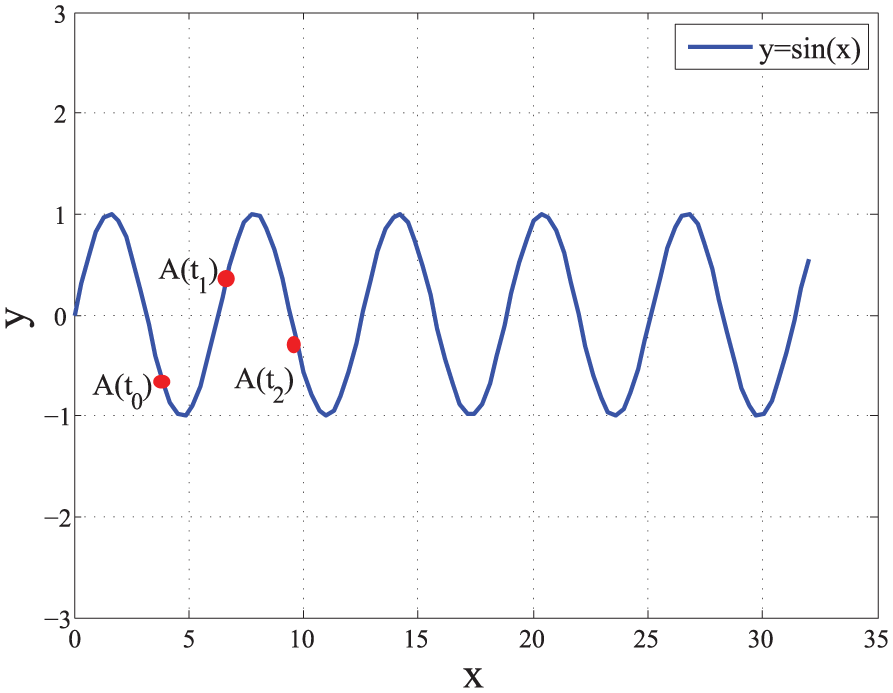
Fluctuation function.
With the above definition, we can get the following lemmas.
Lemma 1
The relationship between failure rate


Lemma 2
Steady-state availability (SA) can be expressed as follows

where parameters as
Lemma 3
A continuous function
Reliability characteristics analysis of WMSN
The WMSN consists of multimedia sensor nodes, sink nodes, wireless communication links, the Internet, and information-processing terminals, as shown in Figure 2. The wireless communication network is self-organized through random or predefined deployment of sensor nodes in the monitoring area. The multimedia information obtained by the sensor nodes is transmitted to the sink node through the wireless communication link, and the sink node sends them to the information-processing terminal through the Internet after preprocessing. Thus, WMSN has the following features:
Self-organization. Nodes in WMSN are automatically organized into a network through the coordination of distributed algorithms. It is required that the sensor node itself must have self-organizing, automatic configuration, and management ability, and the wireless network system formed by the automatic formation of topology control mechanism, network protocol, and transmission of perceived information.
Dynamic. Some uncertain factors such as node failure and communication failure impel the WMSN to be a dynamic network that can adjust and change the network topology at any time.
Data centered. The main concern of WMSN is sensing data of the monitoring area, without paying attention to the observation information of a specific node. This is the difference from other networks.

The structural framework of WMSN.
Failure characteristics
According to the architecture and functions, the failure of WMSN can be divided into sensor node failure, sink node failure, and communication failure.
Sensor node failure
The sensor node failure means that the node is unable to communicate with other nodes in the network, which is mainly caused by the factors such as the node damage, the node layout, and the lack of power supply. Among them, node damage is the most serious failure mode, which can be divided into four types: energy supply module failure, sensor module failure, processor module failure, and wireless communication module failure. In addition, the long-distance communication between nodes or the strong skin effect due to obstacles and topography will also affect the information transmission.
Sink node failure
Sink node is a sensor node with enhanced function. It is responsible for publishing the monitoring task of head cluster node for cluster structure network. If it fails, other routing optional nodes within all jurisdictions are incapable of achieving normal data access. In a strong electromagnetic interference environment, the sink node and satellite connection strongly fluctuate or even fail to connect.
Communication failure
Connection failure—the sensor nodes that cover the monitoring area cannot be connected normally, including the direct connection of the adjacent nodes and the indirect connection of the non-adjacent nodes with multiple hops, which leads to the communication failure in the target area.
Network congestion—network congestion is a direct manifestation of information overload, which leads to network delay, packet loss, and even the collapse of the entire network.
Malicious attack—WMSN is full in the physical space; the invaders can read the secret information of the node and even rewrite the memory, causing the node losing the presupposition function.
Percolation characteristics
Percolation is an important concept in statistical physics and theory of probability, as well as the most basic and important model in the study of the network dynamics evolution, indicating that the connection between the elements in variety of chaotic system reaches a certain threshold, leading to the sudden emergence of macroscopic properties.23,24 To establish a random network (ER) model

Random network diagram.
In a complex network, a branch that contains the most connected nodes is called the largest cluster,
25
whose size is indicated as G, while SG represents the second largest cluster. In Figure 3, G is the cluster consisting of the red nodes, and SG is the cluster consisting of the blue nodes. In the process of generation of random network, there are only small isolated clusters before the phase transition which can be expressed as
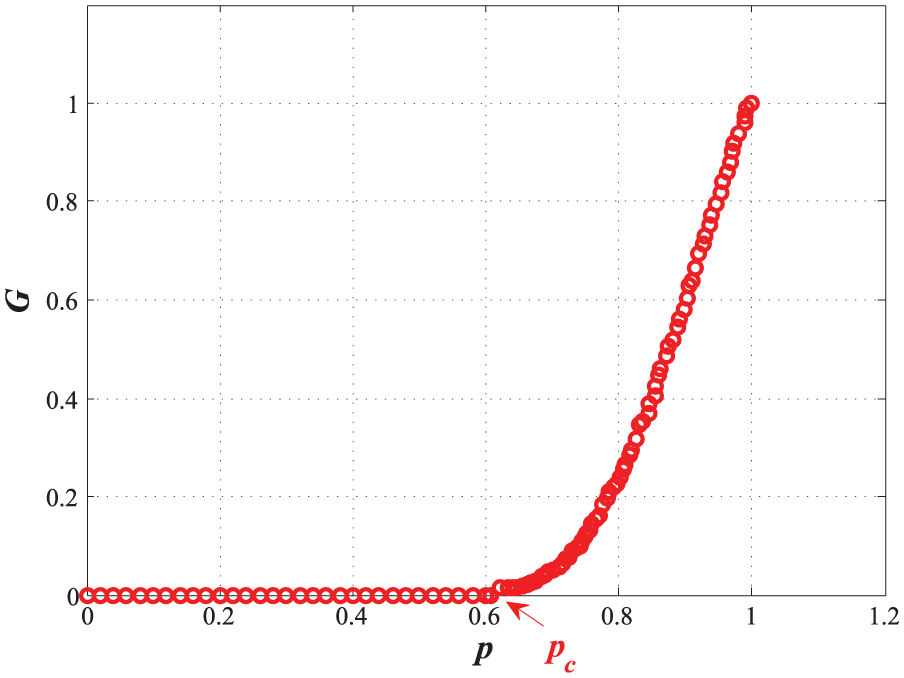
The change trend diagram of the largest cluster G with the percolation proportion p.
The failure process of WMSN is similar to percolation process. According to the relevant research works on the reliability of network connectivity,27,28 the failure of some nodes/edges is sufficient to cause the entire network to collapse. As a result, the percolation theory is also applicable to the macroscopic aspect of the network failure process. In this article, we combine the percolation theory and Markov process to research the reliability of WMSN, and the phase transition threshold is regarded as the main indicator of WMSN failure which can be obtained by numerical calculation. This method does not focus on the network node, edge, paths, and other details, which effectively avoids network problem of state space explosion and algorithm complexity caused by microscopic reliability research methods.
Furthermore, percolation theory is applied to describe the WMSN failure process which can be regarded as a typical phase transition process, assuming that at the beginning of the system operation all nodes are in working state. With the continuous operation of the system, some nodes/edges will fail, and some failure nodes will be repaired under the condition of repairable system. When the failure rate is greater than the repair rate, the WMSN will evolve to the fault direction and gradually be close to the critical threshold of phase transition, resulting in the collapse of the whole system eventually.29,30 The failure process above provides the direction for the modeling of reliability evaluation, which is described in the next section.
IA model of WMSN based on percolation theory
Model description
The system is composed of n nodes and l edges, assuming that percolation critical threshold is
After the system enters into the failure state, the remaining m − 1 nodes stop working and no more failures occur.
The IA of the system is defined as the probability that the system is in normal state at the time of t, that is, the probability of

The life distribution of each node is assumed to be exponential distribution. Its distribution function is

Then, the probability density function of node life distribution is

where
In network system, since the number of branches connected to each node is different, the failure rate and repair rate of one node are not the same as the others, which can be described by the relationship between node degree and failure rate as well as repair rate. Node degree k refers to the number of edges associated with the node, also known as correlation degree. Considering the node degree has great impact on failure rate and repair rate, we define the failure rate

where
It is assumed that each node is independent of each other.
Model analysis
WMSN is a typical centralized–distributed network system containing self-organized sensor nodes. Similar to other distributed systems, component failures in sensor nodes will cause the collapse of nodes and even the whole system, which requires each node to be responsible for maintaining the running state information of its components (work or failure state), which is the basic problem of the reliability model analysis of distributed systems. Consequently, the system state, sensor node state, and state transition process of the WMSN IA model will be analyzed below.
System state
The state of the system is represented by the number of failure nodes;

The system state of q failure nodes has

Node state
We use 0 and 1 to represent the failure and working state, and the state of the system can be described as the state of each node: 1011 … 1 indicates that the system has one failure node and the failure occurs on the second node, that is,
State transition
Let

State transition of network system diagram.
We assume that

It can be expressed as vector
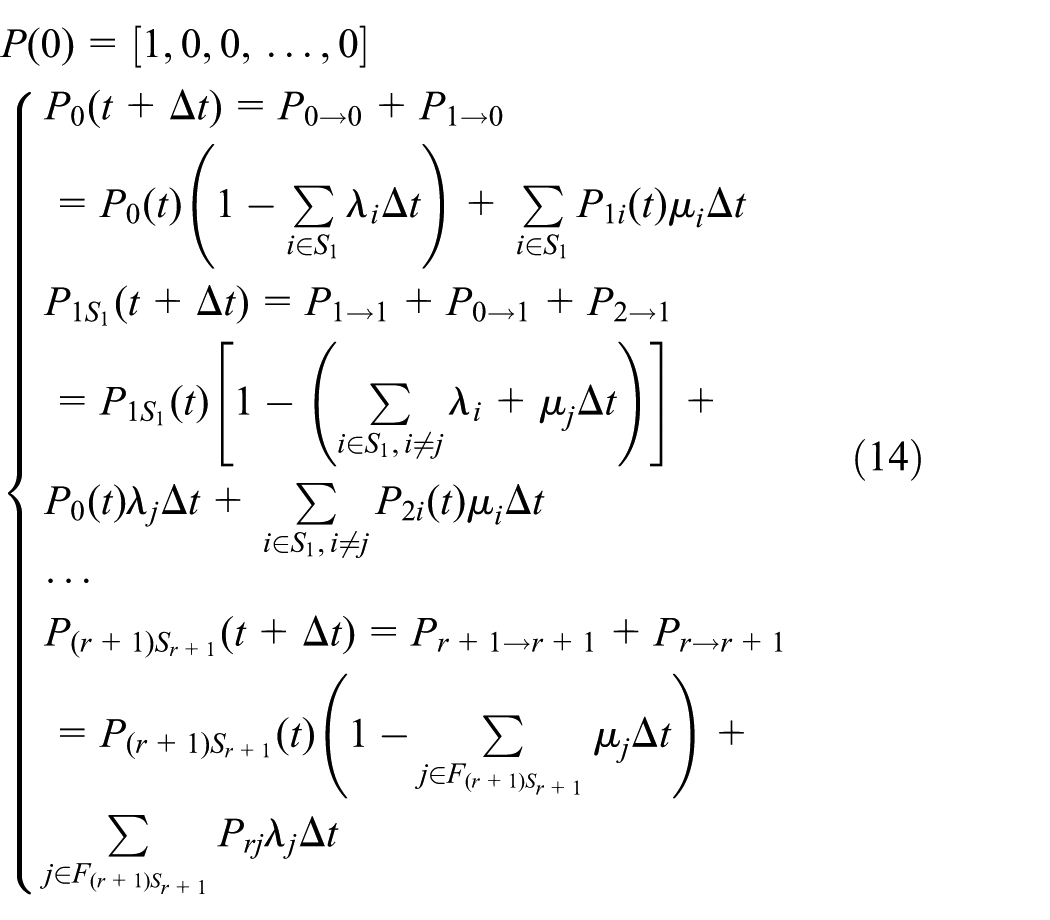
Similarly,

where
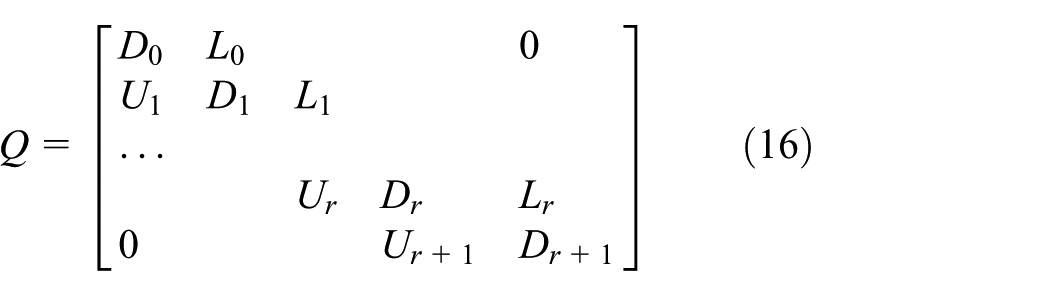
where


Model solution
In this section, IA model of WMSN based on percolation theory will be solved. The probability of WMSN in failure state at the time of t is

Since
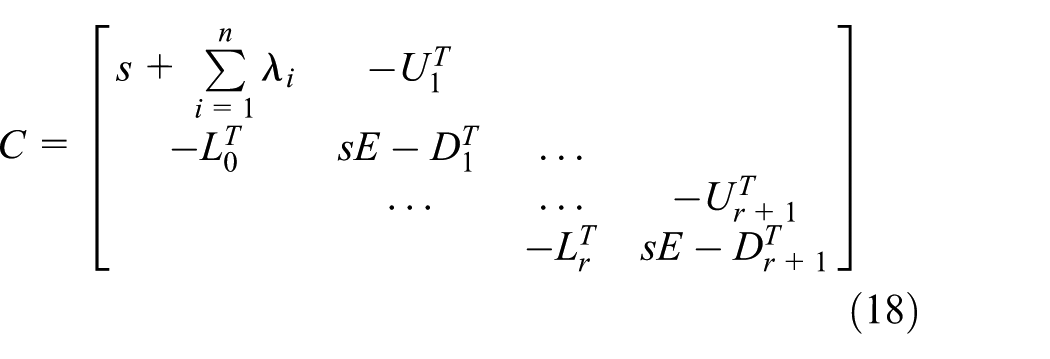
where

According to Cramer’s rule

where W is the determinant of matrix C, and
The probability of the system in failure state is expressed as follows

where
The IA WMSN is

Model verification
Assuming that the number of nodes of the example system is 2
State 0: node 1 and node 2 are in normal working state;
State 1: one node failed, and the other node is still working;
State 2: both nodes are all in failure state.
According to the definition of the system state in section “Reliability characteristics analysis of WMSN,” state 0 and state 1 are working states, and state 2 is the failure state. At the same time, state 1 also has two sub-states:
Node 1: working state, node 2: failure state;
Node 1: failure state, node 2: working state.
Then, we get the state transition diagram of the system (as shown in Figure 6) and the state transition matrix can be obtained

where

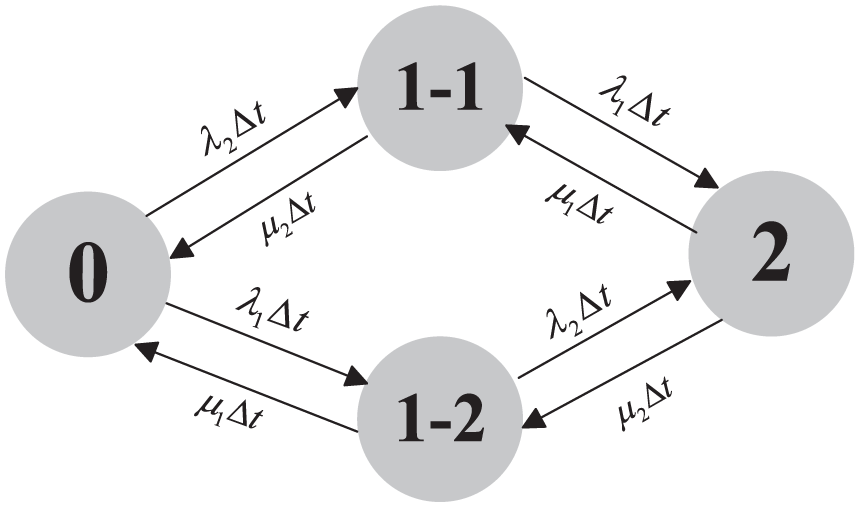
Example system state transition diagram (
We fix the failure rate and repair rate of node 1 and node 2 as follows

Through the solution, we get the IA and SA as shown in Figure 7, where the blue curve indicates IA and the red curve indicates SA. It can be seen that the initial availability of the network system drops sharply to the lowest level in the system life cycle, and the system reaches a steady state after a short period of time, where value of SA is 0.763. It is verified that the results of our model are consistent with the results of Cao and Cheng. 31 So the validity of the model is proved.
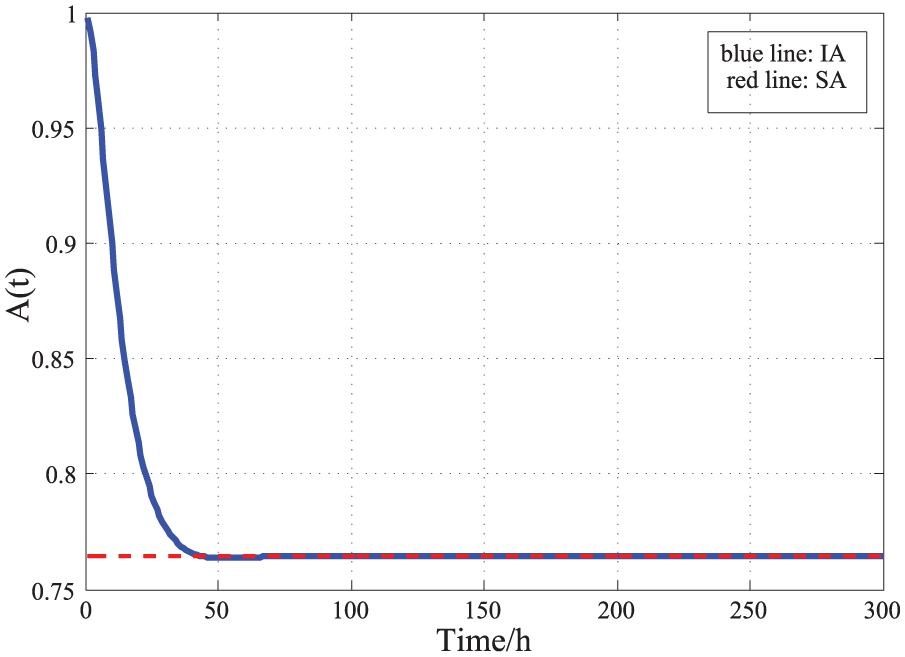
IA and SA of example system (
Numerical simulation analyses
In order to demonstrate the influencing factors and variation of IA, numerical simulation is applied in this section, generating the random network with 100 nodes
Sensor nodes with the same degree
The relationship between three influence coefficients
Figure 8 shows the contrast curve of IA when the percolation threshold

The curve of IA with the variable
The curve of IA with different values of

The curve of IA with the variable

The curve of IA with the variable
What is more, in the case that every sensor node has the same degree, the IA of the system has no fluctuation. This conclusion is consistent with one-unit and two-state system. 32
Sensor nodes with different degrees
The degree of each sensor node is generally different for the reason that WMSN is self-organized through random or predefined deployment in application. So, numerical simulations and analyses are performed for sensor nodes with different degrees.
Figure 11 shows the contrast curve of IA with the same and different degrees. The red line (Case 1) indicates different degrees of sensor nodes, and the green line (Case 2) shows the same degree where the degree of each node is replaced by the average in Case 1. Owing to the same values of

The contrast curve of IA with the same and different degrees.
In order to suppress the IA fluctuation at the initial stage of the system, we made several attempts. We found that reducing the complexity of the nodes arrangement and improving the repair rate of the failure nodes have obvious effect, as shown in Figure 12. Therefore, we must consider the influence of the complexity of node arrangement on the reliability of in the system design stage to improve the reliability level of WMSN. Second, it is necessary to replace or repair the failure nodes in time to prevent cascading failures of normal nodes because of the increasing data load. Furthermore, the change of percolation threshold

The contrast curve of IA fluctuation suppression.
Conclusion
In this article, the IA model of WMSN based on percolation theory has been established, which can be applied to evaluate the reliability of WMSN. The other contribution of this article is that the impact of some key parameters on IA of WMSN has been analyzed by numerical simulations and fluctuation of IA has been found. It can be concluded that the main influence factors of IA include percolation threshold and the influence coefficient of degree failure rate and degree repair rate. In the case of sensor nodes with different degrees, the fluctuation of IA is found and some measures are taken to suppress, including reducing the complexity of the nodes arrangement and improving the repair rate of the failure nodes, which can provide reference for the design and operation of network system.
However, as preliminary study on reliability of WMSN, there still exist plenty of problems in this article. The model has limitations on large-scale system. When the number of nodes is large, it is difficult to solve the IA due to the explosion of state space. On the other hand, the cascading failure of network and the non-exponential distribution of node lifetime have not been studied. In the future, the reliability research of WMSN will be carried out based on these problems above in order to make the evaluation results more accurate and comprehensive.
Footnotes
Handling Editor: Songhua Xu
Declaration of conflicting interests
The author(s) declared no potential conflicts of interest with respect to the research, authorship, and/or publication of this article.
Funding
The author(s) disclosed receipt of the following financial support for the research, authorship, and/or publication of this article: This work is supported by National Natural Science Foundation (NNSF) of China under grants 61573041, 61573043, and 71671009.
