




Abstract
Conflict management is a hot research topic in Dempster–Shafer theory which is used to avoid the counterintuition problem of combination results. In the present conflict management methods, conflicting evidence is assigned to smaller weight to reduce its influence on the combination result. However, these methods will be disabled when similarity collision occurs. In this article, a new conflict management method based on similarity and Basic Probability Assignment-Matrix is proposed; in the proposed method, similarity collision is diminished by computing the index of each element in evidence, and then, a more reasonable evidence weight can be determined in this way. In the end, two experiments are set to compare the results of several different methods, and the results illustrate that the conflicting evidence will be assigned to a smaller weight in our method than in others.
Keywords
Introduction
Dempster–Shafer (D-S) theory 1 is an effective tool to make a decision from several answers with ambiguity. To each answer, the probability that it must be true is denoted as Bel and the probability that it cannot be false is denoted as Pl. Bel is also marked as BPA (basic probability assignment) or mass function m. All the BPAs of a same question will constitute a D-S evidence. A set of evidence can be combined into a new piece of evidence by combination rules, and the largest BPA in the combination result represents the decision. Traditionally, the biggest BPA in BOE (Body of Evidence) is the answer supported by the evidence. Based on the attributes above, evidence theory is widely applied in reliable analysis,2–5 relationship computing, 6 making decision,7–10 and optimal problems.11–13
However, the evidence we gathered may be not accurate and even the answer supported by each evidence may be different. 14 This phenomenon is the conflict of evidence,15,16 and the defects of combining conflicting evidence directly mainly lies on: 17
Combination a set of conflicting evidence may assign 100% probability to a BPA which is counterintuitive.
The combination result may be totally wrong due to a highly conflicting evidence.
The BPA equal to zero will always be zero in combination whatever the other BOES.
To overcome the defects above, many scholars proposed their conflict management methods to control the influence of conflict evidence by assigning weight to each evidence. Based on evidence similarity values, weight of each evidence is determined. Wen et al. 18 proposed a similarity calculation method based on computing the cosine value between evidence. Zhao et al. 6 proposed another conflict management method based on computing the intersection part of evidence. In addition, similarity of evidence can be obtained by computing the distance of evidence.
Cuzzlion 19 explained the meaning of evidence distance in geometric view which stands for the process that transforms the difference between evidence into the distance of points in geometric space. Jousselme et al. 20 proposed an evidence distance calculation method based on the difference of BOEs and the number of elements in BPA. Sunberg and Rogers 21 modified Jousselme’s distance by comparing the difference of the biggest and the smallest BPA in evidence.
Based on similarity of evidence, Deng et al. 22 proposed a conflict management method by transferring similarity values into the weight of evidence. Wang et al. 23 modified Murphy’s combination rule by computing evidence distance. Chin and Fu 24 proposed another conflict management method based on evidence distance and mass function. Su et al. 25 proposed a combination method for determining dependent evidence based on conflict management. Jiang et al. 26 proposed a fault diagnosis method based on managing conflicting evidence. Yang and Han 27 proposed an uncertainty measure method based on conflict management. Sankararaman and Mahadevan 28 proposed a validation measure method based on conflict management.
But similarity calculation methods used by many scholars are not as faultless as they believe. Similarity calculation is the key in conflict management, and the difference of BOEs should be represented by the difference of similarity values. However, the phenomenon that two different pairs of evidence share a same similarity value is easy to be found, and this phenomenon is the collision of similarity which is mainly caused by the BPA sequence in BOE is not computed, and the exchange of BPA sequence may not change the similarity calculation result.
In this article, a matrix named BPA-Matrix (Basic Probability Assignment-Matrix) that stands for BPA sequence in BOE is introduced. With the introduction of BPA-Matrix, collision of similarity is diminished and weight of evidence becomes more reasonable. The frame of this article is as follows: section “Introduction” introduces D-S theory and the necessity of conflict management. Section “Preliminaries” depicts some important definitions and equations used in conflict management method proposed in this article, and a brief example is given to illustrate the defects in existing conflict management. Section “The method proposed” illustrates the process of the proposed conflict management, and an example is given to illustrate the computing process of BPA-Matrix. Section “Experiments” is the experiment part, and the weight of each evidence determined by several conflict management methods is compared under two different sets of evidence.
Preliminaries
D-S evidence theory
Let Ω be a set containing several exclusive and exhaustive elements:

In the equation above, A, B, and C are single-element focal elements, and AB is multi-element focal element. m(A) or m(B) is BPA of A or B, and m(Ω) is the probability that all the focal elements are uncertain. All the BPAs will constitute a piece of D-S theory evidence which is marked as m. A set of evidence can be combined into a new piece of evidence by combination rule, and the combination rule proposed by Dempster is as follows


In equations (1) and (2), m is the combination result of m1 and m2. Equations (1) and (2) denote the combination rule when two pieces of evidence are combined, and equations (1) and (2) will be transferred into equations (3) and (4) when the number of evidence is larger than two


According to equations (1)–(4), combination rule proposed by Dempster meets the law of commutation and the law of association. 7 Even though evidence can be combined based on combination rule proposed by Dempster, the combination result may be counterintuitive. A brief example is given in the following section.
Example 1
Assuming m1 and m2 are two pieces of evidence under a same frame of discernment, and the BOEs of m1 and m2 are given as follows

From equation (2), C is obtained as follows:
And, focal elements in combination result can be obtained by equation (1)

The combination result of m1 and m2 is
Similarity of evidence
Similarity calculation
As described in section “Introduction,” the difference between evidence can be transferred into a value by similarity calculation. And, similarity calculation method proposed by Wen et al. 18 is defined in Definition 1.
Definition 1 (evidence similarity proposed by Wen et al.)
Assuming that m1 and m2 are two pieces of evidence under a same frame of discernment, the similarity value between m1 and m2 is as follows

Nonnegativity:
Nondegeneracy:
Symmetry:
Triangle:
Definition 2 (evidence distance proposed by Jousselme et al.)
Assuming that m1 and m2 are two pieces of evidence under a same frame of discernment, the distance between m1 and m2 is as follows


Collision of similarity
Similarity calculation is a key process in conflict management, but collision of similarity may occur in both the methods proposed by Jousselme et al. and Wen et al. A brief example is given in the following section.
Example 2 (similarity collision)
Assuming that m1, m2, and m3 are three pieces of evidence under a same frame of discernment, the BOE of each evidence is shown as follows

Based on equation (5), similarity value between m1 and m3 in Wen et al.’s method is as follows

And, similarity value between m2 and m3 in Wen et al.’s method is as follows

According to equation (6), the distance of m1 and m3 is as follows

From equation (7), similarity value between m1 and m3 based on distance is as follows

And, distance of m2 and m3 is as follows

And, similarity between m2 and m3 based on distance is as follows

According to similarity calculation results above, simwen(m1,m3) = simwen(m2,m3) and simJou(m1,m3) =simJou(m2,m3) but m1 ≠ m2. The difference between m2 and m3 lies on the exchange of A and C. Since BPA sequence in BOE is not computed in similarity calculation, the alternation of BPA sequence may not change the similarity calculation result. Similarity of evidence is the base of conflict management, and the collision of similarity may lead to the deviation of the weight assigned to evidence. Before introducing the conflict management method in this article, further steps in previous conflict management only based on similarity are shown in section “Conflict management only based on similarity.”
Conflict management only based on similarity
Definition 3 (support of evidence)
Assuming

Support of evidence can be obtained by equation (8), but the range of evidence support is not [0, 1]. Note that support of evidence is different with the focal element supported by a piece of evidence. To realize the weight determination of each evidence, a new parameter named evidence credit is defined in the following section.
Definition 4 (credit of evidence)
Assuming that

Evidence credit is the weight of evidence in traditional conflict management. Referring to Example 2, similarity of evidence may collide, and conflict management only based on similarity will be invalid. To overcome the shortage, conflict management based on similarity and a matrix named BPA-Matrix which depicts the BPA sequence in BOE is proposed.
The method proposed
According to Example 2, conflict management only based on similarity of evidence is not sufficient. And, BPA sequence needs to be computed in conflict management to diminish the collision of similarity. The frame of conflict management proposed in this article is shown in Figure 1.

Frame of the proposed conflict management method.
There are three mainly parts in our method: BPA-Factor calculation, evidence credit calculation, and the combination of them. In the beginning of BPA-Factor calculation part, BPA sequence in BOE is converted into a matrix named BPA-Matrix, and the difference of each BPA-Matrix is transferred into a BPA-Factor which is marked as F in the end of this part. Evidence credit calculation part acts as the traditional conflict management, and the evidence credit based on similarity is computed. In the last part, union support is defined as the fusion of BPA-Factor and evidence credit, and union credit realizes the determination of each evidence weight based on union support.
BPA-Factor calculation
Assuming that D1 and D2 are two matrixes, the equation D3 = D1 × D2 can be considered as the amplifier and exchange on columns of D1 or lines of D2. The evidence can be considered as a single line matrix D1, and the BOE with BPA sorted by the size of each BPA can be considered as another single line matrix D3. With D1 and D3 being settled, D2 can be obtained by Definition 5.
Definition 5 (BPA-Matrix of evidence)
BPA-Matrix is a matrix that BPA sequence can be sorted by multiplying it. BPA-Matrix is marked as BMatrix in this article. The dimension of BMatrix is
Set a new array R that contains all subsets of P(Ω), the array belongs to all evidence and it is generated only once;
Expand the BOE of m by setting BPA to 0 which exists in R, but not in m, and the expanded BOE is marked as v;
To each BPA in v, mark its index in R as iBPA, just as R[iBPA] = BPA;
A new array t is formed by sorting all BPAs in v from big to small and mark the index of each BPA in t as jBPA;
Create a matrix BMatrix with the dimension 2Ω × 2Ω. For each BPA in v, set
A brief example is given in the following section to illustrate the calculation process of BPA-Matrix.
Example 3 (BPA-Matrix calculation)
Assuming that m is a piece of evidence under the frame of discern Ω: {A,B,C}, and the BOE of m is as follows

First, we need to specify an array R that contains all subsets of Ω

Second, v is obtained by expanding m

To each BPA in v, mark its index in R as iBPA

A new array t can be obtained by sorting each BPA in v from big to small

Here, we get a new index jBPA of each BPA in t

To each BPA in v, set

BMatrix is the BPA-Matrix of to m. And, we can find BPAs in BOE can be sorted by multiplying the BPA-Matrix of it, just as the equation below

Each evidence is mapped into a BMatrix by Definition 5, and a new matrix AMatrix can be obtained as follows

n is the number of evidence, AMatrix is not only an overview of all BMatrix but also a standard in computing the difference of each BMatrix. The difference can be marked as MMatrix which is defined as follows

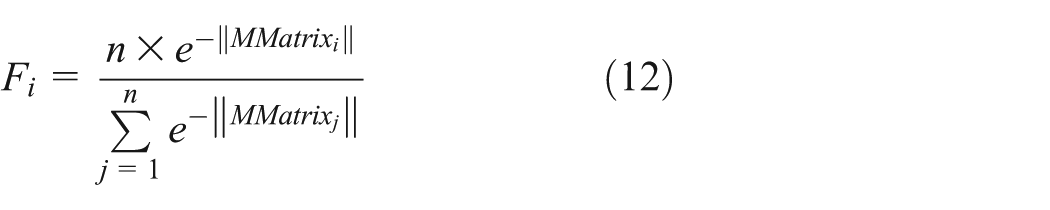
Each evidence is mapped into a BMatrix and a MMatrix. However, MMatrix is a matrix and it is inconvenient to be combined with other parameters. To overcome the shortage, BPA-Factor marked as F is introduced to realize the process that transforming MMatrix into a numerical value which is defined in the following section.
Definition 6 (BPA-Factor of evidence)
Assume that
Evidence credit calculation based on similarity
According to section “Similarity calculation,” similarity calculation of evidence is realized by two kinds of methods. The first kind is based on computing the difference between two pieces of evidence directly, and the second is based on evidence distance. The similarity calculation used in this article is the method based on evidence distance which is marked as
Based on equation (8), evidence support can be obtained as follows

With evidence support is obtained, evidence credit can be obtained based on equation (9)

Combining BPA-Factor and evidence credit
According to Example 2 in section “Preliminaries,” conflict management only based on similarity is not sufficient, and BPA-Matrix is introduced to diminish the collision of similarity. To realize the combination of BPA-Matrix calculation and similarity calculation, a new parameter named union support is introduced. The definition of union support is described in the following section.
Definition 7 (union support of evidence)
Assuming that

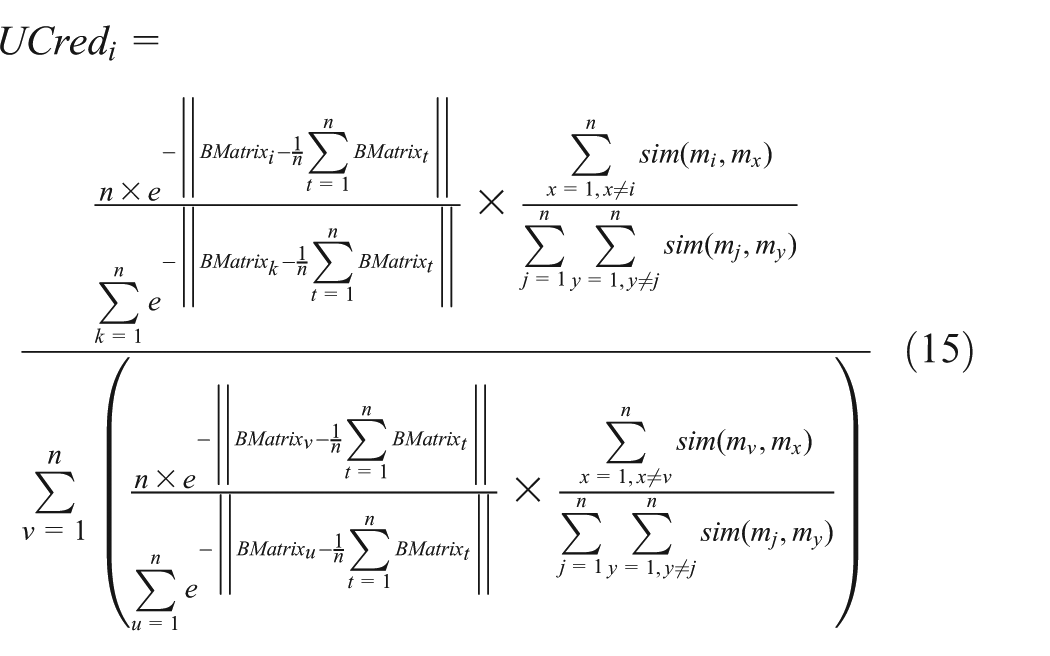
Note that the value range of union support is not [0, 1]. To realize the weight determination of each evidence, another process is needed to transform union support into a value with value range [0, 1]. The value is marked as union credit and is defined in the following section.
Definition 8 (union credit of evidence)
Assuming that

Union credit is the weight of evidence in conflict management. Compared with previous conflict management only based on similarity, conflict management in this article is sensitive to BPA sequence in BOE. The exchange of BPA sequence will lead to the alternation of union credit and similarity collision is diminished. In addition, equation (14) can be expressed as equation (15) using primary similarity and BPA-Matrix
Experiments
In this section, two experiments are given to compare the effect of the four representative methods for conflict management.
Experiment 1
Suggest that

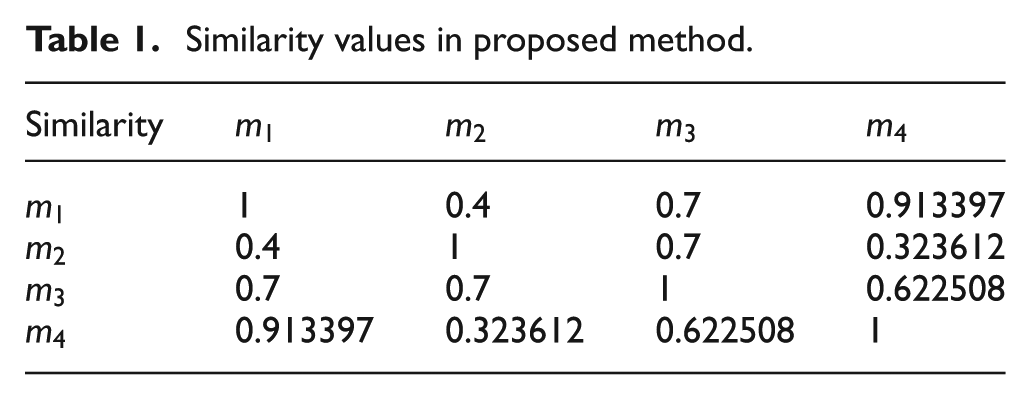
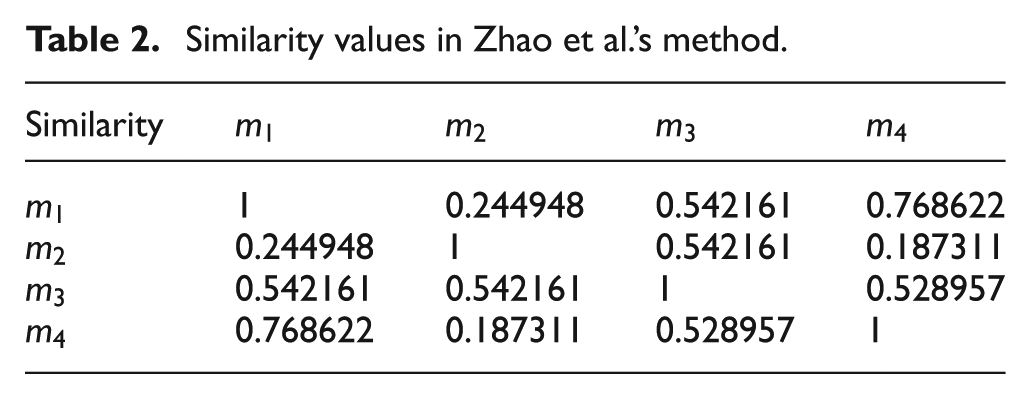
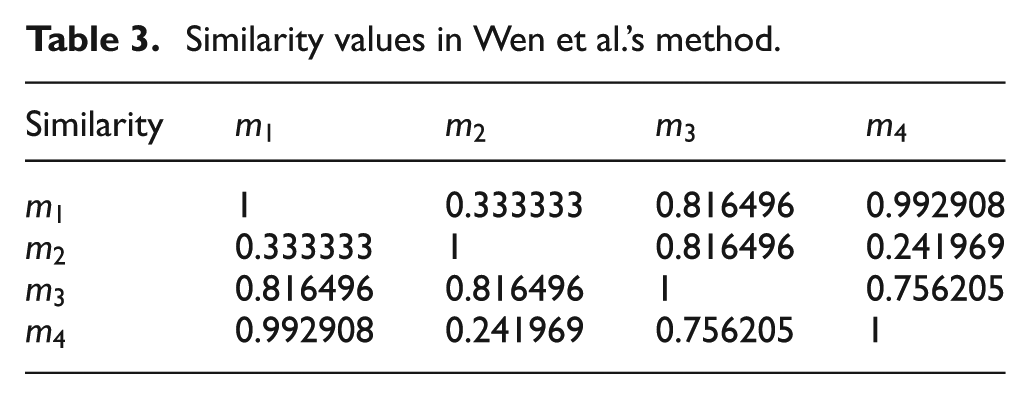
The first attribution to be compared is the similarity value in different methods which is shown below. From the similarity calculation results in Tables 1–3, it is obvious that the similarity values that m1 and m2 towards m3 are same; however, m1 is different from m2. This phenomenon is the collision of similarity. In our method, the collision can be detected by BPA-Matrix and represented as BPA-Factor in this article. The BPA-Factor of each evidence is shown in Figure 2.
Similarity values in proposed method.
Similarity values in Zhao et al.’s method.
Similarity values in Wen et al.’s method.

BPA-Factor of each evidence.
Based on similarity values and BPA-Factor above, evidence support or union support can be obtained and is shown in Table 4.
Comparison of evidence supports.

Support calculation of evidence is not the last step in conflict management, and evidence credit or union credit in this article can be obtained by evidence support. Evidence credit or union credit is shown in Table 5.
Comparison of evidence credits.

According to the tables above, the proportion of each evidence credit value in the sum of all the credit values is given in Figure 3, which is proportional to the weight of evidence in the final combination.

Comparison of proportion of evidence credit.
As m2 or m3 is conflicting evidence, the proportions of its credit values should be as small as possible. Oppositely, m1 or m4 should have larger credit proportion for it is not conflicting evidence. From the experiment result, it is obvious that the proportion of evidence credit value computed by our method is the most reasonable.
Experiment 2
Example 2 depicts a more general case that evidence is gathered from the real world, and the collision of similarity may occur or not. We gathered a set of evidence from five temperate sensors as m1, m2, m3, m4, and m5, and the BOE of each evidence is shown as follows

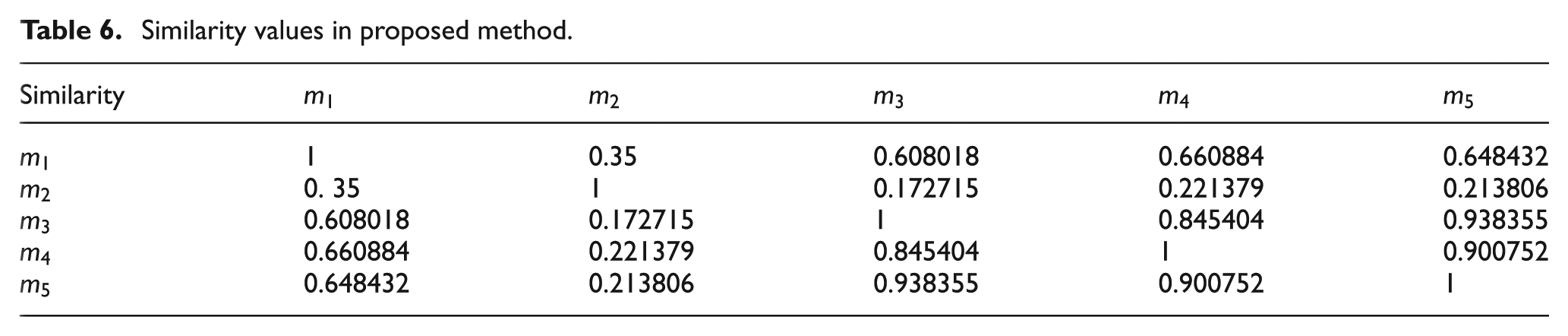
The similarity values of evidence are shown in Tables 6–8.
Similarity values in proposed method.
Similarity values in Zhao et al.’s method.

Similarity values in Wen et al.’s method.

According to three tables below collision of similarity does not occur. However, BPA sequences in BOEs are different, and the biggest focal element in each evidence may be different. This kind of difference can be represented by BPA-Factor F, and Figure 4 is the comparison of each BPA-Factor.

BPA-Factor of each evidence.
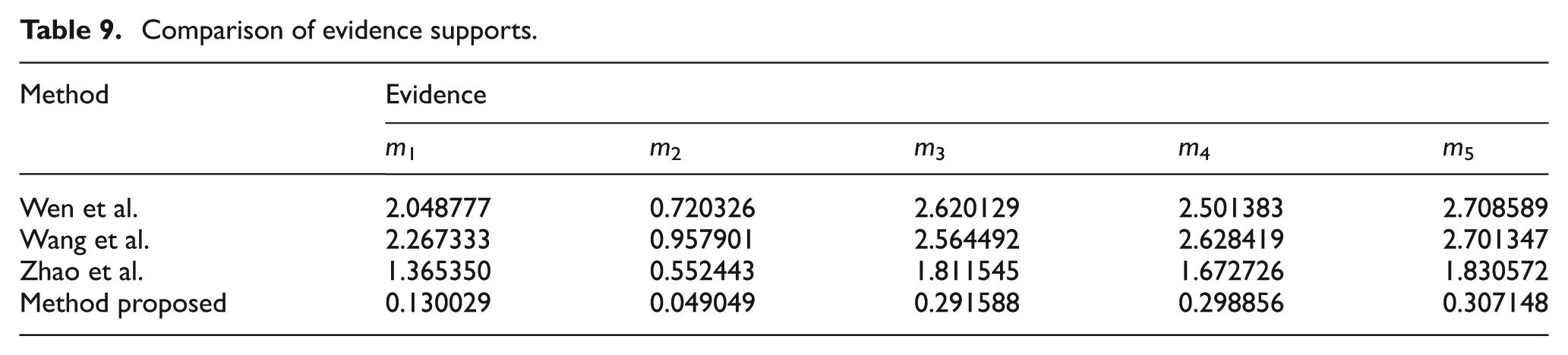
Referring to the giving evidence, we can find that m1 and m2 are conflicting evidence. BPA-Factor of them is smaller than that of m3, m4 and m5. Based on BPA-Factor and similarity, evidence support of each evidence in each method can be obtained and is shown in Table 9.
Comparison of evidence supports.
Based on evidence support, evidence credit can be obtained by Definition 4. And, the comparison of each evidence credit is shown in Table 10.
Comparison of evidence credits.

Based on the values in tables above, the proportion of each evidence credit is shown in Figure 5.
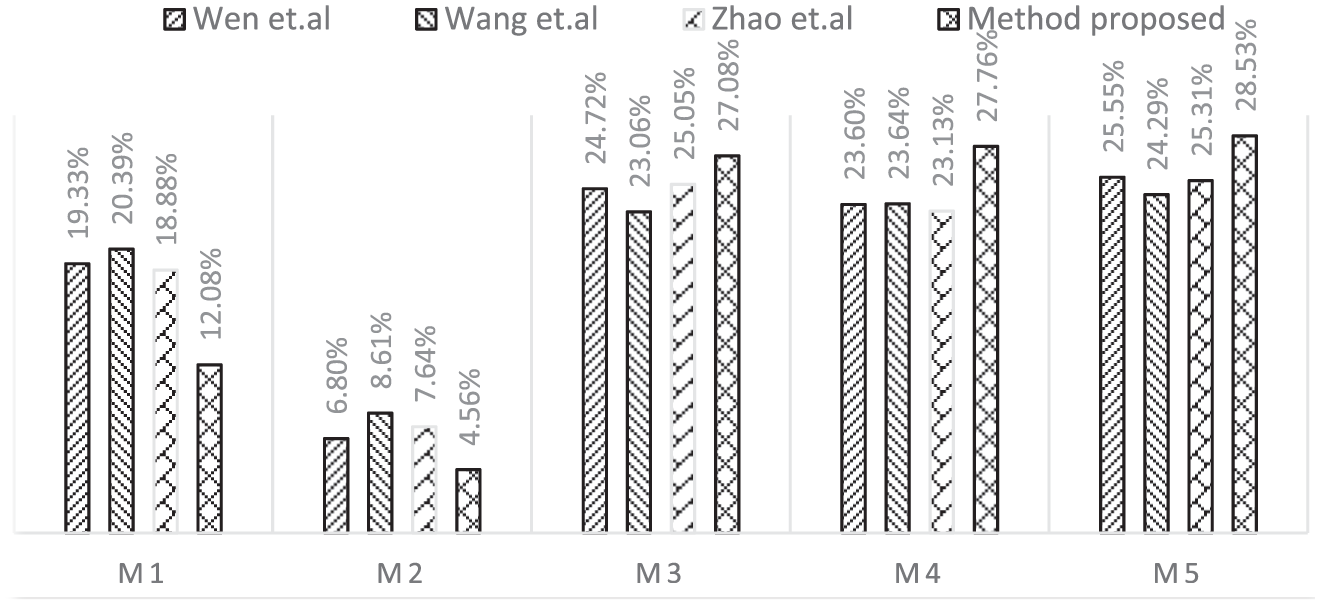
Comparison of proportion of evidence credit.
Within the giving evidence, m1 and m2 are conflicting evidence. The proportions of their credits are the smallest in our method. And, the proportions of m3, m4, m5 computed by our method are the largest. It is obvious that the proportion of evidence credit value computed by our method is the most reasonable.
Two experiments above describe two kinds of cases that similarity collision occurs or not. As BPA-Matrix is an extra step, there should be more time cost in our proposed scheme when compared with the methods only based on similarity. When the number of evidence is n, we need to compute similarity value for n2 times, but BPA-Matrix is computed only n times, that is, compared with the time cost of similarity calculation, the time cost of BPA-Matrix computing is tiny. As similarity calculation method used in conflict management method proposed by Wang et al. and this article is same, a comparison of time cost in processing same evidence scale on a same platform (CPU: i7 4710, GPU: GTX960, RAM: 16G, ROM: 250G SSD) is shown in Figure 6.

Time cost in two management methods.
From Figure 6, time costs by two methods are almost same when handling with same evidence. However, the weight determination by our conflict management method is more reasonable. Based on the comparisons above, it shows that our scheme is a better conflict management method for assigning more reasonable weight to evidence with very tiny performance loss.
Conclusion
In this article, a new conflict management method based on similarity and BPA-Matrix is proposed. Compared with the previous methods, similarity collision is diminished, and the weight determination is more reasonable. In more general cases, the weight determination by our method is more reasonable no matter whether similarity collision occurs or not. In the end, we compared the time cost of our scheme and the method of Wang et al. which is based on similarity. The experiment result shows that the time cost in the two methods is almost same; however, the proportion of evidence credit value in our scheme is more reasonable, which means that the determination of evidence weight is more reasonable. The determination of weights assigned to BPA-Matrix and similarity in conflicting management will be a new point in our future research.
Footnotes
Academic Editor: Nageswara SV Rao
Declaration of conflicting interests
The author(s) declared no potential conflicts of interest with respect to the research, authorship, and/or publication of this article.
Funding
The author(s) disclosed receipt of the following financial support for the research, authorship, and/or publication of this article: The work was sponsored by National Natural Science Foundation of China grant no. 61370220, Plan For Scientific Innovation Talent of Henan Province grant no. 174200510011, Program for Innovative Research Team (in Science and Technology) in University of Henan Province grant no. 15IRTSTHN010, Program for Henan Province Science and Technology grant no. 142102210425, Natural Science Foundation of Henan Province grant no. 162300410094, Project of the Cultivation Fund of Science and Technology Achievements of Henan University of Science and Technology grant no. 2015BZCG01.