




Abstract
There is ample agreement in the scientific literature, across diverse areas of study, that suggests that language and movement are interrelated. In particular, it is widely held that the upper limb and hand play a key role in language use. Aphasia, a common, disabling language disorder frequently associated with stroke, requires new restorative methods. A combinatorial hand-arm-language paradigm that capitalizes on shared neural networks may therefore prove beneficial for aphasia recovery in stroke patients and requires further exploration.
The Problem
Aphasia is a debilitating language disorder that often follows stroke. It can affect any or all aspects of linguistic expression and comprehension, whether verbal, written, or gestural. Despite a growing understanding of the phenomenology of aphasia, new treatment paradigms are needed that directly target the underlying impairment.
There are varying aphasia types and levels of severity, determined largely by the site and extent of stroke lesion as well as the degree of white matter integrity. 1 Herein, we will focus largely on the nonfluent or expressive poststroke aphasias, emphasizing how the affected anterior brain regions of the dominant hemisphere are interwoven with proximate cortical areas supporting upper limb and hand movement.
Speech therapy is beneficial for patients with aphasia; however, no single treatment has proven most advantageous. 2 Many patients with aphasia experience chronic language deficits. Promising strategies to reduce permanent language deficits, such as pharmacological agents 3 and noninvasive brain stimulation 4 alone or in combination with speech therapy, have yet to be tested in appropriately powered clinical trials. One exciting perspective that is emerging from these multidisciplinary studies is the potential interaction between motor and aphasia recovery.5,6 Increasingly, collateral effects on language production and comprehension have been reported as a result of the observation of movement. 7 Not coincidentally, given the close proximity of hand-arm and speech-language neural structures, in many patients with poststroke aphasia, the contralesional hand and arm are often simultaneously impaired. While the extent and limitations of hand-arm and speech-language cortical reciprocity remain under debate, it is likely that hand-arm movement and spoken language have at least a parallel, if not primary, relationship. 8 Nonetheless, stroke patients receiving speech-language therapy for aphasia are frequently seated during treatment, with hands and arms impassive.
The use of hand-arm movement and exercise (eg, reaching, grasping, lifting) has not been sufficiently explored for direct use in aphasia rehabilitation. Objects that may be named in aphasia treatment, however, may also be simultaneously grasped. Manual tasks may be accompanied by verbal language, as they often are during activities of daily living.
In this “Point-of-View” article, we provide an overview of data supporting hand-arm and language cortical reciprocity garnered from literature across multiple disciplines. Toward this aim, a PubMed search was conducted using multiple combinations of the terms “Limb,” “Arm,” “Gesture,” “Speech,” “Language” “Motor,” “Action Verbs” and “Aphasia,” yielding 652 articles. We excluded 384 articles due to their lack of relevance to our topic. For example, if the terms were combined incongruously or as part of a larger unrelated topic, these articles were excluded. A total of 268 applicable articles remained, reflecting an interest in the cortical and functional synergy between language and hand-arm or motor function across a wide range of disciplines. The largest number of articles (139) were specifically devoted to the relationship between motor function and the processing and/or production of action verbs (Figure 1). (Nonaction verbs would include those representing thoughts or emotions, such as “feel” or “think,” as opposed to action verbs such as “grab” or “lift.”) From the 268 identified articles, we included only original research articles that while not exhaustive, provide a representative overview of relevant literature.
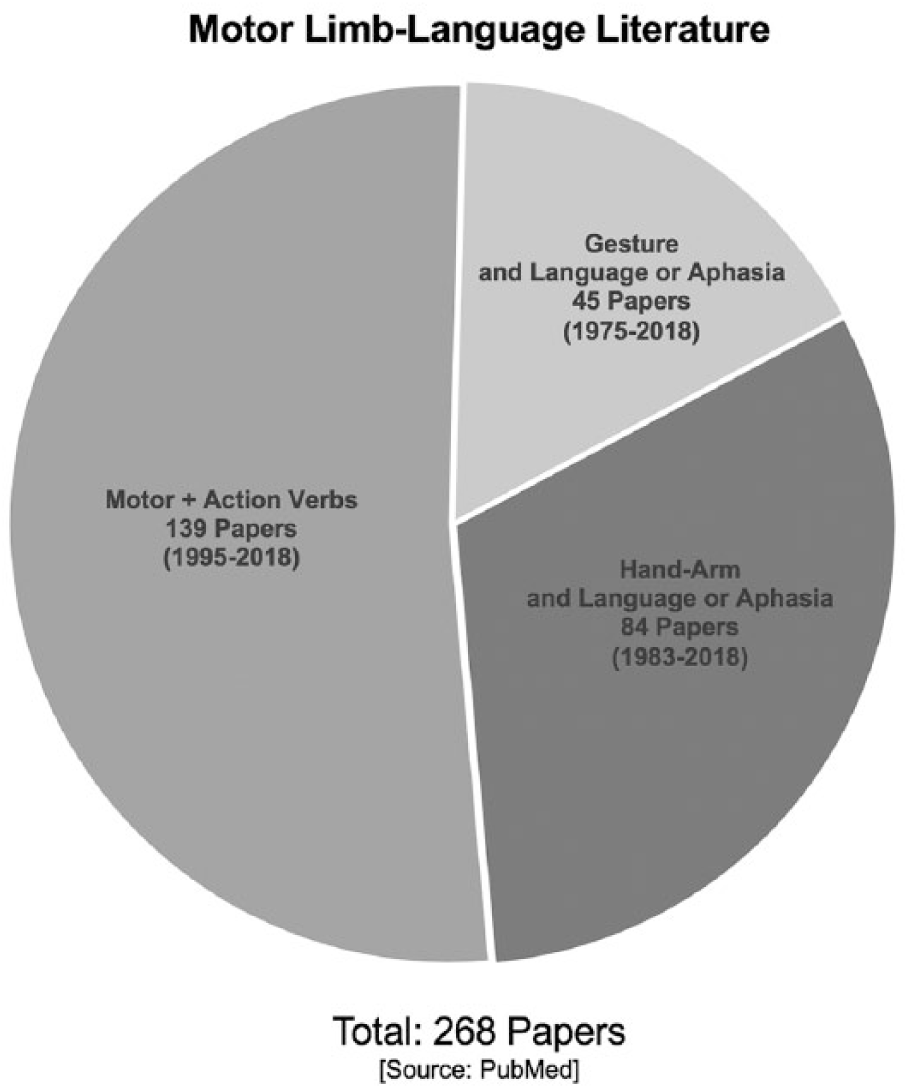
A PubMed search using multiple combinations of terms, including “limb, arm, gesture, speech, language, motor, action verbs and aphasia” yielded 268 articles relevant to the hand-arm/motor and speech-language relationship. These articles are divided above into 3 categories according to their major focus. The largest number of articles, notably the most recent, are related to the synergy between motor function and action verbs.
Language
Shared data from translational and clinical research is essential to the creation of evidence-based aphasia therapies, particularly given our inability to use animals as surrogates. To work collaboratively toward the goal of improving language outcomes in aphasia, however, it is important to first define “language.” We operationally define language as the transmission of content and meaning through speech, written symbols, and gesture. “Speech,” a term that is used interchangeably with language colloquially, represents herein a subset of language; specifically, the critical oral-motor component of verbalization, rather than the symbolic expression of ideas, as it applies to language loss in aphasia. As in the oft-told tale of several blind persons, each asked to touch a different part of an elephant and then describe what an elephant is like, language, it may be said, is a particularly large elephant, with a multiplicity of fields each revealing their own unique impressions and disparate points of view, creating an impression of separate fields rather than an integrated whole (Figure 2).
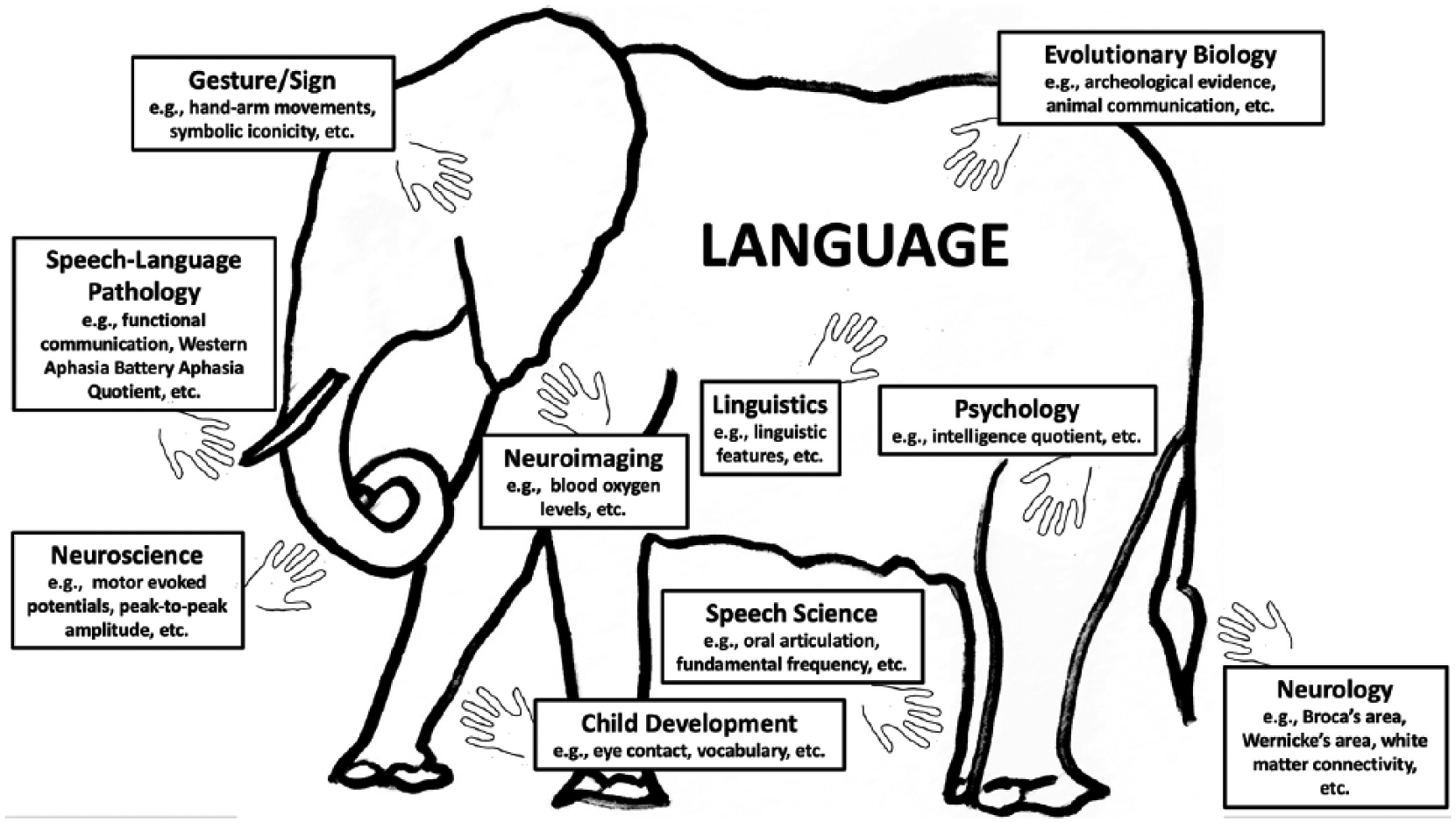
Language is analyzed through divergent means across multiple disciplines, resulting in varied perspectives. One commonality shared among language-related fields, however, is agreement that a somatotopic and functional relationship exists between language and the upper limb and hand. This hand-arm-language reciprocity holds potential promise for aphasia treatment.
The field of anthropological linguistics for example, attempts to answer the question of precisely how human language evolved. 9 Fragmentary archeological evidence from early Homo sapiens suggests that representational language, in the form of cave drawings, coincided with increased manual tool use. 9 Similarly, present-day language development in young human children has been shown to emerge in parallel to their manipulation of objects. 10 This is thought to assist children in vocabulary development, as an outgrowth of their sensory experiences. 10 Some linguists believe this process is supplemental to a cortically hard-wired universal grammar, not generated by our physical encounters with the world per se, but rather shaped by these outside influences. 11 Additional support for an allied relationship between hand-arm and language function comes from neuroscientists, who are able to analyze complex brain activity through imaging and measurement of neuroelectrical activity. 12 As a result of recent neuroimaging studies, Broca’s area, a cortical language hub once thought to solely support verbal language, is now thought to additionally represent the interpretation of movement. 12 Sign language is a grammatically complex language construct that relies heavily on the interpretation of hand movement.13,14 Hand gestures among verbal language users, often used concurrently with spoken narratives, are also linguistically bound, demonstrating another connection between hand-arm use and language. 15 As a consequence, aphasia may consist of deficits in both verbal and gestural modalities. 16
In spite of the many points of view from which language can be observed or measured, whether as part of a series of neural networks, or as a generative rule-based system, one shared concern emerges. When viewed in aggregate, language literature reflects, to varying degrees, an evolutionary, somatotopic and behavioral reciprocity between language and the human upper limb and hand. It is this common interest across disciplines that may offer opportunities for innovation in aphasia treatment.
Co-evolution of Language With Hand-Arm Movement
The study of human linguistic origins has historically focused on nonhuman primates’ use of their upper limbs for gestural behaviors 17 and has made use of comparisons between human, early-human and nonhuman primate orolaryngeal anatomy and brain architecture. 18 Some researchers stress the evolutionary refinement of nonhuman primates’ orolaryngeal structures as the most important factors in human language evolution. 19 Nonetheless, while phylogenetic changes such as upright body posture led to the repositioning of laryngeal and oral musculature, and these unquestionably played key roles in the development of human language, this may not be entirely sufficient to explain human language development. It has been argued that the development of language was equally, and perhaps primarily, spurred by freedom of hand movement as an additional consequence of this upright posture. 19 There is a divide in the study of linguistics wherein one branch suggests that when early modern humans began to walk as bipeds, the evolutionary transition toward human language originated with gesture, while others purport that gesture and vocalization developed in tandem. 20 As one means of investigation, some scholars look toward nonhuman primates to explore language origins. Lemeira et al 21 note that the leap into richer methods of primate communication would not have been possible without concomitantly improved motor control of both orolaryngeal and hand musculature. 21 The authors cite the orangutan as a unique evolutionary example, as it has been known to mold a leaf against its lips, altering the pitch of its vocalizations to sound larger and more foreboding, an act requiring both manual and oral skills not seen in other apes. 21
Linguists studying language evolution continue to debate whether gesture and speech were inseparable parts of one developing language system. 8 Neither camp may ever know what protowords our Paleolithic relatives used, if any, for communication purposes; but interestingly, it is stenciled images of their hands upon cave walls that continue to speak to us today, some 35 000 years or more hence. 22
Child Language Development and Manual Praxis
The developing human brain is advantageously primed for multimodal communication. 23 As such, it is widely held that hand-arm motor development plays an important role in child language acquisition. 24 According to Iverson, 10 ongoing changes in motor ability provide the developing child with diversified circumstances through which to experience the world. Such manual and physical engagement allows the child, from infancy, to hone linguistic skills. 10 Reduced motor ability has been correlated with delayed language in children with cerebral palsy and other developmental motor disorders 25 and has been implicated as a component of language deficits in autism. 26
In a seminal study, Roy et al 27 examined whether a developmental hand-arm motor planning antecedent to the acquisition of language syntax could be observed by studying upper limb reaching and grasping movements of children with specific language impairment, children with fragile X syndrome (similar in behavioral language characteristics to autism), and adults with fragile X syndrome, versus healthy adults. The authors examined subjects’ reaching and grasping of differently weighted bottles and found that hand-arm movement in anticipation of object weight was reduced in both children and adults with language impairments. 27 Roy et al 27 suggest that both hand-arm movement and language require similar skills; namely, the shared sequencing and planning of an agent to an object (the actor to the thing acted upon), whether that thing is a representation (word), or actual object (bottle). The authors posit that the innate development of language skills such as grammar and syntax may correlate with, or mirror, hand-arm motor planning skills, so that it is no coincidence when both are impaired in developmental language disorders. 27
Even at an ontogenetic level, a relationship between language function and hand movement may be observed. Recently, a gene known to be crucial for the development of speech and language, FOXP2, has been implicated in human hand movement. 28 Disruption of the FOXP2 sequence, known to cause speech and language-related developmental disorders 29 is now similarly understood to cause fine-motor developmental deficits, reducing a child’s ability to perform hand-related tasks such as tying shoes, or buttoning a shirt. 30 As noted by Pulvermüller, 31 human infants learn language in the context of actions, such that the cortical representations of words become activated synchronously with motor networks, thereby reinforcing this association, during early-life brain development. This integrated relationship between hand-arm use and language continues into adulthood with the use of gesture.
Gesture and Sign Language
Gestures are purposefully interwoven with verbal communication, and may either correspond, or contradict what is being said. 31 Gesture accompanying the spoken word is not to be confused however, with body language (see Proverbio et al 32 for in-depth analyses of body language 32 ). Even at a cortical level, there are differences between the meaningful, but often unconscious alternating body positions that we refer to as body language, and the more linguistically bound gestures of the arm and hand. A study by Nagels et al, 33 for example, used imaging to compare the interpretation of body positioning to the interpretation of co-speech manual gestures. It was discovered that gesture was activated in areas similarly implicated in speech and language, whereas interpretation of body movement was not. Researchers have identified several types of manual gestural behaviors. Hand gestures that accompany syllable stress, for example, known as beat gestures, are believed to provide prosodic reinforcement, but do not contribute specifically meaningful information. 8 Hand gestures that convey intentional meaning are either classified as iconic (concrete and representational, such as one might use to demonstrate someone’s height), metaphorical (indicating abstract concepts, such as moving one’s hand to indicate the passage of time), or deictic (such as pointing to indicate a desired object or location).8,23 Furthermore, gesture is constrained by the particular language of the speaker, so that in one study by Özçalışkan et al, 34 the hand gestures of English speakers sequentially conformed to English grammar (eg, subject-verb-object), while the hand movement of Turkish speakers corresponded in sequence to rules of Turkish grammar (subject-object-verb). Importantly, 40 subjects in this study were congenitally blind, further illustrating that gesture is ingrained, even among those unable to visualize hand movement. 34 McNeil 23 contends that verbal language and gesture are part of a single consolidated language system. Goldin-Meadow 8 agrees with, but modifies McNeil’s position, noting that in young children, gesture is not initially combined with verbalization, but becomes interwoven with a child’s verbalizations gradually, during toddlerhood.
Aphasia literature reflects a concern with gesture as a prospective aide in communication, suggesting to the clinician support for the incorporation of gesture into aphasia treatment; however, to date, conclusions regarding the degree of benefit and specific type of gestural approach to aphasia therapy have been inconclusive.35,36 It has been suggested that gesture may be promising for cuing word-retrieval in patients with aphasia 35 ; however, Mol et al 16 report that because of its linguistically bound nature, symbolic hand gesture is often impaired de facto in patients with aphasia, much as other facets of language are disordered. This confirms the earlier work of Daniloff et al, 37 who investigated the use of American Sign Language and Native American iconic gestural signs (Amer-Ind) to determine whether gesture could be used therapeutically for mild-to-moderately impaired patients with aphasia. Danillof et al 37 similarly found that gesture appears to be symbolic in a way that is difficult for many patients with aphasia to comprehend or produce. The authors concluded that only gestures for verbs could be reliably produced by their aphasic subjects. 37 In an experimental case study, Raymer et al 38 similarly found that verbs were more favorable than nouns for the production of gesture in a patient with aphasia. The authors suggest that activation of the hand-arm motor network may be particularly helpful for patients with sound substitution errors, rather than semantic word-finding deficits. 38 Rose 39 supports the use of gesture as part of an overall multimodal approach to aphasia rehabilitation that for some, may provide a doorway to enhanced communication. The author notes that increased gesture usage draws on preserved cognitive and sensorimotor systems and should therefore be encouraged as a means of functional communication. 39 A gestural approach to aphasia recovery is primarily endorsed as an adjunct to verbal communication and is promoted for its use as a compensatory word retrieval strategy.35,36
The connection between hand-arm use and language is particularly salient to many in the Deaf community. Unlike hand gesture, Sign Language contains structured and expansive grammatical rules that share many of the same neural substrates as spoken language.40,41 MacSweeney et al 13 found that in sentence tasks, both hearing nonsigners and deaf signers had activation of Broca’s area and other superior temporal brain regions, with lateralization of language in the left hemisphere in both sets of subjects. In a study by McCullough et al, 14 it was shown that cortical areas sensitive to the visual interpretation of movement were activated in both hearing and deaf signers equally when processing language about movement.
There is limited literature on aphasia in the Deaf; however, in one early case report by Chiarello et al, 40 the authors present the case of a prelingually deaf woman with a left hemisphere stroke, in which the patient, who was premorbidly fluent in American Sign Language, lost the ability to produce signs or finger spell. 40 Interestingly, the authors report the patient could isolate certain hand movements but was unable to perform the coarticulating sequencing of signs required to communicate. 40 In a review of studies comparing the comprehension of nonlinguistic actions with Sign Language interpretation in the Deaf, Patterson et al 41 report a clear dissociation between the processing of extraneous hand movements and Sign Language. The authors report that Sign Language is represented in the brain in much the same way as spoken language. 41 As a result, damage to the left hemisphere in Deaf persons results in the same forms of aphasia found in the hearing population. 41
Aphasia Research and Treatment
A common path to understanding language is to investigate language-related disorders of the brain. The process of recovery from aphasia has therefore been a rich source of investigational inquiry across disciplines. In the mid-19th century, aphasia was classified according to a modular view of cortical language representation, with all forms of expressive aphasia generally categorized under the umbrella, “Broca’s aphasia.” Similarly, forms of aphasia wherein comprehension was the primary deficit, were, at the time, combined under the overarching mantle “Wernicke’s aphasia.” 42 During the time of Paul Broca’s and Carl Wernicke’s prodigious research, there was not yet an understanding of the heterogeneous nature of cortical language representation, nor was there acknowledgment that most forms of aphasia are neither exclusively expressive nor entirely receptive. More recently, the terms fluent and non-fluent aphasia have gained traction as categories under which the many types of aphasia may be divided, as these terms more appropriately describe patients’ symptoms and are not based on an outdated representation of cortical language architecture. 42 Broca’s area, for instance, is now understood to play a vital role in the interpretation of movement that precedes action-word production. 7 Some forms of aphasia therapy have attempted to harness the interplay of language and hand-arm action with the use of action picture cards, the imitation of the therapist’s actions, or through object manipulation.
Visual action therapy (VAT), intended for the most severe forms of aphasia, combines both action observation and object manipulation. VAT involves the imitation of live and pictured actions, using everyday objects. 43 VAT has not been shown, however, to lead to generalization of functional communication skills. 44
One aphasia treatment paradigm designed to promote recruitment of the non-lesioned hemisphere (usually the right hemisphere in patients with aphasia), is Melodic Intonation Therapy (MIT), 45 intended for patients with nonfluent aphasia. In MIT, intoned melodies are first used to assist in the production of rote phrases, with the melodic aspect gradually phased out, in the hope that this will lead to greater ease with spontaneous (nonintoned) utterances. Importantly for our discussion, these melodies are initially accompanied by hand movement, with tapping of the patient’s hands to emphasize beats and phrase structure. 45 One proposed means by which the hand motions of MIT activate the nonlesioned hemisphere is set forth by Schlaug et al. 46 While it is conjectured that the binding of words with ascending and descending vocal pitches enables right hemisphere recruitment, Schlaug et al 46 suggest that hand tapping may also be responsible. The authors refer to a study by Lahav et al 47 that emphasizes the convergence of auditory and motor learning during the combined tapping and intoning of MIT, to illustrate this point. In the study by Lahav et al, 47 the authors posit that the intersection of sound and hand movement establishes a functional connection between the 2 modalities, which are simultaneously entrained during the verbal intonation and hand tapping movements of MIT. Zumbansen 48 cautions that fidelity to the original MIT method is not consistently maintained across all studies; nonetheless, MIT holds additional promise for the recovery of apraxia of speech.
One well-investigated form of behavioral intervention for poststroke aphasia is constraint-induced aphasia therapy (CIAT). 49 CIAT is an outgrowth of constraint-induced movement therapy (CIMT) for hemiplegia of the upper limb, which has demonstrated considerable efficacy. 49 Pulvermüller and Berthier 50 place CIAT under the broad heading of “intensive language action therapy (ILAT).” The contentions of CIMT and CIAT are that constraint promotes brain plasticity around the lesioned area, whether by constraining the noninjured arm in the case of hemiplegia, or by restricting communication to verbalization only, in the case of aphasia. CIAT prompts the aphasic patient to request picture cards from other participants within a group setting, while limiting communication to the spoken word. In doing so, Pulvermuller and Berthier 50 assert that CIAT embeds action (the exchanging of action-related picture cards) within the verbalizations through “language action games,” although the use of gesture to convey a message is discouraged.
An emerging form of aphasia therapy, verb network strengthening treatment (VNeST), capitalizes on the link between actions and language, highlighting action words, around which written and verbal phrases can be structured. 51 Edmonds et al 51 posit that the training of action words is more likely to generalize to spontaneous language in patients with aphasia, as a single verb can be at the root of multiple semantic relationships. For instance, there may be multiple semantic agents (actors) for a given action such as “play” (eg, children, musicians, and dogs are among the many semantic actors who can “play,” etc), permitting the generalization of one action to multiple agents. 51 This is unlike an object (eg, a noun such as “ball”) that cannot be as readily expanded. 51 The authors suggest this may explain why the training of nouns, so often used in aphasia therapy, has fewer functional applications to real-world communication. 51 It is believed that the verbalization of action words may draw on networks linking language and movement. 52 While VNeST encourages the discussion of actions, it neither explicitly promotes nor restricts the actual use of actions or movements during treatment. More recently, Action Observation Therapy, which has been used to promote hemiplegia recovery, has been suggested for the recovery of aphasia, as it is believed to use the mirror neuron system to promote verb retrieval. 53
Interest in the development of combinatorial movement and language therapies poststroke is gaining traction. 54 A 2007 study by Hesse et al, 55 for example, examined the effects of transcranial direct current stimulation and robot-assisted arm training in 10 subjects with poststroke hemiplegia and noted unexpected language improvements in 4 of the 5 participants having aphasia. 55 This corresponds with a 2014 study by Benjamin et al, 36 in which patients using hand movements combined with language tasks, showed greater laterality of blood oxygen levels to the right hemisphere on functional magnetic resonance imaging (fMRI), followed by improved naming scores. While this appears to contradict the findings of researchers who promote aphasia treatment methods that curtail contralesional disinhibition, 57 it nonetheless points to improvement in language tasks when verbalization is coupled with upper limb movement. 56 Interestingly, in a recent study by Harnish et al, 58 brain-derived neurotropic factor, known to encourage neuronal protection and growth, was reported to increase in aphasic patients following aerobic exercise. In the study by Harnish et al, 58 following 6 weeks each of 2 exercise regimens, one using aerobic exercise and one involving stretching, both followed by speech therapy, those patients with aphasia receiving aerobic exercise demonstrated greater language gains. Even more recently, in a preliminary study of 17 patients with aphasia and right-sided hemiparesis, Buchwald et al 6 cautiously reported language gains following 36 sessions of robot-assisted arm treatment without the benefit of speech therapy, echoing the earlier study by Hesse et al. 55 , while noting the need for further controlled experiments.
Neuroimaging
In further support of a relationship between movement and language, preliminary imaging studies have shown subcortical pathways associated with voluntary movement linked with Broca’s area. 59 It has been suggested that the processing of verbs, for example, is conceptually dependent on an understanding of movement. 60 This appears to be borne out in imaging studies using fMRI, in which brain areas associated with movement become engaged during auditory comprehension and reading tasks, 52 as well as in studies using transcranial magnetic stimulation to produce motor-evoked potentials during language tasks. 61 There has been a persistent argument within language literature regarding the motor theory of speech perception, which argues that we perceive speech as a series of articulatory gestures. 62 This theory is similar in-kind to theories of embodied language and cognition, that suggest the existence of integrated motor-limb and language neural pathways. 63 Three separate experiments by Flöel et al 61 lend weight to the motor theory of speech perception. The authors used transcranial magnetic stimulation to observe the effects of language on the excitability of the motor cortex in 26 subjects. 61 Their aim was to demonstrate an “articulatory/manual action-perception network” by comparing changes in hand motor-evoked potentials during verbal and nonverbal tasks. 61 The authors concluded that listening to human speech engaged the hand motor system, as demonstrated by heightened excitability. 61 Activation of Broca’s area while observing hand movements has similarly been reported in other imaging studies.64,65
In a study by Hauk et al, 52 fMRI images showed an overlap between the oral reading of leg-, arm-, and face-related verbs, and the cortical representation of leg-, arm-, and face-related movements in 14 subjects, suggesting shared neural substrates. Pulvermüller 31 has written extensively on neural mechanisms that tie action with language, reporting that arm- and leg-related action words are associated with activation of arm- and leg-related motor cortices. Additional confirmation of the synergy between language and hand-arm movement comes from Crosson, 66 in which the author reviewed a treatment for nonfluent aphasia that used left-hand movement during verbal word production. In this treatment, combining a naming task with an “intention manipulation” that consisted of purposeful left-hand movements, was demonstrated on fMRI to shift language activity toward the contralesional hemisphere. 66
It should be noted that not all language researchers are in agreement. Postle et al 67 looked at 100 healthy subjects across 3 separate experiments and did not find synergy between action-words related to specific body parts nor cortical activation of corresponding body areas. The findings of this study are contradicted however by recent investigations into the reduced processing of verbs in patients with movement disorders such as amyotrophic lateral sclerosis, 68 Parkinson’s disease, 69 and progressive supranuclear palsy. 70 Furthermore, a 2017 study by Mirabella et al 71 examined the processing of action words in 18 developmentally motor-impaired children versus 18 healthy age-matched controls and similarly reported reduced language processing for action-words in children with motor disorders.
In 2014, Harnish et al 72 presented a case series in which the authors assessed the effects of intensive upper-limb motor therapy on language and hand-arm recovery. Each of the 5 subjects with aphasia and hemiparesis received upper-limb therapy combined with epidural cortical stimulation, but no speech therapy. Language improvement was noted in 3 of the 5 subjects, in spite of having received no language training. fMRI data revealed that shifts in increased blood oxygen levels were strongest in those subjects who had combined improvements in both language and upper-limb scores. 72
Recommendations
This overview of extant literature provides converging lines of evidence for a relationship between language and hand-arm function. It is reasonable to conjecture, given widespread acknowledgment of the existing somatotopic and behavioral associations between hand-arm use and language, that exploiting this physiological partnership could benefit language recovery in poststroke aphasia.
While the study of shared neural pathways between hand-arm movement and language is not new, a method by which this data can be used in the creation of new, more robust rehabilitation strategies for aphasia has yet to be determined. To establish whether a combinatorial therapeutic approach might be leveraged for superior outcomes in aphasia recovery, the following investigations are recommended:
Further exploration into the natural recovery of the 2 modalities. Existing studies on the proportional recovery rule as it applies to post-stroke motor versus language improvement have yet to yield conclusive data 73
Determination of the effect of acute poststroke intervention such as intra-arterial treatment or pharmacological therapies on motor versus aphasia recovery 74
Examination of whether combinatorial motor-language approaches to aphasia recovery are always synergistic or could be competitive
Analysis of the effect of aphasia therapy when it is delivered concurrently with motor-limb treatment, versus the effect when it is provided sequentially
Experimentation to address the effects of training the dominant versus nondominant upper limb
Establishing whether altered attention at an executive level is at the root of language improvement when using hand-arm movement, or whether it is the movement itself that is providing the benefit
Exploration of differences, if any, between the effects of adjunctive hand-arm training on poststroke language gains versus motor-speech improvement.
While we stress the importance of obtaining a firm scientific basis prior to the development of a hand-arm-language aphasia recovery paradigm, the information presented herein suggests it is time to get moving. The manipulation of objects brought in from home by a family member might be a rich linguistic resource to couple with traditional workbook exercises. Clay might be molded during supported conversation, or a ball might be tossed during a naming exercise. The demonstration of success in exploring combined movement and language tasks within the treatment room is what may be needed to spur on future studies.
Physical exercise of the hand and arm has been demonstrated to drive neuroplasticity in stroke patients with hemiparesis 5 and the literature argues in favor of interconnectivity between hand-arm and language networks. As such, we see a potential pathway to improved aphasia outcomes through co-verbal upper-limb movements and exercises that are not restricted to linguistically bound gestures. We have aimed to demonstrate that upper-limb movement and language are likely interrelated. While further studies are required to support this claim, investigation of co-action between hand-arm and speech-language representation may hold promise toward the development of combinatorial aphasia treatments that directly target the impairment itself. We contend that for the millions of stroke patients suffering with aphasia, “reaching for the right word” need not remain a metaphor.
Supplemental Material
Supplemental_Material – Supplemental material for Poststroke Aphasia Rehabilitation: Why All Talk and No Action?
Supplemental material, Supplemental_Material for Poststroke Aphasia Rehabilitation: Why All Talk and No Action? by Susan Wortman-Jutt and Dylan Edwards in Neurorehabilitation and Neural Repair
Footnotes
Acknowledgements
The authors wish to thank Dr Rajiv Ratan for providing valuable commentary.
Declaration of Conflicting Interests
The authors declared no potential conflicts of interest with respect to the research, authorship, and/or publication of this article.
Funding
The authors disclosed receipt of the following financial support for the research, authorship, and/or publication of this article: Dr. Edwards received support from the Burke Foundation in the development of this manuscript. The authors received no other financial support for the research.

References
Supplementary Material
Please find the following supplemental material available below.
For Open Access articles published under a Creative Commons License, all supplemental material carries the same license as the article it is associated with.
For non-Open Access articles published, all supplemental material carries a non-exclusive license, and permission requests for re-use of supplemental material or any part of supplemental material shall be sent directly to the copyright owner as specified in the copyright notice associated with the article.
