




Abstract
Although motor learning theory has led to evidence-based practices, few trials have revealed the superiority of one theory-based therapy over another after stroke. Nor have improvements in skills been as clinically robust as one might hope. We review some possible explanations, then potential technology-enabled solutions. Over the Internet, the type, quantity, and quality of practice and exercise in the home and community can be monitored remotely and feedback provided to optimize training frequency, intensity, and progression at home. A theory-driven foundation of synergistic interventions for walking, reaching and grasping, strengthening, and fitness could be provided by a bundle of home-based Rehabilitation Internet-of-Things (RIoT) devices. A RIoT might include wearable, activity-recognition sensors and instrumented rehabilitation devices with radio transmission to a smartphone or tablet to continuously measure repetitions, speed, accuracy, forces, and temporal spatial features of movement. Using telerehabilitation resources, a therapist would interpret the data and provide behavioral training for self-management via goal setting and instruction to increase compliance and long-term carryover. On top of this user-friendly, safe, and conceptually sound foundation to support more opportunity for practice, experimental interventions could be tested or additions and replacements made, perhaps drawing from virtual reality and gaming programs or robots. RIoT devices continuously measure the actual amount of quality practice; improvements and plateaus over time in strength, fitness, and skills; and activity and participation in home and community settings. Investigators may gain more control over some of the confounders of their trials and patients will have access to inexpensive therapies.
Keywords
Introduction
Neurologic rehabilitation has been testing a motor learning theory for the past quarter century that may be wearing thin in terms of leading to more robust evidence-based practices. The theory has become a mantra for the field that goes like this. Repetitive practice of increasingly challenging task-related activities assisted by a therapist in an adequate dose will lead to gains in motor skills, mostly restricted to what was trained, via mechanisms of activity-dependent induction of molecular, cellular, synaptic, and structural plasticity within spared neural ensembles and networks.
This theory has led to a range of evidence-based therapies, as well as to caricatures of the mantra (eg, a therapist says to patient, “Do those plasticity reps!”). A mantra can become too automatic, no longer apt to be reexamined as a testable theory. A recent Cochrane review of upper extremity stroke rehabilitation found “adequately powered, high-quality randomized clinical trials (RCTs) that confirmed the benefit of constraint-induced therapy paradigms, mental practice, mirror therapy, virtual reality paradigms, and a high dose of repetitive task practice.” 1 The review also found positive RCT evidence for other practice protocols. However, they concluded, no one strategy was clearly better than another to improve functional use of the arm and hand. The ICARE trial 2 for the upper extremity after stroke found that both a state-of-the-art Accelerated Skill Acquisition Program (motor learning plus motivational and psychological support strategy) compared to motor learning-based occupational therapy for 30 hours over 10 weeks led to a 70% increase in speed on the Wolf Motor Function Test, but so did usual care that averaged only 11 hours of formal but uncharacterized therapy. In this well-designed RCT, the investigators found no apparent effect of either the dose or content of therapy. Did dose and content really differ enough to reveal more than equivalence, or is the motor-learning mantra in need of repair?
Walking trials after stroke and spinal cord injury,3-8 such as robot-assisted stepping and body weight-supported treadmill training (BWSTT), were conceived as adhering to the task-oriented practice mantra. But they too have not improved outcomes more than conventional over-ground physical therapy. Indeed, the absolute gains in primary outcomes for moderate to severely impaired hemiplegic participants after BWSTT and other therapies have been in the range of only 0.12 to 0.22 m/s for fastest walking speed and 50 to 75 m for 6-minute walking distance after 12 to 36 training sessions over 4 to 12 weeks.3,9 These 15% to 25% increases are just as disappointing when comparing gains in those who start out at a speed of <0.4 m/s compared to >0.4 to 0.8 m/s. 3
Has mantra-oriented training reached an unanticipated plateau due to inherent limitations? Clearly, if not enough residual sensorimotor neural substrate is available for training-induced adaptation or for behavioral compensation, more training may only fail. Perhaps, however, investigators need to reconsider the theoretical basis for the mantra, that is, whether they have been offering all of the necessary components of task-related practice, such as enough progressively difficult practice goals, the best context and environment for training, the behavioral training that motivates compliance and carryover of practice beyond the sessions of formal training, and blending in other physical activities such as strengthening and fitness exercise that also augment practice-related neural plasticity? These questions point to new directions for research.
The Problems
RCTs in rehabilitation are rather rigid. Investigators aim to control for any differences other than the defined comparison intervention. But rehabilitation is not usually provided as directly as a single drug in a capsule. Therapists in the real world deploy multiple evidence-based approaches that may be synergistic to achieve their goals, aiming to amplify mechanisms of plasticity and learning. By design, RCTs do not include this approach. Should they? For example, multiple animal and human studies reveal the benefits that exercise to increase fitness and strength has on motor learning, executive function, and functional recovery.10-13 Yet physical conditioning and bilateral strengthening goals are almost never part of the basic foundation of care for participants in a trial of a new strategy for upper extremity skill acquisition or walking. Excluding these components of training is not unlike excluding an enriched environment in rodent studies of recovery and repair, a component that appears to augment the add-on experimental intervention’s results. 13 One problem is the higher cost to the sponsor of additional therapy in a clinical trial. Also, there is the sponsor’s concern that combining a foundation of strengthening, fitness, and skills practice along with a new experimental device, physical strategy, drug, or cellular implant may minimize or obscure the effects of the experimental intervention. Of course, if the combination did so, there would be no need for the additional strategy. But a new intervention could become more robust when built on this more holistic foundation for training.
Another cause of the apparent plateau in gains may be that most motor training interventions no longer fundamentally differ enough from each other, despite the anticipated distinctions between, for example, progressive shaping of more complex movements versus virtual gaming tasks to improve upper extremity reach and grasp. That is one possible explanation for the equivalent results of the ICARE trial. In addition, practice carried out in a clinic or laboratory lacks the context and ecological validity of how outpatients might practice and deploy their skills in the home and community. Indeed, in the LEAPS trial, equivalent outcomes for walking after stroke were found for task-specific BWSTT and for home exercise that did not emphasize the training of walking.3,14 Perhaps participants at home were more likely to carry over their practice with a therapist into more daily activity in that familiar environment. Encouragement to practice may also have been more meaningful than for the BWSTT group, who were challenged to try to carry over clinic-based training on a complex apparatus and over ground to their home environment, but were not instructed in how to transfer whatever skills they had achieved. So clinic practice or practice on a complex device may not transfer to real-world activity. 14
Only rarely do RCTs include a feedback about performance protocol and almost never does one find systematic feedback incorporated to challenge a participant’s motivation and self-management skills for intended goals. 15 Readers can almost never determine from an RCT report whether participants were actively engaged by their therapy and encouraged to practice beyond the time of formal treatment. Indeed, low contrast differences between mantra-type therapies may be further obliterated by the remarkably little actual physical practice accomplished within and in between treatment sessions during an RCT.
These potential confounders may limit gains and lessen the opportunity to get better results. Let us take a closer look at the problem of the apparent plateau in gains before examining technologically enabled solutions that are ready for testing.
Targets to Improve Trial Results
As noted, seemingly diverse mantra-based strategies may lack enough contrast in their fundamental styles and goals to produce more than a me-too effect. Perhaps more frequent therapy sessions are necessary, say over 60 hours. 16 But trials in a clinic setting are expensive and a burden on participants, so 12 to 36 one-hour sessions spread over 4 to 12 weeks are the usual compromise. Based on a recent assessment of the effects of various intensities of repetitions of upper extremity practice after stroke, 17 the duration of a single session and number of repetitions may be less important to gains than other factors, such as employing more frequent, but shorter intervals of training within the context of the daily environment. 18 In addition, most trials collect their measurements only at pre- and postintervention. This design does not include enough interim measurements to help determine whether the rehabilitation strategy being tested has led to a plateau of change in the primary outcomes by the time of the final treatment. Thus, participants may be cut short before they have reached maximum gains. 19 Repeated measures, especially obtained in the community by remote assessment, could resolve this potential dose-response shortcoming.
Perhaps participants in rehabilitation RCTs vary considerably in how much or how little they practice outside of the formal intervention. Subjects travel to a clinic to practice their intervention for only about 20 to 30 minutes per 1-hour session due to time for set up, instruction, and rest. They may then remain sedentary at home until the next session. Any contrast between the control and experimental groups may be lost on a couch when modest formal practice is followed by little or no practice or physical activity for 48 hours or more. In addition, investigators have no idea what the experimental and control groups are doing to maintain or increase strength, endurance, and home-based skills. Indeed, patients after stroke see exercise as a high priority, 20 but often do not know how to accomplish meaningful exertion. Disuse atrophy after stroke or any debilitating neurological disease will add to weakness of the hemiparetic side and reduce endurance for repetitive movements. Even modest variations in strengthening and fitness-related exercise may confound the primary intervention, because deconditioning, which affects 80% of persons after stroke, 21 may limit endurance for progressive practice and gains. Just as important, greater physical activity and exercise may augment the biological effects of any type of motor learning protocol for deficient skills,22-24 whereas sedentary behavior may have a markedly negative impact on improvements.25,26 Finally, when 6- or 12-month outcomes are obtained following a 4- or 12-week intervention, investigators have no measure of how much practice and general activity have transpired since the end of formal therapy. Wide variations could affect the impact of comparison treatments. Thus, remote monitoring of physical activity and efforts to provide a basic level of exercise and practice seem indicated to maximize motor learning and retention.
Although the practice mantra calls for feedback, remarkably few trials include formal feedback and instruction strategies to support the self-management of training, problem solving, and practice beyond the time of the formal therapy. So it is considered a victory of statistical significance when an RCT shows no decline 6 months after completion of the experimental intervention or the control group declines, making the experimental strategy look better. But if patients were to continue to practice on their own, following what they were taught during the training, could they improve further? To do so requires self-management skills. Wade has recently reemphasized the need for rehabilitation to enable patients to practice personally relevant activities as much as is feasible and to measure what they are doing in their environment. 27 He called for greater efforts at enabling self-directed practice. This element is missing in RCTs as well. Many trials have shown that encouragement and verbal instructions alone do not usually increase physical activity after stroke. 28 Self-management training to develop self-efficacy for the practice of skills and exercise appears to be necessary and should be considered as a routine strategy in clinical trials and early poststroke care.29,30
Perhaps the plateau is reached because the chosen outcome measurements did not directly capture what the trial participant actually did accomplish in the home and community. Self-reports about activity may not be as reliable as direct measurements of, for example, the amount of purposeful use of the affected hand or the usual walking speed and distance for each bout of walking in home and community settings. 31 Laboratory-based tests of motor gains may be standardized, but do not inherently reflect what is actually performed in the real world or reflect patient-centered outcome measurements. 32 Studies of self-report instruments about participation, within the definition of the International Classification of Functioning, Disability and Health, show that available tools meet very limited success. 33 The need here is great. Continuous identification and quantification of physical activity within the context of daily roles may help better operationalize the concept of participation.
Perhaps lack of outcome differences between the motor learning mantra therapies has a more fundamental basis, such as insufficient residual neural substrate to subserve additional recovery. Clearly, for patients with profound sensorimotor impairment, rehabilitation strategies that adhere to the motor-learning mantra seem to have rather modest effects on impairment and function; 34 they enable greater self-care and participation almost exclusively by adaptive behavioral compensation. Structural imaging methods may provide further insight into, for example, how much of the corticospinal tract needs to be spared to maximize improvements. 35 Perhaps the motor learning theory works best within the most intrinsically adaptive period after stroke, the first 3 months. 36 Motor gains for selective arm and leg movements, particularly what is measured by the Fugl-Meyer Motor Assessment, tend to reach a so-called proportional recovery plateau in the first few months after stroke,37,38 with adaptive strategies increasingly incorporated over time when trying to accomplish any given task. Thus, efforts are needed to provide as much rehabilitation as feasible immediately after discharge from inpatient care, because this period may be critical to the maximum success of a fully scaled mantra training strategy.
Solutions
How might we improve upon the outcomes of theory-based therapies and optimize the potential benefits of new interventions that are to be tested in an RCT? Small trials of telerehabilitation strategies that provide remote telephone or video assistance to patients and caregivers may boost the amount of practice, but the trials have been too small to draw conclusions. 39 Indeed, the evidence that telehealth alone can improve outcomes for patients with chronic diseases has been modest.40,41 A proof-of-principle RCT, however, found that the combination of caregiver training for sets of specified exercises performed daily during the inpatient stay and video conferencing after discharge to maintain the program was able to add 1000 minutes of practice compared to controls, associated with a shorter length of inpatient stay and greater caregiver self-efficacy. 42
A more comprehensive approach is more likely to boost positive outcomes. Clinical trials and post–acute care could include a basic spectrum of activities to support the rehabilitation of motor skills, including personalized guidance for home-based practice, exercise and fitness interventions that may enhance skills training and participation, and the self-management training that builds lasting motivation to continually try to enhance gains. During clinical trials, both the experimental and control subjects would receive these foundational interventions. How may investigators provide this optimization of training?
Mobile health (mHealth) strategies can enable this synergistic foundation.43,44 Internet-connected mHealth tools include mobile telecommunications between medical professionals and their patients. Smartphones, for example, enable text messaging, conference calls with video, instructional video recordings, and visual and spoken feedback between patients and investigators, therapists, or a social support group. In addition, wearable sensors with algorithms that recognize activity patterns can identify the type, quantity, and aspects of quality of movements during skills practice and daily activities.43,44 To date, body sensors have been underutilized for health care purposes, but they are likely to become ubiquitous. 45
Other home-based mHealth devices are available. Reaching and grasping of items can be remotely monitored by a Kinect 46 or other virtual reality (VR) haptic training systems in a defined practice space. 47 Other remote monitoring options include pressure sensors or bar codes on objects to record practice goals for grasping and grip strength; computer gaming to improve reaction time and coordination; mechanical and electronic robotic assists to assist and monitor arm and hand practice using real or virtual items; and combinations of these and other tools. The home-based training lends itself to another important aspect of skill acquisition—patients can use success-based exploration and varied movement strategies to accomplish a goal. These mHealth devices are also part of what has been dubbed as the Internet-of-Things, which includes anything that can be connected including people-people, people-things, and things-things. The network of physical devices, household appliances, medical monitors, and buildings embedded with electronics, software, sensors, actuators, and network connectivity enables these things to collect and exchange data.
Rehabilitation Internet-of-Things
The components of a smartphone- or tablet-connected electronic home rehabilitation gym add up to a flexible Rehabilitation Internet-of-Things (RIoT) supported by interactive telerehabilitation methods. Each component has to have a compatible operating, data analysis, and report system. 48 Encryption and passwords enable confidentiality. Many potential components have been tested and continue to be studied.49-62
A variety of telerehabilitation strategies are being tried. Although still emerging, some have been generally effective for people with multiple sclerosis 63 and stroke. 39 A key component has been personal interaction. For example, even a rather simple intervention of 3 home visits, 5 phone calls, and in-home text messaging for 3 months led to somewhat better outcomes in poststroke persons randomized to exercise and adaptive strategies, compared to no particular reinforcement. 64 In healthy adults, remote Internet interventions had a positive, moderate sized effect on increasing self-reported physical activity and fitness 12 months postintervention, 65 but comparisons between face-to-face instruction and remote input are too meager to judge relative efficacy. 66 Teleneurology beyond acute stroke management is also receiving more attention. 67 The American Physical Therapy Association and American Occupational Therapy Association have endorsed telehealth services especially to overcome lack of access to in-person care. 49 Along with this trend comes the so-called quantified self-movement, which aims to incorporate technologies for frequent, routine data acquisition about health. Its goal, which is consistent with mHealth devices, telehealth programs, and telerehabilitation via an RIoT, is to enable more transparency, self-knowledge, and customization about care; improve decision-making about health; and develop a patient-centric approach to monitoring a range of metrics about health. 45 This push should continue to make wearable sensors and monitoring systems less expensive, more flexible, and a routine aspect of patient care. Still, the acceptability of wearable sensors and other devices by disabled persons as well as medical professionals needs to be further established.
RIoT, mHealth, and telehealth technology are evolving so rapidly that no specific hardware or software is likely to survive very long without a smaller, less expensive or more powerful version becoming available. Thus, rehabilitation trials that use these tools should not emphasize a particular hardware or software; the emphasis should be on how well the apps fit our motor learning mantra and contribute to rehabilitation needs and goals. The overall remote health monitoring business, which is also tied to electronic health records for care, is growing rapidly. mHealth conferences and journals, with support from industry, the National Institutes of Health, 68 and the National Science Foundation, include descriptions and funds for a variety of sensors, signal processing strategies, software options, operating systems, and Big Data management plans. Systematic approaches have been offered for the design of mHealth mobile apps that support health programs and services so they are replicable, share an open mHealth platform, meet common standards for app development, and become scalable once efficacy is shown and they have been adapted to real-world settings.69-71 Although these efforts will not be trivial undertakings, the rapidly falling cost of monitoring and telecommunication systems and data analysis are making mHealth an inevitable component of clinical trials and patient care. With all this flux, it seems more important to establish whether remote behavioral management of patients within a broad motor learning strategy works as well or better for neurologic rehabilitation rather than whether one mHealth device alone alters clinically important outcomes.
To date, mHealth apps for chronic diseases and recovery have been tested primarily to compare whether one works better than another, or to no mHealth intervention. This approach may not lead to robust RIoT strategies for care and trials. The addition of any single mHealth component for motor learning is no more likely to enhance recovery than any single mantra-based strategy has. A more holistic approach is to combine theory-driven, practical mHealth and telerehabilitation components that provide the fundamental environment for motor learning, then test a package for efficacy once their feasibility has been worked out.
Exemplar System
At this stage of consideration for a successful RIoT, low cost, user-friendliness, and reliability for monitoring basic motor learning, exercise and fitness strategies seems the most practical direction. We successfully tested a key component of an RIoT, a remote motion sensor system for walking and cycling that includes a triaxial accelerometer and gyroscope worn on each ankle (see Figure 1). 44 In this randomized clinical trial called SIRRACT, 140 inpatient stroke rehabilitation subjects from 16 sites on 4 continents were given feedback about 10-m walking speed twice a week or enhanced feedback about daily walking speeds, distance, and duration of bouts from sensor-derived data. 44 For our goal of increasing self-managed practice and fitness after stroke, we are also testing the user friendliness of a bundle of potential mHealth devices, including a heart rate monitor, an instrumented resistance exercise band (see Figure 1), a pedaling ergometer for bed and floor, and a small box with sensor that makes a virtual reality transformation of reach-to-pinch or grasp practice tasks. Our experience may help others develop their direction for motor training research.
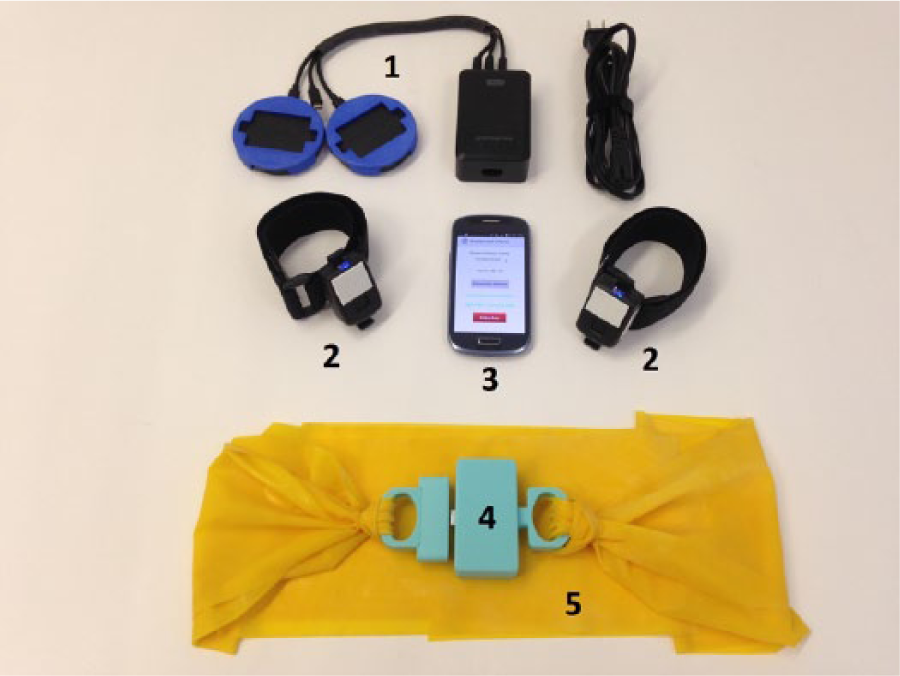
Components of a Rehabilitation-Internet-of-Things: wireless chargers for sensors (1), ankle accelerometers with gyroscopes (2) and Android phone (3) to monitor walking and cycling, and a force sensor (4) in line with a stretch band (5) to monitor resistance exercises.
The raw data from the $100 ankle sensors is collected from the start of the day at home until bedtime, then transmitted overnight by Bluetooth radio to a smartphone that sits on a night table (Figure 1). Patients do not carry the phone during the day. The sensors are charged wirelessly overnight as the raw data for walking (the accelerations and decelerations of each gait cycle for each leg, including heel strike, foot flat, heel-off, toe-off, swing, and single- and double-limb stance duration) are sent to a server. All signal processing is performed automatically, providing a therapist with a record of every bout of walking with its time of day, duration, speed, distance, and aspects of quality. The coaching therapist and patient can use the feedback to lessen sedentary time, summated on an hourly basis, and to increase the number, duration, and speed of walking bouts.
Bilateral sensors placed at the ankles or over the top of the foot allowed us to develop algorithms to recognize walking versus cycling versus individual leg exercises, as well as enable accurate measurements even at walking speeds below 0.6 m/s. One key way to ensure accuracy of a machine-learning algorithm is to obtain a template of movement at casual and fastest walking speeds and use this to build an individualized movement signature for the slow and irregular steps of a disabled person. In the SIRRACT trial, this method enabled daily data collections that revealed that the average amount of daily walking practice during inpatient rehabilitation for stroke across 16 facilities was only 17 minutes and decreased as patients achieved walking speeds of only 0.8 m/s. 44
Commercial motion sensors worn on the wrist or waist use proprietary algorithms designed for healthy persons. We and others found that as walking speed falls below 0.5 m/s, the devices increasingly fail to count steps, with accuracy declining to 50% by 0.3 m/s. 72 Worn on the ankle, a single FitBit One may be more accurate at slow speeds in healthy persons compared to wrist wear, 73 but the irregular accelerations and decelerations of the affected hemiparetic leg may confuse most commercial sensor algorithms. Even a 10% to 20% miss rate will not do for rehabilitation trials, because a 20% increase in speed or step counts has often been the key primary or secondary outcome measurement aim for walking trials. 74 Thus, optimal sensor placement and open algorithms are necessary for rehabilitation research. Bilateral sensors also allow the calculation of stance and swing ratios, step-to-step variations, smoothness of swing leg motion, and peak inertial forces for each phase of the gait cycle, which may help a therapist remotely manage gait deviations in the home and community, perhaps aided by occasional video. Energy expenditure during fitness exercise and walking is most accurate when a heart rate sensor is added, 75 so we have incorporated this in an ongoing multicenter trial of exercise training after stroke. Upper extremity use of a paretic limb compared to the nonparetic arm can also be quantified, 76 but it is far more complex to discern purposeful movements of a hemiparetic arm given its 9 degrees of freedom of motion or determine whether the hand successfully grasps an object during free ranging activities.
For home-based strengthening exercise, we have connected a Theraband or other type of stretchable resistance cord in series with a force sensor that has Bluetooth output to the smartphone that also transmits ankle sensor data (Figure 1). During concentric and eccentric resistance exercises for one or both arms and legs, the duration and force is recorded. If of interest, the subject can try to stay within the velocity and timing of a sample waveform that appears on the phone. The quality and quantity of each exercise is recorded and summarized for the patient and therapist.
For upper extremity reach and pinch or grasp recognition during practice, we place an $80 LEAP Motion Controller (LEAP Motion, Inc, San Francisco, CA) developed for gesture control of devices and VR gaming into a box under a clear plastic cover. The box rests on a table at an appropriate height for the patient’s affected arm. With open source software, the device can record and calculate the speed, accuracy, and smoothness of hand movements over the surface and 6 inches above the cover within peripersonal space, revealing hand opening and grasp and pinch of small objects placed on the surface. We prefer to have patients manipulate real items of different sizes and shapes, rather than make movements in virtual space, to increase sensorimotor integration and not add the visuoperceptual cognitive burden of virtual gaming.
This RIoT combination inexpensively monitors fitness and strengthening exercises appropriate for a physically disabled person, as well as walking and simple arm/hand skills that can be practiced throughout the day at home in practical increments of time and intensity. The wearable sensors can also reveal how much persons in the home and community practice other planned tasks, such as stair climbing or moving kitchen items repetitively. More important, this RIoT system aims to meet many of the remote sensing requirements of a basic upper and lower extremity motor learning protocol for training moderately impaired hemiparetic patients across the skills of reach and grasp, gait practice in all environments, arm and leg strengthening, and fitness exercise. The efficacy of the combination of devices is being tested. Other combinations of devices may also serve as the background for motor learning rehabilitation.62,77,78
Behavioral training seems a critical component of any RIoT strategy. In our pilot studies, a therapist contacts a subject once a week to offer summary feedback from daily sensor measurements that have been most meaningful to the participant. The conversation emphasizes behavioral change techniques that include education about the aims of the therapy (eg, risk factor management improved by strengthening and greater fitness, neuroplasticity, greater independence). We consider monitoring and practice devices as components of behavioral intervention technology, so we emphasize goal setting, instruction on ways to meet goals, adherence to convenient practice schedules, barrier identification, and self-monitoring, which when combined have elicited the largest effect sizes for positive change.29,79 Tailored counseling plus remote supervision are critical components to increase practice and exercise.80,81 In our experience, phone interactions take about 15 minutes a week. Thus, one therapist, therapy aide, or nurse practitioner may be able to remotely monitor and promote self-management for the rehabilitation of up to 100 outpatients. This strategy also encourages compliance in wearing body sensors. During the LEAPS trial, for example, only 76% of 404 participants complied in wearing the ankle StepWatch 3 Activity Monitor on at least 1 of the 3 days of monitoring. 82 Daily monitoring for data signals from devices and next-day follow-up with participants if no data had been streamed could have greatly improved compliance. 44
In an RIoT approach, what seems most important to users is the simplicity of device interfaces. We try to limit users to the need to tap no more than one button on a device. Users also seem to appreciate our conversational assistance with goal setting and instruction about how to overcome perceived barriers to community activity, practice, and exercise. Smartphone graphics are often used in mHealth trials for feedback and cues for chronic disease management, but have been a bit overwhelming for the disabled person who cannot easily manipulate buttons or has cognitive or language impairment. At present, we prefer direct weekly communication with a therapist. Since only about 58% of adults over 65 use the Internet, it may take more flexible and versatile communication systems for these persons to tackle anything other than phone interactions. 41
Further Monitoring
As a flexible, multidomain (physical-cognitive-psychological-social) 15 foundational system for RCTs, home-based RIoT-type systems could also track parameters such as blood pressure, respiratory and heart rate during activities, use biosensors for glucose and other blood or saliva tests, and monitor other physiological signals of interest to a particular trial. The need for more motion or other worn sensors must be balanced with the burdens on participants and the value of the additional information. The frequency of wearing sensors depends on the questions being asked. Some trials using frequent feedback may require daily use, others that are interested in a dose-response effect may do with intermittent use, such as wearing them for 1 week before the start and at the end of a trial and, perhaps, monthly in between or during postintervention follow-up.
A system might also include timely personal observations by subjects of symptoms or psychological state during exercise and practice via smartphone apps with pop-up telemessaging queries timed to training sessions. Simple prompts (visual or auditory cues) and rewards (a message or graphic of success) for approaching and reaching goals can be activated as well. Hundreds of small trials for weight loss, addiction, taking medications, exercise, chronic disease monitoring, and care for diabetes, hypertension, asthma, congestive heart failure, and other diseases have been undertaken using prompts and graphics, but evidence for their efficacy has been modest for narrowly sought outcomes, with some exceptions. 83
New Outcome Measurements
As noted earlier, conventional outcome measurement tools may confound the results of rehabilitation trials. The outcome measures of an RIoT include the actual amount and aspects of quality of practice, measurable changes during that practice (eg, speed, accuracy, kinematics), improvements in the skills and activities of patients in daily settings monitored by wearable sensors, and carryover of practice, exercise, and daily home and community activity beyond the time of training. By being able to calculate the actual dose of RIoT training, insight into why an experimental intervention did or did not improve outcomes can be assessed in dose-response terms. Self-report scales about physical and mental functioning and daily activities may become more reliable and meaningful when examined within the context of the continuous, ratio scale data from sensors and instrumented devices. An RIoT approach also enables adaptive trial designs; investigators can add or subtract components (devices or how they are deployed) during trial phases to assess for major or absent contributions to change, enabled by ground-truth measurements.
RIoT as a Component of Post–Acute Care Services
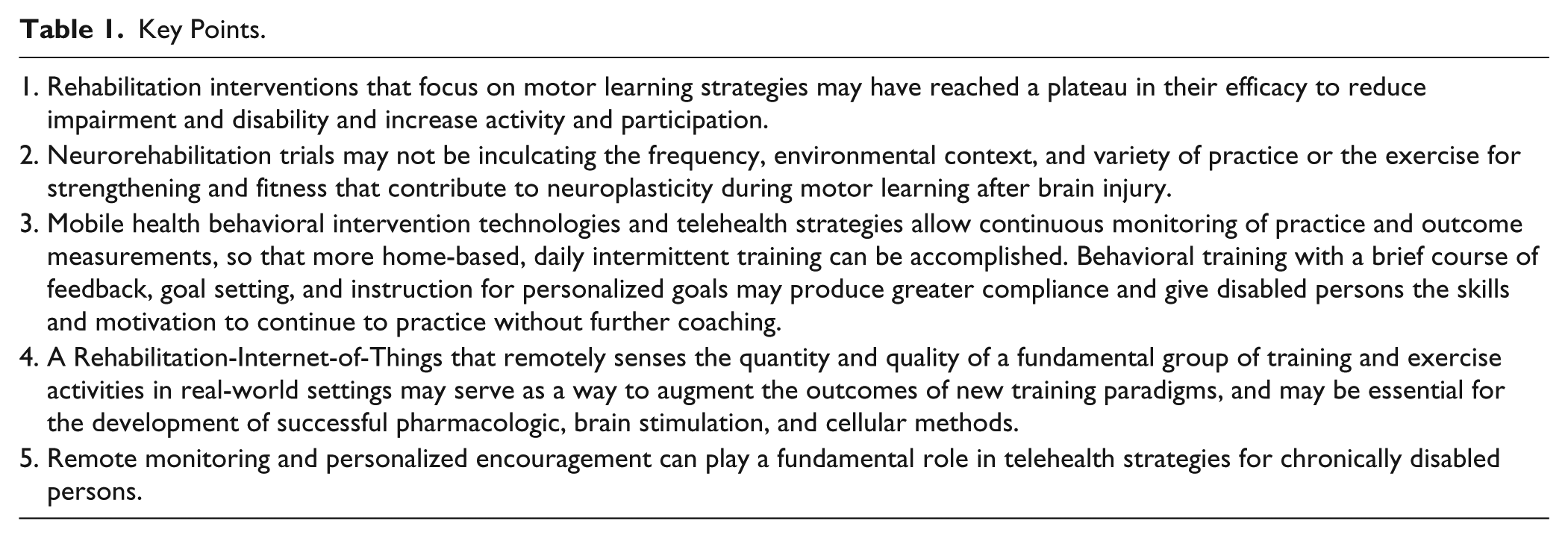
Home-based activity monitoring and telerehabilitation could also serve as a key component of post–acute care, especially after stroke discharge from the hospital or from a rehabilitation or skilled nursing facility. Transitional care aims to help manage risk factors for recurrent stroke, find support services, and manage medications, along with lessening impairments and disabilities and increasing participation in usual roles. In the near future, Medicare will probably bundle all post–acute care services to try to improve continuity and reduce hospital readmissions. Thus, a therapist or nurse practitioner that monitors RIoT activities and engages patients by phone weekly about their progress and goals could be part of a transitional program. The deployment of wearable sensors and other behavioral intervention technologies for feedback, planning, goal setting, and instruction would also aim to train disabled persons in self-sustained daily activity, so they can maintain and grow skills and fitness without more than occasional direct supervision. As part of a telehealth system, 41 the same person who interacts with patients can also identify falls or unexpected declines in walking bouts (eg, speed, frequency, and duration) or other activities routinely engaged, consider whether the findings from wearable sensors suggest a medical complication (eg, a decline in activity on starting a new medication, or new dyspnea on exertion or tachycardia during daily activity picked up by sensors), and then warn primary care and neurology/rehabilitation clinicians before a hospitalization is required. Summary data about activity levels checked even 1 day a month may also give clinicians a better perspective about how well a patient is managing at home and adhering to important health instructions (see Table 1).
Key Points.
Conclusion
The science underlying activity-dependent neural adaptations associated with recovery strongly suggests that patients should benefit from key alloys of a basic foundation built into rehabilitation trials that is offered to experimental and control participants of RCTs. These include more progressive practice of walking, reaching, and grasping within home and community environments, and exercise for strengthening and fitness. These synergistic therapies are monitored and guided by behavioral management techniques for compliance, progression, and carryover. The continuous data collected from wearable sensors and instrumented rehabilitation devices also provide outcomes anchored in ground truth rather than self-reports. These strategies can be an important component for the future of telehealth for both rehabilitation and the care of those with chronic disabilities.
It seems likely that a motor learning RIoT strategy can be developed, given the relative efficacy of most mantra-based interventions for walking and upper extremity function. Consider the RIoT holistic. Consider it as a response to some of the confounding problems with our motor training trials to date. Call it putting into play what we have learned over the past 20 years about motor learning and the fundamental neuro-adaptive effects of task-related, progressive shaping of skills that is amplified by the influences of exercise, fitness training, and practice in the context of real-world activities. This strategy also engages patients with feedback, goal setting, and instruction to enable long-term self-management.
Investigators will have to demonstrate the functional advantages of more varied and intense therapeutic practice within an RIoT environment. Other potential advantages of remote monitoring and therapy to be examined include cost-benefit and outreach to those who might not otherwise access adequate therapy or participate in a trial. If demonstrated, trialists may be more likely to incorporate an RIoT into RCTs to optimize the effects of add-on interventions, such as noninvasive brain stimulation and biological and pharmacological efforts to enhance neural network learning and neural repair. Without home-based practice, remote monitoring and outcome measurement tools, and training that delivers self-efficacy for rehabilitation goals, we may continue to stumble in trying to move past today’s plateau in recovery of walking, fitness, and upper extremity skills.
Footnotes
Declaration of Conflicting Interests
The author declared no potential conflicts of interest with respect to the research, authorship, and/or publication of this article.
Funding
The author disclosed receipt of the following financial support for the research, authorship, and/or publication of this article: Support was provided by the American Heart Association—Bugher Foundation (14BFSC17810004), National Institutes of Health (HD071809), the Dr. Miriam and Sheldon G. Adelson Medical Research Foundation, the Stolper Family Foundation, and the Frieden Foundation.