




Abstract
Background. Visual vertigo (VV) symptoms improve only when customized vestibular rehabilitation (VR) integrates exposure to optokinetic stimuli (OK). However, equipment is expensive, biweekly sessions are not standard practice, and therapy is often unsupervised. Methods. A controlled, parallel-group comparison was made of patients’ responses to an 8-week customized program incorporating OK training via a full-field visual environment rotator (group OKF) or DVD (an optokinetic disc or drum rotating at 40° or 60° s−1), supervised (group OKS) or unsupervised (group OKU). A total of 60 participants with chronic peripheral vestibular symptoms were randomly allocated to 1 of 3 treatment groups: group OKF (n = 20) or OKS (n = 20), in which participants attended weekly sessions and were prescribed customized home exercises incorporating the DVD, or group OKU (n = 20) who practiced customized exercises and the DVD unsupervised. Treatment response was assessed at baseline and at 8 weeks with dynamic posturography, Functional Gait Assessment (FGA), and questionnaires for symptoms, symptom triggers, and psychological state. Results. No significant between-group differences were present at baseline or at post interventions. All groups showed significant within-group improvements for vestibular (ie, lightheadedness), VV, and autonomic symptoms (P < .05). Posturography and FGA improved significantly for groups OKF and OKS (P ≤ .01) as well as anxiety scores for group OKS (P < .05) and depression for group OKF (P < .05). Migraine significantly affected VV improvement (migraineurs improved more; P = .01). The drop-out rate was 55% for group OKU and 10% for each supervised group (P < .01). Conclusions. The DVD may be an effective and economical method of integrating OK into VR. However, rehabilitation should be supervised for greater compliance and improvements, particularly for postural stability and psychological state.
Introduction
Customized vestibular rehabilitation (VR) incorporating appropriate movements and sensory exposure is currently the standard of care for patients with peripheral vestibular disorders, with approximately 50% to 80% achieving significant subjective symptom, dynamic visual acuity, gait, and postural stability improvements.1-4 However, in persons with chronic peripheral vestibular disorders, visual vertigo (VV) symptoms do not always improve with customized exercises alone. 5
Patients with a peripheral vestibular disorder may experience dizziness, disorientation, and/or unsteadiness in situations involving visual-vestibular conflict (eg, walking down supermarket aisles) or intense visual motion (eg, watching wide-screen movies). Visual vertigo, 6 space and motion dicomfort, 7 and visually induced dizziness 8 are terms used to describe these symptoms.
Patients with VV over-rely on visual cues for perception and postural responses (ie, visually dependent). 9 It is believed that this factor contributes to poor vestibular compensation, especially in visual-vestibular conflict situations, where a mismatch exists between visual and vestibular input regarding movement and orientation.6,9
Customized VR promoting desensitization and increased tolerance to visual stimuli through optokinetic stimuli (OK) exposure provides greater benefit, improving dizziness, postural instability, and particularly VV symptoms in patients with chronic vestibular symptoms. 5 However, the semiweekly therapy sessions and equipment used (ie, in-house built, expensive) make transferring OK exposure into everyday clinical practice difficult. Many clinics lack access to high-tech OK equipment such as optokinetic discs or moving rooms. 5 Wrisley and Pavlou 10 reported that busy screen savers (eg, mazes), head-mounted displays, or a DVD that includes OK recorded from available clinical equipment could provide similar, although less intense, stimulation. However, the effectiveness of low-tech methods has not been investigated.
A relationship between motion sickness and increased visual dependence also exists with a stronger influence of disorienting visual stimuli on verticality perception 11 and an inability to accurately use available visual input to resolve conflicting sensory information. 12 Approximately two-thirds of migraineurs are prone to motion sickness. 13 Patients with peripheral vestibular dysfunction and migraine headache demonstrate significant physical performance and subjective symptom score improvements following VR. 14 However, no studies in this patient cohort have investigated VV symptoms, tolerability of VR incorporating OK exposure, and its impact on outcome.
This study aims to compare treatment responses to a customized VR program incorporating OK exposure via a full-field visual environment rotator and/or limited-field-of-view DVD and assess the role of supervision and migraine headache on treatment outcome.
Methods
Allocation
Figure 1 summarizes the flow of participants through this randomized, controlled, parallel-group study. Participants were assigned to an 8-week customized exercise group incorporating OK training via (1) a full-field visual environment rotator (group OKF), (2) supervised DVD (group OKS), or (3) unsupervised DVD (group OKU). An independent person randomly allocated eligible patients to a treatment group via sequentially numbered opaque sealed envelopes. Each envelope contained an insert indicating the allocated treatment group (OKF, OKS, or OKU). The therapist and patient were informed of group allocation after completing the baseline assessment. Local ethics committee approval was obtained.
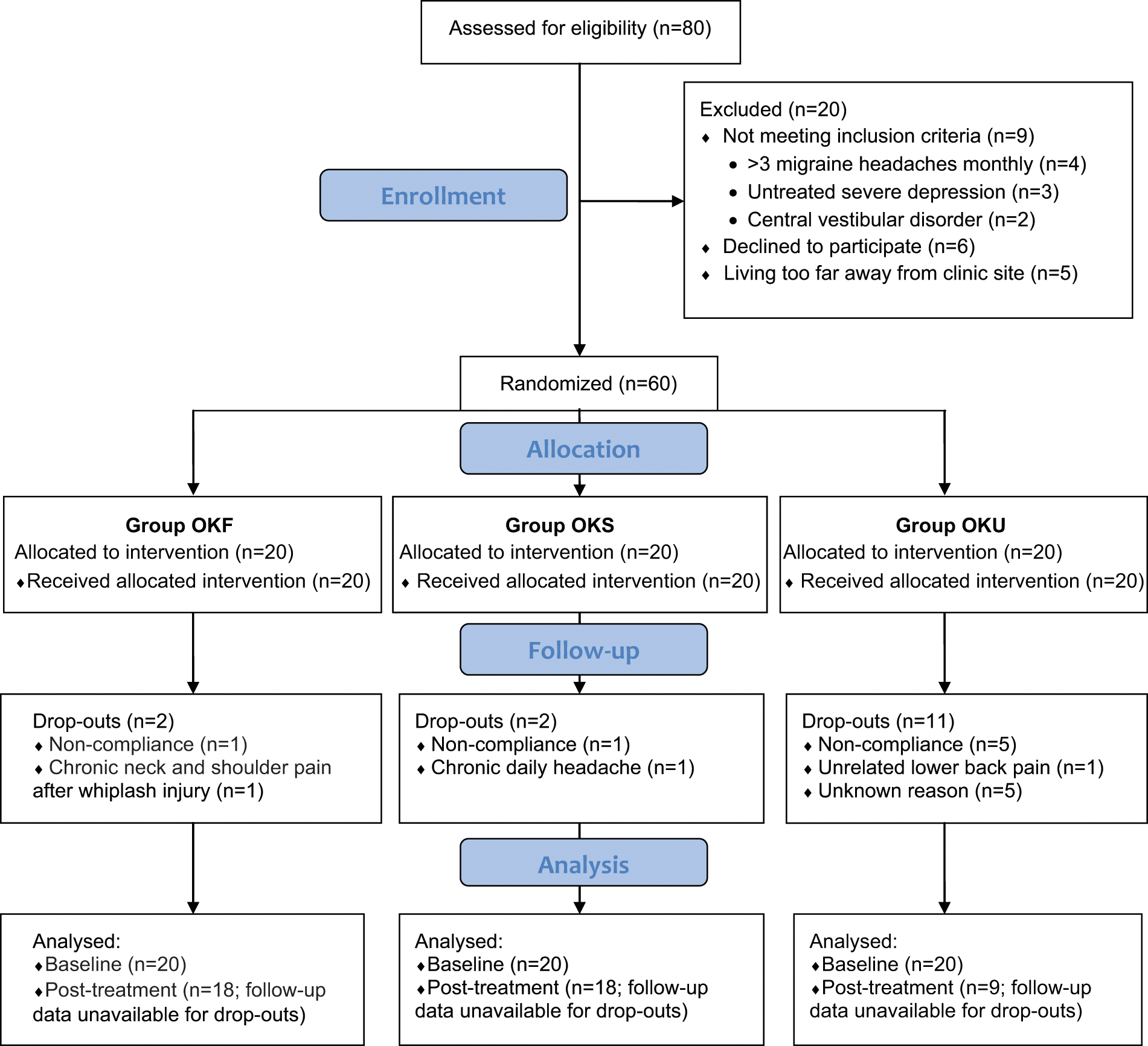
Flow diagram of the study with regard to enrollment, allocation, follow-up, and analysis: All groups received customized vestibular rehabilitation incorporating optokinetic stimulation training via (1) a full-field visual environment rotator (group OKF), (2) supervised DVD (group OKS), or (3) unsupervised DVD (group OKU).
Participants
Between 2007 and 2009, 60 patients were recruited from neuro-otology clinics at the National Hospital for Neurology and Neurosurgery, Queen Square and Charing Cross Hospital, London, UK, after a complete neurological and neuro-otological examination, including Hallpike positional testing, pure tone audiogram, electronystagmography, and caloric testing. Inclusion criteria were (1) clinical diagnosis of a peripheral vestibular disorder, (2) chronic dizziness and/or unsteadiness, (3) 18 to 80 years old, and (4) previous VR program completed with partial/no improvement. Patients with (1) CNS involvement excluding migraine; (2) fluctuating symptoms, for example, active Ménière disease; (3) orthopedic deficit affecting balance and gait; or (4) inability to attend sessions, were excluded. Patients with severe migraine (>3 migrainous headaches monthly) or untreated severe depression (Beck Depression Inventory score >29) were excluded. No significant between-group differences were noted for age, sex, or symptom duration (Table 1).
Participant Characteristics at Baseline
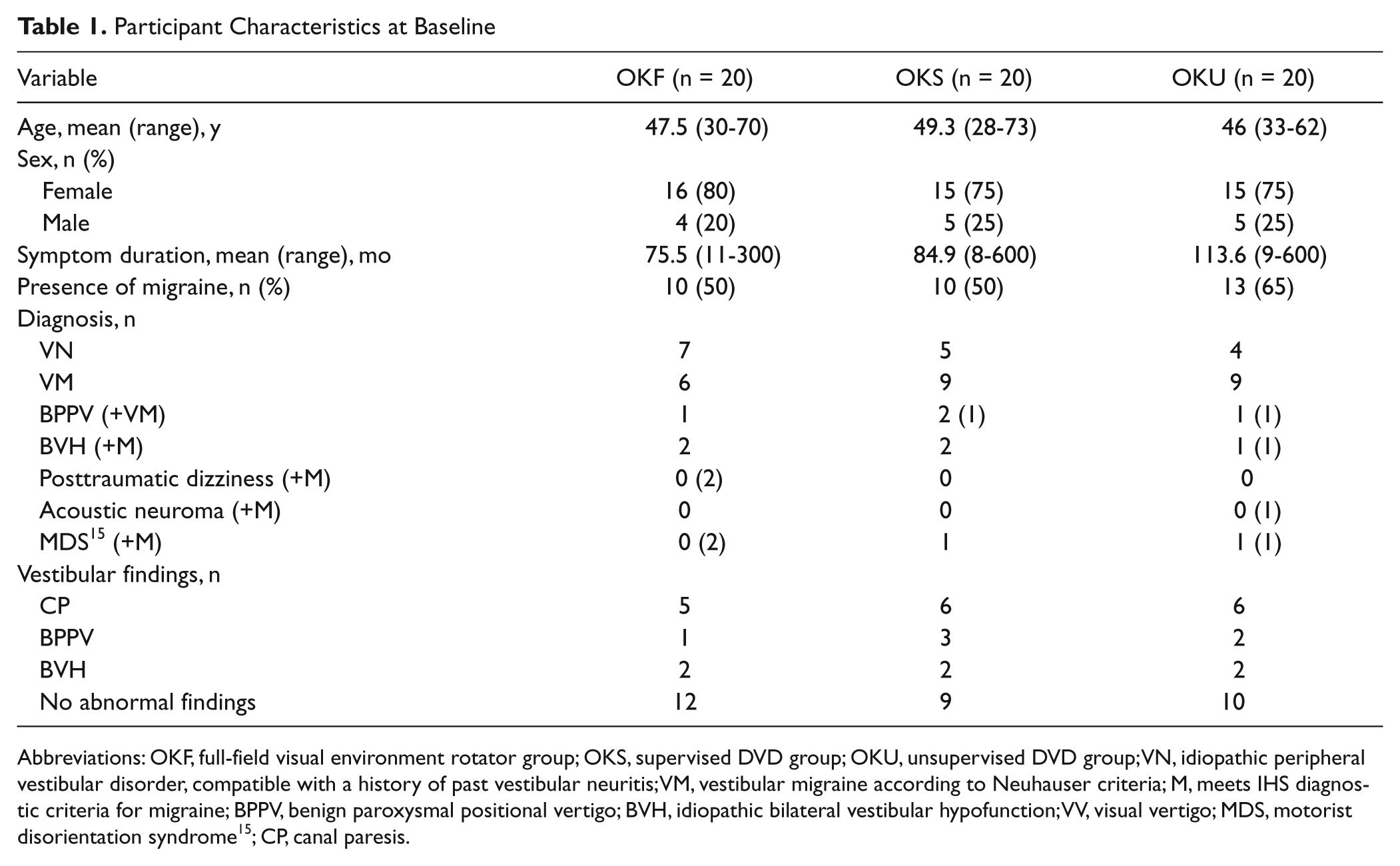
Abbreviations: OKF, full-field visual environment rotator group; OKS, supervised DVD group; OKU, unsupervised DVD group; VN, idiopathic peripheral vestibular disorder, compatible with a history of past vestibular neuritis; VM, vestibular migraine according to Neuhauser criteria; M, meets IHS diagnostic criteria for migraine; BPPV, benign paroxysmal positional vertigo; BVH, idiopathic bilateral vestibular hypofunction; VV, visual vertigo; MDS, motorist disorientation syndrome 15 ; CP, canal paresis.
Patient diagnosis was based on clinical history and/or neuro-otological findings, according to published normal data and limits. 16 All patients with benign paroxysmal positional vertigo entered the study because of a persistent sense of imbalance and dizziness after the condition resolved. In patients with recurrent headaches, migraine was diagnosed if all 5 major International Headache Society criteria for migraine 17 were met (Table 1); vestibular migraine was diagnosed if symptoms fit the Neuhauser criteria. 18 Diagnoses, vestibular findings, and presence of migraine headache for each group are listed in Table 1. Similar to previous findings, 19 50% of patients with chronic peripheral vestibular disorders had normal test results.
Sample Calculation
Sample size was calculated based on the anticipated average score change for the Situational Characteristic Questionnaire (SCQ). 5 Anticipating average outcome values (Tend − Tinitial) of −1.2 (group OKF), −0.8 (group OKS), and −0.4/4 (group OKU) with a common standard deviation of 0.6, 20 patients were required in each group. This was assuming 5% statistical significance, 80% power, a 20% drop-out rate, and adjustments for multiple comparisons.
Outcome Measures
Subjective symptoms, balance, and gait were assessed at baseline and 8 weeks (end of treatment).
Balance and Gait Measures
Computerized dynamic posturography
The Sensory Organization Test was performed according to a published protocol (Equitest; Neurocom International, Oregon). Composite scores range from 0% (no balance) to 100% (maximum stability); scores <70% are considered abnormal. 20
Functional Gait Assessment (FGA 21 ).
This is a 10-item test based on the Dynamic Gait Index. 22 The maximum score is 30; higher scores indicate better performance.
Self-report Measures
All participants completed validated questionnaires regarding symptoms, symptom triggers, and psychological state during the previous month, unless otherwise stated. The primary outcome measure is the SCQ; all other measures are secondary outcomes.
The SCQ7,9 measures frequency of symptom provocation or exacerbation in environments with visual-vestibular conflict or intense visual motion. Scores ≥0.7/4 indicate VV symptoms. 23 The Vertigo Symptom Scale (VSS) 24 assesses common vestibular (VSS-V; eg, lightheadedness, unsteadiness, and/or spinning) and autonomic/somatic anxiety (VSS-A; eg, heart pounding) symptoms. The Beck Depression Inventory 25 assesses depressive symptoms experienced during the “past few days.” Composite scores ≤9 are normal; scores of 10 to 16 indicate mild to moderate depression, 17 to 29 moderate to severe depression, and 30 to 63 severe depression. The Beck Anxiety Inventory 26 assesses anxiety level. Composite scores ≤7 indicate minimal anxiety, 8 to 15 mild anxiety, 16 to 25 moderate anxiety, and >26 severe anxiety.
Treatment
Group OKF and OKS patients attended individual 45- minute weekly physical therapy sessions for 8 weeks and received customized exercises and DVDs with which to practice on days with no clinic attendance. Group OKU patients attended a physical therapy assessment and were provided with customized exercises and a DVD to practice unsupervised for 8 weeks. Treatment goals were (1) improvement of functional balance, gait, and ability to perform daily activities; (2) decrease in symptom severity; and (3) patient education.
All patients in each group were given a diary to record frequency, duration, and symptom level for each customized and DVD exercise practiced daily at home. The diary was reviewed at each session (groups OKF and OKS); group OKU patients were asked to bring it to the final assessment session.
Customized Exercise Program
All patients in every group received a customized home exercise program based on individual functional deficits (neuromuscular, musculoskeletal, and eye-head coordination) and subjective symptoms. All patients practiced 3 to 5 exercises (examples Pavlou et al 5 ) for 1 minute, twice daily, and the movement velocity progressively increased over time. A structured program for gradually increasing daily activities and exposure to symptom-provoking environments was provided.
At each supervised session for groups OKU and OKS, progress was assessed, any concerns discussed, exercises not yet included in the home program were practiced, and exercises were modified to gradually increase task difficulty. For Group OKU, the customized program included individual stages of increasing task difficulty where each exercise was to be stopped and replaced with one from the next stage, when practiced symptom free for three consecutive days to ensure it consistently failed to provoke symptoms.
Optokinetic Training
Optokinetic DVD (all groups)
The DVD comprises 13 sessions, lasting 2 minutes each, in which an optokinetic disc (Figure 2A) or drum rotates (Figure 2B) at constant velocities or sinusoidally, with peak velocities of 40° or 60° s−1. The drum’s stripes are positioned vertically or horizontally. Exercises were divided into progressive levels (beginner, intermediate, and advanced). Patients were instructed to look at the disc’s center, or “stare” ahead in the case of the optokinetic drum. At beginner and intermediate levels, patients practiced this sitting and standing 1 and 0.5 m from the screen but with alternating repetitions of 10 vertical and horizontal head movements at the intermediate level. The advanced level involved watching the video while walking forward/backward without and then with vertical and horizontal head movements or in tandem. For home practice, all groups received the same instruction sheet. In week 1, patients watched 4 optokinetic disc and 2 drum (horizontal stripe) sequences; 2 further sequences were added weekly until all sequences were watched once daily.
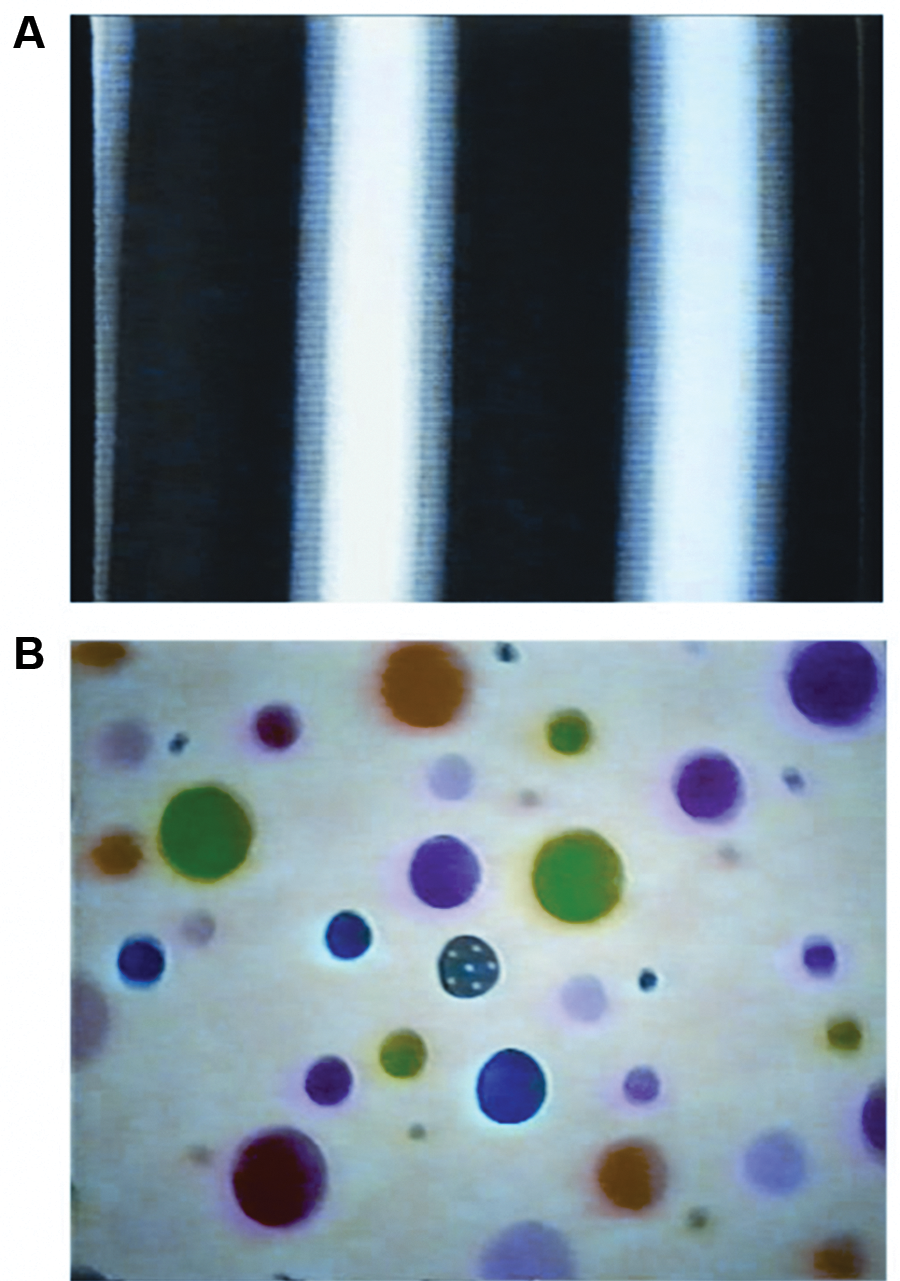
Still images from DVD optokinetic stimuli. A. Still image from an optokinetic drum sequence rotating clockwise at 40° s−1. B. Still image from an optokinetic disc sequence rotating counterclockwise at 60° s−1. Exercises while watching the DVD are divided into a progressive sequence where patients are asked to look at a particular area of the moving image while sitting or standing at varying distances from the screen or during walking toward and away from the screen with and without head movements.
Optokinetic ball (group OKF)
An externally illuminated rotating ball (Stimulopt, Framiral, Cannes, France; Figure 3A) covered with 1-cm reflective metal square pieces, induced a pattern of full-field, multiple rotating white squares (width 12 cm; Figure 3B). An external LED source, whose exact positioning could be adjusted to change projection intensity and accuracy, illuminated the ball. Images were projected by the ball positioned 2.33 m away from a white semicircular wall (area 3.26 m2, height 2.37 m). Exercises with head stationary or while performing various head (vertical and horizontal) movements in sitting or standing 1 and 0.5 m from the wall or while walking alongside or toward/away from it were practiced as the ball rotated clockwise, counterclockwise, or vertically at angular velocities between 6° and 30° s−1, which were the equipment’s minimum and maximum velocities. Patients were instructed to constantly look ahead and try “to stare through the image avoiding following the images with your eyes.” These instructions were provided for two reasons: (1) optic flow desensitization and (2) because by following the images, an optokinetic nystagmus response with a gain of one, a nauseogenic stimulus26, would be generated. This additional stimulus combined with the effect of optic flow may provoke a severe level of symptoms preventing the patient from continuing the session.
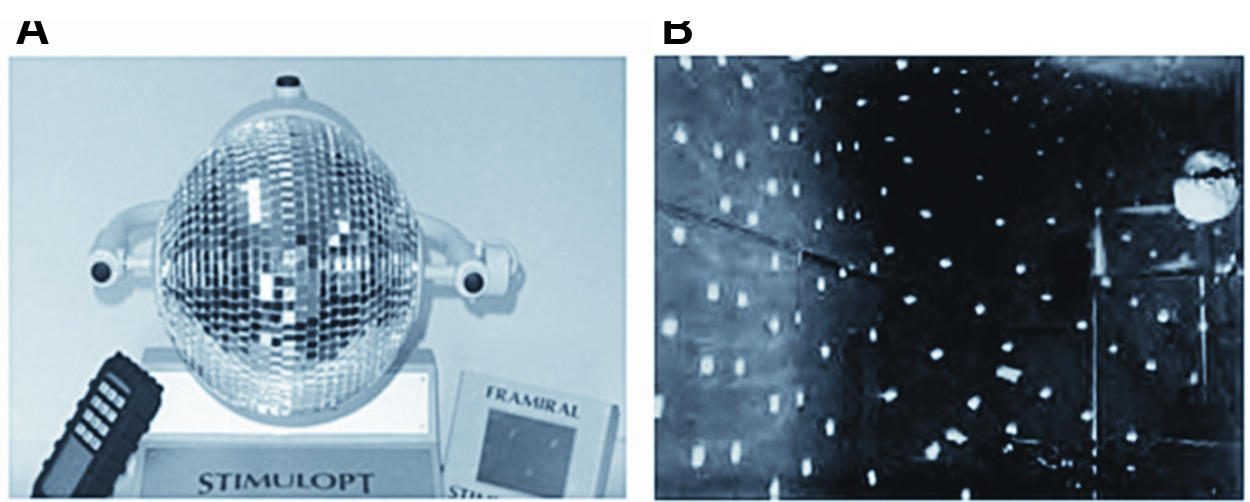
Apparatus used for the “high-tech” full-field simulator-based intervention. A. A photo of the visual environment rotator apparatus (Stimulopt, Framiral, France). B. Participants are asked to stare ahead while the apparatus rotates in different directions and at differing speeds. Participants practice exercises while sitting, standing, and walking either toward and away from the stimulus or alongside it with or without sagittal or horizontal head movements.
Peak velocity discrepancies between the DVD and optokinetic ball relate to each device’s specifications. The DVD was originally developed as an additional form of OK stimulation for home use on days with no clinic attendance in an earlier study 5 and was recorded at the aforementioned velocities.
Exercise progression during supervised sessions (groups OKF and OKS)
At the first session, a maximum of 4 optokinetic ball (group OKF) or DVD (group OKS) sequences (2 horizontal clockwise and counterclockwise sequences at minimum and maximum velocities) were watched sitting 1 m from the wall/screen. Typically, 2 additional exercises were practiced at each session progressively increasing to 14 exercises. Each exercise lasted 2 minutes, followed by a minute’s break and was stopped if a participant felt unable to continue because of nausea/dizziness or symptoms verbally graded at 1 minute were reported as moderate or severe. No exercises were practiced until symptoms subsided to nil or mild. If no symptoms were induced, the exercise was progressed to the next level and/or OKS velocity increased in 5° increments (group OKF only). For group OKS, DVD exercises during supervised sessions were at a more advanced level than those practiced at home. All participants in both groups progressed.
Analysis
SPSS 17 (SPSS Inc, Chicago, Illinois) was used for statistical analysis. Data are presented as mean ± SD. Between-group differences were determined using the Kruskal-Wallis test. Within-group differences pre intervention (baseline) and post intervention (week 8) were analyzed using Wilcoxon signed rank tests. Mann-Whitney U tests compared baseline data between migraineurs and nonmigraineurs. The Pearson χ2 test compared the relationship between treatment group and completion rate. Preliminary screening with Spearman bivariate correlations enabled the selection of covariates (age, symptom duration, and migraine) and a fixed factor (sex) to be tested with analysis of covariance (ANCOVA) models of ranked data; only significant covariate and fixed-factor effects are reported. Spearman correlation assessed the relationship between pretreatment and post treatment changes for objective and self-report measures and for the relationship between psychological symptoms and drop-out rate.
Results
Baseline data for all participants (60) showed no significant differences between treatment groups or study completers (45) and noncompleters (15). At baseline, migraineurs experienced significantly greater autonomic/somatic anxiety symptoms compared with nonmigraineurs (U = 289; z = −2.327; P < .05; Figure 3B). No significant relationship was noted between sex, symptom duration, completion rate, baseline data, and treatment outcome.
Balance and Gait Measures
Posturography
At baseline, 73.3% of scores were abnormal (group OKF, n = 15; group OKS, n = 17; group OKU, n = 12). Within-group improvements (Table 1) were noted only for groups OKF (Z = −3.66; P < .01) and OKS (Z = −2.72; P = .01). In group OKF, 94% of patients improved and in group OKS, 78%. No significant between-group differences were noted (Table 2).
Mean (SD) of Outcome Measures
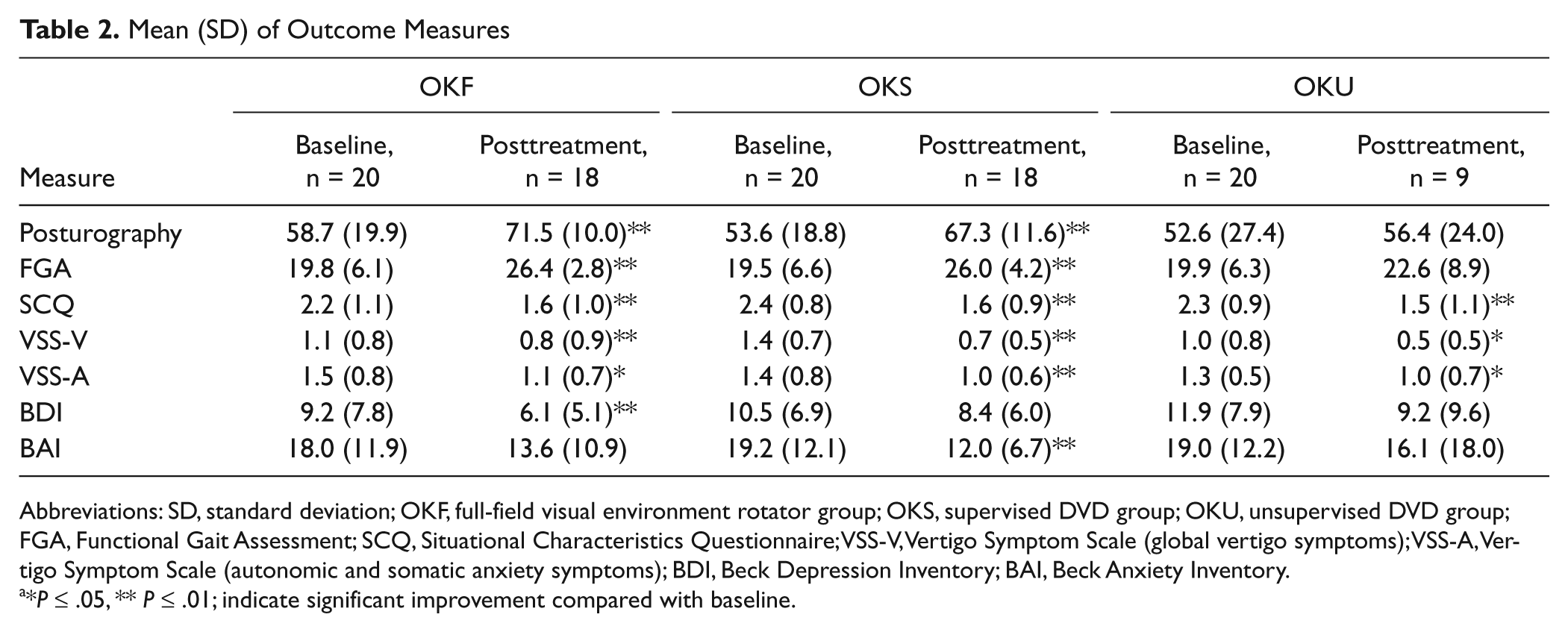
Abbreviations: SD, standard deviation; OKF, full-field visual environment rotator group; OKS, supervised DVD group; OKU, unsupervised DVD group; FGA, Functional Gait Assessment; SCQ, Situational Characteristics Questionnaire; VSS-V, Vertigo Symptom Scale (global vertigo symptoms); VSS-A, Vertigo Symptom Scale (autonomic and somatic anxiety symptoms); BDI, Beck Depression Inventory; BAI, Beck Anxiety Inventory.
*P ≤ .05, ** P ≤ .01; indicate significant improvement compared with baseline.
Patients with bilateral vestibular hypofunction (BVH) were unable to maintain balance in conditions 5 and 6 where vestibular cues play a major role; they did, however, show improvements of 19 and 11 points for group OKF, 17 and 7 points for group OKS, and 16 and 8 for group OKU. They were included in the analysis because their removal did not significantly alter findings.
Functional Gait Assessment
A significant within-group improvement was noted for groups OKF (Z = −3.62; P < .01) and OKS (Z = −3.73; P < .01); group OKU showed a trend toward significance (Z = −1.90, P = .06; Table 2). No significant between-group differences were noted (Table 2). All group OKF and OKS patients and 89% of group OKU patients improved. Age had a significant effect on FGA baseline scores (poorer performance in older patients; F (1, 41) = 48.01, P < .01) and outcome (greater change for older patients; F (1, 41) = 9.14, P < .01).
Questionnaires
No significant between-group differences were noted. All groups showed significant within-group improvements for VSS-S (group OKF: Z = −2.70, P < .01, 67% of patients improved; group OKS: Z = −2.94, P < .01, 78%; group OKU: Z = −2.38, P < .05, 78%), VSS-A (group OKF: Z = −2.42, P < .05, 72%; group OKS: Z = −2.86, P < .01, 78%; group OKU: Z = −1.97, P = .05, 78%), and SCQ (group OKF: Z = −3.16, P < .01, 89%; group OKS: Z = −3.59, P < .01, 89%; group OKU: Z = −2.49, P = .01, 89%). Only group OKF showed a significant within-group improvement for depression scores (Z = −2.59, P = .01, 61%), and group OKS showed a similar improvement for anxiety scores (Z = −2.62, P = .01, 78%). Descriptive data and statistics are displayed in Table 2.
At baseline, scores indicated mild depression for 5 patients in group OKF and 6 in group OKS and group OKU and moderate depression for 3, 4, and 6 patients in groups OKF, OKS, and OKU, respectively. No patient score indicated severe depression because this was an exclusion criterion. Individual baseline scores denoted (1) mild anxiety for 6, 7, and 3 patients; (2) moderate anxiety for 3, 6, and 5 patients; and (3) severe anxiety for 6, 4, and 7 patients in groups OKF, OKS, and OKU, respectively. No correlation was noted between psychological symptoms at baseline and dropout.
When collapsing all patients’ scores independent of group, anxiety score improvements correlated with SCQ improvement (r = 0.34; P < .05). VSS-A improvements significantly correlated with both SCQ (r = 0.34; P < .05) and VSS-S (r = 0.33; P < .05) improvement.
Migraine had a significant effect on pre-post treatment SCQ (F(1, 41) = 7.50, P = .01; Figure 4A) and VSS-A (F(1, 41) = 7.39, P = .01; Figure 4B) change, whereby migraineurs showed greater improvement. Baseline scores indicated elevated SCQ scores for 100% and 89% of patients with and without migraine, respectively; 100% of migraineurs and 82% of nonmigraineurs improved.
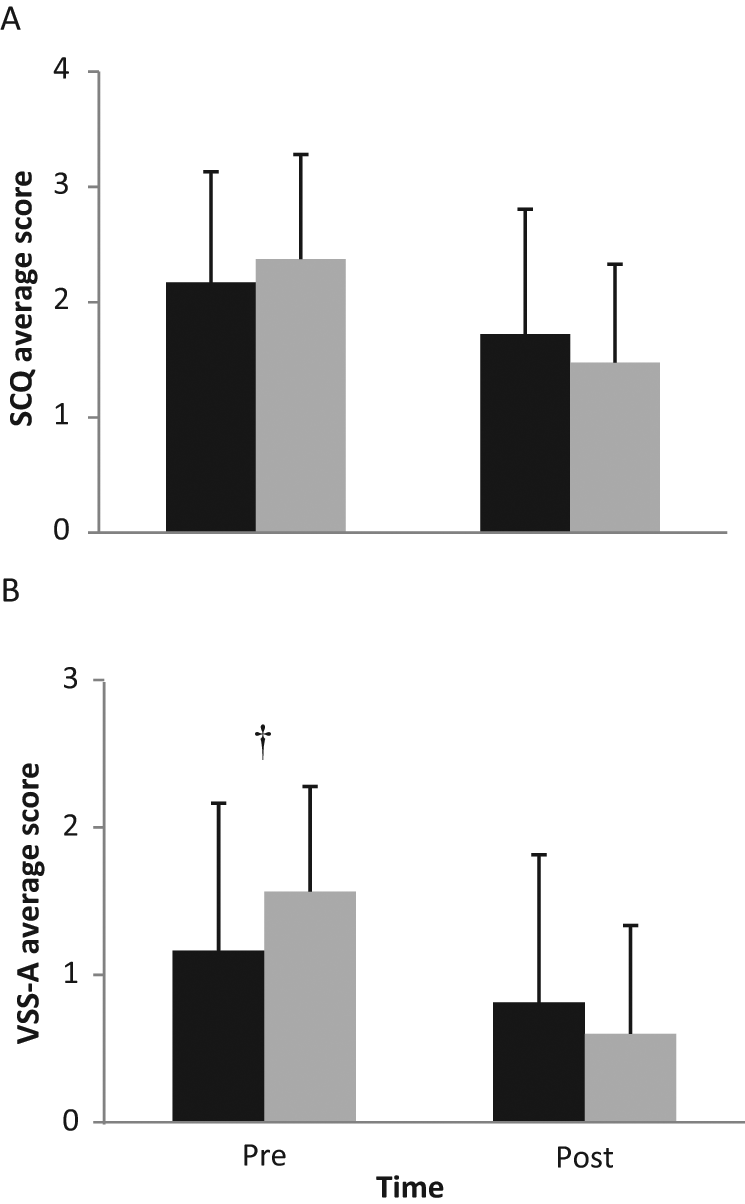
Mean and standard deviation of (A) Situational Characteristic Questionnaire (SCQ) scores for assessment of visual vertigo symptoms and (B) Vertigo Symptom Scale autonomic/somatic anxiety (VSS-A) scores pretreatment and posttreatment for patients with peripheral vestibular dysfunction without (black bars) and with (gray bars) history of migraine headache. “†” Indicates a significant difference between groups (P < .05).
Participation and dropout
A significant relationship was noted between treatment group and completion rate: χ2(2, n = 60) = 14.40; P < .01. The drop-out rate was 10% for groups OKF (noncompliance = 1; chronic neck and shoulder pain after whiplash injury = 1) and OKS (noncompliance = 1; chronic daily headache, present prior to participation in study = 1). The drop-out rate was 55% for group OKU (noncompliance = 5; unrelated lower back injury = 1; unknown reason [patients neither attended final assessment nor replied to e-mail/telephone messages or postal letters] = 5).
Discussion
This study compared the effects of (1) a full-field rotating visual environment (group OKF) versus a DVD, (2) supervised (groups OKF and OKS) versus unsupervised rehabilitation (group OKU), and (3) treated migraine on treatment outcome. A major finding was the 55% drop-out rate for group OKU compared with only 10% for both supervised groups. Within-group analysis showed FGA, posturography, and psychological state significantly improved only for supervised treatment with a significant interaction noted between age and FGA results. Migraine had a significant effect on VV and autonomic symptoms, with migraineurs showing, surprisingly, greater improvement. The discussion is separated into (1) postural stability and gait, (2) subjective symptoms, (3) psychological state, and (4) migraine and treatment outcome.
Postural Stability and Gait
Current results resemble findings showing improved posturography scores following customized VR with or without OK exposure for patients with unilateral vestibular hypofunction or BVH,1,2,5 although the latter remained unable to maintain balance in conditions relying on vestibular cues. As findings are similar to those reported following VR without OK stimulation,1,5 we hypothesize that posturography improvements are primarily a result of the former rather than the latter. As previously reported, approximately 30% of patients had normal posturography scores, and no correlation was noted with outcome measures related to symptom frequency, intensity, and/or triggers, or psychological state. 5
Only groups receiving supervision achieved significant within-group posturography and FGA improvements. Outcome measures detecting a minimal clinically important difference (MCID) over time are necessary in determining an intervention’s efficacy. 28 The MCID for posturography is 10 points in young adults with concussion 29 and 7 points in patients with multiple sclerosis. 30 Although this has not been established for the FGA, it has been reported as an average 6-point improvement based on clinical experience. 31 Both supervised groups achieved the MCID for both measures, regardless of whether they received full- or limited-field-of-view OK exposure, unlike group OKU, which did not. We believe lack of supervision contributed to the findings for group OKU. Frequent assessment allows the timely introduction of more challenging balancing tasks and ensures that exercises are correctly performed, 2 a crucial element of supervised therapy, particularly when considering the implications of posttreatment FGA scores for group OKU.
Reduced gait speed is associated with reduced capacity in functional activities. 32 The FGA includes timed walking at speeds required to safely cross a street (0.5 m/s) 33 and many tasks necessary for functional mobility. 34 Group OKU’s posttreatment FGA score indicates that gait speed and performance on tasks such as walking with head movements remains impaired. Furthermore, group OKU’s posttreatment score is just above the cutoff (22/30) for classifying fall risk and predicting unexplained falls in community-dwelling older adults, 34 whereas scores for both supervised groups improve to normal ranges.
Age significantly influenced FGA results, with older patients showing poorer baseline performance, as previously noted using the Dynamic Gait Index, 35 as well as greater pre-post treatment change, because of a greater capacity for change resulting from poorer baseline scores. The findings emphasize the value of balance rehabilitation for older patients; however, final scores as noted in other work 36 remained significantly lower for older adults, indicating that they continue to perform worse on complex gait tasks.
Subjective Symptoms
Our results agree with work showing that customized VR incorporating OK exposure significantly improves dizziness, postural instability, psychological state, and particularly VV symptoms in patients with chronic vestibular symptoms. 5 However, this is the first study comparing customized VR, incorporating full- or limited-field-of-view OK exposure, supervised and unsupervised.
It is hypothesized that improvements are based on neural adaptability. Optokinetic stimulation induces adaptation of specific vestibular parameters, including postrotational vestibular sensation and vestibular ocular reflex gain in primates, chronic peripheral vestibular patients, and/or healthy individuals.37-40 Recently, short-term repeated exposure to visuovestibular exercises was found to induce adaptive changes, improving the magnitude of visual dependence in healthy controls. 41 Although the current study did not directly measure this, we believe that VV improvements are the result of a decreased overreliance on visual input for perceptual and postural responses. In turn, the underlying mechanism is likely to relate to motion-induced changes in neuronal excitability in visual motion cortical areas (V5/MT). 42
PET scans and functional MRI studies involving small- or large-field OK stimulation without additional vestibular stimulation note activation in cortical areas related to visual motion processing and eye movement control and deactivation of parietoinsular vestibular cortices, indicating a reciprocally inhibitory visual-vestibular interaction.43-45 Similarly, when multisensory vestibular cortex areas are stimulated, bilateral deactivation is noted in visual and somatosensory cortex areas. 43 It is suggested that these interactions have a functional significance and indicate a sensory reweighting process with greater weight given to the more reliable input, thus suppressing the possible mismatch between contrasting sensory information. 45 Recurring exposure to conflicting visual input, as in our study, is also believed to promote reduced visual reliance and foster a more effective use of vestibuloproprioceptive cues through sensory reweighting. 46
Parameters that include frequency, velocity, texture, stimulus area, and position within the visual field influence postural response amplitudes and illusory perceptions of self-motion (ie, vection).47-49 Furthermore, small-field OK stimulation induces steady optokinetic nystagmus, whereas large-field stimulation induces vection, during which increased activity has been noted in, or close to, the cerebellar nodulus. 44 Despite these differences and varying OK parameters used in various studies,43-45,50 both small- and large-field OK stimulation show similar reciprocally inhibitory visual-vestibular interactions, indicating that sensory reweighting occurs independent of visual field size and other aforementioned factors. This may explain why we noted significant VV improvements, both with full- and limited-field-of-view OK stimulation without significant between-group differences.
Because group OKF also viewed the DVD on days with no clinic attendance, it appears that there is no greater benefit to incorporating once weekly full-field OK exposure into VR programs. Earlier work 5 included twice weekly full-field OK exposure incorporating various stimuli, and average VV improvements were greater compared with current results. Our inclusion of migraineurs cannot account for the difference because migraine had a positive effect on VV outcome. It may be that full-field OK exposure frequency or stimulus variety contributed to previous findings, but this cannot be confirmed, and further work is required.
Psychological State
Psychological symptoms are common in patients with peripheral vestibular disorders. 51 It is unclear why within-group depression scores improved significantly only for group OKF and anxiety scores only for group OKS. However, the lack of psychological state change in group OKU is unambiguous and unsurprising. Supervision is believed to implicitly improve psychological status (eg, increasing confidence, providing reassurance, and emphasizing positive effects of VR). 2 Our findings appear to indicate a direct relationship between supervision, motivation, and compliance, with an unacceptable 55% drop-out rate for the nonsupervised group.
Poor exercise compliance is a well-recognized problem across clinical populations, with reports of up to 70%. 52 Reasons for noncompliance are multifactorial, 52 including perceived barriers (ie, lack of time), lack of positive feedback, support, and particularly motivation for unsupervised programs. In Ménière disease patients, the main reasons for noncompliance with an unsupervised VR program were symptom severity or aggravation by therapy with a similar, albeit higher rate than ours, at 62.5%. 53
However, autonomic/somatic anxiety improvement significantly correlated with both VV and VSS-S improvements, whereas anxiety score improvements related only to VV improvements. Therefore, supervision, its associated psychological effects, and subjective symptom improvements appear to influence improvement of psychological variables. 5
Many similarities, including addressing distressing symptoms and functional impairments, promoting habituation, gradual exposure to symptoms and provoking situations, and challenging negative beliefs, exist between VR and cognitive-behavioral therapy (CBT). 54 Studies comparing VR with explicit CBT with waiting-list controls or no control group demonstrate improvements in patients’ coping ability, function, symptoms, and care satisfaction. 55 However, the clear additional effect of combining CBT with VR remains unknown.
All groups continue to indicate mild anxiety posttreatment, which may partly relate to the observation that anxiety and psychiatric problems often exist prior to vestibular disorder onset. 51 Mild remaining VV symptoms posttreatment may have also influenced final anxiety scores.
Migraine and Treatment Outcome
Current results agree with findings reporting that patients with vestibular dysfunction and migraine history can adhere to and benefit from VR.14,56 The new finding is that patients with treated migraine also tolerate structured OK exposure, and migraine history does not influence the drop-out rate. Subjective vestibular symptoms and psychological state improvements were similar in migraineurs and nonmigraineurs, and migraine history, as previously reported, 56 did not influence postural and gait responses. However, migraine significantly affected VV and autonomic/somatic anxiety scores.
Migraineurs showed significantly elevated baseline autonomic/somatic anxiety scores. However, scores improved significantly with a greater pre-post treatment change compared with nonmigraineurs. Our work differs from studies demonstrating significant improvements in all Dizziness Handicap Inventory (DHI) scores apart from the emotional subscale in persons with migraine-associated dizziness 14 and less improvement in the self-perception of dizziness in persons with peripheral vestibular dysfunction and migraine. 56 We believe that the discrepancy with current findings is a result of the OK exposure and resulting VV improvements noted, which significantly correlated with VSS-A and anxiety score improvements. Participant numbers were insufficient to compare patients with vestibular migraine with those with migraine headache and other etiologies in regard to their symptoms of unsteadiness and/or dizziness. The analysis included all patients with migraine because removing the latter did not alter findings.
Baseline VV symptoms were significantly elevated and similar for migraineurs and nonmigraineurs. Studies showing increased visual cortical excitability both in patients with BVH 50 and migraineurs 57 support these findings. In migraineurs, this response persists during the interictal state 58 and is further enhanced in patients with chronic daily headache, 59 which may explain why the patient with this diagnosis could not complete the study.
As OK exposure increases migraineurs’ symptoms, 60 they would be expected to perform less well. However, a higher percentage of migraineurs reported VV improvements that were significantly greater compared with those for nonmigraineurs. Previous authors suggested that medication may help control VV symptoms in migraineurs enabling better exercise tolerance. 14 All participants with >3 migraines per month had been treated with prophylactic medication prior to commencing the study. Medication though was not controlled for, apart from no patients changing medication during the study, and therefore, its role in VV improvements cannot be clarified.
Conclusion
The visual motion DVD may be an economical, clinic friendly, and effective method of incorporating OK exposure into VR programs. Patients with migraine can tolerate and benefit from OK exposure. However, supervision promotes greater compliance and improvements in postural stability and psychological state. Future research should investigate optimal treatment duration, stimulus, long-term benefit, and the role of medication, particularly for VV improvements in vestibular patients with migraine.
Footnotes
Acknowledgements
The authors would like to thank Dr Bernard Cohen for his guidance in using the optokinetic ball and Mr Peter Milligan for statistical advice.
Declaration of Conflicting Interests
The author(s) declared no potential conflicts of interest with respect to the research, authorship, and/or publication of this article.
Funding
The author(s) received no financial support for the research, authorship, and/or publication of this article.