




Abstract
Background. In addition to cognitive dysfunction, locomotor deficits are prevalent in traumatic brain injured (TBI) patients; however, it is unclear how a concussive injury can affect spinal cord centers. Moreover, there are no current efficient treatments that can counteract the broad pathology associated with TBI. Objective. The authors have investigated potential molecular basis for the disruptive effects of TBI on spinal cord and hippocampus and the neuroprotection of a curcumin derivative to reduce the effects of experimental TBI. Methods. The authors performed fluid percussion injury (FPI) and then rats were exposed to dietary supplementation of the curcumin derivative (CNB-001; 500 ppm). The curry spice curcumin has protective capacity in animal models of neurodegenerative diseases, and the curcumin derivative has enhanced brain absorption and biological activity. Results. The results show that FPI in rats, in addition to reducing learning ability, reduced locomotor performance. Behavioral deficits were accompanied by reductions in molecular systems important for synaptic plasticity underlying behavioral plasticity in the brain and spinal cord. The post-TBI dietary supplementation of the curcumin derivative normalized levels of BDNF, and its downstream effectors on synaptic plasticity (CREB, synapsin I) and neuronal signaling (CaMKII), as well as levels of oxidative stress–related molecules (SOD, Sir2). Conclusions. These studies define a mechanism by which TBI can compromise centers related to cognitive processing and locomotion. The findings also show the influence of the curcumin derivative on synaptic plasticity events in the brain and spinal cord and emphasize the therapeutic potential of this noninvasive dietary intervention for TBI.
Introduction
Traumatic brain injury (TBI) is a leading cause of death and disability in civilian and military individuals aged 45 years and younger. 1,2 The health care problem related to the disability causes serious hardships to its victims, their families, and the economy. It has been well accepted that TBI promotes cognitive deficits in humans, 3-5 conditions that can be reproduced in animals. 6-8 Locomotor deficits are also a prevalent consequence of human TBI. 3 Patients with moderate to severe TBI show reduced stride length, decreased walking speed, and temporal asymmetry, 9,10 particularly under challenging walking situations. 11 Some of these conditions have been modeled in rodents using controlled cortical impact injury, which is characterized by prominent neuronal death. 12,13 By using a beam walk task test to measure fine motor coordination, Fox et al 6 found pronounced deficits for at least 2 and 4 weeks following mild and moderate controlled cortical impact in mice. Concussive brain injury is also associated with gait deficits in human patients 14 in spite of minimal neuronal death, and its physiological and molecular mechanisms are poorly understood. We have initiated studies to understand better how a brain concussion can result in the neurological sequel of cognitive and motor disorders, up to the point to affect infraspinal centers that control locomotion.
Brain-derived neurotrophic factor (BDNF) likely plays a major role on the pathology of TBI as it has been associated with the function of neural circuits important for cognitive processing and locomotor control. For example, cognitive impairment and reduced levels of hippocampal BDNF secondary to experimental TBI 8,15 can be counteracted by exercise-induced BDNF. 16 In turn, reduction of BDNF levels after spinal cord injury has been related to locomotor deficit. 17,18 The powerful actions of BDNF on synaptic facilitation and neuronal excitability 19-22 may be crucial for the restorative effects of BDNF following TBI. In particular, BDNF promotes phosphorylation 23 of synapsin I involved in neurotransmitter release, axonal elongation, and maintenance of synaptic contacts. 24,25 CREB, a transcription factor involved in learning and memory, is an important modulator of gene expression induced by BDNF. 26 CaMKII has been implicated with the action of BDNF on neuronal signaling and synaptic plasticity. 27 Understanding the events that arrest proper neuronal function can lead to major advances in the development of treatments to reduce the effects of TBI.
There are no efficient treatments to reduce the consequences of TBI. The phenolic yellow curry pigment curcumin, supported by a long curative tradition in India, 28 has shown promise to protect the brain when supplemented into the diet before TBI. 29 In the current studies we have used a curcumin derivative CNB-001, which is rapidly absorbed into the blood and brain and is biologically stable and neuroprotective. 30 In particular, we have evaluated the possibility that the curcumin derivative supplemented in the diet after experimental brain concussive injury can have comprehensive restorative action on centers that control cognition and locomotion, involving the action of BDNF-mediated synaptic plasticity. The noninvasive and physiological nature of a therapy based on diet has the promise to lead to treatments that can be easily translated to humans to reduce the consequences of TBI.
Materials and Methods
Experimental Design and Tissue Preparation
Male Sprague-Dawley rats (Charles River Laboratories, Inc, Wilmington, Massachusetts), weighing between 200 and 240 g, were housed in cages (1 rat per cage) and maintained in environmentally controlled rooms (22-24°C) with a 12-hour light/dark cycle. After acclimatization for 1 week on standard rat chow, 1 set of rats (n = 6-8 per group) were exposed to fluid percussion injury (FPI) or sham injury and then maintained on regular diet (RD) or special diet containing curcumin derivative CNB-001 (CD, 500 ppm) for 2 weeks. The rats were divided into 4 groups: RD-Sham, CD-Sham, RD-FPI, and CD-FPI. The diets, fed ad libitum, were provided in powder form (TestDiet, Inc, Richmond, Indiana) in a large bowl and contained a standard vitamin and mineral mix with all essential nutrients. At the end of experiments, the rats were killed by decapitation, the brain and spinal cord were rapidly dissected, frozen on dry ice, and stored at −70°C until use for biochemical analyses. Another set of rats (n = 5 per group) used for immunohistochemistry was perfused with 4% paraformaldehyde. The 25-µm-thick coronal sections spanning the hippocampus from each brain or lumbar region of spinal cord were cut on a cryostat for immunohistochemistry. All experiments were performed in accordance with the US National Institutes of Health Guide for the Care and Use of Laboratory Animals and were approved by the University of California at Los Angeles Chancellor’s Animal Research Committee. The suffering and number of animals used were minimized.
We used curcumin hybrid molecule curcumin derivative CNB-001 (CD) based on its capacity to penetrate the brain and maintain high biological activity. 30 Rats fed CD diet and regular diet after FPI were compared, and the therapeutic potential of CD was evaluated by behavioral tests including Morris water maze and beam walk along with biochemical markers for oxidative stress and synaptic plasticity. We also explored the effects of FPI and CD on BDNF’s downstream effectors such as synapsin I and CREB, as well as on superoxide dismutase (SOD) and Sir2 levels. Both SOD and Sir2 have been implicated in protection against oxidative damage after TBI. 31,32
A moderate fluid percussion was performed as previously described. 8 The cognitive testing was performed in a water maze as described previously. 33 The beam walk test was performed as previously described with minor modifications for this study. 34 This test was used to evaluate the fine motor coordination for all animals at days 1, 3, and 7 after TBI. The device consists of a narrow wooden beam 10 mm wide and 180 mm in length, which is suspended 400 mm from the tabletop. The rats, placed on one end of the beam, walked both directions of the beam. We observed all limbs and the number of foot faults over 50 steps for the right hind limb recorded were counted in either direction on the beam.
The protein levels of BDNF, synapsin I, CREB, CaMKII, and Akt were analyzed by western blot. 8 The mRNAs for BDNF, synapsin I, CREB, and CaMKII were measured by TaqMan reverse transcriptase polymerase chain reaction (RT-PCR) as previously described. 8,27 Serial coronal sections (25 µm) from brain were cut on a cryostat, mounted to gelatin-coated slides, and processed for immunohistochemistry of BDNF, synapsin I, and CREB, as previously described. 8,35,36 The amounts of oxidized proteins containing carbonyl groups were measured using an Oxyblot kit (Intergen, Purchase, New York) as previously described. 33
Statistical Analysis
Actin was employed as internal standard for Western blot. The RD-fed rats with sham surgery were regarded as experimental controls for comparisons with other experimental groups. For Western blots, the values were expressed as a ratio of actin value and then converted to percentage of sham group as presented in bar figures and represented the mean ± standard error of the mean (SEM). By using software SPSS 16, the data were analyzed by 2-way analysis of variance (ANOVA) (diet vs injury) followed by Fishers protected least significance post hoc test. Statistical differences were considered significant at P < .05.
Results
Curcumin Derivative Compensates for Deficits in Locomotion After TBI
We used a beam walk test to detect fine motor coordination 6,34 such that the number of errors (foot faults) made by the right hind limb over 50 steps was recorded. The rats were trained before injury, and the test was performed at days 1, 3, and 7 after lesion. Typical representations of animal stepping in the beam walk test are shown in Figure 1A and B. The foot faults in FPI-RD rats were significantly higher than that in Sham-RD rats (18.0 ± 1.2 vs 4.8 ± 0.3 at day 1, P < .01; 20.0 ± 0.7 vs 4.5 ± 0.2 at day 3, P < .01; 14.4 ± 0.6 vs 2.8 ± 0.3 at day 7, P < .01; Figure 1C) at all 3 days. The foot faults were significantly reduced in FPI-CD rats at all 3 days compared with untreated FPI-RD rats (11.4 ± 0.4 vs 18.0 ± 1.2 at day 1, P < .05; 9.4 ± 0.4 vs 20.0 ± 0.7 at day 3, P < .05; 9.8 ± 0.4 vs 14.4 ± 0.6 at day 7, P < .05; Figure 1C).
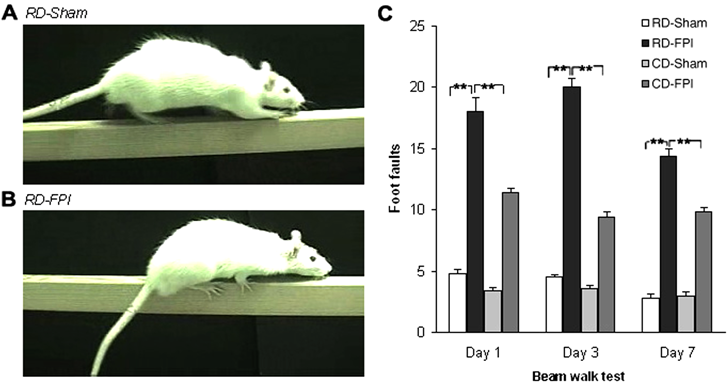
Curcumin derivative supplementation provides protection against behavior deficits in fluid percussion injury (FPI) rats. The foot faults in FPI rats (B) at all 3 days were significantly higher than that in sham rats fed regular diet (RD; A), whereas they were significantly reduced in FPI rats-fed curcumin derivative (CD) diet compared with untreated FPI rats. (C) Fine motor coordination test on a beam walk apparatus. Deficits in coordination were expressed as foot faults. **P < .01.
Curcumin Derivative Normalizes BDNF mRNA and Protein Levels in Spinal Cord After TBI
Molecular studies in the spinal cord were focused on mRNA assessments to discern local changes in the various markers as opposite to protein modifications that may originate from brain. Levels of BDNF mRNA were measured in the cervical (Figure 2A) and lumbar (Figure 2B) regions of the spinal cord.
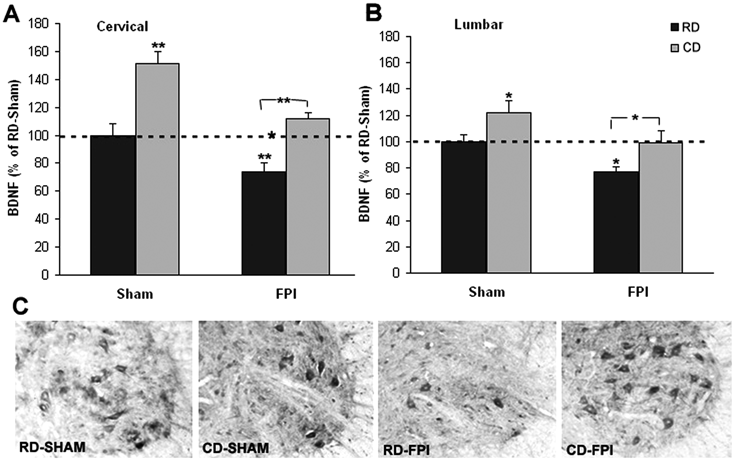
Curcumin derivative (CD) supplementation increases brain-derived neurotrophic factor (BDNF) mRNA and protein levels in the spinal cord of fluid percussion injury (FPI) rats. BDNF mRNA levels in cervical (A) and lumbar (B) regions were determined by reverse transcriptase polymerase chain reaction. FPI resulted in reduction of BDNF mRNA levels in both regions of the spinal cord in regular diet (RD) rats, which was preserved by CD supplementation. (C) There was a marked reduction in BDNF labeling in the motoneurons in the lumbar spinal cord of FPI rats, but CD supplementation preserved BDNF labeling in those regions. *P < .05. **P < .01.
Cervical region
The levels of BDNF mRNA in FPI rats (FPI-RD) were reduced to 74% of RD-Sham (Figure 2A; P < .01). After curcumin derivative supplementation, the levels of BDNF mRNA in FPI rats (FPI-CD) were increased to 112% of RD-Sham, such that BDNF levels in FPI-CD rats were significantly elevated relative to FPI-RD rats (Figure 2A; P < .01). Curcumin derivative treatment also elevated levels of BDNF in sham animals (CD-sham) to 151% of RD-Sham (Figure 2A; P < .01).
Lumbar region
The levels of BDNF mRNA in TBI rats (FPI-RD) were reduced to 77% of RD-Sham (Figure 2B; P < .05); however, curcumin derivative supplementation elevated BDNF mRNA to 99% of RD-Sham. The BDNF mRNA increase in TBI-CD rats was also significant relative to FPI-RD rats (Figure 2B; P < .05). Curcumin derivative treatment also elevated levels of BDNF mRNA in sham rats (CD-sham) to 122% of RD-Sham (Figure 2B; P < .05).
We used immunohistochemistry to evaluate the phenotypic manifestation of mRNA alterations. Qualitative immunohistochemical analysis showed that there was a marked reduction in BDNF labeling in motor neurons in the right (contralateral to the FPI) ventral lumbar region of spinal cord in FPI rats, but curcumin derivative supplementation preserved BDNF labeling in this region (Figure 2C). The curcumin derivative alone also showed a qualitative increase in BDNF immunostaining in the same region (Figure 2C).
Curcumin Derivative Normalizes Synaptic Plasticity Markers in Spinal Cord After TBI
Synapsin I mRNA was measured in the cervical and lumbar (Figure 3A) regions of the spinal cord.
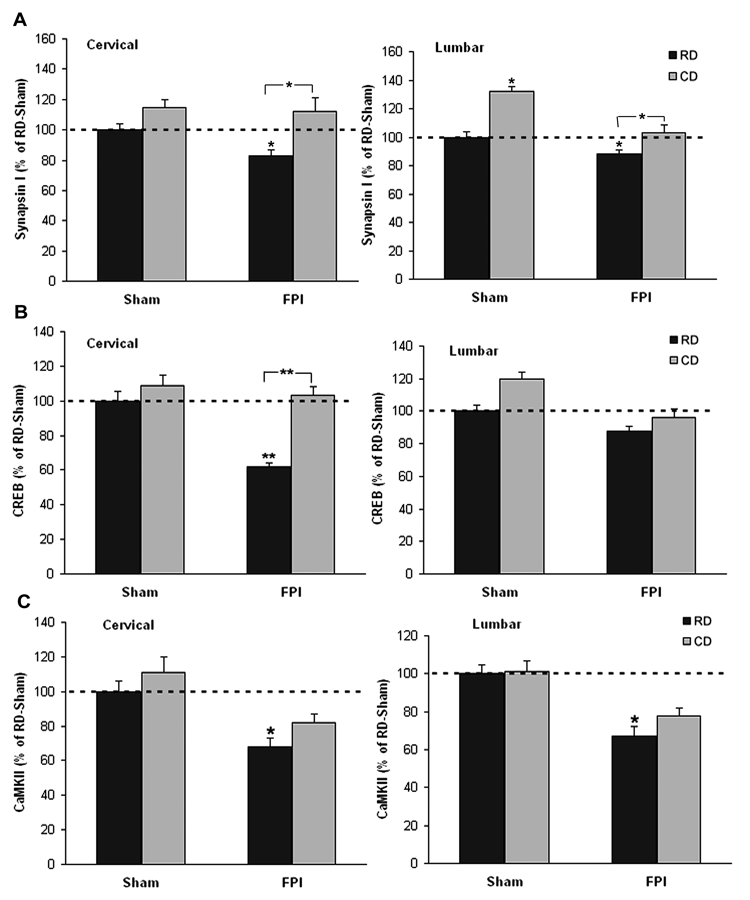
Synapsin I, CREB, and CaMKII mRNA levels in the spinal cord of FPI rats. Synapsin I (A), CREB (B), and CaMKII (C) mRNA levels in cervical and lumbar regions were determined by reverse transcriptase polymerase chain reaction. FPI, fluid percussion injury; RD, regular diet; CD, curcumin derivative diet. *P < .05.
Cervical region
FPI reduced the levels of synapsin I mRNA to 83% of RD-Sham (Figure 3A; P < .05). Curcumin derivative supplementation elevated the levels of synapsin I mRNA in FPI rats (FPI-CD) to 112% of RD-Sham and to 115% of RD-Sham in sham rats (Sham-CD; Figure 3A). There was a significant difference in synapsin I mRNA levels between FPI-RD rats and FPI-CD rats (Figure 3A; P < .05).
Lumbar region
The levels of synapsin I mRNA were 88% of RD-Sham in FPI-RD rats (Figure 3A; P < .05), 103% of RD-Sham in FPI-CD rats. The synapsin I mRNA levels were 132% (Figure 3A; P < .05) of RD-Sham in Sham-CD rats. There were also significant differences in synapsin I mRNA levels in the lumbar region between FPI rats and FPI-CD rats (Figure 3A; P < .05).
CREB mRNA was measured in the cervical and lumbar (Figure 3B) regions of the spinal cord.
Cervical region
In FPI-RD rats, the levels of CREB mRNA were 62% of RD-Sham (Figure 3B; P < .01). After curcumin derivative supplementation, the levels of CREB mRNA in the same region were 103% of RD-Sham in FPI-CD rats and 109% of RD-Sham in Sham-CD (Figure 3B). There were significant differences in CREB mRNA levels between FPI-RD rats and FPI-CD rats (Figure 3B; P < .01).
Lumbar region
The levels of CREB mRNA were 88% of RD-Sham in FPI-RD rats (Figure 3B) and 96% of RD-Sham in FPI-CD rats (Figure 3B). The CREB mRNA levels were 120% of RD-Sham in Sham-CD rats (Figure 3B).
CaMKII mRNA was measured in the cervical and lumbar (Figure 3C) regions of the spinal cord.
Cervical region
In FPI-RD rats, the levels of CaMKII mRNA were 68% of RD-Sham (Figure 3C; P < .05). After curcumin derivative supplementation, the levels of CaMKII mRNA were 82% of RD-Sham in FPI-CD rats and 111% of RD-Sham in Sham-CD rats (Figure 3C).
Lumbar region
The levels of CaMKII mRNA were 67% of RD-Sham in FPI-RD rats (Figure 3C; P < .05) and 78% of RD-Sham in FPI-CD rats. The CaMKII mRNA levels were 101% of RD-Sham in Sham-CD rats (Figure 3C).
Curcumin Derivative Normalizes BDNF Levels in Hippocampus After TBI
BDNF levels in the left hippocampus of the injured side of the brain decline after TBI. 15 We found that TBI resulted in reduced BDNF (67% of RD-Sham, P < .05; Figure 4A) in rats fed regular diet (FPI-RD). Curcumin derivative increased the levels of BDNF (86% of RD-Sham, P > .05; Figure 4A) in FPI-CD rats compared with untreated FPI-RD rats. Immunohistochemical analysis showed that there was a marked reduction in BDNF labeling in the CA3 and DG of hippocampus in FPI rats, but curcumin derivative supplementation preserved BDNF labeling in those regions (Figure 4B).
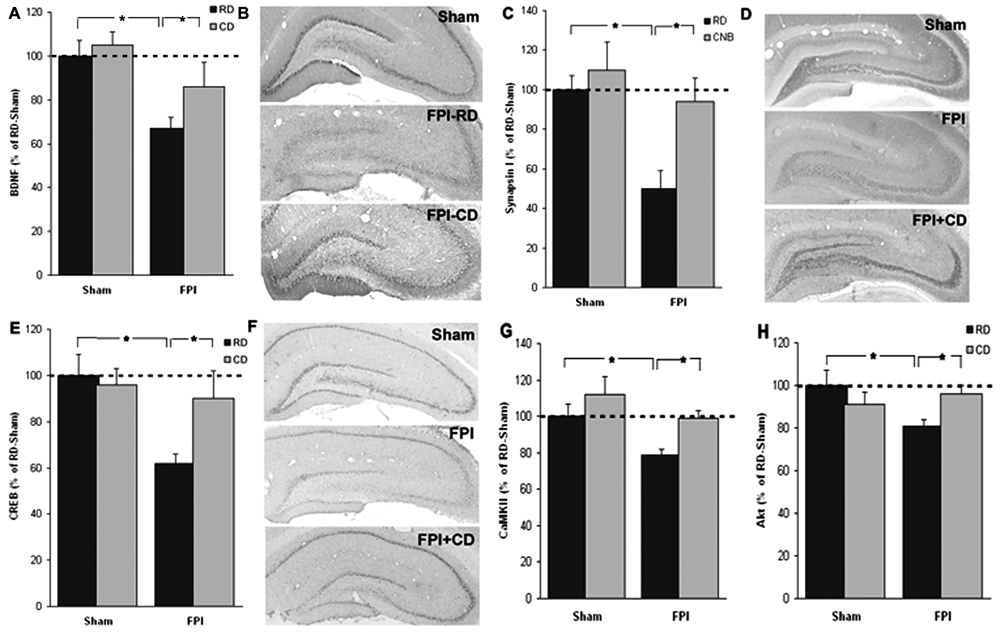
Curcumin derivative supplementation increases brain-derived neurotrophic factor (BDNF), synapsin I, CREB, CaMKII, and Akt levels in the hippocampus of fluid percussion injury (FPI) rats. BDNF (A), synapsin I (C), CREB (E), CaMKII (G), and Akt (H) protein levels were determined by Western blot. FPI resulted in reduction of all molecules in regular diet (RD) rats, which was reversed by curcumin derivative (CD) supplementation. There was a marked reduction in BDNF (B), synapsin I (D), CREB (F) labeling in the CA3 and DG of hippocampus in FPI rats, but CD supplementation preserved BDNF, synapsin I, and CREB labeling in those regions. *P < .05.
Curcumin Derivative Normalizes Synaptic Plasticity Effectors in Hippocampus After TBI
BDNF facilitates synaptic transmission and regulates gene expression through activation of synapsin I and CREB. 23,25,26,37 Our previous report indicates that TBI may affect cognitive ability by compromising some of the action of BDNF on synaptic plasticity. 8 To investigate whether curcumin derivative supplemented in the diet can protect against disrupted synaptic plasticity after TBI, we measured the protein expression of synapsin I in the hippocampus by Western blot analysis. The results showed that supplementation of curcumin derivative significantly increased levels of synapsin I in FPI-CD rats compared with untreated FPI-RD animals (94% vs 50% of RD-sham, P < .05; Figure 4C). We also measured the protein expression of CREB in the hippocampus by Western blot analysis. The results showed that supplementation of curcumin derivative significantly increased levels of CREB in FPI-CD rats compared with untreated FPI-RD animals (90% vs 62% of RD-sham, P < .05; Figure 4E).
Qualitative immunohistochemical analysis showed that there was a marked reduction in synapsin I (Figure 4D) and CREB (Figure 4F) labeling in the CA3 and DG of hippocampus in FPI rats, but curcumin derivative supplementation preserved immunolabeling of both in those regions.
Finally, we measured CaMKII levels based on its involvement in the effects of BDNF on hippocampal learning and memory. 27 We found that TBI resulted in reduced CaMKII (79% of RD-Sham, P < .05; Figure 4G) in rats fed the regular diet. Curcumin derivative supplemented in the diet elevated the levels of CaMKII (99% of RD-Sham; Figure 4G) in FPI-CD rats. We also measured the protein expression of Akt in the hippocampus by Western blot analysis. These results show that supplementation of curcumin derivative significantly increased levels of Akt in FPI-CD rats compared with untreated FPI-RD animals (96% vs 81% of RD-sham, P < .05; Figure 4H).
Curcumin Derivative Normalizes Oxidative Markers in Hippocampus After TBI
To evaluate the oxidative damage induced by TBI, we analyzed the oxidized protein levels in the hippocampus by using Western blotting of DNPH-derivatized carbonyl groups. Representative examples are shown in Figure 5A. There were increased oxidized protein levels in FPI-RD rats (200% of RD-Sham, P < .01; Figure 5B). Curcumin derivative supplementation decreased the oxidized protein levels in FPI-CD rats compared with untreated FPI-RD rats (84% vs 200% of RD-Sham, P < .01; Figure 5B).
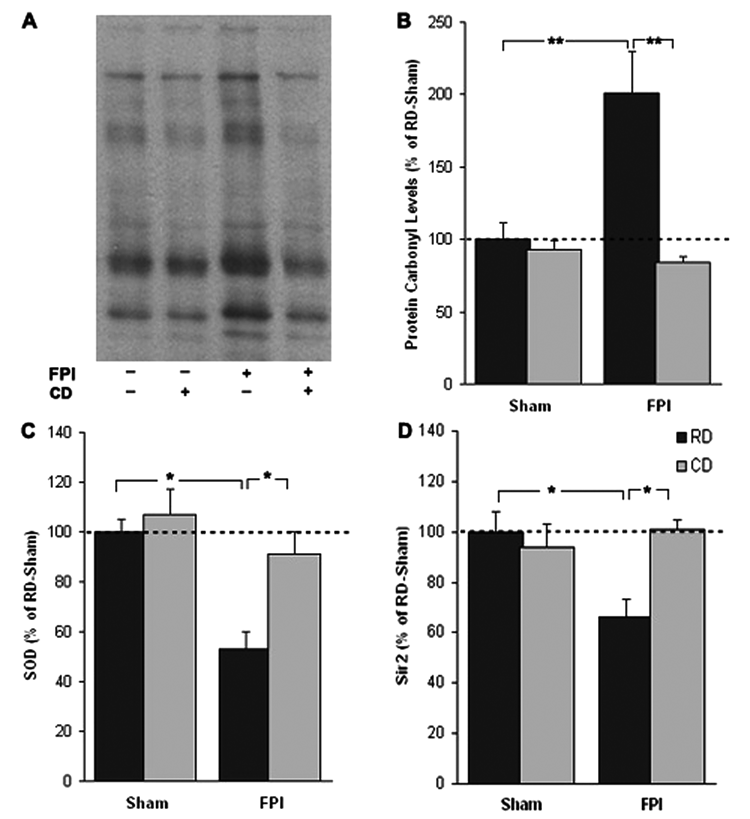
Curcumin derivative supplementation provides protection against oxidative damage in fluid percussion injury (FPI) rats. (A and B) Measurements of oxidized protein levels in the hippocampus. The oxidized protein levels were determined by Oxyblot kit. FPI resulted in higher oxidized protein levels compared with sham animals, whereas supplementation of curcumin derivative (CD) in the diet dramatically reduced the FPI-induced elevation of protein carbonyl levels. The values were converted to percentage of regular diet (RD) sham (mean ± SEM). (C) Supplementation of CD significantly increased levels of SOD in FPI rats compared with untreated FPI animals. (D) Supplementation of CD also significantly increased levels of Sir2 in FPI rats compared with untreated FPI animals. The values were converted to percentage of RD sham (mean ± SEM). *P < .05. **P < .01.
We next measured SOD levels because of its involvement in the antioxidant system that declines after TBI. 32 We found that FPI resulted in reduced SOD (53% of RD-Sham, P < .05; Figure 5C) in FPI-RD rats. Curcumin derivative increased the levels of SOD (91% of RD-Sham; Figure 5C) in FPI-CD rats compared with untreated FPI-RD rats.
Since Sir2 has been shown to mediate the elevation of antioxidant system involving SOD, we also measured Sir2 levels. FPI resulted in reduced Sir2 (66% of RD-Sham, P < .05; Figure 5D) in FPI-RD rats, but curcumin derivative elevated the levels of Sir2 (101% of RD-Sham; Figure 5D) in FPI-CD rats compared with untreated FPI-RD rats.
Curcumin Derivative Compensates for Deficits in Learning After TBI
Our previous study demonstrated impairment of cognitive function in FPI animals. 8 To determine whether supplementation of CD can provide protection from cognitive impairment following FPI, we maintained some rats on the regular diet containing 500 ppm CD starting immediately after injury. Repeated-measures ANOVA showed that there was significance in learning behavior in all groups (F 3,23 = 6.4; P < .05). Rats subjected to FPI displayed reduced learning ability (ie, the latency to find the platform at day 3 during learning test: 47.1 ± 3.3 seconds in FPI-RD rats vs 32.2 ± 6.0 seconds in Sham-RD rats; P < .05, LSD post hoc test, Figure 6). Supplementation with curcumin derivative increased the learning ability of FPI rats (ie, the latency to find the platform at day 3 during learning test: 34 ± 5.5 seconds in FPI-CD rats; P < .05, LSD post hoc test, Figure 6).
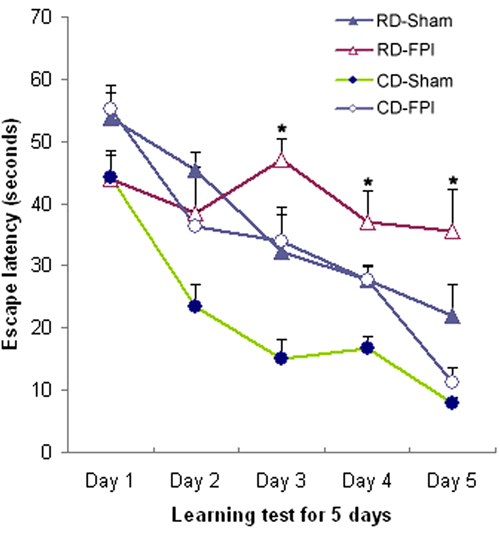
Curcumin derivative (CD) supplementation provides protection against behavior deficits in fluid percussion injury (FPI) rats. Learning performance was scored as an average of escape latencies to locate the platform in the Morris water maze. We started water maze testing at day 7 after injury. Days 1 to 5 refer to days of training. FPI rats fed a diet-containing CD showed a shorter latency to find the platform compared with untreated FPI animals. RD, regular diet. *P < .05.
Discussion
Our results demonstrate that experimental concussive brain injury promotes a clear deficit in locomotor performance, in conjunction with deficit in learning and memory abilities. Cognitive and motor impairments were accompanied by alterations in molecular systems important for synaptic plasticity in centers related to cognition (hippocampus) and locomotion (spinal cord). The curcumin derivative supplemented in diet after TBI normalized levels of BDNF and its downstream effectors on synaptic plasticity (CREB, synapsin I) and neuronal signaling (CaMKII). In addition, the curcumin derivative normalized levels of SOD and Sir2 that have antioxidant abilities. These studies are significant to define a molecular mechanism by which TBI can compromise centers related to cognitive processing and locomotion. Our results also show that the curcumin derivative activates mechanisms that are intrinsically neuroprotective and emphasize the therapeutic potential of this noninvasive dietary intervention.
Our results show that FPI compromises locomotor performance in conjunction with reducing mRNA levels of synaptic markers in the spinal cord. The unilateral FPI used in the current study exerted its effects on the spinal cord on the hemi-side contralateral to the cortical injury. These results are in general agreement with human studies showing that moderate to severe TBI often causes motor deficits in humans, which includes reduced stride length, decreased walking speed, increased limb support time, and temporal asymmetry. 9-11 In particular, concussive injury in humans has been associated with gait deficits. 11,38 The beam walk is a reliable test to assess fine motor coordination, which is under control of suprasegmental centers. Although suprasegmental centers play a major role on the fine motor coordination involved in the beam walk, it is significant that FPI decreased the mRNA levels of all molecular systems assessed in the spinal cord. We assessed mRNA levels to ascertain that the effects of FPI could be related to the function of local neuronal networks in the spinal cord as mRNA generally remain nearby its place of synthesis. The current results showing that FPI decreases select mRNA levels in spinal cord circuits may reflect dysfunction or reduced plasticity of these circuits controlling motor/sensory performance. These molecular changes could translate in reduced capacity of the spinal cord to sustain synaptic plasticity and function, thereby affecting fine locomotor control.
The molecular studies were centered on the cervical and lumbar enlargement of the spinal cord as these regions contain neurons controlling motor and sensory functions of front and rear legs, respectively. It is interesting that FPI reduced levels of BDNF and the rest of molecular systems under study in both spinal cord subregions. Like in the hippocampus, BDNF has shown an extraordinary capacity to promote plasticity in the spinal cord 39 up to the point that the suboptimal level of BDNF after TBI may disrupt spinal cord function. For example, functional blocking of BDNF abolishes the restorative effects of exercise following spinal cord injury. 18 In addition to promoting axonal growth in the injured spinal cord of adult rodents, 40 BDNF can also stimulate locomotor-like activity in spinal cord injured adult rats by increasing the excitability of spinal locomotor networks 41 and support spinal cord for learning. 42 Therefore, it is possible that the TBI-related reductions in spinal cord BDNF in conjunction with its downstream effectors on synaptic plasticity and neuronal signaling such as synapsin I, CREB, CaMKII, and GAP-43 may compromise function and plasticity of spinal circuits. Our results are very encouraging to show that the curcumin derivative counteracted the locomotor deficit as well as normalized levels of all the plasticity markers in the spinal cord.
Although learning and memory deficits involving hippocampal dysfunction are prevalent in human TBI pathology, 4,43,44 their underlying cellular and molecular events are poorly understood. It is notable that persistent cognitive dysfunction after mild to moderate human concussion 45 shows only modest structural pathology on brain scans and suggests that altered function and plasticity may underlie these deficits. 8,46 Therefore, our results showing that FPI reduced hippocampal levels of BDNF and downstream systems associated with synaptic plasticity harmonize with the latter. BDNF has the extraordinary capacity to support synaptic efficacy in the hippocampus, 19,47,48 and a reduction in hippocampal BDNF has been shown to reduce learning performance in the Morris water maze. 49 Therefore, it is possible that suboptimal levels of BDNF after TBI may disrupt proper neuronal function in select neural circuits. Interesting dietary supplementation with the curcumin derivative counteracted the effects of FPI on learning and normalized hippocampal levels of all the molecular systems under study. We have previously shown that the natural product curcumin when supplied into the diet before TBI has a protective effect on the brain. 29 Accordingly, the overall evidence seems to indicate that curcumin has a powerful action on ameliorating the effects of TBI and emphasizes the therapeutic potential of curcumin in clinical TBI.
Our results showed that dietary supplementation with the curcumin derivative counteracted the deficits in hippocampal learning and fine motor coordination likely related to spinal cord function. This curcumin derivative has several properties that can become instrumental to counteract the deleterious effects of TBI such as rapid absorption into the blood and brain and demonstrated biological stability. 30 According to our results, the curcumin derivative treatment after the FPI counteracted the reductions of BDNF and its downstream effectors on synaptic plasticity and neuronal signaling synapsin I, CREB, CaMKII, and Akt in the spinal cord and the hippocampus. Given the involvement of these molecular systems with neuronal signaling and information processing, it is likely that they play a crucial role on the effects of curcumin on functional recovery following FPI.
Elevated oxidative stress is a major factor for the effects of TBI on synaptic plasticity and processing of cognitive information. 15,32 We found that supplementation of the curcumin derivative in the diet dramatically normalized levels of protein carbonyls in TBI rats, a marker for oxidative damage. In addition, the curcumin derivative normalized levels of superoxide dismutase (SOD) and Sir2 after TBI, which may reflect a role of curcumin derivative promoting stress resistance. SOD is a powerful ROS, the antiscavenger manganese scavenger, and Sir2 is a NAD+-dependent deacetylase implicated in the oxidative stress response, metabolism, and gene expression. Sir2 has been shown to promote elevations of antioxidant systems such as SOD, thereby contributing to promote stress resistance and synaptic plasticity. 50 Curcumin has demonstrated antioxidant activity, and according to the current results the curcumin derivative investigated seems to have a robust antioxidant capacity.
Conclusions
According to our studies, FPI has a broad influence across the neuroaxis affecting molecular systems important for synaptic plasticity and neuronal signaling in the hippocampus and the spinal cord, with the capacity to influence learning and memory ability and locomotor performance. In addition, TBI appeared to reduce the capacity of the hippocampus to resist oxidative stress. Our results also show that dietary supplementation with a curcumin derivative activates mechanisms that are intrinsically neuroprotective and emphasizes the therapeutic potential of CNB-001 for the treatment of TBI, encouraging testing in animal models of other neurological disorders. These studies are significant to define a mechanism by which TBI can compromise the function of centers related to cognitive processing and locomotion and the potential of interventions based on curcumin to counteract these effects.
Footnotes
The author(s) declared no potential conflicts of interest with respect to the authorship and/or publication of this article.
The author(s) disclosed receipt of the following financial support for the research and/or authorship of this article: This study was supported by NIH award RC1 NS068473 and R01 NS056413 and Craig H Neilsen Foundation.