




Abstract
Background. Ambulating on stairs is an important aspect of daily activities for many individuals with incomplete spinal cord injury (SCI), and little is known about the effect of training for this specific task. Objective. The goal of this study was to determine whether staircase ascent training enhances motor recovery in animals with contusion injury. Methods. Rats received a midthoracic contusion lesion of moderate severity and were randomly divided into 2 groups, with one group receiving staircase ascent training for up to 8 weeks and the other receiving no training. To assess the direct effect of training, a task-specific staircase climbing test was performed. Open field test (BBB) and gait analysis (CatWalk) assessed overground recovery, and a grid test was used to assess improvement in sensorimotor tasks. Changes in muscle mass of the forelimb and hindlimb muscles were also measured, and the extent of spared white matter was determined for lesion verification and anatomical correlations. Results. Staircase training improved the task-specific performance of ascent. Gait parameters, including base of support, stride length, regularity index (RI), and step sequence, also improved. Overground locomotion and the grid test, both showed a trend of improved performance. Finally, hindlimb muscle mass was maintained with training. Conclusions. Staircase ascent training after incomplete SCI has beneficial effects on task-specific as well as nonspecific motor and sensorimotor activities.
Introduction
Approximately half of spinal cord injuries (SCIs) are incomplete, and most are contusive in nature. 1,2 Current treatments for incomplete SCI rely on rehabilitation strategies that maximize the residual function through exercise and training, and most of these rehabilitation strategies work on the principle of intensive task-specific training. 3-5 People with incomplete SCI trained using conventional therapy or on a treadmill with partial body weight (BW) support exhibit a significant improvement in locomotor function. 6-8 The intensive task-specific step training facilitates walking abilities in these individuals. Because a major goal of rehabilitation therapy is to enable patients with incomplete lesions to perform normal activities in their daily lives, in addition to treadmill training, additional exercise therapies are required to facilitate ambulation. This study is designed to determine if training in staircase ascent can contribute to enhanced task-specific performance and also improve overall functional recovery in rats with incomplete SCI.
Although ambulating on stairs is an important aspect of daily activities for many individuals with incomplete SCI, little is known about specific training for this task. A number of studies have investigated kinematics and kinetics during normal stair ambulation and have reported that during stair ascent, the ankle joint and gastrocnemius muscle play a crucial role in stair negotiation. 9 Studies have also shown that during stair ascent, the lower limb functions not only to support and balance BW but also to shift that weight onto the next supporting step. 10 As in treadmill training, staircase climbing also uses sensory cues of load bearing. It seems reasonable to assume that the neuromusculoskeletal system of the lower limbs will respond to the repetitive limb loading and stepping during staircase climbing training as it does with treadmill locomotion. It is also noteworthy that the underlying neural mechanisms involved in coordinated walking on a level surface can be modified to coordinate other locomotor tasks, such as incline walking and stair climbing. 11 Thus, we hypothesize that an overlap in the neural control of these different forms of locomotion and training should translate to improved functional recovery after SCI.
Also, several humans with incomplete SCI (ASIA C and D) exhibit higher functioning levels after step training, such that they can practice activities requiring higher level balance and gait, such as climbing staircases. 6 Thus, designing a combinational training paradigm that includes other tasks with similar neural controls is a logical next step toward developing new rehabilitation strategies to enhance the overall ambulation capabilities of these individuals. Before establishing a combinational training paradigm, the individual effect of these training protocols needs to be understood. In this study, a midthoracic contusion lesion of moderate severity was made in rats, producing a deficit sufficient to enable weight-supported steps in some animals and allowing an estimate of training induced recovery of function. To evaluate the direct effect of training, a task-specific staircase climbing test was performed. Open field test (BBB) and gait analysis (CatWalk) assessed overground recovery, and a grid test was used to assess improvement in sensorimotor tasks. Changes in muscle mass of the forelimb and hindlimb muscles were also measured, and the extent of spared white matter was determined for lesion verification and anatomical correlations.
Materials and Methods
Animal Groups
A total of 22 Sprague-Dawley rats (male, n = 10, and female, n = 12; 225-250 g; Taconic, Germantown, PA, USA) were studied. All animals received moderate (25 mm) contusion injuries. The animals were randomly divided into 2 groups. One group (n = 11; male = 5, female = 6) received staircase climbing training for 200 steps/d, 5 d/wk for 8 weeks. The other group (n = 11; male = 5, female = 6) served as a nontraining group. Rats were group housed (3/cage) in the animal facility and maintained under conditions of constant temperature and humidity on a 12-hour light/dark cycle.
Spinal Cord Injury
Rats were injected intraperitoneally with a mixture of ketamine (76 mg/kg; Fort Dodge Animal Health, Fort Dodge, IA), xylazine (7.6 mg/kg; Ben Venue Laboratories, Bedford, OH), and acepromazine maleate (0.6 mg/kg; Boehringer Ingelheim Vetmedica, Inc, St Joseph, MO). After the rats were deeply anesthetized, the back of the animals was shaved and cleaned with betadine. A laminectomy at spinal level T9/10 exposed the dura. All animals received a moderate contusion injury using the NYU impactor device. A 10-g, 2.0-mm diameter rod impactor head was dropped from a height of 25 mm onto the exposed spinal cord. Following contusion, subcutaneous fat was excised and placed on the exposed dura to prevent adhesions, back muscle was sutured, and the skin was stapled closed. Animals were transferred to cages on a heating pad (36.5°C) overnight and then returned to their home cage. Animals were food restricted 2 weeks prior to injury, receiving 3 to 4 food pellets once a day. However, to minimize the stress immediately postinjury, all animals had access to food ad libitum for 2 days postinjury and then returned to the food-restricted diet for the remainder of the study.
Immediately following surgery and for the first week postinjury, saline (3-5 mL) and ampicillin (0.3 cc, 22.7 mg/mL subcutaneous, twice a day) were administered to minimize dehydration and urinary tract infection, respectively. Bladders were expressed twice daily until normal bladder control recovered, typically by 10 days postinjury. All procedures were carried out in accordance with protocols approved by the Institutional Animal Care and Use Committee of Drexel University College of Medicine, following the NIH Guidelines for the Care and Use of Laboratory Animals.
Staircase Climbing Training
All animals were trained preoperatively for 2 weeks to provide baseline data on staircase ascension. Staircase ascent training was performed on a custom-built staircase with 20 stairs. Each stair step measured 3 inches in length × 2 inches in width × 1 inch in height and was lined with a non-slip floor mat. Plexiglass plates were attached to the sides of the staircase to create walls that minimized the stress in animals as they climbed the stairs (Figure 1). The walls extended outward at the base of the staircase to create a bottom landing where the animals were placed to initiate the staircase climbing. The transparent plexiglass plates allowed video capturing of the animals while they performed the task. In the first week of preoperative training, food rewards were placed midway and at the top of the stairs. Once the food-restricted animal learned to climb the stairs, the reward was placed only on the top stair. This strategy motivated the animal to climb the stairs without stopping or exhibiting exploratory behavior. Animals ate the food reward on reaching the top of the steps. The nontraining group also received a food reward, but in their home cage. Beginning 5 days postinjury, animals in the training group began climbing 200 steps/d (ie, 10 ascents), 5 days/wk for 8 weeks. If necessary, the trainer provided some trunk support as the animal climbed the staircase in the initial weeks (up to 3 weeks) of training.
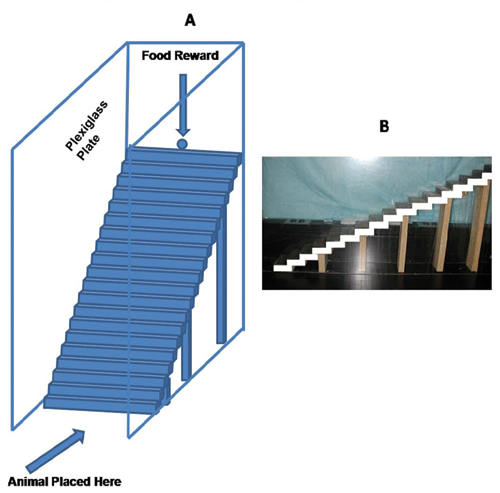
(A) Schematics of staircase setup consisting of 20 steps, clear plexiglass sidewalls, and nonslip floor mat on each step. (B) Actual staircase setup
Behavior Tests
The staircase climbing performance was assessed 1 week preoperatively, and at weeks 4 and 8 postinjury. Additional behavior tests included open field locomotion test (BBB), grid, and CatWalk, to which animals were habituated prior to injury. The BBB test 12 was performed 1 week preoperatively, 2 to 3 days and weeks 1 to 8 postinjury. The grid test was performed 1 week preoperatively, and biweekly (weeks 2, 4, 6, and 8) post injury. The CatWalk test was performed 1 week preoperatively, and weeks 4 and 8 postinjury. Performance was videotaped where appropriate, and mirrors were used for observation of contralateral limbs. All tests were scored by trained observers who had interrater reliability scores greater than 95%. Observers were unaware of the group identity of the animals.
Task Performance Test
A modified staircase climbing test adapted from Coumans et al 13 was used to assess task-specific motor behavior of the animals. Animals were allowed to ascend freely on the staircase, and quantitative observations were made from the video data as the animal performed the task. Assessments were made as the rat ascended the 10 stairs located midway on the staircase where the animal’s speed was observed to be more consistent. Testing sessions consisted of 3 trials, and an average was used for data analysis. Videos taken from the lateral and ventral aspect were used to count the number of weight-supported plantar placements of the hindpaw, coordination of the forelimb and hindlimbs (reciprocity of stepping movements), paw placements with trunk stability, and tail-up position as the animal ascended (Figure 2). These parameters are comparable with the BBB scale, in which the overground stepping performance is assessed by observing the paw placements with weight support and coordination along with trunk stability and tail position.
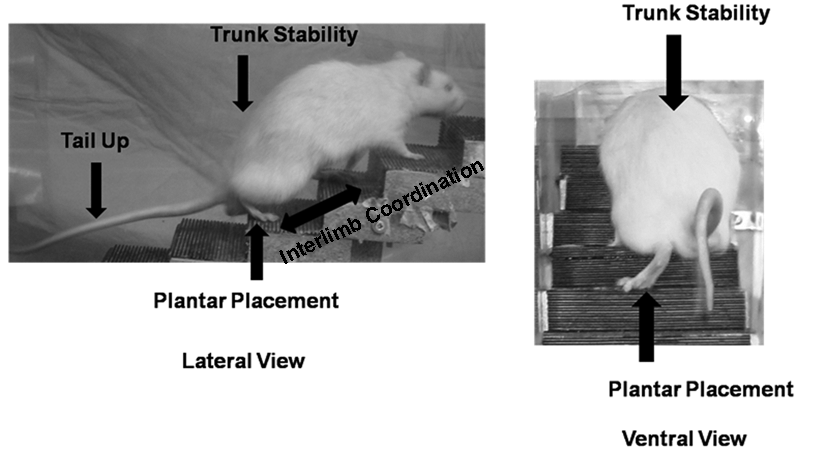
Animals were filmed with cameras placed in the lateral and ventral view. The lateral view was used to analyze the number of: plantar paw placements, coordinated steps, steps with trunk stability, and steps with a tail-up position. The ventral view confirmed plantar placed steps and steps with trunk stability
Hindlimb Function
Hindlimb motor function was assessed using the open field (BBB) scoring system, 12 a test developed to assess deficits and recovery following thoracic contusion injuries. Hindlimb function was scored from 0 (no observable movements) to 21 (normal locomotion). Individual rats were placed in an elliptical enclosure, allowed to accommodate to the enclosure, and then observed for 4 minutes by 2 trained observers. The animals were also simultaneously videotaped for a modified frequency analysis. 14 Frequency analysis was performed on a 1-minute video recording obtained while the animal was continuously locomoting. Analysis was performed on animals with BBB scores of 7 or 8, and the frequency of this score in the 1-minute recording was noted.
Grid Test
Paw placement on the grid bar for each hindlimb was assessed as animals walked on a plastic-coated wire mesh grid (36 cm in length 38 cm in width × 30 cm in height, with 3 × 2 cm2 openings) for 2 minutes. 15 Steps in which the paw gripped the grid bar and supported the animal’s weight were counted as correct. If the hindpaw fell through the grid hole, the step was counted as a slip. The number of correct paw placements was expressed as a percentage of the total hindlimb steps. Furthermore, the percentage of correct paw placements was calculated for each hindlimb and averaged.
Gait Analysis
Gait was analyzed during overground locomotion using the CatWalk device, 16 where the walking patterns of all 4 limbs are filmed from underneath while the animal crosses an enclosed walkway. The walkway has a glass floor in which light is shone from one of the long edges. Paw–floor contact shows up brightly, whereas the rest of the floor appears dark. Three runs were obtained from each animal, and using the CatWalk software (v7.1) paw prints were labeled and parameters such as base of support, stride length, swing duration, regularity index (RI), and step sequence were measured. Only animals that displayed stepping (either dorsal or plantar) during open field locomotion test (BBB > 9) were selected for the CatWalk test.
Muscle Atrophy
At the end of the experiment, rats were anesthetized with an intraperitoneal injection of sodium pentobarbital (100 mg/kg, Abbot Laboratories, North Chicago, IL) and the right medial gastrocnemius (MGM), soleus (S), tibialis anterior (TA), and triceps (TRI) muscles were excised and weighed. Wet muscle weight (MW) to BW ratios (MW/BW) were calculated.
Tissue Preparation and Histology
After the muscles were excised, animals were killed via intracardiac perfusion with 200 mL of 0.1 M, pH 7.4 phosphate buffer, followed by 500 mL of ice cold 4% paraformaldehyde fixative in phosphate buffer (0.1 M, pH 7.4). The spinal cord was removed and postfixed for 24 hours in the same fixative at 4°C, followed by cryoprotection in phosphate-buffered 30% sucrose solution for 3 to 5 days. To estimate lesion size and volume of spared host spinal cord, an 11-mm long segment of thoracic spinal cord, containing the lesion, was sectioned at 20-µm thickness. Every 10th coronal section was mounted onto a gelatin-coated slide and stained with Nissl–Myelin stain. 17 In each cord, the total volume of cord segment and of spared white matter was determined.
Statistical Analysis
Data from each behavioral test exhibited a normal distribution overall; therefore, statistical analysis was performed using t tests between groups and repeated measure analyses of variance between times. Post hoc analysis was performed using Fisher’s post hoc test for parametric data or the Mann-Whitney U test for nonparametric data (such as BBB scores). An independent-sample t test was performed for frequency analysis of BBB scores at each time point. Significance levels were set to .05 for all comparisons.
Results
No gender effect was observed in any of the tests, so the results for the male and female rats within individual groups were pooled.
Staircase Ascent Test
Preoperatively, all animals had consistent weight-supported plantar placements, coordinated steps, and steps with trunk stability, with the tail lifted in an extended (tail-up) position (Figure 3). In the initial weeks postinjury (up to week 3), all animals mostly performed dorsal steps. Co-stepping (placing both feet on the same step) was also observed in these animals, and this behavior seemed to be related to poor trunk stability. At week 4, all animals in both groups had significant deficits: fewer weight-supported steps with plantar placements and deficits in coordination, trunk stability, and tail-up position compared with their preoperative performance. By week 8, the numbers of weight-supported plantar steps in the trained animals returned to normal and were significantly better than those in untrained animals. Numbers of coordinated steps and paw placements with trunk stability were also significantly higher in the trained animals than in untrained animals. Untrained animals at both weeks 4 and 8 exhibited many erratic behaviors, including several dorsal surface contacts. No difference was observed in the number of steps with the tail-up between the 2 groups. Thus, staircase ascent training resulted in a significant improvement in the weight-supported plantar steps, coordinated steps, and steps with trunk stability (Figure 3).
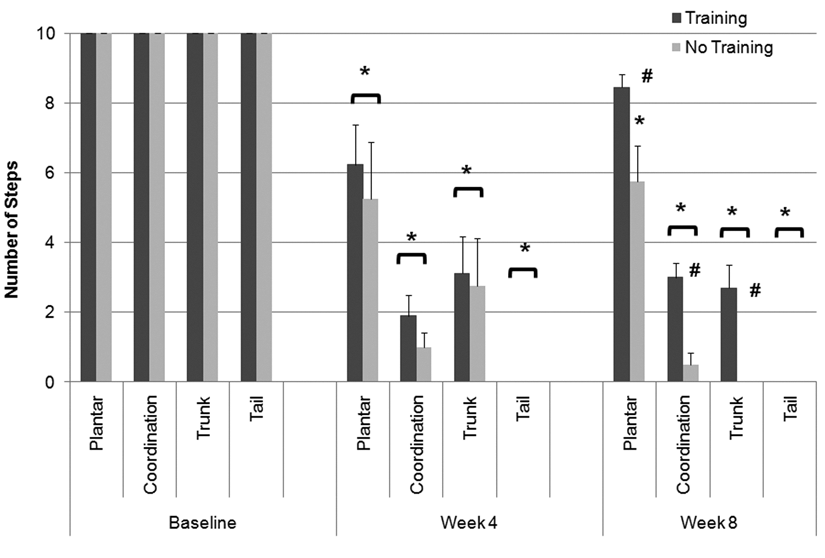
Assessments of staircase climbing: baseline values of 10 indicate peak performance for each measure. At week 4, a significant decrease in each measure and no effect of training was observed. At week 8, a significant effect of training was observed; however, all measures were below baseline performance except number of plantar steps in the trained animalsa
Open Field Locomotion: BBB Test
No differences were observed in the BBB scores of trained and untrained animals at any time. Further quantification of the hindlimb movements in the open field using the frequency analysis technique, however, indicated a trend (P < .1) toward greater number of movements involving extensive movements of all 3 joints or sweeping (BBB = 7 or 8) in the trained animals as compared with the untrained animals at week 8 (Figures 4A and 4B). No significant differences were observed between the 2 groups at earlier time points. Thus, although no difference was observed in the BBB scores between the 2 groups, the number of extensive movements in all 3 joints appeared to be greater in trained animals after 8 weeks of training.
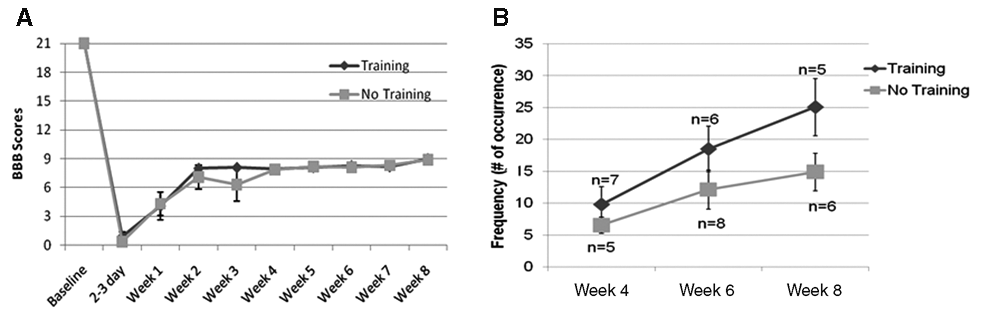
(A) Open field locomotion (BBB): no significant differences were observed in the BBB scores of trained and untrained animals. (B) Frequency analysis suggested greater number of movements of the same BBB score (7 or 8) in the trained animals
Sensorimotor Function: Grid Test
Normal rats locomote readily on a grid, placing the plantar surface of the paw centrally on the grid bar with very few errors (about 95%-98% correct paw placements). In the early weeks following SCI, animals in both groups made significantly more hindlimb foot faults compared with baseline. However, with training, rats exhibited a trend (P = .07) to better recovery in performance of this sensorimotor task compared with the untrained animals (Figure 5).
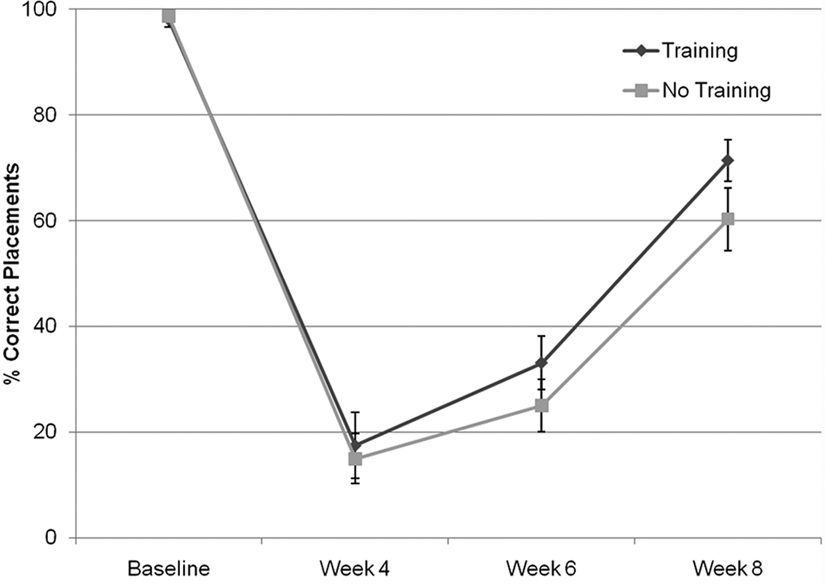
Paw placement on the grid bar for each hindlimb was assessed as animals walked on a grid
CatWalk Gait Analysis
Animals with a BBB > 9, exhibiting weight-supported stepping overground, were tested on the CatWalk device. No weight-supported stepping, in any animal, was observed at week 4. At week 8, a total of 6 animals in the trained group and 5 in the untrained group exhibited weight-supported stepping and were tested using the CatWalk device.
Base of Support
The ability to recover balance depends on the base of support. 16 Forepaw base of support was not significantly affected by injury (data not shown). Hindlimb base of support showed a compensatory increase in both groups following injury, but by 8 weeks, the base of support reached baseline values in the trained group. In contrast, hindpaw base of support in untrained animals remained significantly greater than preoperative values or values in trained animals (Figure 6A).
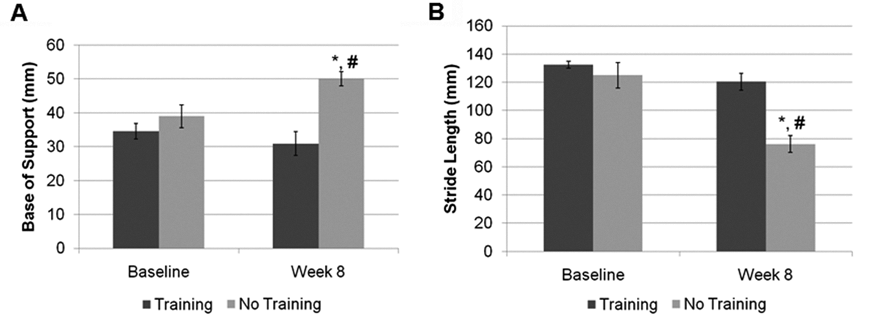
Base of support (A) and stride length (B) in the trained animals returned to preoperative levels and was significantly different from that in untrained animals at week 8a
Stride Length
Training led to a significant increase in the stride length. At week 8, the stride length in the trained animals reached baseline values, whereas untrained animals had significantly shorter stride lengths compared with those in trained animals or with their baseline values (Figure 6B).
Swing Duration
No difference in the swing duration was observed between the 2 groups at any time point (not shown).
Regularity Index
RI is a validated measure of forelimb and hindlimb coordination while locomoting overground. 16 RI was 99% ± 0.2% in all animals preoperatively. At week 8, RI in the untrained animals was significantly lower (P = .04) compared with the baseline and RI in trained animals. Average RI in the trained and untrained animals was 86% ± 3% and 60% ± 2%, respectively.
Step Sequence
An alternate step pattern (Ab, LF–RH–RF–LH) is preferred by intact rats. 18 The prevalence of the Ab step pattern was observed to be 87% ± 4% in animals preoperatively. A significant decrease in the Ab was observed in the untrained animals (frequency 17% ± 7%) when compared with their baseline and with trained animals (frequency 52% ± 3%).
In summary, gait analysis showed an improvement in the base of support, stride length, RI, and step sequence during overground locomotion after 8 weeks of staircase ascent training in animals that recovered the capacity for plantar placements. Also, to understand how training influenced these animals (BBB > 9) in other tasks, we present the data obtained from the BBB, staircase climbing, and the grid test in this subset of animals (Table 1).
Values of Mean ± Standard Error of the Mean for the BBB, Staircase Climbing, and Grid Tests in Animals That Recovered the Capacity for Plantar Placements
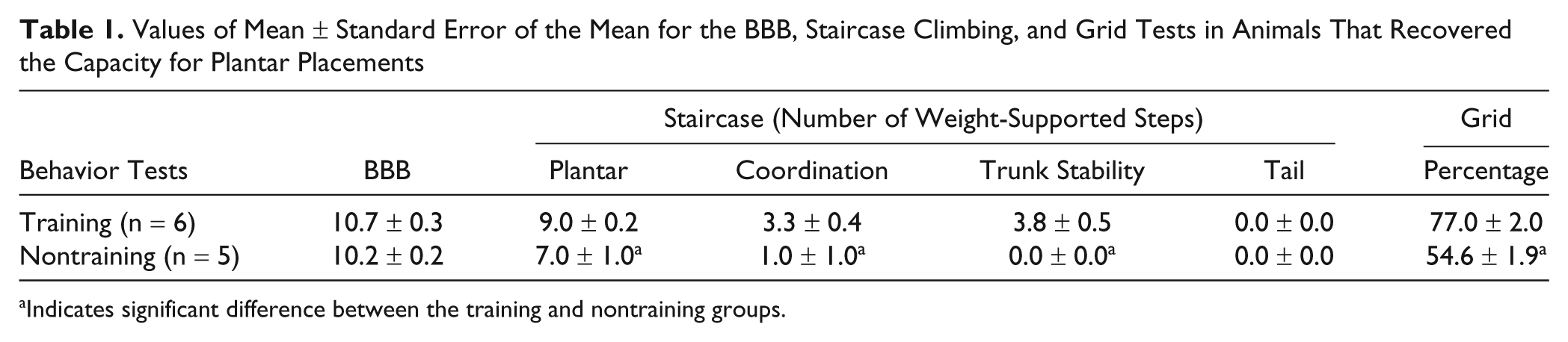
Indicates significant difference between the training and nontraining groups.
Muscle Atrophy
The hindlimb wet MW/BW ratio of MGM and TA muscles was significantly lower in untrained animals compared with noninjured animals (obtained from a previous experiment). The TRI MW/BW ratio was significantly higher in both trained and untrained animals compared with unoperated controls (Figure 7). Thus, training led to less muscle atrophy in MGM and TA muscles and increased mass of the selected forelimb muscle.
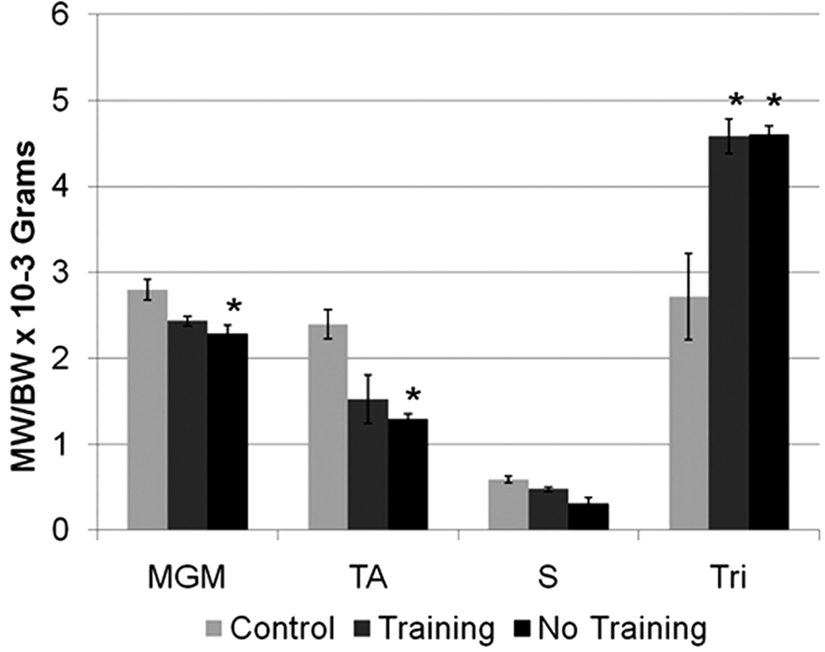
The ratio of hindlimb muscles (MGM, TA, and S) and a forelimb muscle (TRI) to body weight (MW/BW) in unoperated control, trained, and untrained animalsa
Lesion Size
No difference was observed in the volume of spared white matter tissue in the trained (24.23 ± 1.21 mm3) and untrained (23.78 ± 1.0 mm3) animals. The percentage of spared white matter at the epicenter was also not different in the trained (8.9% ± 7.2%) and untrained animals (9.1% ± 5.6%).
Discussion
The goal of this study was to determine whether staircase ascent training enhanced motor recovery in contused animals, and indeed, a significant improvement in the task-specific performance of trained animals was observed. Furthermore, there were improvements in overground locomotion evidenced by a trend toward increased hindlimb movements and significantly improved gait parameters. Results also show an improvement in sensorimotor behavior and maintenance of hindlimb muscle mass with training. These improvements indicate the beneficial outcomes of staircase ascent training after incomplete SCI.
Animals with a moderate contusion injury that received 8 weeks of staircase ascent training showed an increase in the number of weight-supported plantar paw placements, limb coordination, and paw placements with trunk stability, thereby exhibiting a significant improvement in task-specific motor behavior. This outcome is similar to that reported after swim training in contused animals, in which an improvement in swimming abilities was reported after 8 weeks of training. 19 The swim training, however, did not translate to enhanced recovery of overground locomotion as assessed by the BBB test. Because one goal of rehabilitation therapy is to improve overall functional capabilities, it is necessary to be careful while selecting a task-specific training paradigm. Previous work 20 has shown that animals, when trained specifically to stand, could stand, but they exhibited little ability to walk; conversely, when they were trained to walk, their ability to stand was diminished. Thus, it is important that the training exercise be such that the neural mechanism of control overlaps among various locomotor tasks required for ambulation. To test this hypothesis in our training paradigm of staircase ascent, we assessed improvements in overground locomotion and sensorimotor tasks. Although no improvements in BBB scores were observed, an increase in the frequency of limb movement and gait parameters, such as base of support, stride length, RI, and step sequence pattern, was shown along with improvements in performing sensorimotor tasks. This outcome indicates that the task-specific functional recovery after staircase training also translates to recovery in overground locomotion, possibly because of the overlap in the neural circuits controlling these tasks.
After SCI, several factors are necessary for recovery in overground locomotion, including coordination and trunk stability. Staircase ascent training led to improvement in the coordination of limbs and trunk stability while climbing the staircase. Translation of these improvements to overground locomotion was also observed as improvement in the RI and base of support parameters obtained from gait analysis. Previous studies have shown a strong correlation between coordination and trunk stability with RI and base of support, respectively. 16,21 RI, which was significantly higher in the trained animals, is an indicator of increased sequence of coordinated stepping across the walkway. More missteps lower the RI, as was observed in the untrained animals. Step pattern sequence was also studied as the animals walked overground because RI relies on step patterns. Details of step sequence pattern in normal and contused animals have been described previously. 16 Briefly, normal animals have an alternate step sequence pattern (Aa, RF–RH–LF–LH; or Ab, LF–RH–RF–LH). Postcontusion injury, animals exhibit a more rotary step sequence pattern (Ra, RF–LF–LH–RH; or Rb, LF–RF–RH–LH). In our study, the trained animals were able to regain their regular step sequence pattern (Ab), whereas untrained animals adapted to new step sequence patterns (Ra or Rb), or they performed locomotion with a higher percentage of missteps.
It has been reported previously that a significant decrease in the stride length occurs after SCI in rats. 17 We made a similar observation in untrained contused rats, but trained rats showed an improvement in the stride length. This improvement could be attributed to training on the staircase, with the stride length being dictated by the dimensions of the stairs. Furthermore, with training, the animals learned to perform coordinated steps to navigate more quickly on the staircase and to reach to the food reward placed at the top. Coordinated stepping requires increasing the extent of joint excursion, which could be directly related to the increase in the number of steps with longer stride length while locomoting overground. We observed that animals with weight-supported plantar placements and trunk stability had a higher number of coordinated steps. This increase in the number of coordinated steps leading to an improvement in the joint movement also led to increase in the number of extensive joint movements as observed in the frequency analysis (BBB: frequency analysis). Future studies using kinematic analysis with markers placed at various joint locations are required to quantify these improvements in the degree of joint movement.
Loading on the affected limbs contributes to motor recovery after treadmill training. 22 Passive rhythmic hindlimb cycling with little or no load on the limbs also improves sensory processing after SCI. 23 The staircase training paradigm involves both hindlimb loading and rhythmicity as the animal ascends the stairs, and repetitive training may have provided activity-dependent enhancement of neural circuits involved in sensorimotor function.
Changes in muscle mass were also noted after 8 weeks of contusion injury. In untrained animals, a significant loss of hindlimb muscle mass was observed, but in trained animals, muscle mass was not significantly different from that in unoperated controls. Muscle mass maintenance in the trained animals could be directly related to limb loading during training. Furthermore, the loading of the muscles could cause activation of these muscles while performing the task. Human EMG studies have shown peak amplitude of EMG activity in the S, MGM, and TA muscles during uphill walking in normal people. Post-SCI, very limited adaptation of the peak amplitude of EMG activity in these muscles was observed. 24 Staircase ascent training might help restore the activation of these leg muscles to some extent, resulting in prevention of muscle atrophy. Future studies using EMG implants in these muscles are needed to verify these observations. We also harvested a forelimb muscle (TRI) from all the animals and observed a significant increase in the muscle mass in both training and nontraining animals, reflecting the increased load on the forelimbs during the recovery phase after SCI, suggesting a compensatory increased forelimb weight bearing in both groups.
These improvements in overground locomotion after staircase ascent training are similar to those observed after treadmill training in incomplete SCI animals. Treadmill training in hemisected mice resulted in improvement in grid walking, gait analysis, and kinematics. 25 Also, a more recent study in contused rats reported improvement in overground locomotion after 8 weeks of body weight supported treadmill training (BWSTT). 26,27 An overlap in the neural control mechanism is likely to contribute to this improvement from activity-dependent treadmill training to overground locomotion. Because the outcomes of the treadmill training overlap with those observed in this study, we postulate that a considerable overlap of neural control exists in staircase ascent and overground locomotion, and thus, training in the former task translates to recovery in the latter.
In summary, several studies have established that the task-specific nature of rehabilitation therapy improves functional ability. However, to optimize neural plasticity, the practice task should be as close as possible to the goal task. 20,28 Current approaches include BWSTT as a method for improving functional ambulation after SCI; however, its effect on staircase climbing is not known. Because there is overlap in the neural mechanisms involved in coordinating level walking and stair climbing, combining the training of staircase climbing with treadmill training may enhance the overall functional mobility of SCI individuals. Our demonstration of improvement in task-specific performance, overground locomotion, sensorimotor function, and reduced muscle atrophy suggests that ascending staircase training can be used as a new rehabilitation training paradigm.
Footnotes
Acknowledgements
We thank Stacy Jacob, Latasha Carter, Kassi Miller, Laura Krisa, Christina Spino, Ilana Galex, and Theresa Connors for their excellent technical assistance.
The author(s) declared no potential conflicts of interest with respect to the authorship and/or publication of this article.
The author(s) disclosed receipt of the following financial support for the research and/or authorship of this article: This study was supported by The Craig H. Neilson Foundation and NIH NS 055976.