




Abstract
As rates of conflict and environmental risk increase, peace agreements offer a unique occasion to reach accord on both fronts. A systematic review of peer-reviewed articles published in the last decade reveals that little research has been conducted on the presence of environmental provisions in peace agreements, and that such provisions, where they are mentioned in scholarly literature, are often vague and poorly implemented. As the environmental risks of both conflict and post-conflict prosperity are well documented, multi-level management structures for these risks formalized in peace agreements may be helpful in mitigating them. What role peace agreements currently play and may play in the future in establishing provisions to achieve this aim deserves further investigation. This review identifies key trends in the direct and tangentially related peer-reviewed journal articles on environmental provisions in peace agreements. The identified trends are then used to develop recommendations for future investigation in order to build the empirical evidence base and best practices for the inclusion of environmental provisions in formal peace agreements.
Keywords
Introduction: Junctures of Conflict, the Environment, and Peace Agreements
Globally, rates of conflict and environmental risk are simultaneously increasing (IEP, 2022; Pinho-Gomes et al., 2023; UCDP, 2024). These risks to human and environmental health and flourishing emerge both independently and interactively. Scholars have increasingly identified environmental risks as drivers of both particular conflicts and conflict more generally, albeit with important caveats (Hendrix et al., 2023; Telford, 2023), and all conflicts have environmental degradation implications (Austin & Bruch, 2000). In fact, the environmental damage of conflict is more monitored today than ever before, partially as a result of advances in remote sensing and other monitoring tools (Mueller et al., 2021; Sticher et al., 2023). Alarmingly, while conflict and potential major contributors to it are on the rise, together with the environmental degradation from conflict, as exemplified by the unfolding conflicts in Ukraine (Shumilova et al., 2023) and Gaza (UN EP, 2024), the construction and effective implementation of formal peace agreements to end and transition from conflicts are decreasing (Joshi, 2024). Such agreements are crucial, and, as we will see, including environmental factors in them is critical for transitioning to sustainable peace (Bruch & Morley, 2023; Marcantonio, 2023).
Anthropogenic climate change, toxic air, and chemical pollution, and other human-caused environmental risks have continued to increase over the last few decades (Costello et al., 2023; Persson et al., 2022; Rentschler & Leonova, 2023). This is despite growing awareness and scientific innovation for reduction and remediation. Today it is estimated that several planetary boundaries have been exceeded, pushing the earth system into “unsafe operating spaces” (Richardson et al., 2023). The distribution of and contribution to these risks are unequal, and often inversely related, exceeding both safe and just thresholds of risk (Marcantonio, Javeline et al., 2021; Rockstrom et al., 2023). The outflowing impacts of these risks on communities, realized and potential, can facilitate or cause conflict formations ranging from ecological distribution conflicts over environment injustices (Martinez-Alier, 2021), to climate-conflict risk factors (Mach et al., 2019), to more specific conflict linkages regarding water (Gleick & Shimabuku, 2023), land (Abrahams, 2021), food (Anderson et al., 2021), and migration (Wiederkehr et al., 2022). Conversely, it is not just resource scarcity or degradation that has conflict linkages, but resource abundance, too, where it results in competition (Abrahams, 2020; Mildner et al., 2011).
In conflict contexts, the primary focus of peace agreements is to end the direct violence. Direct violence is salient and visceral, causing suffering both to those who directly harmed and to a broader complex of family, friends, and others. Many more suffer under the threat of violence and the broader, cascading impacts of conflict, such as food shortages, displacement, and myriad other maladies. All of this gives ending the direct violence of conflict primacy. Growing environmental risks connected with conflict-affected areas, however, indicate the need to explicitly consider environmental issues in peace agreements and the corresponding broader governance capacity. For example, during the Sierra Leonean Civil War, an estimated 60,000 people died from direct violence over the 12-year period: an average of 5000 people per year (Kaldor & Vincent, 2006). In the decade and a half after the signing of the Loma agreement and the expansion of “development” in the ensuing peace, death rates from toxic pollution emissions rose to an estimated 12,200 per year by 2018, with 5900 deaths attributable to pollution from mining alone (Fuller et al., 2019). In the Democratic Republic of the Congo, where conflict continues to simmer, an estimated 32,000 people died as a result of direct violence between 2013 and 2022 (UCDP, 2024). But in 2018, the estimated number of deaths from toxic pollution was 102,000, with half from air pollution and half from water pollution. In both countries, the deadly toxic pollution was not unrelated to the conflict there. Peace agreements cannot be seen as the primary solution for environmental challenges in conflict-affected societies. However, explicitly considering environmental issues from and related to the conflict, their potential fluctuations in post-agreement contexts, and how to best promote environmental and human security and sustainability in the transition from conflict to peace could help to mitigate perverse outcomes and promote peacebuilding aims (Beevers, 2019; Bruch et al., 2012, 2016, p. 201).
Given the complexity of the many potential environmental conflict drivers, as well as the demonstrated importance of environmental considerations for post-conflict peacebuilding (Bruch & Morley, 2023), the inclusion of environmental considerations in formal peace agreements may seem obvious. For example, it is estimated that at least 40% of all wars within states between 1949 and 2009 had a link to natural resources, and, in those cases, fighting was twice as likely to resume within 5 years after the conflict ended (UNEP, 2009). Recent developments in international law and United Nations (UN) declarations further amplify the importance of environmental factors and provide legal frameworks supporting the inclusion of environmental provisions in peace agreements. For example, the UN Human Rights Commission and subsequently the UN General Assembly declared access to a safe, clean, and healthy environment a human right (UN GA, 2022; UN HRC, 2021). Concomitantly, the UN's International Law Commission published a normative framework for the Protection of the Environment in Relation to Armed Conflicts (PERAC; UN ILC, 2022). The 27 PERAC stipulations outline a combination of binding and non-binding principles for the environment in conflict. Despite this recent progress, the environment is not consistently included in peace agreements. For example, of the 34 comprehensive intrastate peace agreements that the Peace Accord Matrix monitors, natural resource management provisions only appear in 10—and none have been effectively implemented to date (Joshi et al., 2015).
To better understand how to narrow this gap in practice, a natural first step is to assess the current research on peace agreements and environmental provisions. Based on an extensive search of peer-reviewed journal articles, there are no existing recent systematic review articles currently available on this topic. This article seeks to account for and analyze how environmental provisions in peace agreements have been investigated in peer-reviewed scholarly journal publications in the last decade. Through a systematic literature review process, this article identifies a substantial gap in the literature generally, and more specifically as regards the inclusion, formation, and implementation of environmental provisions. For example, from 2013 to 2023, in the three major journal databases, only 23 peer-reviewed journal articles appeared on peace agreements and the environment.
This article will provide a step-by-step overview of the systematic literature review process conducted. Next, it will report summary results on the content and focuses of the literature. It will then draw out and discuss emerging themes and gaps in the literature stemming from these results. Finally, it will offer policy and future research implications that result from the current state of the literature. The need for understanding how to best account for environmental factors in peace agreements is increasingly evident; this review highlights the lack of past attempts in peer-reviewed literature to meet this need.
Methods
A systematic literature review was conducted to determine the frequency, extent, and context of scholarly investigations into the inclusion of environmental provisions in formal peace agreements in peer-reviewed journal articles. Peer-reviewed journal articles are the prime outlet for academic research and often considered to represent the highest standard; for this reason, they are the primary focus of this literature review. The literature review process utilized three search engines to ensure inclusion of a broad and comprehensive literature set: EBSCO, Web of Science, and JSTOR. The articles were analyzed and collected with the use of advanced search parameters to systematically analyze the text of each article. Each article was analyzed for inclusion of the following terms: “peace agreement” or “peace accord,” and “environment,” “natural resources,” “pollution,” “contamination,” and “land.” The varied environmental terms were employed to capture different descriptors of ecological components. The project's scope focused on peer-reviewed articles published in English during or between 2013 and 2023. Using key words and additional parameters such as year limitations, the initial systematic review process resulted in 10 articles from Web of Science, 147 articles from EBSCO, and 1784 articles from JSTOR. The Appendix provides a step-by-step outline of our methodology. The literature searches were completed in January 2024 and, thus, any literature published later or corrected in any way after that date is not included.
The articles resulting from the initial search (N = 1941) were then manually, individually analyzed by at least two researchers for relevance. To be “relevant” the article had to mention peace agreements or accords and discuss, note or in some way explicitly recognize ecological factors broadly defined. For example, articles that included the word “environment” but in reference to the “political environment” or “social environment” were excluded from the literature set. This process yielded 24 articles that met these criteria collectively across the three databases.
The 24 articles were then analyzed to construct a dataset measuring 39 factors to explore and account for their content and characterizations of environmental factors (see database in the Supplemental file). The database includes a variety of factors, ranging from the type of article, the geographic scope, the form of agreement discussed, the extent of the provisions included, and the bodies responsible for their implementation. It also records funding sources, environmental standards provided, timeline of provisions, databases referenced, and international laws referenced. To assess the articles, a two-person independent coder assessment approach was applied. After each coder evaluated the full literature set, an inter-reliability test (Cohen's kappa, k) was utilized to test the concordance of the results, which demonstrated high inter-rater reliability (k = 0.87). Discordant results were collectively reviewed and reconciled, and then all results were consolidated into the final dataset.
Results
The literature on environmental provisions and considerations in formal peace agreements showed substantive variation in geographic focus, environmental mediums considered or centered, methods of analysis, and whether they included notes about environmental phenomena such as climate change (see Supplemental File 1 for all variables assessed). The number of publications discussing the environment in formal peace agreements has dropped off in recent years, with only four such articles published between 2021 and 2023 (see Figure 1). A surge of articles of this kind appears beginning in 2016, with most of these focused on the 2016 Colombian Peace Agreement, as discussed further in the next section.
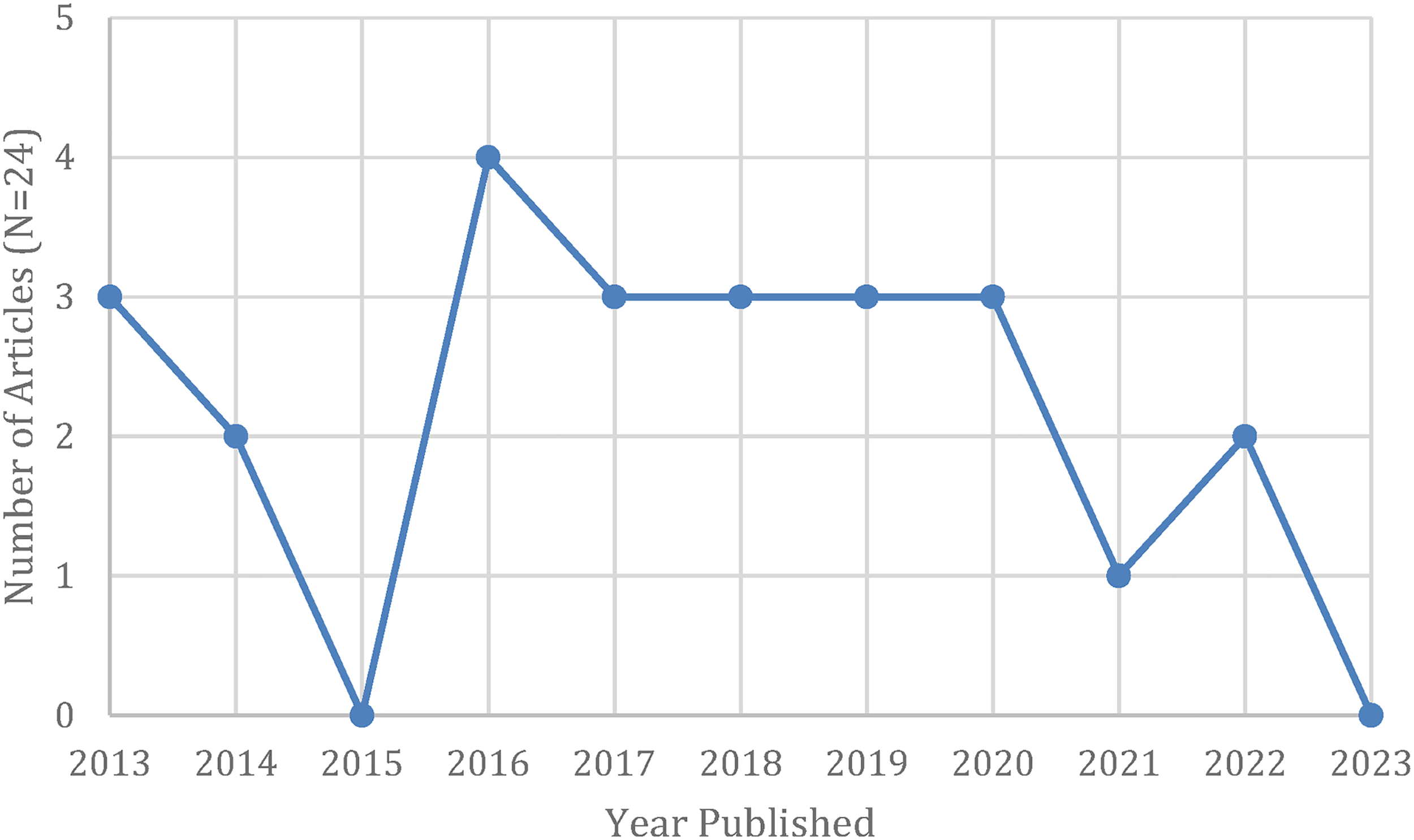
Number of publications per year matching systematic literature review search criteria.
The geographic distribution of the peace agreements and the outlets discussing them varied, but with clear standouts in most categories. The geographic focus of the 24 total articles breaks down as follows: 12 address Colombia; 5 address Palestine, Israel, and/or Jordan; 5 address Sudan; 1 addresses El Salvador; and 1 addresses Papua New Guinea. The geographic location of the publishing journals varied as well, though North American and European outlets predominate. The primary discipline or thematic area of each outlet varied but with political science or international relations journals most highly represented (N = 7; 29%). International Affairs and the Journal of Peacebuilding and Development were the only journals to have more than one article on the topic (N = 2 each). The primary methodological approach utilized by the authors was qualitative in nature (N = 18; 75%), though mixed-methods (N = 3; 12.5%), literature review (N = 2; 8%), and quantitative methods (N = 1; 4%) were also represented. The majority of the articles were singular case studies (N = 13; 55%), and only two articles were comparative studies.
All of the articles noted environmental considerations, each mentioning the term “natural resources.” This is not unexpected, given the parameters of the systematic literature review, but also because it is often a catch-all term for environment or ecological factors. As a standalone term, however, it is not specific enough to tie together specific provisions, standards, monitoring, and/or enforcement—that is, the conditions necessary for effective environmental management (Lame & Marcantonio, 2022). Additionally, 54% (N = 13) of the articles discussed land, with Colombian rural land reform provisions most represented; 21% (N = 5) discussed water; 21% (N = 5) discussed oil or minerals, and all of these focused on Sudan; 17% (N = 4) included hazardous waste management, with two focusing on surface waste and one on water waste; 50% (N = 12) mentioned pollution or contamination; and 46% (N = 11) mentioned climate change. Conflict has a direct effect on each of these environmental factors albeit at varied rates depending on the specific ecology and context of the conflict. And yet they are not consistently discussed and, indeed, rarely collectively or comprehensively explored at all—only one article, on the Colombian Peace Agreement, discusses all of these environmental mediums excluding only a discussion on oil or minerals. Only two of the articles mentioned specific provisions and standards for the factors mentioned. Both articles were focused on oil sharing agreements and protections in South Sudan and draw on national policies referenced in the peace agreements as the specific standards to attain. For implementing standards, most articles assigned monitoring and enforcement to national-level institutions (N = 21, 88%) and/or local-level institutions (N = 15, 63%), while foreign third-party monitors were mentioned in about a quarter of articles (N = 6, 25%). Utilizing multi-level entities for monitoring and enforcement is common in most environmental management and monitoring regimes (Lame & Marcantonio, 2022), though third-party entities are often relied upon as a disinterested or unbiased external arbiter. For example, the Peace Accord Matrix at the Kroc Institute for International Peace Studies at the University of Notre Dame is the formal monitoring body for the implementation of the 2016 Colombian Peace Agreement.
Discussion: Emergent Trends and Gaps
Although the literature is relatively sparse, a systematic review nonetheless provides clear indications of emerging concerns around accounting and providing for environmental issues in formal peace agreements. Predominantly by way of omission, the review also indicates understudied areas within the peer-reviewed journal literature, offering a roadmap for future research. While not exhaustive of all of the variables included in the database resulting from the analysis of the articles, the following seven trends represent dominant emergent tendencies and gaps.
The Case of Colombia as an Archetype
The 2016 Colombian Peace Agreement between the Government of Colombia and the Revolutionary Armed Forces of Colombia—People's Army (FARC-EP) and its environmental components emerged as the most represented agreement in the literature. This may be due in part to the time period parameters of the systematic review process, which was centered around the final negotiations, signing, and implementation of the agreement. It may also be due in part to the significance of the agreement, which ended the longest ever running civil war. But probably most importantly, the agreement was widely lauded for its consultative development process with stakeholder groups, which resulted in identifying critical concerns around environmental factors and related issues. These resulted in the inclusion of rural development programming and land distribution reform such as the Participatory Development Programs with a Territorial Focus (PDET). These and other reforms provide sustainable livelihood support to former FARC-EP and rural communities (Londoño, 2023). Although the Colombian Peace Agreement has been characterized as the most environmentally inclusive peace agreement to date, for reasons that emerge in the following sub-sections, substantial leakage—that is, spillover or displaced effects from a lack of comprehensiveness—and omissions occurred that resulted in numerous environmental risks increasing, for example, deforestation reaching its highest rates to date from a combination of expanded cattle ranching and illicit crop production (Clerici et al., 2020; Vanegas-Cubillos et al., 2022). While the management of these issues falls primarily on the competent national authorities, such as the Colombian Ministry of the Environment and Sustainable Development, the peace agreement can influence and directly shape (and potentially prevent) environmental outcomes, especially those directly related to programming such as PDET (Grant & Le Billon, 2019; Johnson et al., 2025; Navarrete-Cruz et al., 2020).
The Need for Provisions and Dangers of Non-Specificity
The research on the construction and implementation of peace agreements suggests that the more comprehensive and specific an agreement is, the higher the likelihood of effective implementation (Joshi & Quinn, 2015). For environmental management schemes in general, such specificity is necessary to facilitate effective protection of human health and the environment through permitting, monitoring, enforcement, and accountability (Lame & Marcantonio, 2022). Although many of the articles meeting the search parameters reference the environment and peace agreements, few introduce a conversation on environmental provisions in specific peace agreements (Deonandan, 2015; Forster, 2019; Ratner et al., 2017). For instance, Forster (2019) explores the Ottawa Convention and presents the frequency of “mine action provisions” included in peace agreements (PAs) over a period of time, but it lacks specificity concerning what these provisions contain and how they relate to the environment. Other articles comment on the effects of poor provisions without including details on their content (Clerici et al., 2020; Krause et al., 2022; Morales-Muñoz et al., 2020). For instance, Morales-Muñoz et al.'s (2020) article “Assessing impacts of environmental peacebuilding in Caquetá, Colombia: a multistakeholder perspective” highlights the negative implications of a peace agreement without specifying which provisions, if any, are responsible. Morales-Muñoz et al. note, “Forest areas that were previously subject to security restrictions are increasingly accessible, with the side-effect of increasing deforestation rates—by 44% in 2017—and land degradation.” This work serves as a testament to the environmental harms that can stem from peace agreements, thus highlighting the need for an intentional, thoughtful inclusion of environmental provisions in these agreements. However, without clarity as to which parts of the peace agreement positively or negatively affected the environment, discussion on ensuring effective environmental protections in peace agreements going forward remains limited.
Graser et al. (2020), analyzing the impact of the 2016 Colombian Peace Agreement on Caquetá, critique the substantive limitations or failings of specific peace provisions in the Colombian Accord. Graser et al. highlight that, although the Integrated Rural Reform (IRR) in Colombia created by this agreement addresses access and land use as well as infrastructure and adaptation in the region, a lack of specificity hinders its effective implementation. Graser et al. (2020, p. 11) conclude that: …there are no specific regulations in the peace agreement for sustainable land use, like traditional or agroecological farming. This, in turn, facilitates more intensive and competitive forms of land use, further encouraging deforestation, which, paradoxically, should be monitored and restricted through the IRR. These circumstances threaten its successful implementation, not only in Caquetá, but throughout the whole of Colombia.
Creation of Environmental Programs and Compliance
Specific provisions on environmental considerations within peace agreements may help prevent further environmental degradation in post-conflict transitions. To render them effective, complimentary, deliberate programs and mandates may be necessary to provide the capacity and capabilities necessary to permit, monitor, enforce, and assist with their implementation (Boudreaux & Abrahams, 2023; Bruch et al., 2016; Patel & Bruch, 2023). Fourteen of the reviewed articles reference the creation of environmental programs to support the enforcement of environmental mandates. Ten of these articles discuss the rural reform provisions of the 2016 Colombian Peace Agreement (Barrera et al., 2022; Betancur-Alarcón & Krause, 2020; Boersma, 2018; Fontecha-Tirado, 2016; Graser et al., 2020; Howland, 2022; Negret et al., 2017; Suarez et al., 2018; Vanegas-Cubillos et al., 2022; Yoshida & Céspedes-Báez, 2021). For example, Betancur-Alarcón and Krause (2020) point out that “broadly, the proposed reform sought to create a ‘land fund’ (3 million hectares) for people without property (subtractions of natural reserves are allowed), formalisation of land ownership (7 million hectares), support for agricultural initiatives, promotion of participation regarding land-use decisions, modernisation of the land registry, and other mechanisms.” The land fund program is especially significant, since the conflict between the Government of Colombia and the FARC-EP began in reaction to unimplemented rural reforms. Institutional development of this kind has been necessary to provide support structures for the environmental mandates and general aims of many of the provisions of the Colombian Peace Agreement with environmental considerations. It should be noted, however, that most of these aims have not been effectively achieved to date (Quinn & Gomez, 2023).
The four articles unrelated to Colombia that address environmental programs in peace agreements look at several different cases, but all reach similar conclusions: institutional facilitation through mandates and support are critical to fulfilling environmental provisions (Forster, 2019; North & Grinspun, 2016; Roach, 2016; Wight, 2017). For example, Roach (2016) discusses the programs included in South Sudan's 2015 Comprehensive Peace Agreement, which “institutionalises disincentives for corruption and forcible annexation of the oilfields and increases public transparency.” It bears noting, however, that the 2015 South Sudan Agreement focuses only on accountability and fairness regarding oil revenue and fails to address the environment in the context of sustainability, reinforcing the conclusion that such programs and their corresponding provisions need to be jointly calibrated to attain sustainable outcomes. Regardless, mandates like this one contribute to peacebuilding by offering a pathway to resolve control over natural resources, even where they do not comprehensively ensure environmental sustainability. Without the capacity and tools in place to monitor and enforce environmental provisions, they become symbolic gestures rather than implemented realities, potentially harming peace from taking root and growing. Understanding how practical pairings of this kind can best promote peace in future agreements is a critical area for exploration and needs empirical evaluation across cases.
A key element of environmental programs and mandates is ensuring compliance with provisions. The extent to which an agreement is implemented is shown to have significant long-term impact on how long peace lasts (Joshi & Quinn, 2017). The available data on comprehensive intrastate peace agreements indicates, however, that environmental provisions have been, to date, either not implemented at all, or implemented only to a limited extent (Joshi et al., 2015). Six of the articles reviewed described how parties to the peace agreements have failed to comply with the environmental provisions therein (Betancur-Alarcón & Krause, 2020; Graser et al., 2020; Navarrete-Cruz et al., 2020; Suarez et al., 2018; Vanegas-Cubillos et al., 2022; Yoshida & Céspedes-Báez, 2021). For example, Betancur-Alarcón and Krause (2020) point out that Colombia's implementation of the IRR has been inadequate in the eyes of most stakeholders, failing to live up to its promise to rural communities who had suffered for decades. Betancur-Alarcón and Krause specifically focus on the limited implementation of land tenure and ownership reforms, resulting in increased land inequality in Colombia. They demonstrate that Colombia's implementation of water regulation measures, without proper land access reforms in the Las Hermosas region, has also heightened water access issues throughout that watershed (Bentacur-Alarcón & Krause, 2020). Because peace agreement negotiations are a political process, often bringing raw tensions and antagonistic parties to the table, the resulting agreements at times sacrifice specificity to ensure compliance. They tend to eliminate or forgo specifying the provisions and programs needed to support a generalized aim so that stakeholders will commit to the agreement. However, the reality is that the more specific and comprehensive an agreement is, the more likely it is to be implemented effectively (Joshi & Quinn, 2017). Even specifying the sequencing of implementation and inclusion of specific third parties can impact compliance with provisions (Joshi et al., 2017; Karreth et al., 2023). This is especially important when certain stakeholders have incentives to avoid implementation, as in Colombia, where increasing land equality would weaken large landowners. The literature and its lack of comprehensiveness indicate that further evaluation of how best to facilitate compliance with peace agreement environmental provisions and programs is needed. A thorough evaluation is needed particularly given that the most recent, and purportedly most environmentally calibrated, agreement to date has not effectively achieved its stated aims (Quinn & Gomez, 2023).
Control and Access to Natural Resources
Concerns relating to access to and distribution of resources in conflict contexts are common and can be complicated, especially if the conflict is connected to resource issues to begin with (Bruch et al., 2012). Addressing these concerns, as opposed to shying away from them, can be critical for effectively developing a comprehensive peace agreement and mitigating the tendency toward conflict relapse (UNEP, 2009). In the review, nine articles examined PAs containing provisions on control of or access to natural resources (Awad & Zuhair, 2017; Betancur-Alarcón & Krause, 2020; Choi, 2016; Haddad, 2014; Howland, 2022; Mason, 2013; Teff-Seker et al., 2018; Wight, 2017; Yoshida & Céspedes-Báez, 2021; Zack, 2015). For example, Zack (2015) explores the inclusion of water access and environmental protection provisions in the 1993 Israeli–Palestinian peace accords and the 1994 Israeli–Jordanian peace accords. In these cases, control and access provisions ensure stakeholders will share water resources, and environmental provisions prevent their exhaustion.
Clear, equitable, and environmentally sound resource allotment in peace agreements can ensure that the resulting peace is also sustainable (Bruch et al., 2016). Nevertheless, environmental protections do not always appear in tandem with natural resource management provisions. For example, Choi (2016) explores provisions dividing oil revenues in Sudan's 2005 Comprehensive Peace Agreement. The oil in question is located in southern Sudan but had not been accessible due to civil wars in that part of the country. The peace agreement officially divided control of this oil wealth between Sudan and South Sudan. Sudan and, after 2011, South Sudan, enjoyed billions of dollars of wealth from these resources. However, the peace agreement did not address the negative environmental costs of oil extraction. The ecosystems of oil-producing areas were degraded, particularly through groundwater pollution, harming the health of local populations and offsetting the economic benefits of oil extraction. Choi's findings indicate that when peace agreements focus on natural resource access only in terms of economic profit, environmental harms may follow. This highlights the need to consider benefits and environmental harm simultaneously.
(Sustainable) Development
As societies transition away in the aftermath of conflict, post-conflict rebuild often includes considerations of (re)development. Scholars and practitioners increasingly see this phase as a potential opportunity to transition to a sustainable development trajectory and highlight the need to conceptualize this transition as spanning social, economic and ecological sustainability (Bruch et al., 2016; Marcantonio et al., 2023; Rutt & Lund, 2014). Previous research has found that post-conflict economic development can not only result in an unequal “peace dividend” favoring political and economic elites (Beevers, 2015; Rohner & Thoenig, 2021), but also result in substantial environmental degradation that is often unequally distributed (Akiwumi & Butler, 2008; Jensen & Lonergan, 2012; Marcantonio & Fuentes, 2020). While development remains a key part of post-conflict contexts, only four articles specifically mentioned development and peace agreement provisions (Graser et al., 2020; Howland, 2022; Nuwer, 2019; Vanegas-Cubillos et al., 2022). For example, exploring the representation of development in the 2016 Colombian Peace Agreement, Howland (2022, p. 1261) notes: “the agreement includes the key ‘integral rural reform’ measure to boost rural development and reduce poverty and food insecurity via land use, land right formalization, and land restitution and redistribution programs.” In the wake of the peace agreement, conflict-affected areas and areas that were under the direct control of armed groups became open to renewed development. While the immediate economic benefits of this are necessary for sustaining livelihoods and stability, Howland (like the other articles engaging in the case of Colombia) argues that stakeholders should ensure that development is pursued sustainably to prevent short-term development from resulting in long-term environmental harm. The Colombia case demonstrates the importance of this environmental dimension, since deforestation rates accelerated in the years after the signing and initial implementation of the agreement, as discussed further below.
Considerations of Contamination
Conflict always entails concomitant pollution and, often, contamination. Whether from unexploded ordnance and buried mines, or from damaged buildings and vehicles, or from trash not being picked up or properly disposed of, environmental degradation always occurs in conflict (Jensen, 2012). Post-conflict rebuilding can also cause environmental degradation, resulting in various forms of environmental degradation and damage (Krampe, 2017; Marcantonio, 2022). While environmental provisions are needed to ensure that peace agreement action is implemented sustainably, specific attention to contamination may be particularly useful, given that it poses a direct threat to human health and can potentially persist in the environment over time without effective remediation. Although about half of the articles, as noted above, contained at least the word(s) “pollution” or “contamination” somewhere in the text, only three articles specifically discussed peace agreement provisions for “contamination” or “pollution.” Alleson et al. (2013) and Haddad (2014) both look at pollution provisions in the Oslo Accords between Israel and Palestine. Alleson et al. assessed the effectiveness of hazardous waste management provisions. The Oslo Accord included specific provisions for hazardous waste management transport across borders and for appropriate waste disposal. The article found that, unfortunately, these provisions were largely not implemented. Haddad (2014) focused on water sharing and treatment cooperation provisions adopted in light of water access and sewage management issues that link ecological challenges for both parties. Again, the provisions were found to not be broadly implemented, resulting in a persistent sewage waste problem along the Mediterranean coast—a problem that still exists today and has been exacerbated by the current conflict (UN EP, 2024). In the third article, Nuwer (2019) makes the case for assessing and repairing environmental pollution from illegal mining associated with rebel groups in Colombia as part of implementing the rural reform provisions of the 2016 Colombian Peace Agreement. While not discussed in any of the reviewed articles, similar problems have emerged in other contexts, such as Sierra Leone (Akiwumi, 2014; Marcantonio, et al., 2021), confirming the need to not only explicitly account for access and distribution of natural resources by means of the environmental provisions of peace agreements, but also to include environmental management provisions focused on toxic pollution. Given the limited literature and lack of specific attention to important toxic pollution streams from conflict—for example, disposal of destroyed building materials or military material—further inquiry into best practices for including these environmental concerns in peace agreement negotiation and construction.
Outlining Local Government Support in Instituting Change
Synchronization and coherence of governance at various scales is critical for effective implementation of any programming. Most of the reviewed articles noted both national- and local-level responsibilities for implementing peace agreement provisions, and local-level contexts are particularly important because they represent the point of direct interaction between people and policies (Johnson et al., 2025; Le Billon et al., 2020). In the reviewed literature, two articles explored the role of peace agreements in establishing institutional support for local groups working to address environmental problems. Navarrete-Cruz et al. (2020, p. 695), discussing rural productivity development, notes that the 2016 Colombian Peace Agreement “established support for Rural Producer Organizations (RPO) through funding, access to credit, technical assistance, and market access.” Similarly, and also regarding the Colombian agreement, Boersma (2018) looks at support given specifically to farmers through a provision designed for illicit crop substitution. The article notes that this provision serves to “[provide] technical support and financial incentives for coca farmers who voluntarily eradicate their coca plants” through local institutions, supported through national funding, directly engaging with farmers (Boersma, 2018, p. 29). Navarrete-Cruz and Boersma draw attention to the importance of government-based support backing up the changes outlined in a peace agreement at the local level. As Mac Ginty (2021) makes clear, a top-down peace can only reach its potential if it is given life through bottom-up enactments and embodiment, highlighting the importance of local institutions in facilitating the conditions for peace to seed and grow.
Conclusion
In conclusion, the scarcity of relevant peer-reviewed articles is, in itself, a relevant data point, indicating that environmental concerns are not an established part of peace agreement scholarship. The practice covered in the relevant pool of articles appears to confirm that specific provisions targeted to manage outcomes for environmental concerns are rarely included in peace agreements and, where they are included, they may not be fully or effectively implemented. And yet environmental degradation is clearly correlated with conflict, and is even correlated with the growth and economic reconstruction that often follows after conflict has ended. The negotiation of peace agreements provides an appropriate setting for including provisions geared toward clean-up of conflict-related environmental risks, as well as for spelling out sustainable solutions for the challenges that may come with economic growth in peacetime. Experience suggests that the more specific such provisions are, the more likely that are to be implemented, making specificity an important priority, even if the context of peace negotiations between hostile parties can tend to make specificity difficult to achieve. Finally, local buy-in, and national support for locally engaged actors would likely be an important part of successful implementation of environmental provisions included in peace agreements. As both conflict and environmental risks continue to rise, further inquiry in this direction may offer increasingly important solutions.
Supplemental Material
sj-docx-1-jpd-10.1177_15423166261421748 - Supplemental material for Environmental Provisions in Formal Peace Agreements: What Does the Literature Say?
Supplemental material, sj-docx-1-jpd-10.1177_15423166261421748 for Environmental Provisions in Formal Peace Agreements: What Does the Literature Say? by Richard Marcantonio, Gabrielle Penna, and Liam Gibson in Journal of Peacebuilding & Development
Supplemental Material
sj-xlsx-2-jpd-10.1177_15423166261421748 - Supplemental material for Environmental Provisions in Formal Peace Agreements: What Does the Literature Say?
Supplemental material, sj-xlsx-2-jpd-10.1177_15423166261421748 for Environmental Provisions in Formal Peace Agreements: What Does the Literature Say? by Richard Marcantonio, Gabrielle Penna, and Liam Gibson in Journal of Peacebuilding & Development
Footnotes

Funding
The authors disclosed receipt of the following financial support for the research, authorship, and/or publication of this article: This work was supported by the Helen Kellogg Institute for International Studies, University of Notre Dame.
Declaration of Conflicting Interests
The authors declared no potential conflicts of interest with respect to the research, authorship, and/or publication of this article.
Supplemental Material
Supplemental material for this article is available online.