



Abstract
The study compared concerns, anxiety, mindsets, and belonging in introductory statistics among Latine students across three higher education institutions. Students at the Predominantly White Institution voiced more concerns about R-coding and lack of prior knowledge. Students at the Hispanic-Serving Institutions voiced more concerns about math anxiety and social comparison and had more fixed mindsets, yet higher levels of belonging—pointing toward the value of exploring Latine students’ experiences across different contexts and providing tailored interventions.
Introduction
A major challenge in the United States is broadening participation, persistence, and achievement among college students from racially marginalized backgrounds in Science, Technology, Engineering, and Mathematics (STEM) fields, particularly among Latine 1 students (Burke et al., 2022; Muenks et al., 2020). Despite being one of the fastest-growing ethnic groups in the United States, Latine students are still significantly underrepresented in several STEM fields (President’s Council of Advisors on Science and Technology, 2010). For instance, although almost 20% of the youth population in the United States is Latine, less than 2% of the STEM workforce is Latine, which is reflected also in their underrepresentation in STEM higher education (National Science Foundation, National Center for Science and Engineering Statistics, 2019). College STEM learning contexts uniquely threaten the expectations, experiences, and perceptions among Latine students (Rodriguez & Blaney, 2021) because of stereotypes about who can be successful, the lack of diverse representation of faculty and students from different racial, ethnic, and socioeconomic backgrounds, a curriculum that emphasizes more masculine and Caucasian values, and the inability to support students who enter the classroom with differing levels of academic preparation (Rosenzweig & Wigfield, 2016; van den Hurk et al., 2019). Consequently, undergraduates who identify as belonging to a marginalized group often enter STEM courses with concerns, which are likely to shape their experiences and perceptions and perhaps limit their participation and persistence in STEM (Jehangir et al., 2023).
Anxiety, mindset beliefs, and sense of belonging are important factors that shape the experiences and perceptions of students from marginalized backgrounds, including Latine students (Fernández et al., 2021; Limeri et al., 2023; Rodriguez & Blaney, 2021). These students often face unique (structural) barriers in college STEM learning contexts, which can exacerbate their concerns. Math anxiety, characterized by fear or apprehension towards math, can hinder their performance and engagement in mathematics courses (Ramirez et al., 2018). A lack of belonging, stemming from, for example, limited or a lack of diversity among faculty and students, can make Latine students feel isolated and doubt their belonging in STEM classrooms (Nelson Laird et al., 2007). Additionally, fixed mindset beliefs, such as the belief that math ability is fixed and cannot be developed, can further contribute to lower self-efficacy and persistence in STEM (M. H. Kim & Karr, 2023). Exploring these factors is crucial for designing inclusive and supportive learning environments that promote the success and engagement of Latine students in STEM courses.
In sum, students’ experiences of their (STEM) learning environment can vary (Y. K. Kim et al., 2014). If student experiences and perceptions vary based on the degree to which they feel represented within the larger student body, we would expect to see differences between Hispanic-Serving Institutions 2 (HSIs), where enrollment is at least 25% Hispanic, and non-HSIs. Yet, to date, no studies have systematically explored Latine students’ motivational and emotional experiences, including their voiced incoming course concerns and how they might differ across different institutions. Therefore, exploring the concerns and psychological experiences of Latine students in STEM courses is crucial for improving academic outcomes and promoting interest and persistence in these fields. While common methods of assessing students’ experiences of the learning environment rely primarily on closed-ended questions, our study supplements closed-ended questions related to students’ anxiety, belonging, and mindset beliefs with an open-ended question to capture students’ course concerns, allowing us to center students’ unique voices, perceptions, and expectations.
Gaining a deeper understanding of Latine students’ motivational and emotional experiences and whether, for instance, Latine students at different institutions voice different concerns or voice concerns more frequently, might generate practically relevant insights about how we can better design learning contexts and opportunity structures to support students who are traditionally underrepresented or marginalized in STEM (Gray et al., 2018). The research questions (RQ) guiding this study are: (RQ1) What concerns do Latine students voice about their introductory statistics course?; (RQ2) Do Latine students’ concerns differ by institution?; (RQ3) Do Latine students’ motivational and emotional experiences (e.g., anxiety, sense of belonging, and mindset beliefs) vary by institution?; and (RQ4) Are Latine students’ motivational and emotional experiences related to performance in their introductory statistics course and do those relationships vary by institution?
Students’ Concerns in STEM
Ameliorating students’ concerns and addressing challenges has been a focus in education, and perhaps no more so than in STEM education. As the job market increasingly demands STEM training (Camilli & Hira, 2018; Xue & Larson, 2015) and to close gender and racial gaps among individuals pursuing these fields (Arcidiacono et al., 2016; Graham et al., 2013; Griffith, 2010), there has been an interest in better understanding the barriers students experience. Meaders et al. (2021) explored undergraduate student concerns in introductory STEM courses and identified a wide variety of them: knowing what to study, course difficulty, pace, being expected to do too much independent learning outside of class, lack of prior knowledge, skills, and/or background, receiving too few in-depth explanations and being able to get help. While their study highlighted disparities in how female and male students experience STEM courses, with female students reporting higher levels of incoming course concerns, this study did not consider differential experiences by race.
Overall, students’ expectations, perceptions, and experiences play a critical role during college and can not only determine whether they persist in their chosen major but also whether they apply what they have learned in their everyday lives (Kosovich et al., 2017). Therefore, in this study, we were particularly interested in students’ experiences in introductory statistics as it is required across a wide variety of college majors, with statistical understanding fundamental not only to writing research papers but also to reading academic literature (Friedrich et al., 2000). Understanding students’ concerns in introductory statistics may be particularly relevant for improving instruction in complex domains like statistics, about which many students hold negative perceptions and in which many students often struggle and fail to transfer what they learn.
Anxiety in STEM
Anxiety about mathematics is a widely shared experience, and it has been studied among students from elementary school through college (Jackson & Leffingwell, 1999; Ramirez et al., 2018). These studies have consistently shown that as age increases, math anxiety increases, with high school and college students having significantly higher levels of math anxiety than elementary-aged children (Dowker et al., 2016). Although several factors might contribute to the increase in math anxiety as children age, many students attending institutions of higher learning suffer from math anxiety (Ramirez et al., 2018; Fernández et al., 2021; Hembree, 1990).
Studies have also explored math anxiety by subgroups of students (e.g., by race/ethnicity or gender; Hart & Ganley, 2019; Hembree, 1990). When exploring math anxiety by race/ethnicity, the results are mixed. For example, some research suggests that Latine students experience more math anxiety than their white peers (Hembree, 1990; Ramirez et al., 2018), and other work has failed to find a difference between these groups (Hart & Ganley, 2019). Finally, there is limited research on math anxiety at the intersection of race/ethnicity and type of institution (Ramirez et al., 2018). In the present study, we hope to contribute to the literature surrounding Latine students’ experiences of anxiety in STEM courses and how those experiences vary across institutions.
Sense of Belonging in STEM
A student’s sense of belonging in college is described as social support on campus and is “a feeling or sensation of connectedness, and the experience of mattering or feeling cared about, accepted, respected, valued by, and important to the campus community or others on campus such as faculty, staff, and peers” carries important implications for academic outcomes (Strayhorn, 2018, p. 4). Particularly within the context of college STEM learning environments, institutions may unintentionally send messages of non-belonging (van den Hurk et al., 2019) to Latine students due to the lack of representation among students and faculty as well as the male and Caucasian-dominated STEM curriculum. In fact, a growing body of research points to students from racially marginalized backgrounds experiencing lower levels of belonging compared to White students, particularly in STEM domains (Barbieri & Miller-Cotto, 2021). Hence, institutions that are characterized by different student body demographics might have different effects on students’ experiences, with research suggesting that Latine students feel a greater sense of belonging at HSIs than at Predominately White Institutions (PWIs; Bennett & Okinaka, 1990; Nelson Laird et al., 2007; Smedley et al., 1993).
Factors such as campus climate, positive faculty and peer interactions, and social and intercultural capital have been found to strongly influence Latine students’ sense of belonging (Hurtado & Ponjuán, 2005). Latine students at PWIs often report feelings of alienation, cultural mismatch, and hostility, which can negatively impact their sense of belonging. The lack of diverse representation among faculty and the overall student body demographic at PWIs can result in Latine students feeling less understood and affirmed and may also contribute to Latine students feeling unwelcome in certain fields, such as STEM (Chang, 2002). Whereas HSIs may provide culturally relevant support systems and resources that enhance Latine students’ sense of belonging and reduce anxiety, thereby facilitating their academic success, PWIs may offer different experiences, potentially leading to distinct challenges and opportunities for students from marginalized backgrounds (Cuellar, 2014; Fosnacht & Nailos, 2016; Jones et al., 2002; Ponjuán & Hernández, 2021). By examining Latine students’ experiences across institutions, we can increase our opportunities to develop targeted strategies and interventions that foster inclusive and supportive learning contexts.
Mindset Beliefs in STEM
Mindset theory (Dweck, 2000; Dweck & Leggett, 1988) proposes that individuals who adopt a growth mindset endorse the idea that intelligence is malleable and can be expanded and developed by persistence and effort, whereas individuals who adopt a fixed mindset endorse the idea that intelligence is innate and fixed. These mindsets, in turn, play a key role in student-level learning and performance outcomes (Yeager & Dweck, 2020).
Growth mindset interventions, which help students view ability and intelligence as malleable that can grow with effort, feedback, and adapting effective strategies (Kroeper et al., 2022), have been widely seen as a way of reducing the achievement gap between marginalized and majority students and their implementation has generally been met with success. For example, S. Kim et al. (2022) found that an online growth mindset intervention in the college setting, in which students read and learned about growth mindset, improved Latine students’ GPAs, increased the probability that they chose selective majors, and improved their graduation rates. Broda et al. (2018) also found that an online growth mindset intervention, in which students learned about and reflected on the concept of mindset beliefs and brain plasticity (i.e., the idea that the brain can grow with practice and effort), significantly improved GPAs for Latine students, reducing the GPA gap between White and Latine students by 72%. Finally, Fink et al. (2018) found an effect of a growth mindset intervention on the performance of students enrolled in a general chemistry group. While the authors found an achievement gap between racially marginalized and White students in a control group, students who were randomly assigned to an intervention group in which they read an article on the malleability of the brain followed by a reflection and application activity, controlling for academic preparation, the mindset intervention eliminated that gap.
Prior work on the mindsets of racially marginalized students in STEM have focused on using mindset interventions to close the opportunity gap between these students and their peers. The assumption has been that a growth mindset, no matter its initial level, if improved, will benefit students academically. In our study, we seek to better understand students’ mindsets before interventions are implemented. We also hope to add to the literature by investigating how the mindsets of Latine students might differ across institutions.
Methods
Participants
Between Spring 2020 and Spring 2021, qualitative and quantitative data were collected among 1,428 students enrolled in an introductory statistics course at three different institutions: A 2-year, open-access Community College that is an HSI (Institution A; 48% Latine), a 4-year, open-access, state university that is an HSI (Institution B; 67% Latine), and a 4-year, selective, state university that is a PWI 3 (Institution C; 21% Latine). 4 All three institutions are located in the same urban area in Southern California. Of the 1,428 students enrolled in the course, 1,228 students disclosed their race/ethnicity, and 525 students (42.8%) identified as Latine (see Table 1). To address RQ1 and RQ2, we analyzed the data of all Latine students who responded to a survey question about incoming course concerns at the beginning of the course (n = 474; Institution A: n = 137; Institution B: n = 195; Institution C: n = 142). To address RQs 3 to 4, we analyzed the data of a subsample of the students (n = 126) who responded to two surveys assessing their anxiety, belonging, and mindset beliefs at the beginning and end of the course (Institution A: n = 31; Institution B: n = 45; Institution C: n = 50).
Study Sample and Demographics for Latine Students.
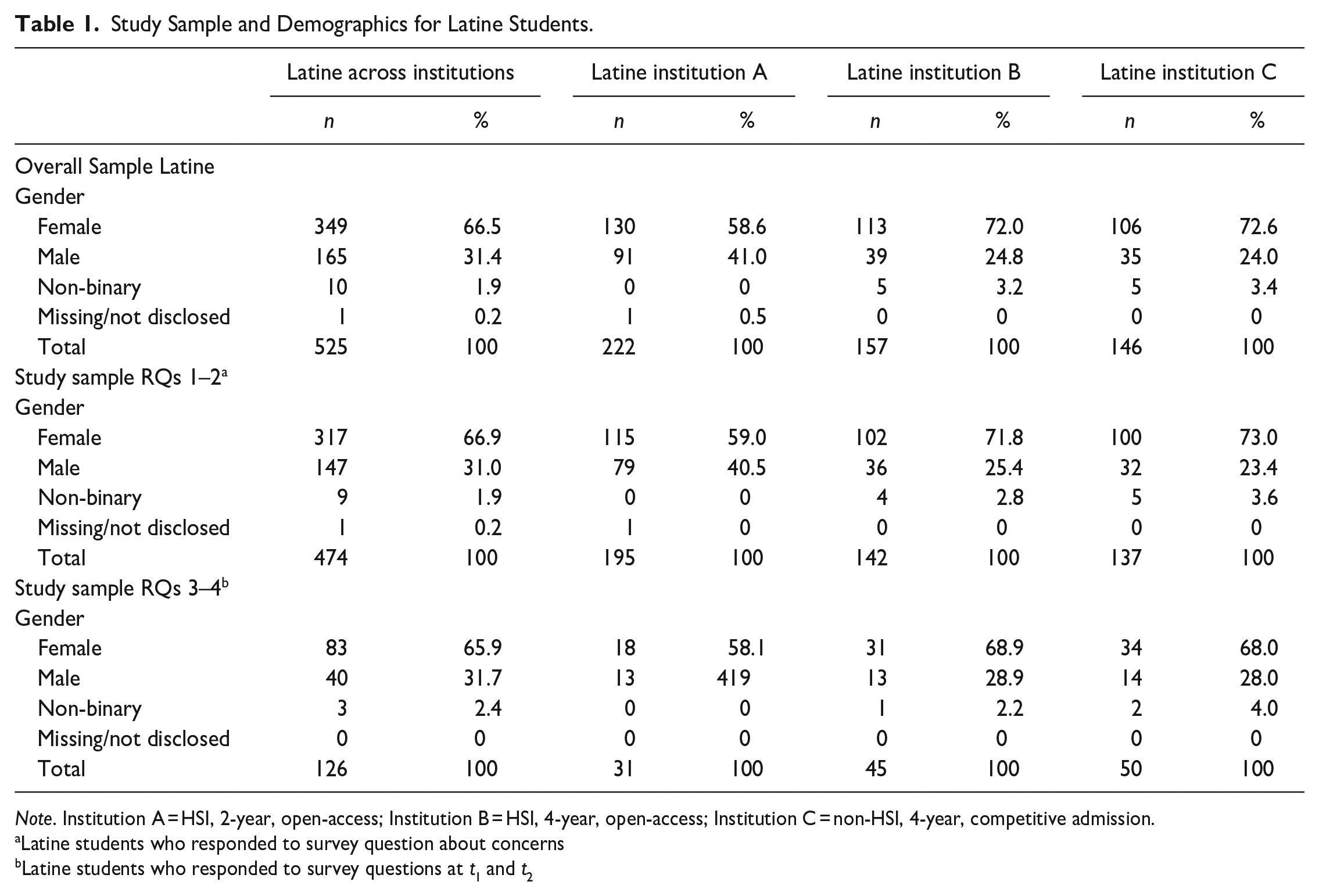
Note. Institution A = HSI, 2-year, open-access; Institution B = HSI, 4-year, open-access; Institution C = non-HSI, 4-year, competitive admission.
Latine students who responded to survey question about concerns
Latine students who responded to survey questions at t1 and t2
Data Sources and Measures
This study incorporated both qualitative insights from open-ended student responses and quantitative data from closed-ended survey questions. This combination allows us to capture a more comprehensive understanding of students’ subjective experiences. In the subsequent paragraphs, we will detail the survey measures employed.
Qualitative Student Responses
In a required pre-course survey, students were asked the open-ended question, “When I think about this course, I’m concerned that. . . (If you have no concerns, you may simply write ‘none’)”, allowing students to express a wide range of concerns. We adopted this question from Gal and Ginsburg (1994) and developed a preliminary coding scheme derived from the literature on student concerns as well as from students’ responses. We coded sets of 20 responses, met to discuss the codes and their application, and modified the coding scheme as necessary. We did so five times before feeling satisfied that the scheme adequately represented the universe of likely responses. A single student response could be coded for more than one concern. Research assistants were provided with the final coding scheme (see Sutter, Givvin, Tucker, et al., 2023), including the overarching concept, descriptors, definitions, and examples for each code. Research assistants were assigned a subset of responses to code independently to check for inter-rater reliability, which reached over 92% for all categories. The remaining responses were divided among the research assistants to code.
Quantitative Student Responses
Anxiety
Following the Single Item Math Anxiety Scale (SIMA; Núñez-Peña et al., 2014) students’ math anxiety was captured using one item (“In general, I tend to feel very anxious about mathematics”) at both the beginning of the course (t1) and the end of the course (t2). The items were rated on a six-point-Likert scale from strongly disagree (1) to strongly agree (6).
Belonging
We used one item to assess students’ subjective level of belonging uncertainty (“Sometimes I feel that I belong at this school, and sometimes I feel that I don’t belong at this school”; Walton & Cohen, 2007) and one item to capture college belonging (“I feel like this school is a good fit for me”; Tibbetts et al., 2018) at both the beginning of the course (t1) and the end of the course (t2). These items are consistent with conceptual definitions and items typically used in belonging research (Walton & Cohen, 2007). The items were rated on a six-point-Likert scale from strongly disagree (1) to strongly agree (6).
Fixed Mindset Beliefs
Students’ fixed mindset beliefs in math were measured using two items (“You can learn new things, but you can’t really change your basic math ability”; “My math ability is something about me that I can't change very much”; αt1 = .85; αt2 = .86) that are consistent with conceptual definitions and highly similar to established scales that are typically used in mindset research (Dweck, 2000; Muenks et al., 2020). The items were rated on a six-point-Likert scale from strongly disagree (1) to strongly agree (6).
Course Performance
At the end of each of the 11 chapters in the online textbook, students were given the opportunity to complete conceptual and application questions related to the content in the chapter. The review activities comprised multiple choice questions, open-ended response items, and interactive R coding exercises. As an indicator of course performance, we calculated the average of students’ review question scores.
Procedure
Data were collected as part of an ongoing project, which was approved by the Institutional Review Board at the University of California, Los Angeles. All students used the same online interactive statistics and data science textbook developed by CourseKata 5 consisting of 12 chapters and in which the surveys were embedded (Son & Stigler, 2017/2023; see Figure 1). At the beginning of the textbook, students were informed that completing the embedded surveys was a course requirement but that their responses were confidential and would not be counted as part of their grades. Further, they could skip any questions they did not feel comfortable answering and could opt out of having their data included for research purposes.
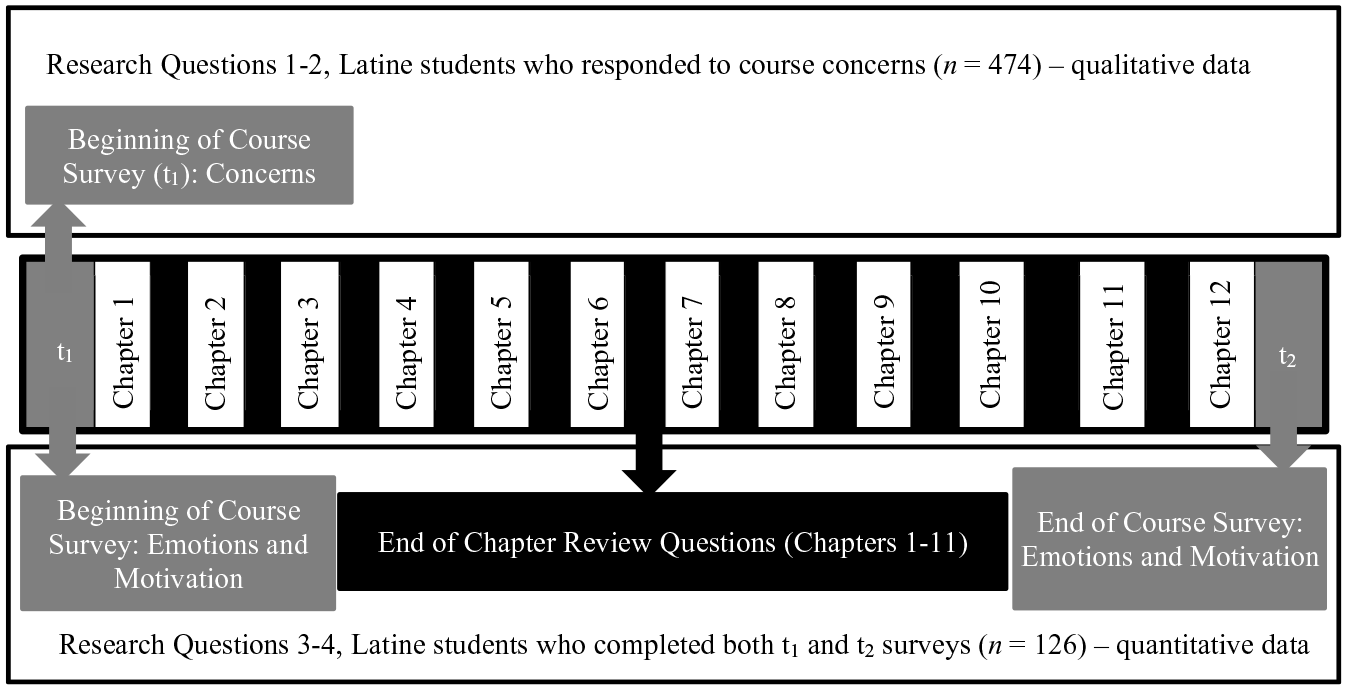
Study design.
Although the textbook was identical across all classes and terms, the surveys differed slightly across the two samples. All students were asked to reflect on concerns (n = 474), but only students who were enrolled in a course during the Winter and Spring 2021 term were exposed to survey questions on anxiety, belonging, and mindset beliefs at both the beginning and end of the course (n = 126).
Missing Data
Out of the 525 Latine students in our sample, 474 voiced concerns in response to the open-ended question at the beginning of the course. Because part of the prompt asked students to write “none” if they had no concerns, we are able to differentiate between those who indeed had no concerns and those who skipped the question (9.7%). Out of the 525 Latine students, 309 students were enrolled in a course during the Winter or Spring 2021 term and exposed to all motivational and emotional constructs. Out of those 309 students, we had complete data from 126 students (40.8%). The reasons for the high survey attrition are multifold. For one, although the surveys are a course requirement, not all instructors explicitly assigned them. Another reason is that the end-of-course survey is embedded at the end of the last content chapter, and students may not have reached that point in the book.
Data Analyses
To address RQ1, we explored students’ incoming concerns in statistics courses by computing frequencies of the categories of concerns mentioned. To explore differences in the proportion of concerns mentioned by Latine students across the three institutions (RQ2), a 3 × 2 Fisher’s Exact Test (Fisher, 1922) was performed, which accounts for cell counts below five observations. For significant concerns, post hoc tests (2 × 2) were conducted to determine which groups differ from one another. To explore whether Latine students’ experiences and perceptions (anxiety, sense of belonging, and mindset beliefs) varied by institution (RQ3), we relied on the students who had responded to the motivation surveys. We conducted a series of one-way analyses of variance (ANOVAs; Verma, 2013) to determine whether there are any statistically significant differences between Latine students at the three different institutions. Finally, correlations were computed to explore the interrelations between the motivational constructs and course performance (RQ4).
Results
What Concerns Do Latine Students Voice About Their Introductory Statistics Course? (RQ1)
The concerns most frequently mentioned by Latine students included understanding (31.2%), R coding (13.9%), performance (13.9%), virtual learning (11.8%), time management (11.2%), and workload (10.8%; see Appendix A for an overview of all concern categories). Apart from virtual learning, these are consistent with those most frequently voiced by the overall sample (see Sutter, Givvin, Tucker, et al., 2023).
Do Latine Students’ Concerns Differ by Institutions? (RQ2)
For the following concerns, there were significant differences in the proportion of concerns mentioned by Latine students across the three different institutions: R Coding (p ≤ .001), math anxiety/negative affect (p ≤ .001), lack of prior knowledge (p ≤ .001), and social comparison (p = 0.018). Post-hoc tests for these concerns (2 × 2) revealed that although there were no significant differences between the proportion of concerns mentioned by Latine students across the two HSIs, there were significant differences between the two HSIs and the PWI.
Concerns related to R Coding were significantly more frequently mentioned by Latine students at the PWI (Institution C: 29.9%) compared to Latine students at the HSIs (Institution A: 8.2%, p ≤ .001, and B: 6.3%, p ≤ .001). Similarly, lack of prior knowledge was significantly more frequently mentioned by Latine students at the PWI (Institution C: 15.3%) than by Latine students at the HSIs (Institution A: 3.1%, p ≤ .001, and Institution B: 1.4%, p ≤ .001). Conversely, concerns related to math anxiety/negative affect were less frequently mentioned by Latine students at Institution C (1.5%) than in Institution A (7.7%, p = .011) and B (13.4%, p ≤ .001). Finally, concerns related to social comparison were more frequently mentioned by Latine students at Institution A (4.1%) than Latine students at Institution C (0%, p ≤ .001).
Do Latine Students’ Motivational end Emotional Experiences Vary by Institution? (RQ3)
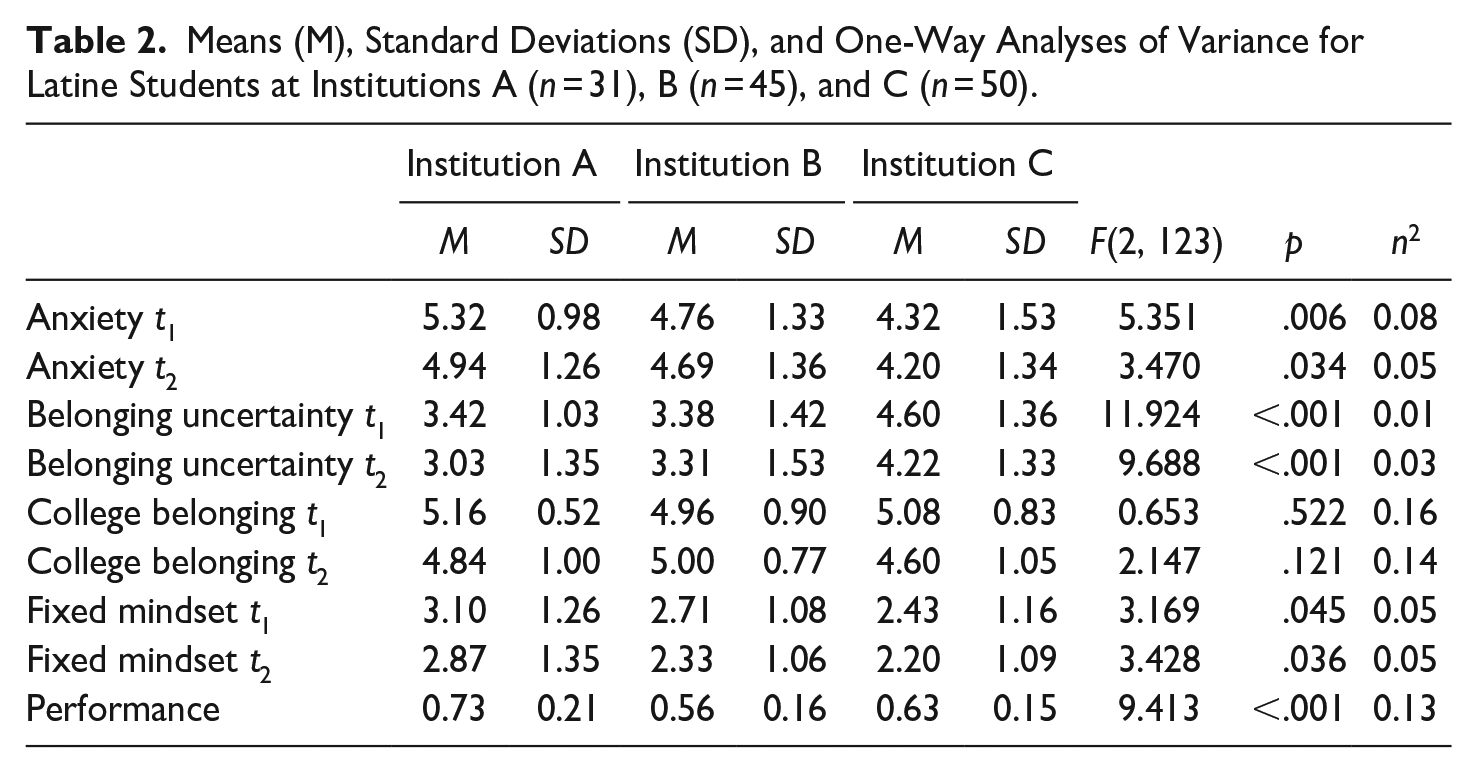
At both time points there were statistically significant differences between Latine students at the three different institutions for anxiety, belonging uncertainty, and fixed mindset beliefs (see Table 2). Post hoc comparisons using the Tukey HSD test (Tukey, 1949) revealed that math anxiety was significantly higher for Latine students at Institution A than at Institution C at t1 (p = .004) and t2 (p = .037). Similarly, fixed mindset beliefs were significantly higher for Latine students at Institution A than at Institution C at t1 (p = .035) and t2 (p = .036). Both coming into the course and upon completing the course, Latine students at the PWI Institution C reported significantly higher belonging uncertainty than Latine students at both HSI institutions A (t1: p ≤ .001; t2: p ≤ 0.001) and B (t1: p ≤ .001; t2: p ≤ .001).
Means (M), Standard Deviations (SD), and One-Way Analyses of Variance for Latine Students at Institutions A (n = 31), B (n = 45), and C (n = 50).
Are Latine students’ Experiences and Perceptions Related to Their Course Performance and Do Those Relationships Vary by Institution? (RQ4)
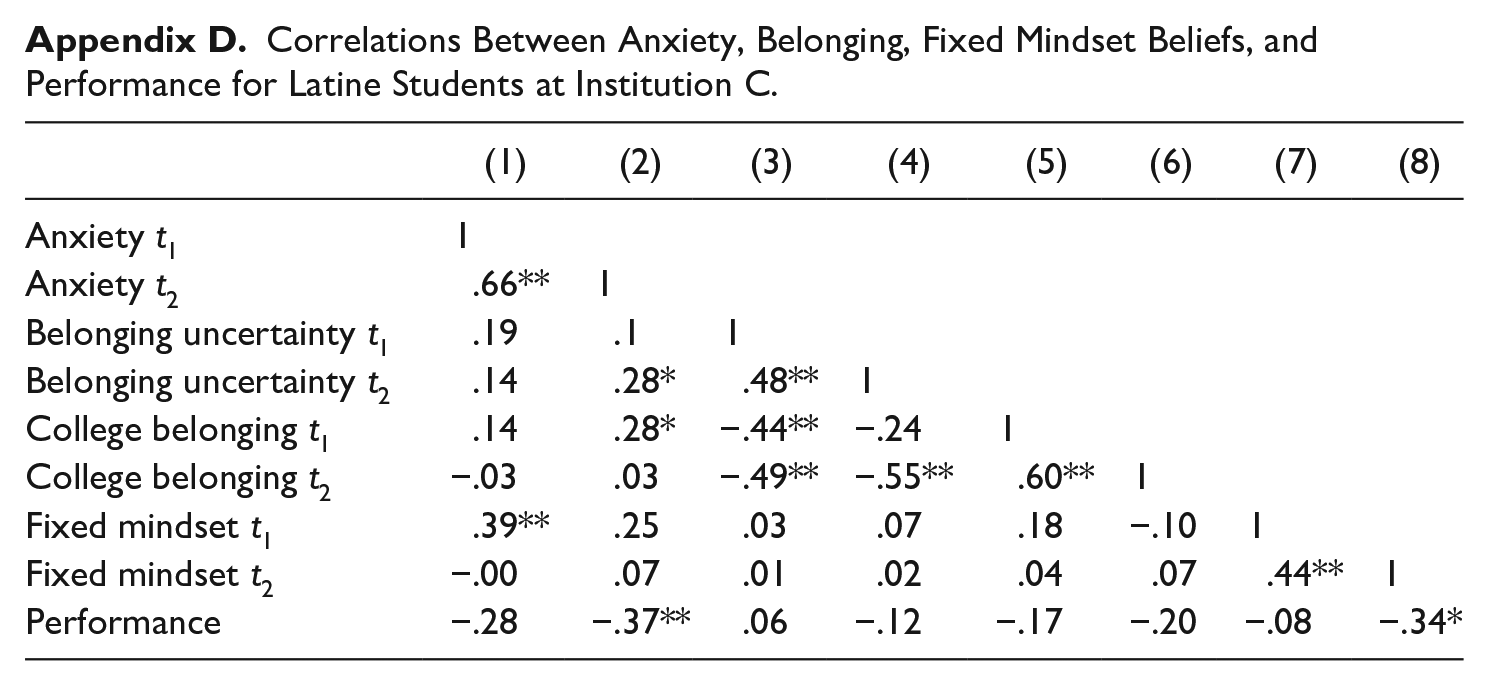
Overall, there was only one significant interrelation between experiences and perceptions and course performance across all Latine students, namely math anxiety at the end of the course was negatively related to course performance (r = −.19, p < 0.05; see Table 3). Notably, we found differences between Latine students at different institutions (see Appendix B–D). Although we did not find any interrelations between math anxiety, belonging, mindset beliefs, and course performance for Latine students at the two HSIs, there were two significant relations for Latine students at the PWI: Performance was significantly negatively related to math anxiety and fixed mindset beliefs at t2.
Correlations for Latine Students.
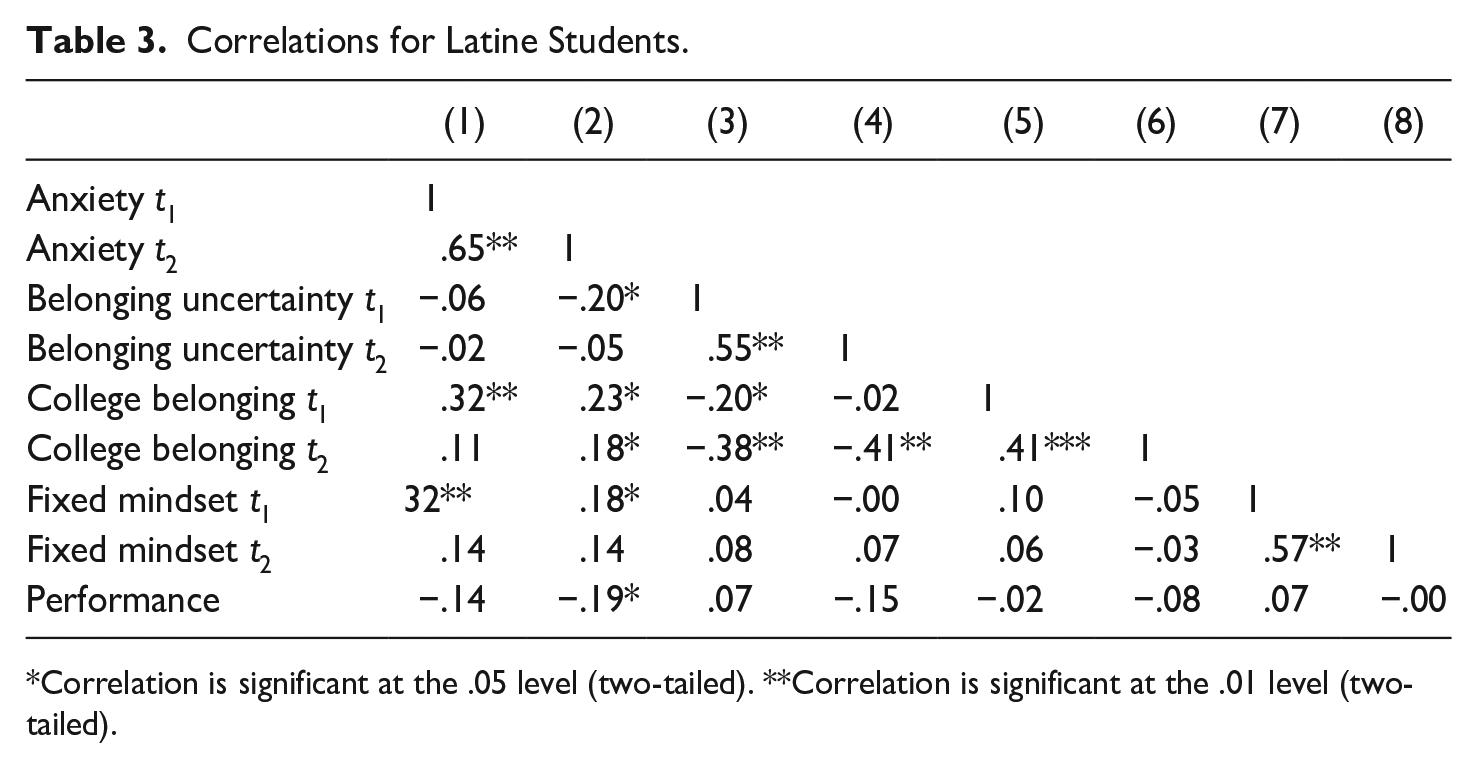
Correlation is significant at the .05 level (two-tailed). **Correlation is significant at the .01 level (two-tailed).
Discussion
The current study followed Meaders et al. (2021) call that we capture the variety of students’ concerns at different institution types and “assess if different interventions are required to provide those students with positive course experiences” (p. 212). In this study we explored the motivational and emotional experiences of Latine students enrolled in an introductory statistics course, focusing on how their experiences may vary across institutions. Through our analysis, several key findings emerged, shedding light on the unique experiences and challenges faced by Latine students, which we outline in the following sections.
Latine Students’ Concerns About Their Introductory Statistics Course and How They Vary by Institution
Our findings indicate that Latine students at both HSIs and PWIs encounter concerns in their STEM education that are similar to those held by our full sample of students (see Sutter, Givvin, Tucker, et al., 2023). These concerns are related to understanding concepts, R coding, workload, time management, and performance. Unlike the full sample, our findings suggest that Latine students are more concerned about virtual learning. Importantly, though, our results point to Latine students’ experiences at HSIs being different from Latine students’ experiences at PWIs. The former students were more concerned about math anxiety and social comparison—more affective concerns. The latter were more concerned about R coding and lack of prior knowledge—more content-related concerns. Perhaps students at the open-enrollment Institutions A and B had more difficult prior experiences in math classes, which presented in the form of salient emotional responses in class. Those students at the selective institution were more likely to have had a history of positive math experiences, and their concerns were therefore directed at learning the course content. Gaining a deeper understanding of whether Latine students at different institutions voice different concerns or voice concerns more frequently might guide us in better designing learning contexts to support their experiences in STEM courses (Gray et al., 2018). A recent study showed that incoming course concerns can shape students' motivational experiences and their future interest in introductory statistics (Sutter, Givvin, & Hulleman, 2023), highlighting the need for tailored efforts to address specific concerns faced by different student groups.
Latine Students’ Motivational and Emotional Experiences, Their Relation With Performance, and How They Vary by Institution
We found differential motivational and emotional experiences for Latine students at the different institutions. Experiences of math anxiety and fixed mindset beliefs were significantly higher for Latine students at the HSI A than at the PWI C. This finding is in line with our qualitative findings regarding incoming concerns with Latine students at the HSI A voicing concerns related to math anxiety and social comparison more frequently. Although Latine students at the PWI C reported lower levels of math anxiety, we found a significant association between experiences of math anxiety (at the end of the course) and course performance only for this group. It might be tempting to think that low levels of anxiety remove any cause for concern, but it must be kept in mind that it is the mean levels of anxiety that are compared across groups. At an individual level, the degree of anxiety was still consequential when it came to performance. Although speculation, they might be Latine students at the PWI who feel more pressure to conform to the norms and expectations of a PWI (Ancis et al., 2000). Latine students might experience more feelings of exclusion from the “dominant group” (as supported by our finding that they experience significantly higher levels of belonging uncertainty), encounter more stereotype threat in their learning environment as more threatening, leading to a greater need to prove their competence and an increase in the likelihood of fixed mindset beliefs affecting their performance (Holguín Mendoza et al., 2023).
Latine students at HSIs reported lower belonging uncertainty compared to those at the PWI. Although our study does not allow us to assume that the source of these cross-institution differences lies in the ethnic composition of the institutions, our findings are in line with prior research (Hurtado & Ponjuán, 2005), which suggests that the presence of a supportive and culturally inclusive environment in HSIs can positively impact Latine students’ experiences in STEM. HSIs often prioritize serving Latine students and fostering a sense of community, which may contribute to the enhanced sense of belonging reported by Latine students in these institutions. In contrast, Latine students in PWIs may face additional challenges related to a lack of cultural representation and support. The absence of Latine students, and perhaps faculty, at PWIs can contribute to feelings of isolation and marginalization.
Implications and Future Research
Examining Latine students’ experiences across different institutions has important implications for educational practice and can guide us in developing targeted strategies and interventions to create inclusive and supportive learning environments that meet the unique needs of Latine students in STEM. If Latine students at HSIs hold concerns related to math anxiety and social comparison and they report higher levels of anxiety and fixed mindset beliefs, a growth mindset intervention might be particularly beneficial in empowering Latine students and promoting their success in STEM fields. Helping students view their ability as something that can grow over time with effort can help them reframe how they perceive and interpret challenges and mistakes in a more positive and adaptive manner, and might further reduce anxiety (Dweck, 2000). Because the current research was conducted in the context of understanding and improving the textbook used by students in the study, we have begun to increase growth mindset supportive messaging throughout the book and measure the effects of these changes. We believe that such changes are necessary to create a more supportive and positive learning environment, reducing experiences of anxiety and fixed mindset beliefs. Students from racially marginalized backgrounds—including Latine students—are particularly subjected to situational cues (Murphy et al., 2007; Murphy & Taylor, 2012) within the STEM learning environment that question and undermine their abilities (Canning et al., 2019; Muenks et al., 2020; Steele & Aronson, 1995) as well as signal to individuals what and who is valued in a particular environment (Muenks et al., 2020). Such situational cues can increase students’ anxiety or their beliefs about their intelligence or ability (i.e., fixed mindset belief). Adding positive, growth-mindset supportive messaging throughout the textbook that encourages students to embrace challenges, persevere through setbacks, and believe in their capacity to develop and grow their statistical skills would likely be beneficial to all students but particularly beneficial for Latine students with higher levels of anxiety or fixed mindset beliefs. 6 For those who held concerns about R coding or lack of prior knowledge, simple messaging in the textbook or the syllabus highlighting that the course is designed such that all students—regardless of their coding background—can be successful, might help alleviate worries about preparedness.
In interpreting our study findings, it is important to consider other factors about the contexts of the institutions included in the study. First, with respect to belonging, it is far more common for students at each of the two HSIs to live at home than it is for students at the PWI to do so. As such, the students at the HSIs might have more access to family, friends, and their childhood community, and this might impact the degree to which they feel like they belong where they are. Furthermore, the two HSIs are similar to each other and different from the PWI in that they are open-access schools and are on the semester system. The PWI is selective and on the quarter system. These differences might affect students’ actual and perceived preparation for higher education and the pace of their course. Future research should include selective HSIs and open-access PWIs. It should also examine the intersection of race/ethnicity and gender. It could be, for instance, that Latinas at PWIs face particular challenges and we would see better representation of these students in STEM fields if we better understood and addressed their unique needs.
Finally, our findings have broader institutional implications. Because Latine students’ expectations, experiences, and perceptions vary, universities must acknowledge this diversity in their efforts to make predominantly white institutions more diverse and equitable. For example, Gonzalez et al. (2018) found that Latine students who participated in a Latine student-focused organization at a large PWI felt that “the university treats all Latine students as one homogenous group, ignoring the diversity that exists between different Latine groups,” suggesting that PWIs could benefit from “incorporating the diverse Latine student perspectives into institutional diversity policy, and prioritizing higher-quality initiatives for greater visibility of Latine student issues across campus.” Importantly, future research should also seek to better acknowledge the multifaceted identities among Latine students.
Conclusion
This study provides valuable insights into the concerns and psychological experiences of Latine students in introductory statistics courses at different institutions, highlighting the need for targeted support and motivational interventions at the systemic level. Whether the source of the cross-institution differences was the ethnic composition of the institutions or their selectivity is worth further exploration. What can be said, though, is that Latine students are not a monolith and that “diverse groups of students do not experience college in the same way” (Y. K. Kim et al., 2014, p. 262). Latine students’ concerns and motivational and emotional experiences vary across contexts and interventions to support their success must also.
Footnotes
Appendices
Correlations Between Anxiety, Belonging, Fixed Mindset Beliefs, and Performance for Latine Students at Institution C.
| (1) | (2) | (3) | (4) | (5) | (6) | (7) | (8) | |
|---|---|---|---|---|---|---|---|---|
| Anxiety t1 | 1 | |||||||
| Anxiety t2 | .66** | 1 | ||||||
| Belonging uncertainty t1 | .19 | .1 | 1 | |||||
| Belonging uncertainty t2 | .14 | .28* | .48** | 1 | ||||
| College belonging t1 | .14 | .28* | −.44** | −.24 | 1 | |||
| College belonging t2 | −.03 | .03 | −.49** | −.55** | .60** | 1 | ||
| Fixed mindset t1 | .39** | .25 | .03 | .07 | .18 | −.10 | 1 | |
| Fixed mindset t2 | −.00 | .07 | .01 | .02 | .04 | .07 | .44** | 1 |
| Performance | −.28 | −.37** | .06 | −.12 | −.17 | −.20 | −.08 | −.34* |
Declaration of Conflicting Interests
The author(s) declared no potential conflicts of interest with respect to the research, authorship, and/or publication of this article.
Funding
The author(s) disclosed receipt of the following financial support for the research, authorship, and/or publication of this article: Chan Zuckerberg Initiative DAF, an advised fund of Silicon Valley Community Foundation (DRL-1229004); California Governor’s Office of Planning and Research (OPR18115); andNational Science Foundation (EHR-2000507)
