




Abstract
The primary goal of this article is to provide detailed instructions as to how to run a mindset intervention in a psychology statistics course. A secondary goal is to provide preliminary data on such an intervention’s relationship to students’ statistics anxiety and course grades. Large randomized studies have demonstrated that using a one-time mindset intervention can have positive benefits for students’ course outcomes. We adapted this approach to design an intervention that includes a 75-minute presentation on what mindsets are, how are they are related to learning, and strategies for students to learn statistics with a growth mindset and, thereby, reduce their anxiety. Data from N = 75 students split into an experimental and comparison group suggested that receiving the intervention resulted in students’ mindsets becoming more growth oriented and that this was related to a decrease in anxiety and an increase in course grade.
Introduction
Implicit theories of intelligence, otherwise known as “mindsets” (Dweck, 2006; Dweck et al., 1988), have a very specific meaning in the educational context. Mindsets refer to the beliefs that individuals hold with regard to the origins of intelligence and are thought to exist along a continuum with one side anchored in a “growth mindset” and the other in a “fixed mindset.” A growth mindset refers to the belief that intelligence is not born but made, through trial and, importantly, error, using critical feedback following guided trials. A fixed mindset refers to the belief that intelligence is born or “hard wired” and unchangeable. Those with a fixed mindset accept that they have a set capacity for certain tasks or domains and that they are unable to change this. When a student who is struggling to learn statistics comments that “my brain just doesn’t work that way” or “I’m not a math person,” it is reflective of a fixed mindset. Comments from a student with a growth mindset would differ, and they would state things such as “I’m not good at this yet” or “I need more practice.”
It is important to note that mindsets stem from a general belief about the origin of intelligence, but do not stop there. They define a person’s level of openness to mistakes and use of mistakes to improve knowledge and skills (Dweck, 2000). As such, a student’s behaviors when learning will differ based on their mindset (see Dai & Cromley, 2014). For example, if a student with a fixed mindset makes a mistake they will be more likely to interpret it as confirmation of their inability; this would perpetuate a fixed mindset and can lead to reduced effort. On the other hand, if a student with a growth mindset makes a mistake they will be more likely to welcome it as a means to better understanding the task or topic at hand; this would perpetuate a growth mindset and can lead to increased effort.
It is also important to note the distinction between mindsets and other similar, but distinct concepts such as grit (Duckworth, Peterson, Matthews, & Kelly, 2007), ability self-concept (Bong & Skaalvik, 2003), and achievement goals (Ames, 1992). Mindsets are related to each of these constructs (see Dai & Cromly, 2014; West, et al., 2014), but are distinct in that mindsets refer to the belief about the origin of ability—innate or grown through experience. Ability self-concept and the competence-based achievement goals that a student sets for their performance will vary depending on their mindset (Dweck, 2000). For example, a student with a fixed mindset who believes that their ability is unchangeable is likely to have a more negative ability self-concept, less grit, and lower achievement goals. On the other hand, ability self-concept, grit, and achievement goals would be more positive when a student has a growth mindset because they believes their ability can grow and will, therefore, see themselves in a more positive light and be willing to work harder toward more difficult goals. Although these constructs are different to mindsets, they are related in that mindsets can predict positive or negative levels of grit, ability self-concept, and even achievement goals. In this article we describe an intervention that targets a change in students’ beliefs that ability is innate (i.e., a fixed mindset), thereby allowing them to believe that their ability level can improve.
Students’ beliefs while taking a statistics course set the stage for their interest in statistics, how they value statistics, and how difficult they perceive their statistics course will be, as well as their level of statistics anxiety (Emmioğlu & Capa-Aydin, 2012; Finney & Schraw, 2003; Ramirez, Schau, & Emmioğlu, 2012; Smith, Brumskill, Johnson, & Zimmer, 2018). If a student believes that they is not capable of doing well in statistics (“math and numbers just isn’t my thing”) they will be less interested in attempting to learn statistics and will value the subject less. This makes sense as we move away from things we feel we are going to fail (decreased interest) and justifies these behaviors in terms of value (“it’s okay if I don’t do great in stats, because I’m not going to do research anyway”). Unfortunately, when students are faced with taking statistics despite the fact that they don’t feel capable of tackling the subject, they will develop anxiety, which in statistics is the strongest predictor of performance (Fitzgerald, Jurs, & Hudson, 1996; Macher et al., 2013).
This cycle is not unknown to psychology students taking statistics (Ruggeri, Dempster, Hanna, & Cleary, 2008). Psychology students are often surprised to be taking a statistics course, and believe they are no good at the subject, which peaks anxiety. A method for breaking this cycle is to intervene to address the initial beliefs psychology students have about their quantitative abilities. By changing students’ beliefs that they are “not a math person” we are able to reduce their anxiety, increase their openness to engaging with mistakes and, ultimately, increase their performance in statistics. Below, we present a mindset intervention developed specifically for psychology majors taking an introductory statistics course with the aim of changing their beliefs about the origin of ability and reducing their statistics anxiety. This intervention is an extension of the work of Smith (2017), and the information below and in the supplementary documents provides more detail on how to implement a mindset intervention in a statistics class (Smith, 2017).
Mindset Intervention for Psychology Students Taking Statistics
Developing a Mindset Intervention
The intervention presented here follows the principles of design thinking (Yeager et al., 2016), in that it was created based on theoretical knowledge, centered on known beliefs of the population (undergraduate psychology majors taking statistics), and revised through iterations. Major changes made in the iterations included expanding the focal points of the intervention to include those found to be most effective in a large-scale development of a mindset intervention discussed by Yeager et al. (2016): an explanation of mindsets and their impact on academic achievement, the effects of mindsets on the physical development of the brain, and strategies for successfully studying with a growth mindset, including ways to reduce anxiety. The primary goal of the intervention is to change students’ beliefs about their ability to be successful in statistics by targeting the common belief that math ability is innate and fixed. Interventions that work to restructure students’ beliefs about the origin of ability have been successful in reducing math anxiety (Hekimoglu & Kittrell, 2010; Karimi & Venkatesh Kumar, 2009; Tzohar-Rozen & Kramarski, 2013; see also Hembree, 1990). In addition, a randomized control study of a brief, one-time mindset intervention in an introductory psychology course was also found to have been effective in increasing academic achievement (Bostwick & Becker-Blease, 2018). Furthermore, mindset-specific interventions that focus on changing beliefs about the general nature of ability have been successful in reducing academic anxiety (Blackwell, Trzesniewski, & Dweck, 2007; Boaler, 2013; Paunesku et al., 2015; Ramirez, Gunderson, Levine, & Beilock, 2013). Together, this research suggests that students’ beliefs about the origin of ability are not only related to outcomes in statistics, but that they are integrated with students’ anxiety. Given that statistics anxiety is a strong predictor of statistics course outcomes, and mindsets are domain specific, it seems fitting to develop a mindset intervention specifically for statistics that targets beliefs about the origin of ability along with statistics anxiety.
The Current Intervention
The intervention is an interactive presentation with students at the beginning of their statistics course that is designed for a class meeting that lasts one hour and 15 minutes; however, slight adjustments may be possible to make the presentation shorter or longer. Effective mindset interventions reported in the literature have varied in length, and include longer durations (e.g., eight 25-minute sessions, Blackwell et al., 2007; three one-hour sessions, Aronson, Fried, & Good, 2002) and short interventions (e.g., 45 minutes, Paunesku et al., 2015). In this intervention, students are engaged throughout by creating a one-page reminder about mindset, applying what they have learned to a task they don’t believe they are good at, and then by helping a hypothetical student who is struggling with statistics. Each portion of the intervention is outlined below. Slide content for each section is provided in the supplementary material.
Introduction: What you believe matters
This section includes a “pop quiz,” in which students are asked “Who are you: a math person, a creative person/artist, an athlete, a musician; and, how do you know?” Following this discussion, the results of a research study (Tomasetto, Matteucci, Carugati, & Selleri, 2009) are presented. In this study, students who self-identified as having stronger linguistic skills outperformed students identifying as stronger in math in a statistics test after being (falsely) told their linguistic skills would be necessary to help them with the statistics. Finally, the concept of mindsets, their definitions, and the difference between fixed and growth mindset are presented.
This section informs students about mindsets and helps them personally connect to the concept by thinking about the group presented in the “pop quiz” that they best belong to. The use of Tomasetto et al.’s study begins to present the idea of beliefs impacting ability with emphasis on the domain of statistics. Importantly, using the results of a research study to introduce this idea provides data that can be helpful in addressing any potential resistance to the idea.
Where mindsets come from: Society, teachers, and parents
The results of four research studies are presented in this section. These highlight ways in which mindsets are communicated to us from society (see Leslie, Cimpian, Meyer, & Freeland, 2015), teachers (see Yeager et al., 2013 and Smith, et al., 2018), and our parents (see Maloney, Ramirez, Gunderson, Levine, & Beilock, 2015). Leslie et al. (2015) found that in disciplines in which PhD holders believed innate ability is needed to be successful, fewer women and African Americans obtained PhDs, highlighting the systemic effects of mindsets. Yeager et al. (2016) and Smith et al. (2018) both found that statements such as “I know you can do this” or “some people do better with math than others” made by teachers directly to students do affect student performance. A single quote from Maloney et al. (2015) is presented. This reports their finding that students’ anxiety about math correlated with their parents’ level of anxiety but only for students whose parents reported helping the student with their math homework.
Presenting results from these studies helps to address the fact that we are often told (explicitly or implicitly) what we are capable of by others around us. This can serve as a springboard for discussion about students’ past experiences in being told whether or not they would be capable of something based on their individual characteristics. Again, using research results helps reduce resistance to this idea.
The cause and effects of mindset
A colorful slide is presented listing more than 30 variables that mindset has been shown to be related to (see Dai & Cromly, 2014 for a review). These include motivation, self-regulated learning, and feelings of worry and helplessness, as well as various outcomes such as course grade, standardized test scores, and grade point average (GPA). Following this, students are presented with slides that show the way in which the brain responds to errors differs based on the mindset the individual holds. This information is based on the research results of Moser, Schroder, Heeter, Moran, and Lee (2011), who demonstrated that those with a growth mindset had more ERN and Pe brain activity when presented with an error they made compared to those with a fixed mindset. It is useful to point out to students at this point that if your brain is less active, you will learn less. A growth mindset can lead to a more active brain and, therefore, more learning.
Activity one: Create a one-page mindset reminder
Students are given time to create a one-page reminder about mindsets. They share the activity in small groups and then report back to the full class. This gives students an opportunity to process the information they have learned. It also provides a “cheat sheet” for them to keep in their notes to refer to later (perhaps prompted by the instructor during difficult times!)
Mindsets and anxiety
Students are introduced to the idea of working memory and given an example using a math problem that requires carrying a number. After solving the problem successfully, they are told about the effect that anxiety could have on the process, that is, by taxing working memory they will be focused on worrying rather than remembering to carry the 1. Research results from Beilock (2008) are presented. These demonstrate how induced anxiety can lead to just as many errors on math tasks as can constant distractions while trying to complete the task.
The information in this section presents to students the biological basis for why anxiety can impede academic performance. It allows students to recognize the way in which anxiety serves as a distractor by taxing working memory with internal “worry messages” (“I’m not good at this”). The point is made that anxiety may happen after we fail, but is often part of the cause of the failure as well.
Students are given three steps to use to help regulate their anxiety (see Pintrich, 2000):
Before you start your work: How do I feel about having to do this task? Is that because I am in a fixed mindset? Remember mistakes are good for increasing brain activity needed to learn. During your work: I am capable of this! Mistakes are a good thing. Reflect after you complete the work: What worked? Congratulations on your accomplishments so far!
Activity: Applying mindset to something you don’t like to do
Students are given an activity to help them practice applying the intervention messages to themselves. The following prompts are used:
Think about an academic task you don’t like doing. It may or may not cause you anxiety. How do you feel when you do the task? How do you believe you will perform when completing the task? Take a look at your answers. Do you see any of the following in your answers? Can you hear anxiety messages? Do you hear messages about fear of failure? Do you hear apathetic messages?
Effective study strategies
To utilize mistakes, we must make them. Therefore, the intervention provides three study techniques that allow for mistakes (and forgetting) so that students can learn effectively. These include: the use of retrieval (rather than re-reading); trying problems without directions; and varying the time and subject of study (see Brown et al., 2014).
Final activity: Help a student
In this final activity, the following statement from a fictional peer is presented. Students then need to respond using the messages from the intervention. I need to figure out what to do about this class I’m in. I don’t know if I should withdraw. I took the midterm, and the professor like, just tore me apart. I studied and all, but they just, I don’t know, I guess they just didn’t like what I had to say. I asked her about it, and she said I should see a tutor. So, I just don’t know what to do, I guess. I might just withdraw because, I don’t know, I mean if she doesn’t like me, then it’s probably not worth staying in the class.
This scenario presents examples that undergraduates could easily experience if they are taking statistics. The interpretations in this example are important because they demonstrate a fixed mindset. For example, the statement that the professor “just tore me apart” demonstrates that the student does not value mistakes or feedback. The students completing this activity have the challenge of finding these hidden messages and combating them. In the past, the first author has often had to provide prompting to help students do this.
Evaluations of Mindset Interventions
A recent meta-analysis (Sisk, Burgoyne, Sun, Butler, & Macnamara, 2018) suggested that mindset interventions may have a small effect. One potential confounder in this analysis was that the characteristics or quality of the interventions were not screened. This could lead to studies being included that did not utilize a systematic process in ensuring the interventions were well designed. Several large-scale studies that have used such processes for creating mindset interventions have shown that the interventions successfully shift students’ mindsets to be growth oriented (Paunesku et al., 2015), reduce their academic anxiety (Cury, Da Fonseca, Zahn, & Elliot, 2008; King, McInerney, & Watkins, 2012), and improve academic outcomes with several populations (Blackwell et al., 2007; Chen, & Pajares, 2010; Good, Aronson, & Inzlicht, 2003; Mueller & Dweck, 1998).
Results
We have evaluated the mindset intervention presented here when used in the first author’s classroom by measuring student knowledge, anxiety, and mindsets before and six months after the intervention. Scores were compared between students who had the intervention (n = 45) and those who did not (n = 30). The course topics, assignments, and instructional techniques were the same for all students. The students were psychology majors completing their required psychology-based statistics course in a small, private liberal arts school (74.7% female, 52.94% Caucasian, 38.23% Black or African American, 8.70% other ethnicity; Mage = 20.62, SDage = 2.21).
Implicit belief questions that are commonly used to assess student mindset (Blackwell et al., 2007; Paunesku et al., 2015) were used in this study. We chose to use these items as they have been used in large-scaled randomized trials of mindset interventions and would allow us to compare effects observed in this study to those observed in larger trials. Three items measured students’ theory of intelligence, or mindset, (e.g., “a student’s smartness is not something they can change very much”) on a five-point Likert scale with higher scores indicating agreement with fixed mindset statements. Three additional items measured students’ beliefs about ability in school (e.g., “there is not much a student can do to influence their performance in school”).
Although this measurement is short, it has been shown to have acceptable reliability and validity (α = .72; Wang, & Ng 2012). In this study, a similar reliability estimate was obtained for mindset relating to intelligence at T1, α = .83, and T2, α = .78, but not for mindset relating to school, T1, α = .53, and T2, α = .37.
Mean and Standard Deviation for Mindset Scores, Anxiety Scores, and Statistics Course Grade
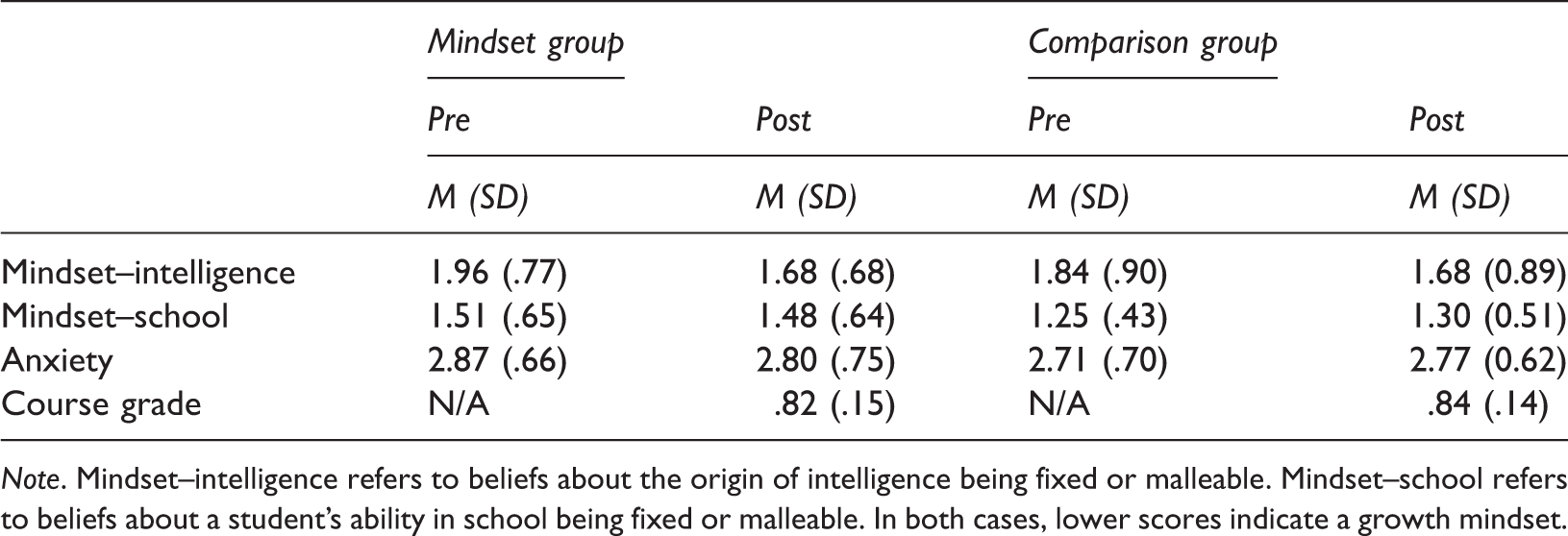
Note. Mindset–intelligence refers to beliefs about the origin of intelligence being fixed or malleable. Mindset–school refers to beliefs about a student’s ability in school being fixed or malleable. In both cases, lower scores indicate a growth mindset.
The purpose of changing students’ mindsets is to reduce anxiety and improve course performance and, as such, we examined changes in anxiety and potential correlations between mindset, student statistics anxiety, and course grades. We measured anxiety with 23 items on the Statistics Anxiety Rating Scale (STARS) (Cruise, Cash, & Bolton, 1985). Students reported their levels of anxiety for each task, 1 = no anxiety to 5 = strong anxiety (i.e.,“Doing coursework for statistics course”). The STARS has been demonstrated to have a high degree of reliability (α = .69 to .90) (Baloglu, 2004; Cruise, et al., 1985; Hanna, Shevlin, & Dempster, 2008; Mji, 2009; Papousek et al., 2012), and we found similar results in this study for both T1, α = .93, and T2, α = .94.Validity for the STARS has been established previously (Cruise, et al., 1985; Hanna, et al., 2008; Papousek, et al., 2012). We also recorded statistics course grade (0–100%) as a measure of course performance.
Anxiety scores for the experimental group had a small, non-significant decrease, t(44) = 1.315, p = .195, d = 0.19 [-0.10, 0.49], whereas the comparison group had a small, non-significant increase in anxiety scores, t(28) = −0.90, p = .373, d = −0.16 [−0.53, 0.20]. Although changes in anxiety were small, beliefs about intelligence after the intervention had a moderate significant correlation with anxiety at the end of the statistics course, r = .40 [.12, .62], p = .007. Beliefs about intelligence were also moderately correlated with course grade, r = −.35 [−.59, −.05], p = .023. The more a student held growth mindset beliefs about intelligence, the lower their anxiety and higher their course grade. Beliefs about school performance after the intervention were not correlated with anxiety, r = .10[−.19, .38], p = .496, or course grade, r = −.16[−.44, .15], p = .311.
Discussion and Implications
Psychology students taking statistics report a high level of anxiety, are not confident about doing well, and feel taking statistics is not important (Ruggeri et al., 2008). Research has shown that students’ beliefs about ability to do well are correlated with statistics anxiety (Finney & Schraw, 2003) as well as performance (Bostwick & Becker-Blease, 2018). To address these barriers, we created a mindset intervention tailored to psychology undergraduates studying statistics. The intervention was developed iteratively to include the elements known to make mindset interventions effective. A small-scale study of the intervention showed results similar to several large-scale mindset interventions. Students moved toward a growth mindset and this correlated with both lower anxiety and higher course grades. This provides preliminary data that may suggest that the intervention presented here is a successful tool for shifting psychology students’ beliefs about their ability, thereby decreasing statistics anxiety, and increasing their statistics course grade.
The intervention is brief and requires limited resources. Instructors can use the information presented in this report to engage students in an interactive presentation to help reduce their anxiety and shift their mindsets to a growth-oriented perspective. Such a presentation will also help to initiate conversations throughout the course regarding ability and anxiety. By improving students’ experiences in statistics, they will be better equipped for graduate studies and/or professional work. Although many students are interested in the clinical applications of psychology, even this requires a level of knowledge about how to interpret data that can guide practice. As such, all psychology undergraduates can benefit from this mindset intervention.
Supplemental Material
Supplemental material for Using a Mindset Intervention to Reduce Anxiety in the Statistics Classroom
Supplemental Material for Using a Mindset Intervention to Reduce Anxiety in the Statistics Classroom by Tamarah F. Smith and Grace Capuzzi in Psychology Learning & Teaching
Footnotes
Declaration of Conflicting Interests
The author(s) declared no potential conflicts of interest with respect to the research, authorship, and/or publication of this article.
Funding
The author(s) received no financial support for the research, authorship, and/or publication of this article.
Author biographies
References
Supplementary Material
Please find the following supplemental material available below.
For Open Access articles published under a Creative Commons License, all supplemental material carries the same license as the article it is associated with.
For non-Open Access articles published, all supplemental material carries a non-exclusive license, and permission requests for re-use of supplemental material or any part of supplemental material shall be sent directly to the copyright owner as specified in the copyright notice associated with the article.
