




Abstract
In this article, we develop a command,
1 Introduction
The panel model with threshold effects in Hansen (1999) has been widely used in empirical research. Hansen’s fixed-effects estimator has been applied to applications on the investment decision of firms under financial constraints, the relation between a fiscal deficit and economic growth (Adam and Bevan 2005), the relation between inflation and growth (Khan and Ssnhadji 2001), and others. The threshold effect in the model allows for the asymmetric effect of the exogenous variables, depending on whether the threshold variable is above or below the unknown threshold. The threshold variable is typically dictated by the economic model. For instance, in the investment decision problem, the size of the firm is often considered a candidate threshold variable. Wang (2015) developed a command,
Hansen’s (1999) model is static, and his fixed-effects estimator requires the covariates to be strongly exogenous for the estimator to be consistent. However, strong exogeneity can be restrictive in many real applications. Thus, the model has been extended to the dynamic panel model with a potentially endogenous threshold variable as proposed by Seo and Shin (2016). Their model allows lagged dependent variables and endogenous covariates. Indeed, various applications of Hansen’s fixed-effects estimation can benefit from dynamic modeling. For instance, the investment decision depends on the previous period’s investment, and the panel threshold autoregressive model is another example of dynamic models.
We developed commands for the first-differenced generalized method of moments (GMM) estimators and the associated asymptotic variance estimator that are proposed by Seo and Shin (2016) as well as linearity testing for the presence of a threshold effect. While the previous command
We also propose a computationally more attractive bootstrap algorithm to implement the linearity test than the nonparametric independent and identically distributed bootstrap that was originally proposed by Seo and Shin (2016). Furthermore, we present a constrained GMM estimator that reflects the kink restriction that has become more popular in recent years—see, for example, Zhang, Zhou, and Jiang (2017)— along with its asymptotic variance formula and a consistent estimator.
This article is organized as follows: Section 2 introduces the dynamic threshold panel model and the first-differenced GMM estimator. It also presents the asymptotic variance formula for a kink-constrained estimator and a bootstrap algorithm for the linearity test. Section 3 explains the command
2 Model
The dynamic panel threshold model is given by

where
Specifically, set an l-dimensional vector of instrument variables, (

where

with Δ signifying the first-difference operator and

Then, introduce the GMM criterion function with a weight matrix

which is minimized to produce a GMM estimate,
The minimization is done by the grid search because for each fixed γ the model becomes a linear panel with a fixed effect, which yields the closed-form solution

and the criterion function
For the weight matrix, either

was proposed in the first step, and it is updated to

where
Seo and Shin (2016) showed that under suitable regularity conditions, 1 the GMM estimator is asymptotically normal. Specifically,

where

and

where Et (·|γ) denotes the conditional expectation given qit = γ and pt (·) denotes the density of qit .
The estimation of the asymptotic variance is standard; that is,

where gi
(θ) =
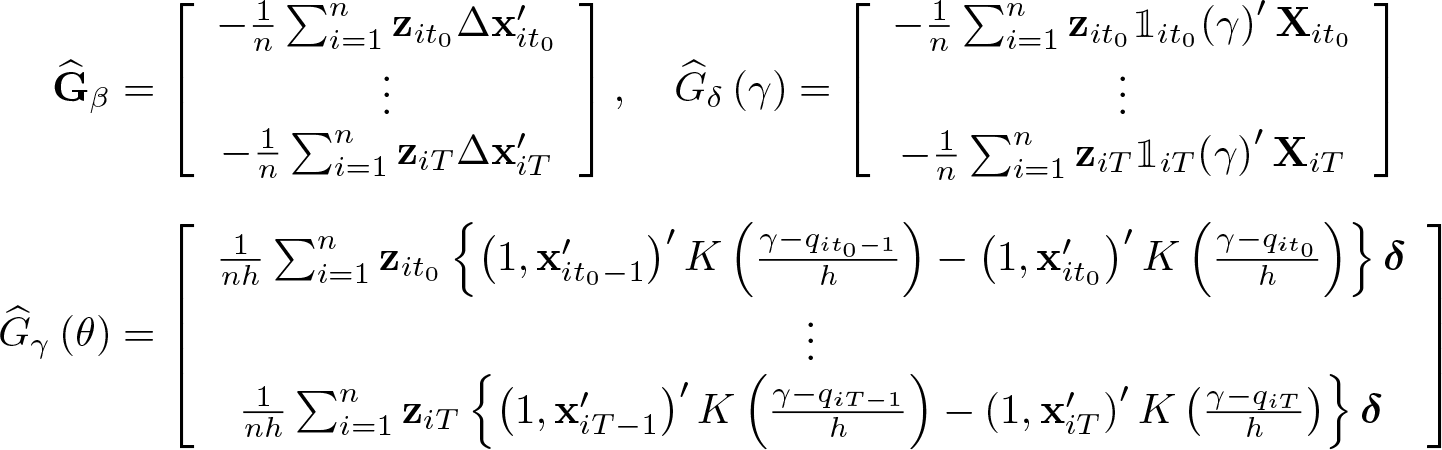
which is the Nadaraya–Watson kernel estimator for some kernel K and bandwidth h, for example, the Gaussian kernel and Silverman’s rule of thumb. We plug in
2.1 Kink model
Although the threshold model typically implies the presence of a discontinuity of the regression function, it may mean the presence of a kink, not a jump, if (1,

Even when the true model is a kink model, it is shown that the asymptotic distribution of the GMM estimator in the preceding section is valid. This contrasts with the least-squares estimator for the linear regression, for which Hidalgo, Lee, and Seo (2019) have shown that the cube root phenomenon appears.
The asymptotic distribution of the constrained GMM estimator of (β, κ, γ) that imposes the kink restriction can also be derived for the same reason as Seo and Shin (2016). Specifically, the asymptotic variance is given by redefining
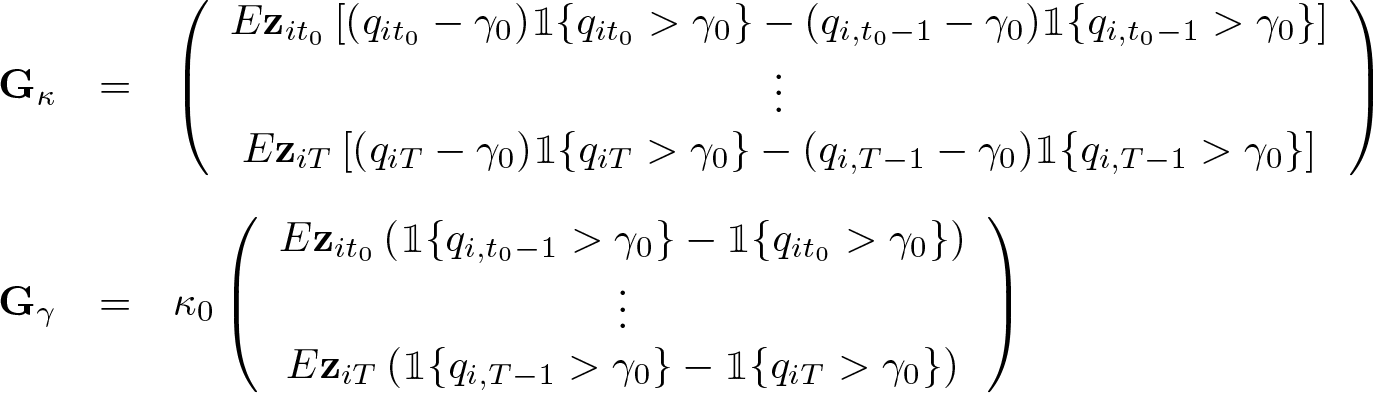
The estimation of these terms is analogous to that of
2.2 Bootstrap test of linearity
This section proposes a fast bootstrap algorithm to test for the presence of the threshold effect, that is, the null hypothesis

where Γ denotes the parameter space for γ, against the alternative hypothesis

A standard approach is to use a supremum-type statistic to take care of the loss of identification under the null; that is,

where W n (γ) is the standard Wald statistic for each fixed γ; that is,

where

is a consistent asymptotic variance estimator, where
Because the asymptotic distribution is not pivotal, we propose a bootstrap algorithm, which is faster than the independent and identically distributed bootstrap proposed in Seo and Shin (2016). Specifically: Draw Recall the definition of Compute a bootstrap statistic Repeat steps 1–3 B times, and compute the empirical proportion of supW∗ bigger than supW.
3 The xthenreg command
3.1 Syntax
where depvar is the dependent variable and indepvars are the independent variables. Detailed instructions for users are as follows:
Your inputs should be When there are endogenous independent variables, set the Default instruments are the independent variable itself for an exogenous independent variable and deeper lags (as in the Arellano–Bond estimator) for an endogenous independent variable such as The threshold variable q can also appear in covariates. But in this case, one has to write then Strongly balanced panel data are required, and the

3.2 Options
3.3 Stored results

4 Monte Carlo experiments
In this section, we illustrate the finite sample performance of the bootstrap linearity test. Some estimation simulations were performed in Seo and Shin (2016). Here the model under H0 is linear; that is, δ =

We summarize more details of our simulation design in the following table:
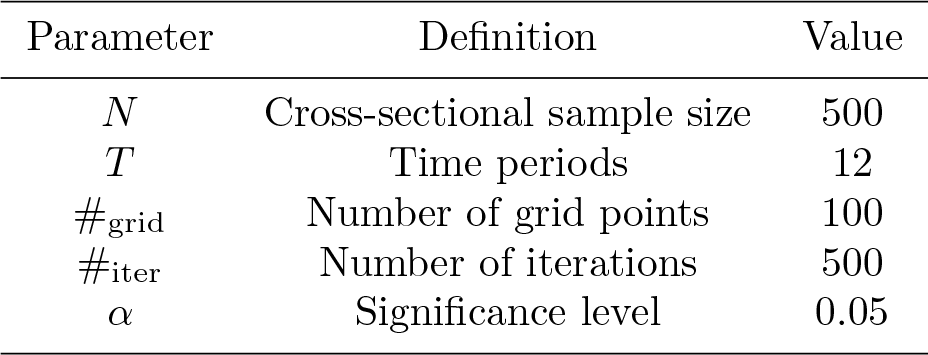
Moreover, xi,t and εi,t were drawn independently from the centered normal distribution with a standard deviation of 1 and 0.25, respectively. For each iteration, we calculate the bootstrapped supW∗ once following, for example, Giacomini, Politis, and White (2013). Consequently, we obtain 500 simulated supW and supW∗ statistics. With these, we compute the bootstrap critical value, which is the empirical (1 − α) 100-percentile of those 500 supW∗ statistics, and the rejection probability for the given α, which is the proportion of 500 supW statistics bigger than the bootstrap critical value.
4.1 Test size
Here we impose (β
1
, β
2
, δ
0
, δ
1
, δ
2) = (0.5, 0.8, 0.0, 0.0, 0.0) so that H
0 : δ =

Original and bootstrapped sup-Wald statistics under H0.
4.2 Test power
Here we tested three sets of coefficient choices, maintaining H1 : δ ≠
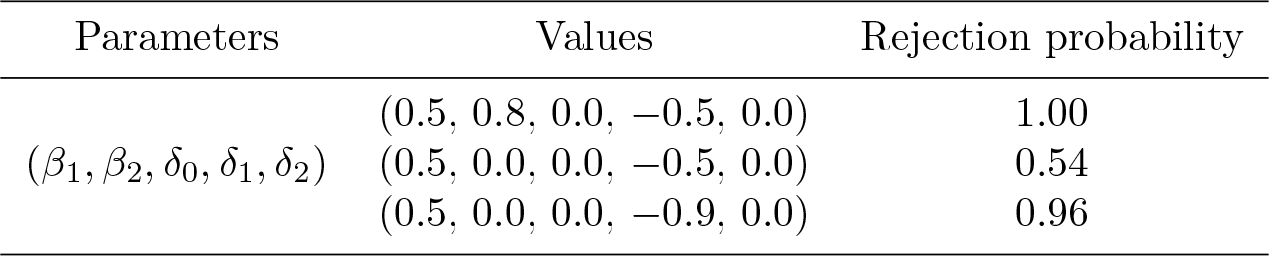
We observe that our test has significant power to reject H 0 when H 1 is true, especially when the true δ is sufficiently far from zero.
5 Application
We apply our method to evaluate the effect of obesity on work hours. Obesity is measured with body mass index (BMI), which is someone’s weight in kilograms divided by height in meters squared. Individuals with a BMI between 25 and 30 are considered to be overweight, and individuals with a BMI of 30 or higher are considered to be obese. Using data from the British Cohort Study, which can be accessed through the UK Data Service, 2 and the methods described in the earlier section, we examine how BMI is associated with work hours. For more detailed discussion, see Kim (2019).
In this example, we consider work hours and BMI of male workers using the following model with a kink in BMI:

We present work hours as yit for an individual i for a period t, xit as family size, and qit as BMI. We have two-period panel data (t = 1, 2) and take the first difference as follows to remove αi, the individual time-invariant characteristics that are associated with work hours:

To implement GMM estimation, we use instrumental variables birthweight (
After loading the data, we first need to declare that the data are panel. The default model for

The information preceding the table is as follows:
Because we change the set of included and excluded instruments using the

We can fit the model with a restriction on the sample:
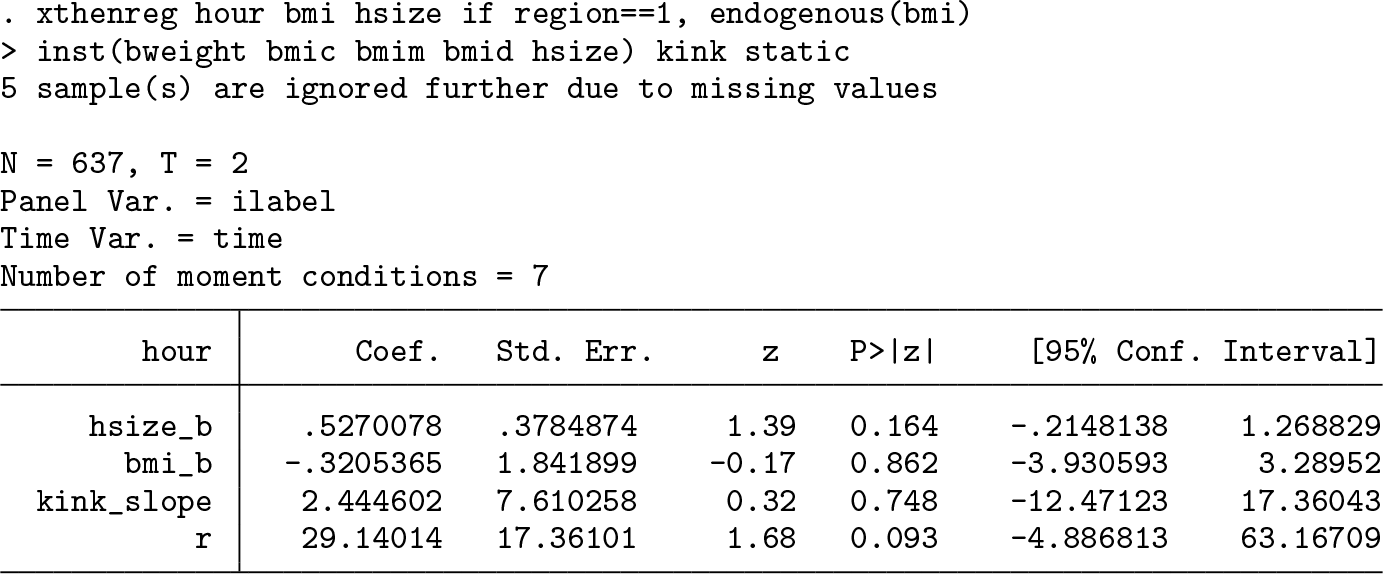
Next, we consider discontinuity in BMI effect without imposing a kink in the model.

By taking the first difference, we obtain the following model and fit it only with the


6 Conclusion
In this article, we presented a set of algorithms to facilitate inference for the dynamic threshold panel model with two regimes. An interesting future research avenue is to develop an algorithm to determine the number of regimes. The commonly used sequential approach in, for example, Bai and Perron (1998), where the linearity test is applied to each subsample until the test cannot reject the linearity null, is less appealing for the first-differenced GMM estimation because of the lack of the oracle property in the threshold estimate. The penalized approaches in Lee, Seo, and Shin (2016) or Lee et al. (2018) may prove useful.
8 Programs and supplemental materials
Supplemental Material, st0573 - Estimation of dynamic panel threshold model using Stata
Supplemental Material, st0573 for Estimation of dynamic panel threshold model using Stata by Myung Hwan Seo, Sueyoul Kim and Young-Joo Kim in The Stata Journal
Footnotes
7 Acknowledgments
This work was supported by the Ministry of Education of the Republic of Korea and the National Research Foundation of Korea (NRF-2017S1A5A8019707) and 2018 Hongik University Research Fund. Seo acknowledges financial support from the Center for National Competitiveness in the Institute of Economic Research.
8 Programs and supplemental materials
To install a snapshot of the corresponding software files as they existed at the time of publication of this article, type
Notes
References
Supplementary Material
Please find the following supplemental material available below.
For Open Access articles published under a Creative Commons License, all supplemental material carries the same license as the article it is associated with.
For non-Open Access articles published, all supplemental material carries a non-exclusive license, and permission requests for re-use of supplemental material or any part of supplemental material shall be sent directly to the copyright owner as specified in the copyright notice associated with the article.
