




Abstract
Ashley C. Rondini and David Cunningham on an indelible community.
When President Obama designated the Stonewall monument in New York’s Greenwich Village a National Parks site in 2016, it became the country’s first, and only, officially recognized national monument honoring LGBTQ+ history. The site’s visitor center memorializes iconic activists like Marsha P. Johnson and Sylvia Rivera—who respectively self-identified as a drag queen and a transgender woman—for their courageously defiant resistance against police brutality and harassment during the Stonewall Inn uprising of 1969.
As evidenced by the annual commemorations of the Stonewall uprising in LGBTQ+ Pride celebrations around the world, such monumental sites offer spaces for the public to understand a history whose values and significance extend beyond the bounds of the space being commemorated, to the workplaces, schools, households, and communities that comprise our social lives.
Stonewall was neither the first nor the only site of resistance associated with the LGBTQ+ liberation movement in the United States. Gay rights organizations like the Society for Human Rights formed as early as the 1920s, and, as a direct result of successful advocacy efforts, Illinois became the first state to decriminalize homosexuality in 1962. However, the uprising at the Stonewall Inn marked what is considered a turning point in the tenor of the movement. Today, we remember it as a place and time when the community’s collective assertion of agency took center stage—not with entreaties for recognition of the group’s humanity but, rather, with pride, solidarity, and temerity alongside unapologetic claims to the right to occupy physical and symbolic spaces.
Stonewall’s amplified visibility, then, as sociologists Elizabeth A. Armstrong and Suzanna Crage (2006) have explained, functions less as a robust account of the movement’s origins than as the cogent realization of a community’s capacity to tell its own story. The ability of the site to elevate that movement, and the values that undergird it, shapes how that story continues to be conveyed and shared.
It is not merely symbolic, therefore, that in February of 2025 the National Parks Service, to comply with a Trump Administration executive order (EO 14168), abruptly removed all references to transgender and queer people in the text referring to Stonewall and shortened the acronym “LGBTQ+” to “LGB” at the site. The order had declared that the federal government would “only recognize two biological sexes, male and female” and mandated that all federal agencies immediately “take down all outward facing media (websites, social media accounts, etc.) that inculcate or promote gender ideology.”
Nearly every facet of this population's lived experiences has been impacted by the larger project of transgender erasure.
Erasing references to transgender and queer activists at Stonewall not only distorts and degrades how we remember a watershed historical moment, it also seeks to invalidate and invisibilize the achievements of a movement in our current watershed moment.
Positive visibility and validation are especially important here, as the consequences of being unrelentingly maligned and dehumanized in political speech have been dire for the transgender community. According to the Williams Institute at the University of California-Los Angeles School of Law, transgender Americans make up just 1% of the U.S. population but experience violent crime victimization at 4 times the rate of cisgender Americans. Certainly, the use of vitriolic anti-transgender rhetoric in contemporary conservative political discourse has fueled the cultural antagonisms that frame the conditions in which transgender people live. Steadily rising threats of physical violence have manifested in what the FBI reports is an ongoing increase in anti-transgender hate crimes, which have corresponded with heightened political scapegoating of the trans and non-binary population.
Beyond that, the Trump Administration’s sweeping efforts to erase transgender people from every aspect of American public life constitute a different form of harm against this already vulnerable group. “Structural violence”—a term coined by sociologist Johan Galtung in the 1960s and re-popularized by physician Paul Farmer in 2003—refers to the consequences of decision-making processes by individuals with power that place less powerful groups in harm’s way. This means that harm is inflicted in ways that are embedded within the normal daily functioning of social systems, because the systems are structured inequitably by design.
The larger project of transgender erasure that has been undertaken swiftly and comprehensively under the Trump administration reflects this embedding process. Parallel to the symbolic erasure encapsulated by the removal of language that includes transgender and non-binary Americans on any government websites or outward-facing documents, nearly every facet of this population’s lived experiences has been impacted.
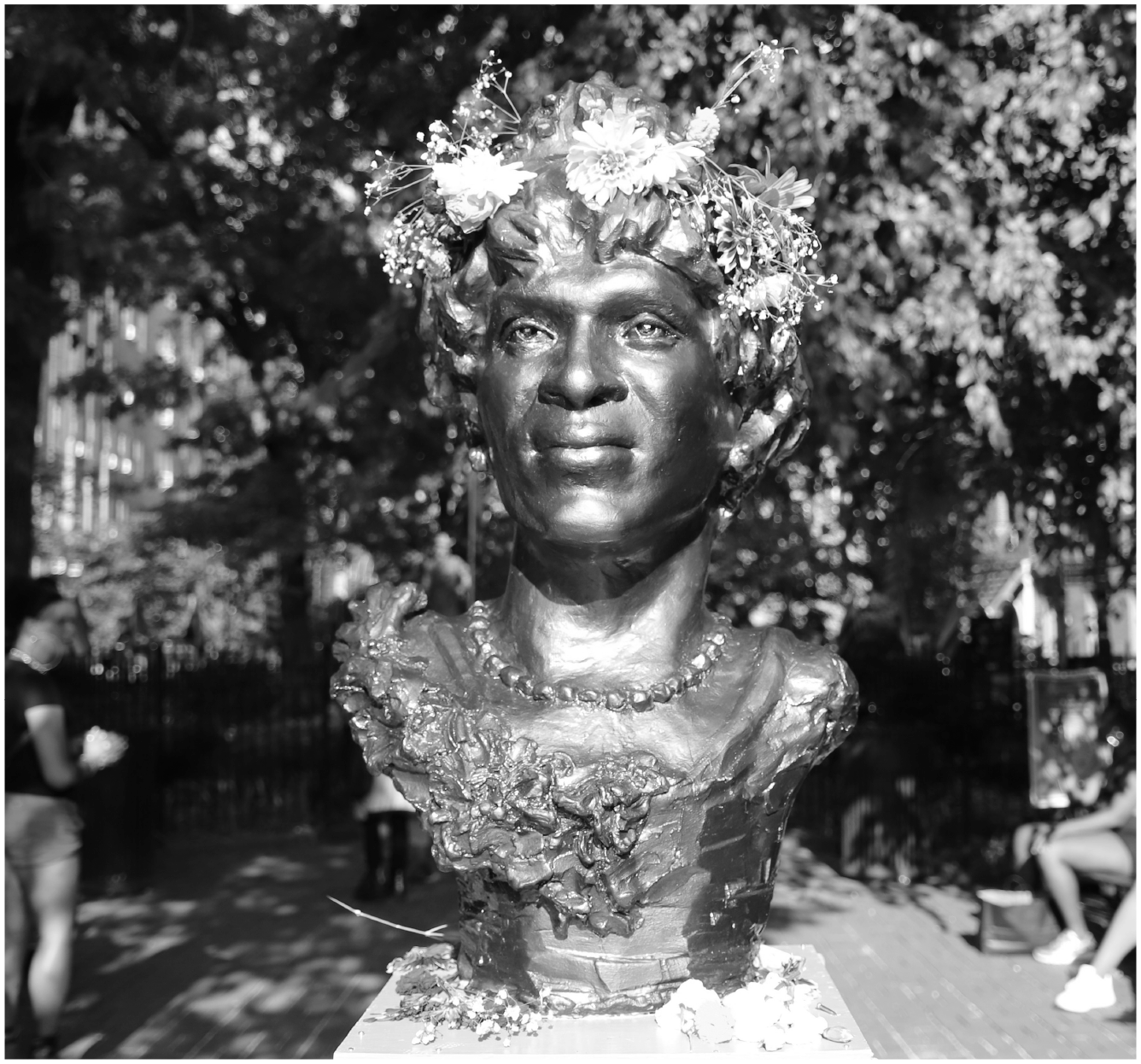
A bust of Marsha P. Johnson, iconic activist, Stonewall protestor, and self-professed drag queen, on the day it was installed inside Christopher Park, part of the Stonewall National Monument in New York City, August 25, 2021.
Elvert Barnes, Flickr CC
In just the first two months of Trump’s current term, a flurry of executive actions led the federal government to abruptly curtail the civil rights of transgender Americans in multiple spheres. Given the incremental progress with legislative and legal protections that advocacy for transgender rights had yielded in recent years, much of the work to rewrite public historical memory has consisted of “unmaking,” or reversing, the evidence of such recent policy advances.
Moves by powerful forces to violently erase and deny the civil and human rights of persecuted communities also sow the seeds of coalition-building and resistance.
One of Trump’s earliest and farthest-reaching orders (EO 14168) resulted in the removal of legal protections for transgender citizens against employment discrimination under the Equal Employment Opportunity Commission, barred transgender federal employees from using single-sex bathrooms and other facilities congruent with their gender identities, and was later referenced in an Executive Order to remove transgender service people from the U.S. military (EO 14183). Compliance with the former led, for instance, to the Department of Housing and Urban Development blocking unhoused transgender individuals from accessing shelters. This disproportionately endangers transgender and non-binary youth, who suffer homelessness and housing instability at twice the rate of their cisgender peers—particularly, according to the Trevor Project (2021), because they are frequently rejected by unsupportive families.
Other recent changes have served to render trans and non-binary youth invisible, too: As of February 2025, at the direction of the Department of Justice, the National Center for Missing and Exploited Children’s database removed all references to transgender and non-binary youth. This means that reports concerning the risk factors that impact this population in specific ways, as well as descriptive information regarding gender identity and presentation that would aid in accurately identifying missing trans and non-binary children, have been scrubbed from public records.
Under Trump, the Department of Education has also rescinded Biden-era civil rights protections against sex-based discrimination, violence, and sexual assault in school settings that had previously included transgender students under Title IX of the Education Amendments of 1972. In addition, Trump has used executive orders to threaten the federal funding provided to any school or school system that either affirms transgender youths’ gender identity or uses inclusive curricular materials that acknowledge the existence of LGBTQ+ people in any way (EO 14190). Making good on a sensationalized campaign promise, Trump, with great flourish, even banned transgender athletes from NCAA sports (according to the NCAA itself, only about .002% of eligible athletes—that is, roughly 10 students—are trans) and youth sports (EO 14201), going so far as to order that past records and titles earned by transgender athletes at publicly-funded schools be rescinded retroactively.
The healthcare of transgender and non-binary Americans has been another focal point for a virulent disinformation campaign, aimed at distorting public views of this community, throughout Trump’s political career. He, and others, have routinely invoked inflammatory language and false claims, fueling what sociologist Stanley Cohen (1972) refers to as a “ moral panic” about gender-affirming care for children—with the goal of garnering public support by provoking outrage, regardless of the facts at hand.
In reality, “best practice” standards for gender-affirming care in young children focus on the holistic cultivation of social and emotional safety, well-being, and support. It is not until after the onset of puberty that reversible pubertal suppressants (“puberty blockers”) are even considered as a possible component of a comprehensive care plan established in consultation with an endocrinologist. Therapeutic hormonal interventions—testosterone or estrogen—are not recommended by the World Professional Association for Transgender Health (WPATH) until after age 14. And gender-affirming surgical interventions—despite their outsized place in the inflammatory agenda of detractors—are the least frequently provided gender-affirming care services. Of the limited surgical care available to older teens, the most common is surgery to remove breast tissue (and, fascinatingly, a 2024 Journal of the American Medical Association study by Dai and colleagues found that just 146 such procedures were undertaken on minors in the year prior, and that 97% of those surgeries were performed on cisgender males uncomfortable with the shape of their chests, rather than on transgender males assigned female at birth). Gender-affirming genital surgeries, the target of so much media outrage, remain unavailable until early adulthood and infrequently performed even then.
When Trump uses media outlets to advance the narrative that children are regularly subjected to “maiming” and “chemical and surgical mutilation” at school (EO 14187) and undergoing “transgender sex change operations” without parental consent, he concocts extreme falsehoods for political purposes. The outrageous scenarios he advances are ones in which no reasonable person could disagree, but their disingenuousness elevates his influence with a manipulated public and allow him to move forward with his anti-trans agenda (for instance, by eliminating language in the Affordable Care Act’s Section 1557 that once included gender identity under sex-based discrimination, cutting funding for healthcare organizations providing gender-affirming care, and cancelling federal grants for research related to transgender health). To meet Trump’s political end goals, it is immaterial that he uses gross mischaracterizations to erase lived realities—and the very existence of professionally approved standard practices for pediatric gender-affirming care.
All these coordinated political attacks underscore the stakes of erasing “TQ+” at Stonewall, as well as the importance of resisting such silencings. March 31st of this year saw the first national rally for Transgender Day of Visibility, an event that drew roughly 400 demonstrators to the Capitol. Across the nation, locally organized rallies continue to emerge in cities and towns pushing back on the impact of Trump’s EOs within their communities. The first national Trans Pride March is planned for June 7, during the 2025 World Pride celebration hosted this year in Washington D.C.
Meanwhile, as the Trump Administration moves to institutionalize mechanisms for erasure within public memory, law, and policy, they have also been met by an urgent, forceful coalition committed to protecting the rights of transgender and non-binary populations. Federal judges in places like Tennessee and Utah have blocked drag bans on the basis of their violation of first amendment rights to free speech. Preliminary injunctions to block Trump’s bans on transgender military service have been issued by multiple federal courts, although the Supreme Court has ruled that the ban will stand while the legal challenges play out. At the time of this writing, attempts to ban gender-affirming healthcare more permanently have been blocked by judges, and individual legislators have voiced refusal to comply with executive orders at the state level. Some clinics, citing their ethical obligations to professional standards of care, have (re)committed to continuing to provide gender-affirming care to youth.
iStockPhoto.com // Amber Roberts
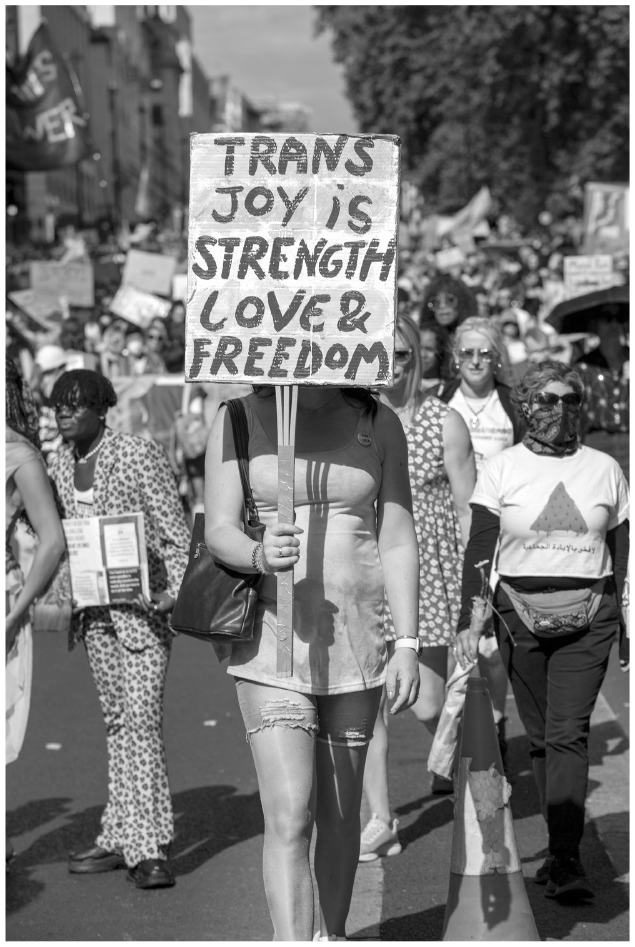
Monuments and other commemorative spaces gain significance and meaning not merely by presenting a static, settled history, but also through the public’s interaction with them. In 2020, many of the Confederate monuments occupying public land across the U.S. South, for example, became sites of mobilization—to resist the narrow, false histories those statues were meant to communicate as well as the broader forces of structural violence that continue to impinge upon Black lives. Similarly, the erasure of LGBTQ+ lives from Stonewall has spurred a renewed re-activation of the site, where protest signs assert defiantly, literally, and metaphorically, “We will not be erased.” Such spaces can offer crucial lessons—teaching us, once again, how moves by powerful forces to violently erase and deny the civil and human rights of persecuted communities also sow the seeds of opportunity for coalition building and resistance to injustice by any name... or by any acronym.